


This paper examines how the legitimacy of global tax governance emerges at the intersection of technocratic programmes (allocation formulas, transfer pricing rules, tariff schedules) and digital programmes (platform algorithms, engagement optimisation). We investigate why structurally similar governance reforms produce radically different visibility patterns on social media. We propose that these visibility patterns act as the empirically observable “shadow” of communication inputted into platforms as a precursor to establishing a programme as binding (legitimate).
Drawing on Luhmann’s systems theory, we analyse social media discourse surrounding three reform types: the OECD’s BEPS initiative, the US Tax Cuts and Jobs Act (TCJA) and tariff policies across the Trump and Biden administrations. We collected 19,423 reform-specific posts from Facebook via the Meta Content Library (2013–October 2025) and developed a modular Python analytical framework to examine temporal patterns, actor composition and engagement metrics.
We identify three visibility configurations producing differentials spanning three orders of magnitude. Strategic opacity: BEPS generates 3.2 posts/month even during the “historic” G7/G20 breakthrough. Controlled visibility: TCJA spikes to 266.5 posts/month during legislative passage, then declines to 1.9 posts/month (a 99% decline). Mobilisation-dependent visibility: tariffs generate an average of 8.9 posts/month under Biden (dropping to 2.7 during the first year) vs 1,221 posts/month under Trump 2.0 (a 137× administration-level differential, peaking at 452×). These configurations reveal three distinct legitimation architectures – expert-consensus, democratic-authorisation and mobilisational.
We advance Luhmannian theory by proposing that massive empirical visibility differentials are structural traces of varying legitimation dynamics. By conceptualising dynamic structural coupling as a conversion mechanism that translates communication inputs into platform visibility, we illustrate how varying visibility configurations – from strategic opacity to continuous mobilisation – reflect the ongoing communicative operations needed to stabilise governance programmes, explaining why policy content and legal standing alone do not determine public circulation or political survival.
1. Introduction
Global tax and trade governance operate through highly technical instruments, including allocation formulas, transfer pricing rules and tariff schedules, that determine how cross-border economic flows are taxed and contested. While reforms such as the OECD’s BEPS initiative, the US Tax Cuts and Jobs Act (TCJA) and recent tariff policies all govern the same underlying object, namely multinational value chains, they exhibit radically different patterns of public visibility.
This paper examines why structurally similar governance reforms produce visibility differentials spanning three orders of magnitude on social media. Why does a historic multilateral tax agreement generate negligible attention (strategic opacity), while a domestic tax bill triggers a massive but short-lived spike (Controlled visibility), and tariff policies fluctuate widely in response to political activation (mobilisation-dependent visibility)?
These variations present a theoretical puzzle. If governance programmes operate through self-executing conditional logic – IF conditions obtain, THEN consequences follow – visibility should be irrelevant to their functioning. A transfer pricing rule executes identically whether observed or unobserved; a tariff applies at the border regardless of public attention. Yet the legitimacy of cross-border fiscal governance appears contingent on visibility patterns that vary dramatically across reform types. We argue that these variations cannot be explained by policy content or institutional venue alone, nor can they be dismissed as mere failures of communication strategy or suboptimal public outreach.
We propose a theoretical heuristic to resolve this puzzle: we posit that the patterns we observe on platforms – visibility – function as the “shadow” of the communication processed by these platforms as a precursor to legitimation. Following Luhmann (1969/1983), we define legitimation functionally as the process through which a programme’s decisions are recognised as binding, allowing them to act as unquestioned premises for future conduct. A technocratic programme can only operate at scale, pre-structuring decisions and absorbing uncertainty, if this recognition is secured. Legitimacy, in short, is the condition for automation.
Because different programmes rely on varying pathways to achieve this stabilisation, communication circulates in different volumes and types across a diverse ecology of actors – ranging from expert intermediaries and politicians to mass media and influencers. To explain how this occurs in platform-mediated environments, we re-describe these instruments as technocratic programmes that structurally couple with digital visibility programmes (platform algorithms and engagement-optimisation mechanisms). Departing from Luhmann’s canonical view of structural couplings as stable institutional interfaces, we treat coupling here as a dynamic, activation-dependent conversion mechanism. Through this mechanism, the recognition (legitimacy) required for programmatic automation emerges functionally from circulating communication. As platform algorithms process this communicative flow, they translate it into the empirical byproduct of public visibility. In this sense, we maintain a strict analytical separation between observation and process: visibility is not legitimacy itself. Instead, visibility is the empirically observable trace of the communication required to establish or maintain a programme as binding.
Based on an analysis of 19,423 Facebook posts concerning BEPS, the TCJA and tariff policies between 2013 and 2025, we infer three distinct legitimation architectures. Where recognition is already installed through expert consensus (BEPS), minimal communication circulates, resulting in strategic opacity. Where legitimacy relies on a founding democratic moment (TCJA), communication concentrates then retreats in controlled visibility. Where recognition never fully installs (tariffs), continuous communicative operations across media, influencers and politicians produce mobilisation-dependent visibility – a dynamic illustrated by the February 2026 Supreme Court ruling on US tariffs, where the administration relied on accumulated political capital to sustain the policy despite its legal invalidation.
Against the conventional assumption that transparency is a uniform prerequisite for legitimacy, we show that visibility differentials – from strategic opacity to mobilisation – are functional traces of how governance programmes are politically stabilised in platform environments. The following sections outline the theoretical framework of programmed visibility, present our empirical findings across the three reform types and discuss how platform infrastructures reshape the legitimation of cross-border fiscal governance.
2. Theoretical framework and problem setting
2.1 Tax and trade reforms as programmed governance
Global tax governance operates through highly technical instruments that determine how profits are allocated, how flows are modelled (Mason, 2020) and how costs are calculated at borders (Kim, 2025). In this context, we define technocratic governance as the coordination of cross-border economic flows through highly specialised, rule-bound administrative instruments (such as allocation formulas or transfer pricing rules). This mode of governance operates primarily through expert networks and professional consensus, structurally insulating decision-making from direct democratic contestation or ongoing mass public authorisation. Within this space, the Organisation for Economic Co-operation and Development’s (OECD) Base Erosion and Profit Shifting (BEPS) initiative coordinates corporate income tax rules through multilateral negotiation and consensus-building (Brauner, 2014). Major domestic reforms such as the TCJA reshape the treatment of foreign profits through unilateral legislation that both complements and competes with the BEPS framework (Avi-Yonah, 2020). Border taxes – most visibly tariffs – tax cross-border trade flows through customs and trade instruments, which are being mobilised as instruments of economic statecraft (Clausing and Obstfeld, 2025).
We treat these reforms together because they govern the same underlying object: cross-border transactions and multinational value chains. Corporate income tax programmes target profits and their allocation across jurisdictions, while tariffs target flows at the border. Both allocate fiscal burdens across international economic activity, but they do so through different institutional venues and political styles. This paper’s unit of comparison is therefore not “tax versus trade”, but programmatic architectures that shape how cross-border economic life is taxed and contested.
In Luhmannian terms, we re-describe these instruments as programmes: decision premises that reduce complexity by pre-structuring how future decisions will be made across administrations, firms and legal venues (Luhmann, 2018). The question is less about how these programmes condition economic outcomes, and more about how they condition public circulation: why structurally similar reforms generate radically different visibility patterns on social media.
The BEPS project spans two related but distinct programmatic forms, which together foreground the centrality of conditionality in contemporary tax governance. The initiative’s 15 action items establish conditions under which tax administrations must request information, reassess transfer pricing positions or modify treaty application when specified profit-shifting arrangements are identified (OECD, 2015). In this sense, BEPS 1.0 primarily structures administrative decision premises rather than prescribing immediate fiscal outcomes.
BEPS 2.0, most clearly through Pillar Two’s Global Minimum Tax, introduces direct and outcome-oriented conditionality: IF the effective tax rate falls below 15%, THEN a top-up tax applies (OECD, 2025). The complexity lies not in the logical structure – which remains strictly IF–THEN – but in the technical apparatus required to determine whether conditions obtain: country-by-country reporting templates, substance-over-form tests and multi-layered computational rules (Eberhartinger and Winkler, 2023). Each technical instrument constitutes a nested conditional programme, determining inputs for higher-order conditions. This highlights the challenge of applying propositional logic to complex social systems, where paradoxes inevitably emerge in the application of strict ontological distinctions (Fritzsche, 2025).
The TCJA presents a different programmatic architecture. While it contains conditional elements (e.g. IF foreign-derived intangible income, THEN reduced rate applies), its political construction foregrounded a purposive logic (Hanlon et al., 2019): the reform was justified IN ORDER TO create jobs, IN ORDER TO enhance competitiveness, IN ORDER TO repatriate offshore profits (Bird-Pollan, 2019). The legislative process required translating technical provisions into purposive narratives accessible to the public. Unlike the BEPS project – negotiated among technical experts across 140+ jurisdictions (OECD, 2017) with minimal public attention (Avi-Yonah and Xu, 2016) – the TCJA required passage through a legislature operating under electoral constraints. This structural difference, we argue, produced fundamentally different visibility dynamics.
Tariff policy operates through yet another programmatic configuration. Section 301 tariffs, Section 232 national security tariffs and “reciprocal” tariff announcements share the conditional form (IF goods originate from a designated country, THEN tariff rate applies), but their deployment follows a mobilisational logic foreign to multilateral tax coordination. Tariffs are announced, threatened, escalated, paused and reimposed through political performances that require public attention (Schweinberger, 2025). Where BEPS is insulated by technical complexity that makes mass circulation unlikely, tariff politics is rendered circulable by simplification that travels easily across rallies and social media feeds. Slogans such as President Trump’s “China is ripping us off” (Bruggeman, 2025) compress extraordinarily complex trade relationships into a slogan that is legible to crowds and algorithmic distribution.
These three reform types thus present a natural experiment in programmatic visibility. Each restructures cross-border economic flows through legal-technical instruments and operates on multinational value chains. Yet, they generate radically different visibility patterns. These variations cannot be explained by policy content or institutional venue alone. Instead, we posit that they reflect varying legitimation dynamics and the differing volumes of communication that functionally stabilises them in platform-mediated environments.
2.2 Programmes, automation and legitimation
Within Luhmann’s systems theory, programmes occupy a crucial position. While codes establish binary distinctions (legal/illegal) – truth tables that allow systems to draw true distinctions (Roth, 2024) – programmes determine which side of the distinction applies in concrete cases (Luhmann, 2018; Seidl, 2005). Legal programmes specify: IF these conditions obtain, THEN this legal consequence follows. Economic programmes specify: IN ORDER TO achieve profitability, THEN these operational strategies apply. Programmes thus translate abstract codes into operational decision premises – they tell systems how to apply their codes in practice.
In this context, programmes operate as decision premises: they structure future decisions by absorbing uncertainty in advance (Seidl, 2005). This pre-structuring shapes the flow of decision-communication, determining how “final decisions” are reached and attributed within organisational systems (Aal, 2025). An organisation that adopts a programme need not deliberate each decision anew. Instead, the programme pre-decides by specifying how situations will be classified and what responses will follow. This is what enables governance to operate at scale: without decision premises, each of the millions of customs entries, tax filings or transfer pricing determinations would require fresh deliberation. Programmes routinise, automate and render decision-making invisible (Nassehi, 2005).
Legitimation acts as the stabilising condition for this automation. A programme can only operate at scale – pre-structuring decisions and absorbing uncertainty – if its decision premises are recognised as binding. Without such recognition, each application becomes contestable, and programmatic automation fails. Our concept follows Luhmann’s (1969/1983) functional account, which distinguishes between accepting decision premises and accepting decisions themselves (1969/1983: 30–31). For positivised systems, legitimacy attaches to the recognition of decisions as binding – they must be taken as premises for one’s own behaviour. This acceptance need not rest on substantive conviction or informed deliberation. What matters is unmotivated acceptance that is institutionalised within a social climate as a matter of course (1969/1983: 32–34).
This functional definition establishes the basis on which structurally distinct legitimation modes can be analytically compared without treating any single mode – expert deliberation, democratic publicity or popular mobilisation – as the normative standard against which others are measured as deficits [1]. Because different programmes rely on varying pathways to achieve this stabilisation, they demand different volumes of communicative operations. We analytically infer three such functionally equivalent architectures:
2.3 Structural coupling as a conversion mechanism
To explain how these varying communicative inputs generate distinct visibility patterns, we turn to the mechanism of structural coupling. For Luhmann (1989), modern society is functionally differentiated into operationally closed systems (law, economy, politics, science, mass media) that process complexity according to their own binary codes. Each system observes the world through its own distinctions and cannot directly access the operations of other systems.
This operational closure creates a coordination problem: how do functionally differentiated systems align their operations without collapsing into a single logic? Luhmann’s answer is structural coupling – mechanisms that enable systems to coordinate expectations while maintaining operational autonomy (Luhmann, 1992). Because operationally closed systems cannot directly exchange information or operations, structural coupling establishes highly selective interfaces where events in the environment act as continuous sources of irritation or perturbation. The receiving system then translates these external irritations into internal information strictly according to its own code (Luhmann, 2012). Constitutions structurally couple law and politics; property and contract couple law and economy; taxation couples economy and politics through law. In Luhmann’s canonical formulation, these couplings are relatively stable institutional interfaces that persist independently of individual communicative events (Luhmann, 1992, 1995).
Our usage departs from this formulation in one important respect. We argue that the interface between governance programmes and platform infrastructures is better captured by an ongoing history of recurrent interactions between operationally closed systems and their medium. This understanding returns to the original conceptual anchor: Maturana and Varela (1980, 1987), for whom structural coupling denotes precisely such an ongoing history, in which both systems co-drift through mutual perturbation while maintaining operational closure. In the biological original, coupling is inherently dynamic: it intensifies, weakens and restructures as the history of interactions unfolds. Platform architectures do not couple with technocratic programmes through stable institutional mechanisms analogous to constitutions or property rights. Coupling in platform environments is asymmetric and activation-dependent: it can remain dormant (BEPS), concentrate in temporally bounded windows (TCJA) or fluctuate with mobilisation (tariffs).
We theorise this dynamic coupling as a conversion mechanism. As communication functionally stabilising a governance programme circulates across diverse actor ecologies, this communication acts as an external irritation for the platform system. The platform’s digital programmes then operationally observe this irritation, processing it according to their own internal selection codes (engagement optimisation, algorithmic ranking) and converting it into probabilistic visibility. Structural coupling is the underlying infrastructural channel of mutual perturbation; visibility is the observable trace of the platform system selecting that communication. Our three visibility configurations describe variable coupling patterns – recurrent forms of mutual perturbation between governance programmes and platform selection logics that produce structurally distinct visibility outcomes.
These coupling patterns link the legitimation architectures identified in Section 2.2 to their empirically observable traces. Where legitimation architectures describe how recognition is produced – through epistemic seal, democratic seal or continuous input – visibility configurations describe what we observe when that communicative work is processed through platform selection logics. Table 1 summarises these configurations as the empirical shadow of Table 2’s legitimation dynamics.
Emergent visibility configurations in cross-border fiscal governance
| Configuration | Coupling pattern | Visibility dynamics | Illustrative case |
|---|---|---|---|
| Strategic opacity | Weak coupling between technocratic programmes and visibility programmes | Low and stable public circulation; reliance on expert networks | BEPS |
| Controlled visibility | Temporary coupling during moments of democratic authorisation, followed by decoupling | Short-lived spikes in visibility followed by a sustained decline | TCJA |
| Mobilisation-dependent visibility | Coupling contingent on political activation rather than programmatic change | High variability in visibility for substantively similar policies | Tariffs |
Functionally equivalent architectures of legitimation
| Legitimation architecture | Case example | Locus of operation | Mechanism of recognition | Required volume of Mass communication |
|---|---|---|---|---|
| Expert-consensus | BEPS | Decision premises | Epistemic seal: Recognition is institutionalised within a professional social climate as a matter of course | Minimal: Binds conduct without requiring mass public attention |
| Democratic-authorisation | TCJA | Decision-acceptance (legislative passage) | Democratic seal: A publicly visible moment installs new programmatic premises | Episodic: Requires initial public visibility, but binds independently of continuous attention once installed |
| Mobilisational | Tariffs | Contingent (struggles at the premise level) | Continuous input: Lacks a stable epistemic or democratic seal; relies on shielding against de-legitimation | Continuous: Requires sustained mass political communication to maintain bindingness |
2.4 Digital programmes and visibility architectures
Platform algorithms can be conceptualised as digital programmes in the Luhmannian sense: operational devices that translate abstract distinctions into concrete selections (Luhmann, 1989, 2018). While mass media selection operates according to criteria such as novelty, conflict and personalisation (Luhmann, 2000), social media platforms resolve this selection problem through recursive algorithmic architectures that rank, filter and prioritise content according to engagement-oriented criteria rather than editorial judgement (Gillespie, 2014; Bucher, 2018). Enacting an operational distinction between visibility and invisibility (Bucher, 2018; Terenzi, 2024), recommendation systems and feedback architectures translate interaction traces into probabilistic visibility decisions (Narayanan, 2023; Jung et al., 2024). Crucially, these digital programmes operate across functional boundaries, imposing a common selection logic on heterogeneous communications circulating within platform environments (Roth, 2019; Tække, 2022).
The coupling between technocratic and digital programmes is asymmetric. Technocratic programmes can operate without digital visibility, but legitimation increasingly cannot (Scherz, 2021). Visibility does not condition whether a programme functions legally or economically; it conditions whether that programme can acquire, sustain or lose standing in public arenas shaped by platform architectures. Digital programmes do not collapse functional differentiation by replacing political, legal or economic codes. Instead, they introduce a transversal selection layer that conditions which communicative operations become publicly observable (Roth, 2019; Tække, 2022). Compatibility or incompatibility with platform selection criteria shapes whether circulating communication enters public circulation, remains marginal or fluctuates in visibility (Tufekci, 2015; Jung et al., 2024).
We define visibility architectures as the recurrent configurations through which governance programmes and platform selection mechanisms interact to produce structured patterns of public circulation, actor participation, and engagement. They describe how and under what conditions technocratic programmes achieve, sustain or remain outside of platform-mediated visibility.
This systems-theoretical perspective departs from standard empirical research on agenda-setting (McCombs and Shaw, 1972), framing (Entman, 1993) and political mobilisation (Kriesi, 2008). Traditional political communication frameworks treat visibility as a direct reflection of an issue’s objective salience or the success of a strategic campaign (Chadwick, 2017). They struggle to explain why structurally similar policies with massive economic consequences exhibit orders-of-magnitude differences in visibility. By treating visibility as the observable trace of legitimation dynamics, we can explain why some governance programmes actively require opacity to stabilise, while others depend on continuous communicative mobilisation.
The empirical sections that follow examine how this coupling operates in practice across different governance domains, treating visibility patterns as traces of legitimation at work.
3. Empirical context and methods
3.1 Data collection: Meta Content Library
We collected social media data from Facebook via the Meta Content Library (Meta Platforms, Inc, 2025), an official research access point that provides systematic access to public posts from Pages. Facebook was selected as a major global social media platform, and because the Meta Content Library provides structured data suitable for systematic analysis. Relative to other platforms, such as X/Twitter, where research access has become more constrained, the Meta Content Library presently represents a comparatively stable access point for academic research.
Data collection via the MCL imposes technical constraints that directly dictate query design. Unlike traditional full-text search APIs, the MCL interface does not support exact-match queries using quotation marks or precise string matching. Instead, queries operate on tokenised text fields and return results based on partial matches, which increases the risk of semantic contamination and false positives, particularly when dealing with polysemic or generic terms.
To mitigate these constraints, we adopted a hashtag-centric Boolean search strategy. Hashtags serve as anchoring tokens: they function as explicit semantic markers intentionally introduced by content producers. Compared to untagged lexical items, hashtags reduce ambiguity by signalling topical relevance and communicative intent, making them particularly effective for identifying specific reform-related discourse. For example, while generic terms such as “minimum tax” or “tariffs” frequently appear in unrelated economic or journalistic contexts, their hashtagged counterparts (e.g. #BEPS, #GlobalMinimumTax, #TradeWar) exhibit substantially higher topical specificity. We combined these hashtags with technical keywords using Boolean operators while excluding known sources of noise. This process was iteratively refined through manual inspection of retrieved posts to ensure that ambiguous terms were replaced by more constrained hashtag combinations.
This approach reflects a necessary trade-off between recall and precision imposed by the MCL infrastructure. Given the impossibility of enforcing phrase-level constraints, prioritising recall through broad keyword searches would have yielded datasets dominated by irrelevant content. Consequently, we prioritised semantic precision over exhaustive coverage to capture a stable and analytically coherent subset of posts. The resulting datasets should therefore be understood as high-precision samples of platform-visible communication rather than exhaustive representations of all relevant discourse.
Our data collection proceeded in two stages. First, we conducted a broad field-mapping search (Search 1) to characterise the general structure of tax discourse on social media. Second, we developed targeted reform-specific searches (Searches 2–6) to examine visibility patterns for our focal reforms.
Search 1 (general tax discourse field mapping; n = 13,880). We collected posts using broad tax-related keywords to map the overall structure of tax discourse on Facebook. Post texts were embedded using OpenAI’s text-embedding-3-small model and clustered using K-means to identify recurrent thematic groupings (see Section 3.2 for the full analytical pipeline and code repository). This field-mapping step served to contextualise our reform-specific findings within the broader landscape of tax-related social media discourse.
For reform-specific analysis, we developed five targeted searches. Search 2 (BEPS 1.0, 2013–2017; n = 155) targeted Base Erosion and Profit Shifting, OECD tax initiatives, transfer pricing and related technical terminology. This search captured the period from BEPS inception through the release of final reports (October 2015) and early implementation.
Search 3 (TCJA, 2017 October 2025; n = 1,584) targeted the Tax Cuts and Jobs Act, GOP tax reform, Trump tax cuts and related legislative terminology, capturing pre-legislative discussion, the legislative spike (November–December 2017), implementation and subsequent years.
Search 4 (Tariffs Trump 1.0, 2018–2020; n = 4,777) targeted trade war, China tariffs, Section 301/232, steel and aluminium tariffs and related trade conflict terminology.
Search 5 (BEPS 2.0/Pillar Two, 2019–October 2025; n = 266) targeted Pillar One/Two, the Global Minimum Tax, G7/G20 tax agreements and technical implementation terminology (IIR, UTPR, QDMTT). A revised query eliminated contamination from unrelated hashtags.
Search 6 (Tariffs Biden/Trump 2.0, 2021–October 2025; n = 12,641) targeted tariffs, trade war, EV tariffs, reciprocal tariffs and related terminology. The reform-specific searches (Searches 2–6) yielded 19,423 posts in total.
All searches were bounded by the data collection endpoint of October 31, 2025. For searches extending into 2025 (Searches 3, 5, and 6), the final temporal period captures posts through October 2025. We expect that this uniform endpoint ensures comparability across searches while reflecting the most recent data available at the time of collection. For each search, we retrieved post metadata including creation timestamp, posting Page name, post text and engagement statistics (reactions, comments, shares).
3.2 Analytical pipeline
The complete analytical pipeline – including configuration files, analysis scripts, search query specifications and documentation – is available at: https://github.com/programmed-visibility/replication_programmed_visibility. The repository structure follows the modular replication framework developed by Giglietto (2026) for Meta Content Library research.
Posts were parsed by creation date and aggregated at yearly and monthly intervals. We calculated posts per month as our primary volume metric, enabling comparison across searches with different total durations. For each reform, we defined theoretically motivated critical periods corresponding to key political or institutional moments, such as legislative passage windows, international agreement dates or administration transitions. These temporal measures allow us to distinguish between stable low-visibility regimes, short-lived visibility spikes tied to institutional moments and highly variable visibility driven by political activation.
Engagement was assessed using mean, median and maximum values for reactions, comments and shares, along with the proportion of posts receiving zero engagement. These distributions indicate whether visibility is concentrated in a small number of highly amplified posts or dispersed across routine content.
To examine who produces discourse around each reform, we identified the top posting Pages by volume. Actor composition provides evidence for distinguishing expert-dominated fields from politically mobilised fields.
We also examined keyword presence using regular-expression pattern matching to assess the prevalence of reform-specific terminology within each corpus, validating that searches captured the intended discourse and enabling analysis of framing patterns.
Finally, all searches were benchmarked against BEPS 1.0 as a baseline, generating comparative ratios that quantify magnitude differences across reform types. The clustering pipeline for Search 1 – including embedding generation, UMAP dimensionality reduction, K-means optimisation and cluster labelling – is documented in notebooks/R; the cluster composition analysis for Search 1 is documented in notebooks/Clustering_search_1.ipynb; the reform-specific analysis for Searches 2–6 is documented in notebooks/Searches_2–6_analysis.ipynb; keyword lists and query specifications are provided in SEARCH_QUERIES.md. Raw post-level data cannot be shared outside the MCL secure environment; replication, therefore, requires independent data collection through the MCL API using the query specifications provided in the repository.
3.3 Limitations
Our methodology entails several limitations.
First, the analysis is platform-specific. Facebook captures a particular demographic composition and discourse ecology, with a greater presence of institutional and professional actors than platforms such as X/Twitter or TikTok. The findings, therefore, characterise visibility dynamics on Facebook rather than social media visibility in general. Cross-platform comparison lies beyond the scope of this study.
Second, search-based data collection necessarily involves keyword sensitivity. While broad queries risk capturing irrelevant content and narrow queries risk omitting relevant discourse, we mitigated these trade-offs through iterative query refinement and manual validation of captured posts.
Third, the searches span different temporal horizons, which complicates direct comparison of raw volumes. Normalising by posts per month facilitates comparison across reform types but cannot fully account for platform growth (Helmond, 2015), shifting algorithmic priorities – such as recent policies explicitly designing political invisibility (Giglietto, 2026) – or shifts in user behaviour over the 2013–2025 period. Accordingly, our analysis does not rely on fine-grained linear comparisons over time, but on relative visibility differentials that span orders of magnitude (e.g. low single-digit vs four-digit posts per month). Such differentials remain analytically meaningful despite shifting baselines, as they indicate structurally distinct visibility regimes rather than incremental variation.
Fourth, the analysis identifies visibility configurations as emergent properties of the interaction between programme types and platform logics, rather than as the outcome of linear causal relationships. We do not claim that policy content is the sole determinant of visibility; exogenous factors, such as concurrent news cycles or geopolitical friction, may act as confounders at specific moments. However, the recurrence and internal coherence of distinct visibility patterns – such as strategic opacity and mobilisation-dependent activation – across different administrations and policy contexts indicate that these configurations are better understood as recurrent empirical traces of dynamic structural coupling, rather than as incidental or purely conjunctural correlations.
Finally, while our infrastructure supports detection of coordinated amplification behaviour, including coordinated link sharing, the present analysis focuses on volume, temporality and actor composition. A systematic examination of coordination mechanisms forms part of ongoing work.
4. Findings
4.1 Field mapping: the marginal position of global tax reforms
Before examining reform-specific visibility patterns, we mapped the general tax discourse field through clustering analysis of 13,880 posts (Search 1). The results reveal a structurally segmented distribution of tax discourse. Two clusters (32% of posts) consist of expert-professional content dominated by accounting firms, tax publishers and policy organisations. Two further clusters (67% of posts) are dominated by a single advocacy organisation (FairTax), focused on consumption tax reform unrelated to our focal cases. One residual cluster (<1%) consists of localised promotional content.
Within this field, BEPS, the TCJA and tariff reforms appear only marginally. BEPS-related content accounts for approximately 10–12% of posts within expert clusters and falls below 1% elsewhere. TCJA- and tariff-related content remain below 1% across all clusters. This distribution indicates that major cross-border fiscal reforms do not circulate through general tax discourse channels on Facebook. Instead, their visibility must be examined through reform-specific analyses, which we turn to next.
4.2 Strategic opacity: BEPS 1.0 and BEPS 2.0
4.2.1 BEPS 1.0 (2013–2016)
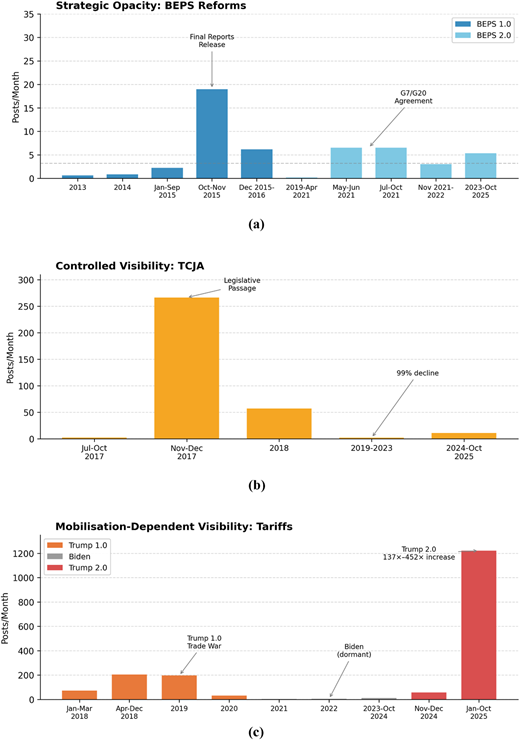
The BEPS 1.0 dataset comprises 155 posts across 48 months, yielding an average of 3.2 posts per month. Volume remained minimal throughout the project’s development: 7 posts in 2013, 10 in 2014, 61 in 2015 and 77 in 2016. The October 2015 release of the BEPS Final Reports – the culmination of a two-year multilateral negotiation involving 44 countries – generated a peak of 33 posts in that month. This represents the maximum visibility achieved by a reform that restructured international tax architecture for 140+ jurisdictions [2]. Within two months, volume returned to baseline levels. Table 3 disaggregates visibility by critical periods in the BEPS 1.0 policy cycle.
Disaggregates visibility by critical periods in the BEPS 1.0 policy cycle
| Period | Posts | Months | Posts/Month | AVG engagement |
|---|---|---|---|---|
| Early development (2013–2014) | 17 | 24.0 | 0.7 | 23.8 |
| Pre-Release (JAN–SEP, 2015) | 20 | 9.0 | 2.2 | 30.9 |
| Final reports release (OCT–NOV, 2015) | 38 | 2.0 | 19.0 | 16.2 |
| Post-release (DEC, 2015–DEC, 2016) | 80 | 13.0 | 6.2 | 48.2 |
Discourse is dominated by expert-professional actors. The top five posting Pages are Young Business Leaders of Nigeria (21 posts, 13.5%), PwC India (13 posts, 8.4%), OECD (11 posts, 7.1%), Taxmann (9 posts, 5.8%) and Truth and Lies and other Liberal Promises (7 posts, 4.5%). Politicians and mass media outlets are absent from the top actors. Mean engagement reaches 35.5 reactions per post, with a median of 7.0. The maximum engagement post (627 reactions) is a professional services announcement from RSM Egypt. Zero-engagement posts constitute 14.2% of the dataset.
BEPS 1.0 exemplifies strategic opacity. A reform of major structural significance to international tax governance generated minimal public visibility even at its peak moment. The dominance of expert-professional actors – Big 4 firms, tax publishers, the OECD itself – and the absence of politicians and mass media from top posters indicates that discourse remained confined to specialist intermediaries rather than circulating to mass publics.
4.2.2 BEPS 2.0/Pillar Two (2019–2025)
The BEPS 2.0 dataset comprises 266 posts across 82 months, yielding an average of 3.2 posts per month – nearly identical to BEPS 1.0 despite covering the “historic” G7/G20 global tax agreement of 2021. That agreement established a 15% global minimum corporate tax rate, the first coordinated floor on tax competition among major economies and was endorsed by 139 jurisdictions (OECD, 2021).
Volume remained minimal even during moments of significant political attention. The G7 Agreement (June 2021) and G20 Confirmation (October 2021) – which established the 15% global minimum tax and were hailed as the most significant reform to international tax architecture in a century – generated only around 6.5 posts per month during the May–October 2021 window. Table 4 disaggregates visibility by critical periods in the BEPS 2.0 policy cycle.
Disaggregates visibility by critical periods in the BEPS 2.0 policy cycle
| Period | Posts | Months | Posts/Month | Avg engagement |
|---|---|---|---|---|
| Development phase (2019–APR, 2021) | 4 | 28.0 | 0.1 | 3.5 |
| G7 Agreement Window (MAY–JUN, 2021) | 13 | 2.0 | 6.5 | 22.8 |
| G20 Confirmation Window (JUL–OCT, 2021) | 26 | 4.0 | 6.5 | 7.4 |
| Post-Political Window (NOV, 2021–2022) | 42 | 14.0 | 3.0 | 7.4 |
| Implementation Phase (JAN, 2023–OCT, 2025) | 181 | 34.0 | 5.3 | 9.7 |
The actor composition mirrors BEPS 1.0. Top posting Pages are Taxmann (17%), Deloitte (14%) and other tax publishers and professional services firms. Political actors, including the G7/G20 leaders who announced the agreement, are absent from top posters. Mean engagement is 9.6 reactions per post, lower than BEPS 1.0 despite covering a more recent period; the highest-engagement post (304 reactions) is from a tax publisher, as shown below in Subsection 4.6.
These patterns confirm that strategic opacity persists even during political “breakthrough” moments. The G7/G20 agreement generated visibility that remains negligible relative to its policy significance, consistent with the proposition that technical complexity constrains mass circulation even when political attention is formally present.
4.3 Controlled visibility: TCJA
The TCJA dataset comprises 1,584 posts across 100 months, yielding an average of 15.8 posts per month. This average obscures the defining feature of TCJA visibility: a sharp spike during legislative passage followed by a sustained decline.
The legislative window (November–December 2017) generated 533 posts at 266.5 posts per month—a 107× increase from the pre-legislative baseline of 2.5 posts per month. December 2017 alone produced 358 posts, the single highest month in the dataset. Following passage, volume declined systematically: 57.1 posts per month during 2018 implementation, then 1.9 posts per month during 2019–2023, representing a 99% decline from peak. Discussion increased again in 2024–2025. Table 5 disaggregates visibility by critical periods in the TCJA policy cycle.
Disaggregates visibility by critical periods in the TCJA policy cycle
| Period | Posts | Months | Posts/Month | Avg engagement |
|---|---|---|---|---|
| Pre-legislative (JUL–OCT, 2017) | 10 | 4 | 2.5 | 283.1 |
| Legislative passage (NOV–DEC, 2017) | 533 | 2 | 266.5 | 411.0 |
| Implementation (2018) | 685 | 12 | 57.1 | 80.4 |
| Strategic Fade (2019–2023) | 114 | 60 | 1.9 | 164.4 |
| Renewed Discussion (JAN, 2024–OCT, 2025) | 242 | 22 | 11.0 | 139.2 |
During the legislative spike, politicians dominate discourse. The top posting Pages are Rep. Larry Bucshon (52 posts), Congressman Jason Smith (38 posts), Senate GOP (38 posts) and Miami Dade GOP (34 posts). The highest-engagement posts come from Donald J. Trump (107,406 reactions; 38,133 reactions) and Ivanka Trump (8,163 reactions). Opposition voices also appear, including “Republicrooks are Thugs in Suits” (27 posts) and The Christian Left (23 posts). Mean engagement reaches 207.8 reactions, substantially higher than BEPS. The distribution is highly skewed: the median is 21 reactions, while the maximum reaches 107,406 – Trump’s November 2017 post celebrating House passage. This reflects the mass-audience character of TCJA discourse during legislative passage.
The TCJA exhibits temporally concentrated visibility consistent with a legitimation window: visibility escalates sharply during legislative authorisation and then recedes during technocratic implementation.
4.4 Mobilisation-dependent visibility: tariffs
Tariff visibility presents the starkest pattern: substantively similar policy instruments generate radically different visibility depending on political mobilisation.
4.4.1 Trump 1.0 (2018–2020)
The Trump 1.0 tariff dataset comprises 4,777 posts across 36 months, yielding an average of 132.7 posts per month – approximately 41× the BEPS baseline. Volume sustained at high levels throughout the trade war period: 2,052 posts in 2018, 2,353 in 2019, and 372 in 2020 as COVID displaced attention. Table 6 disaggregates visibility by critical periods in the Trump 1.0 policy cycle.
Disaggregates visibility by critical periods in the Trump 1.0 policy cycle
| Period | Posts | Months | Posts/month | Avg engagement |
|---|---|---|---|---|
| Initial Announcements (JAN–MAR, 2018) | 215 | 3.0 | 71.7 | 21.5 |
| First escalation (APR–JUN, 2018) | 604 | 3.0 | 201.3 | 37.1 |
| Peak escalation (JUL–DEC, 2018) | 1,233 | 6.0 | 205.5 | 92.0 |
| Sustained phase (2019) | 2,353 | 12.0 | 196.1 | 25.4 |
| Covid period (2020) | 372 | 12.0 | 31 | 22.1 |
International news and financial media dominate discourse. The top posting Pages are National Committee on US-China Relations (218 posts), Mohamed A. El-Erian (190 posts), Money and Markets (168 posts), Orbex (132 posts) and NDTV Profit (122 posts). Mean engagement reaches 43.6 reactions per post, comparable to BEPS 1.0 despite vastly higher volume. The distribution is shaped by international media amplification: the maximum engagement post (68,445 reactions) comes from CGTN, Chinese state media, reflecting the geopolitical salience of US–China trade conflict.
Trump 1.0 tariffs demonstrate that political mobilisation can sustain high visibility over extended periods. Unlike the TCJA’s concentrated legislative spike, tariff visibility remained elevated throughout 2018–2019 as ongoing escalation, retaliatory measures and presidential rhetoric provided continuous activation. The dominance of international news and financial media outlets, rather than domestic political actors, reflects the global audience for US–China trade conflict.
4.4.2 Biden era (2021–2024)
Under the Biden administration, tariff visibility collapsed despite broad policy continuity. Across January 2021 to December 2024, the dataset contains 429 posts, yielding 8.9 posts per month, driven by a 2024 uptick – a 93% decline from Trump 1.0 (132.7 posts/month). Annual volumes remained low: 32 posts in 2021, 51 in 2022 and 61 in 2023. Volume increased in 2024 (285 posts), including 112 posts in November–December 2024 during the transition period immediately preceding the 2025 surge.
Policy substance alone does not determine visibility. The Biden administration maintained Trump-era tariffs, yet the absence of sustained political mobilisation returned posting volume to near-BEPS levels, confirming that visibility depends on active political activation rather than programmatic content.
4.4.3 Trump 2.0 (2025)
The return of Trump to the presidency produced an explosion of tariff visibility unprecedented in our dataset, as detailed in Table 7.
Disaggregates visibility by critical periods in the Trump 2.0 policy cycle
| Period | Posts | Months | Posts/Month | Avg engagement |
|---|---|---|---|---|
| Biden transition (2021) | 32 | 12.0 | 2.7 | 13.4 |
| Biden sustained (2022) | 51 | 12.0 | 4.3 | 99.6 |
| Biden late period (2023–Oct, 2024) | 234 | 22.0 | 10.6 | 122.2 |
| Trump 2.0 transition (Nov–Dec, 2024) | 112 | 2.0 | 56 | 23.6 |
| Trump 2.0 active (Until Oct, 2025) | 12,212 | 10.0 | 1,221.2 | 327.7 |
The 2025 monthly breakdown reveals the scale of activation: January (100 posts), February (520), March (663), April (4,217), May (1,133), June (352), July (1,146), August (2,252), September (1,339) and October (490). April 2025 alone generated 4,217 posts—approximately 27 times the entire BEPS 1.0 dataset (155 posts across four years).
Indian and international media dominate discourse. The top posting Pages are Lina Migurt (620 posts), Business Standard (372 posts), News18 (368 posts), The Economic Times (187 posts) and India Today (148 posts). The highest-engagement posts come from Indian influencers: Shubhankar Mishra (742,918 reactions) and RJ Archana Jani (309,358 reactions; 174,973 reactions). Mean engagement reaches 327.7 reactions, roughly 9× the BEPS baseline; maximum engagement (742,918 reactions) exceeds the TCJA maximum (107,406) by approximately 7×.
Mobilisation-dependent visibility produces variation spanning three orders of magnitude. The same policy instrument – tariffs on imported goods – generated an average of 8.9 posts/month under Biden (dropping to 2.7 in the first year) and 1,221 posts/month under Trump 2.0. This yields a 137× differential at the administration level, and a 452× differential when comparing the most dormant baseline to active mobilisation. This illustrates that visibility is not determined by policy content but by political activation.
4.5 Comparative summary
As summarised in Table 8, the magnitude differentials are stark. Figure 1 visualises these disparities on a logarithmic scale, highlighting how tariff politics under mobilisation achieves visibility levels nearly 400 times higher than the BEPS baseline.
Summarises visibility metrics across all searches
| Reform | Configuration | Total posts | Duration | Posts/Month | Peak month | Avg engagement | vs BEPS ratio |
|---|---|---|---|---|---|---|---|
| BEPS 1.0 | Strategic opacity | 155 | 48 mo | 3.2 | 33 | 35.5 | 1.0× (baseline) |
| BEPS 2.0 | Strategic opacity | 266 | 82 mo | 3.2 | 29 | 9.6 | 1.0× |
| TCJA | Controlled visibility | 1,584 | 100 mo | 15.8 | 358 | 207.8 | 4.9× /111× |
| Tariffs Trump 1.0 | Mobilisation-dependent | 4,777 | 36 mo | 132.7 | 479 | 43.6 | 41× |
| Tariffs Biden | Mobilisation-dependent (dormant) | 429 | 48 mo | 8.9 | 76 | 78.4 | 2.8× |
| Tariffs Trump 2.0 | Mobilisation-dependent (active) | 12,212 | 10 mo | 1,221.2 | 4,217 | 327.7 | 378× |
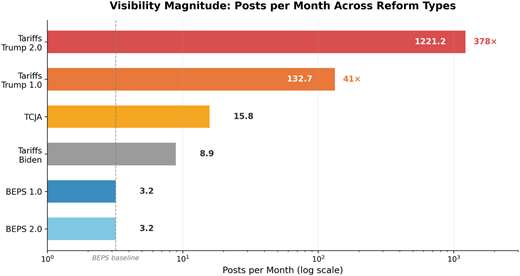
BEPS maintains roughly 3 posts per month regardless of major political events. The TCJA spikes to 266.5 posts per month during legislative passage and then recedes to around 2 posts per month during the prolonged post-enactment period. Tariffs range from around 3 posts per month under Biden to over 1,000 posts per month under Trump 2.0, depending on political activation. As illustrated in Figure 2, these aggregates conceal distinct temporal dynamics: while BEPS exhibits a flatline consistent with strategic opacity, the TCJA and tariffs reveal radically different patterns of pulse and mobilisation.
Structurally similar governance programmes, each operating on cross-border economic flows through legal-technical instruments, produce visibility differentials spanning three orders of magnitude.
4.6 The character of visibility: who speaks and how
As illustrated in Table 9, the qualitative content of highest-engagement posts reinforces these configurations. BEPS 1.0’s most engaging post (627 reactions) was a professional services firm promoting a survey download; BEPS 2.0’s peak (304 reactions) similarly featured technical tax news. By contrast, the TCJA’s maximum (107,406 reactions) was President Trump celebrating House passage – a political performance of democratic authorisation. Tariff visibility was shaped by geopolitical framing: Trump 1.0’s peak came from Chinese state media (68,445 reactions), while Trump 2.0’s extraordinary maximum (742,918 reactions) came from an Indian influencer framing tariffs through nationalist discourse. These patterns suggest that visibility differentials are not merely quantitative but are analytically consistent with qualitatively different modes of legitimation – a theoretical implication we develop in the Discussion.
Maximum-engagement posts by reform type, illustrating the qualitative character of visibility across legitimation configurations
| Reform | Max reactions | Author type | Content character |
|---|---|---|---|
| BEPS 1.0 | 627 | Professional services firm (RSM Egypt) | Survey report download |
| BEPS 2.0 | 304 | Professional services firm (RSM Kuwait) | Technical tax news |
| TCJA | 107,406 | President Trump | Political celebration |
| Tariffs Trump 1.0 | 68,445 | Chinese state media (CGTN) | Geopolitical conflict |
| Tariffs Trump 2.0 | 742,918 | Indian influencer | Nationalist framing (“India wins”) |
5. Discussion
5.1 Contribution to theory
Before detailing these architectures, a clarification regarding their analytical status is warranted. To operationalise these concepts beyond our present cases, the legitimation architectures we identify should be understood strictly as analytically constructed ideal types inferred from the observable traces of platform communication – functional categories stripped of normativity. In other words, they are not fixed, inherent properties of specific governance domains; rather, as our cases demonstrate, they are recurrent yet historically contingent outcomes that remain mutable under changing communicative activation conditions.
5.1.1 Three legitimation architectures
Expert-consensus legitimation. The BEPS visibility pattern is consistent with a mode of coordination that operates without mass public authorisation when technical decision-making remains insulated from broad circulation. The visibility signature is structural opacity: posting volume remains at roughly baseline levels even at moments treated as “historic” within policy circles, and peak engagement is generated by professional intermediaries rather than mass-audience actors. Legitimation is stabilised primarily through epistemic authority, in which complexity and professional gatekeeping filter out mass contestation while preserving peer validation and multilateral credibility. The qualitative character of the highest-engagement BEPS posts – professional services firms promoting survey downloads and technical tax news – confirms that even peak visibility remains confined to expert intermediaries rather than mass publics.
Democratic-authorisation legitimation. The TCJA visibility signature is consistent with legitimacy produced through a temporally concentrated authorisation window. Visibility spikes during legislative passage and then collapses post-enactment: circulation surges alongside the assembly and display of authorising coalitions, then recedes as implementation shifts into routinised administrative work. The actor ecology during the spike is dominated by politicians and high-audience political entrepreneurs, and the communicative form shifts from technical exposition to political performance. In this architecture, democratic legitimacy is punctuated – performed at founding moments and then institutionally carried forward – while prolonged visibility during implementation would reopen contestation of complex administrative choices.
Mobilisational legitimation. Tariffs illustrate that programme legitimation can become contingent on ongoing communicative activation rather than policy substance. The visibility differential between Biden and Trump 2.0–137× at the administration level, rising to 452× between Biden’s first year (2.7 posts/month) and Trump 2.0 activation (1,221 posts/month) – for substantively similar instruments illustrates this decoupling: the programme operates identically in legal-economic terms, yet its standing fluctuates with visibility.
The dominance of international media (Chinese state media during Trump 1.0) and nationalist influencers (Indian commentators framing Trump 2.0 as a geopolitical contest) reveals that this architecture operates through conflict personification and identity activation. This explains the divergence from the TCJA. While the TCJA also generated significant international friction – such as WTO challenges by the European Union regarding its Foreign-Derived Intangible Income provisions (Avi-Yonah and Vallespinos, 2018) – those disputes remained technically opaque and failed to trigger mass mobilisation. In contrast, tariffs transform cross-border friction into a legible geopolitical reality. By activating the fear that the “US will be overtaken”, tariffs reframe economic policy as an existential nationalist struggle. The policy becomes “real” because its global circulation forces political actors to performatively react to a perceived shift in the balance of power.
The February 2026 Supreme Court ruling striking down the administration’s use of emergency powers (IEEPA) for tariffs illustrates this precise dynamic. Because recognition was never institutionally installed at the premise level, the programme remained entirely vulnerable to legal invalidation. Yet, the massive communicative capital accumulated through platform mobilisation (evidenced by our observed 452× visibility differential) completely decoupled the programme’s political survival from its legal standing. Rather than retreating after the legal defeat, the administration leveraged this mobilisational shield to immediately reimpose a higher 15% worldwide tariff under alternative statutory authority (Section 122) (Lucey and Mijares Torres, 2026). The policy survives not through the stable bindingness of expert-consensus or democratic-authorisation, but through the continuous input of communicative operations that makes political retreat costlier than legal escalation.
These architectures imply a general proposition: visibility traces the legitimation architecture a governance domain can sustain given its complexity, its pathways to stabilisation and the activation incentives of diverse actor ecologies and attention infrastructures.
5.1.2 Extensions to Luhmann’s systems theory
First, programmes operate through field-level infrastructures that shape legitimation possibilities. Luhmann’s original formulation positions decision premises as organisational mechanisms. Our findings extend this by demonstrating that such programmes operate within visibility environments structured by platform architectures that no single organisation controls. Expert-consensus legitimation relies on selection environments that privilege professional intermediation. Democratic-authorisation legitimation requires infrastructures capable of generating short-lived visibility spikes. Mobilisational legitimation relies on infrastructures that amplify conflict and personification.
Second, visibility operates as the empirically observable shadow of the conversion mechanism between technocratic governance programmes and platform selection infrastructures. As theorised in Section 2.3, dynamic coupling between governance programmes and platform environments is variable and activation-dependent rather than institutionally stable. Our three visibility configurations illustrate this variability: coupling remains dormant under expert-consensus legitimation (BEPS), concentrates in temporally bounded windows under democratic-authorisation (TCJA) and fluctuates with communicative mobilisation (tariffs). These are variable coupling patterns – ongoing histories of recurrent interaction that intensify, weaken and restructure as activation conditions change. The TCJA case is paradigmatic: the conversion mechanism is enacted through controlled exposure, with visibility spiking as authorising coalitions are assembled and displayed during legislative passage, then dampened once the programme shifts into administrative execution.
In this context, the spike-and-fade pattern observed in TCJA discourse is a structured sequence of exposure and retreat. While visibility enables initial authorisation, opacity enables technocratic stabilisation. This specifies a concrete mechanism by which complex governance can remain democratically authorisable without remaining continuously democratically contestable.
Platform-structured visibility does not replace functional differentiation. Instead, it reshapes the conditions under which legitimation is performed, stabilised or rendered fragile in cross-border fiscal governance. This finding aligns with recent theoretical work arguing that digital technologies have not created new forms of sociality but have made visible society’s fundamental operation through distinct but interconnected systems of communication (Neri and Cordeiro, 2025). Our cases provide observational evidence consistent with this claim: the same fiscal event – a tariff announcement, a legislative vote – is processed simultaneously by the legal system (compliance determination), the economic system (adaptation), and the mass media system (visibility selection), each according to its own operational code. The visibility differentials we observe are not distortions or communication failures but traces of this differentiated processing made observable through platform data.
Third, mobilisational legitimation decouples legality from political survival under conditions of continuous communicative activation. Luhmann emphasises that functional systems operate according to autonomous codes – politics according to power, economy according to payment, law according to legality. The tariff findings demonstrate this autonomy empirically while revealing its consequences for governance stability under platform conditions. As Section 2.1 observed, tariffs are formally conditional programmes, yet their purposive deployment as instruments of negotiation, punishment and electoral mobilisation means their legitimacy environment is decoupled from their programmatic execution.
As the February 2026 Supreme Court ruling on tariffs illustrates, the legal system’s binary code (legal/illegal) operates autonomously from the communicative generation of legitimacy. The Court coded the initial tariff programme as illegal, dealing it a fatal legal blow. However, because stabilisation in mobilisational architectures is shaped by platform-mediated visibility activation rather than programmatic legality, the policy’s standing remained robust. This accumulated communicative capital allowed the administration to immediately bypass the legal defeat and pivot to a new statutory premise.
Under such conditions, political risk diverges sharply from legal risk – and conversely, communicative capital can override legal invalidation. Organisations may remain fully compliant with conditional programmes while becoming vulnerable to shifts in visibility activation they cannot control. Conversely, a programme’s legal execution may be formally invalidated, yet its legitimation environment can remain robustly insulated by continuous communicative mobilisation. This challenges both the credible commitment thesis in regulatory governance (Gilardi, 2002), and rule of law scholarship, which emphasises that clear legal rules create predictable compliance environments (Fuller, 1969; Raz, 1979; Tamanaha, 2004). Our findings suggest otherwise: the programme may execute predictably in law – or fail legally – while its survival remains contingent on communicative mobilisation and platform amplification that traditional institutions cannot control.
We argue that these extensions explain why the three visibility configurations identified in Section 2.3 – strategic opacity, controlled visibility, and mobilisation-dependent visibility – correspond to distinct legitimation architectures rather than to variations in communication intensity alone.
5.1.3 Challenging conventional assumptions
We contend that our findings challenge four assumptions common across democratic theory, transparency studies and governance literatures.
First, low visibility does not indicate failed legitimacy. Early scholarship on digital democracy anticipated that networked platforms would enable mass publics to engage with technical governance, transforming policy deliberation through accessible information and participatory affordances (Benkler, 2006; Shirky, 2008, 2010). Our findings suggest otherwise: BEPS achieves multilateral coordination precisely because its technical programmes do not circulate within platform formats. We emphasise that this is not a transparency problem, as BEPS documents are publicly available. Rather, it is a visibility condition: complexity filters out mass engagement. This aligns with the logic of “quiet politics” (Culpepper, 2010), where expert coordination thrives because issues stay off the public agenda, and with Christensen and Hearson’s (2019) account of the “professional tax consensus” sustaining OECD coordination through expert networks. Strategic opacity, in the sense of low platform visibility, is a condition of operation rather than a communication failure.
Second, democratic legitimation does not require continuous publicity, and much fiscal governance legitimation is not democratic at all (Kingma, 2020). Scholars of global governance have argued that legitimacy in complex policy domains often derives from technocratic delegation and output performance rather than democratic input (Moravcsik, 2002; Zürn, 2018). However, the implicit model across much democratic theory treats ongoing public scrutiny as the normal state for legitimate reform. This assumption is particularly strong in deliberative democracy, where theorists from Habermas to Gutmann and Thompson have insisted that publicity is a necessary condition for generating legitimacy – with Habermas demanding “publicity and transparency for the deliberative process” precisely because it is necessary to “generate legitimacy” (Habermas, 2006; see also Gutmann and Thompson, 1996; Steiner, 2012). Our findings complicate this picture by identifying three distinct visibility configurations that are analytically consistent with structurally distinct legitimation architectures.
Expert-consensus legitimation, exemplified by BEPS, operates entirely outside democratic channels. Legitimacy is produced through epistemic authority, multilateral participation among states and peer-based validation within expert networks – not through public deliberation or electoral accountability. This aligns with Majone’s (1999) argument that the regulatory state derives legitimacy from delegation to non-majoritarian institutions, where effective problem-solving substitutes for democratic input. Strategic opacity in this sense is less a deficit to be corrected and more a structural condition enabling technocratic coordination at scale.
Democratic-authorisation legitimation, exemplified by the TCJA, does require publicity – but only at founding moments. Visibility spikes during legislative passage to secure authorisation, then recedes during implementation. This mirrors Rosanvallon and Goldhammer’s (2011) distinction between the “legitimacy of identification” (produced during electoral moments) and the “legitimacy of impartiality” (produced by independent, insulated institutions). Legitimacy here emerges through controlled coupling—a bounded window of exposure for passage, followed by decoupling for technocratic execution.
Mobilisational legitimation, exemplified by tariffs, produces high visibility that mimics democratic engagement but operates through different mechanisms entirely. The visibility differential between Biden and Trump 2.0–137× at the administration level, rising to 452× at maximum dormancy – for substantively identical instruments reveals that this architecture is driven by identity activation and conflict personification rather than by deliberation over policy content. Political standing fluctuates with presidential mobilisation, decoupled from programmatic change or democratic authorisation.
These findings suggest that legitimation in a complex arena like fiscal governance operates as a plural phenomenon: punctuated democratic performance in some domains, technocratic insulation in others and mobilisational activation in still others – rather than the continuous public relationship presupposed by deliberative theory. This plurality is consistent with the notion of the punctuated equilibrium framework (Baumgartner et al., 2018; Baumgartner and Jones, 2009), which shows that policy agendas are driven by bursts of attention rather than incremental, ongoing scrutiny.
6. Conclusion
This paper started from an empirical asymmetry that standard accounts of transparency and democratic publicity do not explain. Cross-border fiscal reforms operating through legal-technical programmes display radically different public visibility trajectories. The comparative analysis of BEPS, the TCJA, and tariff reforms shows that these trajectories are patterned in volume, temporality, actor composition and engagement, with variation spanning orders of magnitude. The paper treated these visibility patterns as evidence of underlying governance architecture, not as incidental communication noise.
The theoretical framework positioned programmes as decision premises that scale governance by pre-structuring how codes are applied in concrete cases, while locating visibility within mass media and platform selection environments that process complexity through their own programmes. The findings show that governance programmes and visibility programmes interact in structured ways, with consequences for political standing and contestability. The mechanism linking these levels is structural coupling reconceived as a dynamic, activation-dependent conversion process: governance communication irritates platform systems, which convert it into probabilistic visibility according to their own selection codes – a coupling that can remain dormant, concentrate in bounded windows or fluctuate with mobilisation.
Legitimation appears here, as analytically inferred from platform-visible communication patterns, as a stabilising condition for programmatic automation – it secures the unmotivated acceptance of decision premises required to operate under complexity, interdependence and attention scarcity. The relationship between legitimation architectures and visibility configurations is therefore structural. Legitimation architectures describe how recognition is produced – through epistemic seal, democratic seal or continuous communicative input. Visibility configurations describe what we observe when that communicative work is processed through platform selection logics. Visibility is the shadow of legitimation: low and stable where recognition is already installed (strategic opacity), concentrated where a founding moment installs bindingness (controlled visibility), continuous where recognition never fully stabilises (mobilisation-dependent visibility). The visibility differential spanning three orders of magnitude across our cases is, in this sense, a trace of differentiated legitimation dynamics made observable through platform data.
The general implication is that visibility infrastructures shape the conditions under which legitimation can operate in cross-border fiscal governance, conditioning which architectures remain feasible – and which become structurally unavailable – for technocratic programmes governing multinational value chains.
6.1 Future research directions
This study opens a focused research agenda on the relationship between platform-mediated visibility, legitimation and governance. While the empirical analysis concentrates on Facebook and cross-border fiscal reforms, the programme–visibility framework developed here invites further investigation into how algorithmic infrastructures condition public circulation, contestation and reflexivity.
First, future research could pursue a systematic cross-platform comparison. Visibility architectures are not platform-neutral: different platforms operate through distinct affordances, ranking mechanisms and temporal dynamics. Comparative analyses across platforms such as X, TikTok or YouTube could examine whether the legitimation architectures identified here reproduce across environments or whether platform-specific selection logics generate distinct patterns of public circulation.
Second, having established the macroscopic visibility architectures that condition global governance, future research can build on this framework to systematically disaggregate the specific tactical mechanisms of coordination and amplification used to engineer them.
Analysing coordinated practices, including networked page ecosystems, influencer cascades and algorithmically advantaged reposting, would allow researchers to distinguish organically emergent visibility from strategically engineered communicative inputs, adding granular depth to our understanding of mobilisation-dependent regimes.
Third, longitudinal research could examine how visibility architectures evolve over time. Returning to our functional definition, legitimation – the continuous securing of unmotivated acceptance of decision premises—must be treated as a dynamic achievement rather than a fixed attribute: programmes initially stabilised through opacity may later face de-legitimation and become highly contested, while highly visible policies may eventually routinise into unobserved administrative premises. Tracing such transitions would clarify how governance continuously adapts to shifting visibility environments and changing platform conditions.
Fourth, the concept of visibility architectures could be tested across policy domains beyond fiscal governance. Regulatory fields such as environmental policy, public health governance or financial regulation involve comparable tensions between technical complexity and public contestability and may exhibit analogous configurations of strategic opacity, controlled visibility or mobilisation-dependent activation. Cross-domain comparison would help clarify whether the architectures identified here are specific to fiscal governance or capture more general patterns in the relationship between programmatic complexity and platform-mediated legitimation.
The authors wish to thank the Guest Editor, Professor Steffen Roth, and the two anonymous reviewers for their insightful feedback and constructive guidance throughout the review process.
Notes
To be clear, our use of “legitimation” follows Luhmann’s strictly functional account. While Section 5.1.3 engages with normative theories of democratic legitimacy – particularly deliberative accounts that treat publicity as a precondition for legitimation – it does so analytically, to illustrate that our empirical findings complicate rather than endorse any single normative position. We do not prescribe which legitimation architecture is democratically preferable. Instead, we observe that structurally distinct architectures coexist and produce different visibility configurations.
The BEPS Action Plan was negotiated (2013–2015) by OECD and G20 countries, roughly 44 members at the time (34 OECD members plus non-OECD G20 members such as China, India and Brazil) (OECD, 2013). The Inclusive Framework, which expanded participation to 140+ jurisdictions, was not established until 2016, after the Final Reports were released (OECD, 2024).

