This study aims to explore how cross-border e-commerce (CBEC, enabled international businesses through platforms such as Alibaba International and JD Worldwide) and government policy support jointly affect agricultural export performance across regions in China. It particularly focuses on the moderating role of National High-Tech Zones (NHTZs, which serve as innovation hubs offering infrastructure and policy incentives) in strengthening the impact of CBEC on agricultural exports.
Using panel data from 31 Chinese provinces from 2009 to 2021, the study employs a robust empirical strategy combining an error correction model (ECM) to capture long-run equilibrium dynamics and geographically weighted regression (GWR) to examine spatial heterogeneity.
The results show that CBEC significantly boosts agricultural exports. More importantly, the number of NHTZs amplifies this effect, confirming a strong and positive moderating role. This synergistic effect is particularly pronounced in provinces with strong innovation-oriented institutional capacity, many of which are located in the eastern coastal region, while NHTZs play a more critical compensatory role in central and northern provinces where market-driven forces are weaker. Compared with central and northern regions, eastern and western provinces benefit more directly from CBEC development itself, and the marginal contribution of additional NHTZ support is relatively smaller.
This study is limited by the availability of CBEC data at the provincial level, which required indirect estimation using customs and logistics proxies. Additionally, the dataset covers the period from 2009 to 2021, excluding recent years affected by the COVID-19 pandemic. Methodologically, the study employs established models (ECM and GWR) without incorporating advanced machine learning or dynamic forecasting techniques. Future research could explore post-pandemic shifts in policy impact, use real-time CBEC data and apply predictive models to simulate how regional innovation policies shape agricultural exports under evolving digital trade environments.
This study contributes to the growing literature on digital trade and regional policy by uncovering the moderating role of innovation-driven policy zones in facilitating agricultural exports. It also highlights the importance of differentiated region-specific strategies to enhance the effectiveness of e-commerce policies in the agricultural sector. The findings may offer useful policy insights for other developing countries.
1. Introduction
Since 2012, cross-border e-commerce (CBEC, enabled international businesses through platforms such as Alibaba International and JD Worldwide) in China has witnessed rapid development, marked by growing transaction volumes, evolving operational models, and emerging industrial clusters (Mi et al., 2021). This expansion has been driven by global trade liberalization, ICT advancement, and increasing digital infrastructure (Zhao, 2020). In particular, China’s policy initiatives, including the development of National High-Tech Zones (NHTZs, which function as innovation hubs providing infrastructure and policy incentives) and the reinforcement of bonded logistics systems, have created a supportive environment for the expansion of CBEC (Ma et al., 2021). Against this backdrop, CBEC is increasingly recognized as a new internationalization channel, especially in digitally advanced markets like China (Giuffrida et al., 2021).
However, despite the steady growth of agricultural exports, China’s trade balance in this sector remains in deficit, with further setbacks during the COVID-19 pandemic (Li and Lin, 2021). This raises the question of how CBEC and government policy instruments such as NHTZs can jointly improve agricultural export performance.
Recent years have seen strong governmental support for CBEC, particularly through NHTZs, which offer policy incentives and infrastructure for digital trade. The modernization of agricultural trade via CBEC has thus become a strategic goal aligned with China’s broader vision of high-level trade openness and rural revitalization. Understanding how to enhance the effectiveness of CBEC, especially under the influence of regional policy support, is of growing policy and academic interest.
To address this gap, this study proposes a theoretical framework that examines the moderating role of regional policy, measured by the number of NHTZs, in the relationship between CBEC development and agricultural exports. It uses an error correction model (ECM) to estimate long- and short-term dynamics at the national level, and applies a Geographically Weighted Regression (GWR) model to assess regional heterogeneity across 31 provinces. The spatial configuration and east–west disparities are further explored to understand how the CBEC–export nexus varies under different policy contexts. The definitions of all key abbreviations are provided in Appendix 1.
This article offers three key contributions. First, it empirically tests the joint influence of CBEC development and NHTZs distribution on agricultural export trade, adding new insights to a relatively underexplored topic. Second, the use of GWR allows for a nuanced understanding of spatial heterogeneity in policy effectiveness. Third, by modeling the interaction between CBEC and policy support, this study introduces a novel mechanism analysis that highlights the role of NHTZs as moderators in the e-commerce–export relationship. Building on this contextual background, the next section reviews the relevant literature and develops the research hypothesis.
The remainder of this article is structured as follows: Section 2 reviews relevant literature and presents the research hypothesis. Section 3 outlines the methodology and data. Section 4 reports the empirical results, and Section 5 concludes with policy implications and directions for future research.
2. Literature review and research hypothesis
2.1 Literature review
This study aims to investigate the moderating role of government policy in e-commerce-driven agricultural exports, drawing on two relevant bodies of literature. China’s cross-border e-commerce (CBEC) policy has expanded rapidly through the establishment of CBEC Comprehensive Pilot Zones, which aim to streamline customs procedures, reduce transaction costs, and promote digitally enabled trade. Evidence shows that these pilot zones significantly boost local economic activity, partly by improving urban digitization and trade openness (He et al., 2024). The policy has become an important institutional driver supporting China’s CBEC development, particularly in regions with stronger infrastructure and digital capabilities.
Regarding the relationship between CBEC and agricultural product exports, several studies have applied a macro-level perspective. A survey of EU CBEC, for example, demonstrated that online cross-border trade can reduce distance-related trade costs and provide comparative advantages for English-speaking exporting countries (Gomez-Herrera et al., 2014). Research in Southeast Asia also suggests that CBEC promotes China’s export trade (Yin and Choi, 2023). Scholars have further examined various factors influencing CBEC development, such as the level of government support, R&D intensity, and logistics capacity (Xi et al., 2023; Nguyen et al., 2024). Studies consistently find that CBEC development has a positive impact on agricultural product exports (Yue-ming and Cheng, 2020), and indicators like the CBEC Development Index are positively correlated with China’s agricultural export performance (Zhou et al., 2023). The impact, however, varies across regions, with stronger effects in provinces and coastal areas with CBEC pilot zones. Evidence also shows a long-term equilibrium relationship between CBEC and agricultural exports, with potential multiplier effects in the short term (Aslan et al., 2023).
Another stream of research focuses on NHTZs and their role in supporting export trade. Scholars have mainly approached these zones from the perspective of regional innovation systems (Yuan et al., 2013) or explored their spatial temporal distribution and influencing factors (Shan, 2017). Empirical studies show that firms in these zones often benefit from government support, resulting in improved output, employment, and trade activity. For instance, Batam firms in Indonesia outperformed their peers due to policy incentives (Negara and Hutchinson, 2020), and in the Eurasian Economic Union, specialized agricultural high-tech zones are being promoted to enhance agri-food trade (Altukhov et al., 2019).
Recent studies on policy-driven innovation and pilot zones provide useful insights into how institutional interventions shape agri-food trade. He et al. (2025a, b) shows that digital-infrastructure policies can influence regional development and trade conditions. Other work demonstrates that zone-type reforms improve logistics efficiency, regulatory environments, and value-chain upgrading, thereby enhancing agri-food export performance (He et al., 2024; Wang et al., 2025; Zhou et al., 2025). Although the contribution of NHTZs to innovation is widely acknowledged, limited attention has been paid to the moderating effect of government policy within this relationship, including differences in CBEC development levels, long- and short-term export impacts, and regional disparities. The idea of “building regional advantage” emphasizes the transformation of comparative advantages into competitive ones, often through product differentiation and innovation (Asheim et al., 2011).
Research on this topic also faces data-related challenges. Most studies are conducted at the national level (Djojosoeparto et al., 2022), while provincial-level CBEC data is often estimated. Provincial CBEC transaction volume is typically measured through proxies such as consignment trade volume, logistics activity in bonded zones, and customs data from special supervision areas designated by the General Administration of Customs (Ma et al., 2021). Following this approach, the current study constructs regional CBEC indicators to support geographically weighted regression (GWR) analysis. Based on the gaps identified in the existing literature, the following subsection proposes the research hypothesis of this study.
2.2 Research hypothesis
CBEC has emerged as a transformative force in international trade, particularly for agricultural exports. By reducing transaction costs and enhancing trading efficiency, CBEC platforms enable producers to reach global markets more directly and efficiently than traditional trade models (Aslan et al., 2023; Ma et al., 2021). Moreover, CBEC leverages network effects that expand customer reach and accelerate brand visibility across borders (Du, 2023). However, the effectiveness of CBEC in promoting agricultural exports often depends on the broader institutional and infrastructural context in which it operates.
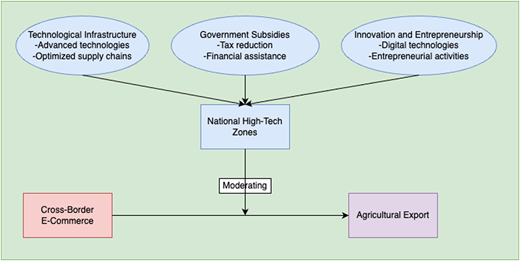
NHTZs are designed to foster innovation-driven development and serve as policy-backed clusters of technological and commercial activity. Their potential moderating effect on the CBEC export relationship can be explained through three complementary mechanisms. First, NHTZs offer advanced technological infrastructure and optimized supply chain systems, including integrated logistics customs services, digital traceability platforms, cold-chain facilities, and unified quality-inspection procedures that are generally unavailable in non-NHTZ regions. These features directly enhance agricultural product traceability, reduce information asymmetry, and strengthen global competitiveness, especially for perishable goods (Zandiatashbar et al., 2019). For example, several NHTZs have implemented digital customs-inspection platforms and cold-chain monitoring systems that allow real-time tracking of perishable agricultural goods, significantly reducing spoilage and cross-border clearance delays. Second, enterprises operating within NHTZs benefit from government subsidies and incentives aimed at stimulating innovation, R&D, and export-oriented growth (Chen and Liu, 2022). Such support lowers financial and administrative barriers, providing firms with greater capacity to convert CBEC-driven market access into tangible export performance. For instance, many NHTZs operate export-service centers that offer fast-track certification, export tax rebates, and technical support, reducing administrative burdens for agricultural exporters. Third, NHTZs often concentrate entrepreneurial activities and promote the adoption of digital technologies, such as AI, IoT, and blockchain, which improve supply-chain visibility, support real-time quality monitoring, and enhance logistics coordination, capabilities that help firms meet increasingly stringent international standards (Wang et al., 2022). For example, pilot projects in several NHTZs use blockchain-based traceability systems to verify the origin and quality of agricultural products before export, improving credibility in overseas markets.
In this context, NHTZs are expected to play a moderating role in the relationship between CBEC development and agricultural export performance. Specifically, provinces with a higher number of NHTZs are likely to exhibit stronger synergies between e-commerce activity and export growth, as CBEC’s market expansion effects are reinforced by the superior infrastructure, policy support, and innovation resources embedded in NHTZs. Figure 1 illustrates this process.
The number of NHTZs positively moderates the relationship between CBEC development and agricultural export performance.
3. Data and methodology
3.1 Methodological framework
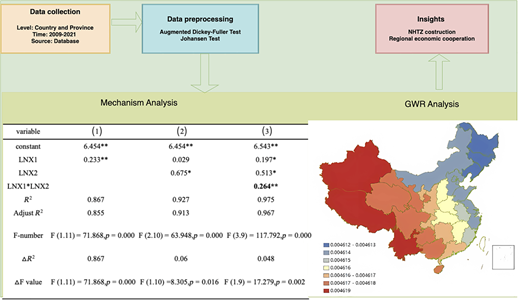
This study aims to empirically analyze the intricate interplay and consequential effects among CBEC, government policy support areas such as NHTZs, and agricultural product export trade. Drawing on a rich dataset spanning from 2009 to 2021, the research employs a combination of ECM and GWR methods to comprehensively explore the dynamics and nuances of these relationships, as shown in Figure 2. For the ECM analysis, provincial data are aggregated to the national level to construct a time series from 2009 to 2021, whereas the GWR model uses the full provincial panel to capture spatial heterogeneity. To operationalize this framework, the following subsections detail the GWR specification, the error correction model setup, and the construction of key variables.
3.2 Geographically weighted regression (GWR)
According to Tobler’s “First Law of Geography”: everything is related to everything else, but near things are more related than distant things. Therefore, unlike traditional cross-sectional data, the spatial correlation of spatial data leads to spatial non-stationarity (spatial heterogeneity) in regression relationships. In order to explore the spatial non-stationarity of spatial data, (Fotheringham and Brunsdon, 1999) proposed a geographically weighted regression model (GWR) based on summarizing local regression analysis and variable parameter research and drawing on the idea of local smoothing, as shown in Model (1):
represents the dependent variable at the observation point, is the independent variable at the observation point, represents the spatial coordinates (e.g. latitude and longitude) of the observation point. is the regression coefficient estimated at point which varies with geographic location. is the error term. For our analysis, the model is shown in Model (2).
denotes the 31 provinces while corresponds to the geographic centroid (latitude and longitude) of each province. The GWR model enables the analysis of spatial heterogeneity in how provincial policies and the development of CBEC influence export performance.
To ensure transparency and reproducibility of the GWR estimates, this study explicitly reports the key model parameters. The GWR analysis was conducted using the ArcGIS Pro GWR module, which applies default spatial weighting settings. Specifically, the model adopts an adaptive bi-square kernel, allowing the bandwidth to vary with the spatial distribution of provincial observations. The optimal bandwidth is automatically selected through the corrected Akaike Information Criterion (AICc) minimization procedure, which balances local model fit and parameter stability. These default specifications are widely used in GWR applications and are particularly appropriate for datasets with heterogeneous spatial density such as Chinese provincial data.
3.3 Error correction model (ECM)
The estimation of the ECM follows three standard steps. First, an ordinary least squares (OLS) regression is used to estimate the long-run equilibrium relationship between the dependent variable and its explanatory variables. Second, the residuals from this regression are subjected to an Augmented Dickey–Fuller (ADF) unit root test to evaluate whether they are stationary. A stationary residual series indicates that the variables are cointegrated, whereas non-stationary residuals imply the absence of a long-run equilibrium relationship (Yuan et al., 2013). Third, when cointegration is confirmed, the residuals from the long-run equation are lagged and incorporated into the short-run dynamic specification as the error-correction term. This component captures deviations from long-run equilibrium and measures the speed at which the system adjusts back to equilibrium when short-run shocks occur, forming the basis of the ECM, as shown in Model (3):
represents the first-order difference, capturing short-term fluctuations. is the error correction term, reflecting deviations from the long-term equilibrium. measures the speed at which the system returns to equilibrium; it is expected to be negative, indicating the direction of adjustment.
3.4 Variables and data sources
3.4.1 Independent variables
The Scale of CBEC Transactions: This indicator reflects the development level of CBEC. It is widely used to examine both the long- and short-term impacts of CBEC on China’s agricultural exports, considering regional variation (Yin and Choi, 2023). As shown in Table 1, national-level data are sourced from the Net Economics E-Commerce Research Center, while provincial-level estimates are based on customs data. To validate the provincial CBEC proxy, we aggregate the provincial CBEC indicator to the national level and compare it with the officially reported national CBEC statistics. The two-time series exhibit a moderate positive correlation (r = 0.526), which is reasonable given the measurement differences and the fact that official CBEC statistics are not disaggregated by province. This suggests that the proxy captures the underlying dynamics of CBEC development and aligns with approaches commonly used in the digital trade literature. The quantity of NHTZs: This variable represents the intensity of government policy support. Data are obtained from the Torch High-Tech Industry Development Center. NHTZs often host CBEC incubation centers and bonded zones that support new business models such as “CBEC + bonded display” and “smart logistics + distribution hubs,” promoting innovation and trade integration (Zhuang and Ye, 2020).
3.4.2 Dependent variable
The scale of agricultural product export trade: This variable captures the overall volume of China’s agricultural product exports and is commonly used to assess export performance in CBEC-related studies. Data are drawn from the China Agricultural Statistics Yearbook.
3.4.3 Control variables
Dollar-Weighted Average Exchange Rate (%): This indicator reflects the average exchange rate between the Chinese yuan and U.S. dollar, weighted by trade volume. It captures how currency fluctuations affect export competitiveness.
Agricultural Production Price Index (APPI): APPI reflects changes in prices received by domestic agricultural producers. It affects both producer incentives and price competitiveness in global markets. Controlling for APPI and exchange rates helps isolate the effects of CBEC and policy support on export performance.
4. Empirical results
4.1 Stationarity and cointegration tests
To address potential heteroskedasticity arising from differences in measurement units, types, sizes, and characteristics across variables, all variables were log-transformed to achieve standardization. This transformation not only mitigates heteroskedasticity but also enhances the comparability and interpretability of coefficients across different scales of measurement.
Accordingly, the Augmented Dickey-Fuller (ADF) test was conducted to evaluate the stationarity of each series. As presented in Table 2, the ADF test shows that some series are stationary at level, while others become stationary after differencing.
To examine the existence of long-term equilibrium relationships among variables, the Engle-Granger (E-G) two-step cointegration method was employed. The E-G test confirms a cointegration relationship among the variables. The ADF test yielded a p-value of 0.0021, which is below the 1% significance threshold. This result leads to the rejection of the null hypothesis of a unit root, confirming that the residual series is stationary. Therefore, it can be concluded that a cointegration relationship exists between LNY and the four explanatory variables, indicating a stable long-term equilibrium. While Granger causality tests are commonly used to assess temporal predictive relationships, this study focuses primarily on long- and short-term equilibrium effects and moderation mechanisms. Therefore, Granger results are omitted for parsimony and to maintain alignment with the conceptual framework. Having established the stationarity and long-run relationships among the variables, we proceed to estimate the error correction model to capture both long- and short-term dynamics.
4.2 ECM estimation results
Following the confirmation of a cointegration relationship among the variables, an ECM was developed to capture both the short-term fluctuations and the long-term adjustment process within agricultural export dynamics.
The results from Model (4) show that the coefficient of the error correction term is −1.3335. The significant negative ECM coefficient indicates rapid adjustment toward long-run equilibrium. This supports the hypothesis that agricultural exports are dynamically influenced by their underlying long-run drivers, including CBEC and policy support.
In terms of overall model performance, the coefficient of determination (R2 = 0.85) indicates that 85% of the variation in the dependent variable (logarithm of agricultural exports, LNY) can be explained by the included explanatory variables. This high explanatory power reflects the robustness of the model in capturing export dynamics.
Furthermore, the Durbin-Watson (D-W) statistic is 2.05, suggesting the absence of first-order autocorrelation in the residuals, thereby reinforcing the reliability of the model estimates. Although the D-W statistic primarily detects first-order serial correlation, additional diagnostic tests based on the residuals of the cointegration model were conducted to verify conformity with the classical linear regression assumptions. Diagnostic tests indicate good model fit without autocorrelation.
These findings motivate further analysis of spatial heterogeneity, which is explored using the GWR model in the next subsection.
4.3 Spatial heterogeneity analysis (GWR results)
The U.S. dollar exchange rate is excluded because it does not vary across regions. The measurement of CBEC activity across provinces is based on consignment trade data, including goods entering and exiting bonded supervision areas and logistics activity within special customs supervision zones authorized by the General Administration of Customs (Ma et al., 2021).
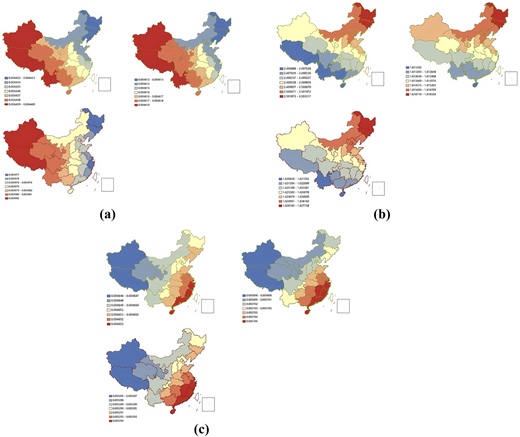
Figure 3 and Appendix 2 present the GWR results using panel data from 31 Chinese provinces (excluding Hong Kong, Macau, and Taiwan). The coefficient of determination (R2) in most provinces falls between 0.40 and 0.50, indicating that the selected explanatory variables account for a moderate portion of the variation in agricultural export performance at the provincial level. While the explanatory power is not uniformly high, this range suggests a reasonable model fit given the structural diversity and economic disparities across regions. Although the absolute differences in coefficients across provinces are moderate, their spatial configuration reveals a clear east–west and north–south pattern.
CBEC has stronger effects in the eastern and western regions, while northern provinces show weaker responsiveness. NHTZs influence is more pronounced in central and northern provinces. These zones may act as catalysts for agricultural modernization, digital transformation, and export facilitation in otherwise underperforming areas.
These findings confirm the presence of regional heterogeneity in the effects of CBEC and policy support on agricultural export performance. Specifically, they highlight the complementary roles of market-driven digital trade expansion and government-led high-tech development in shaping regional trade outcomes. The spatially differentiated patterns suggest that tailored policy interventions such as reinforcing digital infrastructure in the north or expanding NHTZ coverage in the west could improve trade equity and agricultural export resilience across regions. To validate these spatially differentiated effects, the subsequent subsection provides a mechanism analysis incorporating interaction terms.
4.4 Moderating mechanism analysis
To further examine the moderating effect of regional policy support on the relationship between CBEC and agricultural exports, a series of multiple regression models were developed. Drawing on prior literature on policy-environment interactions in trade (e.g. Ma et al., 2021), an interaction term was introduced to capture the regulatory function of NHTZs within the CBEC export dynamic.
As presented in Table 3, CBEC positively affects agricultural exports. Specifically, a 1% increase in CBEC scale is associated with a 23.3% increase in agricultural export volume, significant at the 5% level. This result confirms that CBEC plays a critical role in enhancing export performance by reducing transaction costs and expanding market reach.
NHTZs have a positive effect on exports. A one-unit increase in the number of NHTZs corresponds to a 67.5% increase in agricultural export volume, suggesting that innovation-driven policy zones provide institutional support that facilitates trade.
In Model (3), an interaction term between CBEC scale and the number of NHTZs is introduced to test the hypothesized moderating effect. The positive interaction term confirms that NHTZs strengthen the effect of CBEC. In other words, the beneficial effect of CBEC is magnified in regions with more innovation-oriented policy infrastructure. This suggests a synergistic relationship in which NHTZs provide complementary support, such as digital logistics, regulatory services, and innovation resources, that amplifies the trade-enhancing role of CBEC. These results support H1 and emphasize the importance of coordinated policy and infrastructure strategies. The findings imply that developing more NHTZs in high-CBEC regions can yield significant trade performance gains in the agricultural sector.
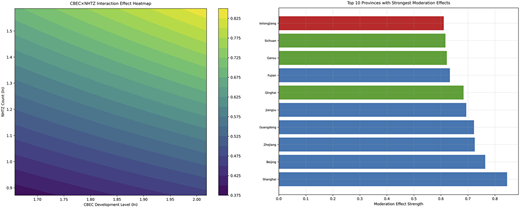
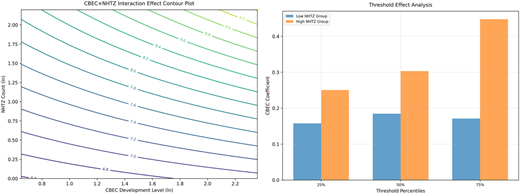
Figure 4 presents the marginal effects of CBEC on agricultural exports under different levels of NHTZ intensity. The results show that the moderating effect becomes stronger as NHTZ density increases, while provinces with more advanced digital and logistics infrastructures, especially in the east, display a relatively stable response. The contour plot illustrates a clear upward pattern in predicted export levels, with the highest values appearing where both CBEC development and NHTZ presence reach their strongest levels. This pattern confirms that policy support enhances the effectiveness of CBEC, whereas provinces with limited NHTZ activity experience only modest export gains.
The provincial ranking of moderation strength further highlights substantial spatial variation. Coastal provinces such as Shanghai, Beijing, Zhejiang, and Guangdong exhibit the strongest effects, reflecting their more mature institutional and innovation environments. Several central and northwestern provinces, including Qinghai and Gansu, also demonstrate noticeable gains, suggesting that targeted policy interventions can compensate for structural disadvantages. Overall, the visual evidence shows that the export-enhancing impact of CBEC is significantly amplified in regions with stronger innovation-oriented institutional capacity.
Although coastal provinces exhibit the highest absolute magnitude of moderation effects due to their mature industrial bases (as shown in Figure 4b), the relative importance of NHTZs as a compensatory mechanism is more critical for Central and Northern regions, where market-driven forces are weaker.
4.5 Robustness checks
To assess the reliability of the core findings and address potential omitted variable bias, a series of robustness checks were conducted.
4.5.1 Robustness check: inclusion of additional control variables
Recognizing that regional characteristics may jointly influence CBEC activity and agricultural export performance, we expanded the original ECM to include additional controls. Road density was used as a proxy for logistics capacity, Internet penetration captured digital literacy, and per capita agricultural output accounted for regional differences in agricultural productivity. GDP per capita and the stock of foreign direct investment were added to reflect economic development and trade openness.
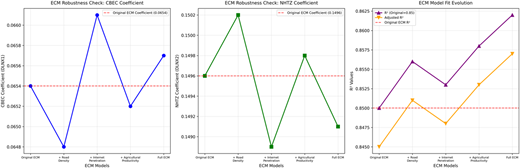
Figure 5 reports the results based on the stepwise inclusion of these controls. The short-run coefficients of the core variables remain remarkably stable. The coefficient on CBEC (DLNX1) stays within the narrow range of 0.0648–0.0661, closely aligned with the baseline estimate of 0.0654. Likewise, the coefficient on NHTZs (DLNX2) remains highly consistent, ranging from 0.1489 to 0.1502. The error-correction term, ECM (−1), remains close to −1.33 across all specifications, confirming a stable adjustment path toward long-run equilibrium. Although the model fit improves slightly (R2 increases from 0.850 to 0.862), the stability of the core coefficients indicates that the main conclusions are not driven by omitted regional features.
4.5.2 Mechanism robustness: mediation and threshold effects
To further examine the non-linear nature of the policy moderation effect, a threshold analysis was conducted. Figure 6 compares the estimated CBEC coefficients across different percentiles of the NHTZ distribution, distinguishing between provinces with low and high NHTZ intensity. A clear stepwise pattern emerges: the CBEC coefficient is substantially larger in the high-intensity group, often two to three times greater than in the low-intensity group. This pattern suggests the existence of a policy threshold beyond which the trade-enhancing effects of CBEC become significantly stronger. Once NHTZ density surpasses this critical point, institutional support amplifies CBEC’s contribution to export performance, indicating increasing marginal returns to policy engagement.
5. Conclusion and policy implications
5.1 Research conclusion
This study employed an ECM and a GWR model to rigorously examine the moderating role of government policy in e-commerce-driven agricultural exports in China, while accounting for spatial heterogeneity across provinces. Based on panel data from 2009 to 2021, key indicators were analyzed which including CBEC transaction volume, the number of NHTZs, the U.S. dollar-weighted exchange rate, the agricultural production price index, and agricultural export volumes.
CBEC and policy support jointly promote agricultural exports. Their effects are particularly pronounced in provinces with higher levels of policy engagement, suggesting that well-targeted interventions amplify the benefits of digital trade. Notably, provinces with stronger institutional support experienced greater export growth, underscoring the essential role of policy in facilitating market expansion.
NHTZs amplify the positive effect of CBEC. This implies that high-tech zones not only act as direct drivers of trade, but also improve the enabling environment for e-commerce-led export growth by providing infrastructure, subsidies, and innovation ecosystems.
Significant regional variation exists in CBEC and NHTZ effects. The impact of CBEC is strongest in eastern and western provinces, while NHTZs exert more influence in central and northern regions. These findings confirm the presence of geographically differentiated effects and reinforce the need for place-based strategies in agricultural export development. Building on these empirical findings, the next subsection outlines several policy implications.
5.2 Policy implications
Strengthen the synergy between High-Tech Zones and CBEC. Policymakers should promote the coordinated development of cross-border e-commerce CBEC and NHTZs. These zones can serve as both innovation hubs and trade facilitators by offering targeted support to CBEC enterprises, particularly within dedicated e-commerce parks. Investments in infrastructure, digital services, and overseas warehousing can enhance both the volume and quality of agricultural exports.
However, the design of such support should consider regional heterogeneity. In eastern provinces, where logistics systems, digital connectivity, and industrial bases are already advanced, the marginal effect of additional NHTZ support is limited. Therefore, these regions should focus on technological upgrading, high-value branding of agricultural products, and the diversification of global markets rather than relying on NHTZ-driven institutional support.
Improve institutional support for CBEC platforms and logistics. To fully leverage CBEC in agricultural trade, governments should improve the institutional environment. Key measures include establishing robust online platforms, optimizing return and exchange mechanisms for agricultural goods, and integrating intelligent logistics systems, risk monitoring systems, and streamlined customs procedures. These initiatives can reduce operational frictions and improve export efficiency.
According to Table 4, for central and northern provinces, where our results show that NHTZs exert the strongest moderating effect, institutional support should prioritize enhancing supply-chain connectivity, cold-chain logistics, and digital trade capabilities. Strengthening the service functions of NHTZs, including R&D support, quality inspection centers, and CBEC incubation platforms, can substantially amplify the positive impact of CBEC in these regions. Adopt region-specific strategies for agricultural export development. Given the spatial disparities revealed in this study, regionally tailored strategies are essential. Eastern and central provinces should focus on technological upgrading and the optimization of CBEC pilot zones. Western provinces should align agricultural export standards with international norms and promote local brands through CBEC platforms. For western regions, where infrastructure gaps and fragmented supply chains continue to constrain CBEC-driven export gains, policy measures should prioritize improving transportation networks, establishing standardization systems, and supporting geographical indication (GI) branding to help local producers better integrate into cross-border e-commerce channels.
Overall, differentiated policy approaches that are aligned with each region’s development stage and structural constraints are necessary to fully realize the combined benefits of CBEC development and NHTZ policy support.
5.3 Boundary and future research
While this study offers important and timely insights into the synergistic effects of CBEC and government policy on agricultural exports in China, several opportunities for future research remain. The analysis was based on data from 2009 to 2021, a period that captures the formative phase of CBEC development but excludes recent post-pandemic dynamics and newly updated statistical categories after 2021. Future studies could incorporate post-2021 data to examine how external shocks such as COVID-19, supply chain disruptions, or geopolitical changes further reshape the CBEC-policy-trade nexus.
In terms of methodology, this study applied robust and interpretable techniques, ECM and GWR which enabled rigorous analysis of long-run and spatially heterogeneous effects. Nevertheless, future research could build upon these findings by employing more advanced tools such as structural equation modeling (SEM), spatial econometrics, or machine learning algorithms to capture nonlinear relationships and improve forecasting accuracy.
Moreover, while this study focused on a single-country context, cross-country comparisons (particularly among emerging economies or Belt and Road Initiative participants) could yield broader insights into how digital trade platforms and policy interventions operate under different institutional settings. Such comparative studies would further enrich our understanding of digital globalization and help design context-sensitive trade policies.
Overall, this study lays a foundational framework for investigating the policy-moderated impact of CBEC on agricultural exports, offering theoretical and empirical pathways for future inquiry into sustainable and inclusive trade development in the digital era.