The purpose of this paper is twofold. First, it provides a systematic review of the expanding accounting literature which uses self-determination theory (SDT) to better understand how and why results controls (i.e. the measurement, target-setting, follow-up, and rewarding of employee work performance) can foster different types of employee motivation and the outcome effects thereof. Second, based on the identified achievements and weaknesses of this literature, it proposes an agenda for future scholarly effort.
The present study conducts a systematic, qualitative, and in-depth review of 38 articles published from 2010 to 2024 in high-quality accounting journals, all of which use SDT in their theorizing. The literature was analyzed by means of a thematic approach using the NVivo software.
A key achievement of the reviewed literature is the recognition that employees’ work motivation can be depicted as a self-determination continuum, ranging from controlled types (external and introjected motivation) to autonomous ones (identified, integrated, and intrinsic motivation). The literature has also shown that when results controls support employees’ basic psychological needs for autonomy, competence, and relatedness, this will foster more autonomous types of motivation, and vice versa when they thwart these needs. Moreover, through fostering autonomous types of motivation, these controls may not only contribute to high employee creativity and work performance but also enhance feelings of well-being and job satisfaction. This said, however, the reviewed literature also suffers from several weaknesses. These include a limited attention to key SDT ideas such as the motivational effects of individual-level personality traits and the internalization processes through which employees “take in” results controls. The literature also suffers from limited knowledge cumulativity largely as the result of diverging views on how to understand key SDT concepts and their relationships.
To the best of our knowledge, this study is the first systematic review of the accounting literature that uses SDT as a theoretical lens to examine the influence of results controls on employee motivation. As such, it uncovers overall achievements and weaknesses which are difficult to grasp when reading individual studies. It also highlights several knowledge gaps, thereby providing a basis for future research on the motivational effects of results controls.
1. Introduction
In the accounting literature, it is generally assumed that results controls—i.e. the measurement, target-setting, follow-up, and rewarding of work performance—affects employee motivation (Merchant and Van der Stede, 2017). Large parts of this literature use Self-Determination Theory (SDT) to study this relationship (see, e.g. Chen et al., 2020; Groen et al., 2017; Pfister and Lukka, 2019). An important reason for this is that SDT not only focuses on how results controls can bring about more or less motivation, but also different types of motivation. In fact, SDT proposes a continuum “with the order from least to most autonomous [type of motivation] being external, introjected, identified, integrated, and intrinsic” (Deci et al., 2017, p. 22). The first two types constitute so-called controlled motivation as employees’ engagement in work tasks emanates from external contingencies such as rewards/punishments or a wish to be perceived in positive light by important others. The last three types constitute autonomous motivation as employees perform these tasks because they find them personally relevant, even enjoyable (Deci et al., 2017; Gagné and Deci, 2005). SDT also asserts that the influence of results controls on employees’ motivations is largely mediated by three basic psychological needs, namely, to feel autonomous, competent, and related to important others (Gagné and Deci, 2005). The premise is that the satisfaction of these needs will foster autonomous types of motivation which, in turn, will have positive effects on employees’ well-being and work performance.
Drawing upon these ideas, accounting researchers have explored how various aspects of results controls can affect the satisfaction of the basic needs, thereby supporting or thwarting the development of autonomous types of motivation among employees (Pfister and Lukka, 2019; Sutton and Brown, 2016; Van der Hauwaert et al., 2022). They have also examined how such autonomous types of motivation affect various outcomes, such as the well-being of individuals (Siverbo, 2021; Stringer et al., 2011), their work efforts (Chen et al., 2020), creativity (Pfister and Lukka, 2019), and performance (Van der Hauwaert et al., 2022; Wong-On-Wing et al., 2010).
In this paper, we present the findings from a systematic review of this emerging literature. The reason for this is twofold. First, considering that the accounting literature using SDT has now reached a critical mass and is expanding rapidly (more than half of the reviewed papers have been published within the last five years, 2020–2024), the time seems opportune to undertake a critical review of this literature. Second, as the literature is to some extent in its early stages, it is still emerging and highly malleable. A review that identifies and critically discusses important achievements and weaknesses can thus be expected to have a relatively large impact on its future development (see also Hiebl, 2023a). Based on these arguments, the overall aims of the paper are to:
Provide a systematic review of the accounting literature which has used SDT to better understand how and why results controls (i.e. the measurement, target-setting, follow-up, and rewarding of employee work performance) can foster different types of employee motivation and the outcome effects thereof.
Propose an agenda for future scholarly effort based on the identified achievements and weaknesses of this literature.
Overall, the review shows that while this literature has indeed generated several novel insights into the motivational effects [1] of results controls, it also seems to suffer from limited use of the conceptual resources [2] provided by SDT and a lack of knowledge cumulativity. On these bases, our study makes two main contributions. First, it is to our knowledge the first full examination of the accounting literature which uses SDT to theorize how results controls affect employee motivation and the outcome effects thereof. As such, it not only provides an overview of the state-of-the-art and the key achievements of this literature but also a critical discussion of its weaknesses. Second, through highlighting patterns and tendencies of the literature as a whole, the review also uncovers common ground for a future research agenda.
The remaining parts of the paper are organized as follows. In the next section, we outline the basic tenets of SDT, after which we describe how the accounting papers reviewed were collected, selected, and analyzed. The following section then presents a detailed description of our review findings. Finally, we discuss major achievements and weaknesses, based on which several directions for future research are proposed.
2. Self-determination theory
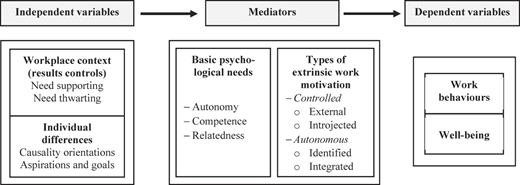
SDT is a leading macro theory which not only elaborates on the nature of human motivation, but also on important antecedents of such motivation and on the psychological processes by which these antecedents lead to important behavioural and well-being outcomes (Ryan and Deci, 2017). Based on a comprehensive literature review, Deci et al. (2017) develop what they refer to as “the basic self-determination theory model in the workplace” which subsumes core elements of SDT as applied to work organizations (see Figure 1). This mediation model forms the basis for the following description of SDT as well as for how to conduct and structure the systematic review of the accounting literature (Sections 3 and 4).
A central idea of SDT is that “the type or quality of a person’s motivation should be more important than the total amount of motivation for predicting many outcomes” (Deci and Ryan, 2008, p. 182). On this basis, SDT distinguishes between six types of motivation along a continuum ranging from amotivation (where individuals lack the intention to engage in a particular behaviour) to intrinsic motivation (where individuals engage in a particular behaviour because they find it inherently interesting and enjoyable). Between these endpoints, there are also four types of extrinsic motivation that are of particular interest for organizations as they are all affected by different aspects of workplace contexts of which this study focuses on the influence of results controls (see Figure 1).
As mentioned above, two of them are referred to as controlled as employees engage in a particular behaviour because they perceive a controlling pressure to do so (Deci et al., 2017). When such behaviour is entirely regulated by external forces—i.e. when they feel pressured to engage in a behaviour solely to attain extrinsic rewards or avoid punishments—SDT refers to this type of motivation as external. However, when the pressure is perceived to be internal—i.e. when employees engage in a behaviour to achieve feelings of pride or avoid feelings of shame and guilt—SDT refers to it as introjected motivation. The other two types of extrinsic motivation are referred to as autonomous as employees have come to identify with the values of results controls. When they are incited to engage in a particular behaviour because they find it congruent with their personal goals and aspirations, it is referred to as identified motivation (Deci et al., 2017). Furthermore, when the values conveyed by results controls have been fully internalized by employees so that they engage in a behaviour because it is perceived to be an integral part of who they are, it is referred to as integrated motivation (Deci et al., 2017).
SDT also postulates that employees can internalize the values of results controls so that the latter become more autonomous types of extrinsic motivators. Specifically, such internalization is likely to take place when results controls (as an important part of workplace context) support individuals’ three basic psychological needs to feel autonomous (i.e. to feel that a particular behaviour is performed out of their own volition and choice), competent (i.e. to feel that they possess the necessary skills to perform the behaviour successfully), and related (i.e. to feel supported and respected by important others). Furthermore, SDT argues that when results controls increase employees’ need satisfaction, this fosters more autonomous types of extrinsic motivation (see middle part of Figure 1, and also Deci et al., 2017). In contrast, when these controls thwart their basic needs, they tend to result in more controlled types of motivation (Deci et al., 2017).
This said, however, SDT also argues these effects are not given by any “inherent” properties of results controls, such as the design of performance-contingent rewards. Rather, their “functional significance” (Ryan et al., 2022) or meaning is likely to be affected by individual-level personality traits, in particular, by their (1) general causality orientations and (2) aspirations and goals (see lefthand side of Figure 1) [3]. Regarding employees’ general causality orientations, SDT argues that they typically differ with respect to how they interpret the cause of their behaviour, and as a result, the type of motivation they tend to experience (Gagné and Deci, 2005). As put by Hagger and Hamilton (2021, p. 711), “individuals endorsing an autonomy orientation tend to interpret their actions as originating from their self [thereby supporting autonomous types of motivation, while] those with a control orientation tend to interpret their actions as emanating from others [thereby resulting in controlled types of motivation]”. Hence, one and the same aspect of results controls is likely to be experienced as less salient and controlling among employees having an autonomous causality orientation compared with those having a controlled orientation.
Regarding the second type of personality traits listed above, SDT assumes that employees differ with respect to the type of aspirations and goals they pursue over their lifetime and that such differences influence their perceived level of psychological need satisfaction (see Figure 1 above). As Deci et al. (2017) argue, individuals who pursue intrinsic aspirations and goals, such as personal development and meaningful relationships, typically experience more basic psychological need satisfaction and well-being, compared with individuals pursuing extrinsic aspirations and goals such as financial wealth, recognition and status (Ryan et al., 2022). Deci et al. (2017) also draw upon previous research to propose that intrinsic aspirations and goals tend to be correlated with autonomous types of motivation, while extrinsic aspiration goals tend to be correlated with controlled types. By extension, it can thus be expected that employees’ life aspirations and goals are likely to affect the motivational effects of results controls. Specifically, it can be presumed that employees who pursue extrinsic aspirations and goals are likely to be more attentive to, and controlled by, controls which focus on financial rewards, recognition, and status relative to those who pursue intrinsic aspirations and goals.
Finally, as the righthand side of Figure 1 illustrates, SDT presumes that different types of motivation will have different effects on employees’ perceived well-being and behaviour (Deci et al., 2017). In fact, after conducting a large meta-analysis of the outcome effects of different types of work motivation, Van den Broeck et al. (2021, pp. 240–241) found that “Intrinsic motivation is the most important type of motivation for employee well-being, attitudes and behavior, yet identified regulation is more powerful in predicting performance and organizational citizenship behavior. Furthermore, introjection has both positive and negative consequences, while external regulation has limited associations with employee behavior and has well-being costs” (see also Ryan et al., 2022). In other words, SDT presumes that more autonomous types of motivation will predict greater well-being and work performance than will more controlled types (Deci et al., 2017).
In the next section, we will outline how the basic SDT model briefly described above (see Figure 1) has formed the basis for the systematic literature review.
3. Methods
Based on the aim to identify key achievements and weaknesses of the accounting literature using SDT, several criteria to select works to be included in the systematic review were used (cf. Fisch and Block, 2018; Hiebl, 2023a, 2023b; Linnenluecke et al., 2020). To begin with, they needed to have a clear and combined focus on results controls and SDT. That is, they should not only cover issues related to these controls in a wide sense, but also use SDT as an important theoretical lens to conceptualize or theorize such issues, either as the sole theoretical lens (see, e.g. Chen et al., 2020; Pfister and Lukka, 2019) or in combination with others (e.g. Appuhami, 2023; De Baerdemaeker and Bruggeman, 2015).
Following the commonly used approach in management research (Hiebl, 2023a), we decided to review both conceptual works and works that reported upon some form of empirical study. This allowed us to explore not only how results controls have been conceptualized and theorized in SDT terms, but also the kind of empirical support that is available for such conceptualizations and theorizations. Also, to ensure that the identified weaknesses of this stream of literature are not due to that many studies have not undergone high-quality peer-review processes, we also decided to restrict the review to publications in journals ranked B-A* in the Australian Business Deans Council (ABDC) Journal Quality List from 2022. This inclusion criterion is consistent with other, recent systematic literature reviews (e.g. Adjei-Mensah et al., 2024; Habib et al., 2024). The ABDC list was chosen because it comprises relatively many journals which makes it inclusive compared to other journal rankings (Grossmann et al., 2019). This is important because, as Adjei-Mensah et al. (2024, p. 7) argue, “[t]his makes it possible for us to obtain a larger representative sample that gives comprehensive knowledge and coverage of different perspectives on the topic” (see also Hiebl, 2023a, for similar arguments about the importance of inclusive sample selections).
Based on these criteria, we started out from a database-driven approach (Hiebl, 2023a; Linnenluecke et al., 2020) where we used Web of Science and Google Scholar as search engines [4]. Criteria for inclusion in the first selection round were (1) that the label “self-determination theory” or the abbreviation “SDT” were included somewhere in the text (including reference lists), and (2) that the publication outlet included the word “accounting”. In addition, we made a complementary search to include accounting-oriented journals listed in the ABDC Journal Quality List that do not have “accounting” as part of the journal name, e.g. Abacus, Financial Accountability and Management, and Journal of Management Control. In total, these search procedures allowed us to identify a total of 393 research papers.
The second selection round involved an extensive “screening” (Hiebl, 2023a, b) or “data cleaning” process (Linnenluecke et al., 2020) where a large number of “false positives” (Linnenluecke et al., 2020, p. 180) were removed from the sample. Specifically, we removed papers that either did not focus on the motivational effects of results controls, or where SDT did not constitute an important part of the study. Drawing upon the data cleaning procedures recommended by Linnenluecke et al. (2020), this was done through the following sub-procedures. First, we imported basic data on each paper into an Excel spreadsheet, organized in terms of “Author names”, “Year of publication”, “Source of publication”, and “Title”. Based on these basic data, 53 items could be removed at an early stage. Reasons for this were that some papers occurred more than once (13), some were unpublished (31), and some papers were not available in English (9). For the remaining 340 research papers, we read through the abstracts—and when needed also relevant parts of the paper—to classify them in terms of the relative importance of SDT in the paper according to a scale from 0–2 (where 0 = Not important at all, 1 = Some concepts/aspects of SDT are used but are not central to theorizing, and 2 = SDT constitutes a central lens for theory development). In a similar vein, we classified the papers in terms of whether or not they focused on important aspects of results controls (0 = does not focus, and 1 = focus; see also Category 1 of the coding scheme in Table 1 below for an overview of aspects considered as important facets of results controls).
Based on these classifications, we first removed 227 papers that clearly did not focus on results controls (i.e. which were classified with the score “0”). For the remaining 113 papers, we then removed 47 papers where SDT was clearly not important for theory development (i.e. papers classified with the scores “0–1”). The remaining 67 papers were read from beginning to end, after which another 16 papers were removed as SDT or results controls proved not to be central to their theorizing or their empirical study (e.g. Burney and Widener, 2013; Drake et al., 2007). Finally, after having removed 12 papers that were not published in journals ranked B-A* in the ABDC Journal Quality List, a total of 38 papers served as the basis for our systematic review. Of these, 50% were ranked as A*, 37% ranked as A, and 13% as B. Following the recommendations of Linnenluecke et al. (2020) about how to summarize new, emerging streams of literature which currently comprise a rather small number of studies, we compiled a table covering the following features of each study; Author name/s, Year of publication, Publication outlet (journal name), ABDC rank, Research method used, Results control system/s studied, Type/s of motivation studied, and Type/s of outcomes studied (see Appendix).
Importantly, however, while the rather limited number of studies included in the literature review decreased the usefulness of meta-analyses (cf. Linnenluecke et al., 2020), it increased the possibilities to conduct qualitative, thematic analyses (Bazeley, 2021) of how key notions such as “results controls”, “psychological needs”, and “work motivation” have been conceptualized and theoretically related to one another (cf. Fisch and Block, 2018). It also enabled us to identify important themes across the reviewed literature (cf. Linnenluecke et al., 2020) where, for example, parts of the literature have primarily focused on the motivational effects of results controls on employees’ psychological well-being and job satisfaction, whereas other parts have focused more on their effects on work-related performance and creativity.
In brief, the thematic analysis of the reviewed literature was conducted using the following iterative process (see also Bazeley, 2021). To begin with, all authors read and reread all papers over a period of several months. In relation to the key tenets of SDT described above (see Figure 1), a few broad and rather open-ended questions organized these initial readings. For example, we asked ourselves: What kind of results controls are being studied and in what ways? How are different types of motivation linked to such controls? What kind of outcomes/effects are identified based on such links? Preliminary results from these readings were discussed between researchers which, in turn, resulted in both new and more specific themes for further investigation. For example, early observations made us attentive to interesting similarities and differences in the literature, such as the ways of using key concepts from SDT, and the ways in which such core SDT concepts and assumptions are used to theorize how results controls influence motivation. Moreover, they made us attentive to areas that do not seem to have attracted a lot of attention thus far despite being central to SDT.
Based on these (and other) observations, we developed a more formalized coding scheme, imported the articles into NVivo, and coded them according to the scheme presented in Table 1. Two things can be noted regarding this coding scheme. First, Categories 1–5 correspond to the main concepts that make up the theoretical model in Figure 1 (from left to right). Second, we allowed several sub-codes (themes) to emerge to capture the largely different foci of this literature. This proved particularly important for the more accounting-oriented codes, where many different aspects of results controls have been conceptualized both as important antecedents to (Category 1), and outcomes of (Category 5), work motivation.
Next, we present the findings from these codings and our further analyses of them.
4. Review findings
In the following three sections, we present the results of our systematic review of the accounting literature that uses SDT to examine the influence of results controls on employee motivation. The order of presentation will be based on the mediation model illustrated in Figure 1 (from left to right) and the coding scheme in Table 1 above. This means that Section 4.1 describes how results controls and individual level traits (as independent variables) have been conceptualized and studied. In Section 4.2, we show how these antecedent variables have been theorized to foster different types of work motivation through supporting or thwarting employees’ basic psychological needs for competence, autonomy, and relatedness. Finally, in Section 4.3, we describe how such different types of motivation (as mediators), in turn, have been found to affect a large range of outcomes (dependent variables).
4.1 Conceptualizations of results controls and individual level traits
4.1.1 Results controls
In the reviewed literature, three central aspects of results control conceptualized as a performance follow-up cycle emerge (see Table 2). First, the literature has taken an interest in issues related to performance targets and target setting processes. For example, Lau and Roopnarain (2014) explored how nonfinancial and financial performance measures, respectively, affected employees’ intrinsic and extrinsic motivation to participate in the setting of targets, while Groen (2018) investigated how employees’ participation in such target setting affected their commitment to the targets. Similarly, Pfister and Lukka (2019, p. 345) studied how the interplay between multiple management controls enabled the internalization of values of stretch targets among employees which, in turn, fostered autonomous motivation required for their creativity.
Second, the reviewed literature has taken an interest in performance measurement systems (PMSs) through which performance targets are followed up and evaluated. For example, some studies have investigated the diverging motivational effects of input-relative to output-based performance evaluations (Guo et al., 2014) and nonfinancial relative to financial performance measures (Appuhami, 2023; Lau and Roopnarain, 2014). Others have taken an interest in the motivational effects of relative performance information (Holderness et al., 2020; Schedlinsky et al., 2020), enabling performance measures (Van der Hauwaert et al., 2022), and the extent to which performance measures are sensitive to employee action and are precise in the measurement of relevant aspects of their performance (Groen et al., 2017). Yet other aspects of PMSs studied include the timeliness (Christ et al., 2012) and frequency of control feedback (Holderness et al., 2020; Sutton and Brown, 2016), objective relative to subjective elements of such feedback, and the im-/preciseness of performance evaluations (Li et al., 2024; Kunz, 2015).
Third, and finally, many studies have studied incentive systems, either as an addition to PMSs, or as the sole focus of the study. Examples of the former are the studies of Guo et al. (2012, 2014) which investigated the motivational effects of linking incentives to different strategic performance measures and incentive intensity (see also Groen et al., 2017; Schedlinsky et al., 2020). Examples of the latter type of studies include Kunz and Pfaff (2002), Stringer et al. (2011), and Robinson and Farkas (2021) which focused on monetary incentives in the form of pay schemes, and those of Kunz and Linder (2012) and Linder (2016) which investigated the motivational effects of monetary incentives relative to nonmonetary incentives.
Another interesting review-finding is that while most scholars have drawn attention to design issues, others have (also) focused on issues related to the use of results controls and/or on employees’ participation in their development. Table 3 summarizes the reviewed literature with regards to these three conceptualizations.
Pure design studies include those that have focused on the motivational effects of different types of performance evaluations such as those of input-relative to output-based performance measures (Guo et al., 2014), non-financial relative to financial performance measures (Appuhami, 2023; Lau and Roopnarain, 2014), feedback frequency (Holderness et al., 2020), timeliness of feedback (Christ et al., 2012), and objective and precise relative to subjective and imprecise performance evaluations (Kunz, 2015). Similarly, many studies investigating incentive systems have had a clear focus on design issues, including those which have focused on performance-contingent pay (Kunz and Pfaff, 2002), non-incentivized systems relative to incentivized ones (Robinson and Farkas, 2021), driver and outcome performance measures relative to outcomes measures only (Guo et al., 2012), and those that differentiate between non-monetary relative to monetary incentives (Kunz and Linder, 2012; Linder, 2016).
Scholars have also drawn attention to the use of results controls (see Table 3). For example, studies have focused on the motivational effects of results controls being used for performance evaluations (Donnelly et al., 2021; Pfister and Lukka, 2019; Sutton and Brown, 2016), performance-contingent verbal rewards related to such evaluations (Siverbo, 2023), and the importance managers attach to evaluations (Groen et al., 2017). Studies have also drawn upon Simons’ (1994) Levers of Control framework to explore the motivational effects of interactive and/or diagnostic uses of results controls (e.g. Boedker and Chong, 2022; Chen et al., 2020; Speklé et al., 2017). Many studies have also mobilized the established SDT-distinction between controlling and informational uses (see, e.g. Koestner et al., 1984). In brief, the former denotes cases where managers use performance feedback to exert a coercive pressure on employees toward a specified outcome, whereas the latter is more about informing about how well employees are doing and it is then up to them to decide how act in the future (cf. Guo et al., 2014; Schedlinsky et al., 2020; Sutton and Brown, 2016).
Finally, there are several studies that draw attention to the motivational effects of employees’ participation in the development and/or use of results controls (see Table 3). Examples of studied issues include participation in budgeting (Wong-On-Wing et al., 2010), in setting performance targets (Gómez-Ruiz and Rodríguez-Rivero, 2018; Groen, 2018), strategic planning (De Baerdemaeker and Bruggeman, 2015), performance measurement development (Groen et al., 2017), costing system design (Hoozée and Ngo, 2018; Mazbayeva et al., 2022), and in choosing the frequency of the feedback information that they receive (Holderness et al., 2020).
4.1.2 Individual level traits
As illustrated by Figure 1 above, SDT argues that different types of work motivation are not only the result of results controls, but also of individual level differences in personality traits (Deci et al., 2017; Gagné and Deci, 2005; Ryan and Deci, 2017). This said, however, our detailed readings of the reviewed literature show that such traits are almost entirely absent. However, one notable exception is the early paper by Adler and Chen (2011) which explicitly acknowledges individual characteristics as antecedents to employee motivation (see Table 4). Specifically, they use the term “general causality orientation” (see Figure 1 above) “to distinguish individuals who tend to experience identical situations as affording more versus less autonomy [and furthermore] intrinsic versus extrinsic motivation are to some extent stable personality traits, or dispositions; so too are propensities for introjection and identification” (p. 73). Hence, Adler and Chen (2011) largely equate individual-level characteristics with the different types of motivation per se—i.e. where these motivations emanate from employees’ personality traits or dispositions.
Additionally, while not explicitly referring to the individual level traits pointed out by SDT (see Figure 1), a few accounting studies elaborate on how such traits can affect how results controls are perceived by employees (see Table 4 above). In some cases, this is done on more principal or theoretical grounds. For example, Sutton and Brown (2016) departed from the general idea that it “is the perceived impact of the environment, as experienced by the individual” (p. 585) that affects whether PMSs are seen as controlling or informational. Similarly, other studies have stressed how such perceptions can be an effect of individuals’ “self-efficacy beliefs, attitudes, and personality” (e.g. Linder, 2016, p. 272).
There are also a few studies that provide empirical support for the importance of perceptual differences between employees. For example, Van der Hauwaert et al. (2022) theorized and found that the more managers perceived a PMS as enabling (i.e. as something that supports them in their work rather than as a control device for use by superiors), the more their needs for autonomy and competence were satisfied. In a similar manner, Chen et al. (2020) departed from the idea that individuals have a form of general “baseline” when it comes to their sense of autonomy and found that such a baseline influenced their relative autonomy at work.
4.2 Theorizing the motivational effects of results controls and individual level traits
We now turn to the question of how the reviewed literature has theorized the relationship between, on the one hand, results controls and individual level traits and, on the other hand, employee motivation (see Figure 1 above). Before going into details, however, four overall observations can be made. First, while a few individual level traits can be found in the reviewed literature (see Table 4), they are never subject to more elaborated theorizations. As a result, they will not be further dealt with in this section.
Second, when theorizing the motivational effects of results controls, most studies rather strictly adhere to the basic SDT model shown in Figure 1, where it is assumed that these controls will foster different types of motivation by supporting or thwarting employees’ three basic psychological needs of autonomy, competence, and relatedness (see, e.g. Donnelly et al., 2021; Kunz and Linder, 2012; Pfister and Lukka, 2019; Sutton and Brown, 2016). Accordingly, the presentation of review findings below will follow this logic.
Third, rather few of the reviewed studies have examined the effects of results controls on individual types of motivation along the self-determination continuum (but see, e.g. Adler and Chen, 2011). Indeed, several studies have focused on the endpoints of the continuum such as external or intrinsic motivation (Delfino and van der Kolk, 2021; Kunz and Pfaff, 2002; Lau and Roopnarain, 2014; van der Kolk et al., 2019), but for the most part they have used broader conceptualizations of motivation which comprise multiple types, such as controlled and autonomous motivation, or relative autonomous motivation indexes (Chen et al., 2020; Kunz, 2015; Pfister and Lukka, 2019). In the presentation below, therefore, we will use these broader types of motivation.
Fourth, the motivational effects of results controls have been theorized in many different ways across the reviewed literature. As will be detailed next, such theorizations have focused on everything from individual design aspects to how they are used, developed, and affected by the larger workplace context in which they are situated (see Table 5).
4.2.1 The motivational effects of design aspects of results controls
As described in Section 4.1.1 above, parts of the reviewed literature have focused on particular design aspects of results controls. That is, it is presumed that their “inherent designs” can both thwart and support employees’ psychological needs for autonomy, competence, and relatedness (see Item 1 in Table 5), thereby cultivating controlled or autonomous types of motivation among them. When it comes to fostering feelings of autonomy, several studies have pointed to how results controls allow employees a certain manoeuvring space, so that they at least to some extent can choose their own direction (van der Kolk et al., 2019) and be self-monitoring (Guo et al., 2012). As a result, Guo et al. (2012, p. 216) suggested they are “more likely to enjoy autonomy in achieving valued organizational goals”. However, due to how results controls separate desired actions from undesired ones (Groen et al., 2017; Guo et al., 2014) and direct the behaviour of employees towards certain performance dimensions, they can also be expected to undermine or crowd out their autonomous motivation (Linder, 2016). As van der Kolk et al. (2019, p. 909) argued, “For the most part results controls constrain employees’ autonomy; they allow the employee to take action provided the action is directed at the specific dimension of performance that is being measured, and it is this latter part that restricts and constrains autonomy”.
It has also been suggested that results controls can have positive and negative effects on employees’ feelings of competence. As argued by van der Kolk et al. (2019, p. 909), for example, they can “provide employees with feelings of competence when they achieve the expected results” but they can also produce “feelings of incompetence […] when specific results are not achieved”. In other words, the extent to which results-based feedback supports or thwarts individuals’ feelings of competence seems to depend on the level of target achievement (Guo et al., 2014; van der Kolk et al., 2019).
Finally, a few studies have discussed how results controls can affect feelings of relatedness among employees. For example, Groen et al. (2017, p. 55) proposed that “[t]he need for relatedness is satisfied through the social interaction that takes place during the evaluation”, while Van der Hauwaert et al. (2022, p. 4) argued that “a PMS that facilitates communication with people within the organization […] contributes to a work context that provides a sense of belongingness and connectedness, which is expected to satisfy managers’ need for relatedness” (see also Pfister and Lukka, 2019).
4.2.2 The motivational effects of different uses of results controls
As described in Section 4.1.1 above, the motivational effects of results controls can be affected by how they are used by managers (see Item 2 in Table 5). The premise is that the feedback numbers generated by results controls do not “speak for themselves”. Rather, it is through “using” them in the sense that individuals discuss them (Groen et al., 2017; Matsuo et al., 2021) and supplement them with a narrative (Liboriussen et al., 2021) that they are made aware of expectations (Pfister and Lukka, 2019), receive different types of feedback on their performances (Guo et al., 2014), and are evaluated in relation to others (Groen et al., 2017; Schedlinsky et al., 2020; Sutton and Brown, 2016).
As detailed above, managerial use of results controls has been conceptualized in several ways. In most cases, the literature has drawn upon SDT to suggest that they can be used in an informational or controlling way (see also Deci et al., 2017). That is, the feedback information is primarily used as a means of informing about, for example, the competence or ability of an individual, or as a means of putting pressure toward a specific behavioural outcome (Guo et al., 2014; Schedlinsky et al., 2020; Sutton and Brown, 2016). It has also been argued that these uses can both support and thwart employees’ basic psychological needs (Siverbo, 2023). For example, when it comes to the need for autonomy, Sutton and Brown (2016) pointed to how the informational use of feedback information can foster autonomous types of motivation, while Guo et al. (2014) and Chen et al. (2020, p. 76) showed how a controlling use can work in the opposite direction. The premise is that a controlling use puts “constraints on employee behavior to prevent future negative variances”.
Similarly, several studies have shown how encouragement and positive verbal feedback from managers can help satisfy employees’ need for competence (e.g. Guo et al., 2014; Matsuo et al., 2021; Pfister and Lukka, 2019). For example, Groen et al. (2017, p. 55) argued that an informational use of performance measures “provides information to employees about how well they do relative to others and relative to targets, and receiving such information may help satisfy the need for competence and hence increase autonomous motivation”. However, a controlling use of such feedback can also result in feelings of incompetence, especially when individuals receive feedback that expected targets have not been met (van der Kolk et al., 2019).
Finally, it has been proposed that an informational use of feedback information can help satisfy employees’ need for relatedness (Lau and Roopnarain, 2014; Pfister and Lukka, 2019; Sutton and Brown, 2016). As Hoozée and Ngo (2018, p. 752) argue, for example, positive social interactions are likely to foster employees’ “sense of relatedness because they feed the sense of group belongingness.” Moreover, Delfino and van den Kolk (2021) found that a lack of such social interactions, when remote working was required during the COVID-19 crisis, seemed to weaken employees’ feelings of relatedness, thereby resulting in more controlled types of motivation among them.
4.2.3 The motivational effects of different development processes of results controls
When it comes to studies focusing on the development of results controls (see Section 4.1.1 above), these typically presume that if employees are allowed to participate in system design (e.g. Groen et al., 2017; Hoozée and Ngo, 2018; Mazbayeva et al., 2022), in setting performance targets (Gómez-Ruiz and Rodríguez-Rivero, 2018; Groen, 2018), and/or in strategic planning processes (De Baerdemaeker and Bruggeman, 2015) [5], this can help satisfy their basic psychological needs for autonomy, competence, and relatedness (see Item 3 in Table 5). As a result, they are likely to foster more autonomous types of motivation (see, e.g. De Baerdemaeker and Bruggeman, 2015; Groen, 2018; Groen et al., 2017).
In this fashion, for example, Holderness et al. (2020, p. 140) suggested that employee participation in system design “fosters greater intrinsic motivation by satisfying an individual’s need for self-determination, or autonomy”. It has also been suggested that such participation can satisfy employees’ basic needs for competence and relatedness. For example, Mazbayeva et al. (2022) argued and found that it led to feelings of increased self-efficacy, while Hoozée and Ngo (2018, p. 752) suggested that participation in costing system design creates “opportunities for cost-related discussions among managers from different functions in an organization [… which] could trigger managers’ sense of relatedness because they feed the sense of group belongingness”. In line with expectations, Hoozée and Ngo (2018) also found that that such participation in system development processes had a positive direct effect on their autonomous motivation for cost management and on their perceived usefulness of the information produced by such a system. Similarly, although Mazbayeva et al. (2022, p. 359) were not able to re-/establish any direct effect of participation on motivation, they demonstrated how individuals’ involvement in the design process can work as an important moderator for activity-based costing system adoption.
4.2.4 The motivational effects of results controls in different organizational contexts
Parts of the reviewed literature have (also) studied how the relationship between results controls and employee motivation can be affected by aspects of the broader organizational context (see Item 4 in Table 5). One commonly studied aspect is how the motivational effects of results controls are affected by the concurrent use of other management controls. For example, it has been shown how the presumed need-thwarting effects of stretch targets (Pfister and Lukka, 2019) and particular uses of PMSs (Sutton and Brown, 2016) can be mitigated by the concurrent use of personnel controls and cultural controls (cf. Merchant and Van der Stede, 2017). Similarly, the study of Schedlinsky et al. (2020) argued and found that the presumed autonomy-supportive aspect of Relative Performance Information (RPI) was negatively moderated by the concurrent use of action controls in the form of surveillance. The theoretical argument is that when results controls are combined with behavioural constraints, “the controlling aspect of RPI [becomes] more salient and the informative aspect less salient” (p. 2).
Moreover, a few studies have argued that the motivational effects of results controls are likely to be affected by the level of task uncertainty (Guo et al., 2014), task complexity (Robinson and Farkas, 2021), and the broader environmental context of organizations (Wong-On-Wing et al., 2010). Along these lines, Guo et al. (2014, p. 194) found that such controls can have “a positive effect on autonomous motivation when task uncertainty is high but a negative effect when it is low”, while Robinson and Farkas (2021) pointed to how the relationship between monetary incentives and performance depends on task complexity and task attractiveness.
4.3 Outcomes of results controls’ motivational effects
In the previous section, we outlined different ways in which results controls have been theorized to affect work motivation. However, accounting researchers are generally not interested in motivation per se as a final outcome (but see, e.g. Siverbo, 2023; Sutton and Brown, 2016). Rather, they have focused on two principal types of outcomes, namely, the well-being and work behaviour of employees (see Figure 1 above).
4.3.1 Well-being outcomes
As suggested in Section 2 above, the SDT-literature generally assumes that when employees are autonomously motivated, they will both feel and perform better. In line with this, a few researchers have explored how results controls, through cultivating different types of motivation, can affect their overall psychological well-being in both positive and negative ways (see Table 6). On the positive side, studies have investigated how satisfied people are with their jobs as such and found that there are “positive associations between pay and intrinsic motivation and intrinsic motivation and job satisfaction” (Stringer et al., 2011, p. 173). On the negative side, Siverbo (2021) showed how an increased control-related burden can negatively affect the well-being of managers, because of how it reduces their degree of self-determination. Similarly, Stringer et al. (2011) pointed to how pay-for-performance incentives, while increasing the extrinsic motivation of individuals, make them less satisfied with their jobs. It has also been argued that results controls which foster controlled types of motivation can negatively affect the stress-levels of employees (Delfino and van der Kolk, 2021; Siverbo, 2021), to the extent that they become more likely to quit their jobs altogether (Chen et al., 2020).
4.3.2 Work behaviour outcomes
While well-being outcomes has been the centre of attention in a few studies, most attention has been devoted to behaviour-oriented outcomes, including the work performance of employees (e.g. Groen et al., 2017; Lau and Roopnarain, 2014), their creativity (e.g. Pfister and Lukka, 2019), and their work with budgets and new costing systems (e.g. Mazbayeva et al., 2022; Wong-On-Wing et al., 2010). Table 7 summarizes how these types of outcomes have been studied in the reviewed literature.
The first outcome in Table 7 concerns how employees’ motivation affect their work performance (Chen et al., 2020; Christ et al., 2012; Groen et al., 2017; Guo et al., 2012, 2014; Hoozée and Ngo, 2018; Van der Hauwaert et al., 2022; van der Kolk et al., 2019). For example, Holderness et al. (2020, p. 156) found that relative performance information (RPI) feedback “is helpful in improving performance, but only when individuals are provided with the choice to receive feedback. In fact, our results provide evidence that more frequent RPI feedback may even hurt performance if individuals are provided information by dictate rather than by choice”. The premise is that the freedom to choose increases the intrinsic motivation of individuals through satisfying their need to feel autonomous. Similarly, Schedlinsky et al. (2020) showed that the motivating effect of RPI is weakened when behaviour control in the form of surveillance is present. As they conclude, “the motivational effect of RPI diminishes, the more the working environment undermines individuals’ perceived autonomy, and the more intrusive individuals perceive controls to be” (p. 11). This, in turn, has evident effects on work performance in their study.
Another behaviour-oriented outcome in Table 7 concerns the creativity of individuals. As suggested by Speklé et al. (2017), it has often been argued that results controls impede creativity. As the reviewed literature suggests, however, this is not necessarily the case. For example, it has been shown that results controls can foster employees’ intentions to engage in proactive (Guo et al., 2012, 2014) and autonomous strategic actions (Linder, 2016). Similarly, Pfister and Lukka (2019) found that when so-called stretch targets are combined with other management controls which nurture employees’ needs for autonomy, competence, and relatedness, this contributed to foster autonomous motivation and creativity among them (see also Chen et al., 2020). Similarly, Speklé et al. (2017, p. 92) found that “creativity and a system of control can coexist”, not least in organizations where managers have a high emphasis on controls that provide autonomy support, structure, and an information-exchanging environment.
Finally, Table 7 shows that a few studies have modelled aspects of results controls as outcomes of employee motivation rather than as antecedents. For example, researchers have shown how different types of motivation are important for understanding why organizations adopt new systems or engage in particular control practices. Along these lines, for example, Mazbayeva et al. (2022) modelled the adoption of activity-based costing systems as the outcome variable, while Wong-On-Wing et al. (2010) explored the effects of different types of motivation on managers’ participation in budgeting.
5. Achievements, weaknesses, and directions for the future
Based on the comprehensive review of how SDT has been used in the accounting literature, we now turn to a discussion of its main achievements and weaknesses, based on which we propose directions for future research. Table 8 summarizes these main achievements (Item 1), weaknesses (Items 2–3), and their related topics for future accounting research.
5.1 Main achievements and directions for the future
One main achievement of the reviewed literature is the insight that controlled types of motivation are not necessarily the best way of inciting employees to act in the interest of the organization and its owners (see, e.g. discussions in Kunz and Linder, 2012; Linder, 2016). Rather, more beneficial effects can be achieved through fostering different types of autonomous motivation, where employees’ locus of causality is more internal than external (Chen et al., 2020; Kunz, 2015; Pfister and Lukka, 2019; Sutton and Brown, 2016).
Related to this, the reviewed literature has insightfully shown how the values of results controls can be internalized by employees to different degrees, thereby motivating them in very different ways. In fact, this stream of research has moved beyond rather simplistic extrinsic/intrinsic dichotomies to acknowledge that human motivation can be depicted as a continuum where employees’ motivation to undertake particular work tasks may range from passive and unwilling compliance to active and personal commitment (Adler and Chen, 2011; Bouten and Hoozée, 2022; Pfister and Lukka, 2019; Sutton and Brown, 2016).
This literature has also added theoretical novelty by showing that if results controls are to foster more autonomous types of motivation, they must support employees’ basic psychological needs for autonomy, competence, and relatedness (Pfister and Lukka, 2019; Siverbo, 2023; Van der Hauwaert et al., 2022). Moreover, through being supportive of one or more of these needs, this literature has shown how these controls may not only contribute to achieve highly held organizational outcomes such as high employee creativity, work effort, and performance (Pfister and Lukka, 2019; Sutton and Brown, 2016; Van der Hauwaert et al., 2022), but also enhance feelings of well-being and job satisfaction (Siverbo, 2021; Stringer et al., 2011).
Apart from these broader insights, the reviewed literature has also contributed with more specific insights into how various design aspects of results controls can be important for understanding their motivational effects. For example, studies have examined the effects of feedback frequency (Holderness et al., 2020), whether information is non-/financial (Kunz and Linder, 2012; Lau and Roopnarain, 2014; Linder, 2016), and/or im-/precise in character (Kunz, 2015). Moreover, studies have shown how the motivational effects of results controls can depend on their use (Delfino and van der Kolk, 2021; Groen et al., 2017), and the degree to which employees have participated in their development (De Baerdemaeker and Bruggeman, 2015; Wong-On-Wing et al., 2010). Finally, this literature has added important insights into how and why the motivational effects of such controls can be dependent upon several contextual circumstances such as how they are combined with other management controls (Pfister and Lukka, 2019; Schedlinsky et al., 2020; Sutton and Brown, 2016) and characteristics of employees’ work tasks (Guo et al., 2014; Robinson and Farkas, 2021).
One important avenue for future research is to depart from these important achievements and further capitalize on the conceptual resources provided by SDT (see Item 1 in Table 8). That is, future studies should explore how yet more aspects of results controls can contribute to satisfy (frustrate) the basic psychological needs of autonomy, competence, and relatedness, thereby fostering autonomous (controlled) types of motivation. It would also be interesting to further elaborate on how the motivational effects of results controls can be affected by the concurrent reliance on other types of management controls such as action, personnel, and cultural controls (cf. Merchant and Van der Stede, 2017). After all, recent evidence suggests that a concurrent use of other controls can both negatively affect the need-supporting aspects of results controls (Schedlinsky et al., 2020) and positively affect their need-thwarting aspects (Sutton and Brown, 2016; Pfister and Lukka, 2019). There is also reason to continue the current path of not only exploring the motivational effects of various design aspects of results controls, but also of how they are used, developed, and related to other contextual circumstances.
This said, however, future research should also seek to verify and consolidate the main achievements made thus far. The reason being that the reviewed literature seems to comprise empirical results that require further theorical and empirical elaboration. Along these lines, for example, different aspects of results controls have been found to have both negative (Chen et al., 2020; Siverbo, 2021), positive (Pfister and Lukka, 2019; Sutton and Brown, 2016; Van der Hauwaert et al., 2022), and no effects (van der Kolk et al., 2019) on autonomous employee motivation. Hence, more research is warranted to sort out whether this type of apparent inconsistencies is due to different aspects of results controls being investigated or if they can be explained by yet other aspects of workplace contexts as pointed out by SDT (e.g. managerial leadership styles or characteristics of work tasks, see Deci et al., 2017).
5.2 Main weaknesses and directions for the future
Notwithstanding the above-described achievements, our systematic review also suggests several weaknesses that require further theoretical and empirical elaboration. In brief, these weaknesses relate to two areas, namely (1) the limited use of the conceptual resources provided by SDT (see Item 2 in Table 8 above) and (2) the limited degree of knowledge cumulativity within the reviewed literature (Item 3).
5.2.1 Limited use of the conceptual resources provided by SDT
A first weakness that the review exposes is that the accounting literature has not yet exploited the full potential of SDT. Starting out from the left-hand side of Figure 1, for example, we find that while many different aspects of results controls have been investigated (see Section 4.1.1 above), very few studies have considered how differences in individual level traits may affect the motivational effects of these systems. Indeed, some studies stress theoretically that such traits can be important for understanding employees’ perceptions of workplace contexts and their motivational orientation towards the same (Adler and Chen, 2011; Linder, 2016; Sutton and Brown, 2016). In a few cases, such theoretical ideas have also been explored empirically (see, e.g. Chen et al., 2020; Van der Hauwaert et al., 2022). However, none of the reviewed studies expand on the personality traits deemed important in the more general SDT literature, namely, (1) individuals’ general causality orientations (but see Adler and Chen, 2011) and/or (2) their aspirations and goals (Deci et al., 2017; Hagger and Hamilton, 2021; Ryan and Deci, 2017). After all (and again), a basic assumption of SDT is that the motivational effects of results controls are not “given” or “inherent”. Rather, individual-level personality traits are likely to shape how employees interpret their workplace context, implying that the “functional significance” (Ryan et al., 2022) or meaning of one and the same type of results control can differ substantially from one employee to another (see Section 2 above for more details). Accordingly, for employees who have a controlled causality orientation (i.e. who tend to interpret their actions as originating from external actors and events) and pursue extrinsic aspirations and goals (e.g. financial wealth and recognition from others), the controlling aspects of results controls are likely to become more salient. In contrast, for employees having an autonomous causality orientation (i.e. who tend to interpret their actions as originating from their selves) and pursue intrinsic aspirations and goals (such as personal development and meaningful relationships), the more autonomy-supporting aspects of these controls are likely to become salient. However, while recent SDT research has proposed that such personality traits are “prime candidate moderators” in workplace contexts (McAnally and Hagger, 2024), the extent to which they actually affect the relationship between results controls and employee motivation is still an open question. A recommendation for future research thus is to theorize and empirically explore how and why such individual traits may (not) interplay with various aspects of results controls to affect their motivational effects.
If we turn to the middle part of Figure 1, another token of the untapped potential of SDT in the reviewed literature relates to how the core concept of human motivation has been used. The premise is that while practically all the reviewed studies explicitly acknowledge that such motivation may take different forms, surprisingly few studies have used SDT’s core idea of these forms constituting a continuum characterized by different degrees of internalization (but see, e.g. Adler and Chen, 2011; Bouten and Hoozée, 2022; Pfister and Lukka, 2019; Sutton and Brown, 2016, for notable exceptions). Instead, many studies have focused on endpoints of the continuum such as external and/or intrinsic motivation, (Lau and Roopnarain, 2014; van der Kolk et al., 2019), or on broader conceptualizations of motivation comprising multiple types, such as controlled and autonomous motivation, or relative autonomous motivation indexes (Chen et al., 2020; Kunz, 2015; Pfister and Lukka, 2019).
Indeed, such “partial” uses of the work motivation continuum central to SDT are by no means problematic for the individual studies per se. After all, they all come up with interesting results given the research tasks at hand. Arguably, however, a stronger focus on the individual effects of results controls on intermediate types of motivation, in particular introjected motivation, is warranted for two reasons [6]. First, it could be argued that results controls not only can, but are likely to, foster introjected motivation. After all, by organizing employees hierarchically as better or worse along a few performance measurement dimensions, and granting rewards, recognition and status only to top-performers, results controls have the propensity to make employees experience an internal “pressure on the self to act or face the affective and self-evaluative consequences” (Ryan et al., 2021, p. 99). That is, there are theoretical reasons to believe that results controls are likely to foster processes of ego-involvement where employees feel pressured to act so as to enhance or maintain self-esteem and feelings or worth or to avoid feelings of guilt and public shame.
Second, recent meta-analytical evidence shows that while all types of motivation along the self-determination continuum (except for integrated motivation) have unique effects on individuals’ well-being and work performance, it is particularly problematic to “group external and introjected regulations together to form a construct of controlled motivation, as the use of such a composite score masks their differential effects” (Van den Broeck et al., 2021, p. 262; see also Howard et al., 2021; Ryan et al., 2022). Arguably, therefore, future accounting studies should, to a larger extent than is typically the case today, elaborate on the role of results controls for cultivating individual types of work motivation along the self-determination continuum and the outcome effects thereof.
Related to this idea of there being a continuum of types of motivation, another important, yet largely unresearched SDT concept is that of internalization—a concept that depicts the processes through which individuals “take in” the values conveyed by results controls (see, e.g. Gagné and Deci, 2005). Indeed, several studies explicitly refer to the internalization concept (see, e.g. Chen et al., 2020; Hoozée and Ngo, 2018; Speklé et al., 2017). However, a closer look shows that very few of them thoroughly elaborate on how and why results controls can support movements along the continuum from controlled to autonomous motivation (but see, e.g. Bouten and Hoozée, 2022; Pfister and Lukka, 2019). In fact, it seems that they are not primarily interested in the processes through which the externally imposed values and ideals underpinning results controls can be(come) internalized. Rather, they take the existence of different types of motivation as largely “given” and focus more on their effects on various types of outcomes (see, e.g. De Baerdemaeker and Bruggeman, 2015; Guo et al., 2014).
As argued above, while this presumption is not problematic for the individual studies per se, the reviewed literature seen as a whole suffers from internalization processes being under-researched. After all, in similarity with much of the broader SDT literature, this literature is dominated by single-occasion research designs (see, e.g. Chen et al., 2020; De Baerdemaeker and Bruggeman, 2015; Groen et al., 2017; Lau and Roopnarain, 2014; Siverbo, 2021, 2023). But as McAnally and Hagger (2024, p. 8) argue, while this type of studies “are useful in identifying the size and variability of relations among constructs [ …, ] such studies are also limited in so far as they prohibit the inference of directionality (i.e. the order of variables in a proposed nomological network) and causality (i.e. whether change in one variable affects change in another)”. Hence, a promising agenda for the future would be to study the internalization of results controls by means of longitudinal intervention studies (see Deci et al., 2017). This type of “natural experiments” not only promise detailed insights into the importance and variability among key SDT constructs, but also into the temporal dynamics of such processes. Arguably, however, more studies of the reversed processes seem equally important. After all, it has been thoroughly discussed how and why different types of results controls may “crowd out” autonomous types of motivation (see, e.g. Groen et al., 2017; Linder, 2016; van der Kolk et al., 2019). Despite this, however, we have very limited insights into the dynamics of such externalization processes.
Related, SDT argues that employees’ three basic psychological needs for autonomy, competence, and relatedness must be satisfied or frustrated for such processes to take place (Deci et al., 2017). However, while the large majority of the studies reviewed explicitly use these needs as a “conceptual backdrop” when theorizing the motivational effects of results controls, we still lack empirical evidence whether the satisfaction or frustration of these needs actually mediate the relationship between results controls and the development of different types of motivation (but see Pfister and Lukka, 2019; Siverbo, 2023; Sutton and Brown, 2016; Van der Hauwaert et al., 2022, for important exceptions). Hence, an important agenda for future research is to empirically establish the importance and impact of these psychological needs on employees’ work motivation. After all, these needs are fundamental to self-determination theorizing as they make up the very psychological mechanisms that explain how and why results controls may foster different types of motivation (see Figure 1 above).
Finally, turning to the right-hand side of Figure 1, our review shows that a large number of outcomes have been studied (see Section 4.3 above). However, a closer look at the reviewed literature shows that it has almost solely focused on outcomes related to employees’ work performance (e.g. Chen et al., 2020; Groen et al., 2017; Lau and Roopnarain, 2014) or their creativity/innovativeness (e.g. Pfister and Lukka, 2019). Put differently, very few studies have focused on how results controls may affect work-related satisfaction or stress among employees (but see Siverbo, 2021; Stringer et al., 2011), even though these types of outcomes are seen as equally important within SDT. The premise is that the satisfaction of the three basic needs for autonomy, competence, and relatedness promotes psychological health and well-being which, in turn, is an important prerequisite for many work-related outcomes (Gagné and Deci, 2005). Hence, a key message from SDT is that if we want to better understand what drives high-quality work performance—not least when it comes to work tasks requiring high creativity and flexibility (Gagné and Deci, 2005)—we should focus more on how results controls may support employees’ psychological health and well-being.
5.2.2 Limited knowledge cumulativity within the reviewed literature
A second weakness that the review exposes is the limited degree of knowledge cumulativity within the literature (see Item 3 in Table 8). That is, studies rarely discuss how they add to one another to develop a common understanding of the phenomena in question. Rather, the literature seems highly fragmented when it comes to how core notions have been conceptualized and modelled. In terms of the former, one part of the literature has conceptualized results controls as very specific aspects such as incentive intensity (Guo et al., 2014), feedback frequency (Holderness et al., 2020), and the reliance on im-/precise elements of performance assessments (Kunz, 2015). At the same time, another part has conceptualized these controls very “broadly” and instead focused on their motivational effects when combined with other management controls (see, e.g. Bouten and Hoozée, 2022; Sutton and Brown, 2016; van der Kolk et al., 2019) and/or with other aspects of organizational context (Guo et al., 2014; Robinson and Farkas, 2021; Wong-On-Wing et al., 2010). Similarly, when it comes to outcome variables, researchers have conceptualized them as many different things, ranging from employee job performance and creativity (Groen et al., 2017; Holderness et al., 2020; Pfister and Lukka, 2019), engagement in proactive work behaviour (Guo et al., 2012, 2014; Linder, 2016), well-being and job satisfaction (Siverbo, 2021; Stringer et al., 2011), to the likelihood of activity-based costing system adoption (Matsuo et al., 2021).
When it comes to theoretical modelling, the review shows that some models follow the overall SDT-logic depicted in Figure 1 above. That is, it is assumed that results controls work as independent variables that affect the existence or emergence of different types of motivation which, in turn, affect outcomes such as employee performance and well-being (see, e.g. Chen et al., 2020; Van der Hauwaert et al., 2022; van der Kolk et al., 2019). In yet other studies, however, aspects of results controls have been modelled as dependent variables rather than as antecedents of work motivation (e.g. Wong-On-Wing et al., 2010).
As argued above, these fundamental differences in theoretical models are not problematic for the individual studies per se. However, for the accounting literature seen as whole, they pose a significant challenge as it becomes difficult to analytically disentangle what we do (not) know about key SDT concepts and how they are related to one another. Hence, a recommendation for future studies is that they explicitly discuss how and why already-established concepts and theoretical models are (not) deemed appropriate for the research questions they address. Future research should also seek to consolidate the existing literature by elaborating on how already-established concepts used across the literature are related to one another and to other core SDT concepts. Hopefully, the systematic review conducted in this study can work as a useful organizing framework for such elaborations.
6. Conclusions and contributions
After conducting a systematic review of the accounting literature that uses SDT to examine the influence of results controls on employee motivation we can draw two key conclusions. First, this literature has contributed with new and important insights into the motivational effects of results controls. Specifically, it has shown how particular designs, uses, and development processes can both support and thwart employees’ basic psychological needs for autonomy, competence and relatedness. It has also been shown that, through so doing, they tend to foster several different types of motivation, each having unique effects on employees’ well-being and work performance. Second, the literature suffers from at least two main weaknesses, namely (1) a limited use of the conceptual resources provided by SDT, and (2) limited knowledge cumulativity due to diverging views on how to understand key notions and their relationships. Arguably, these weaknesses not only make it difficult to apprehend the literature’s current standing but also risk severely jeopardizing its future development.
This review is to our knowledge the first full examination of the accounting literature which uses SDT to explore one of the most crucial tasks of results controls, namely, to motivate employees to work consistently hard to achieve organizational objectives. As a systematic review, it not only contributes by uncovering important patterns and tendencies which are difficult to grasp when reading individual studies but also promises an important basis for future research in this stream of research. After all, by making explicit both achievements and weaknesses (as summarized in Table 8 above), we are able to develop a comprehensive agenda for future scholarly effort within this rapidly growing stream of research.
Appendix
Overview of the papers included in the review
| Authors | Year | Journal | Title | ABDC rank | Method | Results controls: studied system/s | Type/s of motivation studied | Type/s of outcomes studied |
|---|---|---|---|---|---|---|---|---|
| Adler and Chen | 2011 | Accounting, Organizations and Society | Combining creativity and control: understanding individual motivation in large-scale collaborative creativity | A* | Conceptual | Incentive system, performance measurement system | SDT continuum of motivation types | Large-scale collaborative creativity |
| Appuhami | 2023 | European Accounting Review | Linking performance measures and feedback: self-regulation for creativity | A* | Survey | Performance measurement system | Autonomous motivation | Creativity |
| Becker and Lukka | 2023 | Critical Perspectives on Accounting | Instrumentalism and the publish-or-perish regime | A | Qualitative | Performance measurement system | Autonomous vs. controlled motivation | Instrumentalism among researchers |
| Boedker and Chong | 2022 | Accounting and Finance | The mediating role of accounting controls between supervisors’ empowering leadership style and subordinates’ creativity and goal productivity | A | Survey | Budget system, capital budget system, performance measurement system | Intrinsic vs. controlled motivation | Creativity and goal productivity |
| Bouten and Hoozée | 2022 | Accounting, Auditing and Accountability Journal | Hybridity in a hotel chain: designing a package of controls to sustain a hybrid mission | A* | Qualitative | Budget system, capital budget system, incentive system, performance measurement system | SDT continuum of motivation types | The sustainance of a hybrid organizational mission |
| Chen et al. | 2020 | Journal of Management Accounting Research | Management control system design and employees’ autonomous motivation | A* | Survey | Performance measurement system | Relative autonomous motivation | Creativity, Turnover, Effort, and Performance |
| Christ et al. | 2012 | Contemporary Accounting Research | The effects of preventive and detective controls on employee performance and motivation | A* | Experiment | Incentive system, performance measurement system | Intrinsic motivation | Task performance |
| De Baerdemaeker and Bruggeman | 2015 | Management Accounting Research | The impact of participation in strategic planning on managers’ creation of budgetary slack: the mediating role of autonomous motivation and affective organisational commitment | A* | Survey | Budget system | Relative autonomous motivation | Budgetary slack |
| Delfino and van der Kolk | 2021 | Accounting, Auditing and Accountability Journal | Remote working, management control changes and employee responses during the COVID-19 crisis | A* | Qualitative | Performance measurement system | Intrinsic motivation | Employee responses on control changes, e.g. stress and opportunistic reputation management |
| Gómez-Ruiz and Rodríguez-Rivero | 2018 | Spanish Journal of Finance and Accounting | The motivational role of consultative participation in a multi-period target setting: an experimental study | B | Experiment | Performance measurement system | Autonomous vs. controlled motivation | Task performance |
| Groen | 2018 | Journal of Management Accounting Research | A survey study into participation in goal setting, fairness, and goal commitment: effects of including multiple types of fairness | A* | Survey | Performance measurement system | Autonomous vs. controlled motivation | Perceptions of fairness in goal setting and goal commitment |
| Groen et al. | 2017 | Management Accounting Research | Employee participation, performance metrics, and job performance: a survey study based on self-determination theory | A* | Survey | Incentive system, performance measurement system | Autonomous vs. controlled motivation | Job performance |
| Guo et al. | 2012 | Advances in Management Accounting | Motivational effects of linking incentives to different measures in strategic performance measurement systems: implications for proactive strategic behavior | A | Experiment | Incentive system, performance measurement system | SDT continuum of motivation types | Propensity to engage in proactive strategic behaviours |
| Guo et al. | 2014 | Advances in Management Accounting | Input-based performance evaluation, incentive intensity, and proactive work behavior | A | Survey | Incentive system, performance measurement system | Relative autonomous motivation | Propensity to engage in proactive strategic behaviours |
| Holderness et al. | 2020 | Journal of Management Accounting Research | Assigned versus chosen relative performance information: the effect of feedback frequency on performance | A* | Experiment | Performance measurement system | Intrinsic motivation | Task performance |
| Hoozée and Ngo | 2018 | European Accounting Review | The impact of managers’ participation in costing system design on their perceived contributions to process improvement | A* | Survey | Costing system | Autonomous motivation | Perceived contribution to process improvement |
| Khosa et al. | 2024 | Accounting Education | Casual academics’ motivation and well-being: evidence from Australia | A | Qualitative | Incentive system | Autonomous motivation | Well-being |
| Kunz | 2015 | Management Accounting Research | Objectivity and subjectivity in performance evaluation and autonomous motivation: an exploratory study | A* | Experiment | Performance measurement system | Autonomous vs. controlled motivation | Work effort |
| Kunz and Linder | 2012 | European Accounting Review | Organizational control and work effort: another look at the interplay of rewards and motivation | A* | Experiment | Incentive system | SDT continuum of motivation types | Work effort |
| Kunz and Pfaff | 2002 | Accounting, Organizations and Society | Agency theory, performance evaluation, and the hypothetical construct of intrinsic motivation | A* | Conceptual | Incentive system | Intrinsic motivation | Intrinsic motivation |
| Lau and Roopnarain | 2014 | The British Accounting Review | The effects of nonfinancial and financial measures on employee motivation to participate in target setting | A* | Survey | Performance measurement system | Intrinsic vs. extrinsic motivation | Job performance |
| Li et al. | 2024 | Advances in Accounting | The interactive effects of performance evaluation leniency and performance measurement precision on employee effort and performance | A | Experiment | Incentive system, performance measurement system | Intrinsic motivation | Effort intensity and performance |
| Liboriussen et al. | 2021 | Qualitative Research in Accounting and Management | A learning method of trust building: beyond the performance management of artistic events | A | Qualitative | Budget system, performance measurement system | Intrinsic vs. extrinsic motivation | Individual vs. organizational interests |
| Linder | 2016 | Journal of Management Control | Fostering strategic renewal: monetary incentives, merit-based promotions, and engagement in autonomous strategic action | A | Experiment | Incentive system | SDT continuum of motivation types | Autonomous strategic action |
| Matsuo et al. | 2021 | Journal of Accounting and Organizational Change | The influence of an interactive use of management control on individual performance: mediating roles of psychological empowerment and proactive behavior | B | Survey | Performance measurement system | Autonomous motivation | Individual performance |
| Mazbayeva et al. | 2022 | Journal of Accounting and Organizational Change | The influence of the importance of cost information, product diversity and accountants’ participation on the activity-based costing adoption | B | Survey | Costing system | Motivation as a general concept | Activity-based costing adoption |
| Namazi and Rezaei | 2024 | Accounting Forum | Modelling the role of strategic planning, strategic management accounting information system, and psychological factors on the budgetary slack | B | Survey | Budget system | Autonomous motivation | Budgetary slack |
| Pfister and Lukka | 2019 | The Accounting Review | Interrelation of controls for autonomous motivation: a field study of productivity gains through pressure-induced process innovation | A* | Qualitative | Incentive system, performance measurement system | Autonomous motivation | Process innovation |
| Robinson and Farkas | 2021 | Journal of Applied Accounting Research | The effect of monetary incentives on task attractiveness, effort and performance | B | Experiment | Incentive system | Intrinsic motivation | Task attractiveness, effort and performance |
| Schedlinsky et al. | 2020 | Accounting, Organizations and Society | Interaction of information and control systems: how the perception of behavior control affects the motivational effect of relative performance information | A* | Experiment | Incentive system, performance measurement system | Intrinsic vs. extrinsic motivation | Task effort and performance |
| Siverbo | 2021 | Financial Accountability and Management | The impact of management controls on public managers’ well-being | A | Survey | Performance measurement system | Autonomous motivation | Managerial stress and job-satisfaction |
| Siverbo | 2023 | Financial Accountability and Management | Verbal rewards and public managers’ autonomous motivation | A | Survey | Performance measurement system, incentive system | Autonomous motivation | Autonomous motivation |
| Speklé et al. | 2017 | Behavioral Research in Accounting | Creativity and control: a paradox—evidence from the levers of control framework | A | Survey | Performance measurement system | Intrinsic vs. extrinsic motivation | Empowerment and creativity |
| Stringer et al. | 2011 | Qualitative Research in Accounting and Management | Motivation, pay satisfaction, and job satisfaction of front-line employees | A | Mixed methods | Incentive system | Intrinsic vs. extrinsic motivation | Job satisfaction |
| Sutton and Brown | 2016 | Accounting and Finance | The illusion of no control: management control systems facilitating autonomous motivation in university research | A | Qualitative | Incentive system, performance measurement system | Autonomous motivation | Autonomous motivation |
| Van der Hauwaert et al. | 2022 | Management Accounting Research | The impact of enabling performance measurement on managers’ autonomous work motivation and performance | A* | Survey | Performance measurement system | Autonomous motivation | Managerial performance |
| van der Kolk et al. | 2019 | European Accounting Review | The impact of management control on employee motivation and performance in the public sector | A* | Survey | Incentive system, performance measurement system | Intrinsic vs. extrinsic motivation | Work unit performance |
| Wong-On-Wing et al. | 2010 | Behavioral Research in Accounting | Intrinsic and extrinsic motivation and participation in budgeting: antecedents and consequences | A | Survey | Budget system | SDT continuum of motivation types | Participation in budgeting and managerial performance |
Notes
Where appropriate, we will hereafter use the term “motivational effects” as a shorthand to denote the various ways in which results controls can affect the type of motivation employees experience through supporting/thwarting their basic psychological needs for autonomy, competence, and relatedness and the well-being and behavioural outcomes thereof.
The expression “conceptual resources” refers to the accumulated empirical and theoretical knowledge within SDT about different types of human motivation, important antecedents to these motivational types, and about the psychological processes by which these antecedents lead to important behavioural and well-being outcomes through cultivating different types of motivation among individuals (see Section 2 below for details).
This said, however, SDT asserts that neither should these types of individual-level personality traits be considered as inherent or as fixed dispositions which affect employees’ perceptions of results controls in uniform ways over time (Ryan et al., 2022; Vansteenkiste et al., 2010). Rather, they too should be seen as dynamic propensities which are affected by aspects of social environments (Vansteenkiste et al., 2010), including the use of results controls.
The final search was conducted in September, 2024, to identify any recently published work.
It could be noted that apart from studying how participation affects the motivation of individuals, a few studies have also studied the opposite, namely how certain types of motivation may make them more prone to participate (e.g. Lau and Roopnarain, 2014; Wong-On-Wing et al., 2010).
Indeed, intermediate types of motivation are often included in relative autonomous motivation indexes (Chen et al., 2020; De Baerdemaeker and Bruggeman, 2015) or in broader categories of motivation, such as controlled and autonomous motivation (Becker and Lukka, 2023; Kunz, 2015). This said, however, studies rarely theorize, and empirically investigate, their individual outcome effects (but see Guo et al., 2012; Kunz and Linder, 2012; Wong-On-Wing et al., 2010, for important exceptions).