We provide a systematic literature review of the determinants and consequences of income smoothing in an international context. First, we offer a theoretical discussion of income smoothing, which is motivated either by opportunistic or by informative reasons, followed by an examination of its measurement. Next, we review the determinants of income smoothing, categorizing them into financial reporting standards, firm characteristics, corporate governance, managerial characteristics and macro environment determinants. We then review the empirical literature on the consequences of income smoothing from the perspective of capital market and credit market consequences. We also provide some suggestions for future research.
We perform a systematic literature review using the Preferred Reporting Items for a Systematic Review of Meta-Analysis (PRISMA) guidelines to examine archival studies investigating the determinants and consequences of income smoothing. Using a Boolean search strategy on Scopus and PRISMA selection criteria, we review 111 published archival research articles from 2004 to the first quarter of 2025.
The implementation of reporting standards reduces income smoothing practices. Firm characteristics have varied effects on income smoothing, while governance reforms and internal corporate governance mechanisms are generally found to constrain smoothing behavior. Our review further reveals that managerial characteristics are associated with income smoothing practices. Furthermore, exogenous shocks also shape managerial incentives to engage in income smoothing. The capital market consequences of income smoothing reveal that income smoothing improves earnings informativeness, lowers both equity and credit investors' perceived risk, but increases future stock price crash risk. The credit market effect shows that income smoothing lowers the cost of debt capital.
Although there remains a high-quality review on earnings quality (e.g. Dechow et al., 2010), we lack a thorough coverage of the evolution of income smoothing research for the last two decades. We fill that void in the literature, highlight some research gaps, draw researchers' attention to measurement problems associated with existing smoothing measures, and offer some suggestions for future research.
1. Introduction
We provide a systematic review of the determinants and consequences of income smoothing in an international context. Income smoothing can be defined as the managerial attempt to use their discretion to “intentionally dampen the fluctuations of their firms' earnings realizations” (Beidleman, 1973, p. 653). Income smoothing, “cookie jar” accounting prevails as long as the managers have accounting choices. These smoothing choices can either enhance earnings informativeness or distort it, depending on whether managerial discretion is used to signal or to manipulate performance. Graham et al. (2005) indicate that 78% of the Chief Financial Officers (CFOs) in their survey admit to engaging in real earnings smoothing [1]. Given that managerial choices around income smoothing are often influenced by agency problems, this has important implications for accounting disclosures, capital market outcomes, and governance effectiveness. Understanding managerial incentives behind income smoothing is essential, as this practice reduces earnings volatility by lessening uncertainty and enhancing the predictability of future earnings. These characteristics of smoothed earnings are associated with favorable capital market outcomes, including a lower cost of capital, higher stock returns, and improved analyst following and forecast accuracy (Demski, 1998; Erickson et al., 2017; Subramanyam, 1996; Tucker and Zarowin, 2006).
The managerial incentives to engage in income smoothing can be explained using at least two competing theoretical perspectives. The signaling perspective, i.e. informativeness, posits that managers smooth earnings to communicate private information about the firm's prospects to investors and creditors. This behavior reduces information asymmetry, improves the predictability of future earnings (Demski, 1998; Tucker and Zarowin, 2006), and enhances financial statement reliability in ways that support more efficient contracting and investment decisions (Cao et al., 2023; Demerjian et al., 2020b). In contrast, the opportunistic or the garbling view, grounded in agency theory, suggests that income smoothing conceals the firm's actual performance and impairs the usefulness of accounting information for evaluation and monitoring purposes (Bhattacharya et al., 2003; Khurana et al., 2018; Leuz et al., 2003). It is important to note that the garbling effect arises when income smoothing obscures rather than clarifies firm performance. If smoothing is used for opportunistic reasons, rather than to signal private information, it is expected to reduce the informativeness of earnings. In such cases, current earnings will have a weaker association with future performance. Just as Roychowdhury (2006) highlights the long-term costs of real earnings management via aggressive sales tactics, excessive or artificial income smoothing may distort market perceptions, increase information risk, and ultimately reduce the transparency of the firm's information environment. Furthermore, the political cost hypothesis (Watts and Zimmerman, 1978) offers a complementary explanation, suggesting that managers smooth earnings to reduce visibility and avoid regulatory scrutiny, especially in politically sensitive contexts. Together, these perspectives underscore that income smoothing can serve both informational and self-serving purposes, and its consequences depend on the underlying managerial intent and institutional setting.
There is a growing body of contemporary research published in academic journals examining the determinants and consequences of income smoothing within the fields of accounting, finance, and corporate governance. To ensure comprehensive coverage of the literature, we conducted a systematic and in-depth search using the Scopus database. This approach enabled the identification of a wide range of peer-reviewed academic publications relevant to the topic. We employed a Boolean keyword search incorporating terms such as “income smoothing,” “earnings smoothing,” “earnings AND volatility,” and “smoothing AND financial reporting.” The Preferred Reporting Items for Systematic Reviews and Meta-Analyses (Preferred Reporting Items for a Systematic Review of Meta-Analysis (PRISMA)) framework guided our study selection process through four key stages: identification, screening, eligibility, and inclusion. Our search covered the period from January 2004 to the first quarter of 2025 to capture the evolution of income smoothing research over time. For reviews on income smoothing preceding this era, readers are referred to Stolowy and Breton (2004) and Buckmaster (1992, 1997) [2].
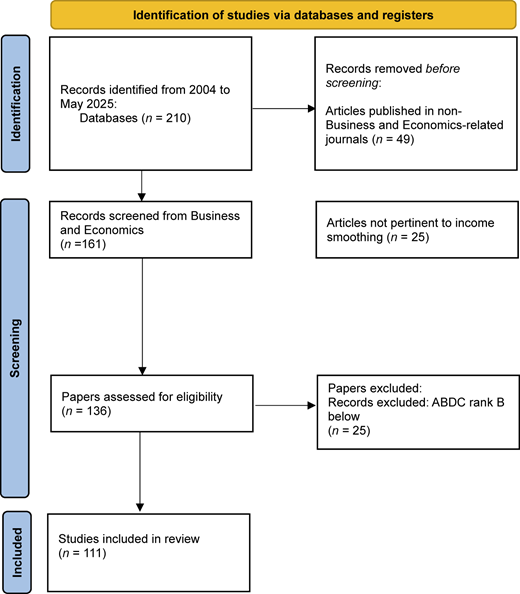
Our initial search returned a total of 210 records (identification). We then excluded 49 records published in non-business-related journals, resulting in 161 records pertinent to the fields of “Business Management” and “Finance and Economics” disciplines. We also excluded 25 articles that were not relevant to the “income smoothing” concept. To maintain the quality of the review, we primarily included journals listed on the 2022 Australian Business Deans Council (ABDC) rankings, Field of Research codes 3,501 (Accounting) and 3,502 (Finance) and 3,801 (Economics) [3]. We retained the articles published in the 2022 ABDC journal outlets ranked A*, A, and B (screening and eligibility phases of the PRISMA) and hence further excluded 25 articles published in below B-ranked journals. Finally, a total of 111 published studies are included in the review. Figure 1 shows the study selection process in detail following the PRISMA recommendations. Table 1 provides a breakdown of the publication outlets of the reviewed papers, including the ABDC journal rank.
We group the determinants into financial reporting standards, firm characteristics, governance, managerial characteristics, macro environment and other factors. The main objective of financial reporting standards is to enhance transparency, consistency, and comparability (FASB, 2010). In line with this objective, a stream of research has examined the impact of financial reporting standards on managerial income smoothing behavior, with most evidence suggesting that the implementation of such standards reduces income smoothing practices. Studies investigating firm-level characteristics report varied effects on income smoothing, while governance reforms and internal corporate governance mechanisms are generally found to constrain smoothing behavior. A substantial body of research has also explored the role of ownership structure, yielding mixed findings regarding its influence on earnings smoothing. In addition, informal institutional factors such as social trust, societal norms, and language orientation have been identified as important determinants of income smoothing. Our review further reveals that managerial characteristics, including ability, tenure, and gender, are associated with income smoothing practices. Finally, prior studies show that exogenous shocks, such as the global financial crisis and the implementation of new regulations, also shape managerial incentives to engage in income smoothing.
Research examining the consequences of income smoothing broadly considers the effects from both the capital market and credit market perspectives. The capital market consequences of income smoothing reveal that income smoothing improves earnings informativeness, lowers both equity and credit investors' perceived risk but increases future stock price crash risk. The credit market effect shows that income smoothing has a beneficial effect with respect to lowering the cost of debt capital.
Our review is important and timely within the broader context of accounting, finance, and corporate governance for understanding how income smoothing practices shape firm behavior and stakeholder responses. Our review supports the assertion by Dechow et al. (2010) concerning the challenges in measuring income smoothing. While existing measures effectively capture earnings volatility, they often fail to adequately disentangle the discretionary managerial component from underlying fundamental performance. As a result, controversy remains over whether income smoothing truly reflects earnings management and to what extent it is driven by discretion versus economic fundamentals. This review (Section 2.2) contributes to the ongoing debate by tracing the evolution of income smoothing measures and critically examining their effectiveness in capturing managerial intent.
The remainder of the paper proceeds as follows. We elaborate on the theoretical background and measurements of income smoothing in Section 2. In Section 3, we present the studies that investigate the possible determinants of income smoothing. Section 4 reviews the literature on the consequences of income smoothing. Section 5 discusses the opportunities for future research. Section 6 concludes the paper.
2. Theoretical overview and measurement of income smoothing
2.1 Theory of income smoothing
The objective of income smoothing is to reduce the amount of variation in periodic earnings over time. As long as managers retain discretion over accounting choices, they may engage in income smoothing, both in terms of reported earnings levels and the rate of earnings growth (Gordon, 1964). The discretion permitted by accounting policies introduces flexibility that allows managers to adjust reported earnings to produce a smoother income stream.
The literature presents two contrasting views on income smoothing. One perspective perceives it as an efficient communication of private information (Demski, 1998; Kirschenheiter and Melumad, 2002; Ronen and Sadan, 1981; Sankar and Subramanyam, 2001). For example, prior research has examined the effect of earnings smoothing on the contemporaneous association between stock returns and earnings (Subramanyam, 1996) or the association between current returns and future earnings (Tucker and Zarowin, 2006). This line of research concludes that earnings smoothing improves the informativeness of past and current earnings about future earnings and cash flows.
Prior analytical research explores the motivations behind managers' pervasive income smoothing. Trueman and Titman (1988) document that a manager may have an incentive to smooth the firm's reported income to maximize the present value of the cash flows accruing to the firm's risk-neutral shareholders. This incentive arises when the firm's future claimants, such as customers, employees, and suppliers, are adversely affected by earnings volatility. Demski (1998) documents that income smoothing can be seen as a means of signaling their acquired expertise. The key assumption is that a manager who works hard is better able to predict future earnings. The manager demonstrates his predictive powers, and hence his hard work, to the owner by smoothing earnings. Because earnings smoothing is an informative variable (the manager is better at it if he works than if he shirks), smoothing can reduce the cost of motivating the manager to work. In fact, the owner is better off allowing for earnings smoothing than if she could prevent it with a perfect and costless audit technology. When income smoothing is costly, it requires managers to accurately forecast future earnings (Demski, 1998; Trueman and Titman, 1988). This links smoothing behavior directly to managerial ability. Empirical research supports this view, suggesting that more capable managers are better at predicting earnings and cash flows, thereby engaging in more informative income smoothing (Baik et al., 2020; Demerjian et al., 2020a).
Related empirical evidence also shows that managers use income smoothing as a communication mechanism with various stakeholders. For instance, smoothing improves contracting efficiency between managers and debt holders by increasing the reliability of financial statements, thereby reducing the risk of technical default and facilitating access to debt financing (Demerjian et al., 2020b). Furthermore, Stakeholders, such as customers and suppliers, also reward smoother earnings with better terms of trade (Dou et al., 2013; Graham et al., 2005). However, when firms are able to convey information directly, managers have less incentive to engage in income smoothing. For example, Jung et al. (2025) suggest that when supplier firms maintain close relationships with major customers, they can communicate information more directly, thereby reducing the need to rely on income smoothing as a signaling mechanism.
An alternative perspective views income smoothing as an opportunistic managerial practice (Leuz et al., 2003; Jayaraman, 2008). Under this view, earnings smoothing obscures a firm's true economic performance, as managers may engage in such practices to achieve personal objectives, such as meeting bonus thresholds (Healy, 1985) or safeguarding their job security (DeFond and Park, 1997; Fudenberg and Tirole, 1995). By using discretionary accounting choices to artificially stabilize earnings, managers introduce noise into financial reports, increasing information opacity and making it more difficult for external stakeholders to assess the firm's actual operational performance. This lack of transparency enables managers to withhold bad news over extended periods (Jin and Myers, 2006; Leuz et al., 2003; Levitt, 1998). For example, income smoothing has been found to increase the likelihood of stock price crash risk, as suppressed bad news eventually accumulates and is released abruptly (Chen et al., 2017; Khurana et al., 2018). In this case, firms with smoother earnings paths are more likely to increase information asymmetry, which in turn leads to wider bid-ask spreads (Habib and Jiang, 2012). These findings indicate that income smoothing is not inherently informative and may be perceived as a signal of opportunistic behavior.
It is important to note that distinguishing opportunistic income smoothing from informative earnings smoothing is often challenging. As a result, when the literature investigates the opportunistic role of income smoothing, it typically focuses on the opportunistic component embedded within overall smoothing activities. Given the differential costs and benefits associated with smoothing, researchers have explored the conditions under which managers are more likely to have incentives to smooth reported earnings. For instance, Trueman and Titman (1988) suggest that the impact of earnings smoothing on credit quality may depend on the amount of information available to investors. Some studies focus on real earnings smoothing (Khurana et al., 2018), while others decompose income smoothing into informative and garbling components (Kuang, 2022). Moreover, research on opportunistic income smoothing is often conducted in specific institutional contexts, such as environments with weak investor protection (Cahan et al., 2008) or where firms operate under high environmental uncertainty (Habib et al., 2011). Empirical research reviewed in Sections 3 and 4 has used these two theoretical frameworks to develop their hypotheses.
2.2 Measures of income smoothing
Dechow et al. (2010, p. 362) note that, “[ …] cross-sectional variation in smoothness can result from variation in the smoothness of fundamental performance [ …] from variation in the ability of an accrual-based accounting system absent any choice to capture fundamental performance, or from variation in accounting choice. Moreover, the accounting choice can be motivated either to increase decision usefulness or to distort it. [Researchers need to] differentiat[e] inherent or fundamental smoothness from smoothness related to accounting choice, and differentiate informative choices from opportunistic choices …”.
Proxies like the correlation between the change in total accruals and the change in cash flow from operations (Bhattacharya et al., 2003) or the ratio of the standard deviation of net income to the standard deviation of cash flows from operations as a measure of smoothing (Francis et al., 2004; Jung et al., 2013; Leuz et al., 2003) do not take into account the motivation for accounting choices. Accruals-based earnings smoothing takes a step towards that direction by calculating smoothing as the correlation between the change in discretionary accruals proxies (ΔDap) and the change in pre-discretionary income (ΔPdi) over a rolling window period (Tucker and Zarowin, 2006). This method assumes that there is an underlying pre-managed income series and that managers use discretionary accruals to make the reported series smooth. Discretionary accruals are estimated using the Jones model modified by Kothari et al. (2005), as specified below:
where Acc is total accruals, Ppp is property, plant, and equipment, ΔSales is the change in sales, Roa is return on assets, and Assets is total assets. “Accruals” are earnings before extraordinary items and discontinued operations minus cash flows from continuing operations (i.e. total cash from operations minus cash portion of discontinued operations and extraordinary items) obtained directly from the statement of cash flows, following Hribar and Collins (2002).
The non-discretionary accruals (Ndap) are the fitted values of Regression (1) and the discretionary accruals (Dap) are the deviations of actual accruals from Ndap. The pre-discretionary income (Pdi) is calculated as net income minus discretionary accruals (Pdi = Ni – Dap). The income smoothing measure is the correlation between the change in discretionary accruals and the change in pre-discretionary income: Corr (ΔDap, ΔPdi), using the current year's and past four years' observations. Firms with a more negative correlation receive a higher income smoothing ranking.
Khurana et al. (2018) rely on the intuition of Tucker and Zarowin (2006) to operationalize real earnings smoothing. They assume that there is an underlying pre-managed earnings stream and that management smooths reported earnings via their discretion over real activities, such as adjusting production activities and altering expense occurrences. Specifically, Khurana et al. (2018) use the negative correlation between managed earnings ascribed to the alteration of discretionary expenses (production) and the pre-managed earnings to capture real earnings smoothing via managerial discretion over expenses (production). The managed earnings ascribed to the adjustment of discretionary expenses are defined based on abnormal discretionary expenses that are estimated from Roychowdhury's (2006) model below by industry-year using the ordinary least squares regression:
where Disexp is the discretionary expense, computed as the sum of (1) advertising expenses, (2) R&D expenses, and (3) selling, general, and administrative expenses; S is sales; and A is total assets. Abnormal discretionary expenses are calculated as the actual values minus the normal levels predicted from Equation (2). Khurana et al. (2018) multiply the abnormal discretionary expenses by minus one (−1) to generate the managed earnings attributed to discretionary expenses so that higher values correspond to greater income-increasing, real earnings management through expenses.
The managed earnings attributed to the adjustment of production are defined as abnormal production costs. Specifically, Roychowdhury (2006) estimates the following model for each industry-year:
where Prod is the sum of the cost of goods sold and change in inventory, ΔS is the change in sales, and other variables are defined as above. Abnormal production costs are calculated as the actual values minus the normal levels estimated from Equation (3). The pre-managed earnings are calculated as earnings minus the managed component of earnings attributed to the adjustment of discretionary expenses or production. Khurana et al. (2018) then calculate the correlation between the managed component of earnings attributed to discretionary expenses and the pre-managed earnings over the rolling five-year window ending in the current year.
Although these models are widely used in the existing literature, Black et al. (2022) caution that discretionary accruals suffer from well-known model specification errors in that accruals are often correlated with firm-specific factors like growth, risk, and performance. Furthermore, the authors address concerns raised by Dechow et al. (2010) about benchmark selection and estimation bias, noting that many smoothing measures based on abnormal accrual models or predicted smoothing tendencies suffer from measurement error and inflated type I error rates [4].
3. Determinants of income smoothing
Dechow et al. (2010, p. 361) ask “When managers have accounting choices that can influence smoothness, do they make choices that result in greater earnings smoothness?” Such studies are categorized as the determinants of smoothness but do not speak about the quality of earnings per se. We review the literature on the determinants of income smoothing in this Section. To enhance clarity and facilitate a robust discussion, we categorize the reviewed studies into the following themes: (3.1) financial reporting standards, (3.2) firm characteristics, (3.3) governance, (3.4) managerial characteristics, (3.5) macro environment and (3.6) other factors.
3.1 Financial reporting standards and income smoothing
This sub-section elaborates on the literature that examined the impact of financial reporting standards on managerial income smoothing behavior. Studies examined whether voluntary adoption of the International Financial Reporting Standards (IFRS) resulted in smoother earnings. Capkun et al. (2016) find that earnings smoothing increased across all IFRS adopters, namely early adopters, late adopters and mandatory adopters. They explain that the IFRS standards provide flexibility because of vague criteria, subjective estimates, and multiple accounting options, which are further worsened by the lack of clear guidance on how to implement these new standards. While Capkun et al. (2016) examined the overall adoption of IFRS, other studies investigated the impact of implementing specific standards on income smoothing. Drawing on information asymmetry theory, Athanasakou et al. (2007) find a significant increase in the use of classificatory smoothing post-FRS3 which is consistent with FRS3 granting managers greater discretion over the classification of exceptional items.
The mandatory adoption of International Accounting Standards (IAS) 39 Financial Instruments: Recognition and Measurement (IASB, 2004), reduces managerial discretion and limits the build-up of reserves by prohibiting the recognition of forward-looking information in loan loss provisioning. Under IAS 39, banks are required to recognize loan impairments only when there is objective evidence of loss occurring after the asset's initial recognition, effectively prohibiting provisions based on expected credit losses. This restricts the use of LLPs as a tool for earnings manipulation (Barth et al., 2008; Ewert and Wagenhofer, 2005). However, this incurred-loss model may exacerbate pro-cyclicality, as banks are compelled to record higher provisions during economic downturns (Wall and Koch, 2000). Empirical evidence supports these theoretical implications. Adzis et al. (2016) find that banks in Hong Kong engaged in less income smoothing following IAS 39 adoption, although they did not observe increased pro-cyclicality in LLPs. Similarly, Osma et al. (2019) report a decline in income smoothing among European banks post-IAS 39 adoption.
The Statement of Financial Accounting Standard No. 133 (SFAS 133) requires mandatory recognition and disclosure of derivative instruments and hedging activities. While the standard enhances transparency and visibility of derivative instruments (Ahmed et al., 2006), it has been criticized for the restrictions leading to higher earnings volatility (Choi et al., 2015; Sapra, 2002). Kilic et al. (2013) explain that banks that are more affected by SFAS 133 rely more on LLPs to smooth income because the mandatory recognition of hedge ineffectiveness under SFAS 133 reduces banks' ability to smooth income through derivatives. Tessema and Deumes (2018) further support that income smoothing through discretionary accruals increases after SFAS 133 adoption, particularly for firms with hedge ineffectiveness. Staff Accounting Bulletin 102 was introduced in 2001 by the Securities and Exchange Commission and other banking regulatory agencies to establish a systematic loan loss allowance methodology for heterogeneous loans. Regulatory changes introduced by the US FFIEC (2001) and jointly by the Securities and Exchange Commission (SEC) and US FFIEC (2001) altered income smoothing practices in U.S. banks [5]. Mamun et al. (2019) find that these reforms reduced the discretionary use of loan recoveries and provisions. Specifically, they report a weakened relationship between charge-offs and recoveries for homogeneous loans, but a strengthened relationship for heterogeneous loans post-regulation. The Basel II framework introduces more refined risk measurement standards, increasing the risk sensitivity and requiring greater capital requirements, placing corporate banks under greater regulatory pressure (Basel Committee, 2011). Lim and Yong (2017) find that during the Basel II period, banks with low capital exhibit more income smoothing than those with high capital, with managers delaying the recognition of LLPs. This pattern is not observed in the retail banking sector.
Ferracuti et al. (2025) examine whether earnings smoothing reflects managerial attempts to avoid undue pressures from outsiders who cannot correctly distinguish the impact of transitory shocks from sustainable trends in value creation. Specifically, when investors cannot differentiate between transitory and permanent fluctuations in earnings, managers become concerned that investors may take a temporary drop in profits as a sign of decline in long-term value creation. The opposite is also true. Using variation in firms' ability to hedge foreign currency exposure through derivatives, they find that firms are less likely to smooth earnings when they can better hedge against such currency fluctuations. These findings support the view that earnings smoothing can serve as a rational response to market misinterpretation [6].
The overarching objective of financial reporting standards such as IFRS, SFAS 133, IAS 39, and Basel II is to enhance the transparency and informativeness of financial statements. However, the extant literature presents inconclusive evidence on whether these standards effectively curtail opportunistic income smoothing practices and increase informativeness. While some studies highlight increased transparency and reduced managerial discretion, others find that the inherent flexibility and ambiguity of these standards may hinder the informativeness of earnings. Theoretically, this inconsistency reflects the tension between the signaling view, which suggests that regulatory reforms should reduce information asymmetry and improve financial reporting quality, and the opportunistic view, which posits that managers may exploit regulatory ambiguity to serve private interests.
3.2 Firm characteristics and income smoothing
A stream of studies investigated how firm-level characteristics such as firm size, profitability, customer concentration, and dividend policy impact income smoothing. There are mixed findings regarding the impact of firm size and profitability on income smoothing practices. Research highlights that smaller firms may be more likely to engage in income smoothing (Ozili, 2017a; Safdar and Yan, 2016; Silhan, 2014). For example, Safdar and Yan (2016) show that smaller firms experiencing more volatile economic activities tend to engage more aggressively in income smoothing practices. In contrast, larger firms are less likely to engage in income smoothing due to increased scrutiny and political visibility (Rusmin et al., 2012). Evidence on profitability as a determinant of income smoothing is also mixed. Abou El Sood (2012) finds that bank holding companies are more likely to smooth income when they are more profitable, suggesting that strong financial performance provides greater discretion for earnings management. In contrast, Silhan (2014) finds that less profitable firms tend to smooth earnings more, possibly to conceal underperformance or reduce stakeholder concern. These contrasting findings reflect the political cost hypothesis, which posits that larger firms are subject to greater public and regulatory scrutiny and therefore have incentives to limit opportunistic income smoothing to avoid attracting unwanted attention or intervention. Monjed and Ibrahim (2020) show that higher financial and operational risks, measured by leverage, solvency, and cash flow volatility, are positively associated with income smoothing behavior.
Prior research finds that the extent of customer concentration is a factor that managers consider in making income smoothing decisions. Jung et al. (2025) find a negative association between customer concentration and income smoothing. This finding suggests that when supplier firms have close relationships with major customers, they can convey more information directly, reducing the need to use income smoothing as a signaling mechanism. Hartlieb and Roy (2022) report that increased cost stickiness reduces the extent of income smoothing, particularly in firms with high adjustment costs and during periods of high economic growth. By contrast, using wrongful discharge laws as an instrumented variable for cost stickiness, Filip et al. (2025) find that cost stickiness encourages income-smoothing behaviors, especially in firms more sensitive to labor costs and those with stronger incentives to provide information. Collectively, these findings underscore that the decision to engage in income smoothing is further shaped by firms' customer base and cost structures.
While firm characteristics such as profitability and customer concentration may reduce the need for income smoothing by providing alternative channels of information, financial policy decisions such as dividend payouts and share repurchases often motivate managers to engage in income smoothing as a signaling device aimed at capital markets and labor markets. Liu and Espahbodi (2014) find that dividend-paying firms are more likely to smooth earnings compared to non-dividend payers, to sustain stable dividend policies. Similarly, Di and Marciukaityte (2015) report that firms experiencing temporary increases in operating cash flows tend to use negative discretionary accruals to smooth earnings before share buybacks. This strategy is employed to enhance the consistency and predictability of reported earnings, thereby signaling stability to investors. In addition to the signaling tool that is used to communicate to the capital markets, managers use income smoothing as a signaling mechanism to the labor markets. Jung et al. (2024) find that firms with greater dependence on skilled labor are more likely to engage in earnings smoothing as a means of reducing employee turnover and facilitating workforce stability, particularly during periods of performance volatility. Sun and Zhang (2023) find that short-selling prospect is negatively associated with one-year-ahead earnings smoothing, suggesting that short-selling interest acts as a disciplining mechanism. Additional analysis reveals that short sale prospect, by curbing income smoothing, reduces future stock price crash risk.
In the banking sector, income smoothing practices are shaped by a range of institutional and financial factors. While securitization offers banks immediate liquidity and risk dispersion, it also introduces agency problems such as adverse selection and moral hazard, weakening loan screening incentives (Keys et al., 2010; Wang and Xia, 2014). Kilic et al. (2021) find that banks with higher levels of securitization engage more actively in income smoothing through LLPs, potentially supporting the informative view of income smoothing. Listing status and market pressures also influence smoothing behavior in the banks (Ozili, 2017b). From a business model perspective, Di Fabio (2019) finds that retail-funded European banks smooth income more than market-oriented or diversified-retail banks, with higher earnings quality supporting the argument that income smoothing can enhance earnings informativeness. Firm-level financial risks also play a role. Ozili and Outa (2018) report that South African banks are less likely to smooth income when facing under-capitalization, high levels of non-performing loans, or moderate ownership concentration. Peterson and Arun (2018) examine the differential use of income smoothing via LLPs between European global systemically important banks (G-SIBs) and non-G-SIBs. Their results show that G-SIBs smooth income more aggressively in the post-2008 crisis period, whereas non-G-SIBs exhibited stronger smoothing behavior before the 2008 financial crisis period. One possible explanation for this shift lies in the alignment between systemic banks and broader financial stability objectives [7].
Compared with the central state, local governments face stricter constraints on revenue, expenditure and debt (Oates, 1999). To circumvent these limits, they often shift spending and borrowing to municipally owned companies (MOCs), thereby avoiding statutory debt restrictions (Grossi and Thomasson, 2011). Using Polish data, Białek-Jaworska et al. (2025) show that MOCs leverage their borrowing capacity to provide off-budget financing for local governments. This role encourages them to smooth earnings more than private firms, as stable performance helps meet debt covenants, enhance credit ratings and reduce financing costs [8].
3.3 Governance and income smoothing
Separation of ownership and control paves way for managers to engage in opportunistic behavior at the expense of the shareholders' interests but effective governance mechanisms constrain these adverse consequences (Jensen and Meckling, 1976). In view of this disciplining mechanism through internal and external governance, Fonseca and Gonzalez (2008) find that investor protection, legal enforcement and supervision affect managerial income smoothing behavior using evidence from listed and unlisted banks across forty countries. Ibrahim et al. (2020) investigate the impact of corporate governance reforms on firms' use of artificial and real income smoothing in the Egyptian context and find that managers are more inclined to engage in real income smoothing than in accrual-based smoothing. In addition to the board structure, research also examined the relationship between co-CEO structure and income smoothing. Although co-CEO structures are theoretically expected to provide internal checks and balances through mutual monitoring and decision-making diversity (Baik et al., 2020; Choi et al., 2018), recent evidence (Demerjian et al., 2020a; Lee and Shin, 2025) suggests that such arrangements may also facilitate opportunistic behavior in financial reporting. Lee and Shin (2025) find that firms with a co-CEO structure exhibit smoother earnings than those led by a sole chief executive officer (CEO).
CEO contractual incentives, such as insider debt holding and cash bonuses, may determine the extent of income smoothing. CEO equity ownership and bonus are intended to align managers' interests with those of shareholders to reduce agency problems (Jensen and Meckling, 1976). Prior research shows that higher inside debt holdings, CEO cash bonuses, and options encourage CEOs to take calculated risks (Edmans and Liu, 2011; Wei and Yermack, 2011). Shu (2021) provides empirical evidence supporting the argument that CEOs with lower inside debt smooth earnings to conceal firms’ underlying economic performance [9]. Consistent with the interest alignment view, Shu and Thomas (2019) report that CEO's holding of stock increases the correlation between past smoothing and the predictability of future earnings. However, the study finds that CEO's holding of options exhibits a contrasting impact. In the context of income smoothing, managers are likely to dampen earnings volatility to signal smoothed income to secure their contractual benefits. Supporting this opportunistic view, Tessema (2018) finds that earnings smoothing and CEO cash bonuses are positively related. Similarly, Grant et al. (2009) report that CEO risk-taking incentives, measured by the sensitivity of stock options to volatility and stock price, are positively related to income-smoothing measures. Eckles et al. (2011) reveal that managers who receive higher bonuses and stock awards are more likely to make reserving decisions that reduce firm earnings. These findings highlight that CEO structures and incentives can both inform and distort earnings. While some mechanisms such as equity ownership and remuneration disclosures can enhance informativeness by aligning interests, others may enable opportunistic smoothing that reduces earnings transparency. This mixed evidence suggests that governance mechanisms are not uniformly effective.
Institutional ownership is considered as an external governance mechanism that determines managerial financial reporting behavior. Institutional investors' investment horizon, nature and ownership stake play a role in determining their governance effectiveness (Chang and Hong, 2000; Chen et al., 2007; Yan and Zhang, 2009). In line with these assertions, Cho et al. (2019) contend that domestic institutional investors in the Korean market with short-term investment objectives encourage firm management to engage in earnings smoothing. Kwak et al. (2009) analyze Japanese banks and find that domestic financial and affiliated institutional owners lead to higher income smoothing through LLPs. In contrast, foreign institutional owners are likely to constrain managerial opportunistic behavior around financial reporting by engaging in effective monitoring mechanisms (Aggarwal et al., 2011). Using evidence from the banking sector in emerging economies (i.e. Africa), Pinto et al. (2020) find that managers' income smoothing activities are less pronounced when there is higher foreign ownership. Similar evidence is revealed by Ozili and Arun (2023).
Although institutional ownership constrains income smoothing, their monitoring effectiveness can also result in higher income smoothing that signals inside information to the capital markets, supporting the informativeness view (Jung et al., 2020). David et al. (2022) report that the exit threat of foreign non-blockholders’ whose ownership of less than 5% is positively linked to income smoothing. Furthermore, Wu et al. (2015) find that foreign strategic investors increase earnings smoothing in Chinese local banks, and they attribute this effect to the safety and soundness channel. Skała (2021) also reports that amongst a sample of Central European banks, foreign-owned banks use LLPs to perform discretionary income smoothing, while state-owned banks do not smooth income. Similar results are reported for Australian firms regarding the positive association between institutional ownership and the likelihood of firms smoothing earnings towards their earnings trend (Koh, 2005). Within the Taiwan setting, Chen et al. (2020) report that high institutional ownership diminishes the informativeness of earnings in firms that engage in income smoothing. This effect is more pronounced when ownership is held by qualified foreign institutional investors rather than local ones. Institutional ownership influences income smoothing in both constraining and enabling ways, with its effectiveness as a governance mechanism depending on ownership type, investment horizon, and monitoring intent, reflecting the dual role of income smoothing as either informative or opportunistic.
Prior research also examined the impact of ownership concentration on income smoothing. Higher ownership concentration can have a negative effect as larger owners can use the control of the firms for private benefits, consistent with the entrenchment hypothesis (Claessens et al., 2002; Jensen and Meckling, 1976). Supporting this entrenchment effect of ownership concentration, Bouvatier et al. (2014) report that concentrated shareholding and control structures are positively related to the intensity of smoothed earnings in Europe. In contrast, on a cross-country sample, Tinaikar (2017) finds evidence that when the levels of private control benefits are low, firms exhibit lower levels of earnings smoothing. Doan et al. (2020) report that banks with more state-controlled shareholders located in developing countries tend to have more incentives to smooth income.
Family ownership is another factor that determines the managerial income smoothing behavior. In family-controlled firms, the agency conflict between owners and managers is reduced as the controlling family closely monitors management and often holds top executive positions (Villalonga and Amit, 2006). Moreover, the stewardship perspective suggests that controlling families are highly committed to the interests of the organization and its stakeholders (Davis et al., 1997; Donaldson and Davis, 1991) because their financial well-being, personal fulfillment, and reputation are closely tied to the firm (Bubolz, 2001). Empirical evidence supports that family-controlled companies are less likely to engage in income smoothing (Prencipe et al., 2011). Dual stakeholders, where shareholders own equity and debt, provide a unique setting to investigate managerial reporting behavior such as income smoothing. Both Type I and Type II agency problems can be addressed in a dual shareholder setting (Armstrong et al., 2010). Bigus and Häfele (2018) find that German private firms with shareholders who are both equity holders and creditors engage in significantly low levels of earnings smoothing. Furthermore, stable shareholding with long-term investment horizons can mitigate myopic behavior and incentivize managers to pursue long-term stable earnings (Jacobson and Aaker, 1993). This view finds support in the Japanese setting, where firms conduct earnings smoothing that provides useful information when stable shareholdings increase (Shuto and Iwasaki, 2014).
Another important governance-related determinant for smoothing is the presence of firm-level political connections and the associated political risks. These factors influence managerial incentives, stakeholder expectations, and strategic financial reporting decisions. Rooted in the political cost hypothesis, prior research suggests that managers engage in accounting choices to minimize wealth transfers in the political process (Watts and Zimmerman, 1978, 1986). Consequently, firms facing higher political risk may have stronger incentives to engage in income smoothing. Supporting this view, Jung and Yang (2024) find a positive association between political risk and income smoothing, suggesting that managers use smoothing to reduce earnings variability and mitigate stakeholder scrutiny. Similarly, Pappas et al. (2024) associate government subsidization with greater political costs and find that subsidized firms engage in more aggressive income smoothing than their non-subsidized counterparts. In addition to the political cost hypothesis, another stream of research views political connections as a source of advantage, offering firms access to lower financing costs and increased chances of government support (Boubakri et al., 2012). In line with this perspective, Tee (2020) finds that politically connected firms engage in more income smoothing than their non-connected counterparts, partly driven by domestic institutional investors who perceive smoothing as a way to convey private information. Jung (2024) finds that politically connected firms engage in more income smoothing, particularly when facing higher expected political costs [10]. In sum, the above research provides evidence to support the political cost incentive of managers when engaging in income smoothing behavior.
Labor unions, in certain circumstances, act as governance mechanisms in the sense that they monitor managerial behavior on behalf of the workforce. Employees with salary-based compensation may perceive earnings volatility as an indicator of heightened bankruptcy risk, prompting them to demand higher wages, enhanced benefits, and improved working conditions (Agrawal and Matsa, 2013). Consequently, managers have an incentive to present more stable earnings (i.e. reduced volatility) to mitigate wage-related demands from unions seeking risk compensation. Hamm et al. (2018) provide empirical evidence that the presence of strong labor unions is positively and significantly associated with income smoothing. This finding is substantiated by Shin and Park (2022) with evidence from South Korea. However, these findings are only significant in non-chaebol firms. Authors argue that Chaebol-affiliated firms have internal capital markets that reduce cash flow volatility, decreasing managers' incentives to smooth earnings via R&D adjustments in response to labor unions. These results support the notion that unions amplify managerial incentives to engage in income smoothing as a strategic tool to contain wage pressures, supporting the information view of income smoothing.
3.4 Managerial characteristics and income smoothing
A few studies that we reviewed examined whether managerial ability affects income smoothing. To engage in income smoothing, managers must have insight into the firm's future economic prospects, enabling more accurate earnings forecasting [11]. Building on these insights, Baik et al. (2020) posit that more capable managers can forecast earnings more accurately, leading to informative income smoothing and find that managerial ability enhances income smoothing and improves the prediction of future cash flows. Similarly, Demerjian et al. (2020a) find that high-ability managers engage in income smoothing when firms are near debt covenant violation thresholds and when managers are younger. Extending the concept of able managers' income smoothing strategies to the M&A setting, Doukas and Zhang (2020) find that acquiring firms engage in higher levels of earnings smoothing before M&A announcements compared to target firms.
The career concerns hypothesis suggests that long-tenured CEOs are less concerned about their career prospects (Thomas and Simerly, 1994), prioritize long-term objectives, and tend to use their authority to influence accounting results or reported earnings (Ghosh and Moon, 2005). Aligning with this view, Nurakhmet and Park (2024) report that firms led by CEOs with longer tenures tend to engage in more informative income smoothing. Literature establishes that managerial optimism affects a wide range of corporate and individual decisions, leading to overly optimistic earnings forecasts (Hribar and Yang, 2016) and misstated earnings (Schrand and Zechman, 2012). Bouwman (2014) extends this strand of research and reports that optimistic managers smooth earnings more than rational managers. Bae et al. (2025) find that firms with female CFOs engage in less income smoothing for a sample of Chinese listed firms. Additionally, the negative relationship between female CFOs and income smoothing is more pronounced in firms with lower financial leverage. Although the authors do not empirically investigate the underlying mechanisms behind this relationship, they suggest that female CFOs with higher risk-aversion and ethical sensitivity may engage in less income smoothing. In conclusion, these studies support the view that managerial characteristics influence income smoothing behavior.
3.5 Macro environment and income smoothing
Evidence exists to suggest that income smoothing behavior is affected by broader macro-environmental conditions. Exogenous shocks, such as the 2008 global financial crisis, have been shown to be associated with firms' income smoothing patterns. During the crisis, firms shifted their focus from long-term planning to short-term survival, which increased the incentive to manage earnings opportunistically (Bowman, 1982). Chen et al. (2020) find that the informativeness of smoothed earnings declined during this period, as firms frontloaded future income to mitigate immediate financial distress. In the banking sector, income smoothing through LLPs persisted, though at varying intensities. Greek banks continued smoothing practices during the crisis, albeit to a lesser extent than in pre-crisis periods (Aggelopoulos et al., 2024), while African banks increased LLP-based smoothing post-crisis, especially where investor protection mechanisms were weaker (Ozili, 2019). Similarly, Rusmin et al. (2012) show that transportation firms engaged in intertemporal earnings deflation during periods of economic stress to manage future expectations, whereas Abou El Sood (2012) finds that banks continued smoothing even in non-recessionary periods, indicating that macroeconomic conditions are just one of several contributing factors.
Government guarantees represent another macro-level force that can influence income smoothing behavior by reducing perceived downside risk. These guarantees can lower investor scrutiny and shift the monitoring burden to regulators, potentially enabling riskier financial strategies (Duchin and Sosyura, 2014; Gropp et al., 2014). However, Dantas et al. (2023) report that government guarantees essentially reduce income smoothing in European banks, while their removal increases the use of LLPs for earnings management, highlighting the dual role of guarantees in dampening smoothing incentives but also in weakening market discipline. The labor economics literature posits that unemployment risk is costly to firms because employees who are concerned about the adverse effects of unemployment require firms to provide a wage premium for this risk exposure. To mitigate these costs, managers have incentives to engage in income smoothing to make their firms appear less risky to current and prospective employees. Using exogenous variations in the U.S. unemployment insurance benefits, Ng et al. (2019) find that more generous state unemployment insurance benefits result in less income smoothing by firms.
The role of regulators and supervisory authorities is similarly complex. Regulatory bodies focused on financial stability may implicitly encourage income smoothing to align reported performance with supervisory expectations (Gaston and Song, 2014). LLPs are often seen as a regulatory tool to retain earnings, reduce cyclicality, and address moral hazard (Beatty et al., 1995). Di Fabio et al. (2021) provide evidence that stricter prudential regulation increases smoothing, but only in jurisdictions with robust accounting enforcement and limited market discipline. This highlights the interdependence between regulation, enforcement quality, and managerial discretion in financial reporting. Legal institutions and enforcement quality further shape the extent and purpose of income smoothing. Strong legal systems enhance transparency and accountability, reducing the need for managerial obfuscation. Zhang and Zhang (2018) show that the enforcement of insider trading laws significantly decreases earnings smoothing, especially in countries with persistent enforcement and severe penalties. Dou et al. (2013) similarly find that firms in countries with weak contract enforcement are more likely to smooth earnings as a signal of long-term commitment, particularly in relationship-intensive industries. Drawing evidence from an international trade perspective, Biswas et al. (2024) find that global trade policies also affect managerial income smoothing practices. Macro-level forces such as exogenous shocks, regulatory frameworks, the extent of legal enforcement, and government guarantees shape income smoothing behavior in complex and often contradictory ways, making it difficult to determine whether such practices serve informative or opportunistic purposes.
3.6 Other factors and income smoothing
Societal trust reflects the generalized trust individuals have toward unknown members of their broader community (Gambetta, 1988). Higher levels of societal trust can influence the extent to which investors rely on reported earnings, as they may perceive financial disclosures as more credible in high-trust environments. Kim et al. (2025) find that firms domiciled in more trusting countries are less likely to use income smoothing, suggesting that societal trust reduces the demand of investors for managers to signal private information and consequently, managers reduce the use of income smoothing as a response to this reduced demand. The perception of the future varies depending on whether a language requires speakers to grammatically mark future events, known as obligatory future time reference (Whorf, 2012). For weak future time reference languages, both the present and the future are in the same conceptual category, making the future feel closer and increasing speakers' psychological concern for it (Dahl, 2000). Speakers of weak future time reference languages tend to prioritize future-oriented benefits, such as savings, retirement wealth, and long-term health (Chen, 2013b). Cao et al. (2024a) find that firms in countries with weak future time reference languages engage in greater earnings smoothing, which enhances earnings informativeness. The findings support the theoretical view that weak future time reference speakers have more ambiguous perceptions and beliefs about future timing.
China, as the world's largest carbon emitter, introduced its Emission Trading Scheme pilot program in 2013, requiring firms to comply with environmental regulations while maintaining economic performance. To meet these requirements, firms invest in costly green technologies and innovation (Guo and Zhang, 2023) and purchase emission allowances, incurring direct compliance costs before transitioning to low-pollution operations. Cao et al. (2024b) find that ETS-regulated firms engage in income smoothing, reinforcing the argument that managers use income smoothing to reduce perceived risk and secure favorable financing terms (Francis et al., 2004; Ni et al., 2022). Prior research demonstrates that firms engage in earnings smoothing to maintain supply chain relationships (e.g. Dou et al., 2013). Chen et al. (2019) argue that the income-smoothing behavior of socially responsible companies depends on how their supply chain partners approach corporate social responsibility (CSR). Specifically, CSR firms with greater supply chain dependence exhibit lower levels of income smoothing, indicating that the CSR-income smoothing trade-off is conditional on supply chain dependence levels.
Recent evidence highlights the role of local social norms in shaping managerial financial reporting decisions. For example, firms headquartered in more religious U.S. counties are found to engage in higher levels of income smoothing, suggesting that religiously influenced risk aversion may drive managers to reduce earnings volatility rather than abstain from smoothing for ethical reasons (James et al., 2025). These studies that we reviewed underscore the importance of contextual and behavioral influences, such as societal trust, language structure, environmental regulation, and religious norms, on income smoothing practices. Collectively, they suggest that managers' smoothing decisions are shaped not only by firm-level incentives but also by broader cultural, institutional, and regulatory environments, often in ways that support the informative role of income smoothing. Table 2 summarizes the key findings of the papers surveyed in this section.
4. Consequences of income smoothing
In this section, we review the empirical literature on the consequences of income smoothing categorizing them into equity market consequences (Section 4.1), credit market consequences (Section 4.2), and other consequences (Section 4.3).
4.1 Income smoothing and equity market consequences
The findings of the consequences of income smoothing, i.e. the relation between income smoothing and decision outcomes such as stock market reaction, should be useful to address the informativeness of income smoothing. However, evidence from the empirical literature on the consequences of income smoothing is inconclusive. On one hand, a body of literature emphasizes the informative role of income smoothing, which is argued to benefit investors. Under this view, managers use income smoothing to communicate private information about firms' future cash flows (Tucker and Zarowin, 2006). On the other hand, the managerial opportunism view suggests that earnings smoothing can obfuscate the actual underlying performance of firms and thus reflects the opportunistic behavior of managers (Bhattacharya et al., 2003; Khurana et al., 2018).
Tucker and Zarowin (2006) conclude that smoothness improves earnings informativeness. They also conclude that the net smoothing effect of accrual accounting enhances earnings informativeness. Specifically, although accruals have the potential to distort earnings if applied opportunistically, their findings support the notion that accrual accounting helps reduce noise and enhance informativeness. Further corroborating the informational value of smoothing, Chen (2013a) documents that firms engaging in higher income smoothing exhibit higher earnings announcement returns, and lower implied cost of equity or lower expected earnings. Importantly, Chen (2013a) demonstrates that income smoothing tends to reduce firms' information uncertainty, as evidenced by decreased stock return volatility, narrower analyst earnings forecast dispersion, and lower analyst earnings forecast errors. These findings reinforce the notion that income smoothing serves as an effective mechanism for reducing information asymmetry and improving the information environment of the firm.
Extending the research by Tucker and Zarowin (2006), subsequent studies demonstrate that the informativeness of income smoothing varies across different contexts. For example, Sun (2011) finds that income smoothing enhances earnings informativeness more significantly in firms with high analyst coverage compared to those with low coverage, suggesting that analysts play an important intermediary role in enhancing the informativeness of income smoothing. Habib et al. (2011) document that current stock price incorporates more information about future earnings for firms operating in high-uncertainty environments, thus supporting the informational value view of income smoothing [12]. This occurs because environmental uncertainty accentuates the information asymmetry between its managers and outside stakeholders. Consequently, managers operating in an environment with high uncertainty, therefore, have an incentive to reduce such variability by smoothing income numbers. Yang and Zhu (2014) find that stock returns are generally positively associated with earnings smoothing, supporting the informative view of income smoothing. Cahan et al. (2008) document that earnings smoothing becomes more (less) informative in countries with strong (weak) investor protection, thereby suggesting that managers in weak (strong) investor protection countries are more likely to use income smoothing for opportunistic (signaling) reasons.
In contrast to the view that income smoothing is linked to firm stock returns, McInnis (2010) finds no relation between earnings smoothness and average stock returns. In other words, owners of firms with volatile earnings are not compensated with higher returns, as one would expect if volatile earnings lead to greater risk exposure. McInnis (2010) further shows that the negative association between income smoothing and the cost of equity capital is driven primarily by optimism in analysts' long-term earnings forecasts. This optimism yields target prices and implied cost of capital estimates that are systematically too high for firms with volatile earnings. Mayberry et al. (2015) find that smoothness reduces the value relevance of taxable income. Their results show that firms exhibiting higher levels of taxable income smoothness, particularly those engaging in discretionary smoothing, experience a substantial decline in value relevance [13]. Furthermore, the authors find that discretionary smoothing is positively associated with higher levels of future tax avoidance, suggesting that managers may smooth taxable income not only to influence investor perceptions but also as part of a broader tax avoidance strategy.
Literature also examines how income smoothing is associated with information asymmetry under certain circumstances, such as managerial incentives and diversification (Habib and Jiang, 2012; Yu et al., 2018). Using data from New Zealand, Habib and Jiang (2012) find that managerial ownership-induced discretionary smoothing is positively associated with bid-ask spreads, indicating that markets perceive this form of smoothing as increasing rather than reducing information asymmetry. Yu et al. (2018) find that investors have difficulty seeing through opportunistic income smoothing before the unexpected loss announcements. When a smoothing firm reports a smoothed stream of earnings in the past, but has to report an unexpected loss in the current quarter, investors are surprised by the breaking of the historical income smoothing pattern, leading to a significant increase in bid-ask spreads around unexpected loss announcements.
A stream of literature examines how income smoothing affects investors' perceptions of firm risk. Using US public firms, Kim et al. (2021) find that real earnings smoothing [14] lowers both equity and credit investors' perceived risk. While this finding suggests that income smoothing can serve as a risk-reducing signal, Kim et al. (2021) further suggest that real earnings smoothing may mislead investors. In specific, they find that firms engaging in real earnings smoothing tend to have higher realized volatility than implied volatility, suggesting that real earnings smoothing operates as a form of artificial smoothing that conceals underlying risk.
Some studies have shown that income smoothing is associated with stock price crash risk (Chen et al., 2017; Khurana et al., 2018; Kuang, 2022; Zhong et al., 2021). The literature defines crash risk as related to negative skewness in the distribution of returns for individual stocks (Chen et al., 2001; Kim et al., 2014; Callen and Fang, 2015). Since crash risk captures higher moments of the stock return distribution, i.e. extreme negative returns, it has important implications for portfolio theories and asset and option-pricing models (Kim and Zhang, 2016).
Using US data, Chen et al. (2017) and Khurana et al. (2018) report a positive association between income smoothing and crash risk, supporting the view that income smoothing reflects managerial opportunism in financial reporting rather than the private information signaling view. Chen et al. (2017) also show that the impact of earnings smoothing on price crash risk is stronger among firms more likely to conceal information through earnings smoothing, providing evidence that managers tend to use smoothing to hide bad news. Khurana et al. (2018) shift their focus to real earnings smoothing and document a positive association between real earnings smoothing and one-year-ahead stock price crash risk. Khurana et al. (2018) identify overinvestment and resource diversion as key mechanisms through which real earnings smoothing contributes to crash risk. Kuang (2022) investigates the association between real earnings smoothing and stock price crash risk in the Japanese setting. Kuang (2022) decomposes real earnings smoothing into garbling and informative components, thereby distinguishing artificial smoothness from informative smoothness more effectively. The study reveals a positive association between the garbled component of real earnings smoothing and crash risk, attributable to management's concealment of bad news about a firm's prospects. However, no significant relationship is found between informative earnings smoothing and crash risk.
The adverse consequences of opportunistic earnings smoothing are also found in the Chinese setting. Zhong et al. (2021) investigate the relationship between discretionary income smoothing and stock price crash risk. Building on the model proposed by Lang et al. (2012), Zhong et al. (2021) decompose income smoothing into expected and discretionary components, focusing on how the discretionary portion–representing the opportunistic aspect of income smoothing—affects crash risk. While Chen et al. (2017) find a positive association between overall income smoothing and stock price crash risk, Zhong et al. (2021) find that general income smoothing has no significant effect on crash risk, whereas discretionary income smoothing significantly increases crash risk. This suggests that the opportunistic use of income smoothing, rather than income smoothing itself, is the key driver of stock price crashes.
Income smoothing, which is a form of earnings management (Dechow and Skinner, 2000), can also improve or impair the quality of earnings and therefore firm value (Beaver, 2002). Building on this idea, Bao and Bao (2004) document that merely reducing earnings variability does not guarantee higher firm values for firms that practice income smoothing (i.e. income smoothers). Instead, the earnings of smoothing firms become more value-relevant only when those earnings are of high quality. They also find that smoothing firms with quality earnings have the highest price-earnings multiple, while non-smoothing firms with low quality earnings have the lowest price-earnings multiple.
In contrast, Dyussembina et al. (2024) find a negative association between income smoothing and firm value in Korea, suggesting that income smoothing increases uncertainty about firms' earnings and thus negatively influences firm value. However, they find that this negative association is stronger for firms with high foreign ownership than for those with low foreign ownership. These results suggest a value-enhancing effect of foreign ownership, which positively moderates the relationship between income smoothing and firm value.
A smooth income stream can be achieved through “artificial smoothing” (e.g. abnormal accruals)” or “real earnings smoothing” (e.g. derivatives)”, with the former characterized by greater managerial discretion and thus more vulnerable to opportunistic manipulation, while the latter relies on real transactions aimed at reducing economic volatility. Asymmetric information is an important phenomenon underlying the choice of artificial and real income smoothing devices. While managers can engage in real smoothing to reduce agency costs, they are likely to use artificial techniques to cosmetically improve income to extract their private benefits. Huang et al. (2009) highlight that artificial and real income smoothing exert distinct effects on firm value. Specifically, they find that firm value decreases with the magnitude of abnormal accruals and increases with the level of derivative use. In further support of agency theories, they report that poor corporate governance motivates the use of abnormal accruals and discourages derivative use.
Ngo and Varela (2012) provide novel evidence on the positive association between earnings smoothing and firm value in the context of seasoned equity offerings (SEOs). Consistent with risk management and signaling theories, they find that income smoothing through discretionary accruals enhances firm value by reducing SEO underpricing. Specifically, firms with a sustained history of smooth earnings before SEOs exhibit significantly superior stock performance and operating outcomes for at least three years following the offerings. The authors argue that sustained earnings through smoothing serve as a credible signal of firm quality, as maintaining smooth earnings over an extended period is more costly for lower-quality firms, thereby increasing the informativeness of such behavior.
4.2 Income smoothing and credit market consequences
While much of the literature examines the impact of income smoothing on equity markets, a stream of literature investigates its effects on the credit market (Allayannis and Simko, 2022; Amiram and Owens, 2018; Demerjian et al., 2020b; Li and Richie, 2016).
Li and Richie (2016) examine whether smoothing affects the cost of public debt in the US bond market. They document a negative association between earnings smoothing and bond yield and accordingly conclude that the information signaling view of smoothing, rather than the garbling perspective of smoothing dominates the public credit markets. The negative association between income smoothing and the cost of debt is stronger in firms with more opaque information, where signaling provides greater value.
However, given institutional differences across markets, the relationship between income smoothing and the cost of debt may be conditional on the country-specific institutional environment. For example, in certain markets, the garbling effect of income smoothing may dominate, leading creditors to interpret smoothing as a signal of managerial opportunism. Expanding on this idea, Amiram and Owens (2018) take advantage of an international setting to examine how variation in the contracting environment affects the relationship between income smoothing and the cost of debt in the private loan market. They document that income smoothing is associated with lower (higher) cost of debt in countries characterized by low (high) threat of private benefits consumption. They also find that the effects of smoothing on the cost of debt are particularly pronounced for firms with relatively high credit risk, consistent with the intuition that lenders would be particularly concerned about the implications of smoothing for expected credit loss in cases where it is more likely that borrowers will default.
Using a sample of 100 listed firms from the UK and 100 from Nigeria, Aboud et al. (2023) find that income smoothing is observed to be more prevalent among Nigerian firms than UK firms. However, despite the cross-country differences in the extent of income smoothing, the study finds no statistically significant association between income smoothing and the cost of debt across the two countries. The authors suggest that this insignificant relationship is consistent with the findings of Amiram and Owens (2018). Nevertheless, the paper does not clearly explain the underlying reasons for the observed differences in income smoothing between the two countries, nor does it offer a detailed account of why income smoothing appears unrelated to the cost of debt. Future research is needed to further investigate the motivations for income smoothing in both the UK and Nigerian contexts.
While Amiram and Owens (2018) identify private benefits consumption threat as the feature of the contracting environment that empirically reveals a sign reversal in the relationship between smoothing and cost of debt, Allayannis and Simko (2022) emphasize the importance of information environment in shaping the association between income smoothing and credit quality as well as firm value. Specifically, Allayannis and Simko (2022) document that firms with higher discretionary income smoothing exhibit a lower cost of debt, and that association is more pronounced for firms with a weak information environment. This is because, in less transparent settings, managers' ability to smooth earnings and obscure volatile cash flows can make the firm appear more stable to investors, thereby reducing perceived risk.
Using a sample of private debt contracts from 1996 to 2017, Demerjian et al. (2020b) explore whether income smoothing enhances the usefulness of earnings in the context of debt contracting. In specific, they document that debt contracts to borrowers with greater levels of income smoothing are more likely to include earnings-based covenants in contracts because earnings smoothing improves the ability of earnings to reflect the borrower's credit risk, making earnings more useful for debt contracting purposes. To assess monitoring effectiveness, the authors also document that income smoothing is associated with a reduced likelihood of Type I errors, without an accompanying increase in the likelihood of Type II errors. These findings suggest that income smoothing can be a channel through which private information is integrated into reported financial and thus improves the usefulness of earnings for monitoring the borrower.
Demerjian et al. (2020b) show that income smoothing enhances the usefulness of earnings for lender monitoring in non-financial firms. Extending this to the banking sector, Narayanamoorthy and Wheeler (2025) develop a bank-specific measure of discretionary smoothing building on the broader literature on non-bank smoothing. Using a sample of US banks from 1994 to 2019, they examine the relationship between discretionary smoothing and the informativeness of LLPs. They find that banks with higher discretionary smoothing record LLPs that better predict future charge-offs and changes in nonperforming loans. These banks' stock returns also reflect more forward-looking information, and analyst forecasts of LLPs are more informative. Importantly, the effect is stronger following the SEC's intervention in 2001 (FFIEC guidance), especially among banks with more homogeneous loan portfolios. Overall, the findings suggest that, in a well-regulated environment, income smoothing can improve bank transparency rather than obscure it.
Because credit ratings have significant cost implications for firms, including affecting both future borrowing costs and the valuation of stocks and bonds, managers are incentivized to maintain or improve their credit ratings. To achieve this, they may take actions aimed at influencing rating agencies' perceptions of credit risk. Jung et al. (2013) provide evidence that earnings smoothing can be used as a tool to manage credit ratings. They find that firms with plus-notch ratings exhibit significantly more income smoothing than firms with middle-notch ratings within the same category. Moreover, firms tend to increase their smoothing activity after receiving a plus-notch upgrade, suggesting that rating status itself alters managerial behavior. Importantly, changes in smoothing are positively associated with the likelihood of a future rating upgrade, supporting the interpretation that smoothing can be an effective mechanism for upward rating management.
4.3 Other consequences of income smoothing
Supporting the informative role of income smoothing, Chang et al. (2021) find a negative association between income smoothing and audit fees, suggesting that firms with more smoothed earnings are perceived to be less risky by auditors and therefore pay lower audit fees. Further distinguishing between innate and discretionary earnings smoothing, the authors find that both types are negatively associated with audit fees, indicating that regardless of the source of earnings smoothing, auditors offer more favorable pricing terms to clients with smoother earnings. While these findings support the idea that auditors view income smoothing as a signaling rather than opportunistic behavior, the decrease in audit fees could indicate either a reduction in perceived audit risk or a decrease in audit effort, but the authors do not test for these possibilities. Using audit fees per hour as a proxy for audit risk, Kim and Park (2024) also find that income smoothing reduces perceived audit risk in the Korean context, which is consistent with the informative perspective of income smoothing.
Shubita (2015) investigates the relationship between income smoothing and earnings quality within the Gulf Cooperation Council (GCC) region. The findings suggest that, on average, income smoothing enhances earnings quality as measured by the ability of earnings per share to explain variations in stock returns over the same period. However, this effect varies across countries. Specifically, income smoothing is found to reduce earnings quality in Saudi Arabia, while it improves earnings quality in Kuwait, Oman, and Qatar. Although these results indicate considerable variation in how income smoothing is practiced across GCC markets, the underlying reasons for these differences remain unclear. For instance, whether income smoothing in each country serves an informative or opportunistic purpose has not been investigated. Using a sample of EU-listed companies in the food and industrial sectors, Paolone et al. (2022) find that non-smoothing firms exhibit higher levels of conditional conservatism, as they provide greater opportunities for the timely recognition of future economic losses. This is because market participants can better anticipate future losses embedded in profit information by relying on stock return data. However, as highlighted in Dechow et al.’s (2010) review, a key concern in this stream of literature is that income smoothing is one component of financial reporting quality. While income smoothing can be either informative or opportunistic, a higher level of conditional conservatism is not, in itself, the ultimate objective of financial reporting. Further discussion is needed, for example, in light of the specific operating environment of the firm.
Earnings smoothing can reduce information asymmetry and improve the ability of stock prices to predict future earnings performance (Demski, 1998; Erickson et al., 2017; Tucker and Zarowin, 2006). Building on information asymmetry theory, Cao et al. (2023) find that real earnings smoothing improves labor investment efficiency through reduced information asymmetry. This is consistent with the private information signaling view that earnings smoothing conveys managers' assessments of firms' future profitability and has a positive impact on corporate employment decisions. Since the extent and nature of income smoothing can differ across institutional contexts, such as varying levels of investor protection, future research could explore the relationship between income smoothing and labor investment efficiency in an international setting. This line of inquiry would help clarify whether institutional factors influence the informational versus opportunistic effects of income smoothing on firms' resource allocation decisions.
In addition, future research could investigate how income smoothing affects labor market outcomes, particularly with respect to human capital stability. For instance, when income smoothing reduces transparency, it may increase employees' perceived uncertainty about the firm's future, thereby raising the likelihood of voluntary exit. Conversely, informative smoothing could reduce such uncertainty and enhance retention. Exploring these micro-level channels would deepen the understanding of how financial reporting quality affects human capital dynamics within the firm. Table 3 summarizes the key findings of the papers surveyed in this section.
5. Future research
In this section, we offer some directions for future research on income smoothing. We organize our discussion around some thematic clusters.
5.1 Improved measure(s) of income smoothing
We propose an investigation into new and more nuanced measures of income smoothing. Greater volatility of fourth-quarter earnings relative to earnings in the first three quarters of the fiscal year has long attracted scholarly attention. By comparing fiscal-year earnings with pseudo-year earnings [15], Gunny et al. (2013) find that if fourth-quarter earnings management is the primary driver of this volatility, then fiscal-year earnings should exhibit greater volatility than pseudo-year earnings. Building on the intuition and methodology of Gunny et al. (2013), Black et al. (2022) argue that managers may use fourth-quarter accruals to intentionally smooth fiscal-year earnings. Specifically, Black et al. (2022) measure pseudo-year earnings that consist of Q3, Q2, and Q1 of the current fiscal year and Q4 of the prior fiscal year. Income smoothing is then calculated as pseudo-year earnings volatility minus fiscal-year earnings volatility. To the extent that managers use accruals to reduce fiscal-year earnings volatility, the reported volatility of fiscal-year earnings should be lower than that of pseudo-year earnings.
The authors also document that compared to traditional approaches, such as using the ratio of earnings volatility to operating cash flow volatility (e.g. Leuz et al., 2003), their method avoids the confounding influence of naturally smoothed cash flows or operating decision-induced cash flow volatility. It also circumvents the model specification errors associated with estimating discretionary accruals, which are often correlated with firm-specific factors like growth, risk, and performance. Furthermore, the authors address concerns raised by Dechow et al. (2010) about benchmark selection and estimation bias, noting that many smoothing measures based on abnormal accrual models or predicted smoothing tendencies suffer from measurement error and inflated type I error rates. Empirically, they find that their measure aligns more consistently with known managerial incentives to smooth earnings—such as meeting or beating prior-year performance or facing public scrutiny—than do other commonly used metrics. Additionally, their measure is less sensitive to firm-specific operating features, such as cycle length or natural volatility, making it particularly suitable for studies involving heterogeneous samples. Therefore, future research needs to carefully consider appropriate smoothing measure(s) to substantiate their empirical findings.
5.2 Alternative theories for income smoothing
While current research tends to examine income smoothing through either the lens of informativeness or garbling, most studies lack clear evidence on whether managerial incentives align more closely with one perspective over the other. We propose that future research should explicitly address this debate by investigating whether managerial motivations reflect an intent to inform or to obscure. We argue that while the informativeness and garbling views provide foundational explanations for income smoothing, to move the field forward, researchers should incorporate broader behavioral and psychological theories to capture the nuances of managerial decision-making. Although political cost theory has been applied in some studies, the dominant theoretical frameworks used to understand the determinants and consequences of income smoothing remain limited. A more diverse and integrative theoretical lens is needed to advance the literature meaningfully.
5.3 Managerial characteristics, corporate culture, and income smoothing
While a significant number of prior studies have examined various firm-level characteristics such as profitability, liquidity, customer concentration, and financial policies (Section 3.2), there is limited evidence on whether factors such as strategic orientation, organizational stability, organizational capital, and stakeholder orientation influence income smoothing behavior. Our review revealed that prior research examined the impact of various managerial characteristics, such as CEO risk-taking and managerial stock ownership on income smoothing. However, managerial cognitive aspects such as CEO depression, CEO narcissism and emotions can have an impact on the smoothing behavior. Future research can delve into these aspects to determine whether managerial psychological states can explain income smoothing. In addition to managerial individual characteristics, top management team dynamics may play a role in determining income smoothing practices. For instance, future research can examine whether top management stability, team dynamics, and conflicts determine firm-level income smoothing. Furthermore, culture can be another determinant of managerial financial reporting behavior. Although prior research provides evidence that culture affects financial reporting practices such as real earnings management (Guggenmos and Van der Stede, 2020) and financial statement comparability (Afzali, 2023), there is a lack of evidence on the relationship between culture (organizational culture as well as community culture) on income smoothing. Additionally, given the growing global focus on climate change, sustainability, diversity, and equity, future research should explore how these factors interact with capital market dynamics and influence managerial incentives for income smoothing. Examining the intersection of environmental, social and governance considerations and financial reporting behavior can offer novel insights into how firms balance long-term stakeholder expectations with short-term earnings management practices.
5.4 Alternative institutional settings and income smoothing
A majority of the extant research on income smoothing has focused on non-financial firms in the United States. Interestingly, a substantial body of work has also examined income smoothing behavior in the banking sector, contributing valuable diversity to the accounting and finance literature. However, this line of inquiry can be meaningfully extended to other organizational settings—such as private firms, not-for-profit entities, and public sector organizations—to better understand the determinants and consequences of income smoothing in non-listed environments. Additionally, more international evidence is needed to assess how institutional, cultural, and regulatory differences shape income smoothing practices across jurisdictions. Insights from such research would be particularly valuable for regulators, as they can inform the design of context-appropriate monitoring mechanisms and disclosure requirements.
5.5 Machine learning and income smoothing
Last but not least, another promising avenue for future research in income smoothing lies in the application of machine learning and natural language processing (NLP) techniques. As reviewed in this paper, a substantial body of research has explored the determinants and consequences of income smoothing; however, there remains a lack of in-depth, granular empirical evidence on the underlying motivations and incentives behind managers' smoothing behavior. These nuanced insights can be uncovered through NLP by analyzing unstructured textual data from earnings calls, 10-K, and 8-K filings, offering a richer understanding of managerial intent and strategic discretion for income smoothing.
6. Concluding remarks
Income smoothing is a well-established managerial practice whereby managers use their discretion to intentionally smooth out the fluctuations in earnings to report a more predictable earnings pattern (Beidleman, 1973). Such discretionary smoothing practices can either enhance earnings informativeness or distort it, depending on whether managerial discretion is used to signal or to manipulate performance. In this paper, we have reviewed 111 published articles on income smoothing categorizing them into determinants and consequences of smoothing. While our review is systematic and comprehensive, it does not incorporate non-English language studies or grey literature (e.g. working papers, regulatory reports), which may provide further insights, particularly in the context of emerging markets. Engagement with a bibliometric analysis would further enhance the breadth of the issue investigated. We further caution against potential publication bias arising from the article selection criteria we adopted. Specifically, we focused on papers published in ABDC “B” and above, and Academic Journal Guide “2” and above journals. This selection criterion may have excluded papers from under-represented contexts, as well as findings that are statistically insignificant or that contradict theory. Such exclusions may have introduced a biased perspective into our review.
Our review finds that the implementation of financial reporting standards reduces income smoothing practices. Studies investigating firm-level characteristics report varied effects on income smoothing, while governance reforms and internal corporate governance mechanisms are generally found to constrain smoothing behavior. Income smoothing reduces earnings volatility by lessening uncertainty and enhancing the predictability of future earnings. These characteristics of smoothed earnings are associated with favorable capital market outcomes, including a lower cost of capital, higher stock returns, and improved analyst following and forecast accuracy, among others.
We critically review empirical studies that investigate the determinants and consequences of income smoothing, including factors related to financial reporting standards, auditing practices, and governance mechanisms. The evidence from these studies informs regulators and policy setters about the effectiveness of current standards in monitoring managerial financial reporting behavior, thereby guiding future revisions and the development of financial reporting standards and governance reforms. Although listed firms are subject to external audits, extant research reveals that income smoothing remains a widespread practice and is associated with negative capital market implications. Our review highlights managerial motivations for income smoothing, whether garbling or informative. These insights are useful for practitioners, regulators, and academics in shaping and understanding managerial financial reporting behavior.
Notes
Real earnings smoothing involves real economic actions that managers undertake to reduce earnings volatility. It can be achieved by changing the timing or structuring of an operating, investment, or financing transactions.
Dechow et al. (2010) in their comprehensive review of earnings quality discuss earnings smoothness as a proxy for earnings quality in Section 3.1.3. and provide some references to earlier studies in footnote 29. In their subsequent discussions on the determinants and consequences of earnings properties in Section 5, the authors list several factors (six and nine categories, respectively) but do not discuss the evolving literature on earnings smoothness that we do in our review. Bansal (2024) offers a bibliometric analysis of the earnings management literature spanning the past thirty years (1992–2022) using four search terms (i.e. “earnings management” or “earnings quality” or “discretionary accruals” or “classification shifting”). The term “earnings smoothing” has not been incorporated. Importantly, our review provides an extensive overview of the income smoothing literature since 2004, summarizing, critiquing, and offering directions for future research.
ABDC ranks journals into four categories: A*, A, B, and C. This literature review includes studies published in journals ranked B and above to ensure a certain quality threshold. The full list of ABDC rankings can be retrieved from https://abdc.edu.au/research/abdc-journal-list/ (accessed at the end of May 2025). We also consulted the Academic Journal Guide (AJG) rankings. We considered journals ranked 2 and above following the AJG ranking for inclusion in our review. The complete list of AJG Journal rankings can be retrieved from https://charteredabs.org/academic-journal-guide-2021/.
Allayannis and Simko (2022) develop a Discretionary Smoothing Index (DSI), which captures the extent to which managers reduce earnings volatility through discretion. It is calculated as the ratio of unexpected volatility in reported earnings to unexpected volatility in pre-managed earnings, where pre-managed earnings are estimated by adjusting reported earnings for discretionary accruals using the modified Jones model. A lower DSI indicates a higher degree of discretionary income smoothing.
In response to concerns over income smoothing through discretionary LLPs, the SEC issued Staff Accounting Bulletin (SAB) No. 102 in 2001, requiring banks to base loan loss estimates on historical loss experience with clear justification for any deviations. Concurrently, the US Federal Financial Institutions Examination Council (US FFIEC) issued its 2001 Policy Statement (US FFIEC, 2001), which extended similar guidance to both public and private banks.
Theoretical work (e.g. Acharya and Lambrecht, 2015; Ewert and Wagenhofer, 2005) shows that less precise earnings can serve a beneficial function by insulating managers from short-term pressures that might otherwise lead to costly real investment distortions. In this view, a reduction in earnings informativeness does not necessarily imply inefficiency—it may, in fact, reflect a more optimal balance between market discipline and managerial discretion. Unlike the stream of literature that focuses on the informativeness of earnings smoothing (e.g. Kilic et al., 2013; Tucker and Zarowin, 2006), which has produced mixed and context-dependent results, Ferracuti et al. (2025) adopt a different perspective. Rather than evaluating whether smoothed earnings are informative, they directly study whether earnings smoothing depends on the presence of transitory shocks, regardless of what it does to the informativeness of earnings.
As Brunnermeier et al. (2009) argue, income stability at the firm level can translate into greater macro-level financial system stability. Thus, G-SIBs, due to their systemic importance, may adopt income smoothing as a tool to project resilience and contribute to perceived stability. In the aftermath of the crisis, G-SIBs were placed under intense regulatory scrutiny as their failure was recognized as a major systemic risk (Acharya, 2009; Gorton et al., 2010).
Although high leverage appears to encourage income smoothing, the possibility of reverse causality cannot be fully ruled out. Firms that already engage in income smoothing may find it easier to obtain debt financing, which in turn increases their leverage. While leverage can serve as a proxy for the extent to which local governments rely on MOCs for financing, it does not fully capture this relationship. Future research could further compare the income smoothing of state-owned enterprises with that of locally controlled firms. For example, in the Chinese context, research can examine how local government fiscal stress shapes firms' incentives to smooth income under different ownership structures.
This effect is amplified in firms with high leverage, low analyst coverage, or poor governance. These findings are consistent with Edmans and Liu (2011), who argue that debt-like compensation aligns managerial incentives with debt holders, suggesting that lower inside debt may lead CEOs to smooth earnings in ways that reduce transparency and increase perceived risk.
Jung (2024) identifies firms located in the home states of senators newly promoted to committee chair positions as politically connected, noting that these firms tend to receive preferential treatment and increased media attention.
Prior research has established a positive association between managerial ability and both the accuracy of management earnings forecasts (Baik et al., 2011) and accruals (Demerjian et al., 2013). Moreover, high-ability managers possess superior business knowledge compared to their lower-ability counterparts (Holcomb et al., 2009).
Theoretical work suggests that ambiguity and uncertainty in the market environment can obscure the relevance of firms' underlying fundamentals (Bansal and Yaron, 2004; Hansen and Sargent, 2010; Veronesi, 2000) and should therefore be explicitly incorporated into the valuation process (Drechsler, 2013; Epstein and Schneider, 2008).
Firms in the highest quintile of discretionary smoothness report a roughly 70% reduction in value relevance, indicating that managerial intervention significantly diminishes the informativeness of taxable earnings. By contrast, innate smoothness, which arises from firms' underlying operational characteristics, has no significant impact on value relevance.
Managers can smooth the fluctuations in earnings figures over time via their discretion over real activities such as production, sales, investment, and financing; this practice is called real earnings smoothing (Acharya and Lambrecht, 2015; Lambert, 1984; Lev and Kunitzky, 1974; Liu and Espahbodi, 2014).
Pseudo-year earnings are defined as earnings over four consecutive quarters other than the fiscal year (e.g. the earnings in four consecutive quarters ending with the third quarter of the current fiscal year).