


The purpose of this paper is to critically review the context of adult protection in Ireland with a focus on older people. The paper traces advances and current limitations in policy, regulation, practice and legislation.
A review of historical and current contexts in adult safeguarding in Ireland is presented with consideration of key public reviews and commentaries related to care provision, governance and the legislative status of adults at risk.
While Ireland’s journey to provide adult safeguarding responses for older people has progressed since 2002, there remain many gaps. Further work needs to be addressed urgently to enable a comprehensive alignment of fit-for-purpose, responsive legislation, practice and policy to meet the complex and diverse needs of an increasing ageing population who may require safeguarding support. This includes fostering robust inter-sectorial collaboration, safeguarding legislation and cultural change related to human rights approaches.
The paper is a discussion on the context of adults safeguarding in relation to practice, policy and legislation.
Identifies the need for significant reform in the Irish system of health service. Argues for an overarching, inter-sectorial approach to addressing adult safeguarding, which focuses on prevention as well as early intervention.
The paper offers a review of the current diverse elements comprising current adult safeguarding and older people in Ireland and integrates legislative, regulatory, policy and practice realities. Challenges are illustrated within the context of reactive rather than proactive safeguarding agendas which are linked to public scandals and debates. The paper argues for a more integrated and robust inter-sectorial approach to safeguarding underpinned by adult safeguarding legislation and an overarching governance structure.
Introduction
Similar to global demographic trends [World Health Organisation (WHO), 2022], Ireland is experiencing a rise in the number of older people (CSO, 2022). While this represents a major achievement in human longevity, it is essential that older people experience lives that are free from abuse. Safeguarding adults at risk has engendered increased attention internationally in the past 30 years. Safeguarding may be described as:
Putting measures in place to reduce the risk of harm/abuse, promote and protect people’s human rights and their health and well-being, and empowering people to protect themselves. (Health Information and Quality Authority, 2019a, p. 8)
Barnes et al. (2017) suggest that safeguarding focuses on supporting people to protect themselves and fostering well-being which is a central focus of the Care Act (DHSC, 2023). In Ireland (the Republic of Ireland), abuse is defined as:
[…] any act, or failure to act, which results in a breach of a vulnerable person’s human rights, civil liberties, physical and mental integrity, dignity or general well-being, whether intended or through negligence, including sexual relationships or financial transactions to which the person does not or cannot validly consent, or which are deliberately exploitative. Abuse may take a variety of forms. (Health Service Executive, 2014, p. 8)
Despite formal attention to safeguarding adults, there remain significant gaps in policy, legislation and practice. This is demonstrated by delays in the development of a national adult safeguarding policy by the Department of Health (announced in December 2017) and significant extensions to the full commencement of the Assisted Decision-Making Capacity Act (2015). This may be related to the relatively slow recognition of family violence in Ireland; for example, legislative reform in child safeguarding occurred in 1991 (reforming the 1908 Children Act) while domestic violence legislation has also experienced long delays in reform (Walsh, 2019).
Cultural links have been made in relation to inadequate safeguarding responses in Ireland. For example, a high state affinity with the ethos of the Catholic church has been associated with child safeguarding cover-ups (Enright and Ring, 2020) while victims of domestic violence have been stigmatized (Ballintine, 2022). In adult safeguarding, there may be a cultural perspective of paternalism and ageism towards older people (Phelan, 2010; Finnerty and Laing, 2022), rendering them silent and powerless. Moreover, organisational culture has also been influential. For example, care in Aras Attracta, a congregated setting for people with intellectual disabilities, was influenced by the normalization of maltreatment while in the Brandon case [National Independent Review Panel (NIRP), 2021], reports were not risk-managed by supervisors while general political inertia was noted (Inclusion Ireland, 2021) (Table 1).
Prominent scandals influencing safeguarding
| Case | Setting | Brief description |
|---|---|---|
| Leas Cross (2005) | Residential care for older people | Undercover filming by the public broadcaster (Raidió Teilifís Éireann) of poor practices and high mortality rates in a residential care facility for older people. Stimulated the establishment of elder abuse services in Ireland. This resulted in several reports and a specific review of the experience of Mr. Peter McKenna, a resident who had Down’s Syndrome and Alzheimer’s disease, who received substandard care |
| The Health Information and Quality Authority and the Health Service Executive’s elder abuse services were established afterward | ||
| Reports: O’Neill, (2006); Commission of Investigation, (2009) | ||
| Aras Attracta (2014) | Residential care for people with an intellectual disability | Undercover filming by the public broadcaster (Raidió Teilifís Éireann) of poor practices in a residential care facility for older people. Again, a public outcry ensued with a change in policy to safeguarding adults occurring shortly after the broadcast. Led to the establishment of the Confidential Recipient |
| Reports: Áras Attracta Swinford Review Group (2016a, 2016b, 2016c) | ||
| Grace case (Service User 1) (2012) | Foster care | Concerns allegations of physical, financial and sexual abuse of a young woman with an intellectual disability who was left in foster care for 20 years. The original Inquiry into Protected Disclosures report was completed in 2012 but only published in 2017. A Commission was established in 2016 to review the allegations and to date (Oct 2022), is due to conclude |
| Reports: Devine (2012), Resilience Ireland (2015); Dignam (2016); Farrelly (2021a, 2021b) | ||
| Supreme Court Judgment (AC v. Cork University Hospital) (2019) | Acute care | This case related to a 93-year-old woman and provided legal consideration regarding the lawful detention of people with capacity-making challenges. The case was reviewed in the High Court, the Court of Appeal and the Supreme Court. The Courts determined that if an individual was removed without consent, then there is a duty of care of protection. Determined that the Doctrine of Necessity may be applied if a person does not have capacity, but this is for no longer than necessary and for the purposes of personal safety (as there are no general powers of detention) and the guidance of the Courts should be sought |
| Report: Smith (2019); Condell (2019) | ||
| Brandon Case (2018–2022) Allegations (1992–2016) | Residential care for people with an intellectual disability | Following a “Look Back Review” in 2018, the National Independent Review Panel (NIRP) was commissioned to complete a review into resident-to-resident incidences of sexual abuse which took place between 2003 and 2016* in Health Service Executive’s care services (Stillwater services) for people with intellectual disability. The NIRP found an overreliance on a medical care model which curtailed residents’ rights. Repeated reports were not responded to, and this was compounded by absenteeism, high levels of agency staff, a lack of external review and leadership, training deficits related to policy implementation. A move to a social inclusion, rights-based model was recommended |
| Report: National Independent Review Panel (2021) | ||
| *Allegations prior to 2003 were not considered by the NIRP |
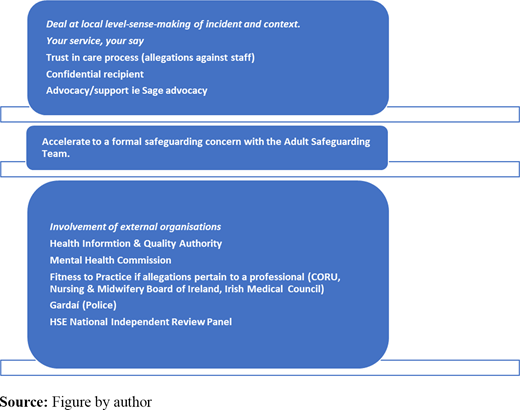
This paper considers the current context of adult safeguarding in Ireland, drawing on older people as a risk group and discussing how the protection can be enhanced. Depending on the context and threshold, there are several responses to safeguarding, as detailed in Figure 1. Allegations or concerns regarding care may be addressed through more than one referral pathway. However, if concerns constitute a criminal matter, a review by another agency, for example, a professional regulator, may delay their investigation while awaiting the legal case outcome.
The policy context
Horkan (1995) noted that the topic of elder abuse (and indeed adult safeguarding) received little formal attention in Ireland. In 1998, O’Loughlin and Duggan (1998) undertook an exploratory study of abuse and neglect of older people, which provided visibility of abuse as a public health issue. Following this, Ireland’s safeguarding responses stemmed from Protecting our future [Working Group on Elder Abuse (WGEA), 2002], which articulated a response framework to elder abuse. Recommendations pivoted on rights-based approaches and the incorporation of elder abuse responses into broader health and social care services as well as a dedicated formal policy that identified staff structure, practice issues and staff training. However, the policy document explicitly stated self-neglect as being beyond the remit of elder abuse, although this was a feature of professional practice (Day and McCarthy, 2015; Day et al., 2015). Accordingly, serious cases were subsequently included under the remit of the elder abuse and adult safeguarding services (Health Service Executive, 2012). Other 2002 recommendations focused on legislation, advocacy, carer support and the establishment of a national centre for research and training. The National Centre for the Protection of Older People (2008–2019) was established at University College Dublin and undertook over twenty studies, reviews and reports on the topic of elder abuse in Ireland.
While Protecting our future [Working Group on Elder Abuse (WGEA), 2002] did point to directions of formal responses, little implementation occurred until some years later. The impetus for action was a 2005 television programme, Primetime, by the national broadcaster Raidió Teilifís Éireann. Using undercover filming, the programme focused on multiple issues of poor care of older residents in a North Dublin nursing home, Leas Cross. There was both public and political outcry and a demand for proper monitoring of care quality within older persons’ facilities. Since this broadcast, additional safeguarding scandals have continued to highlight gaps in safeguarding (Table 1), representing a trend of reactive rather than proactive approaches.
While a dedicated elder abuse response service was established in 2007, another 2014 undercover broadcast (Aras Attracta, Table 1) led to a second public scandal involving people with an intellectual disability living in residential care. This provided the catalyst to broadening policy to a wider safeguarding adults at risk focus. Recommendations following the review of care in Aras Attracta included the establishment of an independent confidential recipient whose role was to give a voice to older people's and people with disabilities' concerns regarding care in the Health Service Executive (HSE) and bring issues to formal services' attention. The HSE National Independent Review Panel (NIRP) was established in 2017 and is commissioned by the HSE’s National Clinical Director, Quality and Patient Safety to review selected major/extreme incidents within the HSE’s incident management framework with a focus on and promoting systems-based learning (National Incident Review Panel and HSE, 2021).
In the 2014 safeguarding policy, the HSE adopted the abuse definition developed by the Health Information and Quality Authority (HIQA) (Ireland’s independent authority to monitor the safety and quality of health and social care) was applied. The abuse was defined as:
[…] any act, or failure to act, which results in a breach of a vulnerable person’s human rights, civil liberties, physical and mental integrity, dignity or general well-being, whether intended or through negligence, including sexual relationships or financial transactions to which the person does not or cannot validly consent, or which are deliberately exploitative. Abuse may take a variety of forms. (Health Information and Quality Authority, 2013; Health Service Executive, 2014, p. 8)
The HSE, 2014 policy was underpinned by a zero tolerance to abuse which promoted an empowerment-based case management approach emphasising the importance of advocacy, inter-sector collaboration, the protection of human rights and person-centredness. While this broadened the safeguarding population base to adults aged 18 years and over, challenges persisted, such as the lack of a national policy beyond public health services and the absence of both a comprehensive oversight body and specific safeguarding legislation. The HSE developed a revised draft operational adult safeguarding policy in 2019; however, this was withdrawn as the Department of Health had commenced work to produce a national policy on adult safeguarding. Despite principles (human rights, person-centredness, empowerment, advocacy, comprehensiveness, consistency, prevention, proportionality/minimum intrusiveness, partnership, collaboration, awareness and safeguarding being everybody’s business) being identified to underpin the new policy, with the advent of the public health crisis of COVID-19, this work has not progressed to a final published policy document.
Other scandals and legal debates have also served to highlight continued challenges and the need to increase clarity and responses for the prevention and early intervention in safeguarding contexts, regardless of setting (Table 1). More recently, the need for stronger governance, the provision of local services and step-down facilities for social care and mental health-funded service users in private placements were identified (Yacoub et al., 2020). Other commentaries also highlighted safeguarding gaps; for instance, revelations by the NIRP (2021) review of a lengthy historical case of peer-to-peer sexual abuse (108 incidences concerning 18 residents with intellectual disabilities) in two facilities (Brandon case, Table 1) pointed to failures in governance. While the review only considered incidents between 2003 and 2016, this highlighted the lack of due process in managing sexual abuse by a resident over the period of 1992–2016.
The practice context
In December 2015, the National Safeguarding Office (NSO) was established and is part of the HSE Quality and Safety Community Health care. The NSO is responsible for coordinating and leading the implementation of safeguarding policy, public awareness, training, strategic planning, data collection and establishment of national and regional committees. Structurally, safeguarding is managed by safeguarding protection teams in each of the nine Community Healthcare Organisations with designated officers in HSE or HSE-funded services. However, research has pointed to limits to case management devoid of supporting adult legislation (Donnelly and O’Brien, 2022).
In 2014, there were 2,590 alleged cases referred to the service with psychological abuse being the most common referral category. The transition to a wider safeguarding remit has been reflected in increased referrals, as detailed in Table 2.
Adult safeguarding referrals 2019–2021 (Health Service Executive, 2020, 2021, 2022)
| Year | 2019 | 2020 | 2021 |
|---|---|---|---|
| Number of referrals | 11,929 | 10,216* | 11,640 |
| Referral group | Social care: 81.12% | Social care: 78.49% | Social care: 82.60 |
| Primary care: 14.40% | Primary care: 15.91% | Primary care: 10.40% | |
| Other 2.23% | Other: 4.35% | Others: 5.10 | |
| Acute hospitals: 1.70% | Acute hospitals: 1.06% | Acute hospitals: 1.40% | |
| Mental Health: 0.43% | Mental Health: 0.08% | Mental Health: 0.40% | |
| Health and Well-being: 0.09% | Health and well-being: 0.01% | Health and Well-being: 0.10% | |
| Tusla: 0.03% | Tusla: 0.01% | Tusla 0% | |
| Person of concern | Other service user/peer: 58% | Other service user/peer: 53% | Other service user/peer: 54% |
| Immediate family member: 20% | Immediate family member: 22% | Immediate family member: 22% | |
| Staff: 13% | Staff: 17% | Staff: 17% | |
| Other relative: 5% Stranger: 2% Neighbour/friend: 2% | Other relative: 3% | Other relative: 3% | |
| Volunteer: 0.1% | Stranger: 2% | Stranger: 2% | |
| Neighbour/friend: 3% | Neighbour/friend: 3% | ||
| Abuse types | Physical: 40% | Physical 33% | Physical: 30% |
| Sexual: 5% | Sexual 4% | Sexual: 4% | |
| Psychological: 33% | Psychological 40% | Psychological: 43% | |
| Financial: 10% | Financial 10% | Financial: 9% | |
| Neglect: 8% | Neglect 9% | Neglect: 8% | |
| Discriminatory: 0% | Discriminatory 0% | Discriminatory: 0% | |
| Institutional: 1% | Institutional: 2% | Institutional: 2% | |
| Self-Neglect: 3% | Self-Neglect 3% | Self-Neglect 4% |
Notes:
*The annual report for 2020 noted a backlog of reporting cases; thus, the outstanding cases (n = 358) were noted in the 2021 report
Since 2014, most referrals have occurred in the service setting as opposed to the community setting. Most allegations are within the 18–64 years age cohort and are in service settings, whereas for those aged 65 years and older, the majority are in the community setting. As demonstrated in Table 2, social care represents the highest referral group and alleged peer-to-peer abuse is the dominant trigger for referrals. Psychological abuse and physical abuse are the most common abuse types in allegations to the Irish safeguarding service. Between the period 2016–2021, there has been an increase in the referrals deemed to have reasonable grounds for concern. In 2016, reasonable grounds for case referrals amounted to 47%, with additional information needed for 20%, whereas 33% of referrals did not meet the threshold of reasonable grounds. In 2021, reasonable grounds for the referral were identified as 70%, whereas additional information needed amounted to just 7%, with 23% of referrals not meeting the threshold of reasonable grounds. However, it was observed that safeguarding services remain under-resourced in the context of meeting the challenges of service demands, structural health care reform and integrated health care agendas.
Since 2007, there has been a focus on training staff in multiple settings regarding safeguarding. However, COVID-19 necessitated the provision of education virtually and the development of a virtual programme within HSeLanD. In 2021, 52,205 people were recorded as completing this virtual training (Health Service Executive, 2022). However, despite the establishment and expansion of adult safeguarding services, it has been recognised that professionals’ agency in response to case management is limited by the lack of legislation (Donnelly and O’Brien, 2022).
The legislative context
The Constitution of Ireland (Government of Ireland, 1937) guarantees the rights of citizens and specifically mentions the “aged” for protection. Ireland’s ratification of various human rights declarations/conventions supports a human rights-based approach; a continued challenge for services is the absence of specific adult safeguarding legislation. Abuse that involves criminal acts may be pursued under general legislation depending on its nature. While primary legislation such as the Equal Status Act (2000), Criminal Justice (2012) (Withholding of Information on Offences against Children and Vulnerable Persons) Act 2012, the Mental Health Act, 2001 (Approved Centres) Regulations 2006 and the National Vetting Bureau (Children and Vulnerable Persons) Act (2012) have contributed to the legislative focus on rights and safeguarding, it has been recognised for some time that the lack of specific legislation represents a significant gap in safeguarding responses. For example, entry to private nursing homes and access to an individual when there is a concern is not mandatory, which inevitably can deny the articulation of the older person’s rights and entitlement to support. In addition, there is no requirement to share information or to mandate multi-disciplinary collaboration (Law Reform Commission, 2019), thus limiting case management. Some efforts have been made to establish adult safeguarding legislation. In 2017, an all-political party private members bill (Adult Safeguarding Bill, 2017) was introduced but has not advanced beyond the third stage of the legislative process. Equally, the introduction of safeguards related to the deprivation of liberty has not progressed to legislative realisation.
A consultation paper by the Law Reform Commission (2019) has considered issues related to safeguarding legislation in Ireland; however, further progress is slow. In the absence of legislation, assistance from organisations such as Sage Advocacy has supported adults at risk in practical and legal terms; however, independent advocacy does not have a statutory basis to date. Equally, while reform in the Domestic Violence Actr (2018) gave a legislative avenue to address psychological abuse, the issue of coercive control remains within the confines of intimate relationships, thus limiting its application in the wider safeguarding context. Moreover, raising public awareness of coercive control is required. Research by Safeguarding Ireland (2021a) identified that 40% of people do not understand the meaning of coercive control with 13% of adults over 18 years disclosing they experienced this and 30% being aware of this occurring to someone they know.
Despite the outdated nature of the archaic Lunacy Regulation (Ireland) Act, 1871, a functional approach to capacity has been evident in Irish courts since 2008 (Laffoy, 2008). Efforts to reform capacity legislation culminated in 2015 with the ratification of the Assisted Decision-Making Capacity Act. Significantly, this established the Decision-Making Support Service within the Mental Health Commission and offered support for people with capacity challenges. The Act aligns with a human rights approach; decisions are based on an individual’s will, preference, values and beliefs and are time and issue specific. In addition, capacity is assumed unless proved otherwise through a functional approach. Yet, confusion on capacity assessment has persisted, as evidenced in the AC v. Cork University Hospital legal case in 2019 which was related to the care of an older lady (Table 1). Here, the Supreme Court ruled that the voice of the person must be sought, and detention is only permitted if criteria such as poor insight into/lack of acceptance of an unsafe discharge, being under undue influence or being unable to make a decision apply. In this context, actions are proportionate to the “doctrine of necessity”, and court assistance must be sought (Condell, 2019). This judgment reflects the principles of human rights in the ADMCA; however, despite the ratification of this legislation 2015, its full commencement had been delayed until amending legislation Assisted Decision Making (Capacity) (Amendment) Act (2022) was signed by the President of Ireland on 17 December 2022.
Other areas that enable the will and preference of an individual include Power of Attorney and the use of advanced care directives. However, both are underused in Ireland. For example, Safeguarding Ireland (2022) identified that only 6% of adults in Ireland have an Enduring Power of Attorney with many never having thought of it or considering it as personally relevant. This contrasts with six million current powers of attorney on the register with the Office of the Public Guardian in England and Wales (Office of the Public Guardian, 2022). Equally, the Irish Longitudinal Study on Ageing (2022) identifies that only 25% of older people have discussed advanced care planning informally, whereas less than 3% have formal documentation identifying their wishes and preferences (Breslin et al., 2022).
Safeguarding within regulation
The HIQA was established under the Health Act 2007 to set standards in health and social care and regulate care environments to ensure both quality of care and safe services. A catalyst to its establishment was the Leas Cross scandal (Table 1), and its first focus within regulations and standards was on residential care of older people. Within HIQA’s health-care standards development framework, the provision of person-centred care, effective services, safe services, health and well-being, use of information, use of resources, a responsive workforce and leadership, governance and management have all fundamental intersections related to safeguarding older people. However, in 2018, HIQA and the Mental Health Commission published a background document to support the development of national safeguarding standards. Building on this, the national adult safeguarding standards were published in 2019 and drew on safeguarding literature, investigations, policy and legislation. Core principles for adult safeguarding were identified as empowerment, a rights-based approach, proportionality, prevention, partnership and accountability. Under the standards development framework, safeguarding objectives were overtly articulated, reinforcing the diversity of related responsibilities under each theme. This was reinforced by the delineation of features of how services can demonstrate meeting the standards and included a plain language insert to explain the standards for people in receipt of care services. An additional focus on a rights-based approach was evident in the promotion of a Human Rights Based Approach to Care (Health Information and Quality Authority and Safeguarding Ireland, 2019) with guidance in decision-making to be underpinned by Fairness, Respect, Equality, Dignity and Autonomy principles. Furthermore, in 2021 the standards development framework explicitly integrated a human rights approach as core to person-centred care within service delivery.
Further work by Health Information and Quality Authority (2019a, 2019b) includes Guidance on promoting a care environment that is free from restrictive practice – Older People’s Services, although this addresses only physical and environmental restraint and not chemical restraint. However, restraint is framed around an infringement of an individual’s rights and is proportionate to risk. Equally, the Mental Health Commission developed separate guidance (Mental Health Commission, 2014). In a report of restrictive practices (physical restraint and/or seclusion) in mental health settings, it was noted that physical restraint and/or seclusion were used in 47 services (70%) with 4,636 incidents concerning 1,790 individuals (Mental Health Commission, 2022).
Wider developments
Within the wider context of safeguarding, progress has been made within other areas, such as the establishment of Safeguarding Ireland, advocacy support and work within financial institutions.
Safeguarding Ireland
Safeguarding Ireland is a registered charity that promotes the collaboration of various sectors to advance an agenda on safeguarding adults at risk. Its first strategic plan was developed in 2015, and a major focus is increasing public awareness of people’s rights, research and lobbying of government on issues such as coercive control, capacity and increasing financial institutions’ protection of customers at risk of abuse. Safeguarding Ireland has developed information resources, and an Irish Safeguarding Charter and established an annual adult Safeguarding Day in November to stimulate attention and discussion on the topic. A core focus is the promotion of human rights underpinned by the person’s voice and involvement in decision-making and support from services.
Advocacy
Independent advocacy is not on a statutory basis in Ireland, although standards within Health Information and Quality Authority (2013, 2016) publications are explicit regarding rights to access advocacy services. An example of national independent advocacy available to people is the National Advocacy Service (incorporating the patient advocacy service) (NAS) for people with disabilities and Sage Advocacy. Advocacy is an essential mechanism to support people’s empowerment, self-determination and voice. In 2021, NAS aided 1,006 people while also providing information and short-term advocacy to 2,827 people. In addition, the Patient Advocacy Service (based in NAS) helps people make a complaint related to care in the hospital or HSE nursing home facilities. In 2021, 3,383 complaints were managed by NAS advocates. Issues include assisting with suitable and desirable residential care, navigating the health-care systems and generally supporting older people to exercise rights. Similarly, Sage Advocacy provides support for adults at risk. In 2020, there were 1,248 referrals, 1,030 information and support calls, 640 helpline calls and 23,000 engagements with family forum members (Sage Advocacy, 2021). Issues related to assistance with housing, finances, access to community services, residential care, planning ahead and supporting decision-making. Sage Advocacy also undertakes research, raises public awareness of safeguarding issues and lobbies for systemic change.
Post-Aras Attracta (Table 1), the HSE funded an independent person to act as a confidential recipient. The role is to offer a service to address complaints and concerns regarding HSE facilities or those funded by the HSE. In 2021, the confidential recipient received 155 formal concerns. The majority pertained to disability services (137) with the remaining centring on mental health care and primary care. In 2022, the confidential recipient commented that the lack of staff in community care translated to people having to reluctantly decide to enter residential care. Other concerns describe a lack of equity in accessing services such as occupational health and physiotherapy for residents in private nursing homes. There have been calls to expand the confidential recipient to enable a wider remit; however, this is not within the planned reorganisation of the HSE (Reilly, 2022).
Financial institutions
The Banking and Payment Federation of Ireland (BPFI) has undertaken some work to empower people to protect against financial abuse which includes the development of principles on financial safeguarding. These principles recognise the importance of awareness raising, supporting disclosure, staff training and tailoring responses to each allegation. Various safeguarding issues have been identified. For example, 20% of young women aged 18–34 in Ireland do not have control over their finances or find financial management difficult and rely on others to support them [Banking and Payments Federation of Ireland (BPFI), 2021]. The BPFI also recognise the challenges for older people in managing bank accounts, and several initiatives have been introduced to promote financial self-determination.
COVID-19
COVID-19 provided a significant challenge to safeguarding services globally, particularly related to older people. This included various scams (Moore and Hancock, 2020; Pollack, 2021; Metropolitan Police, 2021) and concerns that elder abuse risk factors were exacerbated during the pandemic (Phelan et al., 2021). Research has reported substantial increases in abuse perpetrations during COVID-19 (Han and Mosqueda, 2020; Sajan, 2020; Emmer De Albuquerque Green, 2022). An early survey undertaken in Ireland suggested approximately one-third of people over 18 years were subject to abuse during the pandemic (Safeguarding Ireland, 2020). The Banking and Payments Federation of Ireland and Safeguarding Ireland (2022) have reported that many older people who sought assistance with finances during COVID-19 have not resumed control of their finances with five percent disclosing financial abuse during the pandemic restrictions.
In the 2022 NSO report, designated officers described the challenges in managing cases. International studies have shown that the restriction in access to services and external support creates increased safeguarding risks for older people (Age Platform, 2020). The restriction in home and residential visits, enforced because of COVID-19, has led to reduced contact with older residents. Moreover, it has been observed that safeguarding staff were redeployed to contact tracing services (Brennan et al., 2020). This delayed timely responses to safeguarding concerns due to understaffing, with a reported backlog of 1,812 referrals as well as 1,629 unreviewed safeguarding plans (Reilly, 2021). Similar to other countries (Beaulieu et al., 2020; Emmer De Albuquerque Green, 2022), concerns have also been raised regarding nursing home care and safeguarding during the pandemic in Ireland [Irish Council of Civil Liberties (ICCL), 2021]. Moreover, Casey et al. (2021) express concerns regarding the human rights impact of government emergency powers during the pandemic, which was disproportionately experienced by people with disabilities and older people and limited their voice and self-determination.
Discussion
Within the past 20 years, there has been an increasing realisation of the state’s obligation to protect adults at risk from abuse and to positively defend human rights within a balance of empowerment and protection. While Ireland has advanced its understanding and established its safeguarding services, this has generally been undertaken in a reactive rather than proactive way. Moreover, the issue of increasing public awareness is crucial as only one in three adults is aware and understands what safeguarding is (Safeguarding Ireland, 2021b), whereas participation, involvement and self-determination can be limited through paternalism and bureaucratic systems of care. Browne (2022) notes that current safeguarding provision in Ireland is limited both within structure and processes, which lack comprehensive oversight. To provide a robust safeguarding system for older people, a systems-level approach needs to incorporate prevention and early intervention through strong legislation, policy and cultural alignments to human rights approaches.
While legislative reform has occurred related to decision-making capacity, full commencement has been slow. Equally, there has been a stagnation in legislative progress related to the Deprivation of Liberty, which is an important consideration in the care of older people. More importantly, there has been a growing demand for the progression of comprehensive Adult Safeguarding legislation and an overarching statutory body that would be tasked with oversight. At present, challenges occur in a fragmented system devoid of specific legislative teeth or overarching safeguarding approaches. For example, legislation to support powers of assessment, power of removal and powers related to a safety order has been discussed as core elements in adult safeguarding legislation (Law Reform Commission, 2019). Gaps are evident in responses; for example, the HSE policy applies to HSE-funded nursing homes, yet the majority are privately owned in Ireland. While the Department of Health is progressing with a national safeguarding policy, its advancement has stagnated. Other pragmatic issues in safeguarding response gaps relate to the adult at risk’s lack of statutory entitlement to independent advocacy. This is an essential protection in the context of capacity challenges and paternalism in areas such as ageing in place, finances and undue influence by others. Browne (2018) considers independent advocacy as key to supporting individuals’ voices by supporting their will, preferences, values and beliefs. Equally, tensions can exist related to issues of data sharing in safeguarding cases which inevitably impacts the potential for inter-sector collaboration and case management.
Within practice responses, the increase in annual case referrals has presented challenges related to waiting lists, and this has been further hampered in the redeployment of safeguarding staff in the pandemic. Safeguarding is a duty of care for all sectors, settings and organisations that interface with adults at risk, and strengthened responses require an inter-sectorial collaborative approach with strong supporting structures such as legislation, policy and practice. Yet, public awareness and cultural shifts are also fundamental to ensure human rights, self-determination and disclosure. Thus, while Ireland has progressed responses to adult safeguarding issues, much more needs to be done to ensure a comprehensive human rights approach is ingrained in bespoke legislation, adequate service resources and clarity in national policy.
Conclusion
While Ireland has tentatively initiated responses to adult safeguarding, actions have been disjointed, creating gaps in prevention and intervention. Discussions on the need for bespoke adult safeguarding legislation remain stagnant despite calls from professionals, a consultation paper by the Law Reform Commission (2019) and various representative groups. The urgency of defending the rights of older people has also been politically slow. For example, while Ireland signed the Convention on the Rights of Persons with Disabilities in 2007, its ratification was not until 2018. While the Irish government does participate in the United Nations Open Ended Working Group on Ageing, they do not support the establishment of an International Convention on the Rights of Older People (Age Action, 2014). Similarly, the full commencement of the Assisted Decision-Making Capacity Act (2015) was only realized in early 2023 but called for such reform for older people can be tracked to the Law Reform Commission, 2003. Thus, adult safeguarding in Ireland has been hindered by a legislative vacuum leading to a paradox in practice responses. Donnelly and O’Brien (2022) articulate this as dualism, where there is an expectation of professionals to protect adults at risk, yet structurally, the lack of supporting safeguarding legislation limits both their authority and the scope of their individual agency. A turn to a human rights approach demands positioning older people as self-determined beings, where their voice, wishes, will and preferences are at the forefront of case management.
This lag in progress in adult safeguarding has been exacerbated by a cultural reluctance to have public scrutiny of the private lives of citizens within the context of family violence in general and that families are altruistic (Phelan, 2010). Culture within organizations has also been noted as a barrier with failures to appropriately recognise and address safeguarding concerns. Equally, there has been a lack of impetus in progressing other aspects related to adult safeguarding; for example, the proposed national policy remains incomplete despite a commitment in 2017. Consequently, within societal and political environments, safeguarding older people has not been positioned as a critical aspiration with concurrent support at multiple levels. Consequently, Ireland’s enhancement of safeguarding is not predicated only on the introduction of rights-based safeguarding legislation. Although this is a fundamental part of the response armory, careful multi-system, intersectoral configuration is key, which maximises principles self-determination, proportionality and collaborative approaches. Crucially, case progression in safeguarding for older people needs to be person centred and to prioritise the voice, perspectives and involvement in decisions. Without this focus on person-centred and system orientation, practitioners will continue to experience barriers in case management, inevitably creating higher risks at the older person’s individual rights’ level and within systems of care responses.

