Thoughts by the Editors
On March 26 this year we have experienced the failure of the Francis Scott Key Bridge in Baltimore, USA. This failure was a reminder that the value of bridges, as components of a transport networks are not just the cost of the asset itself or its materials—it’s way more than that. Failure of critical assets like bridges cascade into our economies and societies causing losses, which can be several times higher than the value of the asset itself. To date the literature has covered losses of bridges accounting for their materials, cost of construction, loss of business and traffic and disruption in the transportation of goods. However, our models will need to incorporate higher level loss assessments, as a result of cascading events. For example, the Francis Scott Key Bridge disrupted the opetations of the port causing $191 million a day in lost economic activity, including lost work and jobs. Can our resilience models account for these losses and if not what is needed? This Themed Issue aims to give insights to this major challenge, yet more research is needed to provide to the designers, operators and decision makers a simple to use method and tools to proactively build resilience into our interdependent infrastructure systems and operations.
Themed Issue ‘Bridges and network transport resilience: Part III’
This third and final Part of the Themed Issue includes a collection of articles which aimed at understanding the dependencies between bridges and road networks as well as the resilience of critical structural components of bridges. It starts out with a thorough examination of the fragility evaluation of bridges taking into account soil-structure interaction (SSI) effects, a result of local soil conditions. The study by Forcellini (2024) emphasises the significance of SSI in the seismic design of bridges and provides insights into the fragility of bridges during seismic events. This study could be used as a first step to assessing the seismic resilience of bridges to earthquakes.
Aloisio et al. (2024) with their paper made a contribution to the structural resilience of deinforced concrete (RC) piers in the event of multiple earthquakes, which is a challenge that the earthquake engineering community is currently dealing with. This research which combines analytical and experimental insights on the behaviour of piers for consecutive seismic occurrences and concludes with an elementary indicator, defined as the ratio between the displacement demand after multiple earthquake excitations.
To maximise recovery investments for bridges, Forcellini and Walsh (2024) uses functionality–time curves that allow the quantification of resilience along with readable findings for a wider range of stakeholders. The methodology presented in the paper helps with post-seismic recovery planning and prioritisation, guaranteeing that investments are made in an efficient manner.
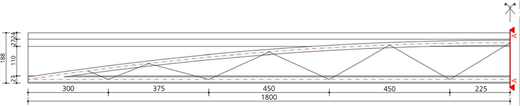
Cucuzza et al. (2024) presented new strengthening systems, (Figure 1) as an alternative to the traditional external prestressing cables method. The method optimises economy and structural performance. The strengthening concerns prestressed girder bridges with steel truss arches and improves the strength and durability of prestressed bridges, offering workable fixes for existing infrastructure.
The study by Carrion-Cabrera and Bruneau (2024) presents a seismic resilient, cost-effective multi-span bridge design with buckling-restraining braces that ensures damage-free columns, minimises displacement requirements, and eliminates the need to replace buckling-restrained braces after an earthquake, thereby significantly improving the overall resilience and durability of bridges.
On the same subject of enhancing the resilience of both new and existing bridges in infrastructure transportation networks, Sheikh and Kharal’s (2024) contribution explores glass-fibre-reinforced-polymer bars as an eco-friendly substitute for steel. It shows that the use of fiberglass spirals in conjunction with longitudinal steel reinforcement in full-scale and half-scale columns improves durability, ductility, and energy dissipation without having an adverse effect on sise, providing a workable option for building resilient and corrosion-resistant bridge columns.
Finally, the contribution by Mufti et al. (2024) deals with the Canadian Highway bridge design code, and proposes improvements through automated inspections and controlled vehicle load tests to reduce uncertainties in element and system behaviour to improve the optimal load-carrying capacities of existing bridges. It uses a target reliability index based on human life risk to evaluate load-carrying capacity.
Conclusions
The Themed Issue ‘Bridges and network transport resilience: Part III’ has delved into the multifaceted aspects of bridge resilience, emphasising the need to consider the broader implications of bridge failures beyond their immediate cost.
By examining the effects of soil-structure interactions, creating new strengthening systems, and combining analytical and experimental methods to study deinforced concrete piers under multiple earthquake events, the contributions in this Themed Issue deepen our understanding of the challenges involved in evaluating and improving bridge resilience. Proactive approaches to post-seismic recovery planning and system optimisation emphasise the need for a holistic bridge resilience strategy that takes into consideration cascading failures at the network, system, and regional levels.
The research presented herein may provide critical insights to aid stakeholders in effectively managing risks and enhancing the resilience of transportation infrastructure against various disruptions.