

Bridges have long been a testament to human ingenuity, serving as vital links that connect communities and enable economic and social progress. As engineering challenges evolve, so do the methods used in the design, analysis, and maintenance of these essential structures. Bridges as parts of critical transport infrastructure are primary systems that underpin human mobility and activities. The loss of bridge service and collapses have far-reaching consequences, affecting entire transport networks that are closely interconnected with other infrastructures (e.g. https://doi.org/10.1016/j.trd.2025.104592). Recent natural disasters have exposed the vulnerabilities of bridges to hazards such as floods, sea level rise blasts, and earthquakes, risks that are further exacerbated by climate change in some occasions. Addressing these challenges requires comprehensive assessment frameworks that quantify capacity and functionality losses under multi-hazard conditions, ensuring that infrastructure remains resilient in an era of increasing environmental and operational uncertainties. The growing integration of advanced technologies, particularly artificial intelligence (AI) and machine learning (ML) is transforming the way bridge structures are assessed and maintained (e.g. https://doi.org/10.1016/j.autcon.2024.105955). Automation and digital twins are redefining how bridges are inspected and rehabilitated, offering more efficient, non-invasive assessment techniques. These technological advancements are instrumental in ensuring that bridges remain not only functional and safe but also resilient in the face of evolving environmental and structural demands.
This editorial introduces the current issue of Bridge Engineering, which explores the evolving landscape of bridge design, analysis, and maintenance through a combination of emerging technologies and traditional engineering principles. The issue features a carefully curated selection of seven research articles that contribute to the broader discourse on structural performance, resilience, and sustainability. These contributions are grouped into two key themes: (i) advances in technology-driven solutions for bridge stability and monitoring, and (ii) the rediscovery and application of historical masonry bridge construction techniques.
The first group examines cutting-edge approaches in bridge engineering, particularly the use of machine learning for predictive modelling, real-time vibration mitigation, and structural health monitoring. These studies highlight the growing role of artificial intelligence and data-driven methodologies in optimizing bridge design and maintenance strategies. The second theme revisits classical engineering knowledge, focusing on the historical evolution of masonry bridges and the relevance of their construction principles for modern preservation efforts.
Beyond summarizing the individual papers, this editorial seeks to provide a broader perspective on the future of bridge engineering by synthesizing key findings and discussing their implications for both research and practice. It concludes with reflections on emerging challenges and opportunities, emphasizing the need for a balanced integration of technological innovation and time-tested engineering wisdom. By bridging these perspectives, this issue contributes to the ongoing pursuit of safer, more efficient, and more resilient bridge infrastructure.
Innovations in bridge engineering: emerging technologies and methodologies
Machine learning is increasingly transforming the landscape of bridge engineering, as demonstrated by two notable contributions in this issue. The first study by Ha et al. (2025) introduces a hybrid ensemble model that combines bagging (B) and instance-based k-nearest neighbours (IBk) to predict vertical deflections in steel–concrete composite bridges (see Figure 1). Drawing from data on 83 bridges in Vietnam, this approach achieves a strong correlation (R = 0.908) between predicted and actual deflections, surpassing traditional models in accuracy. By demonstrating the potential of artificial intelligence in structural health monitoring, this research underscores how predictive analytics can optimize maintenance planning and improve long-term bridge performance.
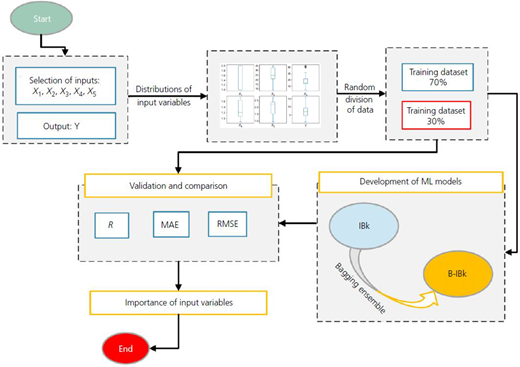
Hybrid machine learning model for prediction of vertical deflection of composite bridges. Flowchart of methodology (Ha et al. (2025))
Hybrid machine learning model for prediction of vertical deflection of composite bridges. Flowchart of methodology (Ha et al. (2025))
A similar application of machine learning is explored by Rajnish et al. (2025), who investigate advanced control strategies for mitigating bridge vibrations induced by moving vehicles (see Figure 2).
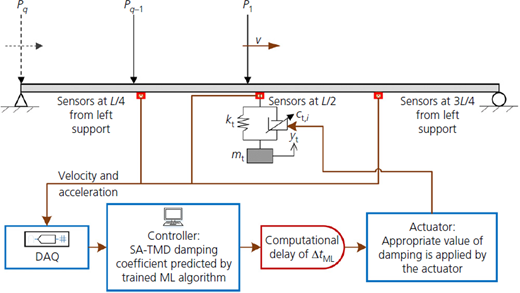
Implementation of trained ML algorithm to predict damping value of SA-TMD (Rajnish et al. (2025))
Implementation of trained ML algorithm to predict damping value of SA-TMD (Rajnish et al. (2025))
Their study compares conventional passive tuned mass dampers (TMDs) with two machine learning-driven algorithms: an energy-based predictive (EBP) model and a weighted random forest (WRF) model. While the EBP algorithm enhances vibration suppression, it struggles with computational delays in complex systems. The WRF algorithm overcomes this limitation, delivering real-time damping control that significantly improves vibration mitigation. This advancement provides a promising solution for ensuring the stability of bridges subjected to dynamic forces, including high-speed train loads.
Beyond the realm of artificial intelligence, Zhao et al. (2025) present a detailed analysis of wind and rain-induced vibrations, which of particular importance for long-span cable-stayed bridges (Tang et al., 2025). By employing an adaptive extraction method that integrates wavelet transform and time-series averaging, the study examines how wind speed and direction contribute to abnormal cable vibrations. The findings highlight the necessity of adequate damping measures to counter excessive oscillations, offering crucial insights for improving bridge resilience in extreme weather conditions.
Addressing another fundamental aspect of bridge stability, the work of Spinelli et al. (2025) focuses on the aerodynamic challenges associated with super-long-span bridges, particularly those exceeding 1,500 meters. With increasing span lengths, aerodynamic concerns such as vortex-induced vibrations and non-synoptic wind effects become critical design considerations. This study emphasizes the need for additional structural stiffness and damping mechanisms beyond traditional aerodynamic solutions, arguing that a holistic approach integrating structural reinforcements is essential for ensuring the long-term serviceability and safety of these monumental structures.
Rediscovering the engineering heritage of masonry bridges
Although modern bridge engineering is largely dominated by steel and concrete, Europe’s infrastructure remains rich with historic stone and brick masonry bridges, which account for approximately 40% of existing railway bridges and a significant portion of road bridges, many of which have been in service for over 200 years. Despite their durability and architectural significance, the technical knowledge required for their preservation is often fragmented and underrepresented in contemporary engineering practices.
The two-part study by León et al. (2023a, 2023b) seeks to address this gap by revisiting historical European treatises on masonry bridge construction from the 16th to 19th centuries. The first part explores the fundamental design principles of these structures, detailing their geometrical configurations, material selection, and the precise stereotomy techniques used in their construction. The selection of composite materials, combined with comprehensive design strategies, forms the foundation of stone masonry bridge design (See Figure 3). These principles not only ensure structural integrity and longevity but also offer valuable insights that can inspire modern bridge projects.
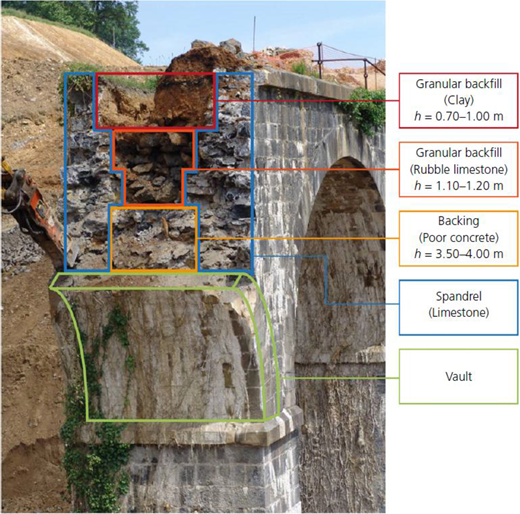
Example of material selection in stone masonry bridge. Example of Urnieta Bridge (Guipúzcoa) (León et al. (2023a))
Example of material selection in stone masonry bridge. Example of Urnieta Bridge (Guipúzcoa) (León et al. (2023a))
The second part reconstructs the step-by-step construction processes, from foundation laying to vault erection and pavement completion. By synthesizing these historical engineering principles, the study highlights the ingenuity of past bridge builders while demonstrating the relevance of their methods for modern conservation efforts. The findings suggest that fostering a deeper appreciation and technical understanding of masonry bridges could inspire new approaches to sustainable, low-maintenance bridge construction in the future.
Conclusions-future perspectives in bridge engineering: bridging tradition and innovation
The research presented in this issue highlights the ongoing evolution of bridge engineering, where cutting-edge technology and traditional design philosophies intersect to enhance safety, resilience, and efficiency. As artificial intelligence and data-driven methodologies become integral to structural health monitoring, predictive maintenance is shifting from reactive to proactive strategies, enabling engineers to anticipate and mitigate potential failures with unprecedented accuracy. Simultaneously, the renewed focus on historic masonry bridges underscores the enduring value of traditional construction techniques, revealing lessons in durability, craftsmanship, and sustainable design that remain relevant today.
With climate change intensifying environmental hazards such as extreme winds, flooding, and seismic events, the need for adaptive bridge designs has never been greater. This issue showcases advancements in wind-resistant engineering, vibration mitigation, and foundation stability, emphasizing the critical role of interdisciplinary research in addressing emerging challenges. By leveraging AI-driven analysis alongside time-tested engineering principles, the field is moving toward a more integrated, data-informed approach to bridge design, assessment, and maintenance.
Bridging tradition and innovation is key to the future of bridge engineering. The insights shared in this issue not only contribute to academic discourse but also provide practical strategies for ensuring that bridges remain structurally sound, resilient, and adaptable. As we move forward, the fusion of AI-powered diagnostics with historical expertise will shape a new era of bridge engineering—one that respects the past while harnessing cutting-edge technology to build a more sustainable and resilient infrastructure for the future.


