
Clean Business Cuisine
Michael Mainelli and Ian Harris ISBN 1 84059 227 3, price £14.99. For further information, please e-mail: michael_mainelli@zyen.com or ian_harris@zyen.com or telephone: +44 (20) 7562-9562. Z/Yen helps organizations make better choices. The name combines Zen and Yen – "a philosophical desire to succeed" – in a ratio, recognizing that all decisions are trade-offs.
With this issue of Journal of Business Strategy we continue serializing one of the more amusing business books of recent times, even though it is about ancient times. Our thanks to authors Michael Mainelli and Ian Harris for providing this divertimento from their book, Clean Business Cuisine
Technology can be a competitive advantage or an uncompetitive disadvantage. Sometimes it's just a problem. The difficulty is discerning the benefits of the technology from the features of the technology. Salesmen "sell the sizzle, not the sausage". Some folk want the jazziest toys around. Yet, without simple emotional enthusiasm for using technology to beat the competition, few advances would occur. How far should enthusiasm be allowed to influence choice?
Chapter two: Gizmo's big adventure
The richer the boy, the bigger the toy (evidently from "Evident Expenditure" by Chao Kli Ning).
[Where Chao Kli Ning was overcome by gadgetry and may have missed a big opportunity to make a quick buck.]
It is a truth universally acknowledged, that a single business in possession of a good fortune must be in want of some ultra-sophisticated apparatuses[1]. Chao Kli Ning's business, the Kwik Klining Duck Tea House and Laundry, was the big exception. Not for Kli Ning the come and go fashions of high technology that no one understood. Not for Kli Ning the passing fads of do-it-all machinery that constantly needed mending. Kli Ning was too hard-headed to be anything but practical, until the day he first saw the abacus at Sha Ky's rickshaw works.
Kli Ning was unsure what the abacus did, but he immediately saw its potential. As the senior executive of the Chao Kli Ning laundry and restaurant works, he could feel the intense power of Sha Ky's enormous central abacus room. The quiet hum of beads slithering up and down their appointed paths, the fevered concentration of the abacus operatives as they oiled the rods, the mystical significance of the numerical workings – all these instilled in Kli Ning a vision for the future of laundry and restaurant administration. He could envision an abacus at every table, an abacus at every counter and a personal abacus for every employee regardless of age or status. Kli Ning wanted an abacus, and he wanted one badly.
"Let me get a detailed grip on the big picture. What does this abacus do, Sha Ky?", asked Kli Ning.
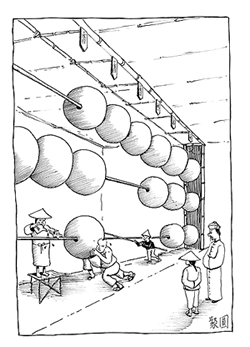
"You see before you the heart of our rickshaw operation. Without this abacus,we wouldn't know how much bamboo to order, we couldn't pay our employees, we wouldn't even know how many rickshaws we have in stock."
Kli Ning surveyed the five rickshaws in stock before noting, "yes, I can see how frightfully complex this operation must be".
Sha Ky beckoned to Gi Zmo, her chief abacus controller and asked him to explain the fundamentals of abacus processing to Kli Ning. The explanation was abstruse, but Kli Ning grasped the basics with ease ...
"... of course everything occurs here in base six. We have plans to double our capacity, but in this warehouse we can only store numbers less than 1,296 due to the weight of one kwong stone beads. If you notice the four men struggling with the ten kwong stone bead on the far side of the room, you'll get an idea of our other beadware constraint. As they push it up the rod, with the two boys oiling ahead of them, you can see that communication times, bead rates as we call them, would decrease if the temperature increased by much. At certain temperatures we find that the operative's heat-stroke rate can crash the system".
It was at this point that Kli Ning began to take notes. Spurred on by Kli Ning's obvious enthusiasm, Gi Zmo's explanations became somewhat technical. Those details have been omitted from this text, as they would serve no useful purpose and may cause unnecessary anxiety to those readers of a slightly nervous disposition.
Kli Ning's abacus arrived three days later. The ABM (Abacus Business Machines) salesman assured Kli Ning that the 5691Q series was a more advanced model than Sha Ky's with enhanced rodware. Further, this model was specifically designed for the restaurant industry. ABM was so committed to supporting the restaurant industry that it was about to launch a new version of the abacus manuals (readware) with improved table counting functions. Kli Ning then knew he had bought the right machine.
Kli Ning explained the proposed operation of the machine to the head cashier,Qia Ming. Kli Ning described the wonderful new abacus room, where all information could be effortlessly produced with the push of a bead. The 5691Q would change the whole way that Qia Ming and his staff worked. Qia Ming then knew that Kli Ning had bought the wrong machine.
Qia Ming had a subtle sense of humour. It was so subtle that there were no recorded cases of anyone detecting its existence. When Lo Fan, the restaurant manager, fell into the sanitation facility, Qia Ming merely tutted and said "Kli Ning told us that this facility would clean up our staffing problems". Had Qia Ming possessed a discernible sense of humour, it would have failed when Kli Ning poached Gi Zmo, Sha Ky's Chief Abacus Controller, and sat him opposite Qia Ming in the cashier's office. Strangely, Sha Ky seemed unperturbed at losing Gi Zmo and her wry remark "thank you very much" had a ring of sincerity rather than sarcasm.
Gi Zmo took control of the situation immediately. The primary function of the new machine was obvious. Tableware. Once all 65 tables had been counted, Gi Zmo thought long and hard to conceive a secondary function for the new machine. He started counting the beans; black, red, yellow, mung, aduki and soya, but couldn't keep up with the chefs. Gi Zmo tried placing the mung beans by the window and the aduki beans by the wall, but it was useless. Gi Zmo gave up bean counting. Nevertheless the term bean counter has been retained in the annals of accountancy history[2].
Eventually Gi Zmo realized that the true benefit of the ABM 5691Q in a restaurant environment must be the timely and precise computation of customer bills. He immediately set to work and developed a mechanism for bill production which would enable a trained professional to input, verify and output an accurate bill. He tested the mechanism thoroughly and presented his proposed changes to Kli Ning. Kli Ning was delighted and decreed that the ABM must be used henceforth for all bill production. Gi Zmo then moved on to bigger and more important business problems such as ensuring an even number of chopsticks.
All of a sudden Qia Ming was having problems with the bills. Firstly, only two waiters were capable of understanding automated bill production. These two staff then seemed to spend all their time doing bills. Secondly, the process took an extra ten minutes at the best of times but became interminable when the bead pushers took their tea break. Thirdly, customers didn't seem to understand the effort required to produce a bill and annoyingly requested extra drinks while they were waiting for their bills to arrive. Naturally the whole bill production process then had to be repeated.
Qia Ming complained to Kli Ning about the extra work and the delays. Kli Ning was displeased and concerned. In his enthusiasm for the new machine he had already placed a large advertisement in the village gazette. "Come to Chao Kli Ning's Restaur-a-mat. See your bill computated mechanistically through the magic of a hugely expensive ABM 5691Q series abacus". True, Kli Ning had managed to sting ABM to go halves with him on the advertising costs. Nevertheless, he had invested heavily in this venture and everyone had promised him that it would work perfectly.
Kli Ning demanded an explanation from Gi Zmo. Gi Zmo assured Kli Ning he was 95 percent of the way to speeding up bill production from ten to seven minutes;he just needed to finalize the change request form with Qia Ming and procure some new expensive rod oil, greaseware. The greaseware would justify its vast cost by speeding up the bead rate quite a bit.
Qia Ming soon started to find his own solutions. He had hired two extra waiters to cover the ABM professionals' tables. Qia Ming had also succeeded in subtly dissuading customers from placing late orders for extra drinks. He achieved this by placing a large sign above the door which read "ordering drinks after calling for your bill is strictly forbidden".
When Kli Ning saw the sign, he was furious. He demanded an explanation from Qia Ming. Qia Ming assured Kli Ning that the sign worked in most instances. On the rare occasions that customers did not submit to the rule, Qia Ming could easily manage the situation by either giving them free drinks or banning them from the restaurant. In any case, the sign was only temporary, as Gi Zmo had assured both of them that he was 90 percent sure that he was 99 percent finished with finding a solution. Within a week, all would be well, all being well.
Within a week, Kli Ning followed up on progress with Gi Zmo. Gi Zmo was optimistic. The solution was 90 percent complete, and only a few minor problems remained. Gi Zmo was 70 percent sure that there could be a suitable resolution to 90 percent of the remaining problems if only Kli Ning would provide him with another ABM for development and testing. Kli Ning was 100 percent sure that Gi Zmo would advance his career more positively by seeking a challenging position elsewhere.
Kli Ning called Qia Ming before him and gave Qia Ming custody of the ABM contraption. Qia Ming expressed intense gratitude for the honor Kli Ning had bestowed upon him. Without questioning Kli Ning's eminent decision, Qia Ming merely said "I can make it count to anything but it may add to nothing". Kli Ning tried to detect Qia Ming's subtle humour, and, in so doing, gained profound enlightenment into the Z/Yen of abacus maintenance, saying "may you get a big picture grip on the details".
Kli Ning laughed as he threw out all the ABM equipment. Kli Ning laughed as he told Qia Ming to get rid of two waiters. Qia Ming failed to detect Kli Ning's subtle sense of humour but succeeded in firing the two ABM professional waiters. True, they were long serving staff. True, they had once been popular with the customers and other waiters. Now, however, they just spoke abacus jargon. Bead rates, greaseware and the next generation of 5691s soon bored their colleagues and the customers. No-one regretted their departure. Naturally, they soon found lifetime tenures as Professors of Abacus Science and Fellows of the Institute of Abacus Professionals.
Some time later, Kli Ning encountered a strange monk begging for alms. This monk had a long beard, sandals and muttered strange numerical incantations to himself, in particular the mantra "bead rate, base Tao". Kli Ning supposed that the monk was a Yen Buddhist, a more ancient sect than Zen. Yen Buddhists were dedicated to the pursuit of salvation, enlightenment, harmony and hard currency beneath a stable exchange rate mechanism. As Kli Ning pondered the mantra, he then realized that this monk must be Gi Zmo.
"Bead rate, base Tao".
For the second time in his life, Kli Ning gave a small contribution to a begging monk in exchange for a brief conversation and some salvation for his conscience.
"Gi Zmo, hello, glad to see you looking so well", commented Kli Ning. "So,are you still into abacuses?"
"Bead rate, base Tao", replied Gi Zmo as he pulled a small personal abacus from beneath his robes and instantaneously clocked up the decimals required for Kli Ning's meager donation.
"That little abacus is a fascinating device", said Kli Ning. "How does it work without a machine room and greaseware?"
Gi Zmo's eyes rolled before he replied, "Oh, this is nothing. The real future is digital binary. Bead rate, base two. That's a virtual certainty. I don't mean two fingered counting, I mean lots of ones and zeros everywhere. Binary is where the future's at. Yes it is, no it isn't. And artificial intelligence too,although I'm a bit fuzzy on that stuff".
Kli Ning persisted, "This micro-abacus, could I buy one?"
Gi Zmo responded, "As the sage says, 'a man with one abacus knows his sums; a man with two abaci is never sure"'.
"Don't you mean two abacuses?"
"I'm not sure", replied Gi Zmo[3].
Kli Ning was a little sad to see Gi Zmo in this muttering state. Kli Ning was a little happier when Gi Zmo wandered off and inflicted his mutterings elsewhere. Once he had recovered from the embarrassment of being seen with that lunatic monk, Kli Ning mused on Gi Zmo's ravings. Kli Ning applied his vast knowledge of the world of business and exercised his uncanny knack for spotting an opportunity to make a quick buck, before deciding:
"Digital binary, lots of ones and zeros, that couldn't possibly catch on".
The off's and on's of life are all but a single bite of the eternal cherry(from "A Basic Tao Response to Z/Yen").
Conclusion
It is difficult to remove emotion from many decisions, including ones about technology. Managers need to be enthusiastic about technology's potential,otherwise they will not spot opportunities for improvement. However,returns-on-investment are frequently unclear. Many technologies benefit customers, but customers may not pay more, buy more or be more loyal. Businesses have to deploy some technologies just to maintain competitive position. Managers should make technology investment decisions based on customer benefits and business needs.
Notes
- 1.
In Sinkiang province "apparati" is the accepted plural of apparatus.
- 2.
Even to this day, in Sinkiang province, mung means debit and aduki means credit.
- 3.
In Sinkiang province "abacuses" is the preferred plural of abacus.


