

Clean Business Cuisine
Clean Business Cuisine Michael Mainelli and Ian Harris, ISBN 1 84059 227 3, price £14.99.For further information, please e-mail: michael_mainelli@zyen.com or ian_harris@zyen.com or telephone: +44 (20) 7562-9562. Z/Yen helps organizations make better choices. The name combines Zen and Yen - "a philosophical desire to succeed" - in a ratio, recognizing that all decisions are trade-offs.
With this issue of Journal of Business Strategy we continue serializing one of the more amusing business books of recent times, even though it is about ancient times. Our thanks to authors Michael Mainelli and Ian Harris for providing this divertimento from their book, Clean Business Cuisine.
“I know that half the money I spend on advertising is wasted. My only trouble is that I don’t know which half.” Ironically this remark has been attributed half-and-half to either Lord Leverhulme or John Wanamaker. Despite tremendous amounts of quantitative and qualitative analysis, no one actually knows what succeeds in sales, marketing or public relations. Complex buyer behaviour is, well, complex. You have to mix art and science, combining the ecumenical and the secular.
Chapter nine
Saving faith
I know that half of my monastery dues are wasted, the problem is that I don’t know which half (possibly from “The Most Lucrative Thoughts of Chao Kli Ning” – 50% likelihood of correct attribution)
[When our protagonists invest heavily in dogma, reap the rewards of hard graft and discover the virtues of international pyramid sales.]
Lo Fan was hardly surprised to hear Kli Ning complain about costs. Chao Kli Ning always complained about costs. To listen to Kli Ning, Lo Fan felt, was to believe that all the costs in the world were met from Kli Ning’s pockets.
“O master, we must spend money on our monastery dues to the Brothers in Alms or our business will suffer,” pleaded Lo Fan.
“Yes, Lo Fan, we must spend the money, but we should get more value for our money. At least half our money is wasted. And I say this as the former personal confessor of the Great Alm himself,” replied Kli Ning.
“But, O Master, if half our monastery dues are wasted, then surely we can find out which half and only spend that?” suggested Lo Fan. “Why are we wasting half our monastery dues?”
“Oh Lo Fan, you can be very trying. Get a big picture grip on the details. You’ve got to try to understand the complexities of PR (paying religion). These monks understand the psyche of our target customers: passing pilgrims, fervent daily worshippers, doubters, agnostics, cynics and skeptical believers who hedge their bets. Our monks use sophisticated techniques to promote our products to our targets,” explained Kli Ning.
“Like telling them to eat in our restaurant and wash in our laundry?”muttered Lo Fan. “Why can’t we tell our customers ourselves?”
Kli Ning was visibly agitated, “Lo Fan, have you learned nothing from our years of association? There are a number of complex skills in dealing with pilgrims, worshippers and such like. For instance, there’s, well, telling them about the um, um, restaurant and, um, laundry. As well as, um, telling them about the benefits of the, um, um, restaurant and, um, laundry. As you see, it’s very complex and we couldn’t possibly do it ourselves.”
Sometimes Lo Fan had a persistent, almost childlike quality to his questions.“Kli Ning, don’t the Sisters of Mo Tzi offer the same services?”
Now Kli Ning was upset, “Lo Fan, there is simply no way that the Sisters of Mo Tzi in their small convent could handle our sizeable account! You are well aware that the Sisters of Mo Tzi only handle jade accounts door-to-door. But, perhaps … ” Kli Ning trailed off into thought.
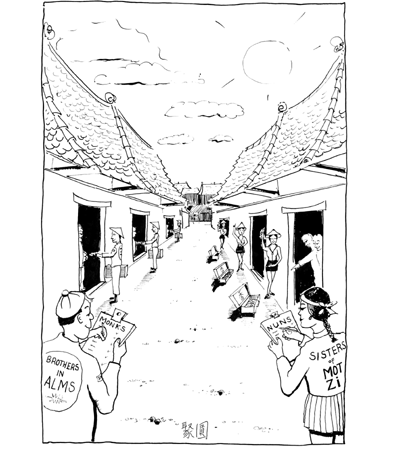
A few days later, Kli Ning’s neighbors couldn’t help but notice the strange assortment of nine monastic orders trying to stay out of the sun. The monks and nuns sought shade along walls and under trees in Kli Ning’s garden. Two particular monastic orders stood out from the crowd. In one corner of the garden, by the bo-tree, the highly successful local order of nuns, the Sisters of Mo Tzi, were clearly practicing some new evangelical chant accompanied by what appeared to be cheer-leading motions and explanatory flip-charts. Mo Tzi herself, the famed proponent of door-to-door proselytization, seemed to create new chants for her order on the spot. In another corner, near the pagoda, the normally serene Brothers In Alms appeared positively sullen, muttering amongst themselves and passing around detailed analyses of the Kli Ning account gross billings and profitability.
The more curious of Kli Ning’s neighbors hung about for a while, eager to share some of the Z/Yen enlightenment clearly about to occur in the vicinity of Kli Ning’s house. If the locals had been any less eager to attain Z/Yen enlightenment, some less charitable gossips in the village might have said Kli Ning’s neighbors were eavesdropping. The neighbors heard Lo Fan call each monastic order in turn. Several times the neighbors listened to a near identical speech by the head of the order, a series of totally identical questions from Kli Ning, the hastened departure of the order’s delegation, sighs of relief from Kli Ning and earnest discussion between Kli Ning and Lo Fan. As eavesdroppers, the neighbors were abject failures. They left the side of Kli Ning’s house late in the afternoon thoroughly confused. These simple village folk were unable to assimilate straightforward religious concepts such as “the unique selling proposition,” “positioning,”“buyer purchase criteria,” “brand extension” and “perpetual salvation that pays.” All they could ascertain was that the Sisters of Mo Tzi had been permitted to chant for five minutes longer than anyone else and had generated the most earnest discussion between Kli Ning and Lo Fan. The Sisters certainly were a most influential order, despite a well-known reliance on door-to-door jade accounts.
The very next day, each neighbor was surprised to be greeting one of the Sisters at their own front door. The Sisters explained that they had returned to the neighborhood to extol the virtues of cleanliness, a healthy diet and value for money. The Sisters praised the Kli Ning laundry and restaurant for exemplifying these virtues. Pilgrims to the Sisters’ convent were greeted by large signs glorifying the excellence of Kli Ning’s establishments and its contribution to salvation. Lo Fan was amazed at how quickly attendance at the restaurant’s luncheon sitting increased.
“Kli Ning, I’m amazed at how quickly the number of diners has increased this lunchtime,” remarked Lo Fan.
“Ah, well Lo Fan, you see that this is the benefit of splitting our marketing budget between two religious establishments. Now we have both sides working for us. This division is something I have long recommended, as you are well aware.”
The Brothers In Alms were up in arms about the Kli Ning account. Within a week, a delegation of belligerent Brothers descended on Kli Ning demanding the full account or nothing. The Brothers adamantly refused to share the Kli Ning account with a bunch of brazen women, led by the garish Mo Tzi, who insisted on using secular locations such as doorsteps to put their message across, rather than religious premises specifically designed for that purpose. The use of these secular locations could only lead to a decline in moral standards, an increasing crime rate, unwanted pregnancies and encouragement to encyclopedia salesmen. The Brothers were emphatic that all of Kli Ning’s PR should be done through one account. Kli Ning was happy to oblige. He explained to the Brothers that if it had to be only one account, then based on recent results, the Sisters had it. Most of the Brothers may have looked surprised at Kli Ning’s decision, but the head of the order merely bowed his head sagely and explained to Kli Ning how joyful it must be to be so close to Z/Yen enlightenment. While the other Brothers listened in astonishment or, as the Z/Yen papers later chronicled,rapture, the head of the order expressed his undying commitment to ecumenical work with the Sisters and proclaimed that Kli Ning had passed the head of the order’s test of unselfishness.
Thus was it written that both orders would go forth to proclaim the message of Kli Ning’s laundry and restaurant in harmony. The Brothers seemed to strive even harder after their awakening. Several of the Brothers appeared to bear the marks of religious education on their backs and legs after failing to make significant converts of passing pilgrims. Other Brothers seemed to drop their objections to using some of the Sisters’ direct-sales techniques, as long as it was for such a worthy cause.
Both orders seemed to have benefited from the healthy debate that Kli Ning had initiated. At least, that was what the heads of the Sisters and the Brothers said in prayer meetings. The Sisters attributed their new-found competitiveness directly to Kli Ning’s account and had rapidly expanded outside just jade. In fact, the Sisters had recently won the Rice Express door-to-door delivery account while the Brothers had publicized their recent win of PR for the So Li Shirt Repair service.
Lo Fan was pleased to report a continuing rise in sales. Most of these new sales seemed to result from the passing pilgrim trade. Less satisfactorily, some of the regular customers had begun to seek other establishments where the whirr of prayer wheels played less havoc with the digestion. Kli Ning could not be happier, but Lo Fan had to deal with some of the religious debates in the restaurant and at the laundry counter. The adherents of the Brothers in Alms could not abide some of the dietary fetishes of the followers of the Sisters of Mo Tzi. The acolytes of the Sisters could not countenance the garbs of the relatively unwashed devotees of the Brothers. The debates became altercations,the altercations became quarrels, the quarrels became brawls. The brawls were expensive and hurt business. Well, the brawls hurt Kli Ning’s business. Rice Express and So Li Shirt Repair seemed to go from strength to strength. Sometimes passing pilgrims remarked that it was difficult to establish exactly for whom the Brothers and Sisters worked, but if you needed a cheap rice meal or a cheap shirt repair you knew where to go – and it wasn’t Kli Ning’s establishments.
Lo Fan was disappointed to report a continuing fall in sales to Kli Ning. As Lo Fan explained to a bemused Kli Ning, “market research appears to evince a passing decline in correlated combined account purchases from separate PR campaigns whilst not undermining core purchase validity, although excessive religious affiliation could be a contributing consumer attribution.”
“What are you trying to say, Lo Fan? Is this some religious jargon Mo Tzi has taught you?” asked Kli Ning.
“With the greatest and utmost respect, Noble Sir, I believe that the Brothers’ and Sisters’ PR campaigns are hurting business,”replied Lo Fan.
“Yes my loyal servant, they stink,” agreed Kli Ning. “But what can we do? We need religious approval to attract the pilgrim trade. None of the townspeople want our food, because they seem to take hot meals delivered to their homes by Rice Express. None of the villagers want our laundry, because So Li handles it all. But still, we can’t afford to stop paying the Brothers and Sisters. Sometimes, I just wish the fights would stop breaking out on our premises.”
“Sir, I learned a new word when talking to a Beijing Mandarin yesterday. This word, ‘secular’, is most confusing. Apparently it means something without religion, or a-religious or something. I am happy that I know of no restaurants or laundries so godless as to be secular. Isn’t it frightening to have something so atheistic?” queried Lo Fan.
“Get a detailed grip on the big picture, my humble servant. Secular is hardly a frightening concept,” assured Kli Ning. “In fact, as a well-travelled gentleman, I am familiar with many foreign lands where secular is not just known, but fervently believed,” boasted Kli Ning.
“O learned master, how happy am I that these secular foreign concepts are banished from our lands so that we may experience the joys of intensive religious debate within our very premises in order to enrich our daily lives and bring meaning to our otherwise worthless existence,” observed Lo Fan.
Kli Ning pondered these platitudes for a moment and then burst forth. “You are quite right Lo Fan, we shall celebrate the beauty of secularity. As I have always said, paying religion is a poor way to promote a business. If you can’t do-it-yourself, don’t ask a monk or nun. Let us be rid of both the Brothers In Alms and the Sisters of Mo Tzi. Let us be rid of this tithing mumbo-jumbo. Let us go forth the Z/Yen way, into the land of secularity where the rivers flow with business opportunities, the pavements are paved with paying customers and where prayer wheels never whirl.”
Lo Fan may have been secretly pleased at Kli Ning’s decision to go secular, but he never showed it. As sales rocketed under the new secular promotion (door-to-door sales, signs rented at nearby monasteries, and a discrete blanket coverage leaflet campaign over several weeks which included a massive jackpot lottery), Kli Ning became more convinced of the efficacy of his do-it-yourself strategy. Unfortunately, as the secular promotion campaign grew,the task began to take up more and more of Lo Fan and Kli Ning’s time. The pair began to realize the effort the Sisters and Brothers put into their marketing. In particular, Kli Ning began to resent frequent late night interruptions, even at his exalted position, as they tried to rush out each last minute campaign.
“Lo Fan,” intoned Kli Ning, “I have begun a process that others may take up after me. And the sooner they take it up after me the better.”
“O esteemed businessman,” remarked Lo Fan, “only a fool would undertake something as risky as marketing from an internal position. Such a fool would be responsible for the marketing strategy, the hiring of a suitable sales force and held liable for any fall in sales. Besides, if this “secular”stuff turns out to be invalid, the fool would be barred from salvation and Z/Yen enlightenment. Such a position would be a sure road to disaster.”
“You are quite right Lo Fan,” said Kli Ning. “I cannot fail to express every confidence in your abilities. May you create the most powerful sales force in the history of my restaurants and cleaning establishments. I, Kli Ning, give you the pyramid, a powerful symbol brought from far-off lands in the West. These western cultures are truly obsessed with sales and marketing. The pyramid is their most potent symbol, uniting the four forces of business beneath a focal point of stone-masonry. May you conquer many sales territories in its name. Thus have I spoken.”
“You honour me above my humble abilities,” demurred Lo Fan.“Much as I aspire to the role you have outlined, my other duties require me to maintain an impartiality in the religious disputes which appear to be making increasing interruptions to our formerly peaceful and lucrative trades. The role you describe in sales and marketing is profoundly religious, even if performed by a secular advocate such as myself.”
Kli Ning frowned, pondered for a moment and replied, “Yes, now that you mention it, secular religious fervour is clearly beyond your capabilities. Sometimes I am slightly too hasty in my desire to resolve problems quickly and to promote loyal, albeit mediocre, staff. Yet we must seek a new organisation to undertake our marketing or continue to do it ourselves. Perhaps we could employ one of the Brothers or Sisters to enlist secular acolytes to perform our marketing? If only there were another agency to whom we could turn.”
“O master, we began this pilgrimage in order to obtain value for money from our religious dues, half of which we believed we were wasting. Yet there seems to be no way to pay but half of our dues and still meet our targets,”observed Lo Fan. “On reflection, perhaps there is another perspective on this problem. Half our dues to the Sisters of Mo Tzi go to Mo Tzi and half are wasted on the gaggle of other nuns who merely repeat the same chants. Curious,isn’t it?”
On the following day, a press release was circulated throughout the province. The revered nun, Mo Tzi, had suddenly abandoned the order she had founded, taken up a secular position with a new agency, “Kli Ning Secular Promotional Communications” and adopted the pyramid as her symbol. Although Mo Tzi’s work for Kli Ning is clearly documented historical fact, she and her agency achieved legendary status with their self-promotional efforts in pyramid selling and the power of pyramids.
Without denigrating her powers, even her most fervent admirers were surprised to see one of the most colossal, secular Imperial deification campaigns undertaken by her agency supporting her own ends so blatantly. Mo Tzi had promised some magnificent, nay outrageous, constructions in far-off lands to support the “pyramid campaign.” Although some critics of Mo Tzi expressed surprise at the apparent rapidity of the construction, others admired the seemingly perfect patina of two and a half thousand years of age Mo Tzi’s set designers had given to the campaign’s sets. Everyone admitted the exotic brilliance of her concept and even Mo Tzi’s critics had to accept that the Imperial Audit Office had traveled to a distant western land, a region called E-Gypt, and had assured itself that such vast sums had actually been spent in support of the campaign. Some of Mo Tzi’s more persistent critics took pains to point out that the Imperial Audit Office should likewise have verified some of the more remote eastern portions of Mo Tzi’s flamboyant campaign in “Amer Ika” where ludicrous sums had been expended clearing jungle for further erections of pyramids.
Mo Tzi’s only comment on the enduring merit of the pyramid campaign was,“we built too many of the blasted pyramids in so many places. Half of these pyramids are wasted, the problem is that I don’t know which half. Technology just always lets me down.”
The peak of success begins in the four corners of a firm foundation (from “Feng Shui For Fun and Profit”).
[Questions for students: Role play a door-to-door sales encounter first as a Sister of Mo Tzi and then as a Brother in Alms. Calculate the exact payback of each door opening. Using papier mache, encapsulate the entire PR strategy for Kli Ning in a work of permanent sculpture suitable for exhibition and resale]
Conclusion
Tolstoy’s Anna Karenina begins with the famous sentence “Happy families are all alike; every unhappy family is unhappy in its own way.” A bit like sales and marketing. When it goes well, a large number of activities come together successfully – good products, good messages, good people,right place, right time, etc. When it goes poorly, it’s easy to criticise specific elements. Skeptical enquiry is required to analyse complex buyer behaviour. Managers need to adopt a portfolio approach not just for their product and service lines, but also for the methods they employ to sell them.

