This study aims to examine the factors influencing customers’ continuous intention to use chatbots in Jordan’s telecommunications industry by integrating the Stimulus-Organism-Response (S-O-R) framework with the technology acceptance model.
A quantitative research design was employed to examine the relationships between stimulus factors and users' continuous intention to use telecom chatbots. Data were collected from 331 users of Jordan’s 3 major telecom providers through an online questionnaire and analysed using structural equation modelling.
The results show that perceived responsiveness and usefulness significantly influence customers’ continuous intention to use chatbots in the telecommunications industry. Moreover, trust fully mediates the relationship between anthropomorphism and continuous intention and partially mediates the link between responsiveness and continuous intention, highlighting its central role in fostering sustained use. In contrast, perceived enjoyment was not a significant predictor. Additionally, age was found to moderate the relationship between perceived usefulness and continuous intention, with younger users demonstrating a stronger intention to continue using chatbots.
The findings highlight that human–chatbot interaction is shaped by both logical assessment and emotional processes. This study provides insights for designing and implementing chatbots that drive economic efficiencies and social inclusion in the telecommunications industry.
The study highlights the critical role of functional performance and trust in driving users’ continuous intention to use chatbots, particularly in emerging markets where artificial intelligence is still gaining user acceptance. These insights contribute to the growing body of literature on chatbot usage and sustainable digital services.
1. Introduction
The digital revolution is transforming how businesses operate and how people interact. Rapid advancements in artificial intelligence (AI) have accelerated this transformation (Hmoud et al., 2023). Among the most prominent applications in this field are AI-driven chatbots that are designed to mimic human communication through text or voice (Pereira et al., 2024). In recent years, chatbots have gained popularity in various industries across both public and private sectors (Cheng et al., 2022), contributing to the significant expansion of the global chatbot market (Klein and Martinez, 2023).
The use of chatbots has socioeconomic implications that are evident at the organisational and individual levels. For organisations, chatbots enhance process automation, which eventually reduces operational expenses and promotes the development of innovative solutions (Diederich et al., 2022). Chatbots serve as a predictive tool, supporting data-driven decision-making and ensuring consistent service reliability (Baabdullah et al., 2022). At the individual level, chatbots influence job responsibilities and employees’ reskilling by assigning mundane tasks to chatbots (Diederich et al., 2022; Fatima et al., 2024) and provide support to customers through engaging and empathetic interactions (Chaves and Gerosa, 2021).
However, despite these advantages, many users stop using chatbots after their initial use. Users remain sceptical, especially about trust and the quality of human-like interaction (David-Ignatieff et al., 2024; Zogaj et al., 2023). These concerns are not directly linked to technical performance, and they are more related to context-specific factors, as the nature of customer interaction differs across industries (Rapp et al., 2021). This variation highlights the need to understand the factors that encourage users to continuously use chatbots in different sectors (Diederich et al., 2022; Park and Lee, 2024; Pereira et al., 2024).
The telecommunications industry is one of the first sectors that have introduced chatbots as one of its services. The telecommunications (hereafter telecom) industry is a dynamic and critical domain that provides the necessary infrastructure to support all other sectors (Ahmmad et al., 2025). It is recognised as a forefront in technology adoption (Asadi, 2025), given its need to manage a high volume of customer enquiries ranging from simple account checks to more complex service-related concerns. To meet these expectations, telecom providers are required to offer fast, reliable and continuous customer support while managing challenges, such as large-scale customer interactions, minimising service disruptions and maintaining high levels of customer satisfaction in a highly competitive market (Chen et al., 2021). Chatbots are prominent solutions in the telecom industry that enhance customer experience and operational efficiency (Sboui et al., 2024).
While global trends confirm the expanding role of chatbots in all industries, the continuous intention to use chatbots in the Arab world remains limited. In this region, chatbot applications are at a nascent stage (Hmoud et al., 2023), often hindered by infrastructural and socio-cultural challenges. This highlights the need to consider both industry-specific and country-level factors (Fatima et al., 2024). Jordan is suitable for such an inquiry. Due to national initiatives such as the Economic Modernisation Vision (2023–2025), its telecom industry is rapidly experiencing digital transformation (Ministry of Digital Economy and Entrepreneurship, 2021). Further, a report by the Information and Communications Technology Association of Jordan (Intaj) showed that 91% of Jordan’s population use the internet (Jordan News Agency, 2024), indicating a strong institutional capacity for digital innovation. Moreover, the national digital strategy directly encourages using emerging technologies to improve public services and citizen well-being (Al-Okaily et al., 2024).
In Jordan, all three major telecom providers (Orange, Zain and Umniah) gained operational and strategic benefits after the adoption of chatbot services. For instance, Umniah has implemented chatbots through Sprinklr, leading to an 89% faster first response time, a 91% reduction in average handling time and a 53% decrease in agent handovers (Umniah, 2024). Taking into account those benefits, still, many users prefer interacting with humans (Hassan and Farmanesh, 2022; Hmoud et al., 2023). This mirrors findings from other regions (e.g. Luo et al., 2019) and highlights the importance of understanding customer behaviour in terms of technology usage in service industries, where trust and customer experience are central considerations (Aljaradat and Shukla, 2025).
The overall aim of this study is to provide a holistic understanding of human–chatbot interaction, capturing the cognitive and emotional factors that influence the continuous use of chatbots. This study is grounded on two main theoretical frameworks: The Stimulus-Organism-Response model (S-O-R) and the technology acceptance model (TAM). S-O-R was first introduced by Mehrabian and Russell (1974) in their seminal work, “An Approach to Environmental Psychology”. The model encompasses three primary components: stimulus (S), organism (O) and response (R). The stimulus refers to an external social, physical or environmental factor that can impact an individual. The organism represents an internal cognitive and emotional state of an individual that the Stimulus can influence. Response refers to the behavioural outcome that results from the individual’s reaction to the external stimulus positively or negatively. In this study, we focus on two key stimuli: the anthropomorphism (i.e. human-like features of chatbots) and the responsiveness of chatbots. Anthropomorphic characteristics promote natural and personal interactions (Chaves and Gerosa, 2021). Responsiveness is a key dimension that influences customer intention and satisfaction in any human–technology interactions (Baabdullah et al., 2022). Chatbots are known for their timely and accurate responses, and thus, responsiveness is one of the common factors used in the literature (e.g. Li et al., 2023). Anthropomorphism and responsiveness act as stimuli that influence customer engagement and behaviour (Cheng et al., 2022; Park and Lee, 2024).
The TAM, developed by Davis et al. (1989), has been extensively used in the literature to evaluate an individual’s acceptance of technology in general (Kelly et al., 2023). The original TAM focuses on perceived usefulness and perceived ease of use as the main factors that predict user intention to adopt technology (Davis et al., 1989). TAM has evolved since then, and other factors were added to include the intrinsic motivations and contextual factors, such as perceived enjoyment (Pereira et al., 2024). Based on TAM, this study focuses on perceived usefulness and perceived enjoyment to understand the factors that influence human–chatbot interaction. Perceived usefulness was selected for this study as it continues to be one of the main factors for predicting technology use (Cai et al., 2022). Perceived enjoyment is an essential factor in the context of this study because communicating with chatbots has an element of entertainment that positively impacts the human–chatbot interaction (Pereira et al., 2024).
This study offers new theoretical insights by combining S-O-R and TAM to collectively investigate the cognitive and emotional factors that influence the use of chatbots. The study also examines the role of trust as a mediating factor, given the substantial effect of trust on the behavioural intentions towards chatbots (Mostafa and Kasamani, 2022). Furthermore, age is incorporated as a moderator to capture the differences in chatbot utilisation across generations (David-Ignatieff et al., 2024). The resulting insights aim to guide the design and implementation of more effective chatbots in the telecom industry while contributing to the broader literature, offering a foundation for future research in contexts with similar levels of technological readiness and institutional capacity.
2. Literature review and hypotheses development
The use of chatbots has significantly increased across various industries, positioning chatbots as the primary communication channel that delivers advanced, round-the-clock services (Chen et al., 2024; Li et al., 2023; Park and Lee, 2024). However, despite their popularity, chatbots fail to promote a positive user experience evenly across all contexts (de Andrés-Sánchez and Gené-Albesa, 2023; Diederich et al., 2022). Empirical studies demonstrate inconsistent patterns of chatbot usage in different countries largely due to cultural variations (Fatima et al., 2024; Park and Lee, 2024). Industry-specific studies show that chatbot design influences customer acceptance and satisfaction (Klein and Martinez, 2023). Accordingly, there is a need to explain sustained chatbot usage by integrating technical, psychological and contextual perspectives (Diederich et al., 2022).
Chatbots are widely implemented in the telecom industry to enhance customer satisfaction and streamline service operations (Shin et al., 2023). Although their applications extend beyond customer service to include network management and predictive maintenance, the factors influencing sustained usage of chatbots in this industry have not yet been fully explored (Chen et al., 2021). In a recent study, Sboui et al. (2024) demonstrated that various factors, such as trust and customer demographics, affect continuous intention to use chatbots, highlighting the importance of social and emotional considerations. Scholars argue that it is crucial to investigate the drivers for continued usage of chatbots (Pereira et al., 2024). The following section reviews the main theoretical frameworks underpinning this study and presents the research hypotheses.
2.1 Stimuli-organism-response model
Prior research has demonstrated the effectiveness of the S-O-R model in examining how external stimuli impact human–chatbot interaction and customers' emotional response. For example, Shahzad et al. (2024) argued that the perceived quality of the chatbot and customers’ awareness represent technological and organisational stimuli, respectively, both of which shape customer behaviour towards chatbots. Moreover, according to Vafaei-Zadeh et al. (2025), anthropomorphic design cues (e.g. human-like language and emojis) impact customers’ emotional state, which in turn influence their behavioural response. Several empirical studies indicate that chatbot design cues enhance human-like qualities, such as language style (Li and Wang, 2023), perceived warmth (Cheng et al., 2022), chatbot gender (Zogaj et al., 2023) and humour (Shin et al., 2023). Accordingly, it is important to examine anthropomorphism as a stimulus that influences customers' emotions and, consequently, affects sustained chatbot usage (Pereira et al., 2024).
There are contradictory views regarding the relationship between human-like dialogue in chatbots and their repeated usage. Some scholars argue that such characteristics encourages users’ intention to continue using them (e.g. David-Ignatieff et al., 2024), while others (e.g. Chi and Hoang Vu, 2023) state that anthropomorphism does not affect sustained chatbot usage. Prior research suggests that customers exhibit varying levels of chatbot acceptance (Park and Lee, 2024), with some experiencing discomfort when interacting with chatbots instead of human agents (Klein and Martinez, 2023). More recent studies, however, reveal that advancements in chatbot intelligence, particularly those that incorporate social and cultural elements, enhance users’ continuous intention to use chatbots (Fatima et al., 2024).
Further, perceived responsiveness is considered a stimulus that influences customer behaviours. Responsiveness refers to the ability of a chatbot to handle customer requests in a timely, accurate and interactive manner (Baabdullah et al., 2022). Previous studies have yielded divergent findings concerning the impact of perceived usefulness. According to Li et al. (2023), some customers found that chatbots improved service efficacy, while others believed that human agents are more responsive to their needs. Similarly, studies by Chen et al. (2024) and Hassan and Farmanesh (2022) have shown that despite the efficiency and accessibility offered by AI-based systems, many users still prefer human assistance for its empathy and adaptability in addressing complex queries. Therefore, it remains unclear how certain stimuli influence customer impressions and behaviours. Based on these insights, the following hypotheses are proposed.
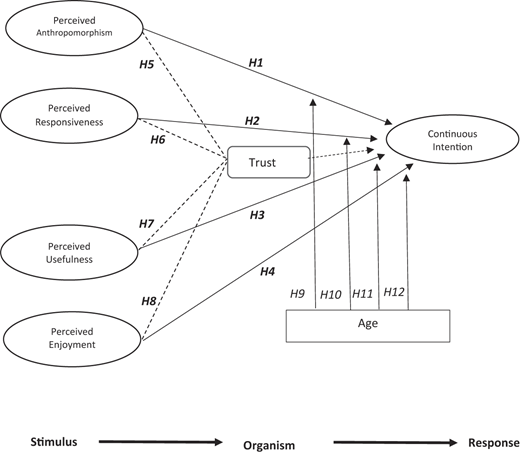
Perceived anthropomorphism positively and significantly influences continuous intention.
Perceived responsiveness positively and significantly influences and significantly continuous intention.
Despite its usefulness, one of the limitations of the S-O-R model is that it mainly focuses on the direct relationship between the stimuli, the organism and responses (de Andrés-Sánchez and Gené-Albesa, 2023), possibly overlooking the complexity associated with human-chatbot interactions. To overcome this issue, prior literature advocates integrating the S-O-R model with other frameworks that allow the exploration of different dimensions of human-chatbot interactions. One such framework is the TAM (Vafaei-Zadeh et al., 2025).
2.2 Technology acceptance model
Various scholars have utilised TAM to look into technology acceptance and usage in different domains, such as education (Chocarro et al., 2023), recruitment (Akram et al., 2024), tourism (Solomovich and Abraham, 2024) and banking (Richad et al., 2019). These studies show that TAM is a solid framework for understanding the various patterns of technology usage. Perceived usefulness is a key factor of TAM that influences customers' intention to use technology. It is defined as the extent to which individuals believe that technology enhances their productivity (Davis et al., 1989). Perceived enjoyment, another factor of the extended TAM, refers to the extent to which individuals find the technology enjoyable regardless of the outcome (Pereira et al., 2024). There is a general agreement within the literature that customers who enjoy interacting with chatbots are more likely to be satisfied, thus positively influencing the intention to continuously utilise chatbots (Ashfaq et al., 2020; Cai et al., 2022).
Despite perceived ease of use as a main construct of TAM, debate remains whether it should be considered a significant differentiator in human-chatbot interaction, given the maturity of technology (Iancu and Iancu, 2023). Moreover, due to the technological progression across all industries, scholarly focus is turning towards experience and value rather than ease of use (Dahri et al., 2024). With this in mind, this study adopts perceived usefulness and perceived enjoyment from TAM. While TAM focuses on cognitive beliefs influenced by perceived enjoyment and perceived usefulness, the S-O-R framework explains the impact of the external stimuli in shaping customers’ behaviour. However, both models show limitations. TAM lacks attention to emotional dimensions, and the S-O-R model is often critiqued for its linear simplicity when applied to complex service interactions such as those involving chatbots (Dahri et al., 2024; Iancu and Iancu, 2023; Vafaei-Zadeh et al., 2025).
In addressing these limitations, this study adopts an integrated model that hybridises the cognitive focus of TAM with the stimulus-based structure of the S-O-R framework. Prior research has identified perceived anthropomorphism and responsiveness as external stimuli that influence customers' continuous intention to use chatbots. Building upon this foundation, the present study extends the model by incorporating two additional stimuli from TAM: perceived usefulness and perceived enjoyment. This integrated approach has been applied with success recently (e.g. Kleine et al., 2025; Vafaei-Zadeh et al., 2025) to provide a more comprehensive understanding of human–chatbot interaction and the factors that affect users’ continued usage. As such, the following hypotheses are proposed.
Perceived usefulness positively and significantly influences continuous intention.
Perceived enjoyment positively influences continuous intention.
2.3 The trustworthiness of chatbots
Advancements in anthropomorphic raise concerns about overreliance on chatbots, which may increase customer hesitation (Choung et al., 2023). This hesitation often stems from a lack of trust (Chi and Hoang Vu, 2023) and failure to display empathy and social characteristics that meet user expectations (Chaves and Gerosa, 2021). Therefore, it is necessary to deepen the understanding of chatbot humanisation (Shin et al., 2023) by considering cultural differences and improving the empathetic quality of chatbot responses (Chi and Hoang Vu, 2023; Rapp et al., 2021). Although trust has been widely examined in studies related to initial and sustained technology use, further research is needed to explore the specific factors influencing the perceived trustworthiness of chatbots (Mostafa and Kasamani, 2022; Rapp et al., 2021).
Trust has been extensively examined as a mediating variable in numerous studies (Liu and Tao, 2022; Mostafa and Kasamani, 2022). It has been argued that trust is shaped by both technological performance and customers’ psychology (Li et al., 2023). However, the degree of trust varies depending on the type of inquiry and the characteristics of the industry involved (Cheng et al., 2022). Furthermore, within the context of developing countries, the examination of trust in using chatbots remains particularly significant, as empirical research in these settings is relatively scarce (Hmoud et al., 2023).
The literature generally concurs that customers' trust in chatbots exerts a positive impact on users’ intention to engage with such systems (Mostafa and Kasamani, 2022). Chen et al. (2024) suggest that chatbots exhibiting stronger anthropomorphism are more likely to be perceived as trustworthy. Conversely, Chi and Hoang Vu (2023) demonstrate that anthropomorphism alone does not improve trust unless it improves the quality of communication. Moreover, trust has been found to influence users’ perceptions of a chatbot's usefulness (Choung et al., 2023) and responsiveness (Li et al., 2023). As identified by Sboui et al. (2024), customers in the telecommunications industry tend to trust chatbots that demonstrate high performance and reliability, reflecting the utility-driven logic central to perceived usefulness.
From the S-O-R model perspective, previous studies demonstrate that trust functions as an internal organismic state, reflecting customers' emotional and cognitive responses (Shahzad et al., 2024). Customer trust is influenced by social factors and anthropomorphism, which subsequently affects chatbot utilisation and user interaction (Vafaei-Zadeh et al., 2025). Accordingly, the following hypotheses are proposed.
Trust mediates the relationship between perceived anthropomorphism and continuous intention.
Trust mediates the relationship between perceived responsiveness and continuous intention.
Trust mediates the relationship between perceived usefulness and continuous intention.
Trust mediates the relationship between perceived enjoyment and continuous intention.
2.4 The moderating role of age
Few studies have examined how demographic characteristics, such as age, affect human–chatbot interactions (Diederich et al., 2022; Park and Lee, 2024). Among these, Klein and Martinez (2023) demonstrated increased chatbot usage among younger generations. Similarly, Sboui et al. (2024) show that the use of chatbots aligns with the lifestyle of Generation Z consumers, thereby exerting a positive influence on trust. Conversely, it was found that perceived responsiveness did not have a significant impact on the intention to use chatbots among this generation. Therefore, examining the moderating role of age may yield deeper insights and contribute to a comprehensive understanding of human-chatbot interactions (Baabdullah et al., 2022; Fatima et al., 2024). According to the previous discussion, the following hypotheses are proposed.
Age moderates the relationship between perceived anthropomorphism and continuous intention.
Age moderates the relationship between perceived responsiveness and continuous intention
Age moderates the relationship between perceived usefulness and continuous intention.
Age moderates the relationship between perceived enjoyment and continuous intention.
The proposed research framework is presented in Figure 1.
3. Research method
3.1 Research design and data collection
A quantitative research design was adopted to test the hypothetical relationships across key constructs. Data were collected through an online questionnaire developed using Google Forms and administered between June and September 2024. A pilot study was performed on 24 participants who were not part of the final sample to evaluate the clarity, structure and comprehensibility of the questionnaire items. Preliminary reliability analysis of the pilot data indicated a high reliability for the questionnaire and for each construct. To ensure methodological rigour, all survey items and measurement scales were critically reviewed and validated by a panel of four experts in consumer psychology and behaviour from the business school. Based on expert evaluation and pilot feedback, minor refinements were made to enhance the wording and logical flow of selected items.
The final version of the questionnaire was disseminated through various social media platforms, including LinkedIn and WhatsApp. A purposive sampling approach was employed, targeting individuals with prior experience using telecom chatbots to ensure the relevance and validity of responses. Two questions were used to verify the participants’ prior experience with chatbots. The first question was “Have you ever used a chatbot to communicate with a telecom company?” and the second, for whoever replied positively, was: “How often do you use chatbots when communicating with your telecom provider?” The survey began with a brief definition of a chatbot to ensure that participants did not confuse it with a human agent. Survey responses with more than 15% missing data were removed during the data cleaning process.
To ensure the adequacy of the sample size, a priori power analysis was conducted using G*Power 3.1 (Faul et al., 2009). The analysis was based on a multiple regression model with five predictors: anthropomorphism, enjoyment, usefulness, responsiveness and trust. A medium effect size (f2 = 0.15), a significance level of 0.05, a statistical power of 0.95 and a two-tailed test were specified. The results indicated that a minimum of 89 participants was required to detect statistically significant effects. With an actual sample of 331 participants, the study exceeded the recommended threshold, ensuring sufficient statistical power for the analysis. Table 1 presents the sample profile.
3.2 Survey instruments and measurement items
The questionnaire contained 4 demographic questions and 22 measurement items across 6 constructs. Perceived anthropomorphism was measured using three items adapted from Park and Lee (2024), while perceived responsiveness items were drawn from Park and Lee (2024) and Baabdullah et al. (2022). Perceived usefulness and perceived enjoyment were measured using items modified from Ashfaq et al. (2020) and Davis et al. (1989). Trust was assessed using four items adapted from Cheng et al. (2022). Continuous intention was evaluated using three items modified from Liu and Tao (2022) and Zaidan et al. (2025). Each measurement item was presented using a five-point Likert scale, allowing respondents to express their level of agreement or disagreement with the statements.
4. Analysis and results
The statistical analysis was conducted using SmartPLS 4.1 following the guidelines of Hair et al. (2021) and Sarstedt et al. (2020). Structural equation modelling using partial least squares (PLS-SEM) was selected because it is appropriate for models with several latent constructs and allows the measurement and structural models to be assessed simultaneously. Given that in this study we have mediating and moderating variables, along with a sample size of 331 participants, PLS-SEM was considered suitable for testing the hypothesised relationships. To ensure the reliability and validity of the measurement items, the heterotrait-monotrait ratio (HTMT) criterion was used as a robustness check on the discriminant validity of the constructs within the model.
To assess the potential influence of endogeneity on the model estimations, the Gaussian copula approach was applied following the guidelines of Sarstedt et al. (2020) and Becker et al. (2022). This method enables the detection of endogeneity without relying on instrumental variables, making it well suited for PLS-SEM. The results showed that none of the copula terms were statistically significant (p > 0.05), indicating that endogeneity does not pose a substantial concern in this model. These findings support the robustness of the estimated path relationships and reinforce the validity of the structural model.
4.1 Descriptive statistics
Table 2 presents the mean (M) and standard deviation values. The highest mean value was reported for responsiveness (M = 4.15), indicating that users strongly perceived chatbot services as responsive to their needs. This was followed by continuous intention, usefulness, trust and anthropomorphism (M = 4.09, 4.06, 4.02 and 4.01 respectively). Perceived enjoyment reported the lowest (M = 3.88), though still above the mid-point, reflecting moderate levels of pleasure derived from using chatbot services. These results offer a foundational understanding of users’ perceptions and support further investigation into the relationships among these constructs.
4.2 Measurement and model assessment
We assessed outer factor loading, composite reliability (CR) and average variance extracted (AVE) to ensure the reliability and validity of the constructs. As presented in Table 3, all outer loadings exceeded the recommended threshold of 0.70, ranging from 0.75 to 0.93, thereby confirming indicator reliability (Hair et al., 2019). The AVE values for all constructs also surpassed the minimum threshold of 0.50, indicating acceptable convergent validity. Furthermore, CR values for each construct exceeded the required benchmark of 0.70, confirming internal consistency reliability (Sürücü and Maslakci, 2020). Cronbach's alpha coefficients were also calculated and found to range from 0.805 to 0.903, further supporting the reliability of the measurement model (see Table 3).
Following the confirmation of convergent validity, discriminant validity was assessed using the HTMT. In line with the guidelines established by Henseler et al. (2015) and Franke and Sarstedt (2019), all HTMT values were below the conservative threshold of 0.85 (see Table 4), thereby establishing satisfactory discriminant validity across all constructs.
4.3 Common method bias
To evaluate potential measurement bias, the dataset was subjected to a series of statistical tests, with particular attention given to common method bias (CMB). Harman's single-factor test was performed as part of the statistical analysis. The analysis revealed that a single latent factor did not dominate the variance structure, as it accounted for less than 50% of the total variance, indicating that CMB was not a critical issue (Podsakoff et al., 2003). The inter-construct correlations remained moderate, supporting the discriminant validity findings presented in Table 4. Furthermore, multicollinearity was assessed using variance inflation factor values, which are reported in Table 3. All values fell below the standard threshold of 5, suggesting no multicollinearity concerns. These combined results, including checks for construct reliability, indicator reliability, convergent and discriminant validity, confirm the robustness of the measurement model and enhance confidence in the integrity of the structural model assessment.
4.4 Structural model and hypothesis testing
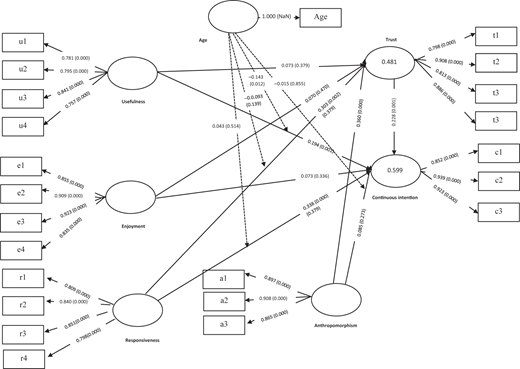
Figure 2 presents the structural model results, and Table 5 illustrates the direct effects between the proposed constructs and customers’ continuous intention to use chatbots in the telecom industry. The results reveal that perceived responsiveness (β = 0.338, t = 3.974, p = 0.000) and perceived usefulness (β = 0.194, t = 3.221, p = 0.001) have significant positive effects on continuous intention. These findings confirm that users’ intentions to continue using chatbots are primarily driven by functional value, encompassing both the system’s usefulness and its responsiveness in addressing customer needs. Conversely, perceived responsiveness (β = 0.085, p = 0.273) and perceived anthropomorphism (β = 0.073, p = 0.336) did not show significant effects on continuous intention. This indicates that users in the telecom context are less influenced by human-like or hedonic features when deciding whether to continue using chatbots.
As shown in Table 6, trust fully mediates the relationship between anthropomorphism and continuous intention (β = 0.082, p = 0.017) and partially mediates the relationship between responsiveness and continuous intention (β = 0.069, p = 0.030). These findings highlight the pivotal role of trust as a relational bridge through which social and interactive cues influence sustained use. However, no mediation effects were observed for usefulness or enjoyment, implying that these factors influence continuous intention primarily through direct rather than trust-based mechanisms.
Table 7 presents the moderation analysis results. Among the four tested interactions, only age × perceived usefulness demonstrated a statistically significant effect on continuous intention (β = −0.143, p = 0.012). This finding suggests that users’ age plays a role in how they evaluate the usefulness of chatbots, with younger or more tech-savvy users possibly attributing more value to functional features than older cohorts. The interaction effects of age with perceived anthropomorphism, perceived responsiveness and perceived enjoyment were not significant. These results suggest a general consensus across age groups in how emotional, responsive and human-like chatbot attributes are perceived, indicating that age does not substantially alter these interpretations.
5. Discussion
This study examined factors influencing the continuous intention to use chatbots in Jordan’s telecom industry. The results highlight that perceived responsiveness has the strongest and most consistent influence on users’ continuous intention to engage with chatbots. This outcome suggests that when telecom customers perceive chatbots as responsive, it signals their effectiveness, thereby fostering continued use and trust. This finding aligns with previous studies conducted by Baabdullah et al. (2022) and Park and Lee (2024), which demonstrated that responsiveness significantly influences customers' trust in chatbot services. These findings reinforce the argument that responsiveness plays a pivotal role in shaping customers’ evaluative and behavioural responses towards AI-driven service tools, especially in service industries where users seek quick and effective problem solutions.
Perceived anthropomorphism was also found to have a positive impact on trust, but did not directly affect continuous intention to use chatbots. This result is consistent with the findings of Fatima et al. (2024) and Liu and Tao (2022). While human-like characteristics can enhance trust, they do not necessarily lead to increased acceptance of chatbots. Similarly, Al-Shafei (2025) found that anthropomorphism has a significant impact on user satisfaction. This suggests that perceived anthropomorphism alone does not drive continued use intention in the telecom context. This emerging research direction, as highlighted by Rajumesh (2024), emphasises that successful anthropomorphism depends on balancing human likeness with authenticity and efficiency.
The findings also indicate that hedonic attributes, such as perceived enjoyment, do not significantly influence continuous intention and trust when using chatbots within the telecom industry. This contrasts with earlier studies, such as Ashfaq et al. (2020), which identified perceived enjoyment as a key driver of sustained chatbot usage. In service settings like telecom, users typically engage with chatbots out of necessity, aiming to resolve issues or obtain specific information efficiently and accurately, rather than seeking emotional engagement or entertainment. This contrasts with other industries, such as food delivery or retail, where users interact more casually, and thus, enjoyment plays a greater role in encouraging continued use. This result is supported by Yuan et al. (2022), who found that functional attributes have a primary effect on the acceptance of AI assistants rather than hedonic ones, and perceived usefulness positively influences continuance intention. Similarly, the research findings are aligned with a recent study conducted by Ma et al. (2025) that shows that perceived usefulness significantly shapes users’ behaviours and influences their intention to use ChatGPT. Together, these results strengthen the suggestion that usefulness and responsiveness are the most influential factors driving continued chatbot use in high-stakes service contexts.
Furthermore, the findings demonstrate that trust mediates the relationship between responsiveness and anthropomorphism on one hand and chatbots’ continuous intention on the other. This underscores trust’s pivotal role as a psychological mechanism that transforms users’ positive perceptions of chatbot functionality and human likeness into long-term behavioural commitment. These are consistent with Liu and Tao (2022), who reported that anthropomorphism indirectly builds acceptance through trust. Therefore, trust acts as a relational bridge, affecting users’ sense of reliability and safety in chatbot-assisted interactions.
Regarding demographic differences, this study found that age moderates the relationship between perceived usefulness and continuous intention, with younger users showing a stronger intention to continue using chatbots. This may reflect generational comfort with AI-based tools, as younger users, being more technologically familiar, derive greater value from chatbot use. However, age did not significantly moderate the effects of enjoyment, anthropomorphism or responsiveness on continuous intention. This finding diverges from studies such as Klein and Martinez (2023), who reported that younger users are more likely to find chatbots engaging, but aligns with Sboui et al. (2024), who reported that perceived ease of use and performance expectancy were not decisive for Generation Z users. This pattern suggests that across age groups, perceived usefulness and trust remain the most universal and enduring predictors of continued chatbot use.
6. Conclusion and implications
6.1 Theoretical implications
This study contributes to the existing literature by developing a comprehensive model of human–chatbot interaction through integrating TAM and S-O-R models. This integration captures the cognitive and emotional aspects of human behaviour towards chatbots. While the TAM model has been widely used to explain the acceptance of using technology from a rational and cognitive aspect, it overlooks the emotional experience of users while using and interacting with technologies. On the other hand, the S-O-R model relies on external stimuli that influence human behaviour. The integration of these two models demonstrates that human–chatbot interaction is a combination of mental and emotional processes elicited by the technology.
This study advances the literature by incorporating perceived anthropomorphism as an external stimulus in human-chatbot interaction, allowing scholars to gain deeper insights into this interaction by considering different human-like features, such as voice and appearance. This highlights the importance of chatbot design and its impact on the socio-technical dynamics of the human–chatbot interaction. This valuable contribution supports interdisciplinary perspectives by bridging psychological and technical aspects, extending the boundaries of traditional acceptance models. Furthermore, studying the impact of the anthropomorphic aspects of chatbots is a promising research topic that aligns with the call in the literature to humanise AI agents (Shin et al., 2023). The findings also illuminate the fact that age is more than a demographic variable, representing a transformative contextual factor. Gradually, different industries will be serving customers who have grown up in a fully digital environment in which technology use is intuitive and embedded, rather than driven by functional needs. This highlights the importance of capturing evolving cognitive and behavioural patterns as new user generations emerge.
6.2 Practical implications
This study offers practical implications for effective design and deployment of chatbots in the telecom industry. The findings emphasise that responsiveness plays a central role in shaping trust and encouraging customers to continue engaging with chatbot services. Improving responsiveness should therefore be a priority for telecom providers. This can be achieved by refining back-end systems, such as upgrading natural language processing engines to deliver faster and more accurate replies and by improving front-end elements, including clearer and more context-aware dialogue. These improvements can reduce customer effort, increase satisfaction and support more efficient service delivery across different income groups.
Trust also emerged as a crucial factor in sustaining long-term use. Even when chatbots are efficient or appear human-like, users must perceive them as reliable. Telecom companies can build this trust by maintaining a consistent communication tone, offering transparent explanations about data use and providing smooth pathways to human agents when needed. Simple additions – such as response ratings, progress summaries, or brief recaps of previous interactions – can help reassure users that the system is dependable and attentive to their needs.
While anthropomorphic features increased trust, they did not directly affect continuous intention. This suggests that human-like elements may help customers feel more comfortable in early interactions but are not enough on their own to secure long-term use. As such, features like chatbot names, avatars, emojis or friendly phrasing should be seen as supportive tools that enhance warmth rather than as core design priorities. They may be most effective during onboarding or in situations where users require reassurance or emotional comfort.
The results also shed light on the expectations of younger users. For this group, maintaining high performance standards such as speed, reliability and seamless communication is essential. Younger customers, who tend to be more technologically confident, are motivated primarily by convenience and functional efficiency. Telecom firms should therefore focus on optimising system speed, reducing unnecessary steps in conversations and ensuring that chatbot interactions clearly deliver value. Finally, the non-significant role of perceived enjoyment indicates that entertainment-driven features or novelty alone do not sustain long-term engagement. While playful design elements may attract initial interest, they are unlikely to influence users’ ongoing behaviour. Providers should avoid overinvesting in gamification or overly animated chatbot personalities. A more effective approach is to offer a straightforward, efficient experience complemented by optional personalisation tools such as preferred tone, language or pace, allowing users to tailor their interaction style according to their needs.
6.3 Limitations and future research
This study has several limitations. First, the study was conducted in Jordan, where AI-based customer service tools are still in the early stages of establishment. This context may influence user attitudes and behaviours differently than in regions with more mature AI ecosystems. Future research should replicate and extend this study in other countries, particularly those with advanced AI integration, to explore how cultural and technological contexts shape user engagement with chatbots. Second, although age was examined as a moderating variable, other potentially influential demographic and behavioural characteristics, such as gender, education level or digital literacy, can be considered to understand how these factors influence the continuous intention to use chatbots. Third, although the study provides valuable insights into the continuous use of chatbots, the sample was largely composed of respondents under the age of 40 (93.1%). This age concentration may limit the generalisability of the findings, particularly regarding the moderating role of age and the relationship between technological familiarity and continued usage. Future research could address this limitation by employing purposive or stratified sampling techniques to ensure greater representation of older age groups (40 years and above). Such efforts would enable a deeper understanding of potential generational differences in perceptions, attitudes and sustained engagement with chatbot technologies. Finally, the study relied solely on a structured questionnaire to collect data. While this method is effective for identifying general trends, it may not fully capture the complexity of user experiences and perceptions. Future studies could incorporate qualitative methods, such as interviews or focus groups, to explore users’ attitudes, expectations and concerns in greater depth or experimental designs to test the impact of specific chatbot features such as tone, personalisation or interactivity on user satisfaction and continued usage.