


This research examines the structure of financial markets by integrating game theory and fuzzy logic. The objective is to develop a differential game model that analyzes competition among financial firms within a specific industry.
This study employs a differential game model, where players set service prices, dynamically influencing market shares and profits over time. The model incorporates two fuzzy criteria—market power (price-variable cost ratio) and product differentiation (Herfindahl-Hirschman index)—to assess market structure. These criteria are applied to data from Tehran Stock Exchange (TSE) industries, specifically banking, insurance, and e-commerce, to evaluate their respective market structures.
The results indicate that financial industries tend to be closer to perfect competition compared to other market structures. Additionally, a comparative analysis of the status of these industries in relation to each other reveals that the banking and the e-commerce industries exhibit characteristics of monopolistic competition, whereas the insurance industry aligns more closely with perfect competition. This study provides useful insights into player behavior and its implications for financial policy, aiding in market analysis and forecasting.
This research offers a novel approach by integrating game theory and fuzzy logic to analyze the structure of financial markets.
1. Introduction
The financial industry is one of the most important and complex sectors of the global economy, playing an important role in finance provision, fund transfers, financial services supply, and the regulation of monetary and credit policy (Mandal et al., 2024). These industries operate in a competitive, dynamic, and imperfect environment that requires accurate analysis and optimal decisions. The study of competition and market structure in the financial industry is particularly significant (Alomari, 2024). Various theoretical and empirical tools can be used to analyze competition and market structure in financial markets (Daghighi et al., 2014). One of these tools is game theory, which examines the strategic behavior of rational actors (Raoufiniya et al., 2019). Game theory can model relationships between financial firms under different market conditions and derive optimal strategies for each firm (Darvishi and Heydari, 2021; Bekius and Gomes, 2023). However, it faces challenges such as uncertainty, insufficient information, and ambiguity, which can reduce its accuracy and efficiency. To overcome these challenges, fuzzy logic can be integrated. Fuzzy logic models ambiguous and incomplete concepts (Davari et al., 2023), by defining different degrees of truth and falsity for each statement and enabling fuzzy computation and decision-making using fuzzy membership functions and inference rules. Fuzzy logic enhances game theory’s ability to handle uncertainty and insufficient information effectively (Daghighi Asli et al., 2014; Wang, 2024). This paper presents a combined model of game theory and fuzzy logic to analyze competition and market structure in the banking, insurance, and e-commerce industries. This model examines the behavior of financial institutions under conditions of uncertainty and insufficient information, determining market structure using fuzzy market power and product differentiation criteria for each industry. The Kalman-Jacobi method is applied to solve the differential game model, using relevant criteria to evaluate the results and incorporating data from the banking, insurance, and e-commerce sectors of the Tehran Stock Exchange (TSE) [1].
In this study, we aim to contribute to the existing literature by integrating game theory with fuzzy logic and applying Kalman filtering techniques to analyze competition among financial firms. Our paper unfolds in three main parts. First, we employ Kalman filtering methods to model dynamic decision-making processes among financial companies over time. Second, we bridge the gap between game theory and fuzzy logic by proposing a novel combined model to analyze market competition in the financial industry. Finally, we extend our analysis to the TSE to gain valuable insights into the Iranian financial market landscape. The choice of the TSE as an empirical context is justified by its accessibility and representativeness of financial markets in the region, allowing for broader generalization of our results to similar contexts.
The article is organized as follows. Section 2 introduces the fundamental concepts and principles of game theory and fuzzy logic, along with a review of the relevant literature. Section 3 presents the research method, including the differential game model, fuzzy market power criteria, product differentiation criteria, the Kalman-Jacobi method, and the proposed algorithm. Section 4 presents the result of applying the model to TSE financial industry data, which includes data from 100 financial institutions in 2023. This dataset comprises variables such as price, quality level, investment level, and market share for each institution. The model and criteria are applied to determine the industry’s market structure, with results presented in tables and charts. To implement the model, the differential game model is first solved using the Kalman-Jacobi method to derive optimal strategies for each institution as functions of state variables. Then, fuzzy market power criteria are calculated for each institution together with product differentiation criteria to determine market structure using a fuzzy table.
2. The theoretical framework
This study integrates multiple advanced approaches to achieve a precise and realistic analysis of competition in financial markets. By combining analytical models, the study provides deeper insights into the competitive behavior of financial institutions, while enhancing decision-making and risk management. Specifically, the study examines competition among financial institutions using a hybrid model that incorporates the Kalman-Jacobi model, game theory, and fuzzy logic. These analytical models are essential due to the inherent complexity and uncertainty of financial markets, as well as the need to understand the behavior of economic agents under competitive conditions.
2.1 Game theory
Game theory is an important branch of applied mathematics that examines strategic decision-making in situations where different players have either conflicting or aligned interests (Praveena and Prasanna Devi, 2022; Debnath and Kamaci, 2023). It is particularly relevant for analyzing competition among financial institutions, as it helps determine optimal strategies and predict the behavior of market participants. Game theory can model both competitive and cooperative situations between financial institutions through various game structures. The primary objective is to identify optimal strategies for each player (financial institution) that maximize their profits while considering the strategic actions of others (Bebeshko, 2022; Praveena and Prasanna Devi, 2022). By simulating decision-making in competitive and cooperative conditions, game theory ultimately enhances market efficiency and sustainability (Kumar, 2013; Shen and Hou, 2021).
A key concept in game theory is the concept of strategy, which consists of a predefined set of rules that dictates each player’s move based on the evolving game conditions. For a strategy to be meaningful, the game must have well-defined moves, which can be categorized as either “personal” or “random.” A personal move refers to a deliberate choice made by a player from a set of available options in a hypothetical situation, similar to decision-making in chess. In contrast, a random move is a choice that is not made by the player’s decision, but determined by a random mechanism, such as rolling a dice or flipping a coin. In this study, game theory is applied to explain and describe the strategic behavior of financial institutions. In this context, a 3 × 3 matrix model is used to represent and examine these competitive dynamics, as detailed in Figure 1.
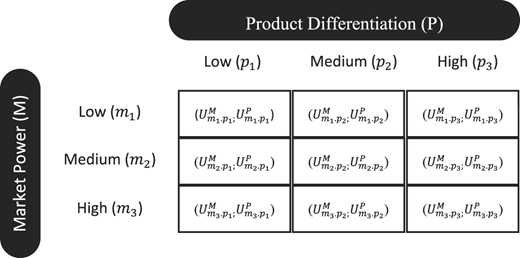
The market power and product differentiation matrix for financial institutions. Source: Authors’ own work
The market power and product differentiation matrix for financial institutions. Source: Authors’ own work
The matrix has shown in Figure 1 comprises three levels of market power—low, medium, and high—and three strategies for product differentiation—low, medium, and high. The intersection of each of these strategies forms a combined strategy, leading to an outcome (desired return or benefits) for each player. For example, represents the benefit to financial institutions () when strategies and are chosen. A Nash equilibrium is a strategic combination in which no player can improve their outcome by unilaterally changing their strategies while the others remain fixed (Bekesiene, 2023). In some cases, one strategy may be superior to all others because it consistently yields a higher payoff. In such cases, regardless of the strategies chosen by the other players, the optimal strategy is always chosen, which is referred to as the dominant strategy. Other strategies that consistently yield lower payoffs are considered dominant strategies. When all players have a dominant strategy, the equilibrium of the game is called a dominant strategy equilibrium.
In this study, differential games, an important branch of game theory, are used to model and analyze the behavior of players in dynamic and complex environments. In differential games, players employ control strategies and dynamic decision-making to optimize their objectives. These games are particularly suitable for modeling situations involving continuous change over time and complex interactions between players. A differential game is a mathematical framework in which changes in system states and strategies are modeled using differential equations. Typically, such games involve multiple players or agents interacting over time, each attempting to maximize their own objective while considering the decisions of others.
The overall structure of differential games consists of several key components. First, there is a state space, which consists of variables that describe the state of the system at a given time. Another key element is control strategies, which represent the decisions players make at each point in time to influence the system’s state. Additionally, the framework includes differential state equations, which describe how the system evolves over time based on the strategies employed. Finally, there is a cost or payoff function, which determines the profit or cost for each player based on the strategies and the system’s trajectory over time. Essentially, this function defines each player’s goal throughout the game and is typically represented as an integral over time, spanning from the beginning to the end of the game horizon, as Equation (1).
Where, represents the objective function of player i, is the instantaneous cost or profit function, and is the marginal cost or profit at the end of the time horizon t.
In a differential game, the optimal strategy for each player is a sequence of controls and decisions that either maximizes their objective function (in the case of profit) or minimizes it (in the case of cost). These strategies must satisfy the necessary optimization conditions, which are determined by the Kalman-Jacobi equation.
2.2 Hamilton-Jacobi-Bellman equation
The Hamilton-Jacobi-Bellman (HJB) equation is one of the fundamental equations in the theory of optimal control and dynamic optimization. It plays a crucial role in decision-making over time, describing the optimal value of a dynamic decision process (Chen, 2024). The purpose of the HJB equation is to determine an optimal policy or strategy that maximizes or minimizes a certain performance criterion (Kim, 2023). The HJB equation is a non-linear partial differential equation, typically represented in Equation (2).
Where, is the value function or optimal value, representing the maximum expected profit or benefit attainable from time until the end of the time horizon, given that the system is in state . is the system dynamics function, which describes the evolution of the state over time under control . is the instantaneous cost or profit function, referring to the immediate cost or profit resulting from applying control in state , and represents the optimization operation to find the best control that maximizes the value function.
The goal of the HJB equation is to determine the optimal control strategy that maximizes the value function by identifying the best possible control at each state and time.
2.3 The concept of Kalman-Jacobi method
The Kalman-Jacobi model is an advanced approach to solving optimal control problems, integrating the Kalman filter with the HJB equation. The Kalman filter is applied within the state-space model, which describes systems that evolve over time. In general, a state-space system is defined by a regression equation for observations and a transition equation. Together, these equations describe the dynamics of the system structure. State-space models are often used in econometrics to model unobserved variables (Caillau, 2023).
The Kalman filter algorithm provides a recursive solution for updating or refining a system described in the state-space model. Instead of storing all past data to generate new predictions and update the model, the Kalman filter directly utilizes mathematical models to adjust and correct the model in real time. It simultaneously solves both the state equations and the measurement equations to optimally estimate unobserved states (Ceci, 2024).
The Kalman filter is a linear optimal algorithm that updates the expected value of a hidden variable based on the latest value (Boumans, 2005). It is linear because it assumes that the observed variable is a linear function of the hidden variable with some noise. Additionally, it assumes that the hidden variable over time is a linear function of itself at time , also subject to noise. These noise components are assumed to follow Gaussian distributions, allowing them to be characterized by an evolving covariance matrix under the assumptions of zero means. Since all these relationships are linear, the expected value of the hidden variable at time is a linear function of its previously expected value and a linear function of the observed variable at time . The Kalman filter is optimal in the sense that it provides the best available estimate under the assumption of Gaussian errors, minimizing the mean squared error of the estimated variables (Zhang, 2013).
3. Research methodology
The study employs a methodology based on library research and content analysis for data collection and analysis. First, the fundamental concepts and principles of game theory and fuzzy logic are introduced, and their applications in different financial areas are examined. Then, a differential game model is presented to analyze competition among financial firms in a specific industry. This model is solved using the Kalman-Jacobi method, with fuzzy criteria for market power and product differentiation structures applied to each industry. Fuzzy membership functions and fuzzy tables are used to achieve this objective. Using a financial industry database — including the banking, insurance, and e-commerce sectors of the TSE — the models and criteria are applied to determine the market structure of these industries, and the results are presented in tables and graphs.
3.1 Differential game model
The game theory model used in this study is a type of differential game. Differential games are dynamic games in which players make decisions over time that affect their control variables (Quincampoix, 2012; Islami and Ehtesham, 2011). These control variables, in turn, influence state variables described by a differential equation. The players’ goal is to maximize or minimize an objective function defined based on state variables and game parameters by choosing optimal control variables (Tukhtasinov et al., 2021). This paper presents a game-theoretic model to analyze competition in the market structures of financial markets. In this model, the players are financial firms operating in a particular industry. The control variables for these players are the prices they set for their products. The state variables are market shares, determined by customer demand and competitors’ prices. The objective function for these firms is profit, calculated based on price, costs, market share, and other parameters. This model is solved using the Kalman-Jacobi method to determine the optimality conditions for each player. The market structure for each industry is then determined using fuzzy criteria for market power and product differentiation.
The combination of game theory and fuzzy logic is used to determine the structure of financial markets. With these two methods, competition among financial firms can be analyzed under conditions of uncertainty and insufficient information. Subsequently, a differential game model is presented to analyze competition among financial firms in a specific industry. In this model, each company offers a financial product that may differ in quality and price from competitors’ products. Each company can improve the quality of its product through investment, while market share is determined based on pricing decisions. Every company strives to maximize its profit. This model is solved using the Kalman-Jacobi method to determine the optimal strategies for each company. The assumptions of the differential game model to analyze competition among financial firms in a specific industry, such as the banking industry, are as follows:
There are two companies, A and B, competing in a bilateral monopoly market.
Each company offers a financial product that may differ in quality and price from the competitor’s product.
Each company can improve the quality of its product by investing in quality enhancement, with costs determined by the level of quality.
Each company determines its market share by setting the price of its product, based on customer demand and competitor pricing.
Each company tries to maximize its profit, calculated based on price, costs, market share, and other parameters.
Based on these assumptions, the differential game model is formulated in Equation (3).
Where, are the prices set by companies A and B; denote the investments in improving the quality of services for companies A and B; represent the quality levels of services for companies A and B; denote the profit functions for companies A and B; represent the functions that describe changes in quality levels for companies A and B; indicates the end time of the game and denote the initial quality levels of services for companies A and B.
Equation (3) can be solved using various methods, with is Kalman-Jacobi method being a common method for solving differential games.
3.2 The Kalman-Jacobi method
The Kalman-Jacobi method is a numerical approach based on Bellman’s principle of optimality., which states that an optimal strategy should maximize both the current profit and the future optimal value at any given time. This method is used to derive optimality conditions for each company, transforming these conditions into differential equations based on the state and control variables of each company (Daghighi Asli et al., 2014). By solving these equations, optimal strategies are obtained for each company as functions of the state variables. The Kalman-Jacobi method follows a step-by-step algorithm as follows:
The first step is to determine the initial values for the state and control variables using approximate values based on historical data or other estimation methods. In the second step, the optimal future value for each company is estimated using numerical techniques such as the finite difference method or the finite element method. In the third step, the optimal values of the control variables are calculated for each company using optimization techniques such as the gradient method or Newton method. In the fourth step, the new values of the state variables are calculated using the differential equations derived from the model. In the fifth step, the relative error between the updated and previous values of the state and control variables is calculated. If the relative error is below a predefined threshold, the algorithm terminates. If not, the process returns to step two and repeats until convergence is achieved. By executing this algorithm, optimal strategies for each company are obtained as functions of the state variables, allowing firms to make strategic decisions based on real-time market dynamics.
3.3 Modeling fuzzy market power and product differentiation criteria
This section presents a game theory model for analyzing competition within financial market structures. In this model, the players are financial firms operating within a particular industry (Oderanti, 2013). The control variables for these players are the prices they set for their products, while their state variables are market shares, which are determined based on customer demand and competitor pricing. The objective function of each firm is profit, calculated using price, costs, market share, and other parameters (Wu et al., 2024). This model is solved using the Kalman-Jacobi method to determine the optimality conditions for each firm. Fuzzy criteria for market power and product differentiation are then applied to determine the market structure for each industry. Market power measures the extent to which an actor can set itself apart from competitors in terms of pricing. It is calculated using the price/cost ratio. A higher ratio indicates greater market power. A lower ratio suggests a more competitive environment with less pricing control. Product differentiation measures how much firms’ products vary from one another. If the products differ more, this means that the players are less dependent on each other. It is calculated using the Herfindahl-Hirschman Index (). A lower ratio suggests greater product differentiation, where firms have distinct offerings. Based on these two measures, a fuzzy matrix of market structure can be created, consisting of four categories, each representing a type of market.
Perfect competition: This market structure occurs when both market power and product differentiation are low. Many firms are offering identical products, and no single firm has control over pricing. As a result, prices align with costs.
Monopolistic competition: This market structure arises when market power is moderate and product differentiation is high. There are many market participants, each offering distinct products. Firms have some control over pricing due to differentiation, allowing them to set prices higher than costs.
Oligopoly: This market structure arises when market power is high and product differentiation is moderate. A small number of players dominate the market, offering similar products. These firms are interdependent, meaning they set prices based on competitors’ behavior. Prices are significantly higher than costs.
Monopoly: This market structure arises when market power is high and product differentiation is low. A single firm dominates the market, offering a unique product. This player has full control over pricing, allowing it to set prices significantly higher than costs.
In the following analysis, market power and product differentiation are determined for each industry based on fuzzy criteria. These criteria are calculated using the price-cost ratio and the Herfindahl-Hirschman index. These criteria can be used to identify market types such as perfect competition, imperfect competition, monopolistic competition, and oligopoly. The modeling of fuzzy criteria is outlined as follows:
It is assumed that there are financial companies operating in a competitive market within a given industry.
Each company offers a financial product or service () that may differ from competitors’ products in terms of quality () and price ().
Each company has a market share () which is determined by customer demand () and competitor pricing ().
Each company has profits (), calculated based on price, costs (), market share, and other parameters.
Two fuzzy criteria are used to determine the market structure: Market power () and product differentiation ().
Market power () measures the extent to which a company can set its product price above production costs. It is calculated using the price-cost ratio ().
Product differentiation () indicates the extent to which a company’s product () differs in terms of quality from competitors’ products. This criterion is calculated based on the Herfindahl-Hirschman index (), which corresponds to the sum of the squares of the market shares of all individual companies in the market.
Fuzzy membership functions are used to calculate these two criteria. These functions assign values between zero and one to each variable, indicating the degree to which this variable belongs to a fuzzy set.
A triangular membership function is used for market power, which is defined in Equation (4).
where and are two parameters representing the minimum and maximum values of market power, respectively. A bell-shaped membership function is used for product differentiation, defined in Equation (5).
Where , and are three parameters representing the minimum, maximum, and center values of service differentiation, respectively.
3.4 The proposed algorithm combines game theory and fuzzy logic
This section presents an algorithm for solving the production combination problem using game theory and fuzzy logic. The algorithm consists of three main stages:
Stage one: Modeling the problem using a fuzzy differential game.
In this stage, financial companies compete with their respective industry groups, including banking, insurance, and e-commerce. Each company adjusts two control variables – price and product investment. Additionally, the quality level and market share of each company are treated as state variables that evolve based on the control variables and competitors’ actions. The mathematical model of this game is expressed using fuzzy membership functions and fuzzy inference rules.
Second stage: Solving the fuzzy differential equations.
The fuzzy differential equations derived in the first stage are solved using the Kalman-Jacobi method. This approach enables the determination of optimal strategies for each company as a function of state variables.
Stage three: Determining market structure using fuzzy criteria.
In the final stage, the market structure is assessed based on fuzzy criteria. Market power and product differentiation metrics are calculated for each company, and the overall market structure for each industry is determined using a fuzzy table. These criteria reveal the extent to which each company can set its product price above competitors or differentiate its product from competing offerings.
4. Findings
The results of the analysis using the proposed algorithm are presented below. This analysis aims to investigate the application of the combined model of game theory and fuzzy logic in analyzing competition among financial companies and determining the structure of the financial market.
Based on the MATLAB software output and Table 1, the following analysis can be considered:
Market structures for the proposed combined algorithm
| Product differentiation | |||
|---|---|---|---|
| Market power | Low | Medium | High |
| Low | Perfect | Perfect | Monopolistic |
| Medium | Perfect | Monopolistic | Monopolistic |
| High | Monopoly | Oligopoly | Oligopoly |
Source(s): Authors’ own work
Market Power: In the banking sector, financial companies exhibit an average market power of about 0.57, indicating relatively high market control. This indicates that banks possess significant pricing power and may influence market conditions. In the insurance industry, the average market power is approximately 0.33, which is lower than that of banks. This could indicate greater competition and market diversity within the insurance sector. In the electronics industry, financial companies have an average market power of around 0.45, positioning them between the banking and insurance industries. This suggests that market power in electronics is moderate with financial firms exercising some level of influence over pricing and market control.
Product Differentiation: In the banking industry, financial companies exhibit an average product differentiation of 0.28, suggesting low differentiation among banking products, likely leading to highly similar offerings across firms. In the insurance industry, the average product differentiation is around 0.34, slightly higher than that in the banking industry. This indicates greater product diversity and differentiation in insurance products. In the electronics industry, the average product differentiation is 0.41, surpassing both the banking and insurance industries. This suggests that the electronics sector offers a highly diverse market with a broader range of differentiated products.
The market structure: Across all three sectors — banking, insurance, and electronics – the market structure aligns with “perfect competition”. This suggests high levels of competition and a converging market structure in each industry. Such conditions can promote innovation and economic efficiency. Overall, Table 2 and the conducted analysis highlight that financial companies in the three studied sectors share common characteristics that contribute to the sustainable development and long-term growth of these industries.
Output of FL-GT combined model algorithm
| Industry | Market power | Product differentiation | Market structure |
|---|---|---|---|
| Banking | 0.57008 | 0.27862 | Perfect competition |
| Insurance | 0.33347 | 0.33751 | Perfect competition |
| E-commerce | 0.45527 | 0.40781 | Perfect competition |
Source(s): Authors’ own work
Table 3 defines the market structure of the industries, integrating the findings from Table 1 and the output algorithm presented in Table 2.
Market structure of various industries based on theoretical foundations and the proposed FL-GT algorithm
| Industry | Market power | Product differentiation | Market structure |
|---|---|---|---|
| Banking | Medium | Low | Monopolistic |
| Insurance | Low | Medium | Perfect competition |
| E-commerce | Low | High | Monopolistic |
Source(s): Authors’ own work
Based on the theoretical foundations and the results of the proposed algorithm, the banking industry exhibits moderate market power and low product differentiation. Consequently, the market structure of this industry falls within the realm of monopolistic competition. This means that banks set prices for their services above their variable costs, yet due to close competition, they cannot establish a complete monopoly. Furthermore, banks seek to increase their market share by offering differentiated and diversified services. However, because banking services are highly standardized, their product differentiation remains low. The insurance industry has low market power and moderate product differentiation, positioning it within the perfect competition framework. This indicates that insurance companies price their services in line with their variable costs and do not exert monopoly or market power. In addition, insurance companies attempt to enhance product differentiation by offering different and customized services. However, due to strict regulatory constraints, their ability to diversify products is moderate.
The e-commerce industry demonstrates low market power and high product differentiation, classifying it under monopolistic competition. This suggests that e-commerce companies price their products close to variable costs, yet due to the high number of competitors, they cannot establish a complete monopoly. However, e-commerce companies differentiate themselves by offering a wide range of products. The presence of advanced technological innovations further enhances their ability to achieve high product differentiation.
Figure 2 illustrates a positive correlation between product differentiation and market power. This relationship suggests that companies with highly differentiated products can charge higher prices and capture a larger market share. Additionally, the figure indicates that market power has been increasing over time, implying a trend toward greater market concentration, where a few large companies dominate the market. This concentration may be driven by several factors, such as economies of scale, barriers to entry, and mergers and acquisitions.
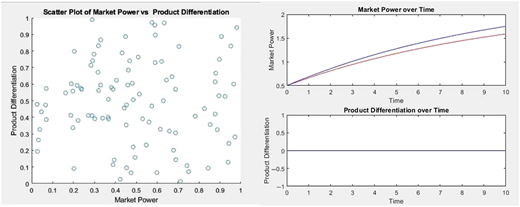
Changes in fuzzy criteria for determining market structure during the game and under ambiguous conditions. Source: Authors’ own work
Changes in fuzzy criteria for determining market structure during the game and under ambiguous conditions. Source: Authors’ own work
Figure 3 depicts the market share of different service differentiation strategies in the banking, insurance, and e-commerce industries in Iran.
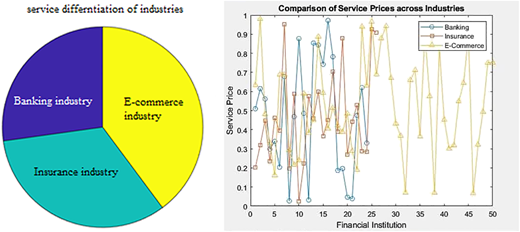
Service differentiation vs. service prices under ambiguous and uncertain conditions. Source: Authors’ own work
Service differentiation vs. service prices under ambiguous and uncertain conditions. Source: Authors’ own work
Figure 4 presents exponential graphs depicting the market structure and depth of different industries. The two axes —market power and product differentiation — are analyzed using game theory principles, highlighting the competitive dynamics and potential strategic interactions among these industries.
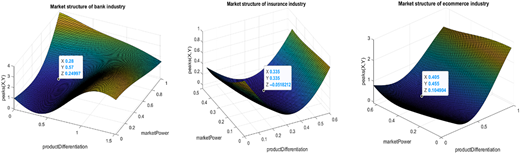
Market structure and market depth of different financial industries. Source: Authors’ own work
Market structure and market depth of different financial industries. Source: Authors’ own work
5. Discussion
The study integrates game theory and fuzzy logic to analyze competition among financial firms in the banking, insurance, and e-commerce sectors of the TSE, yielding important insights into firm behavior and market structures. The findings support the proposed dynamic competition model and offer both theoretical and practical implications for financial policy and strategic decision-making. The combination of game theory and fuzzy logic provides a robust framework for analyzing strategic behavior in markets characterized by uncertainty. Traditional game theory models often assume clear scenarios with precise information, which is rarely the case in real-world financial markets. Fuzzy logic addresses this gap by accommodating the ambiguity and complexity inherent in financial decision-making, especially in volatile markets like the TSE.
A key finding is that the banking and e-commerce industries resemble monopolistic competition, while the insurance industry aligns more closely with perfect competition. This distinction arises from differences in market power and product differentiation. The banking and e-commerce industries exhibit significant market power and moderate product differentiation, suggesting firms in these industries can influence prices while facing intense competition due to the differentiated nature of their products and services. This aligns with theories of monopolistic competition, where firms exert some control over pricing but must continually innovate to maintain their market share. In contrast, the insurance industry, operating in a more regulated and homogeneous environment, shows characteristics of perfect competition. Firms in this sector face lower market power and primarily compete on cost efficiency and customer service, with limited flexibility in price.
The application of game theory to financial markets has been extensively studied, particularly in the context of competition and strategic behavior among firms (Raoufiniya et al., 2019; AlOmari, 2024). However, the integration of fuzzy logic into these models remains relatively novel, especially in the context of the Iranian financial markets. Previous research by (Daghighi Asli et al., 2014) demonstrated the usefulness of fuzzy logic in determining market structure, yet this study extends their work by applying it to a differential game model and incorporating the Kalman-Jacobi method to solve dynamic competition problems.
The findings regarding the banking sector’s high market power are consistent with (Mandal et al., 2024), who examined platform and bank financing in competitive environments. Their study also observed that financial institutions in banking exert significant influence over pricing, especially in regions with concentrated markets such as the TSE. Furthermore, the application of fuzzy criteria for market power and product differentiation aligns with the broader literature on financial competition, where firms’ ability to differentiate their products often determines market outcomes (Wu et al., 2024).
From a policy perspective, the study’s results offer valuable insights for regulators seeking to foster competition and enhance market efficiency in the financial sector. The higher market power observed in the banking and e-commerce industries suggests a need for increased regulatory scrutiny to prevent anti-competitive behavior. Policymakers may also encourage innovation and product differentiation in these industries to promote better consumer outcomes. In contrast, the insurance sector, characterized by perfect competition, may benefit from policies focusing on cost control and operational efficiency rather than stimulating competition. Given the homogeneous nature of insurance products, regulatory priorities should emphasize consumer protection and transparency, as competition alone may not drive significant innovation in this industry.
The Kalman-Jacobi method has proven effective in modeling the dynamic nature of competition, allowing financial firms to make real-time strategic adjustments. This capability is particularly relevant in the fast-moving environment of the TSE, where firms must continuously adapt their strategies to remain competitive.
6. Conclusion
The study presented a combined algorithm integrating game theory and fuzzy logic to analyze the structure of financial markets. This model was applied to assess competition among financial firms in the banking, insurance, and e-commerce industries. Market power and product differentiation for each company were calculated using fuzzy membership functions with real data, and the market structure for each industry was determined using a fuzzy table.
The results indicate that all three industries approach perfect competition. This suggests that financial companies in these industries are not able to set significantly higher prices than their competitors or effectively differentiate their products from those of their competitors. The findings contribute to analyzing and predicting player behavior and its implications for financial policy. A differential game model was used to analyze competition within financial firms, followed by the application of fuzzy criteria to determine market power and product differentiation. Finally, the model and criteria were then applied to financial industry data from the TSE, with results presented using the Kalman-Jacobi fuzzy method.
The results demonstrate that the differential game model effectively determines the optimal pricing and investing strategies for individual firms based on state and control variables. In addition, fuzzy criteria for market power and product differentiation offer a more accurate representation of market structure compared to classical measures. The analysis indicates that the Iranian banking industry is in a state of perfect competition in terms of market structure, with financial firms having different levels of market power and product differentiation. While the integration of game theory and fuzzy logic provides a robust framework for analyzing competition, this study has some limitations that warrant further research. One such limitation is the focus on three specific industries within the TSE. Future studies could expand this analysis to other financial markets or industries to assess the generalizability of the findings. In addition, the model could be enhanced by incorporating cooperative game theory or repeated game structures to explore long-term strategic alliances or collusion among firms.
This article represents a first step toward integrating game theory and fuzzy logic in financial market analysis. However, several challenges and open questions remain for further research. These include (1) evaluating the impact of environmental changes on competition among financial firms and market structures; (2) developing differential game models with alternative game structures, such as cooperative games, repeated games, and dynamic games; (3) providing optimal numerical methods for solving differential game models and computing fuzzy criteria, and (4) expanding the application of combined game theory and fuzzy logic to other industries, such as stock markets and the energy sector.
Note
The data was collected from the website of the Securities and Exchange Organization at www.codal.ir

