This paper introduces Foresight as a structured approach that is increasingly employed across industries and disciplines for anticipating future change and proposes its utility for the heritage sector. We illustrate how integrating greater Foresight into heritage practice can encourage proactive engagement with emerging trends; develop resilient strategies for heritage research, planning and management; and locate where heritage-based actions can bring transformative change for both communities and societies.
This paper presents research undertaken as part of the Alliance for Cultural Heritage Research in Europe (ARCHE) to inform a new Strategic Research and Innovation Agenda. We analysed foresight and future-oriented publications from a range of disciplines to consolidate insights on current and emerging trends across sectors and global regions and to understand the heritage sector's engagement with Foresight approaches thus far.
The analysis identifies several drivers shaping our existing and future landscape and their implications for heritage research and practice. It also highlights opportunities for action where heritage can have a vital role in shaping futures and catalysing societal benefits. To conclude, the paper discusses gaps in the current body of heritage foresight research and identifies avenues to produce a more robust corpus to reflect a greater diversity of perspectives.
As the present study corroborates, the cultural heritage sector has had little engagement with foresight methods, despite the acute relevance of the future to heritage concepts and praxis.
Introduction
The scale and pace of physical and conscious shifts witnessed over the past decades are not only dramatically reshaping current realities but also amplifying uncertainty about the future. Accelerating technological growth, shifting demographics, emerging markets and changing geopolitical power, are consistently cited as major drivers shaping global futures. These drivers, often referred to as megatrends, are key transformative factors shaping the long-term development of societies and industries (UK Government Office for Science, 2017; Ernst and Young, 2015). In response to these changes, many sectors are adopting futures approaches such as Strategic Foresight to remain relevant, adapt and build resilience by anticipating emerging trends and developing strategies to navigate an uncertain future.
Strategic Foresight is described as a “structured and systematic way of using ideas about the future to anticipate and better prepare for change” [1]. At its core, Strategic Foresight involves a methodical analysis of current and emerging drivers of change, from which diverse future scenarios can be constructed. These can be used to explore how different forces might interact to create new dynamics and uncertainties, providing insights into how cascading impacts could potentially unfold across various levels (National Intelligence Council, 2021). Unlike conventional strategic planning, which typically focuses on a one-to-five-year timeframe, Strategic Foresight explores deeper horizons (Iden et al., 2017), raising critical questions about how changing contexts might shape communities, nations and global systems in the coming decades. Through its systematic and structured exploration of emerging trends and their implications, Strategic Foresight can enhance our capacities to anticipate and adapt to change, building greater resilience to future uncertainties.
While Strategic Foresight is a valuable tool for supporting strategic planning and decision-making, it remains relatively underutilised within the cultural heritage sector (Sandford and Cassar, 2020). Acknowledging this gap, in 2021, the International Centre for the Study of the Preservation and Restoration of Cultural Property (ICCROM) launched its Foresight Initiative [2]. This initiative seeks to explore how Foresight techniques can be applied to improve organisational planning and strategy development across the sector. The initiative began with a Horizon Scanning study to gather intelligence about macro-environmental changes that may impact cultural heritage in the future. The insights from this Horizon Scan shaped the development of ICCROM's longer-term strategy. However, the findings also highlighted the need for further work to deepen understanding around how Strategic Foresight methods can inform strategy development in different sectoral, organisational and community contexts (Heritage et al., 2023).
In the follow-up to the initial study, between October 2022 and March 2023, ICCROM conducted an in-depth review and analysis of Foresight and other future-oriented studies and reports. This review covered a wide range of resources published from 2010 to 2022, drawing from diverse fields such as business, the economy, the environment, healthcare, education, arts, culture and heritage (see Wollentz et al., 2023). This included, for example, annual Foresight reports, megatrends analyses or global outlook reports from organisations such as the European Commission, McKinsey & Company and World Economic Forum. Over 60 reports and publications were analysed to identify existing, emerging and anticipated trends on global or regional scales, with time horizons which ranged from four to 79 years into the future. The analysis involved a number of steps:
Active and thorough reading of each document to ensure familiarisation with the context and narratives.
Extraction of citations directly from the literature with sentence and/or paragraph highlights and page numbers, which were collated into an Excel database.
Coding of the extracts with keywords to categorise the qualitative data or its context.
Coding of the extracts into iterative “sub-theme” categories, created through a cyclical act of identifying further codes and links across the raw data.
Coding of the extracts into one or more categories of an adapted PESTLE framework: Political, Research, Environmental, Social, Technological, Economic, Legal (PRETSEL).
Consideration of potential influences the keywords and sub-themes might have on the heritage sector, in any capacity. Identification of research methods and methodologies undertaken in each literature.
Following this analysis, identified trends affecting cultural heritage and their associated future scenarios were discussed with heritage researchers and practitioners during a stakeholder workshop. This collaborative dialogue aimed to broaden perspectives, tap into new expertise and uncover blind spots to surface and challenge assumptions made within the analysis.
The resulting report identified and assessed broad trends that are shaping, or could shape, the future heritage landscape and explored their potential impacts and implications for the heritage sector. Cross-cutting themes and potential opportunities for action within the sector were also highlighted, alongside key considerations for policymakers, researchers and practitioners. These findings informed the development of a Strategic Research and Innovation Agenda (SRIA) to support joint programming for European heritage research and innovation (ARCHE Consortium, 2025) – a key objective of the EU Alliance for Research on Cultural Heritage in Europe (ARCHE) project, launched in 2022 [3]. Beyond this primary objective, the study also sheds light on how other sectors employ Strategic Foresight and the potential benefits that heritage organisations could derive from similar approaches.
In this paper, we discuss the potential role of Foresight in heritage research, policy and practice and make the case regarding its advantages for the sector. We begin by introducing Strategic Foresight within broader futures approaches, discussing how it can be applied and its relevance to cultural heritage. We then present the work carried out by the ARCHE project as a case study. To conclude, we discuss how Foresight research can provide valuable insight to strengthen community resilience and build better collective futures.
Introducing and contextualising Foresight
The focus of this paper is Foresight, an exploratory approach that examines diverse potential futures through scenarios, trends and developments. By considering these insights, Foresight aims to inform present actions and strategies to help shape more desirable outcomes. Unlike conventional planning, which typically focuses on relatively short timeframes, Foresight engages with much longer temporal horizons, sometimes extending 50 years or more. Central to Foresight is the concept of Anticipation, the cognitive process of actively considering different potential futures and building resilience and flexibility into our responses to these possibilities (Miller, 2018, p. 2). Anticipation helps us identify emerging opportunities by envisioning multiple scenarios of change, thereby challenging the established assumptions in dominant narratives about the future.
Within the broader field of Foresight, Strategic Foresight specifically focuses on organisational strategic planning – used by organisations and governments to identify emerging issues and assess their potential impacts, to inform policy and strategy development (Sandford and Cassar, 2020). This systematic process employs a wide variety of approaches, tools and skills, enabling organisations to use Anticipation to be proactive rather than reactive to change. This helps better envision and shape different futures. By expanding our awareness of multiple possible futures that could arise, Strategic Foresight encourages more creative thinking – unlike traditional Forecasting, which attempts to predict the future by extrapolating from historical data and current trends (Poli, 2017, pp. 6-7). By contrast, Strategic Foresight does not aim for precise predictions but rather for an expanded understanding of possible outcomes, helping to evaluate risks and uncertainties. This, in turn, enhances decision-making by identifying strategies through which to pursue more desired futures (Kishita, 2021). This approach can be applied at different levels, to shape policy, develop resilient strategic plans and recognise ways in which current or emerging trends might impact long-term visions and goals (Poli, 2014, 2017). More critically, it helps move beyond scenarios based around the attainment of fixed goals and focus on other possible, probable and desirable futures (Miller, 2007; Bell, 2009, pp. 73-114).
One point to highlight is that Foresight is often wrongly conflated with conventional planning methodologies with which it shares certain characteristics. While tools such as assemblage theory, system dynamics, strategic planning, predictive modelling and scenario development offer valuable insights, Foresight is grounded in distinctive epistemological commitments and methodological orientations that are quite different and shape its unique contribution to long-term strategy development.
The following outlines some of these distinctions:
Like assemblage theory, Foresight recognises complexity, contingency and the dynamic interplay of diverse elements, but while assemblage is primarily descriptive and ontological, Foresight is explicitly normative, seeking to shape rather than simply describe possible futures. System dynamics, as another tool, provides a valuable causal loop and a systems-thinking approach used to understand and simulate how things accumulate and change over time and while Foresight can incorporate such quantitative tools, it extends beyond them by integrating qualitative insights, weak signals and emerging trends that lie outside the bounds of measurable data. Meanwhile, strategic planning offers structured frameworks for achieving agreed objectives within existing institutional contexts; by contrast, Foresight often interrogates and reframes the very assumptions and goals those strategies are built upon. Moving to predictive modelling, which uses historical data to forecast future states, instead Foresight acknowledges the limits of such projections in the face of deep uncertainty and non-linear change. Finally, while scenario development is common to both fields, in traditional planning it is frequently used for contingency purposes, whereas in Foresight it functions as a generative tool for expanding strategic imagination and reframing the present to open new pathways for action (Table 1).
Table 2 provides further insight into methodological distinctions between Foresight and established conventional approaches.
Foresight methodologies tend to be exploratory rather than deterministic. While this orientation may be difficult to operationalise within institutional structures, Foresight draws on diverse epistemic communities, which enable it to engage productively with deep uncertainty and ambiguity. Its purpose is not to replace traditional planning approaches but rather to complement them and where necessary, challenge their assumptions.
Moreover, engaging in Strategic Foresight helps develop Futures Literacy (FL) – the ability to “use the future” through anticipation (Poli, 2021). FL strengthens an individual's or organisation's capacity to navigate future complexities, uncertainties and risks and to think critically about interconnections between present and future. In this way, practising Foresight enhances flexible thinking about the future, enabling more informed and adaptable decision-making within a rapidly changing world. Critically, this flexibility, combined with the interdisciplinary and inclusive nature of Foresight methods, promotes cross-boundary thinking and encourages interdisciplinarity.
Over the past decades, Foresight has developed into an established field integrated across a wide range of disciplines and applications. With dedicated journals, university courses, museum exhibitions and transnational networks [4], its value is increasingly recognised and embedded within international, national and institutional frameworks. For instance, the United Nations (UN) recently acknowledged its system “lacked a high-level space for futures and foresight, which has led to fragmentation and lost learning”. In response, the UN is setting up five Foresight “elements” [5] to expand and improve its Strategic Foresight activities (The Millennium Project, 2022, p. 2). Similarly, the OECD has long advocated for foresight through its Strategic Foresight Unit and the OECD Government Foresight Community, which brings together public sector Foresight practitioners. At the national level, countries are increasingly establishing dedicated government units or departments for Strategic Foresight and futures thinking [6]. Notably, Foresight is also entering national legislation as a key component of good governance – examples include the Well-being of Future Generations (Wales) Act (2015), passed by the Welsh Assembly and New Zealand's Public Service Act (2020) which requires all government departments to undertake foresight reviews (known as Long-term Insights Briefings) at least once every three years.
Within academia, future-oriented fields in the social sciences and humanities, such as critical futures (Ahlqvist and Rhisiart, 2015; Goode and Godhe, 2017; Inayatullah, 2013), sociology of futures (Adam and Groves, 2007; Urry, 2016) and the anthropology of the future (Bryant and Knight, 2019) have emerged. Important contributions have also been made in anticipation studies (Poli, 2017; Miller, 2018). These disciplines critically challenge standard approaches based on predictive models that forecast the future based on current trends and seek to instrumentalise the future for present gains. Predictive models, exemplifying a Forecasting approach, assume the continuity of current trends and are often used by companies to “optimise the future” for present economic growth (Poli, 2017, p. 69). However, sociologists Adam and Groves (2007, p. 10) have argued that such uses of the future risk imagining “a future emptied of content and divorced from context, a future that can be calculated anywhere, at any time and exploited for any circumstance”. In other words, these models do not help us build FL, nor do they prepare us to deal with the unexpected.
In contrast, Foresight takes a more creative and critical approach to the future. It helps us develop FL and prepares us to deal with uncertainty by moving beyond the limitations of forecasting models and prompting deeper thinking about how we can engage with and adapt to an unpredictable future.
Heritage and the future
Heritage practice has always, implicitly or explicitly, involved forms of Foresight. The very act of preservation is a future-oriented choice – one that determines what cultural resources will be available to subsequent generations and under what conditions they will be encountered. The creation of Acts and Conventions, such as Antiquities Acts in the United Kingdom or USA or the World Heritage Convention by the United Nations, that developed over the 19th and 20th centuries, demonstrate how policymakers and conservationists framed heritage (and landscapes) not simply as contemporary assets but as legacies to be safeguarded in perpetuity, embedding a vision of intergenerational benefit that aligns closely with the grand discourse of sustainability. From this perspective, heritage production can be understood as a long-running exercise in anticipatory governance, one in which societal values, political contexts and imagined futures converge to shape decisions about what is preserved, how it is managed and for whom. Situating heritage within the conceptual frame of Foresight therefore invites a re-reading of its history – not as a series of isolated acts of conservation, but as an enduring tradition of negotiating the long-term futures we wish to inhabit.
Understanding heritage as an inherently future-oriented practice creates a valuable bridge to contemporary Strategic Foresight methodologies. Whereas earlier heritage decisions – such as the designation of heritage assets – were often guided by moral imperatives, aesthetic values or conservationist sentiment, modern Foresight frameworks introduce systematic processes for anticipating change, assessing risks and envisioning multiple plausible futures. These tools, from Horizon Scanning to Scenario Planning, make explicit the kinds of anticipatory judgements that heritage actors have long made implicitly. Yet they also expand the temporal and thematic scope of decision-making, incorporating climate modelling, demographic projections and socio-political trend analysis into heritage planning. In this way, Strategic Foresight both formalises and diversifies heritage's historical role as a custodian of the future, offering new ways to navigate uncertainty while remaining rooted in the sector's deep tradition of thinking beyond the present.
As such, heritage scholars have focused attention on the intricate relationship between heritage processes and perceptions of the future. The future is manifested in the present through a vast array of visions/images that are based on projections, estimations, expectations, fears, hopes and desires (e.g. Adam and Groves, 2007; Bryant and Knight, 2019). These visions/images – which often draw upon and are activated by heritage processes – create meaning and influence societal activities (Harrison, 2016). Thus, perceptions of the future are expressed through various social practices that both draw upon and create heritage (Harrison et al., 2020; Holtorf and Högberg, 2022). Indeed, heritage itself is continuously created and transformed through future-oriented practices (e.g. Wollentz et al., 2019).
This connection underlines the relevance of Foresight to the heritage sector, which frequently emphasises a moral responsibility towards the future. Indeed, as mentioned above, “future generations” are often invoked as the beneficiaries of our current preservation efforts (Smith, 2007; Lelyveld and Taylor, 2021; Heritage, 2023; Heritage et al., 2023), a notion also reflected in key texts, policy and strategy documents (e.g. UNESCO, 1972) that frame the conservation of heritage as a duty to safeguard cultural assets for future generations. Despite this stated responsibility, research has shown that the heritage sector lacks sufficient Foresight and futures consciousness (Högberg et al., 2017, 2022). This gap is evident in the sector's limited reflection on critical questions, such as who these future generations might be, how their world may differ from ours and how the value and care of heritage might evolve over time. This lack of reflection compromises the potential relevance and adaptability of current heritage practices to future realities.
Developing FL within the heritage sector offers a potential way to address this gap. By encouraging a more nuanced understanding of the future, FL can help heritage actors understand how perceptions of the future can inform contemporary heritage processes. In doing so, FL can contribute to assembling more desirable futures and enhancing the role of heritage in future-making.
While futures thinking in heritage studies is gaining momentum (Högberg et al., 2017; Harrison et al., 2020), Foresight is still a relatively new approach to cultural heritage that needs further research and application (Sandford and Cassar, 2020; Holtorf and Högberg, 2022). This gap motivated the launch of ICCROM's Foresight Initiative, which seeks to encourage a more proactive outlook in the heritage sector. Thus far, the Initiative's activities have included a global Horizon Scan study to explore the potential future landscape for heritage (Heritage et al., 2023), Foresight workshops to shape ICCROM's Strategic Directions (2026–31) and the case study presented below to inform a forward-looking SRIA for the ARCHE project.
Case study: the ARCHE Foresight study analysis
Methodology
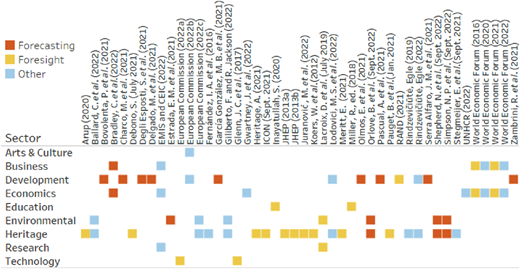
To probe the future landscape for cultural heritage and associated research needs, we conducted an analysis of Foresight and other future-oriented studies to consolidate existing insights on current and emerging trends. A total of 46 English-language publications were analysed, selected through recommendation and targeted report-scanning ( Appendix 1). The corpus encompassed a wide variety of formats, including white papers; peer-reviewed articles; research agendas; and working papers and reports published by governments, research institutions, inter- and non-governmental organisations, professional associations and the private sector. To gain a broader perspective, literature was also sourced from adjacent sectors likely to impact heritage (see Figure 1), drawing on studies that employed Strategic Foresight as well as forecasting methods.
This collected body of literature was then systematically analysed to identify key messages, lessons learnt and significant research findings. These were then categorised into themes that addressed both existing structural forces (such as demographics, the state of the environment, economics and global affairs; and technology) and key emerging trends, including factors likely to shape them over time. Critical uncertainties were also noted to broaden the scope of potential future trends. Time horizons ranged from four to 79 years into the future, with most studies focusing on a ten to 30-year timeframe. All extracts were systematically coded using a multi-round, abductive coding approach. To ensure the final coding remained close to the raw data this process involved the iterative creation of keywords and sub-themes, that were then categorised using a modified STEEP (social, technical, economic, ecological and political) framework (UK Government Office for Science, 2017; Thompson, 2022; Saldana, 2015): “PRETSEL”, an acronym for Political, Research, Environmental, Social, Technological, Economic and Legal. This approach yielded a rich dataset providing nuanced insights and subtle distinctions to consider within the wider trends identified. The resulting extracts and themes informed further inductive and deductive considerations relevant to heritage and the heritage sector now and into the future.
The analysis was further enriched by a participatory Foresight workshop held online in April 2023. Jointly organised by the Dutch Research Council (NWO), the National Research Council of Italy's (CNR) Institute of Heritage Science, ICCROM, UK Research and Innovation (UKRI) and the Fondation des Sciences du Patrimoine, the workshop brought together 84 participants from 24 countries within and beyond Europe. The interactive event captured diverse perspectives from individuals across the heritage sector, from museums, universities, ministries, conservation agencies, heritage tourist venues and beyond, representing a wide range of ages, career stages, knowledge and experience. Building on the findings of the analysis, participants explored the possible implications of drivers of change across STEEP categories, as well as potential opportunities for action across the heritage sector in various contexts. The workshop discussions were embedded into the analysis findings.
Several limitations and biases in the analysis must be acknowledged, beyond time restraints. First, the focus on English-based literature inherently limited our engagement with regional developments and considerations beyond West-based ideologies. Many of the publications analysed were produced by US or European organisations and while the scope of the reviewed literature covered various global regions, European cases were proportionally higher. With heritage studies increasingly prioritising diverse voices, including those of Indigenous Peoples and local communities, this imbalance may have reinforced existing hegemonies. Moreover, while the review focused on publications between 2019 and 2022, it is important to note a time lag as these publications likely drew on data gathered during preceding years. Finally, most studies tended to be expert-based and uni-sectoral, which may have limited the diversity and novelty of imagined futures (Schatzmann et al., 2013). The implications of these limitations, as well as strategies to address them, are discussed below.
Findings: megatrends and opportunities for action
This work identified several megatrends already driving profound changes in values, practices, lives and livelihoods and examined their potential implications for cultural heritage. These trends include shifting geopolitical powers, renewed tensions and value-based alliances; climate change and resource insecurities, with cascading societal and environmental impacts; technological innovation and disruptions and significant ramifications for democracy, workforces and infrastructures; polarised value systems and social fragmentation; and persistent systemic inequities. The analysis delves into these overarching trends' more granular and nuanced implications, their intersections and compounding impacts, as well as potential opportunities to shape more desirable futures for and through cultural heritage.
The full results can be consulted in the published ARCHE report (see Wollentz et al., 2023). Key trends, dominant across much of the literature, indicate an increasingly unstable and divergent, yet interconnected, world (Arup, 2020; Gunashekar et al., 2021; WEF, 2022, p. 8). Across the heritage sector, in particular, was a clear need to rethink established and institutionalised models and move beyond dominant value systems and practices (Stegmeijer and Veldpaus, 2021, p. 7; Veldpaus et al., 2021, p. 207; Shepherd et al., 2022, p. 45; Heritage et al., 2023). This was framed within a broader context of waning multilateralism and the potential proliferation of unilateral, nationalist agendas (WEF, 2020, p. 6). Meanwhile, concerns over the unsustainability of a global economy dependent on perpetual growth were often linked to potential chronic economic instability and widening economic and social gaps (Glenn et al., 2017, p. 1; EMIS and CEIC, 2021, p. 7). These factors are expected to contribute to the erosion of recent socio-economic gains, perpetuating inequalities in new ways such as disparities in resource access (WEF, 2021, p. 89; Zambrini and Rius, 2021, pp. 142–143).
The climate crisis was a central issue across all sectors, not only due to the immediate impacts from climate hazards but also because of legal commitments and compliance, capacity building and other indirect factors. For instance, the disruption of agricultural production and economic supply chains can fuel civil unrest and accelerate rural-to-urban and transnational mass migration (Koers et al., 2012, p. 6; WEF, 2021, p. 88; Bradley et al., 2022; UNHCR, 2022, p. 2). This, in turn, may lead to the disruption, loss or damage of heritage, both tangible and intangible, including knowledge systems, traditions and ways of knowing and living. Meanwhile, climate change and heritage loss could also lead to the creation of new forms of heritage that reflect living with uncertainty and change. Heritage operations may increasingly shift towards managing and helping communities come to terms with loss and adapt to unprecedented levels of change, for which inclusive, transparent and sustainable processes will be needed (Harvey and Perry, 2015; McNamara et al., 2018). Finally, advancing technology will continue to offer new alternatives to tackle challenges in both life and work. That said, while seen by some as a panacea within our complex realities, technologies are also impacting young people's confidence, soft skills and mental health. This highlights the need for careful decision-making to balance the co-benefits and trade-offs of emerging and technological developments. Lastly, spanning all these megatrends are three cross-cutting themes identified in the analysis: changing and competing values, sustainability and well-being.
Heritage is well-suited to play a wider role in contributing to these trends and re-shaping how we conceptualise societal and economic success. As such, the future could see heritage investment increasingly dependent on establishing robust indicators and evidencing sustainability and well-being impacts. These trends reflect a growing demand and shift in policy and practice towards people-centred and human rights-based approaches, inclusion, polyvocality, co-creation and the recognition of different knowledge and value systems (Rhisiart, 2018, p. 117; European Commission, 2022c, p. 27; Giliberto and Jackson, 2022, p. 19; Morel et al., 2022). In the face of complex challenges, another opportunity for action lies in policy development that exploits synergies between sectors, which could foster greater recognition of cultural dimensions within broader policy areas (Dalziel et al., 2018; Frijters and Krekel, 2021; Zbranca et al., 2022). While this may open new avenues for utilising heritage, doing so will require further research to produce a stronger evidence base that communicates heritage impacts in terms that are meaningful to other sectors. Heritage practice may also shift towards promoting well-being, with policy dimensions centred on issues of mental health, social inclusion and trust (Shepherd et al., 2022). More broadly, a holistic nature–culture perspective may gain traction that incorporates multi-species justice, human rights and eventual legislative change, especially as awareness of the climate crisis grows (Fitz-Henry, 2022; Harrison et al., 2020; Morel et al., 2022).
The themes outlined above are familiar as they represent deep drivers of change with significant, long-term effects. However, the precise ways in which these will play out are yet unclear and here, heritage emerges as a resource, tool or service that can help prepare us to deal with the unexpected and uncertain. Foresight helps us to understand the nuances of change and position heritage not only within the future landscape, but as a means for tackling many emerging challenges. Here, heritage can help re-shape how we conceptualise futures. For example, four insights from our work in which we see heritage as a catalyst for positive change are that, in the face of:
Polarising values and social erosion, heritage has a role in understanding how these pressure points have surfaced, legacies that have exacerbated mistrust, and how intangible and tangible heritage can contribute to areas of justice and building empathy through cultural narratives.
Emerging disruptive technologies that can often bring about rapid shifts in social norms, heritage can help alleviate feelings of alienation or loss that such disruptions can cause, through fostering connections between people and integrating heritage values with new technological landscapes.
Climate change and resource insecurities, heritage can draw on knowledge systems that put environmental reciprocity, understandings and stewardship at the forefront, e.g. with ensuring land and water use practices are compatible with environmental sustainability.
Continued systemic inequities, heritage can play an important role in fostering critical thinking, perspectives and engagement and fostering the inclusion of diverse actors and vulnerable groups to have a voice in decision-making and policy development.
Findings: quantity and diversity of heritage foresight studies
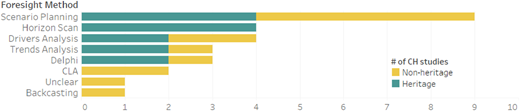
Beyond describing these potential future landscapes for heritage, this analysis also sheds light on how the heritage sector is currently engaging with futures thinking. First and foremost, it highlighted the lack of a substantial body of Foresight research for cultural heritage. At the time of review, we found only ten studies from the heritage sector engaging with Foresight methods. Next, it highlighted a limited diversity of Foresight studies among this small body of heritage literature in terms of the methods used and stakeholders involved. The heritage Foresight studies identified employed just four Foresight methods: Scenario Planning, Horizon Scanning, Driver or Trend Analysis and Delphi (Figure 2). It also found that studies tended more often than not towards uni-sectoral and expert-based approaches; none of the ten studies engaged with stakeholders explicitly outside of the heritage sector and just one reported engagement with a range of stakeholders, though still falling short of fully participatory and open research processes.
Expanding heritage foresight: promises and pitfalls
This ARCHE study represents an application of Foresight to strategic planning for cultural heritage that opens reflection on the megatrends shaping our sector and expands on perceptions of how heritage can contribute to more desirable futures. This intelligence is informing the composition of a futures-resilient agenda for research and innovation activities for heritage across Europe. Yet on a grander scale, this study has uncovered gaps in the current body of heritage Foresight research. In light of the direct relevance of the future to cultural heritage and the benefits that Strategic Foresight can deliver to heritage research and praxis, there is a decisive need for more Foresight in our sector. To better anticipate futures for heritage, we need to see a greater quantity of Foresight studies probing the future of the heritage sector across topics in conservation, research and beyond. We need more heritage in Foresight and more Foresight in heritage.
The lack of diversity in available Foresight research requires particular attention in future Foresight studies, in terms of Foresight methods used, stakeholders involved and futures' perspectives acknowledged. Replication of existing tried-and-tested studies, as well as the further application of a greater diversity of Foresight techniques in heritage research, are encouraged. Moreover, the stakeholders involved in Foresight studies can immensely influence their outcomes and successes, and our review calls for more cross-disciplinary and participatory studies. Foresight research that crosses disciplines and sectors can be challenging, in that it demands creative thinking on the part of participants, as well as skilful, flexible facilitation (Rasmussen et al., 2010). However, this collaboration is critical to tap into intelligence on trends external to, but nonetheless impactful on, the heritage sector. Furthermore, it can bring fresh perspectives and observations that might be overlooked by internal stakeholders (Heritage et al., 2023). Expanding our outlook beyond the scope of heritage can support a broader, more integrated horizon. Similarly, limiting is the abundance of closed Foresight research that involves only experts or few stakeholders. Failing to account for multiple perspectives can produce largely homogeneous futures. We need heritage Foresight research that practises open, collaborative and co-creative approaches engaging a diversity of stakeholders, including, or especially, those traditionally excluded from knowledge creation processes.
Alternative ways of recognising futures
One such potential for further exploration is the contextualisation and conceptualisation of “futures” within that of Indigenous epistemologies and ontologies. The linearity afforded to time within more West-based worldviews can be at odds with more circular notions of time – feeding into specific localised views, intergenerational equity and actions where past, present and future are not so starkly defined. Sardar's (1993) critique of the domain of futures studies being driven by an exclusively western philosophical approach to knowledge generation and distribution is still relevant decades later, with a real risk of colonising Indigenous futures by excluding their relationships to futures. Without a view to this, the relevance of these exercises for Indigenous and local communities can be brought into question. As Terry et al. (2024) articulate, tapping alternative ways of recognising futures can also nurture more creative imaginings of desirable futures to counteract the dystopian future narratives that tend to dominate.
It is also clear that for Foresight to be a powerful tool, it needs wider application and use through much more open and participatory processes. This is necessary to bring forward a diversity of perspectives and imagine futures beyond “used futures” (Inayatullah, 2008), e.g. futures that have already proven to lead to crisis and exclusions but are still repeatedly being re-imagined and re-used. Futures Literacy is a capability that is related to power – in which the poor and subaltern have few triggers to developing what Appadurai calls “the capacity to aspire” (Appadurai, 2013). In such a way, “empowerment has an obvious translation: increase the capacity to aspire, especially for the poor” (Appadurai, 2013, p. 189). This also relates to the argument that particular futures are being foreclosed when others are being made possible (Tutton, 2023, p. 449). When partaking in a Foresight exercise, a critical and constant question to reflect on throughout the process is whether some people are made “futureless” for this future to be realised? In addition, some communities, such as Indigenous cultures, may feel that their futures were stolen from them a long time ago. Thus, we need more decolonial ways of envisioning the future resting on local knowledge and traditions (Terry et al., 2024).
Because colonial and other extractive historical forces have also substantially impacted Indigenous and local cultures, many of these communities are now needing to navigate the complexity of reclaiming traditional ways of being within a rapidly changing world (Whyte, 2017). Arguably, however, it is this unique understanding and capacity to navigate these different worldview perspectives–whether Indigenous and non-Indigenous – that can position Indigenous and local communities as being integral in understanding the complexities of large-scale future issues. Indigenous futurism, showcased and developed in cultural outputs familiar in the space of heritage such as the fields of art, science fiction and film (Dillon, 2016), also provide a basis from which future studies and Foresight could be diversified, and critically, decolonised. The decolonisation of futures must start with choosing methods that open up diverse perspectives which reflect the complexity and plurality of heterogeneous Indigenous and local knowledge and perceptions of the future (Maraud and Roturier, 2023). The intention to create equitable, sustainable and representative futures is a responsibility that must be innately embedded in those wishing to undertake Foresight (Gidley, 2016). More conceptual models designed for greater application of Indigenous knowledge and worldviews within Foresight are a needed positive step (see Phichonsatcha et al., 2024; Maraud and Roturier, 2023; Bourgeois et al., 2017).
Ultimately, these deficits within the existing body of heritage Foresight literature outline a roadmap to enhance the quantity and quality of Foresight research and activities for cultural heritage, to offer practical outcomes for heritage research, management and strategy.
Conclusion
Despite a heritage-sector discourse that often invokes nebulous “future generations” as the objects of our present efforts, heritage praxis seldom peers beyond the short-term to understand how future societies might value and use heritage differently from today. The heritage sector often takes for granted that the future will be business-as-usual, without critically reflecting upon how cultural heritage, its contexts and its values, are invariably in flux. As a sector deeply implicated in questions of time and change, there is a demonstrated need for Strategic Foresight in the heritage sector.
There are open access publications, toolkits and resources available from policy, development and other sectors that present catalogues of Foresight techniques developed and tested, which detail how to apply them (see, e.g. UK Government Office for Science, 2017; Roche, 2019; UNDP Global Centre for Public Service Excellence, 2018; Inayatullah, 2019). However, these resources are seldom explicitly oriented towards heritage [7], which aligns with our finding that engagement with Foresight in the sector remains limited. While some training courses are available, overall, more capacity-building initiatives for Foresight are needed within the heritage sector.
International organisations such as ICCROM, ICOMOS and UNESCO can build upon the momentum of existing Foresight work and use their reach to facilitate initiatives to expand understanding of what Foresight is and what it can do. ICCROM's Foresight Initiative seeks to do precisely this, through raising awareness around the value of Foresight, making it more accessible within the heritage community and providing resources for engaging with Foresight in and through heritage. Above all, ICCROM aims to bring together organisations and individuals eager to proactively address future change, to build a community of heritage Foresight practice.
And indeed, a global Foresight community is essential to face this present moment. One study included in this analysis, a systematic review of Foresight scenarios for the future environment, found a category of scenarios characterised by a “failure and lack of anticipation by governance, leading the world into spirals of negative synergies generating more or less widespread conflicts and at worst, mankind [sic] almost disappearing” (Lacroix et al., 2019, p. 8). The World Economic Forum's 2022 Global Risks Report, moreover, singled out the tension between short- and long-term concerns: “Short-term domestic pressures will make it harder for governments to focus on long-term priorities and will limit the political capital allocated to global concerns” (p. 18). To forge a future of stronger global collaborations, Futures Literacy and Strategic Foresight are critical to ensure that common challenges are jointly and proactively addressed. They should thus be a top priority for facing global challenges – importantly, in the heritage sector as well, as heritage is deeply embedded in these issues.
In the context of such work, it would be essential to employ Foresight methods open to diverse Knowledge Systems and worldviews, and be critical in regard to whose futures are being foreclosed, e.g. who are made futureless – for a specific future to be realised. In other words, there is a need to address the unequal power dynamics present in many Foresight exercises, and thoroughly embed decolonial and participatory approaches into the imagination of more sustainable, just and representative futures.
Looking ahead, as threats to ecosystems and livelihoods continue to escalate, accompanied by political, social and economic upheavals, a clear display of flexibility, creativity, ingenuity and resilience will be paramount. To prepare for these challenges and leverage emerging opportunities, it is crucial to foster Futures Literacy and long-term thinking within the heritage sector and without. For the heritage sector to proactively contribute to shaping a more just and sustainable future, adaptable visions and long-term strategies are urgently needed. Indeed, in the face of an uncertain future, this will prove vital.
Credit roles
Conceptualization – Alison Heritage; Investigation – Alison Heritage, Gustav Wollentz, Hana Morel, Sarah Forgesson, Amy Iwasaki; Literature review data analysis – Hana Morel, Sarah Forgesson; Project administration – Alison Heritage; Writing – Alison Heritage, Amy Iwasaki, Gustav Wollentz, Hana Morel, Sarah Forgesson; Visualization – Anna Cadena-Irizar.
The authors would also like to acknowledge the following organisations and persons for their valuable contributions to the original report on which this article is based.
Thank you to ARCHE project colleagues, with particular gratitude to Merel Groentjes at the Dutch Research Council (NWO); Alexandre Caussé, Elodie Cazenave, Miruna Găman, Shangyun Shen and Giuseppe Zoppo at the Fondation des Sciences du Patrimoine, France (FSP); Vania Virgili and Irazú López Campos at the Italian Research Council (CNR); Marieke van Ommeren and Eva Roell at the Cultural Heritage Agency of the Netherlands (RCE); and to Katherine Warren and Jamie Davies at the Arts and Humanities Research Council, UK (AHRC).
Thank you also to the 84 participants of the ARCHE multi-stakeholder Foresight workshop, Insight into the Future, for their time and insights.
Finally, we would like to acknowledge and thank Anna Cadena-Irizar for her contribution to the data visualisations; and to Chiara Bonacchi (University of Edinburgh), Johanna Leissner (Fraunhofer), Johan Oomen (Netherlands Institute for Sound and Vision) and Richard Sandford (University College London) – who provided critical feedback on the study and its findings.
Appendix List of reviewed literature
AAM (American Alliance of Museums) (2021), TrendsWatch: Navigating a Disrupted Future, Center for the Future of Museums (AAM), Arlington, VA.
Argerich Fernández, I., Carrión Gútiez, A., Chumillas Zamora, R., Díaz Martínez, S., García García, A., Jiménez Cuenca, C., Martín Sánchez, L., et al., (Ed.s) (2016), National Cultural Heritage Plans, Ministry of Education, Culture and Sport, Madrid.
Arup (2020), Historic England Horizon Scan: Final Report, Arup, London.
Ballard, C., Baron, N., Bourgès, A., Bucher, B., Cassar, M., Daire, M.-Y., Daly, C., et al. (2022), White Paper: Cultural Heritage and Climate Change New Challenges and Perspectives for Research, JPI Cultural Heritage and JPI Climate.
Begoña García, M. and Jordano, P. (Ed.s) (2021), Global Change Impacts, Vol. 7 of CSIC Scientific Challenges: Towards 2030, Consejo Superior de Investigaciones Científicas (España), Madrid.
Bovolenta, P., Manzanares, M., and Buceta, J. (Ed.s) (2021), Origins, (Co)Evolution, Diversity and Synthesis of Life, Vol. 2 of CSIC Scientific Challenges: Towards 2030, Consejo Superior de Investigaciones Científicas (España), Madrid.
Bradley, C., Seong, J., Smit, S., and Woetzel, J. (2022), On the Cusp of a New Era?, McKinsey Global Institute, London.
Charco, M., and Martí, J. (Ed.s) (2021), Dynamic Earth: Probing the Past, Preparing for the Future, Vol. 14 of CSIC Scientific Challenges: Towards 2030. Consejo Superior de Investigaciones Científicas (España), Madrid.
Costa, M.J., and Schödel, R. (Ed.s) (2021). Understanding the Basic Components of the Universe, Its Structure and Evolution, Vol. 9 of CSIC Scientific Challenges: Towards 2030, Consejo Superior de Investigaciones Científicas (España), Madrid.
Debono, S. (2021), “Thinking phygital: a museological framework of predictive futures”, Museum International, Vol. 73 Nos. 3–4, pp.156–167, available at: https://doi.org/10.1080/13500775.2021.2016287
Degli Esposti, S., and Sierra, C. (Ed.s) (2021), Artificial Intelligence, Robotics and Data Science, Vol. 11 of CSIC Scientific Challenges: Towards 2030, Consejo Superior de Investigaciones Científicas (España), Madrid.
Delgado, M., and Moros, M., (Ed.s) (2021), Challenges in Biomedicine and Health, Vol. 4 of CSIC Scientific Challenges: Towards 2030, Consejo Superior de Investigaciones Científicas (España), Madrid.
Dreyer, I., and Stang, G. (2013), “Foresight in governments: practices and trends around the world”, Yearbook of European Security, No. 1368, pp.7–32.
EMIS and CEIC (2021), Foresight 2022: What's in Store, ISI Emerging Markets Group, London.
European Commission (2022a), 2022 Strategic Foresight Report: Twinning the Green and Digital Transitions in the New Geopolitical Context, Publications Office of the European Union, Luxembourg.
European Commission (2022b), Get Inspired! Culture: A Driver for Health and Well-Being in the EU, Publications Office of the European Union, Luxembourg.
European Commission (2022c), Strengthening Cultural Heritage Resilience for Climate Change: Where the European Green Deal Meets Cultural Heritage, Publications Office of the European Union, Luxembourg, available at: https://doi.org/10.2766/44688
Giliberto, F., and Jackson, R. (Ed.s) (2022), Cultural Heritage in the Context of Disasters and Climate Change: Insights from the DCMS-AHRC Cultural Heritage and Climate Change Cohort, University of Leeds and University of Edinburgh (Leeds and Edinburgh), available at: https://doi.org/10.48785/100/107
Glenn, J.C., Florescu, E., and The Millennium Project Team (2017), State of the Future v.19.0., The Millennium Project, Washington, D.C.
Gunashekar, S., Ryen Gloinson, E., Dunkerley, F., Virdee, M., d’Angelo, C., Feijao, C., Ali, G.-C., Skjoldager, M., Skjold Frøshaug, A., and Bundgaard Vad, T. (2021), Addressing Societal Challenges in Norway: Key Trends, Future Scenarios, Missions and Structural Measures, RAND Corporation, Santa Monica, CA and Cambridge, UK, available at: https://doi.org/10.7249/RRA966-1
Gwartney, J., Lawson, R., Hall, J., Murphy, R., Djankov, S., and McMahon, F. (2022), Economic Freedom of the World: Annual Report, Fraser Institute, Calgary.
Heritage, A., Iwasaki, A., and Wollentz, G. (2023), Anticipating Futures for Heritage: ICCROM Foresight Initiative: Horizon Scan Study 2021, ICCROM, Rome.
Herrera, E., and Esteban, J.A. (Ed.s) (2021), Brain, Mind and Behaviour, Vol. 5 of CSIC Scientific Challenges: Towards 2030, Consejo Superior de Investigaciones Científicas (España), Madrid.
Inayatullah, S. (2020), “Co-creating educational futures: contradictions between the emerging future and the walled past”, Education, Research and Foresight, No. 27.
ICON (Institute of Conservation) (2021), Horizon Scanning, ICON, London, available at: https://www.icon.org.uk/resource-report/horizon-scanning.html (accessed 9 October 2023)
JPI CH (Joint Programming Initiative on Cultural Heritage and Global Change) (2013a), Foresight Study and Technological Capability Report: 1: Report on Drivers of Change and the Future of Cultural Heritage 277606-JHEJPI CH, JPI CH, Rome.
JPI CH (Joint Programming Initiative on Cultural Heritage and Global Change) (2013b), Foresight Study and Technological Capability Report: 2: Real-Time Delphi Study on the Future of Cultural Heritage Research 277606-JHEJPI CH, JPI CH, Rome.
Koers, W., Giessen, A. van der, Weelden, M. van, and Becker, J. (2012), Future of Cultural Heritage Impact of External Developments, European Foresight Platform, Brussels.
Lacroix, D., Laurent, L., De Menthière, N., Schmitt, B., Béthinger, A., David, B., Didier, C., and Parent Du Châtelet, J. (2019), “Multiple visions of the future and major environmental scenarios”, Technological Forecasting and Social Change, No. 144, pp.93–102, available at: https://doi.org/10.1016/j.techfore.2019.03.017
López, L., Ma, L., and Léger, G. (Ed.s) (2021), Our future? Space colonization and exploration, Vol. 12 of CSIC Scientific Challenges: Towards 2030, Consejo Superior de Investigaciones Científicas (España), Madrid.
Lodovici, M.S., Vasilescu, C., Melloni, E., Crippa, A., Drufuca, S., Paladino, E., Patrizio, M., et al. (2022), HERIWELL: Cultural Heritage as a Source of Societal Well-Being in European Regions, ESPON, Denmark.
Miller, R. (Ed.) (2018), Transforming the Future: Anticipation in the 21st Century, UNESCO and Routledge, Paris, Abingdon, UK and New York.
Montoliu José, L., and Rada Iglesias, A. (Ed.s) (2021), Genome and Epigenetics, Vol. 3 of CSIC Scientific Challenges: Towards 2030, Consejo Superior de Investigaciones Científicas (España), Madrid.
Morel, H., Megarry, W., Potts, A., Hosagrahar, J., Roberts, D., Arikan, Y., Brondizio, E., et al. (2022), Global Research and Action Agenda on Culture, Heritage and Climate Change, ICOMOS and ISCM CHC, Charenton-le-Pont, France and Paris, available at: https://openarchive.icomos.org/id/eprint/2716/
Moyano Estrada, E., and García Azcárate, T. (Ed.s) (2021), New Foundations for a Sustainable Global Society, Vol. 1 of CSIC Scientific Challenges: Towards 2030, Consejo Superior de Investigaciones Científicas (España), Madrid.
Olmos Aranda, E., and Venegas Calerón, M., (Ed.s) (2021), Sustainable Primary Production, Vol. 6 of CSIC Scientific Challenges: Towards 2030, Consejo Superior de Investigaciones Científicas (España), Madrid.
Orlove, B., Dawson, N., Sherpa, P., Adelekan, I., Alangui, W., Carmona, R., Coen, D., et al. (2022), ICSM CHC White Paper I: Intangible Cultural Heritage, Diverse Knowledge Systems and Climate Change: Contribution of Knowledge Systems Group I to the International Co-Sponsored Meeting on Culture, Heritage and Climate Change, ICOMOS and ISCM CHC, Charenton-le-Pont, France and Paris, available at: https://openarchive.icomos.org/id/eprint/2717/
Pascual, A., and Macías, D. (Ed.s) (2021), Ocean Science Challenges for 2030, Vol. 13 of CSIC Scientific Challenges: Towards 2030, Consejo Superior de Investigaciones Científicas (España), Madrid.
Pauget, B., Tobelem, J.-M., and Bootz, J.-P. (2021), “The future of French museums in 2030”, Technological Forecasting and Social Change, No. 162, 120384, available at: https://doi.org/10.1016/j.techfore.2020.120384
Rindzevičiūtė, E. (Ed.) (2019), Nuclear Cultural Heritage: Position Statement, Thurso, 12 September 2019. AHRC Research Networking Project. AH/S001301/1, Kingston University, Thurso, Scotland.
Rindzevičiūtė, E. (Ed.) (2022), Nuclear Cultural Heritage: From Knowledge to Practice. Concluding Report. AHRC Research Networking Project. AH/S001301/1. Kingston University London, Kingston upon Thames.
Serra Alfaro, J.M., and Pérez Coll, D. (Ed.s) (2021), Clean Safe and Efficient Energy, Vol. 8 of CSIC Scientific Challenges: Towards 2030, Consejo Superior de Investigaciones Científicas (España), Madrid.
Shepherd, N., Cohen, J.B., Carmen, W., Chundu, M., Ernsten, C., Guevara, O., Haas, F., et al. (2022), ICSM CHC White Paper III: The Role of Cultural and Natural Heritage for Climate Action: Contribution of Impacts Group III to the International Co-Sponsored Meeting on Culture, Heritage and Climate Change, ICOMOS and ISCM CHC, Charenton-le-Pont, France and Paris, available at https://openarchive.icomos.org/id/eprint/2719/
Simpson, N.P., Orr, S.A., Sabour, S., Clarke, J., Ishizawa, M., Feener, R.M., Ballard, C., et al. (2022), ICSM CHC White Paper II: Impacts, Vulnerability, and Understanding Risks of Climate Change for Culture and Heritage: Contribution of Impacts Group II to the International Co-Sponsored Meeting on Culture, Heritage and Climate Change, ICOMOS and ISCM CHC, Charenton-le-Pont, France and Paris, available at: https://openarchive.icomos.org/id/eprint/2718/
Stegmeijer, E., and Veldpaus, L. (Ed.s) (2021), A Research Agenda for Heritage Planning: Perspectives from Europe, Edward Elgar Publishing Limited, Cheltenham, UK.
Tonejc, M.J., and Ivanuš, M. (2022), “Futures and foresight of Croatian cultural heritage”, Portal: Godišnjak Hrvatskoga Restauratorskog Zavoda, No. 13, pp.153–163, available at: https://doi.org/10.17018/portal.2022.10
UNHCR (United Nations High Commissioner for Refugees) (2022), Global Trends: Forced Displacement in 2021, United Nations High Commissioner for Refugees, Copenhagen, available at: https://www.unhcr.org/refugee-statistics
WEF (World Economic Forum) (2016), The Global Risks Report, 11th ed., WEF, Cologny, Switzerland.
WEF (World Economic Forum) (2020), The Global Risks Report, 15th ed., WEF, Cologny, Switzerland.
WEF (World Economic Forum) (2021), The Global Risks Report, 16th ed., WEF, Cologny, Switzerland.
WEF (World Economic Forum) (2022), The Global Risks Report, 17th ed., WEF, Cologny, Switzerland.
Zambrini, R., and Rius, G. (Ed.s) (2021), Digital and Complex Information, Vol. 10 of CSIC Scientific Challenges: Towards 2030, Consejo Superior de Investigaciones Científicas (España), Madrid.
Zbranca, R., Dâmaso, M., Oana, B., Kiss, K., Dascal, M.D., Yakobson, D., and Pop, O. (2022), Scoping Review of Culture, Well-Being and Health Interventions and Their Evidence, Impacts, Challenges and Policy Recommendations for Europe, CultureForHealth and Culture Action Europe, Brussels.
Notes
OECD, Strategic Foresight webpage (https://www.oecd.org/en/about/programmes/strategic-foresight.html#Publications)
ICCROM, Foresight webpage (https://www.iccrom.org/what-we-do/research/foresight)
Heritage Research Hub, ARCHE 2nd Stakeholders' Workshop to Take Place in Florence on September 25 (https://www.heritageresearch-hub.eu/homepage/arche/)
See: Foresight: The journal of future studies, strategic thinking and policy (https://www.emerald.com/insight/publication/issn/1463-6689); University College London's MSc in Heritage Evidence, Foresight and Policy (https://www.ucl.ac.uk/bartlett/heritage/heritage-evidence-foresight-and-policy-msc); the 2021–22 FUTURES exhibition at the Smithsonian Arts + Industries Building: https://aib.si.edu/futures/); and the Foresight Europe Network (https://feneu.org/).
The five elements are a Futures Lab, a Summit of the Future (carried out in September 2024), an Envoy for Future Generations, periodic Strategic Foresight and Global Threats reports, and a Re-purposed Trusteeship Council as a Multi-Stakeholder Foresight Body (The Millennium Project, 2022).
For example, the following countries have governmental departments or units undertaking foresight work: Australia, Austria, Bahrain, Belgium, Botswana, Canada, China, Czech Republic, Denmark, Egypt, Estonia, Estonia, Ethiopia, Europe, European Union, European Union, Finland, France, Germany, Ghana, Hungary, India, Indonesia, Ireland, Italy, Japan, Japan, Kazakhstan, Kenya, Malaysia, Mauritius, Morocco, Namibia, Netherlands, New Zealand, Nigeria, Norway, Norway, Philippines, Poland, Portugal, Qatar, Saudi Arabia, Senegal, Singapore, South Africa, South Korea, Spain, Sweden, Sweden, Switzerland, Thailand, Tunisia, Uganda, United Arab Emirates (UAE), United Kingdom, USA, Vietnam. While some of these date back to the 1960s, the majority were established in the last 20 years.
The UNESCO Chair on Heritage Futures at Linnaeus University offers some free training resources, but no toolkits or handbooks specifically developed for heritage applications (see https://lnu.se/en/research/research-groups/unesco-chair-on-heritage-futures/). In terms of resources, the SoPHIA-model (https://model.sophiaplatform.eu/) was recently adapted for increased future awareness when planning a heritage intervention (Wollentz, 2023). In terms of toolkits, a notable exception is the Center for the Future of Museums's (2022) toolkit that offers four foundational Foresight tools for museums.