


The Roses Citadel is a bastioned fortification that has archaeological remains from the Greek, Roman and medieval periods in its interior. Currently, the area inside the Citadel is used for a wide range of activities; some directly related with the heritage item, others associated with its use as a public space for the town. The purpose of this paper is to analyse the economic interest of charging an entrance fee vs the alternative of free access and offers a framework to address this issue.
The proposal is to consider the marginal cost of increasing the number of users and to carry out a travel cost analysis. It is vital to take into account the results of specifically economic analyses, but the evaluations of social policies should also be considered, and should have a considerable weight in decision making.
It is proposed that free entry would bring about an increase in the number of visitors and users of Roses Citadel. In turn, this increase would lead to a greater social use of this heritage asset, and a chance for the least privileged sectors of society to use the site more. Financial resources for the maintenance of the asset would not be raised through entry fees, but through contributions relating to the increase in the social consideration of the site.
In the context of a discussion on the advantages and disadvantages of paying an entry fee for heritage assets, the example of Roses Citadel provides several factors for consideration. It shows that payment of an entry fee affects use of the site by society, and particularly by the local community, whereas free access leads to a wide range of opportunities for use.
1. Introduction
Roses is a tourist town situated in the Gulf of Roses, on the Costa Brava (Catalonia). It has 19,438 inhabitants (1 January 2016, Source: IDESCAT); a population that more than triples in the tourist season. At the centre of the town, in the mid-sixteenth century, bastioned walls began to be built according to the military engineering criteria of the time, enclosing the medieval town of Roses. In the following centuries, these fortifications were remodelled on several occasions, and were the site of various military skirmishes until they were rendered useless by the French army at the start of the nineteenth century.
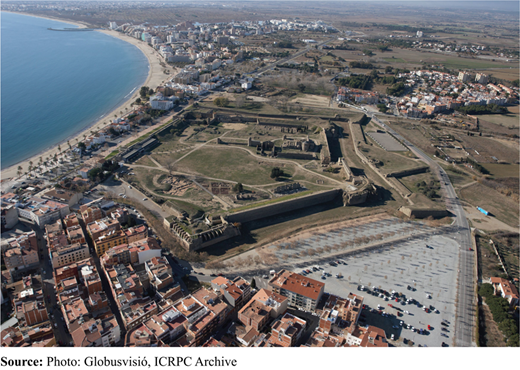
One of the unique characteristics of this fortification is that it was built over ruins from previous periods. Specifically, the area where the Early Modern fortress was constructed contains archeological remains of Rodhe. Rodhe and Emporion (Empúries-L’Escala, Catalonia) were the only two Greek cities on the Iberian Peninsula and marked the most western boundary of known Greek settlements in the Mediterranean. A peripheral part of the ruins of Rodhe can be visited, and is known as the Greek quarter. Although this place was destroyed by the Roman army at the start of the second century BC, it continued to be inhabited during the Roman period and Late Antiquity. From this period, remains of a fish-salting factory can be visited. Subsequently, in the Early Middle Ages, the Santa Maria Monastery was built, whose remains can be found inside the Citadel, particularly the church. A medieval town was established around this monastery, and would remain there during the entire Early Modern Period. Remains from this period include part of the town’s walls, houses and the urban structure, which can be visited, but have not been musealised. As explained above, all these remains are on the same site as the Citadel, which has not been preserved in its entirety. Some bastions and other elements have disappeared completely. However, altogether the Citadel is a notable example of military architecture from the Early Modern Age and, along with the remains of the periods described above, it forms a heritage site with a certain degree of complexity (Buscató, 1999; Díaz et al., 1998; de la Fuente, 1998; Puig and Martín, 2006; Vivó, 1996) (Plate 1).
In 1961, the Citadel was recognised in Spanish legislation as a Historical Monument. This did not prevent the demolition of part of the Citadel’s walls the same year to make way for an urban development project (La Ciutadella de Roses, 2016). At the same time, various archeological excavations began, and finally the demolition of the walls was halted. However, the site remained closed and abandoned for many years. In 1986, the entire site became a municipal property. It was opened to the public in 1991, and in 1993 a master plan for Roses Citadel was approved, which would establish the bases for its conservation and heritage use. Subsequently, work began to restore areas of the site, under municipal management (La Ciutadella de Roses, 2016). In 2004, a permanent exhibition room was opened, and from 2007 the whole area was named the Citadel Cultural Space. Currently, this space is heavily used. According to a statement made in January 2017 by Carles Páramo, the urban planning councillor for Roses, the Citadel ramparts “are no longer a nuisance for the town of Roses, a source of problems and loss of prestige. Instead, they are a monument recognised as a Cultural Asset of National Interest, a monument that has become a top-class tourism resource” (digital newspaper, Vila de Roses, 22 January 2017).
Therefore, some years after opening to the public, we can analyse the current use of this heritage item, and the proposals made to increase its public use. Beyond the conclusions that can be drawn in relation to the local environment, this study could serve as an example for other similar heritage items, due to the size of the monument and its location in a very touristic town.
In this study, visitor surveys were administered in order to apply the travel cost method, which has been used extensively in economic valuations. This valuation model has notable limitations and is open to many criticisms. However, one of the objectives of this study was to demonstrate ways of measuring the social benefits that are obtained through uses of heritage, based on economic valuations. The second objective was to provide an approximation of the economic results of archaeological sites or historical monuments.
The study only measured user benefits, and did not consider non-use values, option values and bequest values (Krutilla, 1967), which are closely linked to the social functions of archaeological sites.
2. The volume of use of Roses Citadel
A few years ago, bastioned fortifications such as Roses Citadel were not highly appreciated; now they are receiving recognition. For example, UNESCO declared the series of fortifications at Vauban in France a World Heritage Site in 2008. This recent increase in recognition has led to more activities being undertaken in these spaces. However, the size and monumental nature of such sites leads to some specific, notable conservation and use problems and limitations.
Current uses of fortifications can be divided into two groups. In the first, the sites are treated as monuments that can be visited, normally by paying an entry fee. Generally, in this group, the fortification and the archaeological remains within it are not considered for a specific use beyond their attractiveness as a historical monument. The second group is comprised of fortifications that have become a setting to address aspects related to the site, and other unrelated aspects. To date, the use of Roses Citadel could be included in this second group.
Inside Roses Citadel, various activities take place relating to historical and archaeological knowledge of the space, as well as other leisure activities that take advantage of the setting provided by the fortification (Duran, 2016). Visitors who pay to enter the site (€4 general entry) can follow a route around the archaeological area and take guided visits or participate in family workshops. In addition to the archaeological area, there is a permanent exhibition that describes the historical evolution of the site, and a room for temporary exhibitions, for exhibits on a range of subjects. To take advantage of the setting of the Citadel, cultural events are programmed in the Summer months, such as concert cycles, plays, dance performances and film projections. During the Christmas period, the town’s living nativity scene is set up inside the Citadel, or the camp for the Three Wise Men’s royal postmen, collecting letters from children for their Christmas presents. At various times of the year, celebrations of sporting events are also held inside the fortifications. In addition, the Citadel’s areas can be used for weddings, birthday parties or other private events. Altogether it is a space that is widely used.
Every year, around 40,000 people enter the Citadel (average for 2007–2016), including those who visit the archaeological site and those who participate in activities that take place inside the fortifications. The highest number of visitors tends to be found in the Summer months, following the seasonal pattern of tourism. This is also when most of the activities programmed in the Citadel take place. In recent years, the number of visitors has risen sharply, due to an increasing number of visits to the archaeological site and an increase in programmed activities (Figure 1).
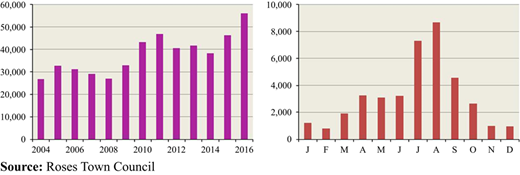
Annual changes in the number of visits to the Roses Citadel ensemble in 2007-2016 and monthly variation (average for the period 2007-2016)
Annual changes in the number of visits to the Roses Citadel ensemble in 2007-2016 and monthly variation (average for the period 2007-2016)
Data from a visitor study carried out in 2010 indicate that 28 per cent of individual visitors were resident in Catalonia (mainly in Barcelona province; 2 per cent of the total were residents of Roses), 37 per cent were residents of the rest of the Spanish state and 35 per cent were from abroad, mainly from France, Germany and Belgium (Puig, 2011). Six years later, in 2016, the number of visitors who were Roses residents remained at 2 per cent, which is lower than the percentage of visitors from Catalonia (20 per cent) and from the rest of the Spanish state (12 per cent) and the number of visitors from abroad increased (67 per cent), amongst which the most represented were people from France, Germany and the UK.
3. Free or paid entry?
Since the Citadel opened its doors to the public in 1991, various conservation, restoration and dissemination actions have taken place that have required the contribution of considerable financial resources from government bodies, and particularly from Roses Town Council. One of the main aims of dissemination activities has been to publicise information about the monument and increase the volume of visitors and users. In this context, charging for entry to the space is considered a way of obtaining funds. Specifically, annual revenue obtained from the sale of entrance tickets to the Citadel stood at around €63,000 a year on average in the period from 2012 to 2016. Although this amount is considerable, it is relatively low in comparison with the spending on the Citadel that is required each year. Therefore, we can analyse whether charging for entry is an obstacle to increasing the number of users of the Citadel and whether, in contrast, free entry leads to greater use of the space.
One point of debate is whether an entrance fee is a barrier to access museums and heritage items and whether free entry is the right measure for ensuring access to heritage. Free entry could be an interesting measure to analyse. The first aspect is strictly economic: what are the costs (basically in terms of loss of income) and potential benefits of free entry? However, other aspects go beyond this. The entrance fee covers only a small part of the costs entailed in being able to visit a museum or an item of heritage, and the implementation of this measure does not necessarily lead to democratisation of the use of heritage items (Paindavoine, 2014). Obstacles to accessing heritage are associated not only with payment of an entry free, but also with ideological aspects and the existence of social and cultural barriers. If the number of visitors does increase, it is important to consider whether this increase is accompanied by diversification in the sectors of society that enter the museum, and particularly the least favoured, or whether the increase is due to higher numbers of visitors from the same social sectors that usually visit heritage items (Gombault, 2013; Alcalde, 2003).
The discussion on free or paid entry covers not only aspects of economic efficiency, but also social policy considerations. From a strictly economic perspective, free entry is normally considered a bad option that leads to inefficient allocation of resources and welfare losses, and could lead to overuse of the resources that has a negative impact on their sustainability.
However, the exception to this general rule could apply to cultural and heritage goods. The exception refers to the case of goods whose marginal cost (MgC) is 0, that is, one additional user or consumer does not increase the cost. These are “non-rival” or “public” goods. For their correct social allocation, all consumers with marginal utility (MgU) above 0 must be able to consume the good; everyone who wishes to can access it. It would make no sense to limit someone’s use of the good if their consumption of it does not generate any extra cost.
Cultural goods that consist basically of information (an idea, an image or a text) can be reproduced at a negligible cost and therefore have an MgC of 0. Heritage goods, which are enjoyed through visits by the consumers, also have an MgC close to 0, up to a certain point of congestion. In these cases, charging fees to consume heritage goods limits their use inefficiently.
This generates a contradiction between the funding that cultural and heritage goods require for their provision and maintenance, and the issue of their correct use and dissemination, which is best served by an entry fee of almost 0.
The question to examine is how to obtain revenue not from an entry fee but from other indirect mechanisms that capture the users’ willingness to pay without restricting use of the goods. The most feasible way to achieve this is based on a two-part tariff: a fixed part, which is independent of use; and a variable part for each specific use. If the variable part drops to 0, because the MgC is 0, then we encourage maximum use until the MgU is 0 and the consumers’ satisfaction and welfare reach a maximum. The key issue is how to design indirect mechanisms to capture this maximum welfare, and thus contribute to the funding of the good.
Up to this point, the discussion has only been theoretical, based on arguments taken to extremes. In reality, MgC is never strictly 0, pricing measures are not always feasible and the response of consumers is never identical. To make the scenario more realistic, imagine the dilemma of heritage managers when the entry fee is abolished and free entry is provided. What variables should they focus on? What should they think? How should they proceed?
The analysis involves three steps, which we can formulate as three questions:
Is the number of visitors and frequency of visits expected to increase if the entry fee is abolished and free entry provided? To answer this, we need to examine the sensitivity of demand to price and the elasticity of demand.
Will the expected increase in the frequency of visits generate an additional cost, an additional expense for the entity that manages the good? To answer this, we need to estimate the MgC for the users. The above theoretical discussion assumes that the MgC is 0. In reality, it is never strictly 0, but could be very small. The cultural manager must make an estimate. One aspect to consider is congestion: if free entry leads to congestion, then this must be examined carefully.
Are there any mechanisms other than the entry fee by which the managing entity can capture a sufficient proportion of the benefits generated by the heritage goods? This question does not have general answers, but needs to be examined for each case individually. It depends on the good, the way it is consumed, the information available to the managing entity and other issues.
The strategy of free entry makes sense in economic terms if the answer to the three questions is yes-no-yes. In other words, free entry will attract more visitors, which will not generate significant additional costs (perhaps employees who were responsible for charging the entrance fee will take on tasks relating to security and information) and the entity has indirect mechanisms for capturing part of the higher social benefits resulting from the free entry strategy (e.g. via concessions for services that could be interested in being located in places that are now highly valued).
Considering the literature on this debate, Martin (2002) analysed the reaction of society when the UK Government decided to establish the policy of free entry to national museums and galleries at the beginning of 2002. There was a 62 per cent increase in visitor numbers in the seven months after implementation of the free entry policy. Cowell (2007) continued the same research by monitoring the demand reaction on a long-term basis in these UK museums and galleries. Data show that the number of visits increased by around 72 per cent when the last year with an entry fee (2001) was compared with two years later (2003), after implementation of the new policy of free entry. Three years later, the increase was around 76.9 per cent (2004), and five years later (2006) the number of visits had improved even more, by 87.2 per cent. All these percentages are compared with 2001.
Frey and Steiner (2012) argued that the policy of free entry can maximise the number of visitors and increase reputation, which could attract publicity or donors.
Kirchberg (1998) showed in Germany that the lowest income bracket considered entrance fees a barrier to visiting museums. In sociological terms, there were groups with a specific lifestyle who would like to enter, but could not afford to. In this context, he argued that establishing an entry fee or increasing it can affect the socioeconomic composition of attendance.
Another aspect to consider is that Roses is considered a tourist municipality. In this context, one option could be to charge local visitors lower prices and foreign visitors higher prices, because they do not contribute to the funding of museums through local taxes (Frey and Steiner, 2012). This is compatible with efficiency pricing because tourists have a lower price elasticity of demand and, therefore, should be charged more. Moreover, lower prices can induce people who rarely or never go to museums to visit more frequently. Therefore, lower prices enhance the educational value of the site for the local population.
The second question refers to the estimation of MgCs per user. The argument in favour of free entry assumes that the MgC is equal to 0 or very small. Is this correct? Yes, for cultural goods whose value is related to new information (an image and an idea), but it is less clear for heritage goods whose consumption requires the physical presence of the user. In this case, free entry could cause congestion for some certain “exceptional” goods or at certain busy times. If this is the case, if congestion does occur, logically, an entry fee should be maintained or introduced. In our present case of Roses Citadel, a congestion cost seems unlikely when there is a high number of visitors (in a very optimistic scenario), considering the size of the site.
The third question refers to potential mechanisms for capturing a part of the greater social value that the cultural or heritage good generates. This question does not have a general response. It depends greatly on the type of good, its ownership, the social context, the information available to the managing entity and other issues. In the case in question, Roses Citadel, reasonable mechanisms are concessions for companies (bars, restaurants and shops) that are interested in setting up within the Citadel, which will have greater value if entry is free. Thus, Roses Citadel could gain prestige and reputation, and increase its value as a resource and the opportunities to exploit it.
4. Empirical approach of the travel cost method in Roses Citadel
In relation to the specific case of Roses Citadel, we studied the benefits that are generated by applying a travel cost analysis (Hotelling, 1947; Clawson and Knestch, 1966) to the study of heritage items (see e.g. Bedate et al., 2004; Poor and Smith, 2004; Sanz, 2005; Saz and Montagud, 2005; Du Preez, 2011). We also considered more recent studies that apply this methodology (Tourkolias et al., 2015; Wright and Eppink, 2016; Voltaire et al., 2017; Chen and Lee, 2017).
The aim was to calculate a demand curve and determine the social benefit of the Citadel. To use this method, we analysed visitor data obtained from the register of entries to the Citadel and data from a survey undertaken during the summer of 2010, which fall within the average for recent years.
The sampling method used in this survey consisted of basic random selection of three days a month during the specific survey administration period. On each of these days, the hours that the Ciutadella is open to the public were separated into bands of 5 min, and in each of these bands, the first person that entered the site was surveyed. The field work was undertaken in July, August and September of 2010 and 315 surveys were completed.
This paper considers the opportunity cost of travel time (which is not addressed in some of the previous papers) as well as the time elapsed during the visit. It is important to consider the opportunity cost of time, as ignoring it could lead to significant underestimations of the economic value of the final consumer. In this case, and following previous studies, the opportunity cost was calculated as the salary that visitors give up (assuming a trade-off between work and leisure), although we are talking about leisure time and, therefore, the cost of an alternative entertainment activity could also be considered. We applied a net average salary per hour per job category, according to the respondents’ statements in the survey. We also added the duration of the visit to the archaeological site (since we knew the time of entry and exit of each visitor).
There are some limitations in this analysis. For example, we did not calculate the weighted cost of travel, which means that we should consider whether there were other goals of the visit apart from the Citadel in the municipality of Roses. This paper does not consider this fact, due to the thoroughness and difficulty required to estimate the distribution of the travel cost within different goals of visit.
The travel cost method calculations that were carried out were based on the equation drawn up by Du Preez and Hosking (2010). The travel cost (TravelCostij) to a specific archaeological site j is the sum of the following items:
where i is the individuals who visit the site j; DC the distance cost; TC the time cost (opportunity cost of time); and EC the entrance cost to the site j.
For the distance cost, we considered the distance between the origin of the visitors and Roses Citadel. Depending on the profile of each visitor, we applied the cost of transport in private cars, public transport by train or bus, cost of tolls (if applicable), cost of rental car and a specific value for other options (bicycle and on foot).
Regarding time cost, we estimated travel time and time duration of the visit. As mentioned above, we considered the hourly net average salary per job category published in official statistics (Instituto Nacional de Estadística, 2012). We proceeded according to the professional activity of the respondent in the survey. In the case of pensioners, the unemployed and students, we applied the general average salary.
Finally, the entrance cost was €3 (standard ticket) in 2010. After performing the calculations, we defined the areas that could be analysed according to the origin of the visitor. The origin of visitors refers to the municipality in which they stayed the day before the visit. For instance, foreign tourists staying in Roses are assumed to incur the same travel cost as local residents. We estimated the average cost of four zones (from closest to farthest) of origin of the visitors to the site and the rate of visits according to the defined area. In our context, the zones considered were:
Zone 1: municipality of Roses;
Zone 2: neighbouring municipalities;
Zone 3: other municipalities in the county of Girona; and
Zone 4: other municipalities in the outer counties of Catalonia.
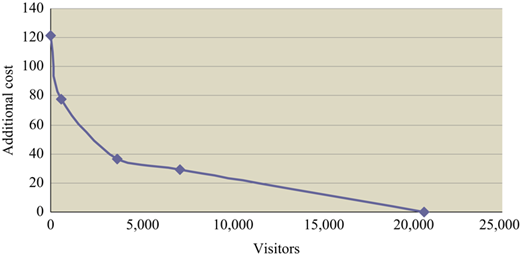
The results of the study show that all visitors are willing to visit the site at 0 cost. However, at a cost above €28.99, visitors from the same town on the day of the visit (whether a foreign or local population) would no longer visit the monument. At a cost of above €36.52, those from the geographic area around the monument would no longer visit it; above €77.55 those from the rest of Girona would not visit; and above €121.63 those from the rest of Catalonia would desist from visiting. Above this figure, no individuals would be interested in visiting Roses Citadel. Overall, the average valuation was €26.41, a figure that is below that calculated in another study using the same method for Empúries archaeological site, which is the most visited site in the surroundings of Roses Citadel, valued at €36.71 (Fluvià et al., 2011) (Table I and Figure 2).
Zone travel cost method in Roses Citadel
| Zones | Average cost trip | Respondents in the sample | ni= total visitorsa | Ni = total population | /Ni = visitor rate |
|---|---|---|---|---|---|
| Zone 1: roses | 28.99 | 198 | 13,507 | 20,418 | 0.661530449 |
| Zone 2: neighbouring municipalities | 36.52 | 51 | 3,479 | 119,844 | 0.029030314 |
| Zone 3: other municipalities in the county of Girona | 77.55 | 45 | 3,070 | 612,784 | 0.005009599 |
| Zone 4: other counties within Catalonia | 121.63 | 9 | 614 | 6,759,335 | 9,08315E-05 |
| Total | – | 303 | 20,670 | 7,512,381 | – |
Note: aa proportional factor was applied according to the sample
Finally, the economic valuation of the social benefits is obtained by multiplying the average valuation per visitor by the 20,670 entries in the summer of 2010. The result of this calculation is €545,984.
If all visitors paid a standard entry fee of €3 (the cost of the entry fee in 2010), the total revenue for this concept would be €62,010. This figure is far from the general social benefits of the Citadel, which, when added to revenue from entrance tickets, stand at €607,994 in total benefits generated as a maximum during the Summer months, which is when most visits take place. Therefore, the revenue generated by entrance tickets is only approximately 10 per cent of the total social benefits during this period. This is a very small proportion, which could even be considered an impediment that prevents the institution that manages the monument, in this case Roses Town Council, from increasing or internalising the social benefits that are generated. Social benefits do not represent income for the Town Council, but they are an indicator of the well-being that society derives from the Citadel.
5. Discussion and conclusions
If the Citadel is treated as an archaeological park or architectural monument with an entry fee, its uses are affected considerably and its social benefit is diminished. In contrast, if the Citadel is considered an open historical space that can be used freely by the public, in which part of the activity generated by the local and tourism population takes place, a wide range of opportunities appear, even though revenue from entry fees, which can be reinvested in the heritage site, is cut.
Free entry to the site would not have much of an impact on visits made by people from outside Roses and its immediate surroundings. As we have seen, payment of the entrance fee is only a small proportion of the costs of the journey to the site, considering that most visitors do not only travel to visit the Citadel, but that a visit to this site generally includes a much broader programme of activities of a longer duration. For visitors from outside the region, customer loyalty with respect to visits must be minor. The advantages of free entry are aimed at the local community, from which the proportion of visitors in recent years has remained stable (2 per cent of all visits in 2010 and in 2016), and people who remain for a certain length of time in Roses. For the local population and those who remain for a certain period in the town, free entry would make the Citadel an open space that could form part of their daily lives. Thus, entering the site could become a regular activity, and this would doubtless contribute to bringing the local community closer to this architectural and archaeological heritage, and ensuring that it is considered an everyday space tied to the population’s identity.
Publisher’s note: It has been brought to the attention of the publisher that the article Josep Burch, Modest Fluvià, Ricard Rigall, Albert Saló and Gabriel Alcalde “Free or paid: the uses of Roses Citadel (Catalonia)”, published in the Journal of Cultural Heritage Management and Sustainable Development should have been published under a Creative Commons Attribution (CC BY 4.0) licence and in front of the paywall. The article has now been corrected in the online version.

