On 1 October 2004 all UK transport facilities, stadia, shops, office receptions and any other premises serving the public will need to have taken reasonable steps to accommodate all types of disabled people. Stephen Homer of law firm Bevan Ashford reports.
The UK Disability Discrimination Act 1995 aims to achieve equality between disabled and able-bodied people. It imposes a basic general duty not to treat disabled people less favourably than any one else in terms of employment and access to goods and services.
Of particular relevance to the construction industry is that by 1 October 2004, when the third and final phase of the Act will come into force, service providers must have made reasonable adjustments in relation to the physical features of their premises where it is impossible or unreasonably difficult for disabled people to make use of the service they provide.
No service providers are exempt
A service provider is any organisation or body (including their employees and agents) that provides services to the public or to a section of the public including the provision of any goods or facilities, whether or not for payment and regardless of the size of the service provider. Unlike ‘small employers’—those that employ fewer than 15 and are exempt from the employment-related provisions of the Act—the ‘small service provider’ receives no such exemption.
Failure, without justification, to make reasonable adjustments, alterations or improvements to premises by 1 October 2004 to ensure that disabled users are not at a disadvantage will amount to discrimination against a disabled person. Any such failure would enable a disabled person to bring a civil court action against the service provider for damages.
A disabled person is defined by the Act as anyone with a physical or mental impairment which has a substantial or long-term effect on their ability to carry out normal day-to-day activities. The definition includes not only people who use a wheelchair or mobility aids but also, for example, people with epilepsy, heart conditions, respiratory problems, learning difficulties or impaired sight, hearing or speech.
Remove barriers or provide alternatives
The Act provides that where a physical feature on a service provider's premises makes it impossible or unreasonably difficult for disabled persons to make use of the service, then the service provider has a duty to take such steps as are reasonable in all circumstances to either remove or alter the feature, provide a reasonable means of avoiding it or provide a reasonable alternative method of making the service available.
The code of practice issued by the Disability Rights Commission provides examples of what would be reasonable changes and adjustments. It states that what constitutes a reasonable step will depend on a number of factors including effectiveness and practicability, disruption, resources available to the service provider and resources already spent. Whether the code of practice is followed will be relevant as to whether reasonable steps have been taken and as to whether there is a defence if court proceedings are issued.
In most cases modest adjustments may suffice, such as widening doorways, installing handrails, providing designated car parking with dropped kerbs and using better signage and lighting. If reasonable alterations to problematic physical features are not possible then a service provider should give consideration to alternative ways of providing the service, for example, home visits or providing the service on-line. Substantial works are therefore avoidable in most cases.
Limited grounds for defence
However, should more expensive modifications prove necessary—such as the installation of ramps or lifts—factors such as the extent of the service provider's financial resources, the availability of any financial or other assistance and the overall cumulative cost of all the alterations would be considered in determining whether the related costs are reasonable.
If a court action is commenced then the service provider will need to obtain advice in order to demonstrate that reasonable steps have been taken or that the failure to take what would otherwise be reasonable steps was justified.
The scope for justifying discrimination is very narrow. To do so the service provider must believe that one or more of the justifications from a set list is satisfied. It must also be reasonable in all the circumstances for the service provider to hold that opinion. Reasons for not making physical adjustments to a property would include protecting the fundamental nature of the business or service or not carrying out any step which would endanger the health and safety of any person, including a disabled one.
Responsibility rests with the service provider
It is important to note that the duty rests on the service provider, regardless of whether it is a tenant or the owner of the freehold. However, the fact that alterations may be needed to ensure compliance with the Act does not override the need to gain all the relevant consents for the work, such as landlord's consent (which cannot be unreasonably withheld), planning permission, building regulations approval and mortgagee's consent.
With less than two years to go, service providers should have access audits carried out now for barriers to access for disabled people and then comply with any recommendations made in such an audit. In this way, if court proceedings are issued, the service provider can demonstrate that action has been taken to comply with the Act.
An early access audit would give the service provider both time to spread the cost of any alterations that prove necessary as well as the opportunity to carry them out gradually, bringing as little disruption as possible to its business. It remains to be seen whether there will be a flood of claims after 1 October 2004. The only certainty is that service providers cannot ignore this Act but must take action now.
Briefing: Developing urban transport hubs
A weakness of the UK government's 10 year transport plan is that people still have to travel significant distances regularly. Ewan Willars of the Royal Institution of Chartered Surveyors' policy unit believes a solution is to encourage development around existing transport hubs.
The UK government's ‘10-year plan’ aims to ease the gridlock in town centres by introducing congestion charging, providing more bypasses and encouraging the use of alternatives to cars with a programme of increased funding and local-level initiatives. The 1999 plan sparked a wave of criticism, from both motoring and environmental groups and, most recently, an influential committee of MPs. Despite this, the mauling given to the government's package has not made the problems of confusion, poor safety and overcrowding any less pressing nor the objectives any less valid.
Among the critics of the 10-year plan is Professor Phil Goodwin of University College London. He claims that the extensive measures introduced by the Government will, at best, only serve to maintain the status quo. His research into the plan on behalf of the Council for the Protection of Rural England showed that improved roads and reduced motoring costs will only encourage even more people to drive. Implementing the step-change necessary to achieve real improvements in the transport system will require a range of new and innovative solutions. While no-one has yet identified a comprehensive and realistic alternative to the government's plan, the problems remain of rising levels of congestion, a poor quality public transport system with insufficient capacity, falling consumer confidence and the piecemeal co-ordination of development and transport planning in many of the UK's cities and town centres.
The need to make fewer journeys
David Hall, Yorkshire regional director at Sustrans and chairman of the Royal Institution of Chartered Surveyors land-use and transport policy panel, believes that the only way forward in the long-term is to ensure that people need to make fewer journeys. He says people are having to travel longer distances to work, to shop and to access essential services such as schools and hospitals. He believes it is all very well encouraging people to walk or cycle but, if the nearest hospital is 10 miles away, realistically it is not going to happen.
The real and only long-term solution is to put people closer to where they need to be – closer to services, jobs and amenities and with a greater choice of transport modes readily available to them. The RICS has thus recently published a blueprint for mixed-use development that will help to achieve just that. Using existing policy and legislation, planners are encouraged to grant permission for higher density development around significant transport hubs, where capacity allows, in so-called ‘transport development areas’.
Transport Development Area Guide to Good Practice has been designed as a toolkit for implementing transport development areas at a local level. The guidance demonstrates to local authorities and all others involved in the development process how to bring together the elements needed to make the areas work. This includes advice on transport, planning, commercial-property and urban-design considerations. Innovative ways of funding transport improvements can also flow from closer working between all stake-holders in a particular scheme.
Creating clean and safe urban villages
The guide aims to help create safe and clean urban villages, increasing the density of urban development while ensuring better co-ordination with local transport facilities. Transport development areas can help to stimulate urban regeneration and, because of an increase in the density of development, maximise the use of brownfield sites.
The consumer is placed within easier reach of the range of services and opportunities they require and offered a choice of transport mode. Far from being anti-car, the central theme of the transport development areas policy is pro-choice. No one factor will be able to bring down the use of cars and the level of car ownership on its own. However, giving transport users a wider choice and better access to improved public transport services will help to get people moving in the right direction.
The new guidance should prove crucial in enabling local authorities and developers to get a good return on their developments, provide greater returns for transport operators and a better living and working environment for the urban community. If we want these improvements to take place, we should think long term but act now.
FOR FURTHER INFORMATION CONTACT, Ewan Willars, TEL +44 (0)20 7334 3751, EMAIL ewillars@rics.org.uk, WEB www.rics.org.uk
Briefing: Building sustainability into business
Since suffering the brunt of environmental protests for building the M3 through Twyford Down eight years ago, Tarmac's former construction division—now part of Carillion—has adopted a far more sustainable approach to business. Engineering and environment director Quentin Leiper reports on the benefits.
Carillion's journey to environmental awareness began with a wake-up call when, as the construction arm of Tarmac (from which it demerged in 2000), it was the target of protester action on the M3 motorway at Twyford Down in Hampshire. Over the past eight years the company has moved from a reactive to a proactive stance and has greatly increased awareness and understanding of, initially, environmental issues and, more recently, the wider canvas of sustainable development.
It was recognised in 2001 that though the company had an environment policy and a suite of employment and social policies, there was a need for an overall sustainability policy that would help create and develop business benefit; demonstrate leadership and commitment both internally and externally and provide a framework for action. It would state intentions and put business sense and commitment to something which many of the company's employees knew, in their hearts, was the right approach.
Through workshops and stakeholder input, a simple and clear policy was developed, supported by four statements that clarify its scope
‘Carillion provies sustainable solutions for the way we live. We will achieve this by
sharing our vision and policy with all
turning our visions into reality by embedding sustainability into everything that we do
measuring and verifying our progress
promoting our vision as an instrument for change.’
Developing key performance indicators
Most UK business sectors are in the early stages of implementing sustainable policies but progress in the construction sector has been particularly slow. For this reason the company joined the Impact on Society project launched by Business in the Community, which is aimed at helping companies develop key performance indicators for sustainable development and understand better how other business sectors are addressing the issues. Partners in the group include major banks, insurance companies, retail companies and food producers.
Joining the group was the catalyst that encouraged the company to review its key performance indicators and understand how best they could be built into, and drive, business strategy. Early in 2001 the company's sustainability operations group reviewed and updated its key performance indicators. They were taken from a number of sources including the company's internal indicators, the Construction Industry Research and Information Association,1 the Global Reporting Initiative2 and Impact on Society3.
Later in the year a strategy model was developed to help the company understand how the indicators could be used to improve environmental and sustainability performance and demonstrate how they support the delivery of business objectives. To focus on the business benefits to be gained from measuring sustainability performance, a review was undertaken to identify what business issues could be better managed by using key performance indicators. A number of indicators were identified as strategic to the business while others helped to deliver business improvement in parts of the group. A third set of indicators, which the company will continue to report as a matter of good practice, are important as part of good corporate social responsibility performance and will continue to demonstrate that corporate sustainability standards addressed by the indicators are met.
A wide range of business benefits
The company believes it has benefited commercially from embedding sustainability into its business strategy. In particular it has help to improve the understanding and management of risk at project, business and corporate levels. Being more sustainable has also enabled the company to
identify social and environmental impacts
reduce costs, raw materials and waste
minimise the risk of prosecution
improve relationships with customers and the community
create more effective supply-chain management
achieve greater employee motivation.
It has also provided opportunities for
encouraging innovation
building for the environment and with the community
attracting, retaining and developing high quality people
improving productivity
enhancing reputation.
Leadership and ownership are vital to the process. On projects where sustainability has been used as a mechanism for step change in design and construction, showing that lots of small wins are as important as big wins has helped drive greater ownership, pride and innovation among the project team.
Ensuring sustainability is actually delivered
But what of delivering sustainability as well as business benefit? With the help of Jonathon Porritt, chairman of Natural Step and a member of the company's sustainability committee, a reality check has been carried out to test how, by using key performance indicators, society and communities would benefit – and how this approach could contribute to sustainable development. In this regard the company's sustainability strategy model will continue to evolve
So, given the clear business and environmental benefits, why is the construction industry so slow to adopt sustainability principles? There is more than enough knowledge in the market place but business leaders and individuals are just not sufficiently engaged or enthused at the moment. New entrants to our industry are beginning to expect ethical, environmental and social performance, so let us not disappoint them or indeed lose them to other industries. Now is the time to make the change and become more sustainable in everything we do.
References
FOR FURTHER INFORMATION CONTACT, Quentin Leiper, TEL +44 (0)1902 422431, EMAIL qleiper@carillionplc.com, WEB www.carillionplc.com
Briefing: Health time for and safety in construction—a new approach?
Despite a plethora of safety regulations and an army of planning supervisors, more people died in construction in the UK last year than any of the previous 10 years. Consultant John Anderson says a more pragmatic approach could be the answer.
There never appears to be any good news on the subject of health and safety in the UK construction sector. It is sad but true that over the last 10 years about 900 construction workers and some 50 members of the public have been killed – in addition to which thousands have been injured or suffered work-induced ill health.
In the UK today we have many laws and regulations related to construction activities in both the design office and on site. An army of some 6000 planning supervisors has been at work on construction industry health and safety issues during the past seven years. Despite all this, last year's fatal accident numbers were the highest for 10 years. It is a true disgrace.
An industry beyond control
Every so often it seems appropriate to take a few steps back and make an appraisal to judge what could be done within the UK construction industry in terms of improvement, but such an exercise is daunting in its scope and complexity. Firstly, no one is ‘in charge’ of how clients and others procure goods and services to enable construction projects. Good procurement systems can hugely influence the priority given and resources allocated to health and safety matters.
Secondly, no one has control over the competitiveness of the industry in bidding for work. There is fee competition for designers as well as cost and time competition for constructors and these factors can influence resources allocated to health and safety.
Thirdly, no one can control the diversity of clients which promote or wish to undertake construction work. The very best clients demand, pay for and get special ways of working – the worst clients just don't want to know.
New strategy is to seek feedback
A welcome strategy document was issued by the UK Government's Health and Safety Executive in September 2002 entitled Revitalising health and safety in construction.1 The document is part of a continuing initiative to raise the profile of the industry's accident record and is described as ‘providing an opportunity for us all to take stock of where we are, where we want to be and how we might get there’.
Everyone in the industry is invited to absorb the information in the publication and reply to the Executive with any practical ideas as to how there could be a significant improvement in the present situation.
The present situation is that the good are very good and the bad are very bad – and that includes clients, designers and constructors. There are rare examples where the very best of project management has been applied and the standards of health and safety on site could hardly be bettered. In these cases it is often the client who has insisted on standards and top class performance and ‘better ways of doing things’. The industry has responded positively creating a team culture that is often talked about but only rarely achieved and often with technical, managerial and organisational innovations.
Learning from the best and the worst
In more general terms, what can we do now that is likely to make a significant difference? Action must surely focus on the following.
Learning more carefully from the best and the worst. As an industry we repeat too many of our past mistakes – this is indefensible.
Make sure that all parties from the boardroom to the workforce have adequate knowledge and skills in respect of health and safety issues. What matters here is the quality of both the education and training.
Harnessing the skills of all involved to aim for continuous improvement in standards – and especially the work-force. The workforce often know more about health and safety matters than the boards of directors, but leadership has to come from the top.
Encouraging clients to ‘raise their game’ in terms of spelling out the importance to them of health and safety issues.
Rewarding excellence. Health and safety issues are so often seen as a ‘project cost’ and it is true that no balance sheet can be prepared. Negative attitudes to safety matters seem universal, and how much better it would be if we had a few more carrots around and a few less sticks.
There is no natural law that says it is impossible to reduce fatal accidents in our industry by, say, 50%. It has been done on selected projects and the necessary approaches are well known and adequately documented.
The Health and Safety Executive is asking for ideas about process and implementation and now is the time for everyone to have their say. Those who have died deserve a thoughtful and energetic response in order to ensure that matters are substantially better in the future.
Reference
FOR FURTHER INFORMATION CONTACT, John Anderson, TEL +44 (0)1244 683124, EMAIL ja@nosredna.demon.co.uk
Briefing: Get it all down in writing
The statutory right to a 28-day adjudication under the Construction Act 1996 has saved civil engineers a small fortune in legal bills. However, Michael Key of law firm Glaisyers says a judgement earlier this year means it is vital to confirm all contract terms in writing.
The number of cases involving disputed construction contracts that have gone to court, have certainly gone down since the introduction of statutory adjudication under the Housing Grants, Construction and Regeneration Act 1996 (the Construction Act).
As such the Act has dramatically reduced costly litigation bills for civil engineering businesses that become embroiled in contractual disputes. Under section 107, contractual disputes can be referred to a 28-day adjudication if the initial agreement between the two parties exists in one of the following ways.
In writing, whether or not it is signed by the parties.
An exchange of written communications.
Written confirmation of an oral agreement to refer to written terms.
Confirmation of a oral agreement written by one of the parties, or by a third party with the authority of the parties.
An exchange of written submissions in adjudication proceedings, or in arbitral or legal proceedings, in which the existence of a verbal agreement is alleged by one party against another and not denied by the other party in its response.
Despite the provisions of section 107, there has been some uncertainty as to what terms need to be in writing in order for a case to be referred to adjudication.
Recent case sets precedent
However, a landmark decision handed down earlier this year by the Court of Appeal has significant ramifications for construction firms. The decision makes clear that all the terms, and not merely the existence of a construction contract, must be evidenced in writing if adjudication is to be possible. The case also specifically refers to a situation where one of the parties claims there is a written agreement and therefore a right to adjudication, whereas the other does not.
The situation arose when The Holiday Inn in Liverpool appointed RJT Consulting Engineers Limited to provide outline designs for mechanical and electrical work to be undertaken as part of a hotel refurbishment. The main contract was given to David Patton (Ballymena) Limited, which then engaged DM Engineering (Northern Ireland) Limited as the mechanical and electrical sub-contractor. The designer agreed to complete the design of some of the works which the sub-contractor had contracted to perform.
The sub-contractor subsequently claimed amongst other things that the designer had failed to design the work properly and failed to produce drawings, specifications and information. It sought to recover nearly £1 million in direct losses and expenses due to disruption and referred the matter to adjudication. However this was challenged by the designer because, in its view, the disputed agreement was not in writing and therefore not in accordance with section 107 of the Construction Act.
Contract terms must be spelt out
Despite the view of the designer, the adjudicator decided the agreement was sufficiently evidenced in writing. The designer issued an application in the Technology & Construction Court in Liverpool for a declaration that the contract made orally between the parties was not an agreement in writing. The High Court judge disagreed but gave permission to go to the Court of Appeal.
Lord Justice Ward then found that the documents relied on in support of the agreement being in writing were insufficient. There were fee notes rendered in respect of the sub-contractor's mechanical and electrical services on the project. There were also letters from the main contractor to the sub-contractor referring to the fact that they engaged the designer to advise on the performance of the tender. There was, however, nothing to indicate what advice was being given. There were also drawings and schedules and minutes of mechanical and engineering design meetings.
The judge found that all of the evidence helped demonstrate the existence of a contract, but it did not evidence the terms of the oral agreement, the terms of the contract that the sub-contractor sought to rely upon in adjudication. He made it quite clear that what must be evidenced in writing was the oral agreement that had been concluded between the parties.
Ensuring all terms are adequately recorded
The Court of Appeal's decision is a significant judgment the construction industry. It is however a judgment that in my view can be easily planned for.
I would submit that for the purposes of certainty it is always preferable to have a written contract setting out all the terms signed by both parties. If however a written contract is not in existence and it is your intention to make a reference to adjudication, it is important to consider whether or not the terms of the oral contract have been adequately recorded in writing. If they are not, following the Court of Appeal's decision, you will lose your right to adjudication, which could lead to a delay in payment.
FOR FURTHER INFORMATION CONTACT, Michael Key, TEL +44 (0)161 832 466, EMAIL mxk@glaisyers.com, WEB www.glaisyers.com
Briefing: Attracting tomorrow's engineers today
A UK consultancy recently took the unusual step of offering a free engineering education to attract potential trainees. Chairman John Allen says such initiatives are vital if the profession is to overcome a potential fatal shortage of newcomers.
Inventor Trevor Baylis recently presented a 17-year-old schoolboy with the prize of a complete engineering education paid for by my firm John Allen Consulting. The prize was for winning a competition we held at this year's Tomorrow's World Roadshow – a science and technology exhibition aimed at secondary school children.
We took part in the exhibition because it offered us an ideal opportunity to give 11–18 year olds an insight into what engineering is all about, to raise the profile of the profession generally and to encourage students into the industry.
Playing the game
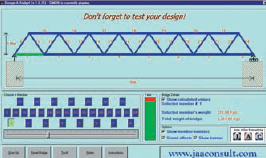
To attract boys and girls of all ages to our stand we wrote a software game in which players could quickly change the weight (and thus strength) of members in a simple truss bridge. The aim was to make the structure as light as possible while still supporting itself and a 40 t truck driving across it (the programme is free to download from our website).
It proved to be very successful and at most times our stand was the busiest in the engineering section. We had an equal balance of interest between girls and boys – something perhaps helped by having female engineers manning the stand.
Our winner turned out to be a very enthusiastic 17-year old young schoolboy. His prize includes support and advice during his remaining school year to achieve suitable qualifications and sponsorship through an engineering degree course at a UK university. On graduation he will also be offered a full-time position with us.
A rewarding experience
I can strongly recommend participation in such events as it proved a thoroughly worthwhile and rewarding experience. During and following the exhibition I was overwhelmed by our staff's enthusiasm. It was also particularly rewarding to see children getting so involved and there was a genuine desire to learn about engineering.
While the original aim was to engage young minds by providing a glimpse into the world of engineers, we were pleasantly surprised by the amount of teachers who also showed a keen interest in both the content of the stand and what engineering is about.
We took the stand in the hope that children would be encouraged to take an interest in the profession and I believe with this kind of focus and attention it will help to combat the serious skills shortage that the industry currently suffers.
Career incentives need to increase
Recently there has been an exodus of talent from engineering practices into other higher paying professions. A recent survey carried out by the Association of Consulting Engineers reveals that 94% of member companies are having trouble recruiting experienced staff, 80% are finding it difficult to recruit good quality graduates and that more than 95% of companies say that structural engineers are the hardest to recruit.
We need to introduce more scope and more glamour to the industry because, at the moment, there is very little incentive. Understandably for the students of today, the prospect of earning £35,000 a year in their mid-30s is no motivation. If this situation is not addressed soon, we are in danger of witnessing the death of the British construction industry in as little as 20 years time.
Making engineering education broader
I also feel that engineering needs to build far more flexibility into its university degree structures. If you do a civil engineering degree now, the only thing you are really qualified to do is to become a civil engineer. We should aim to introduce the same level of flexibility on engineering courses as in humanities degrees, and include subjects such risk management, programming, co-ordination and sales.
Working in the private sector, my engineers need to be able to impress clients with their enthusiasm and inventiveness as much as with their technical abilities.
The UK Government has now recognised the importance of training and developing a new generation of engineers and the Department for Education and Skills has recently made engineering the subject of one of the new vocational GCSE subjects from September 2002. Hopefully this will help to create an increased awareness of our industry.
FOR FURTHER INFORMATION CONTACT, John Allen, TEL +44 (0)1474 872274, EMAIL kent@jaaconsult.com, WEB www.jaaconsult.com
Briefing: National vocational qualifications come of age
The UK's national vocational qualification in construction project management has finally come of age thanks to the construction industry's new focus on training certification. Consultant Richard Larcombe reviews the qualification's seven-year history and reports on revisions to the stringent top-level award.
Construction was the first UK industry sector to develop national occupational standards for higher-level national vocational qualifications, published in 1994. The then Department for Education and Employment, which funded standards development, was keen to see an early exemplar of a level 5 national vocational qualification. Construction project management emerged from within the sector as the most appropriate title.
To counter the anticipated criticisms of mickey-mouseness, the designers of the new top-level award created an extremely demanding qualification. The 22 units in the pilot version were reduced to 14 and, after much negotiation, an awarding partnership was created including six chartered construction institutions. The award was launched in 1995 by Sir Michael Latham and was celebrated by government and industry as a shining example of current best practice.
Original qualification attracted little interest
Since the launch, however, the level five qualification has attracted very few registrants. The demands on candidates were substantial and there was no visible support for the award from clients or employers.
Since then the construction sector has also witnessed much change. The Latham and Egan reports have given rise to several seminal shifts of emphasis within the sector, including
The Engineering Council updated its routes to registration and encapsulated the new vision in the final consultation document Competence and commitment, which signalled a shift towards a more integrated vision for the profession.
The Construction Industry Training Board then launched a register of competent workers—the Construction Skills Certification Scheme—which has now been extended to include supervisors and managers. This is a cardholding scheme, based on national vocational qualification achievement, and has the support of the Confederation of Construction Clients, the Major Contractors Group and the professional institutions in the sector. The aim is to have a fully qualified workforce by 2004.
Vocational qualifications back in demand
All the changes have led to an increased take-up of higher-level national vocational qualifications and triggered a revision of the original level five award. This started with revision of the higher-level construction national occupational standards in 1998, with language being simplified, duplication removed and a more accessible format.
It is a requirement of national vocational qualification accreditation that the awards are regularly reviewed and updated and, in 2001/2002, the level five award underwent this process. Lessons learned about the success and failure of other qualification designs helped to guide the revision, which incorporated the following key features
removal of duplication
removal of non-critical requirements
more user-friendly language
a more realistic ‘core and options’ structure.
Core and options approach provides flexibility
The core and options approach is a powerful means of allowing flexibility of unit selection, while ensuring the rigour and relevance of the full award. This approach also ensures a balance between the ‘hard’ technical functions and the ‘soft’ managerial functions.
The new award has secured endorsement from the Construction Industry Council standards committee and now goes forward to the Qualifications and Curriculum Authority and the Scottish Qualifications Authority for formal accreditation.
The new awarding body partnership of the ICE, the Chartered Institute of Building (CIOB) and Edexcel has been joined by the Association of Project Management (APM) Association for project management, thus uniting the construction project management professional community.
The ICE, CIOB and APM are all developing their own routes to membership to include evidence from the national vocational qualification. The growth of the Construction Skills Certification Scheme scheme will also encourage construction clients, employers and other stakeholders to demand that their senior project managers are demonstrably competent.
FOR FURTHER INFORMATION CONTACT, Richard Larcombe, TEL +44 (0)1753 647765, EMAIL lark@silverbirches1.freeserve.co.uk, WEB www.ssconsulting.com
Briefing: Steel bridge guidance notes updated
The UK's ‘expert forum’ of steel bridge designers and constructors has just published an extended set of guidance notes. David Iles of the Steel Construction Institute introduces the new benchmark for good practice.
The UK's Steel Bridge Group has just produced the third issue of its Guidance notes on best practice in steel bridge construction. There are now 60 separate notes in this ringbound publication.
The group is a technical forum that was established in 1994 to consider matters of high-priority interest to the steel bridge construction industry and to suggest strategies for improving the use of steel in bridgework. It includes representatives from client, designer and constructor sections of the industry as well as from the Steel Construction Association, the British Constructional Steelwork Institutes and Corus. All the members are senior practitioners who can fairly claim to be able to express and comment upon best current practice in the UK. The chairman is John Evans of Flint and Neill Partnership and the group meets about three times a year.
The group recognised that views on design detailing and specification tend to be somewhat subjective and reflect what has traditionally been done within a particular company. The new guidance notes bring together a consensus of what is really needed for an effective and economic design, acknowledging the practical implications for the fabricator and the contractor, and to offer practical information to the whole steel bridge design sector. This should facilitate design, improve economy and speed the process of construction.
New topics included noise in rail bridges
The notes are grouped in nine subject categories, the most extensive categories being design detailing and fabrication. Other categories cover matters such as material specification, testing and inspection, erection and in situ construction work. The most recent additions to the series include subjects such as minimising noise in railway bridges, steel deck plate in footbridges, notch toughness, site welding and the application and inspection of protective treatment.
Many of the notes set down practices that are common but which have not previously been generally recorded, other than in project-specific documentation. They offer both ‘how to do it’ and ‘why you should do it’ advice and should thus become a valuable standard reference for bridge design as well as offering a benchmark of good practice.
The advice presented is not intended to be prescriptive nor does it offer, for example, a fully-dimensioned set of figures of ‘good’ steelwork details. It is intended to contribute to an understanding of how to detail and specify steelwork for a bridge project.
Building on success of original notes
The first two issues (49 notes in total) were well received by industry and are being used by designers and fabricators as a source of independent advice, as well as practical advice to less experienced engineers. One fabricator has provided each of its key staff with a copy, for reference when discussing projects with designers.
It is also worth noting that many of the notes cover general matters, not exclusive to bridges, and that advice has been welcomed in other sectors of steel construction. The Steel Bridge Group invites feedback from all users of the notes, with the aim of keeping the advice as up-date and as relevant as possible.
FOR FURTHER INFORMATION CONTACT, David Iles, TEL +44 (0)1344 623345, EMAIL d.iles@steel-sci.com, WEB www.steelbiz.org
FOR FURTHER INFORMATION CONTACT, Stephen Homer, TEL +44 (0)1392 411111, EMAIL s.homer@bevan-ashford.com, WEB www.bevan-ashford.com