A new generation of ultrasonic equipment could enable us to ‘see’ reinforcing bars in concrete without even touching the surface. Phil Purnell and Dave Hutchins of Warwick University report on the latest developments in non-destructive testing.
Ultrasonics, which are sound waves with frequencies beyond the range of human hearing, were pioneered as a civil non-destructive testing method in the late 1940s and commercial equipment, such as the Pundit, became available in the early 1970s. These devices use two matched piezoelectric transducers placed in contact with the component surface.
The transmitting transducer is excited with short, high voltage ‘spikes’ and the time taken for the resultant ultrasonic signals emitted to reach the other transducer is shown on the display. Converted to speed of sound, this can be related to the strength of the component. Robust and simple to operate, such machines remain in widespread use with their design virtually unchanged.
Electrostatic transducers better
Recent developments in ultrasonic nondestructive testing for other applications have resulted in new transducer and signal processing technologies. In particular, state-of-the-art transducers are now based on electrostatic rather than piezoelectric principles.
A piezoelectric transducer emits a signal shaped by its own acoustic properties rather than the input signal, whereas an electrostatic transducer can more accurately reproduce any input signal fed to it. As an analogy, a piezoelectric transducer is like bell and an electrostatic transducer is more like a hi-fi speaker.
The improved response allows complex frequency and/or amplitude modulated signals known as ‘chirps’ to be used.
Advanced signal processing techniques such as pulse compression can then be employed to increase signal-to-noise ratios significantly.
Surface contact unnecessary
As well as improving the accuracy of speed-of-sound measurement, controlled chirps allow other metrics, such as frequency attenuation, to be analysed. More significantly, the signal-tonoise ratios may be increased to the point where contact between the transducers and sample is no longer necessary, known as aircoupled operation.
The Ultrasonics Research Group at Warwick' University is currently exploring the possibility of developing a second generation of non-destructive testing instruments for construction materials based on the new techniques. Non-contact operation, more accurate diagnosis of properties by combining metrics such as frequency attenuation with speed of sound, and the archiving and analysis ability afforded by computers are some of the potential benefits.
Preliminary work1 by PhD student James Berriman concentrated on proof-of-concept – could a non-contact signal be transmitted through a concrete sample? Even with the low-power equipment originally in the Warwick labs, which was optimised for thin homogeneous materials such as food packaging, it was proved to be possible for a thickness of up to 75mm of concrete.
A recent grant from the Royal Society's Mercer Award scheme has been used to obtain a high-power signal generator optimised for use with construction materials. This will increase potential power by a factor of about 30, though some development in transducer design will be required to make use of the full power in non-contact mode.
Predicting in situ strength
More recent work has looked at the variation in measured speed of sound with moisture content and aggregate content in order to try and account for the scatter observed in many ultrasonic studies. In fact, for a given water-cement ratio, we found that speed of sound is more sensitive to these parameters than to strength. If these parameters can be corrected, more reliable ultrasonic non-destructive testing predictions of in-situ strength could be made.
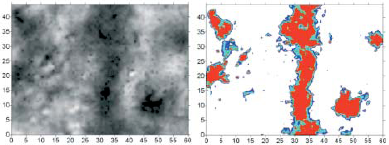
The corrections are the focus of our current research, using combined frequency-speed-of-sound analysis. Other work has imaged reinforcement bars embedded in a concrete slab using a non-contact scanning system (see image).
So far, apart from the Royal Society grant, the work has been internally financed. The team is now actively seeking external funding to continue fundamental research and develop commercially viable instruments for forensic, remote-monitoring and certification applications.
References
FOR FURTHER INFORMATION CONTACT, Dr Phil Purnell, TEL 02476 528392, EMAIL pp@eng.warwick.ac.uk