It is much easier to get people interested in advances in builtenvironment technology if it is presented holistically rather than as the output of individual engineering disciplines. Based on the experiences of a major recent research exhibition, Fionnuala Costello of the EPSRC describes how it can be done.
The Engineering and Physical Sciences Research Council (EPSRC) and the Royal Academy of Engineering held an event in London last November to showcase high quality engineering research currently being carried out in the UK.
Over 200 academics and industrialists from 76 organisations worked together to create 12 themed exhibition areas, collectively entitled ‘A celebration of UK engineering and innovation’. The themed areas displayed work cutting across traditional engineering disciplines and included healthcare, manufacturing, power, materials, environment and the built environment.
The event was a major departure from the traditional presentation methods used at trade shows and academic conferences. Exhibitors used engaging physical exhibits and intriguing but minimal text on branded banners targeted at industrialists and policymakers. The goal was to promote direct conversation about the technologies between researchers and potential users.
Built-environment exhibit
The built-environment theme was the largest stand with 60 people creating and presenting 11 individual exhibits, which represented world-class research at the scale of cities, buildings and micro-scale materials.
At the city scale, architects and designers displayed new insights into socially informed spatial engineering and the design of sustainable, crime-free, high-density cities. Potential building advances shown included a working model of drainage developments following a SARS breakout and the use of sensors to monitor durability of structures exposed to environmental pollutants.
On the micro-scale, exhibits included a running track for dust mites responding to indoor heat and humidity conditions, intelligent sensors in buildings, and light-emitting polymers to aid those with impaired vision.
Interactive ambient environments
Stephen Gage at University College London showed how the built environment can be responsive to its human occupants. Cameras and embedded sensors can be used to identify human location and behaviour so buildings systems interact with occupants – such as by changing lighting, heating and volume levels.
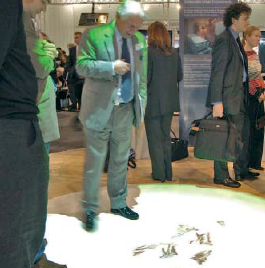
This arts-based engineering research, which couples human factors with advanced technology, was demonstrated using a sample floor on which visitors could step on projected bug images (see photograph).
Vibration sensors in the floor surface detected footsteps and this was coupled to a computer vision system which identified the location of the people. An ambient acoustic system enhanced the sound of footsteps and, when sensors detected impact on the bug images, the images would break up as if squashed.
Overcoming boundaries
The challenge facing the built-environment team was to present a single, coherent, coordinated exhibit from a team of diverse professionals. For many exhibitors it was the first time that architects, engineers, designers, materials scientists, construction management experts and social scientists had worked together on a dissemination project.
Academics and industrialists overcame traditional discipline boundaries during a oneday facilitated workshop event last summer. Together they generated the overarching structure of the stand and identified the desired physical exhibits. Large amounts of time were then devoted to constructing creative exhibits which, on the day, were explained with enthusiasm to visitors and team members alike.
The finished result was outstanding and well worth the effort. One attendee, David Jordan, former managing director of Philips Electronics UK Ltd stated:‘I was hugely impressed by the show, and it was a real credit to the breadth and depth of engineering research in the UK. The thematic grouping of the topics exhibited was particularly effective. I have been to many exhibitions of various kinds in my 40 years in business, but I have to say that this was as impressive as anything I have seen.’
Built-environment presenters intend to build on their new collaborations through a follow-on funding stream provided by EPSRC.
FOR FURTHER INFORMATION CONTACT, Fionnuala Costello, TEL +44 (0) 1793 444134, EMAIL fionnuala.costello@epsrc.ac.uk