ICE membership director David Lloyd-Roach and Jay Merrick of The Independent introduce a little-known joint ICE–RIBA fund for young engineers and architects wishing to become involved on innovative, small-scale community projects.
Louis Kahn, one of the geniuses of mid-twentieth century architecture, said, ‘If you ask a brick what it wants to be, it would say, an arch.’ Karl Popper, meanwhile, grounded his famous ‘small-is-beautiful’ dictum in another equally decisive declaration, ‘All life is problem-solving.’ The raison d'être of the Insitution of Civil Engineers (ICE)–Royal Institute of British Architects (RIBA) McAslan Bursary draws from these two simple but energising ideas.
Small-scale projects, developed and carried through by young engineers, architects and designers, can have remarkable potency. All of the 150-plus projects supported by the bursary fund in the last three years have been like Kahn's bricks: they may be relatively simple, but they add something to the lives of people and places by addressing specific needs in challenging surroundings in Britain and overseas. They also represent a desire to promote collaboration, and do so at an early stage in the careers of engineers and architects.
Supported by ICE and RIBA
The fund was created in 2004 by UK architect John McAslan and is supported by ICE and RIBA. It was not conceived as a simple pro bono exercise: projects that receive funding must demonstrate practical innovation, hands-on involvement with communities and tangible results. In short, the funded projects have to make a useful and humane difference to people's lives.
‘Architecture and engineering must deal with life,’ says McAslan. ‘They must make a beneficial difference. At another level, they can also connect one situation or perception with another.’
McAslan also hopes the work of the bursary-supported teams will add to the canon of architectural, structural and environmental research and experiment—not least in places where the quality of life is under constant pressure. ‘Survival conditions are a ruthless test-bed for forms and structures,’ he says. ‘They also teach young designers to communicate quickly and clearly with those whom they’re trying to help.’
Protecting and improving lives
Since its launch the bursary has funded nine projects worth £42 000. Recent beneficiaries include Julia King and Asif Khan, who received £7242 in March 2007 for their ‘one-year house’ project at a refugee camp on the Thailand–Burma border.
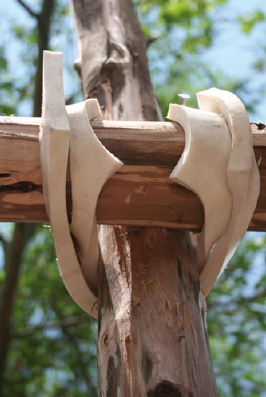
Working with local carpenters, King and Khan sought to better living conditions in the 50 000-strong camp by designing a modular bamboo hut system that could be used in the undulating terrain and deliver better internal conditions. Key to the design was development of a flexible joint-tie, which was strong enough to hold structural elements together yet also simple to make and use (Fig. 1). The design could be in big demand with more than 170 000 other refugees living in nine camps on the Thai side of the border.
In Shimakeldi village on the plains of Maharastra, India, temperatures can reach 45°C in the dry season and trees struggle to survive past the sapling stage, leaving villagers almost completely exposed to the sun when outdoors. With the help of £4250 of bursary funding in 2006, Craig Bamford worked with villagers and very basic materials to design and build a combination sun-shade and sapling protector.
Not all the bursary-funded projects are about life-and-death challenges or based on architecture or engineering skills. This has led to projects such as Adam Khan's design for a homeless youth centre in King's Cross and Sophie Handler's ‘research novel’ highlighting the potential isolation of older people in the East End of London.
March 2008 closing date
The deadline for 2008 bursary applications is 3 March 2008. Applicants must be either on or have graduated within the past five years from a Joint Board of Moderators (JMB)-accredited civil engineering course. The bursaries are up to £10 000 in value and recipients are expected to contribute 25% of total project costs, either through in-kind sponsorship or direct grants from other organisations.
Order forms can be downloaded from the RIBA website at www.architecture.com (search for McAslan Busary).
FOR FURTHER INFORMATION CONTACT, David Lloyd-Roach, TEL +442 20 7222 7722, EMAIL david.lloyd-roach@ice.org.uk, WEB www.architecture.com