

It is now 10 years since the UK built its last nuclear power station. But, as Robert Freer reports, recent research indicates the British public and their politicians are now more open-minded about future nuclear development.
Britain's era of commercial nuclear power started in 1956 when the output from the first nuclear power station at Calder Hall in Cumbria was connected to the National Grid. However, the public's progressive loss of confidence in the nuclear industry has led to no new plant being built in the UK since Sizewell B was completed in 1995.
But in much of the rest of the world, nuclear development has continued unabated. There are now 400 nuclear power stations world-wide and 35 more currently under construction. Total installed capacity is around 360GW and combined output is more than 2700TWh. Just across the Channel in France, for example, nuclear power supplies 78% of domestic demand. Furthermore, French CO2 emissions from fuel combustion are 30% less than in the UK.1
Declining production of indigenous fuels in the UK and the search for carbon-free generation has focussed the Government's attention on the possibility of reviving nuclear development – but also on the fundamental importance of informing the public and engaging them in the decisions to be taken.
Opinions now balanced
Recent research by MORI, the results of which were presented at the Energy Choices conference in London on 2 December 2004, shows that the British public's attitude towards the nuclear industry is the most positive for some years. Those in favour of the industry (28%) have edged ahead of those against (26%), though around half continue to be undecided. MPs are also almost equally divided in their opinions for and against, except that only a quarter did not have an opinion.
Thirty-five per cent of people support replacing existing nuclear power stations with new ones while 30% are against and a further 35% undecided. Opposition to new build has been steadily decreasing since 2001, though safety is still cited as the main concern.
The public's preferred choice of energy source was, by a long way, the sun, followed by wave energy. Unfortunately many engineers consider that neither of these sources are likely to provide reliable and economic energy on a large scale for some years to come.
Education still needed
Asked about what they thought were the ‘big issues’ and what factors should be taken into account in deciding the method of generating electricity, the public's main concern was the effect on the environment.
However, a third of people thought global warming caused the hole in the ozone layer or caused acid rain.
When asked about the effects and consequences of specific sources of energy, half of those surveyed believed that nuclear power does not produce greenhouse gases, and two-thirds were concerned that by 2020 we shall have to rely on imported gas to generate much of our electricity.
The majority of MPs surveyed wanted either to educate the public and improve the image of the nuclear industry, or to take the decision now to build new nuclear power stations. Doing nothing was only a minority opinion.
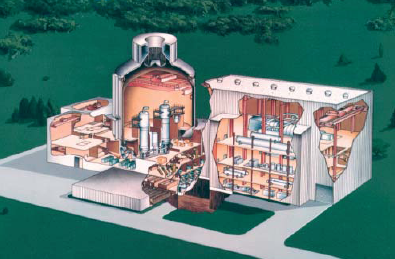
BNFL-Westinghouse AP1000 is a one of the designs which could be considered for future UK nuclear stations – but only if public opinion changes
BNFL-Westinghouse AP1000 is a one of the designs which could be considered for future UK nuclear stations – but only if public opinion changes
Trust is the key
Finally, in terms of who they believe, the public said they most trust doctors, teachers and clergyman and least trust business leaders, politicians and journalists. However, over half those questioned were at least fairly confident that the nuclear industry operated in the best interests of society.
In summary it appears that the public and politicians are warming somewhat to nuclear energy, especially if the alternative is relying on imported gas. However, there is still a major task to be undertaken to help people understand the problems facing the energy industry and the possible realistic solutions.
As MORI research director Robert Knight concluded:‘deep-rooted suspicions of bias disqualify many of the best candidates to lead this effort’.
Reference
FOR FURTHER INFORMATION CONTACT, Robert Knight, TEL +44 (0)20 7347 3082, EMAIL robert.knight@mori.com

