

Five years after the World Commission on Dams report, some dams are still being built without proper planning and risk further erosion of public support. Ute Collier of WWF looked at six dams started since the report and found options and impacts were still not properly considered.
On 16 November 2000 the World Commission on Dams (WCD) launched its landmark report to find new ways forward in what had become one of the most controversial areas of infrastructure development.1
The Commission was established in 1998 as an independent, international, multi-stakeholder process supported by 58 institutions. These included the World Bank and—in the UK—the Department for International Development and the British Dam Society.
The report recognised the benefits of dams but also found that in too many cases an unacceptable and often unnecessary social and environmental price had been paid. The Commission recommended a new framework for decision-making, which was broadly welcomed by most stakeholders in the dams arena. But has the report made a difference?
On the fifth anniversary of the report in November 2005, WWF published an assessment of the Commission's legacy. The new report To Dam or not to Dam?2 looks at six case studies of dams that have been approved and started construction since 2000. The sample includes four hydropower dams, one drinking water supply reservoir and one irrigation dam.
The six dams were assessed against the strategic priorities of the WCD report and shortcomings were found in all of them. They were particularly weak in relation to two strategic priorities of the WCD report: comprehensive options assessment and sustaining rivers and livelihoods.
Options not fully assessed
In terms of options assessment, the Commission recommended a comprehensive and participatory assessment of the full range of policy, institutional and technical options. In the assessment process, social and environmental aspects should be given the same significance as economic and financial factors.
Yet, in the case of the Melonares dam in southern Spain (Fig. 1) for example, feasible alternatives were ignored and the needs assessment for urban water supply in Seville failed to take into account water efficiency trends. In 2005, Seville's water demand is actually 25% lower than the level forecast in the original dam proposal as drought has resulted in water-saving measures which should have been implemented right from the outset as at least a partial alternative to the dam.
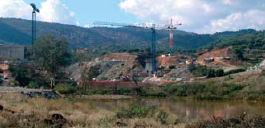
Construction of Melonares dam continues at Andalucia in Spain despite uncertainties about how water from the dam will be transferred to Seville (copyright WWF-Spain/F. Fuentelsaz)
Construction of Melonares dam continues at Andalucia in Spain despite uncertainties about how water from the dam will be transferred to Seville (copyright WWF-Spain/F. Fuentelsaz)
In the case of the Ermenek dam in Turkey, measures to improve energy efficiency and to reduce transmission losses (up to 30% in Turkey) were not considered as options, even though the Commission highlighted the need to prioritise efficiency improvements.
Furthermore, severe shortcomings were found in the environmental impact assessment for the dam. Ecological surveys failed to list several threatened plant species known to occur in the area and no assessment was made of the potential cumulative impacts of Ermenek and the other five planned hydropower projects in the same basin, the delta of which is recognised as a wetland of international importance under the Ramsar Convention. A basin-wide assessment of impacts was one of the specific recommendations of the WCD.
Changes in decision-making
However, WWF also identified a number of developments which indicate some changes in decision-making processes relevant to dams.
For example, in China on the Yangtze River, where 105 dams are planned and under construction, 2005 saw the establishment of the Yangtze Forum which brought together for the first time various central government departments, national and provincial governments, to develop a common vision for the management and conservation of the river. This is a crucial step towards better planning and addressing the cumulative impacts of the large number of dams in the basin.
In WWF's view, the Commission's recommendations are as relevant today as they were in 2000. At a time when there is increasing pressure to develop hydropower and water storage potentials, especially in the developing world, it is crucial that the mistakes of the past are not repeated. In particular, we urge governments, dam developers and financiers to
assess needs and options more comprehensively
consider new dams only after strategic environmental assessment
wherever feasible, rehabilitate existing dams to increase power generation and other economic benefits, while reducing social and environmental impacts.
References
FOR FURTHER INFORMATION CONTACT, Alexandra Hartridge, WWF-UK, TEL +44 (0)1483 412347, EMAIL ahartridge@wwf.org.uk, WEB www.wwf.org.uk

