

Steel-framed buildings are still cheaper than concrete-framed equivalents despite recent hikes in steel costs—and substantially cheaper than two decades ago. Simon Rawlinson of Davis Langdon reports on the results of a recent comparative design project.
Steel frames have been re-confirmed as the fastest and most cost-effective solution for both commercial and residential apartment buildings by the latest cost-comparison survey.
Commissioned by Corus and produced by a team including Arup, Mace, Davis Langdon and the Steel Construction Institute (SCI), the survey compared the relative costs of constructing two commercial buildings in steel and concrete, and also a multi-storey residential building.
The survey has been updated regularly since first being produced in 1993, with the latest based on second quarter 2005 prices. The costs of fully designed buildings were analysed, with Arup producing the concrete designs, SCI the steel designs, Mace acting as project manager and Davis Langdon providing quantity surveyor input.
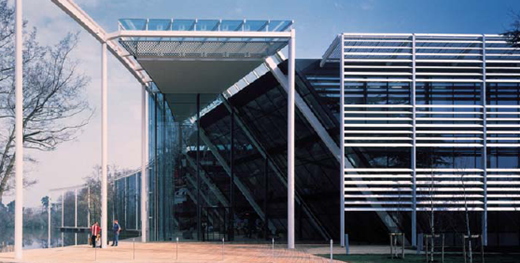
Steel-framed buildings remain 3–5 % cheaper than concrete-framed equivalents despite steel costs having increased by up to 20 %
Steel-framed buildings remain 3–5 % cheaper than concrete-framed equivalents despite steel costs having increased by up to 20 %
The three buildings were a speculative office building in Manchester, a London headoffice building and a multi-storey mixed-use residential scheme in outer London, with retail on the ground floor and a basement car park.
Cost advantages remain
The case studies showed that steel has maintained its cost advantage over concrete despite the well-publicised cost increases that occurred during 2004. Given the wider benefits associated with the specification of steel, including speed and certainty of programme, the flexibility of long-span design and sustainability, the case for selecting steel continues to be strong.
The main cost difference between the steel-framed commercial buildings in the present survey and the last one at the end of 2003 is that the cost of the steel frames, including fire protection and floors, increased in price by 9–20 %. As a result the overall building cost for the steel-framed buildings has risen in that time by 5–9 %.
The price increase for a reinforced concrete frame option in the same period was 3–11 % for frame and floors, while the overall building cost rose 4–8 %. Despite this, steel remains the speediest and lowest-cost option at typically 3–5 % below concrete in overall building cost terms.
In the multi-storey residential comparison, frame and floor costs are found to be typically 13–15 % of overall building costs. The survey shows that steel-framed options are still typically 2 % below concrete in overall building cost terms. The steel-framed schemes have increased in price since 2003 by between 13–21 % for frame and floor, while the overall building cost has risen 8–10 %. The reinforced concrete scheme has risen 19 % for frame and floor while overall building cost is up 10 %.
Prices falling in long term
Recent research completed by Corus looking at cost increases over the past decade shows that, in real terms, a steel frame and floor with fire protection costs 9 % more than it did in 1995. By contrast, concrete frame and floor solutions are typically 29 % more expensive in real terms than they were 10 years ago.
The falling cost of steel has resulted from significant reductions in the real-term cost of materials. By contrast, the process improvements which have occurred with concrete have been insufficient to offset increasing costs of labour.
Corus reports for example that the cost of a tonne of steel for a multi-storey frame including fire protection was about £985 in 1981, which would be around £2500 today if steel-frame costs had kept pace with tenderprice inflation. The current price for a tonne of fire-protected structural steel in 2005 is about £1500—nearly 40 % less.
FOR FURTHER INFORMATION CONTACT, Simon Rawlinson, TEL +44 (0)20 7061 7708, EMAIL simon.rawlinson@davislangdon.com WEB www.davislangdon.com

