

Discussion
P13968: Understanding novel structures through form-finding: by Wanda Lewis (November 2005)
Contribution by Anthony Marchant
I fully concur with the conclusions of this interesting paper, particularly the need for graduates to be trained in conceptual design, which, in my opinion, can only be achieved by several years of good tutorial from appropriate senior designers.
I moved into civil engineering from the aircraft industry, subsequently as a consulting engineer specialising in lightweight and unusual structures. I saw the growth of computational analysis and over my 30 years or so as a consultant, I witnessed the decline in the ability of engineers to analyse structures from first principles. If I wanted a good structural engineer I found such a person from the stress offices of the aircraft industry or we trained the graduates ourselves. I only hope that we were able to pass on the ‘feel’ factor.
With regards to computational analysis, my basic rule has always been that if you are unable to calculate an approximate answer, do not start the analysis.
P14097: Civil engineering—still a job for the boys?: by Liz Hodgkinson and Les Hamills (November 2005)
Contribution by Ted Flaxman
What a pity that the authors have put forward such a misleadingly incomplete view on the numbers of women in civil engineering. This is an important topic which deserves a better understanding of the essentials.
Having quoted the views of youngsters on the ‘gender imbalance’ in this and other profes-sions, the authors really should have given a better lead as to the reasons. One reason has nothing to do with ‘society's gender stereotyping’ but results from the simple fact that the two sexes, within their obvious physical differences, also have very different brains.
A careful reading of one of the popular books on this topic such as Why men don't listen and women can't read maps by Allan and Barbara Pease would have provided more enlightenment to their conclusions. Of course, some women can read maps and the occasional man may listen, but the general conclusions are irresistible—our mental capabilities are, on average, very different.

Author's reply
Biological arguments have too often been used to justify differences in social status and power between men and women, implying that this situation is fixed,‘natural’ and therefore not open to change.
Not that long ago, women were denied access to higher education and the professions. It was 1948 before Cambridge University allowed women to graduate on the same terms as men. Would those who ran the university be horrified or delighted that women now form the majority of the applicants to medicine and law? Yet in 2003 only 246 UK women applied for civil engineering at university (along with 1648 men). It is not, then, that there is a shortage of capable women:they could constitute the majority of the applicants to civil engineering courses if they really wanted to—they just do not want to.
As to the question of whether civil engineering can ever attract equal numbers of women and men—the fact that there are cross-cultural differences in female participation (for example, Eastern Europe and areas of South East Asia have rough parity) shows that there are barriers that need to be addressed within our own society, not least of which is the clear message that many in the industry feel that women are not up to the job.
P14012: Ma'rib Dam and irrigation project—a wonder in the desert: by Rajib Chakraborty (November 2005)
Contribution by Peter Doran
I was both surprised and disappointed that there was negligible mention of the social and agricultural aspects of this project. As civil engineers, we need to recognise our customers and construct what is needed by the societies we serve. I believe these aspects should have been reported on.
There appears to have been so much scope for comment on the social and agricultural practices and the changing aspirations of the people benefiting from this project over the 30 year ‘construction’ period. Yet there was no mention of what crops are being grown—subsistence or cash crops—what the harvesting and secondary processes were and how they may have changed (surely the reason for the elaborate road system), whether the engineering infrastructure is there to serve agribusinesses and/or smallholders, and so on.
Civil engineers need to be more broad-minded than merely concentrating on the technical aspects of projects of this nature. Design, construction and rehabilitation are not the only criteria on which success should be based.
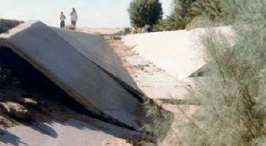
Social impact—or lack of it: the local tribal population had no interest in the project's benefits
Social impact—or lack of it: the local tribal population had no interest in the project's benefits
Author's reply
I agree there was scope for discussing social issues. As I mentioned in the paper, however, the society of Ma'rib is tribally based and different from any other part of the country. The local population is generally hostile in nature to the government and to other tribes. They carry AK47 guns from their childhood for self protection, do not like to obey government rules and would rather go by their own laws. The government also does not have much control over them.
Most locals do not want to realise the benefits of the project. Where the success of such a big irrigation network depends upon the coopera tive association of beneficiaries, here they are only interested in their own profit. There is no cooperative desire for a water-user association. Thus, I did not go into depth about the social aspects of the scheme and described it as an ‘adverse social condition’.
P14193: Why UK wind power should not exceed 10 GW: by Hugh Sharman (November 2005)
Contribution by Bob Johnson
It is not clear from the paper why the conclusions should be based in large part on the comparison of three Danish storms and the lowest summer demand curve for England and Wales, especially when two of the storms occurred in winter. Would it not be more logical to compare average summer and winter wind conditions with average seasonal demand curves?
Furthermore, even on the comparison given, the 12·4 GW capacity response to the storms is always well below the minimum summer demand curve and it is not clear from the paper why this justifies the statement ‘it is clear that 12·4 GW of wind …will impose severe strains on the England and Wales system.’ The argument appears to rest more on the comparison with the installed capacity per capita in Germany than the response to the Danish storms.
Author's reply
Due to space limitations I chose to present three arbitrarily selected storms that can occur at any time of the year, graphically. The main point at issue will be the nature and amount of the base load plants that will be operating in tandem with wind. My paper points out that most of today's firm, base-load capacity, in the form of 12 GW nuclear, will be closed by 2020. Any amount of wind cannot replace the need to replace this ‘firm’ capacity. The replacement can be with combined-cycle gas turbines, ‘clean’ coal or new nuclear.
For the reasons explained, increased dependence on gas would be unwise. That leaves the need for building not less than 12–16 GW of nuclear and/or clean coal, the latter probably in the form of integrated gasification combined cycle (IGCC). Neither nuclear nor IGCC are amenable to cycling, let alone turning on and off. So, in summer, much of the 12 MW (or so) of wind capacity that will not present huge problems for the rest of the year, must often be curtailed during windy weather. This situation could be altered if storage is built on a very large scale.
I cannot pretend that 10 GW of wind power is a scientifically calculated ‘upper’ limit to how much should be built. However, at the point where large-scale curtailment or expensive balancing by fossil plants operating sub-optimally is reached, that is the likely, rational, upper limit for this type of capacity.
Contribution by Ben Tatham
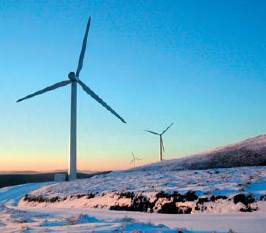
In the Local Government Association magazine First, Jonathon Porritt, chairman of the Sustainable Development Commission UK (SDC), urges councilors to disregard ‘outdated myths’ and to grant planning applications for wind farms.
He also says: ‘Wind power does indeed displace some conventional plant, so there is no need for “additional” or “dedicated” conventional capacity to provide backup for when the wind isn't blowing, as is commonly assumed’.
Would the author please comment on this claim by the chairman of a Government-funded body which is presumably meant to supply the public with reliable data on this important subject?
Author's reply
It is useful to read the SDC report, to which Mr Porritt refers and which is downloadable from www.sd-commission.org.uk.
First, apart from Mr Porritt, no author is mentioned. I wonder what qualifies Mr Porritt to come to his conclusions? It would have been helpful to know who was responsible for what reads to some of us in the engineering profession as propaganda masquerading as science. The references (page 143) exclude the two weighty wind reports by Eon Netz, 2004 and 2005, which, unlike the SDC's report, are fully attributed and recount real experience.
It astonishes me that the UK appears to remain in wilful denial of what is happening elsewhere. In Germany just 4·5 % wind penetration by MWh, or 14 % by capacity (MW) is causing enormous strain on the grid system, despite the fact that Germany is inter-connected with all its neighbours. It is therefore valid to ask how the UK can painlessly achieve even 10 % penetration by MWh given its relative lack of inter-connection and its very limited storage (in the form of pumped hydro in North Wales).
Contribution by Mark Petterson
The capacity factors shown in Table 1 are wrong as the significant new capacity added during each Renewables Obligation Certificate (ROC) period artificially lowers the annual average in this over-simplified analysis as a full year's output is not included from these new sites.
Furthermore, National Grid balances the system in real time and does not rely on the day-ahead forecast as presumed by the paper. The days of the ‘pool’ are long gone. Forecasting accuracies for aggregate wind output are extremely good several hours before each gate closure and the market then works to correct any looming imbalance. These facts are reflected in the more tolerant attitude that National Grid, the system operator, is showing towards the potential market penetration of wind power than readers of the paper might presume.
Author's reply
In calculating the load factors in Table 1, I used the average of the national capacity at the beginning and the end of each Ofgem period. This takes into account the growth of the capacity and gives a reasonable if not perfect approximation for the load factor achieved during the period.
Of course, the UK wind carpet at 1 GW produces a tiny fraction of all generation, and this is easy to balance in real time. Our main point of contention arises from the question of how easy this is to balance when the wind penetration becomes more significant. At what point does the growth of the wind carpet start to deliver more problems than solutions?
It is clear from the Eon Netz wind reports of 2004 and 2005 that optimum levels of wind power in the German system have been exceeded. Eon Netz, RWE and Vattenfall are struggling to keep the German system in balance with a wind capacity of 17 000 MW, 24 % of peak demand, but delivering just under 5% of German electricity demand. The Germans have the same access to wind forecasting and high-tech system balancing as enjoyed by the UK.
Contribution by Peter Hinson
The paper has some fundamental errors. Extrapolating generation issues from a small part of Denmark to the UK is rather like saying that, for example, Yorkshire would have problems if it wasn't linked to the National Grid.
On page 167 the paper incorrectly claims that ‘wind power is already three to four times more expensive than conventional power’. The recent Sustainable Development Commission Report Wind power in the UK (May 2005) compares the wholesale price of electricity at 3 p/kWh against onshore wind at 3·2 p and offshore at 5·5 p. This is not a ‘three to four times’ difference.
There is a fundamental mistake on page 168 in assuming that all CCGT plant will work at reduced load and thereby increase carbon dioxide emissions. The reality is that the dozens of generation stations are called into use on merit order to handle the existing 20 GW daily load variation and most will be working flat-out when in use. But the main flaw is that the author, in criticizing wind power alone, fails realistically to explore how we achieve the essential 60 % cut in our carbon emissions and avoid dependence on diminishing supplies of fossil fuels.
Author's reply
West Denmark is not ‘a small part of Denmark’. It is most of Denmark by land area. It is significantly sized in relation to both Wales (it is larger than Wales) and those areas of Scotland where most applications for wind connections are clustered. This is why, on the whole, I deem it can be valid to extrapolate West Danish experience when dealing with relatively small parts of the UK where most wind is accumulated.
The system for rewarding wind is highly profitable for those developers fortunate enough to receive permission and grid connections to build at good sites in UK. Thanks to the ludicrous system of ROCs, UK developers are receiving an average of £90 /MWh, twice the rate necessary to obtain a 20 % return on the investment.
The undifferentiated ROC subsidy, though not enough to make offshore wind power and more reliable tidal stream and wave power feasible, is grossly over-rewarding much onshore wind power, thus more than doubling its cost to consumers. Equally, given the very low load factor of the national wind carpet (Table 1 in the paper), it seems to have motivated the construction of many wind farms where the wind resource was never enough to justify the landscape destruction caused.
Full versions of these discussions can be read in the online version of the journal at www.civilengineering-ice.com
Proceedings: RECENTLY PUBLISHED PAPERS
In addition to Civil Engineering, the ICE Proceedings includes ten specialist journals. Papers and articles published in the most recent issues are listed here. Summaries of all these and other papers and articles published in the past three years can be read free at www.thomastelford.com/journals. ICE members can download any 15 papers published in 2005 for £25 from www.iceknowledge.com.
Bridge Engineering
158, No. BE4, December 2005, 141–216
PAPERS
Design and construction of the Sail Bridge, Swansea, UK
P. A. Sanders and I. P. T. Firth
Performance of a stress-laminated-timber arch bridge
A. Kermani and G. Freedman

Human–structure dynamic interaction in footbridges
S. Živanoviç, A. Pavic and P. Reynolds
The replacement of Carbrain Gully footbridge
D. Greenslade
Efficient dynamic performance assessment of a footbridge
J. M. W. Brownjohn and C. Middleton
Footbridge over the Sant Adria Marina in Barcelona, Spain
Á. C. Aparicio and G. Ramos
Resonant vibration of shallow suspension footbridges
M.-H. Huang, D. P. Thambiratnam and N. J. Perera
Engineering Sustainability
158, No. ES4, December 2005, 183–242
PAPERS
Guides to sustainable built-environment development
H. V. Bartlett and P. M. Guthrie
Summertime urban heat island hysteresis lag complexity
J. S. Golden, P. M. Guthrie, K. E. Kaloush and R. E. Britter

Achieving sustainability in vibro stone column techniques
C. J. Serridge
Organised recycling in Gaborone, Botswana
B. Bolaane and M. Ali
Geotechnical Engineering
159, No. GE1, January 2006, 1–62
PAPERS
The response of surface structures to tunnel construction
J. N. Franzius, D. M. Potts and J. B. Burland
Foundation design for a large arch bridge on alluvial soils
J. Monnet, D. Allagnat, J. Teston, P. Billet and F. Baguelin

Eurocode design of underground metro structures
D. Beadman
Discrete element modelling of geogrid-reinforced aggregates
G. R. McDowell, O. Harireche, H. Konietzky, S. F. Brown and N. H. Thom
Analysis of behaviour of a high rockfill dam
A. Soroush and A. Aghaei Araei
Maritime Engineering
158, No. MA4, December 2005, 137–185
PAPERS
Large-scale experiences on wave downfall pressures
G. Wolters, G. Müller, T. Bruce and C. Obhrai
A new analysis of the Slapton barrier beach system, UK
A. J. Chadwick, H. Karunarathna, R. Gehrels, A. C. Massey, D. O'Brien and D. Dales

Investigation of detached breakwaters. Part 2—morphodynamics
S. Ilic, A. J. Chadwick and C. Fleming
Looking back: modelling the Cheshire Dee in 1939
D. McDowell
Municipal Engineer
158, No. ME4, December 2005, 249–293
BRIEFINGS
In-vehicle information system interfaces
P. Hampton
PAPERS

Effective taxonomies for database management
B. Wallace and A. Ross
Achieving more intelligent cities
D. Komakech
Advanced transport management in an intelligent city
B. McQueen, K. Chen, Q. Shi and G. Carlin
Integration improves traffic management in York, UK
D. Capes and R. Hewitt
Managing a city's transportation network—a case study
P. Welsh
Structures and Buildings
159, No. SB1, February 2006, 1–62
PAPERS
A new approach for modelling circulation in secondary schools
D. Brocklehurst, D. Bouchlaghem, D. Pitfield, M. Green and K. Still
Performance of structural insulated panels
A. Kermani

Advances in fire engineering design of steel structures
C. G. Bailey
Artificial neural network analysis of infilled planar frames
M. Bagci, and G. Altintas ∧
A framework for objective structural frame selection
R. Soetanto, A. B. J. Dainty, J. Glass and A. D. F. Price
Transport
159, No. TR1, February 2006, 1–56
PAPERS
An analysis of road traffic incidents on the M25 motorway, UK
S. Rodgers, B. Wadsworth, S. D. Smith and M. C. Forde

Children's views on the road environment and safety
K. Lupton and M. Bayley
Using waste to reduce slope erosion on road embankments
J.de Oña and F. Osorio
Development of German non-ballasted track forms
R. Bastin
Testing a traffic signal optimisation algorithm
A. S. Abdelfatah
Water Management
159, No. WM4, December 2005, 135–196
PAPERS
Impact of climate change on UK flooding and future predictions
M. Dale
Two-dimensional model for lateral intake flows
A. Mohamadian

Management of shared watercourses in southern Africa
M. J. Tumbare
Scour of gravel beds at bridge piers and abutments
R. V. Raikar and S. Dey
Hydraulic performance and stability of coarse rock-fill deposits
D. Hansen, W. Z. Zhao and S. Y. Han
Socially sensitive regulation for water services
J. S. Bateman, M. Sohail and C. Njiru
Roof collection and storage of rainwater for drinking
J. Ashworth
Civil Engineering Special Issue
158, No. CESI2, November 2005, 1–64
PAPERS
Introduction
D. Kerr
UK power: an ever-changing challenge for civil engineers
A. Price
Nuclear fission: continuing evolution of a future generation
S. Dagnall
Wind power: a major opportunity for the UK
R. Ffrench, D. Bonnett and J. Sandon
Hydroelectric power: present role and future prospects
A. Bartle and G. Hallowes
Marine power: getting energy from tidal barrages, waves and tidal flows
D. Kerr
Geothermal energy: a major renewable energy resource
T. Batchelor
Solar photovoltaic energy: electricity generation in the built environment
A. Bahaj
Electrical energy storage—a review of technology options
A. Price
Nuclear fusion power: a bright but still distant future
C. Llewellyn and D. Ward
Personal on-line subscriptions to specialist Proceedings journals start from £11 a year for members. Print subscriptions start at £18 a year and include full on-line access to the current and past three years' issues. Please call +44 (0)20 7665 2227, email subs@ice.org.uk or visit the ICE virtual library at www.iceknowledge.com. At the virtual library members can also download any 15 Proceedings papers published this year for £25 or any paper published over three years ago at £5 each.
Request for papers
All Proceedings journals rely entirely on papers sent in by civil engineers and related professionals, researchers, academics and students. Papers should be around 2000 to 5000 words long, in good English and with adequate illustrations and references. Project papers are particularly welcome. All papers sent in will be assessed on merit and not on the status of the author. Simply email your text and images together with your contact details to journals@ice.org.uk. For full guidelines on writing a paper please visit www.thomastelford.com/journals or contact the editor Simon Fullalove on 020 7665 2448 or editor@ice.org.uk.
The following is a list of referees who have reviewed papers for Civil Engineering between 1 November 2004 and 1 November 2005. The Institution is very grateful for their assistance. If you would like to be considered as a referee, please contact the journal secretary Ben Ramster on 020 7665 2242 or e-mail ben.ramster@ice.org.uk
| D. H. Acres | M. Cutler | M. Haines | S. P. Marchand | M. J. Roach |
| D. Allenby | A. C. Dick | G. R. Hallowes | J. Martin | K. Robson |
| D. Anstice | J. W. Davies | L. Hamill | P. Matthews | J. Rolt |
| J. Atkinson | J. P. Davis | I. Hamilton | B. R. Mawson | T. Ruddock |
| A. S. Bahaj | T. M. Day | D. Hawkes | C. McAleenan | N. Sandilands |
| D. Bailey | J. De Rosa | G. Hazel | C. Melbourne | T. Sangster |
| J. K. Banyard | A. C. Dick | H. Hazel | A. A. B. Mills | M. T. Sharman |
| N. M. Barnes | M. Dyer | M. E. Hegarty | J. Morton | S. Simonini |
| A. W. Beeby | C. Dymiotis- | E. J. M. Hepper | S. S. J. Moy | D. Singleton |
| J. J. Beeton | Wellington | P. Higgins | T. M. Mulroy | A. O. Smith |
| E. Bell | T. Elhag | N. B. Hounsell | A. Napier | S. J. Smith |
| G. T. Bessant | D. Ellix | I. Hunt | R. Napthine | T. W. Tanton |
| C. J. A. Binnie | M. Enoch | P. Jackson | I. Neal | K. J. Thomas |
| I. G. Bryden | B. Fawcett | A. Jolly | D. A. Nethercott | M. R. Tight |
| H. J. Burd | R. Fernie | P. W. Jowitt | J. C. Nicholls | D. Turner |
| S. Caccavone | C. Ferrary | W. R. Kemp | I. R. Nicholson | J. Venables |
| T. Caccavone | A. Forster | D. Kerr | A. Oakhill | R. Wardlaw |
| J. N. Carpenter | A. Fox | H. A. Khalid | A. Pavic | T. Warren |
| S. A. Cartney | P. D. Fox | J. Kirke | R. A. Paxton | S. H. Wearne |
| P. Cave | R. Freer | D. R. Lamont | A. D. M. Penman | J. Wernick |
| J. C. Chapman | S. Fullalove | R. Larcombe | G. M. Pinfold | S. White |
| T. Chapman | P. Gerstrom | F. M. Law | J. R. Plumb | T. Whittaker |
| M. S. Chubb | D. Green | A. Laycock | W. J. Rankin | G. M. Winch |
| W. S. Cooper | S. Grubb | S. J. Lee | W. M. Reid | M. C. Winter |
| G. Copley | J. Gunning | M. P. Lutton | M. G. Reynolds | C. Wotherspoon |
| M. Cullen | R. J. Hacker | B. Madge | P. Richens | T. A. Wyatt |
Books: REVIEWS
Dictionary of civil engineering: English–French by Jean- Paul Kurtz, published by Kluwer Academic / Plenum Publishers, 2004, reviewed by Rose Marney, ICE library.
This is a most curious book, not least because it appears to some kind of amalgam between dictionary and an encyclopaedia. It aims to be comprehensive and to index and codify the huge variety of technical terms in civil engineering so that all the technicians involved may speak ‘the same true language’. It is hard to know precisely who it is aimed at, and it is a huge volume. It might work as a reference book for your desk but it certainly isn't portable.

The volume is mainly in English although the French equivalent of the term being defined is given. It doesn't work as a French–English dictionary. The definitions vary quite a bit in length. Some are brief and the language can be awkward, betraying the fact that the complier isn't a native English speaker (e.g.‘Mohr circle of stress—a circle that intervenes in the study of the distribution of stresses around a point’).
Some definitions, such as the one for ‘foundation’, take up pages, complete with sub-definitions and illustrative figures. The figures do not appear with the definition but are gathered together with others from that same letter of the alphabet at the end of the relevant section. I like the idea of the figures and you can see the point of them in a field such as engineering where you can illustrate the various types of lattice girder, for example, or a process such as the production of Portland cement.
However, the compiler has set himself a hugely ambitious and almost impossible task. For an English-speaking engineer who feels the need for a technical dictionary, I would think the New Penguin Dictionary of Civil Engineering (2005) is quite adequate, as much because it is smaller and more portable. It might be as well to retain a copy of the previous edition, too, since there are slight differences between them.
Using earned value:a project manager's guide by Alan Webb, published by Gower, 2003, reviewed by Paul Kidston
Earned value analysis (EVA) is a simple concept—it is really little more than the structured application of common sense. So why do we need a textbook on the subject? Because as a management tool EVA is applied to complex projects, bringing the need for a definition, planning and control of the project. Thus the basics of EVA, including its origins and history, are dealt with in less than a third of this book. The remainder discusses the application of what could be seen as good project management practices, but with the principles and uses of earned value in mind.

There are other guides available that will explain the concepts of EVA more concisely—indeed many companies who use EVA have their own branded booklets, but this author covers the subject comprehensively and it will serve as a reference book to answer some of the trickier questions posed of project managers and controllers—how to deal with materials and different methods of assessing progress, for example. There is also mathematical discussion of earned-value calculations, probably only of interest to the most ardent EVA adherent, although reading this section does assist in understanding the calculation.
It is pleasing to have a UK textbook on the subject. This builds on the home-grown guidance already available (EVM standards are available from the Association of Project Management and have recently achieved reciprocity with the ANSI standard), although there is no reference to this guidance or to activity in the UK such as the annual UK conference on EVA now in its 10th year, which is a shame.
This book is ideal for either the serious student of earned value, or project control practitioners. Certainly for the busy executive, one of the briefer guides would provide an adequate introduction.
NEW BOOKS
The ICE's bookshop in London carries one of the most comprehensive ranges of civil engineering bookshops in the world. New books received in the past three months are as follows.
Brunel—the man who built the world
Steven Brindle £25.00
Building projects in the European Union—architectural export opportunities, a manual for architects and engineers
Bert Bielefeld & Falk Wurfele £30.00
Car park designers' handbook
Jim Hill with contributions from Glynn Rhodes, Steve Voller & Chris Whapples £75.00
Chelsea to Cairo: ‘Taylor-made’ water through eleven reigns and in six continents
Gwilym Roberts £19.95
Coastlines, structures and breakwaters 2005
ICE £95.00
Cross river traffic—a history of London's bridges
Chris Roberts £15.00
Dictionary of energy
Cutler Cleveland & Christopher Morris £50.00
Diffusion of chloride in concrete—theory and application
Ervin Poulsen & Leif Mejlbro £65.00
Disturbed soil properties and geotechnical design
Andrew Schofield £45.00
Earthquake design practice for buildings, 2nd ed.
Edmund Booth £65.00
Engineering the ancient world
Dick Parry £20.00
Engineering the pyramids
Dick Parry £12.99
Fundamentals of renewable energy processes
Aldo da Rosa £39.99
How designers think—the design process demystified
Bryan Lawson £21.99
Mechanical engineer's pocket book, 3rd ed.
Roger Timings £19.99
Mechanics of fluids, 8th ed.
Bernard Massey £35.00
NEC managing reality:introduction to the Engineering and Construction Contract
Bronwyn Mitchell & Barry Trebes £25.00
NEC managing reality:managing change
Bronwyn Mitchell & Barry Trebes £35.00
NEC managing reality:managing procedure
Bronwyn Mitchell & Barry Trebes £25.00
NEC managing reality:managing the contract
Bronwyn Mitchell & Barry Trebes £30.00
NEC managing reality:procuring an Engineering and Construction Contract
Bronwyn Mitchell & Barry Trebes £30.00
On the wrong line—how ideology and incompetence wrecked Britain's railways
Christian Wolmar £10.99
Renewable energy resources, 2nd ed.
John Twidell & Tony Weir £29.99
Risk management in projects, 2nd ed.
Martin Loosemore, John Raftery,
Charlie Reilly & Dave Higgon £19.99
Surveying for engineers, 4th ed.
John Uren & Bill Price £29.99
Tables for the hydraulic design of pipes, sewers and channels, 8th ed.(volumes 1 and 2)
HR Wallingford & David Barr £110.00
The great Brunel
Chris Morris £17.99
The bookshop is in the ICE foyer, 1 Great George Street, London SW1P 3AA and is open from 9.30 am to 5.00 pm, Monday to Friday. Books can also be ordered by calling +44 (0)20 7665 2462, emailing orders@thomastelford.com and by visiting www.thomastelford.com or the bookshop section of www.ice.org.uk
MONITOR: ICE review
A review of recent and forthcoming developments at the Institution of Civil Engineers by ICE director of communications and marketing Anne Moir. For further information please contact the Communications Office on 020 7665 2150.
Award for TV writers

ICE's new president Gordon Masterton took up office in November 2005 and he wants to see the essential work of civil engineers recognised on mainstream television.
‘It still amazes me that the public doesn't realise the importance civil engineers play in society,’ he says. ‘We need to see civil engineers as positive role models across the mass media. If either of the Ross or Rachel characters in Friends had been a civil engineer, I have no doubt we would be attracting more applicants into our profession.’
Over the next three years Masterton will personally underwrite an annual competition with a prize fund of £10000 a year for scriptwriters and authors. They will need to feature a civil engineer character in a television drama, radio play, literature or comic strip.
Masterton has also launched a new mentoring scheme called ‘The President's Apprentice’. Five young civil engineering graduates will shadow the president's working life—spending time with him at various points throughout his year in office.
ICE high-speed rail report

ICE last year launched The Missing Link, a report recommending the construction of a north–south high-speed rail route in the UK. Such a route has the potential nearly to halve the journey time between Scotland and London from 5·5 hours to just 3 hours.
The building of such a high-speed rail route would help meet public expectations, highlighted in a recent ICE public opinion survey, where 67% of the public believe that the UK transport system will improve over the next ten years.
Building new, high-speed rail routes is not only beneficial for competition, but it is environmentally sustainable. This is preferable to expanding the motorway network, or increasing the number of airport runways, as the track would require less land than widening the motorways, and high-speed trains produce lower levels of carbon per passenger than motor vehicles or aeroplanes.
The high-speed rail report was compiled from evidence given from 16 of the UK's most experienced rail industry figures including former and current rail company execu-tives, senior engineers, rail economists and academics. It is available on the ICE website at www.ice.org.uk.
Manager of the Year 2005
Richard Green, contracts manager in MJ Gleeson's engineering division, won ICE's prestigious Civil Engineering Manager of the Year Award 2005.
The award recognises the best of civil engineering management and sets an example to younger civil engineers to develop their project management skills. Green's key project responsibility this year was the management of the construction of Chingford South Water Treatment Works, the first new surface water treatment plant for Thames Water in London for 13 years.
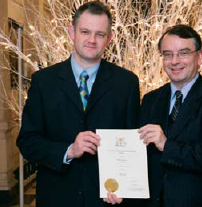
According to Green:‘The award directly reflects the dedication of my site team and the huge effort of the wider team involved in the project, especially our client Thames Water, designer MWH and key suppliers such as Purac.’
Improving public transport
An ICE survey last year revealed that 69 % of the public wanted improvements in public transport to help combat the UK's gridlocked road network. The research was carried out for the State of the Nation 2005 report.
Road congestion is estimated to cost UK business around £20 billion a year. ICE is thus calling on the Government to deliver its promise to increase transport funding, as set out in the Future of Transport 2004 white paper. This document seeks to increase funding from £10·4 billion in 2004 to £12·8 billion by 2008.
Public transport fares in the UK are more expensive than in other European countries with the exception of Denmark and Sweden. ICE believes Government subsidies to reduce the cost of using public transport is one way to make it more appealing to motorists. Additionally, ICE sees road pricing as an effective way of getting motorists to think about using public transport. In the long term, charg-ing to use the UK's roads will make motorists consider whether their journey is really worth paying for.

