

In his inaugural address as 2005/06 ICE president on 1 November 2005, Gordon Masterton set out his vision for the future of the civil engineering profession and the agenda for his year in office.
The fundamental direction of ICE is no longer in the hands of the President, with his individual whims and prejudices; although he may put his personal stamp or style on it. It is now the natural outcome of a business planning process, agreed and endorsed by ICE's executive board and council. Vice-presidents can now look ahead and identify areas in the business plan that they wish to give an extra push, but the business plan underpins the continuity, and provides the focus for continuous improvement and the means of measuring whether we are achieving it or not.
I do not wish to change this. In fact, I have been a proponent of the principle of continuity and five-year planning since the group of vice-presidents and directors came together in Northern Ireland in 2002. This started the process that created the Bailey Report1 and the current revitalisation programme. We must maintain this best practice approach to our future planning for a sustainable Institution.
However, if we are to achieve our objective of creating that sustainable institution, we must ensure that the values we hold are robust, modern and relevant. I want to reflect primarily on what our values must be; what basic principles and traditions underpin them; and make a plea to ensure that we not only put them into practice, but that we actively celebrate them.
The past
Recognising the value of civil engineering
I am an enthusiast for understanding the value of the past. In ICE's 188th year, circumstances and my enthusiasms are such that one of the themes running through the year will be the value of learning from the past, or learning from experience.
Circumstances, because April 2006 is the bicentenary of the birth of one of our greatest vice-presidents, and the greatest never to become president—Isambard Kingdom Brunel (Fig. 1).
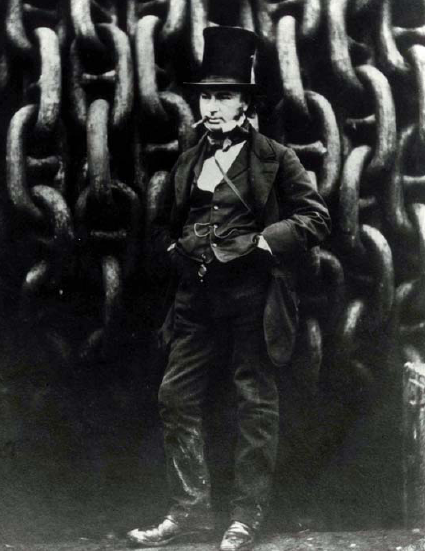
My enthusiasms, because as a Royal Commissioner on the Ancient and Historical Monuments of Scotland, I spend time supporting the surveying and recording of our built heritage—from standing stones to shipyard cranes, from souterrains to shale heaps—and it gives me great pleasure to help an organisation that records Scotland's achievements of civilisation.
I love that word ‘civilisation’. Particularly because it springs from the same root as the ‘civil’ of ‘civil engineer’. A common root for related concepts. I once had to try to define civilisation; my attempt was: ‘a developed, advanced, and enlightened community of people, living in an environment that supports, nurtures and perhaps inspires continuing development; to a state ever more distant from the state of “bar-barism”.’2
Kenneth Clark created a BBC series in the 1960s called Civilisation.3 He did not attempt to define civilisation in abstract terms, but he could recognise it when he saw it. What he saw was the city—man's expression of his achievement in the built environment. He placed more weight on a nation's lasting solid evidence of achievement than on deeds and words, saying ‘If I had to say which was telling the truth about society, a speech by the Minister of Housing or the actual buildings put up in his time, I should believe the buildings.’
What we build, or create, is the permanent record of our achievement as a civilisation—the key performance indicators (KPIs) of civilisation, if you will; and they are far more relevant than political speeches or transient events.
I visited Sri Lanka a few weeks after the tsunami struck. I saw the devastation (Fig. 2). I saw how the removal of the basic life-support systems of shelter, water supply, sanitation, transportation and power, renders existence to subsistence level. The enemies of civilisation are fear and exhaustion. Not physical exhaustion but exhaustion of spirit that creates a feeling of hopelessness, even in societies with a high degree of material prosperity. There are times when society's vulnerability to those destructive influences is all too apparent and those areas struck by the tsunami must have experienced fear and exhaustion in abundance.
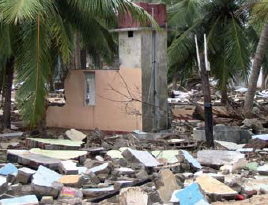
Damage in Sri Lanka following the tsunami in December, 2004 (see page 74 in this issue)
Damage in Sri Lanka following the tsunami in December, 2004 (see page 74 in this issue)
When I met civil engineers in Sri Lanka three weeks later, there was no sign of fear or exhaustion. I saw a strong determination and enthusiasm to rebuild that gave them hope for the future. The essence of civilisation remained strong. My visit was, for me, a defining moment in recognising the value of civil engineers. Without civil engineers and what they create, we simply have no civilisation. We are not just civil engineers, we are ‘civilisation engineers’.
I will return to Sri Lanka in October 2006, to celebrate the centenary of the Sri Lanka Institute of Engineers. I hope to see progress. I also hope that the rebuilding of the country is succeeding and that the obvious enthusiasm of the civil engineers that I met in January has been sustained.
Accepting then the value of civil engineering's contribution to civilisation, what other sources from the past can help illuminate the present?
Looking at what others have said
Incoming ICE presidents have an invaluable tool to help them understand the past. A permanent record of the achievements, the wisdom or the aspirations of their predecessors: the former presidents' addresses. I prefer the term ‘former’ to ‘past’ president; it has less of the air of decrepitude about it.
I did not read them all, but my feeling for continuity prevailed and led me to consult four with whom I felt an obvious affinity—James Banks4 and George Geddes5 of Babtie Shaw & Morton, and Alexander Gibb6 and Angus Paton of Alexander Gibb and Partners. Jacobs Babtie, my employer, now incorporates both these companies. In addition, Sir Norman Rowntree, a consultant with Allott & Lomax, but acquired by Babtie in 2000, was also president. Six presidents from one organisation may be unprecedented.
I also consulted the wisdom of my predecessor of exactly 100 years ago, Sir Alexander Binnie.7 His address was a detailed history of not just engineering or engineers such as Smeaton, Watt, Rennie and Telford, but of Britain and civilisation in general.
I particularly liked his comments on the beneficial effects of the Treaty of Union 1707:7 ‘…Nothing perhaps has added so much to the welfare of the people of Great Britain, as the incorporation in a common bond of those born north and south of the Tweed. …The men so introduced have since distinguished themselves in every walk of life—and to such men, our profession in particular is indebted in no small measure.’
Alexander Gibb6 also chose a historical theme. He supplemented the address given by Sir John Rennie to give a convincing account of the seminal contribution of engineers to the success of the British economy from 1846 to 1936.
James Banks was the second engineer practising in Scotland to be elected as president in 1965 and the first whose election to Council was as a regional representative. In his address he prepared a map recording the birthplaces of previous presidents.4 Forty years later, I have updated it (Fig. 3). Of the 141 presidents to date, 40 have been born in London, but all UK regions have provided at least one president as well as nine from overseas.
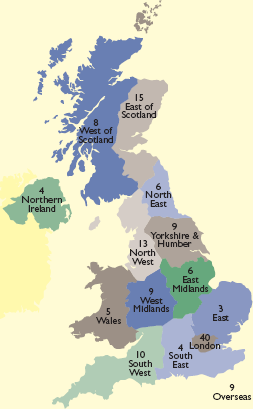
ICE has often in the past been criticised for being London-centric, but at least as far as presidents are concerned, this map proves that ICE has, to the contrary, a history of inclusion and reward on merit. Our current programme of regionalisation, taking ICE out to where the members live and work, is the modern equivalent of what our predecessors believed was the right thing to do: creating regional buy-in at the highest level.
Let us not stray into the trap of being engrossed by the past glories or disasters for the intellectual pleasures it gives. Many of our former presidents used their address solely to give a historical account of the profession, or their part in it. This is the inevitable consequence of the great weight of history and tradition that the presidency inevitably carries, in a direct line from Telford himself. I would much rather promote the past as a source of material to inform and illuminate the present.
Knowledge of the past can help us avoid repeating mistakes already made. In the words of George Santayana:8 ‘Progress, far from consisting in change, depends on retentiveness…Those who cannot remember the past are condemned to repeat it.’ Or, put another way, those who do not know their past will not master their future.
Learning from the past
So how can we learn the habit of retentiveness? ICE can provide members with support in achieving this; but only if we move with the times and offer a highly sophisticated, modern means of accessing relevant information instantly and accurately.
It is vital that we learn from the past. We must jealously preserve and publicise the knowledge we have. That is our springboard to the future.
How we access that knowledge will change—it will no longer exclusively be the domain of the book. Currently much is gleaned from the internet, and it may not be too long before we are carrying a pocketbook-sized ICE knowledge bank. With the press of a few buttons, members will access ICE's entire library displayed in a user-friendly format that is as simple as turning the pages of a book. The device will also allow us to contact colleagues who have similar interests, give us access to similar project information and review relevant problems encountered and solved. A civil engineer's reference tool of limitless proportions—a ‘hitchhiker's guide to the civil engineering galaxy’.
Communicating what we learn
We must also impart the habit of learning to our successors. Telford, Brunel, Stephenson and the great Victorian engineers recognised this. The young engineers who founded ICE recognised this. They had an enlightened interest in self-help. They endowed libraries and supported the technical meetings. And, most importantly, they accepted apprentices to be taught their trade by learning from their masters.
In today's fast-moving, low-margin, bottom-line-focussed business world, it is sometimes hard to value the longer-term benefit of mentoring our young engineers. But if we do not, we are missing a huge factor in the sustainability of our profession and our organisations. ICE's Graduates and Students National Committee has already recognised this and made its first award of Civil Engineering Mentor of the Year, won by Steve Everton of Jacobs Babtie.
ICE has been a pioneer in the mentoring principle with its structured training agreements. To underpin the value of this, I have agreed to be a role model this year, and offer opportunities for the president to mentor seven young graduates to shadow the president in his day-to-day institution business. The young engineers have been selected on the basis of their own account of why they would benefit from a three-day apprentice-ship with the president; as well as a gruelling interview.
The apprentices will be with the president whatever he does—chairing ICE council, visiting a region, attending awards ceremonies, speaking to the media, attending or holding briefing meetings. They are expected to keep a diary of the experience, write an article or two for their own regional news-letter and get involved in the minutiae of the president's day. This might be researching or drafting sections of speeches, or letters, or just observing and making notes.
Now, I cannot say I am not a little nervous at my performance as president being subjected to the critical inspection of our younger members. But I am prepared to lead from the front, in demonstrating the value of mentoring, and the need for senior members to pass on the baton to our younger members in as structured and secure a fashion as possible.
I look forward to working with our apprentices and hearing their views; Katherine Baker, Jonathan Jong, Elizabeth Palfreman, Kin Pang, Helen Whitmore, Steven Brown and Sjouke Tolsma.
The future
Securing quality for the future
How are we to secure the quality of our profession for the future? Where are we going to find the Brunels of tomorrow? While there are promising signs that the number of people studying civil engineering in the UK has risen from a desperately low trough in 1999/2000 (Fig. 4), it is still perceived as a less enticing career than other professions such as the medical, legal and financial sectors.
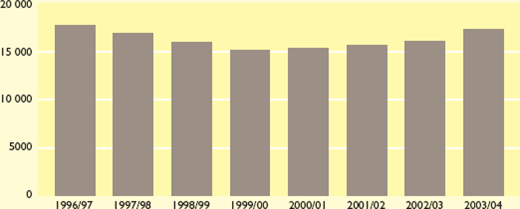
I find that sad, given the immense satisfaction of being part of a highly creative profession that leaves a permanent record of achievement. Yet we work very hard at trying to get our message into schools, which is one answer to addressing the perception gap. Whereas these initiatives are commendable, it is often difficult to measure success; and the initiatives will not be truly successful until there is just as much competition to get into civil engineering as other university degree courses with high demand, such as veterinary science, law and medicine. I also have concerns that the quality of our intake does not draw from those with the greatest ability in our schools.
I have studied a number of reports on the topic of children's career perceptions;9–14 they do not make encouraging reading.
Deep-seated cultural hostility towards science and engineering.
Very few parents knew what a Civil Engineer was.
A large majority saw engineering in terms of working with machinery in a factory.
Only just over a third realised it involved designing things.
Less than a third of students wanted to design buildings, bridges and cars.
Perceptions, rather than reality, emerge as the important determinants of career choice.
What I also found is that there is a common thread. The media has a powerful influence on children, and engineering is simply not perceived as an attractive career.
I believe that what we have to do is to work harder at changing the perception of engineers on a much wider scale than ever before. Whereas the huge effort we put in to reach out to schools is valued, our influence could be much greater if we targeted not just individual schools, but also the media in its widest sense.
In the 1990s, Heinz Wolff and Carol Vorderman worked on a task force that concluded that it is difficult to persuade the media to promote manufacturing. I do not doubt it. Direct promotion of engineering in the media would not enthuse many producers.
My view is that a far more powerful approach is to try to achieve subtle, indirect promotion by encouraging writers to feature engineers in TV or radio drama, novels or movie scripts. In 2000 I wrote a pamphlet on examples of civil engineers in fiction.15 I found precious few. This is where we lose out to lawyers, doctors and vets. Think of Ally McBeal, LA Law, ER, Casualty, All Creatures Great and Small and Silent Witness.
I would settle initially for a sitcom character whose day job was a professional engineer, who came across as a trendy, sassy, upbeat, confident, outgoing character; concerned about the planet's future, enjoying his or her job, someone who is fun and inspiring to be with: a typical civil engineer! If either of the Ross or Rachel characters in Friends had been a civil engineer, I have no doubt we would be attracting more applicants, allowing us to have a wider choice to find the brightest and the best.
I would like to make a start in encouraging this to happen. This year I want to inaugurate an annual prize fund of £10 000 that I will personally underwrite over a three-year period. The fund will be awarded for the most sympathetic and high-profile representation of an engineer as a fictional character in any media form, be that comic strip or literature, radio play or television drama.
If it is picked up, we will start to see some role models in the media. These may influence not just a classroom or a single school, but thousands of readers or even millions of viewers. I believe it is worth a try—we owe it to the spirit of Brunel.
We are currently in discussion with the Royal Academy of Engineering to see how this idea can be incorporated into their new programme ‘Shape the Future’. Welcomed by the Government, the campaign is designed to boost the appeal of engineering to young people and their influencers; to enable young people to take one more step down the road to discovering the joys of engineering; and to look at how we can engage with national media to attract interest.
If we couple these ideas with our own continuing promotion of the value of civil engineers as inspirational and exciting people, who constantly use their creativity in the design and knowledge of technology to solve problems that are important to society, then I believe we could make a step change in the perception of engineers in general and civil engineers in particular.
Sustaining our future
In its broadest sense we, as engineers, need to view the ‘big picture’ in all we do. Brunel addressed the big issues of his day—the growth of trade, and transportation's crucial role in this. If Brunel were alive today, his planet-sized vision and genius would be applied to the planet-sized problems of today.
Solving these problems will require civil engineers working in partnership, crossing disciplines. We need to use our engineering know-how to help influence and educate decision-makers—including the public stakeholders—to take a global view of sustainability issues.
The fragility of what we build has been demonstrated many times in the past months. In particular, the aftermath of hurricane Katrina (Fig. 5) and hurricane Rita. Evidence and consensus is building, on the cause of these extreme events. Many respected scientists now are convinced that the severity and frequency of hurricanes in the USA is related to greenhouse gas emissions. If that is the case, it is another indicator that the biggest challenge facing society today is global warming and the influence of carbon dioxide (CO2) emissions.
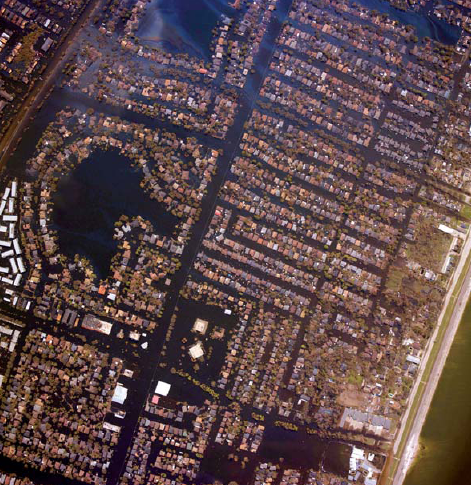
Part of New Orleans submerged by flood water following hurricane Katrina (courtesy NOAA)
Part of New Orleans submerged by flood water following hurricane Katrina (courtesy NOAA)
Acknowledging that there is a scientific, and political, debate on this topic, the ranks of the global warming sceptics are growing thinner.16 My pragmatic view is that we cannot afford to take the chance that global warming is not related to CO2 emissions. It really is time for politicians to listen, when scientists identify threats to our civilisation and civil engineers evaluate the consequences. Recent events in New Orleans demonstrated that all too clearly.
In July 2006 we have an opportunity to demonstrate what we can do. As part of our week of celebrations for Brunel's bicentenary, we are hosting the triennial conference of ICE and our US and Canadian counter-parts—ASCE and CSCE. The topic I have chosen for this is the ‘Safety, Security and Sustainability of the Planet’.
I hope that by the end of the conference three of the greatest civil engineering institutions in the world can agree a protocol for engineering a sustainable future for the planet. I have asked Paul Jowitt, vice-president leading the presidential commission on ‘Engineers without Frontiers’, to work with ASCE and CSCE to have an agreed protocol ready to sign on 4 July 2006.
I am an advocate of environmentally sustainable behaviour. I am an advocate of public consultation and democracy. Anything less is unsustainable as a political system. The model requires that proposed changes to our society or our infrastructure must first win over the hearts and minds of the majority. In cases where there is a conflict between local planning or environmental constraints and the proven greater good of a new piece of infrastructure, then the latter should prevail. Too often, the argument is considered only in its local environmental context and objectors win the day. As a result, we fail to deliver the projects that have a better global sustainability footprint.
We need to address how, as a society, we accept some degree of local environmental impact when there is the payback of ‘globally green’ solutions. In this category, I would include waste recycling plants, waste-to-energy plants and even nuclear power stations. In recent years, far too often, we have been debating long and hard on choosing the healthy item on the menu, while the restaurant is burning down around us.
Taking a higher-level strategic view of the best globally sustainable options will form part of my agenda for engaging with politicians and influencers during the year ahead. Senior vice-president Quentin Leiper will develop this further in his year as president.
Today
Revisiting our values
I have talked about the value of the past as a learning tool for today. I have talked about the value of experienced engineers mentoring the young. I have talked about the prime importance of valuing human life above all else. In fact I have mentioned ‘value’ a great deal.
Let us think about what we mean when we talk about value. Like quality, it is a hard concept to define. It is subjective and it can vary with differing perspective. Value needs a firm rock that defines its essence. For ICE, that firm rock is our core values. In December 2004, the values first examined in the Cawthra Report,17 were re-visited and updated by three vice-presidents: Clinton, Masterton and Leiper.
We identified these: trust and honesty, ethical behaviour and integrity, high standards, quality and professionalism.
As the Bailey Report1 states: ‘These should not be seen as empty phrases or platitudes, but the values by which the Institution and its members judge themselves, in all aspects of professional life.’
John Burland has often spoken of another former president, Sir Charles Inglis, who described the true test of an engineering education as the ‘habit of mind’ that remains, after the detail of what has been taught has been forgotten, or become outdated. Our members must develop the ‘habit of mind’ to observe our core values in everything they do. Sadly, society, or indeed clients, can still apply pressures that conflict with these core values. Even more sadly, some of our members either do not, or feel so pressurised that they believe they cannot, observe these core values at all times.
So we must provide guidance for our members, so that they can deal with these conflicts, overcome perceived pressures and hold firmly onto our core values. Our members must not be over-pressurised into allowing contracts to be let that are only partly thought out and are pregnant with risk. They should never compromise safety, honesty, integrity or professionalism in favour of cheapness or speed. The only beneficiaries of this would be the legal profession. It is a national scandal that the construction industry spends far more on litigation than it does on research and development.
The core values are also reflected in the code of professional conduct that defines our ethical behaviour and integrity, crafted in 2003.18 At the heart of the code are the rules for professional conduct, an excellent road map for a modern professional, concerned with employing high standards and quality in practising his or her art. The code includes concern for the environment and imposes a duty on civil engineers to work in a safe and sustainable manner.
Safety is one area where I believe we have been learning too slowly from the past. The construction industry, where most of our members work, remains an industry with a safety record that should be much better. Although we have been improving in recent years, the construction industry still kills or injures more people than any other industry in the UK. We are key players in that industry. We have a moral duty to our employees, colleagues, neighbours, friends and ourselves to return from work in the same condition as we arrive.
ICE recently articulated its principles in this most important area of our competencies: that health and safety should be the cornerstone of a civilised society; that health and safety must be integrated as a core and automatic consideration of professionally qualified civil engineers in all their undertakings—an inherent part of an engineer's skill set. It is the responsibility of ICE, and the profession it serves, to recognise, promote and endorse this principle.
ICE will be working hard to raise awareness much more widely and to demonstrate the engineer's role. It will act as a signpost to show people what their responsibilities are, what they need to do and where to find the relevant information. Case studies will be developed and promoted, so that everyone can see what is required of them: learning from the past, and learning from others.
I will be the champion for the health and safety register, promoting it wherever I go. A register of special proficiency for all construction professionals—giving the clients, the industry and the public, confidence in what we do; a demonstrable way of raising the bar in competency. I believe that proactive measures such as these—working hard to promote, encourage, coach, benchmark best practice and raise standards—will ultimately be far more successful in improving our safety record than ever-increasing punitive measures. The legislative framework is essential but there must also be balance.
In my view, the increasing blame culture in our society is an extremely worrying trend. What were Kenneth Clark's greatest threats to civilisation? Fear and exhaustion. They are highly negative drivers that drain the spirit of those who are constantly exposed to them. We cannot have our highly trained and skilled engineers being discouraged from advancing in their careers because of an ever-increasing personal risk profile. We cannot have our managers in the front line becoming exhausted and worn down by the fear of prosecution. If that happens, then we have lost the constructive balance of carrot and stick in our approach to safety. By working to restore the balance, by promoting a safety-aware culture in our industry and engaging with the UK Health and Safety Executive (HSE) and Government, we can help our members manage this risk.
ICE has been a co-partner with the Institution of Structural Engineers (IStructE) for 29 years on the Standing Committee for Structural Safety (SCOSS). This is another excellent example of how modern institutions working in alliance can define and develop best value for our standard of professional work. I want to work with IStructE to promote the principles of construction risk management advocated by SCOSS in my year in office.
My call to all our members today, therefore, is to make time to reflect on our core values, to understand our code of professional conduct and, most of all, to raise our awareness of our personal duty of care to friends, colleagues, workmates, or members of the public: everyone involved in the building, maintenance or daily usage of the wonderful things we create.
Applying our values today
The biggest challenge we face however is not our understanding of our values. It is how we put them into practice. How best to apply our skills, attitudes and professionalism to what we deliver in these changing times. Recently we asked some of the key clients in our industry what they think constitutes value for them.
Their answers give us a strong steer.
Being professional—wanting to be the best at what you do.
Not being afraid to lead.
Not being afraid to innovate.
Taking a broader interdisciplinary approach.
Creating sustainable life for a modern society.
Being recognised and represented in the media.
Looking outward—understanding business opportunities, moving beyond engineering detail, taking a long-term view.
Being better communicators.
ICE now actively seeks the views of our stakeholders—employers, academics and clients—through consultation groups that we use to peer-review our plans and initiatives.
We also have another powerful intellectual group available to us that has been much under-used: our former presidents and vice-presidents. To paraphrase Newton, we can only see further if we stand on the shoulders of giants.
I have therefore established a ‘former presidents' round table’ that has the potential to be immensely valuable. It will not be permitted to control or direct ICE—that must always be the job of the current leadership. I hope it will provide an occasional analytical and reflective view on the Institution's direction, as well as an opportunity to learn from their collective experience. Sir Alan Muir Wood advocated a not dissimilar concept in his recent book.19
Action to take us forward
Over the last three years we have been engaged in revitalising ICE. This has involved creating a five-year rolling business plan process, begun by former president Adrian Long. More functions and activities have been devolved to the regions.
We have had a period of internal restructuring. The design is now complete. We have the model and, importantly, an endorsement from our members in this year's subscription ballot. We now need to complete the delivery; to consolidate what we do and how we do it; to deliver measurable improvements; and, most importantly, to test its success, update and refine if necessary, and communicate our successes to all of our stakeholders—members, Government, employers, and the public. I am determined that we do so.
So what are our challenges for 2006? How will we deliver value to our stakeholders so that they value ICE?
We will implement the new membership framework—a new approach to valuing all who work in our industry, with the same high standards and relevance to all our stakeholders.
We will capitalise on our recent success with the media; taking what engineers think to the public and to Government. This includes our State of the Nation Reports, on energy, on waste, on transport, on flooding and many more topics. We will tell the world what engineers do and how they are vital for the future.
We will review what we offer our members so that it is attractive to them and their employers. We will give them value and identify clearly what they get as an ICE member.
We will review information services to see what more can be provided to members and potential members through digital media.
We will review the technical boards and focus on tangible outputs from our learned society activities.
We will give new focus to exploiting the commercial possibilities for ICE through the Thomas Telford business, especially NEC3, which launched recently.
We will continue to modernise our business practices, especially online services, to give our stakeholders a more effective, more efficient and especially more friendly response.
We will commence a review of ICE governance through a working group under vice-president David Orr.
We will use the occasion of Brunel's bicentenary to celebrate civil engineers and civil engineering achievements—the spirit of ingenuity and vision represented by Brunel.
Most important of all, next year we will check how satisfied our members are with the changes we have been making. We will ask them and measure the results against our last member survey in 2003.
I, as president, will maintain the momentum of Colin Clinton's initiative to engage with members directly; visiting them in their companies and universities to give many members and non-members the opportunity to ‘meet the president’
I am also introducing ‘president's breakfast time’ in One Great George Street, to meet employees and visiting members who want to share experiences or just chew the fat.
Finally, we will work with the Institution of Mechanical Engineers (IMechE) to explore the value of convergence.
This is the programme of a modern, vibrant institution responding to the views of its members.
Here is some interesting historical context on the re-unification issue: Isambard Kingdom Brunel, an ICE vice-president when he was invited to join the fledgling IMechE in 1847, decided against it,20 ‘As I fear it would tend to create a division in our Institution of Engineers and thus far would I think, be open to objection.’
Sir Alexander Binnie's address in 19057 closed with a plea for unity in the profession, for ‘so intimately correlated are the laws of Nature with the various divisions of our work, that it becomes impossible to divide the profession into distinct and separate departments.’
Sir Alexander Gibb's Presidential address in 19366 closed with these words: ‘… we should, I am certain, seek now to put a brake on this continuing disintegration, and should attempt … to coordinate and unite engineering activities in the broadest sense… (to create)… a body of engineering opinion so weighty, so authoritative, so sure, so sane, that it would prevent waste of energy and misplaced enterprise, and would inevitably command attention in the politics and life of our country… I believe that that would be the greatest—and perhaps the only—safe-guard for the future of civilisation.’
Scotland seems to have a large number of church buildings—but many of them are no longer used for worship. That is because the church in Scotland was famous for its schisms.
Every schism had introduced new opportunities for the construction industry, as congregations vied to erect grand new buildings. Thomas Telford himself was responsible for designing over 30 churches and over 40 manses. Energy and enterprise were directed to internal restructuring, power struggles and the creation of new administrative empires, rather than what churches were supposed to be doing.
From a peak of at least ten, we now have only three principal groupings. The re-integrations of 1820, 1847, 1900 and 1929 all resulted in real renewal of purpose and healing of rifts that had become obsolete.
The engineering profession seems even more prone to schism than the churches in Scotland. From the first schism in 1847 when the IMechE was spun-off from the ICE, we had 14 further major schisms (Fig. 6).
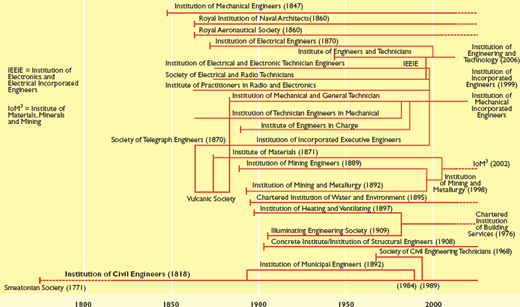
In more recent years, some have re-unified. The latest being the Institution of Electrical Engineers' and the Institution of Incorporated Engineers' agreement to merge as the Institution of Engineering and Technology. There remains considerable potential for more institutions to decide that it is right to come together again to conserve resources, eliminate duplicated enterprise and thereby make a greater impact with the activities and messages we have in common.
So we will be examining the value proposition of ICE/IMechE convergence in far greater detail this coming year. I will lead the joint steering group with Andrew Ives, president of IMechE. We will be tasking our members to work together on high profile issues so we can show how we can create added value through a joint approach. We will encourage our UK and overseas regions and our young engineers to liaise more closely. And we are planning a joint meeting of our two councils in September 2006.
If the added value is clear to our members, we move one step closer to the creation of a new powerful alignment of two great engineering Institutions. If it is not clear, our members will tell us so. Ultimately, if the required majority of our members concur in a ballot at the appropriate time, we would re-unify the two original engineering institutions in the UK.
I mentioned earlier that solutions to the really big issues and planet-sized problems are often made by co-operation across disciplines. A new angle, a new way of looking at old problems, can result in quantum leaps of insight. I will not make that rash promise for our task groups, but if we do not provide the vehicle, then surely it will be all the harder to achieve cross-fertilisation of ideas.
Conclusions
Career tributes
Finally, I want to acknowledge some people who have been my inspiration and support through my career and have been instrumental in defining my values.
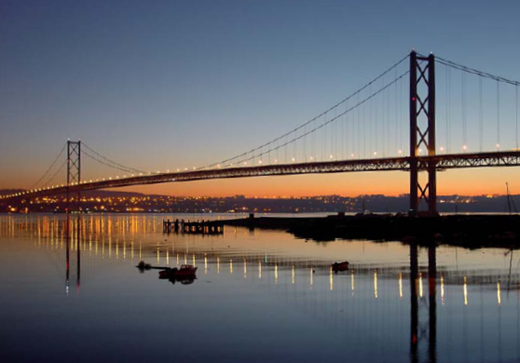
First, those involved with design and building the Forth Road Bridge (Fig. 7). I never met them, but I watched this bridge being built as an 8–10-year-old and it was visible from my home in Fife. I have no doubts that seeing it being built and then my first experience of being driven over the bridge—awesome for a 10-year-old—was instrumental in my later career choice.
Next, those who educated me at Edinburgh University, where I was on an unusual civil engineering course which had a joint first year with the architects. At least one of my fellow architectural students, John McAslan, has been very successful. I will be working with him and the Royal Institute of British Architects to promote his bursary for young professionals who collaborate on environmental and community issues. I also wish to acknowledge those who taught me at Imperial College, London.
My mentors in Babtie Shaw & Morton—including George Geddes, the fourth president ICE practising in Scotland and a great man and a great engineer, David Coats, Norman Berry, George Duncan, Graham Kinder, Henry Perfect, Bill Mitchell, Morris Murray, David Fawcett; all of them fine engineers. All of them influenced me in different ways.
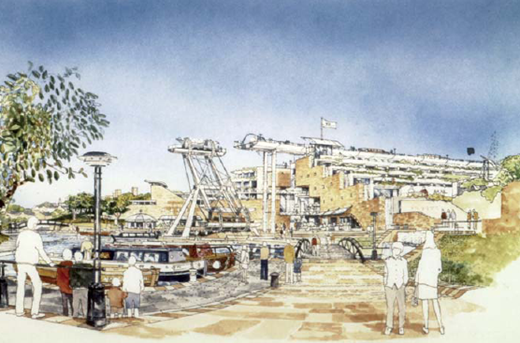
My colleagues in Babtie with whom I worked over the past 29 years over a vast number of projects (Fig. 8). My fellow professionals have consistently impressed me with their talent and commitment. When we had our designs tested to the ultimate—and they still worked!
My new friends in Jacobs—who in 2002 also provided the president of ASCE, Gerry Schwarz. Jacobs is the first company to have supported presidents of both ASCE and ICE, and I am most grateful to Jacobs for endorsing their commitment to these two great organisations. Jacobs also incorporates the former Alexander Gibb & Partners, which has a great record of international projects, including infrastructure for the Athens Olympics. This serves as a reminder that ICE members will be absolutely critical for the success of the London Olympics in 2012. Vice-president Jean Venables is leading ICE's response to this opportunity.
ICE has played a big part in my life, especially the Glasgow and west of Scotland region and, of course, ICE council and executive.
The Scottish Construction Forum, an increasingly influential grouping of industry, clients and government that is a model others would do well to follow. My Smeatonian friends, my fellow trustees on the Forth Bridges Visitor Centre Trust.
We all have friends outside civil engineering—it is important for us to keep a wider horizon in view. I greatly enjoyed studying with the Open University, where I took drama and psychology for fun and then taught engineering design processes. I much enjoy the interaction with fellow commissioners at the Royal Commission on the Ancient and Historic Monuments of Scotland; and trustees of the Scottish Lime Centre; friends in amateur operatics—an interest shared with my wife—and just friends.
My new friends Barry and Linda Atherton who painted my portrait and captured a lot of my interests and enthusiasms.
Most of all, I want to thank my wife and family. Lynda, Matthew and Natalie, who followed me from Edinburgh to Glasgow, to the Kielder Scheme, to London, back to Glasgow, to Kuala Lumpur, and back to Glasgow again. I owe a lot to them all.
Pride o' Worth
At every opportunity I will use this coming year to celebrate the civil engineers who cope with natural disaster and restore normality; the civil engineers who are daring designers of tall buildings, great bridges and dramatic tunnels; the civil engineers who are the great improvers of health and mortality—especially in the developing world; the civil engineers who can create and deliver globally green solutions to the planet's problems; the civil engineers who are exciting to be around; and the civil engineers who can inspire our children.
It will not be difficult, because civil engineers are not ordinary people; they are extra-ordinary. In my book of civilisation, civil engineers are the heroes. I am proud to be an engineer. I am very proud to be a civil engineer. I am fiercely proud to be president of ICE. In the next year, I give you my commitment to do my best for this great institution and its members.
However, this is not a one-man show. It is a team effort and we have now got a great team working together: my vice-presidents, council members, board members, and country representatives and committee members in the regions worldwide.
We also have a great team of employees—no longer all anchored in London. All credit to Tom Foulkes for building that team, and moulding it into fighting shape; that is his great strength. He is a great asset to ICE and I hope I can give support to him.
Summary
This address has been focused on promoting value and securing it for our future. It has also reminded us of our values as a modern institution and the strength these give us, provided we hold to them.
Our challenge is to do just that.
To understand the past so we master the future.
To work together to sustain civilisation—engineers of all disciplines and scientists collaborating with Brunellian flair and imagination.
To change the perception of civil engineers so that we harness the Brunels of the future.
To raise our standards in our duty of care to society.
I am confident that we can.

