

The UK's National Underground Asset Group was launched two years ago to coordinate and share data on the country's vast and inconsistently charted network of buried services. ICE's representative on the Group, James Brayshaw of Ordnance Survey, provides an update.
The UK National Underground Assets Group (NUAG) was set up in 2005 to help the Department for Transport (DfT) achieve the targets introduced in the 2004 Traffic Management Act1 for exchanging information on underground assets. It also serves as a single voice for everyone involved with underground and associated above-ground utility services.
NUAG's vision for the future of buried services is as follows: ‘all information on underground assets, and appropriate associated above-ground assets, will be shared between stakeholders in a consistent way, on demand.’
A growing problem
In repairing, maintaining and upgrading Britain's vast network of buried infrastructure, the utility industry alone undertakes around 1·5 million street works annually. The annual direct cost of this is in excess of £1·5 billion, part of which is attributable to ‘dry’ holes in which nothing is found, and a further £150 million of which is due to damage to third-party assets.
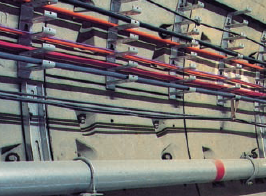
Around 2·5 million km of telecommunications and electricity cables are buried in Britain—but records are incomplete and inconsistent
Around 2·5 million km of telecommunications and electricity cables are buried in Britain—but records are incomplete and inconsistent
More significantly, delays to road users, disruption to business, environmental damage and safety costs amount to a further £5·5 billion a year.
Unfortunately the growth of broadband services and planned high levels of investment to replace gas, water and electricity infrastructure is only likely to increase the number of holes being dug in roads. Direct and indirect costs will thus continue to rise unless better information and more effective technologies can be made available to those doing the work.
The Traffic Management Act introduced measures to encourage all organisations with underground assets to exchange information in order to facilitate better coordination of street works. New technologies are emerging to help enable this, but if asset data are recorded to different referencing standards and on different media their usefulness and reliability are compromised.
New records standards proposed
In September 2006 NUAG published a report2 including series of recommendations that, taken together, offer a road map to achieving the vision and targets set out in the Traffic Management Act.
The recommendations include
revised mandatory code of practice for records with minimum data standards
mandatory national standard high-level framework for capturing, recording, storing and sharing buried-asset information
utilities and highways organisations to have clearly-defined processes compatible with the national standard framework
annual review process to measure performance against the code
implementation within a mandatory timetable.
The recommendations have been shared with high-level stakeholder groups, including DfT and other government departments and the response has been overwhelmingly positive and supportive.
NUAG has now started developing a standard framework—including data definitions, standards, protocols and processes—needed to deliver a set of recommended minimum standards for recording, storing, and sharing information on buried assets more quickly, more consistently and to higher levels of accuracy. The ultimate goal is to have the ability to visualise and distinguish, on demand, all underground asset records in any one given area.
Helping to solve the puzzle
NUAG's work is one aspect of a wider-ranging exercise focussing on solving the ‘jigsaw puzzle’ of buried assets, and aligns closely with two current major research projects, Mapping the Underworld3 and Vista.4
Mapping the Underworld3 aims to solve the problems associated with the difficulty in finding buried infrastructure. Vista,4 on the other hand, is investigating the use of global navigation satellite technology linked to existing asset records to produce three-dimensional images of underground assets.
The combined initiatives will result in more effective means of identifying buried apparatus, and better use of technology. More importantly, they bring together knowledge and data integration to make street works safer and more effective.
References
For Further Information Contact, James Brayshaw, TEL +44 (0)23 8079 2770, EMAIL james.brayshaw@ordnancesurvey.co.uk, WEB www.nuag.co.uk

