

Though the reasons may not yet be fully understood, all the evidence points to the fact that the world's climate is changing. It is a risk civil engineers can no longer afford to ignore, say Alex Hamer and Caroline Peters of law firm Reynolds Porter Chamberlain.
While scientists continue to debate the potential effects of climate change, civil engineers do not have the luxury of waiting to see who is right. Practically any civil engineering project underway now will have a design life extending well into the period when the more serious manifestations of climate change could materialise.
Although society is used to relying on civil engineers to protect both life and economic wellbeing, and is rarely let down, the uncertainties associated with climate change introduce a new and largely unquantifiable element of risk. This is magnified by the pressure to devise and employ new technologies to reduce emissions and pollution, and to minimise energy use.
But what can civil engineers do to protect themselves against claims arising from climate change?
Climate change claims
Extreme weather events and their consequences, including droughts, intense rainfall events and flash floods, high peak wind strengths, heat waves and even wildfires are already factored into civil engineering projects. Climate change potentially extends the geographical spread of such events and makes their frequency and magnitude less predictable. All potentially increase the risk of failure and, of course, claims if design capacity is exceeded or if there are defects in construction, materials or maintenance.
Other sources of climate-change-related claims are less obvious. For example, the Department of Health's May 2007 draft report Health Effects of Climate Change in the UK1 identifies risks with implications for water supply and treatment projects. Heavy rainfall appears to increase Giardia and Cryptosporidium concentrations, both of which can be fatal to vulnerable individuals. Droughts may reduce river flows and hence effluent dilution, a possible source of environmental claims.
Climate change also affects projects under construction. Heat waves cause serious health risks for site workers and could affect materials, processes and equipment. Intense rainfall could not only derail the construction programme but also result in environmental damage.
Uncertainty is no defence
The uncertainty connected with climate change is unlikely to afford civil engineers a defence. Courts are increasingly likely to regard weather extremes as possibilities designers ought to accommodate.
There is also a worldwide consensus that climate change is happening. The Intergovernmental Panel on Climate Change's Fourth Assessment Report, published in February 2007,2 concluded that climate change is ‘now unequivocal’, and that outcomes such as more hot extremes, heat waves and heavy precipitation events have a more than 90% probability of occurrence.
Evidence of climate change is routinely in the news and some emerging science suggests that climate change is occurring more rapidly than expected. In March 2007, Lloyd's published a Rapid Climate Change report3 for concerned insurers.
In short, for a claimant seeking to show that an engineer should have foreseen the effects of climate change in 2007, there is already enough published material to fill a hefty court bundle.
A defensive approach
Whatever a client's views of climate change, it is up to civil engineers to make very clear what assumptions they have made about future conditions and why. Having a debate about the uncertainties will alert everyone involved to the risks. It is important to ensure this is documented and archived. In the UK, in certain circumstances, a claim could be brought up to 15 years after the critical act or omission. Having a contemporaneous explanation of the decisions taken could help with mounting a credible defence.
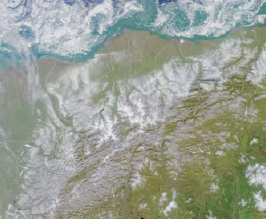
Evidence given in May 2007 to the Stansted Airport expansion enquiry included the detrimental effect of melting permafrost on the Inuit people of North America (NASA/GSFC/LaRC/JPL, MISR Team).
Evidence given in May 2007 to the Stansted Airport expansion enquiry included the detrimental effect of melting permafrost on the Inuit people of North America (NASA/GSFC/LaRC/JPL, MISR Team).
If clients seek a lesser specification, civil engineers should point out the risks. They should even consider threatening to withdraw if they are concerned—but should take legal advice first. If civil engineers wish to try to limit their liability, they should involve their lawyers.
Civil engineers need to be clear about how risk is to be apportioned on projects and ensure that their insurers and other parties' insurers understand and accept this apportionment. They need to be open with their insurers where there are uncertainties, and they need to notify potential claims as soon as they have wind of them, however far-fetched they might seem.
Whereas civil engineers may not be able to predict the effects of climate change, they can manage the risk by staying abreast of the subject and using some lateral thinking.
References
FOR FURTHER INFORMATION CONTACT, Alex Hamer, TEL +44 (0)20 3060 6449, EMAIL alex.hamer@rpc.co.uk

