


Building for a changing climate – the challenge for construction, planning and energy
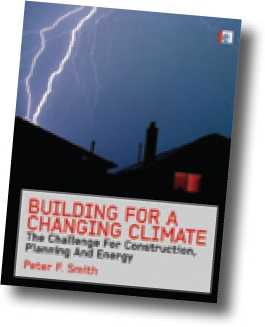
The author then considers the implications to buildings, encompassing housing and non-domestic property, both new and existing. The next part focuses on energy and the amount of reserves of conventional fuels (gas and oil) and then considers renewable energy options and the feasibility of these on a large scale. It concludes with some practical ways in which building design can be adapted to achieve tolerable living conditions in a much harsher environment.
The facts set out in the book are sobering and the evidence presented of climate change is compelling as is the need to take action now. There were times when reading it that I despaired of the world's populations being able to adapt their approach to infrastructure, energy resources and having the political will to implement the necessary changes in the available diminishing time before irreversible change escalates. However, the book offers hope and it is no accident that the last chapter is called a ‘thread of hope’.
I had not previously read such an authoritative and comprehensive book on the subject. Building for climate change has certainly highlighted for me the need to take action now and I recommend it as an informative and thought-provoking book, which also offers remedies for new build, future-proofing existing buildings and moving forward on energy,
Debating climate change: pathways through argument to agreement
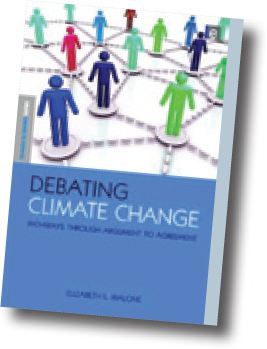
Much has been written about the topic of climate change and there are many opposing views. The author of this book comes to the topic as a social scientist. She does not attempt to analyse the scientific data leading to one or another argument, but examines the debate itself. She discusses and categorises a range of arguments made, in an attempt to identify areas of agreement and disagreement.
Her research examines 100 differing documents and initially analyses them looking at the authority of the speaker, the type of argument, the type of evidence, the worldview or view of nature and the action(s) proposed. These individual arguments are then clustered into a number of ‘families’, ranging from ‘no problem’ and ‘climate change could be good for you’ to ‘rift with nature’. Finally, a system of social network analysis is used to look at the ties between the families to try and discern bases for potential agreement on actions that could or should be taken to address climate change.
The conclusion is that all families take the question of climate change seriously and agree that vast uncertainties exist. They further agree that climate change involves issues of societal well-being and lifestyle. All share a commitment to science and at least some members of all families use scientific literature and data as evidence for their arguments.
The book is well written and takes the reader gradually through the analytical process. A non-social-scientist might find the concluding chapter on the prospects for the debate a little challenging or even disappointing, but this is an interesting read for all those interested in the climate change debate nonetheless.
Tsunami – to survive from tsunami
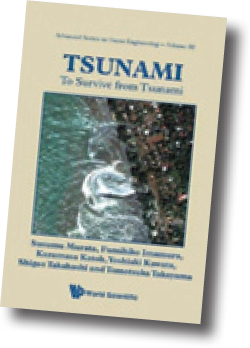
The primary purpose of this book is to provide information and knowledge on how to survive tsunami attacks. It was awarded the 2009 book of the year award by the Japan Society of Civil Engineers.
The first part of the book is on lessons from tsunami disasters, including a detailed account of the Indian Ocean tsunami on 26 December 2004 that claimed the lives of 300 000 people. Case studies on the effects on infrastructure, buildings and people are followed by practical measures for survival and disaster mitigation, including evacuation facilities, emergency communications and warning systems.
The second part provides more detailed scientific information on tsunami behaviour, describing the tsunami occurrence mechanism and near-shore action as well as numerical simulations and tsunami forecasting.
Tsunami is indispensable for research engineers in the field of natural catastrophes and coastal engineering as well as for all people who may live in or travel to tsunami-affected areas.
Progressive collapse of structures
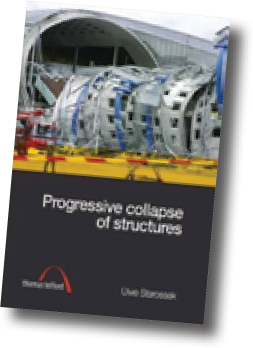
This book offers a comprehensive update of conceptual thinking and related research on progressive collapse of structures. The approach taken in the book is rather philosophical and leads to an excellent critical review of current prescriptive design.
The book introduces some innovative terminology with ‘robustness’ being defined as ‘the structural property of insensitivity to local failure’, which is different to the Eurocode definition of ‘the ability of a structure to withstand events like fire, explosions, impact or the consequences of human error, without being damaged to an extent disproportionate to the original cause’. A new concept of ‘collapse resistance’ is defined as ‘the insensitivity to accidental circumstances, that is, to unforeseeable and low-probability events’. The useful conclusion is drawn that a robust structure is at the same time collapse resistant, but not vice versa.
An invaluable chapter on ‘redundancy versus segmentation’ clarifies an engineers' misconception that the increase of continuity and associated provision of alternative load paths always prevents failure progression. Segmentation and not continuity prevented the total collapse of the Pentagon in Washington due to aircraft impact and Charles de Gaulle airport terminal in Paris due to design and construction flaws.
However, no matter how objective and quantifiable our procedures become, there will always be a need for engineering judgment, imagination and experience. Overall, I thoroughly enjoyed reading this book and highly recommend it to all colleagues, students, academics or practitioners with an interest in progressive collapse.
Site engineers manual (2nd ed.)
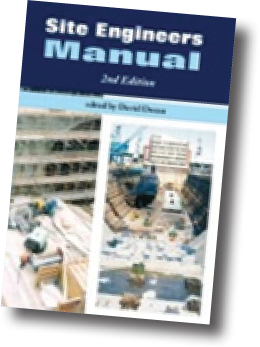
Given the breadth of civil and structural engineering, the second edition of the Site Engineers Manual is undoubtedly a great success in providing a ‘one-stop information shop’ for site engineers.
The 512 page manual is a rich and compact source of vital references, with 20 chapters of practical guidance on quality, setting out, weather, construction plant, roads, drains, earth works, foundations and various types of construction materials. There is a well-thought-out section on building services engineering and the manual ends with updated chapters on health and safety and new sections on glass and demolition.
Many of the topics will not have been covered during the education or training of engineers, yet they are vitally important to their careers. The forms and checklists provided in the book are useful for a wide range of site applications.
The manual is a key piece in the jigsaw for graduate engineers, helping them interface with critical, physical site conditions in the pursuit of successful project delivery. While there may be room for enhancing specific aspects, the manual is an outstanding guide for all engineers working on sites, whether graduate or experienced, design or construction, local or international.
I commend the work done by editor David Doran and all those who gave valuable contributions to this book.
Bright underground spaces – the railway stations of Charles Holden
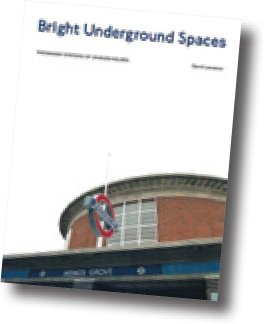
The dramatic enlargement of the London Underground railway network from the mid-1920s to the late 1930s was characterised by radically new architecture in station design, chiefly through the work of Charles Holden. This book charts the work of Holden, who brought light and space to underground stations, most of which are still in use today.
Some of the best examples of Holden's work can be found the north-easterly extension of the Piccadilly line to Cockfosters. The stations at Turnpike Lane, Wood Green, Arnos Grove, Southgate and Oakwood stations all exhibit the classic Holden design of bright, light ticket halls into which daylight floods from large windows above the station entrances. A large part of the book is devoted to a detailed description of these stations, lavishly illustrated with design drawings, sketches and photographs of the projects as they were built and completed.
Holden's stations are for the large part still in operational use today and effectively define what we would now describe as the above-ground style of the London Underground. There has been damage, both unofficially through graffiti and vandalism and also officially through poor maintenance and ill-conceived adaptations, but in general Holden's stations continue to give good service.
This is a fascinating book illustrating station design at a period of rapid expansion of the underground network and provides an excellent record for anyone who is interested in the development of underground station architecture.
Full versions of these reviews can be read in the supplementary data to the online version of these pages at www.civilengineering-ice.com.
NEW BOOKS
The ICE's bookshop in London carries one of the most comprehensive ranges of civil engineering books in the world. New books received in the past three months are as follows.
Art and practice of managing projects
Albert Hamilton £50·00
Construction materials (4th edition)
Peter Domone and John Illston £35·00
Cost studies of buildings (5th edition)
Allan Ashworth £37·99
Cresy's encyclopaedia of civil engineering, vol. 1
Edward Cresy £45·00
Earthquake resistant design and risk reduction (2nd edition)
David Dowrick £90·00
Engineers: a history of engineering and structural design
Matthew Wells £25·00
Ground improvement by deep vibratory methods
Klaus Kirsch and Fabian Kirsch £80·00
ICE manual of health and safety in construction
Ciaran McAleenan and David Oloke £80·00
Introduction to tunnel construction
David Chapman et al. £39·99
Lessons from Aceh
Jo da Silva £14·99
Managing dams
British Dam Society £100·00
Managing interdisciplinary projects
Stephen Emmitt £26·99
Mud on my boots: the memoirs of a civil engineer
Philip Donald £8·00
Pedestrian facilities
John Schoon £60·00
Spon Asia-Pacific construction costs (4th edition)
Davis Langdon and SEAH International £120·00
Steel building design: design data (Eurocodes)
Edurne Nunez Moreno and Ed Yandzio £80·00
Steel building design: introduction to the Eurocodes
Mary Brettle £20·00
Structural analysis with finite elements
Paolo Rugarli £40·00
Surveying for engineers (5th edition)
John Uren and Bill Price £40·99
Twort's water supply (6th edition)
Don Ratnayaka et al. £57·99
The bookshop is in the ICE foyer, 1 Great George Street, London SW1P 3AA and is open from 9.30 am to 5.00 pm, Monday to Friday. Books can also be ordered by calling +44 20 7665 2019, emailing bookshop@ice.org.uk or by visiting www.ice.org.uk/bookshop.

