


10-00054 Carbon dioxide from earthworks: a bottom-up approach
By Lynsay Hughes, Alan Phear, Duncan Nicholson, Heleni Pantelidou, Kenichi Soga, Peter Guthrie, Alex Kidd and Niall Fraser (May 2011)
Contribution by John Greenwood
Hughes et al. (2011) are to be congratulated for setting up a helpful ‘tool’ for comparing different earthwork scenarios, but it must be used within the wider context of energy efficiency in the design, construction and operation of highway projects.
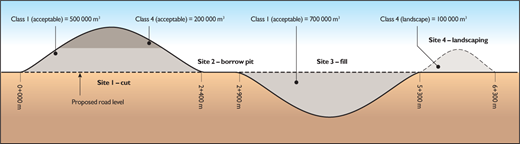
Cutting and filling operations on highway projects emit more carbon dioxide than simply building the road along the actual ground profile
Cutting and filling operations on highway projects emit more carbon dioxide than simply building the road along the actual ground profile
For example, considering the scenarios of Figure 6 (right), there would surely be greater savings if the proposed road were to follow the actual ground profile, as advised by HA 55/92 (Highways Agency, 1992). There is a recent example in the UK where designers focused on ‘balancing’ instead of ‘minimising’ earthworks volumes, resulting in unnecessarily large embankments and cuttings, increased land take, severe environmental intrusion and on-going slope-maintenance liabilities.
Also, when comparing scenarios, should embodied carbon dioxide be considered for the manufacture and delivery of the construction plant as it is for the production of lime?
The carbon dioxide emissions from traffic using the highway will be of greater significance than those generated during the construction (O'Riordan et al., 2011). Analysis of grade-separated junction design (Rahman and Greenwood, 2011) indicates that fuel savings of approximately £1 million can be achieved within 10 years if the highway layout takes account of gradients to assist braking and acceleration.
‘Value engineering’ applied to future projects will hopefully encompass such broader considerations.
The carbon dioxide emissions from traffic using the highway will be of greater significance than those generated during the construction
Authors' reply
The scenarios considered within the paper were developed to understand the impact of different earthworks solutions. It is indeed the case that the smaller the earthworks operation, the less fuel is consumed by earthmoving plant and hence fewer carbon dioxide emissions result. For this specific assessment, the system boundaries were drawn to exclude the manufacture and delivery of the earth-moving plant.
The authors agree that over the whole life of a highway project – including construction, operation, use and maintenance – that it is the use phase that is responsible for a large proportion of the overall carbon dioxide emissions. They are also aware of the small contribution from earthworks. As an example, for a major highway project that has been assessed by the authors, the earthworks comprised 4% of the carbon dioxide from construction, which in turn comprised 7% when the use emissions were included over a 60-year period.
The low carbon dioxide intensity of earthworks operations and the high carbon dioxide resulting from the use phase has led to further research to understand whether additional carbon dioxide should be expended in the construction phase, using earthworks to create a vertical alignment that would result in fuel and carbon dioxide savings in the use phase.
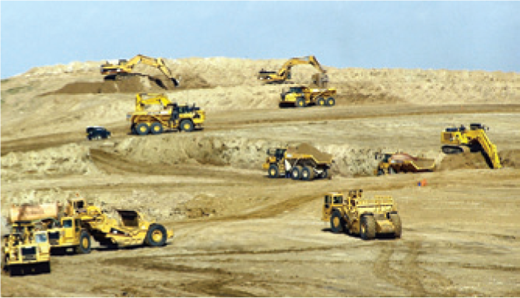
Carbon dioxide emissions of highway earthworks are typically only 4% of that from construction, which in turn is only 7% of operation
Carbon dioxide emissions of highway earthworks are typically only 4% of that from construction, which in turn is only 7% of operation
This and all other discussions can be read in the online version of the journal at www.civilengineering-ice.com.

