BRIEFING The role of the civil engineer in society: engineering ethics and major projects
By Richard Ashley (August 2012)
Contribution by Richard Larcombe
I was taken by the recent article on ethics (Ashley, 2012), as well as by the one on capacity building in the same issue (Bower et al., 2012), and would like to share my observations.
The Institution of Civil Engineers (ICE) qualifies new professionals at all grades – chartered, incorporated and technician – in three stages: their academic base (what they know); their industry experience (what they can do); and their professional review (who they are).
ICE reviewers judge the candidates’ achievements against nine ‘attributes’ – engineering knowledge; engineering application; management and leadership; judgement and responsibility; commercial and contractual competence; health, safety and welfare; sustainable development; interpersonal skills and communication; and professional commitment. Over the years, experience has confirmed that these attributes are a robust definition of what constitutes a civil engineer fit to be professionally qualified.
One question arises – what is the difference between being competent and being professional? I have discussed this with many colleagues and candidates, and the answer seems to be an amalgam of things like attitude, behaviour, commitment, aspiration, integrity, honour, respect, courage – in a word, character.
Recently this made me think of the four cardinal virtues that lie at the core of western civilisation – prudence, justice, temperance and fortitude. You will find them also in all the major religious traditions. This may sound out of place – but perhaps it is our lack of a moral compass that has led to much of the trouble that we find ourselves in today.
Author's reply
The contributor's comments are helpful, especially in relation to the ICE review process. It is notable that the ICE's membership attributes are defined from, ‘experience [that] has confirmed that these attributes are a robust definition of what constitutes a civil engineer fit to be professionally qualified’. This presumes that there are abiding and enduring attributes that can define a professionally qualified engineer, perhaps for all time.
Although I have sympathy with this view, I would contest it, given the challenges that now face the modern civil engineer. External drivers, like climate change, are no longer ‘enduring’ in the sense that they are no longer definable as stationary in the statistical sense (Milly et al., 2008), and thus require new ways of responding from civil engineers and others.
Whether we need to reflect this non-stationary environment better in how professional engineers qualify, or how they are assessed for their competence or professionalism, really does need to be considered. In other words, is the review process still fit for its purpose, is it sufficiently adaptable and flexible?
At the extreme we might even question whether or not ‘civil engineering’ is itself sustainable as a profession. Perhaps we need greater trans-disciplinarity (e.g. Max–Neef, 2006) and to recast our professions into a new age and fitness for the new challenges ahead (Ashley, 2012).
REFERENCE
110071 Dubai Metro: building the world's longest driverless metro
By Matthew Botelle, Patrick McSheffrey, Petros Zouzoulas and Anthony Burchell (August 2012)
Contribution by Heinz Chiu
The paper on the Dubai Metro (Botelle et al., 2012) is a very well-written engineering paper. However, I found no mention of solar power or sustainability. I imagine that there are other papers covering these important aspects and I should be grateful if the authors can point me in the right direction.
Several other topics would be of interest to learn more about. For example, I understand there is no drainage system in Dubai, so is there a drainage system for the metro? What about foul?
Have any calculations been undertaken for power that could be generated if parts of the structures exposed to sun were fitted with solar panels?
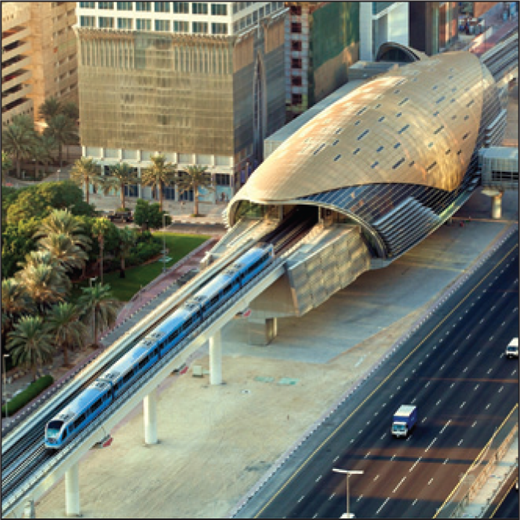
Also, I can see no pantographs in the photographs. Does power come from a third rail, and does the metro use a standard rail gauge?
Authors’ reply
In terms of other papers I believe we have included all references to other published engineering articles relating to the Dubai Metro and we are not aware of any specifically focused upon solar power and sustainability for the metro.
With respect to solar power, while the region clearly has extremely high levels of sunshine, it also has incredibly high levels of fine sand and dust which almost constantly adhere to every surface, hence cleaning is a significant issue with any glass, or solar, panels. We are aware, however, that research is ongoing in the region.
With respect to general sustainability, and over and above the fact that the system is inherently aimed at a reduction in less-sustainable traffic movements, many factors were considered in the metro design. These include local and regional sourcing of materials where possible, highly insulated roof and cladding, high-performance glazing, shared district-cooling provision of chilled water, and rolling-stock measures including regenerative braking and alignment design to support coasting.
Also, there were integrated mechanical, electrical, plumbing and rail systems designs to maximise efficiencies through multiple pre-programmed modes (such as daylight savings modes) that were fully controllable from remote locations.
On the specific questions: yes, there is no complete drainage system in Dubai. The stations use holding tanks for foul water, the same as most of the major buildings in Dubai.
As discussed, there is no solar energy usage. The metro runs on standard third-rail 750 V power delivery and has a standard 1435 mm gauge.
REFERENCE
1200004 Working in harmony with nature: the key to sustainability
By HRH Prince Charles (August 2012)
Contribution by Colin Sherwood
I was very pleased to read Prince Charles’ paper (HRH Prince of Wales, 2012) and very much hope that the ICE and its many members take it fully into account.
However, I would wish to add that we all need to consider the retention and development of ‘natural capital’, that is the ability of the natural world to sustain itself, including mankind.
Too much emphasis is given to gross domestic product (GDP) which merely measures economic activity, even where this activity involves substantial destruction of the natural world. Mankind cannot survive without nature, however much GDP may increase.
Are we too arrogant a species to recognise this? Civil engineers and other professionals all need to reflect this in all their works and seek to rebuild natural capital as a key component of sustainability.
And morally we should not support clients who are continuing to seek to destroy the natural world in search of economic development.
Contribution by Andrew Scott
As a riverside resident of York, I feel I owe it to the reputation of the civil engineers responsible for renewing York's flood defences in the 1980s to point out that the caption to Figure 3 in the paper is inaccurate.
The photograph of flooded buildings in the Yorkshire autumn 2000 floods is not of York but in fact depicts Stamford Bridge, a few kilometres away and on the River Derwent. During this extreme event, York's comprehensive defences achieved perfectly all that was expected of them and the River Ouse did not overrun the city.
REFERENCE
110069 Stabilisation of Combe Down stone mines, Somerset, UK
By David Adamson and Alan Francis (August 2012)
Contribution by Robin Clay
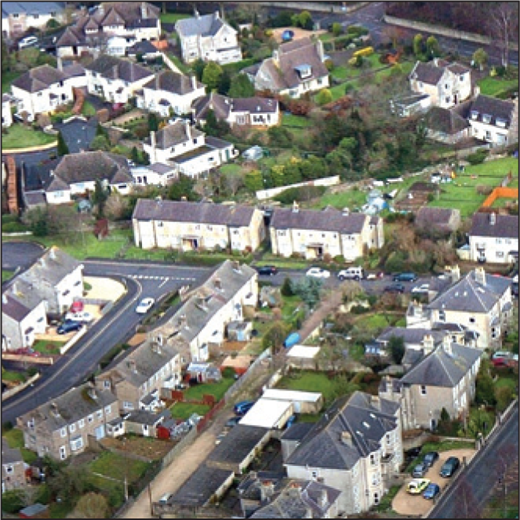
The paper on the Combe Down stone mines (Adamson and Francis, 2012) describes an unusual and fascinating project, which reflects well on all concerned.
However, there is one major point that was ignored. As I understand it, the scheme cost £154 million to safeguard 25 ha, that is about £620/m2. Who paid for it, and why? Mention is made of ‘a funding application’ and to ‘the Treasury Green Book’. From this, I deduce that I, as a tax payer, was paying for this, and I believe this is morally wrong. Why should I pay to protect a house solely to benefit the owner, who bought the house cheap because of the risk?
All that needed to be done was for the council to say to the householders, ‘Your house is at risk; that's why you got it cheap. Your insurance company will not cover it. Your house is now worthless, for you cannot sell it, due to this risk. Because it is worthless, your mortgage company may foreclose. OK, here's the deal. We will arrange for protection works. This will restore the value to your home, and will make it insurable, and sellable. However, this will be at your expense, approximately £620/m2 of the land area of your property. And if the work is not done, we shall be declaring your house unsafe, so you will have to move out. However, your mortgage company will increase your mortgage by that amount, for they will not want to lose everything.’
Sorted, and at minimal cost to tax payers and rate payers.
Authors’ response
The contributor is thanked for his kind compliment, and for his understandable question about the project's funding. He is correct that tax payers paid for the project, via a fund managed by the Homes and Communities Agency set up by government to pay for such threats from abandoned non-coal mining workings.
Stone extraction took place in the eighteenth and nineteenth centuries with houses built from soon after the start of the excavation. No serious threat to stability became apparent until the end of the twentieth century, so most householders bought their property before the danger was known, and so paid full commercial price. The government took the view that the instability was not the property owners’ fault or the fault of anyone in recent history, the beneficiaries of the mining, and their companies, being long gone.
Second, it was becoming apparent that the danger of a collapse and explosion from gas and electricity mains should be addressed urgently – the risk not just to residents but also to road users, children in schools, and many others, was too great.
So, the level of risk and the absence of any basis for requiring property owners to pay (about £250,000 each for 700 properties), led to the government's decision that tax payers should pay (just under £3 per inhabitant of the UK) for this environmental damage caused two centuries ago.
REFERENCE
110018 More for less through private highway maintenance
By John Sunderland and Paul O'Day (August 2012)
Contribution by Chris Parkman
The paper provides some interesting general insights into the different approach of such a scheme from more traditionally procured road maintenance. However, it would have been useful if the authors had given some more specific supporting evidence to their claim that the approach will achieve a, ‘30% more efficient delivery’.
Comparison of the costs and benefits of different forms of highway maintenance procurement are notoriously difficult. Simple comparison of tender prices can be misleading due to the potential for work being delivered beyond the core scope of the original priced estimates.
However, potentially more significant in my experience is the difficulty in comparing the maintenance and operational outcomes of different forms of procurement. Simple comparisons of ‘objective’ measures such as network performance (pavement and other conditions) can be misleading and ignore key components of such contracts, such as customer satisfaction of many of the services provided.
The authors should have therefore given more information on past outturn costs and outcomes and expected future costs and outcomes, as objectively as possible, to allow readers to understand the key benefits of the contract.