


BRIEFING Safeguarding water supplies in England: time for a strategic approach
By Alexander Hamilton (November 2012)
Contribution by Stuart Shurlock
Hamilton (2012) gives a very one-dimensional view of water resources in England and Wales and his analysis is over-dependent on a report 39 years old (WRB, 1973).
There is no crisis, and there is no complacency either. Individual water company water resource management plans are carefully reviewed every 5 years, and each one has to look forward 25 years, taking into account all available data on current resources, population changes, water demand and climate predictions.
The world has changed a lot since 1973. We now have the benefit of hindsight and can see how wrong the Water Resources Board (WRB) predictions were. The major transfers in its national plan have been reviewed twice since then, by the National Rivers Authority (NRA) in 1993 (NRA, 1994) and by the Environment Agency in 2006 (EA, 2006). Neither found that major transfers were justified, and their investigations reversed the WRB finding that local sources were more expensive than major transfers.
The WRB forecast demand for water in England and Wales in 2006 was between 26 000 Ml/d and 28 000 Ml/d. The actual figure was near 15 000 Ml/d. It is easy to see why only its stage 1 new resources were completed. Under the tight regulation of Ofwat and the Environment Agency, the privatised water companies have continued efficiently to manage the balancing act between resources and water charges.
Even in those less environmentally aware times, the WRB had reservations about mixing Severn water with Thames water. By 2006, environmental issues were taken far more seriously and the Environment Agency stated that keeping the water separate meant that, ‘any new transfer would need to be through a pipeline directly to a reservoir somewhere in the Thames catchment’ (EA, 2006: p. 8).
The real challenge is as set out in the Institution of Civil Engineers' State of the Nation: Water 2012 report (ICE, 2012) and in Defra's white paper Water for Life (Defra, 2011): how do we protect the environment and take less water from our rivers while meeting the demands of a growing population? ICE rightly rejects ‘magic bullet’ solutions and calls for more local storage. Both documents call for more collaborative water resources schemes and system connections promoted by neighbouring water companies. The current system works well and, with a few intelligent regulatory changes, will serve us for the foreseeable future.
Author's reply
The contributor states there is no crisis. It is certainly true that the looming water crisis of early 2012 resulting from the second two-dry-winters water resources challenge in 6 years, no longer looms, thanks to the lucky arrival of ‘the wettest drought since records began’.
However, before the heavens broke in mid-April 2012, neither the water authorities nor the customers were expressing the same satisfaction that the second hosepipe ban in 6 years was a sign of the existing system working well. The long-term water resources issues that I noted in my article remain as potent as before.
The contributor downplays the WRB report (WRB, 1973), on the basis of its age and demand predictions. The WRB did indeed use a much higher demand forecast as a planning horizon than currently prevails. However, this in no way invalidates the detailed and careful study of the hydrology, geography, population distribution and engineering that underlies the WRB national development sequence proposals. It simply affects the rate at which such a development programme should be pursued, as was always recognised.
The subsequent NRA study (NRA, 1994) actually generally supported the WRB development sequence, including the supported Severn–Thames transfer if it was needed, albeit subject to full environmental impact studies. No such studies have been done, nor have mitigation measures been considered.
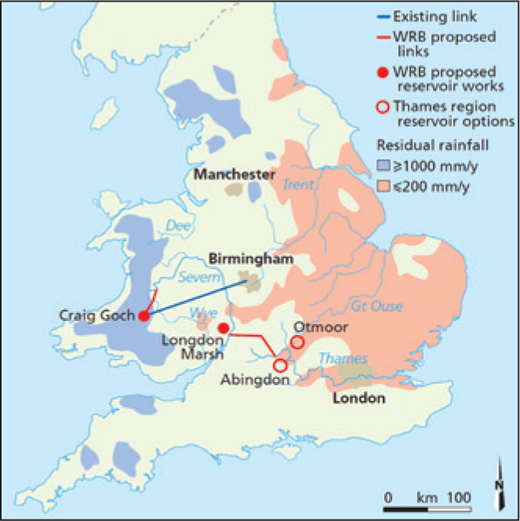
The further Environment Agency report (EA, 2006) adds no new data or further analysis. The 39-year-old WRB report remains valid, is the only detailed national study, has not been superseded, and can – and should – be taken as a benchmark against which further water resources development proposals can be tested.
The contributor emphasises the environmental issues around the Severn–Thames transfer. But in the absence of proper holistic analysis, these issues do not justify rejection out of hand. Neither this nor the alternatives, nor indeed the no-action route, are environmentally neutral.
WRB did foresee problems in transfers across regional boundaries, but also that these would be more than matched by the advantages to be gained. ICE (2012) and Defra (2011) publications also recognise this – albeit more tentatively – in calls for tackling the obstacles preventing collaboration between adjacent water companies and river basins. Now is the time for action.
Reference
1200005 Going under the Devil's Punch Bowl: the story of the A3 Hindhead tunnel, UK
By Paul Arnold (November 2012)
Contribution by Renald Witt
The report on the A3 Hindhead tunnel (Arnold, 2012) was an interesting paper on the hurdles to be overcome delivering civil engineering projects. For the record, it would be of interest to know if non-tunnel schemes were considered in the early stages of this project and, if so, how did their cost–benefit ratios compare to the tunnel?
Author's reply
The author is unable to access the information requested as nearly 20 years have passed since a bored tunnel was announced as the preferred option for the A3 Hindhead road. The decision to announce a tunnel was made largely on construction cost and deliverability criteria.
The only requirement of a benefit–cost ratio for a preferred option was that it should be greater than one. It was concluded that all options considered within the brief would be undeliverable without some form of tunnel, whether cut-and-cover or bored.
The option chosen best met the constraints imposed by the Devil's Punch Bowl site of special scientific interest – being part of an EU designated special protection area under the conservation of wild birds directive (EC, 2009) and National Trust land – and provided a bypass for Hindhead.
In the author's opinion the decision to go with a tunnel scheme was due in no small part to the willingness of the roads and transport minister Kenneth Carlisle and the Department of Transport director in charge of major projects Alan Whitfield to consider what was then an innovative solution.
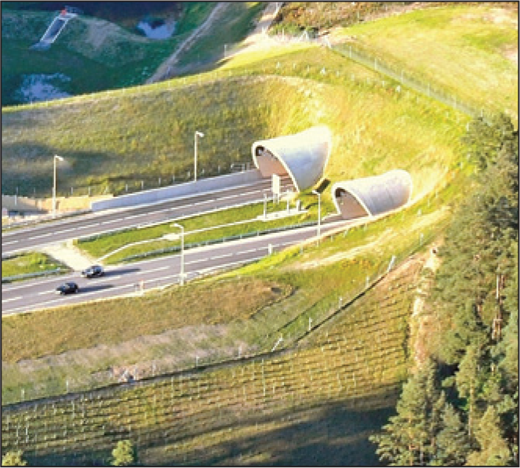
The environmental constraints imposed by the Devils' Punch Bowl site meant non-tunnel options were undeliverable
The environmental constraints imposed by the Devils' Punch Bowl site meant non-tunnel options were undeliverable
Reference
1100031 Lessons learned from Suds implementation at Peterborough, UK
By Ron Henry (November 2012)
Contribution by John Roberts
Henry (2012) outlines the use and implementation of a sustainable drainage system (Suds) at the Hampton development near Peterborough. However, it might have been appropriate to give some credit to Ove Arup and Partners, which was involved with the project from concept through to completion of the first stages of housing and commercial development in the late 1990s, when the client Hanson Properties sold the development to O&H.
A key element in planning the development was demonstrating that an effective surface water drainage strategy was feasible for the catchment of Stanground Lode, which drains to the River Nene. Arup performed a modelling exercise, using the Microdrainage suite, and a steady-state backwater analysis, using the HEC 2 model, to show that the necessary attenuation lakes, pumping stations and regulating structures could control the run-off from the development site. Although Suds was then in its infancy, the basic principles, including limiting the run-off to green-field discharge (2 l/s per hectare), were incorporated in the strategy.
It is disappointing to learn that adoption of the balancing lakes has not yet been implemented. It is fundamental to the long-term sustainability of the catchment drainage system that the balancing lakes, pumping stations and regulating structures be adopted by public or regulated bodies to ensure perpetual operation and maintenance. It was expected that the developer would have to make a substantial contribution, so it would be interesting to know whether this is the obstacle to obtaining adoption.
Author's reply
This has indeed been a very long and complex project and credit is given to the former owner of the site and its consultant, Ove Arup, for developing the initial concept. In addition David Jarvis Associates should be mentioned for the landscaping work it undertook.
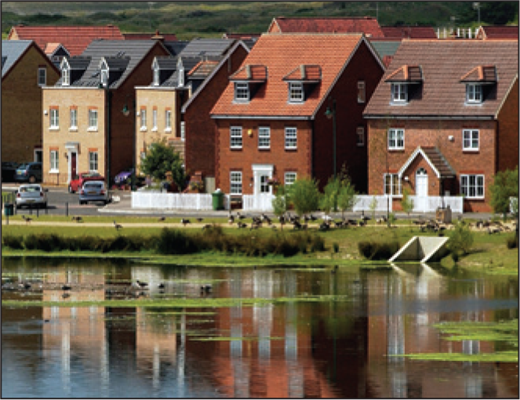
Arup designed the initial Suds scheme at Hampton before the development was sold in the late 1990s
Arup designed the initial Suds scheme at Hampton before the development was sold in the late 1990s

