


Fundamentals of civil engineering: an introduction to the ASCE body of knowledge
This book is a primer for undergraduates and graduates wishing to become professional civil engineers, particularly those wishing to become members of the American Society of Civil Engineers (ASCE).
It provides an excellent introduction to ASCE's ‘body of knowledge’ that represents all non-technical aspects of civil engineering deemed to make a civil engineer professional. As such, it provides a useful reminder to all civil engineers, no matter at what stage of their careers they are, as to what knowledge, skills and attitudes they should possess. In particular, this book covers that knowledge not normally covered within higher education.
The book is well written and very readable. It starts with an indictment of American civil engineering graduates, stating a belief of ‘many practising engineers’ that they are overqualified technically on graduation but under qualified professionally. Perhaps this is not a surprise and probably true of many UK graduates, but then UK graduates have objectives to reach and attributes to attain prior to their professional review and the ASCE has its body of knowledge.
Topics covered are humanities, social sciences, experimentation, sustainability, contemporary issues and historical perspectives, risk and uncertainty, communication, public policy, globalisation, leadership, teamwork, attitudes, lifelong learning, professional and ethical responsibilities, and creativity and innovation. This is quite a list and, in my opinion, this is quite a book.
Some of the topics covered have a US slant but generally any mentor, delegated engineer or supervising civil engineer would find this book very useful in mentoring their trainees or, indeed, if anyone was struggling to find topics for their development action plan the answer can be found in this book.
Professional services agreements: a guide for construction professionals (2nd edition)
This update on the 2000 edition is welcomed in these commercially challenging times when clients can seek to impose more onerous agreements on their professionals. Consequently, as engineers, architects, quantity surveyors and project managers chase appointments at a time of reduced opportunities, special care will be required by them and their legal and insurance advisers in assessing the commercial risks within such agreements. This book will greatly assist those considerations for the current market and in the future.
The book sets out extensive and clear guidance on the obligations, scope, liabilities and rights in several standard appointment agreements, including the Association for Consultancy and Engineering, Royal Institute of British Architects and Royal Institution of Chartered Surveyors versions, as well as giving examples from typical bespoke agreements. References are made to case law to illustrate important aspects of the inherent risks in professional services agreements. It also adds a new, separate section on the NEC3 Professional Services Contract agreement which forms part of the increasingly used NEC3 family of construction contracts.
Particular guidance is given on the complex risk area of supervision, inspection or monitoring services and in relation to novation for design-and-build contracts favoured by many clients. The update also covers the recent changes to the UK Construction (Design and Management) Regulations and refers to the development and influence of the emergence of building information modelling in projects.
Every construction professional's office should have a copy of this excellent book to provide pitfall protection and to assist on how to proceed for most sets of circumstances to be found in contemporary professional agreements.
Dams: engineering in a social and environmental context
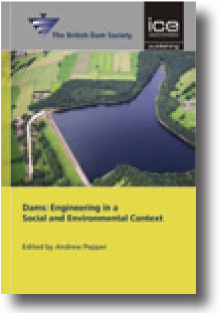
This is the proceedings of the seventeenth biennial conference of the British Dam Society. Despite a variation in styles between papers they are all of a good standard, well presented and easy to read.
The papers cover a wide range of topics varying from the esoteric and legalistic aspects of dams, such as ‘reservoir safety – what do we mean’, to the more practical task of ‘grouting of badger setts in a flood storage reservoir embankment’, with plenty in between. Each paper has its points of interest and the scale of the subject matter varies considerably.
The main topics are concerned with the care of the UK's existing dams, many of which are considerably older than the nominal 100 year design life which civil engineers will put on a new-build scheme. Some structures have become so much part of the local scene that the provision of an increased spillway capacity to meet modern safety standards turns out to be no simple matter.
The book serves as a useful, up-to-date reference for those practising in dams in the UK as well as for those with a more general interest in civil engineering. The range of papers demonstrates the increasing complexity of satisfying the conflicting demands of engineers, environmentalists, social action groups and owners.
The papers do show some of the different ways in which this has been achieved, often calling on engineering ingenuity to produce solutions which, once built, will blend into the landscape and serve unnoticed by the general public for another 100 years or more.
ICE BOOKS
ICE Publishing publishes one of the most comprehensive ranges of civil engineering books in the world. New titles published in the past 3 months are as follows.
| CESMM4: carbon and price book 2013 | Franklin + Andrews (ed.) | £160·00 |
| Designers' guide to Eurocode 8: design of bridges for earthquake resistance, EN 1998-2 | Basil Kolias, Michael Fardis and Alain Pecker (Haig Gulvanessian ed.) | £70·00 |
| ICE manual of structural design: buildings | John Bull (ed.) | £130·00 |
| NEC managing reality series: a practical guide to applying NEC3 (2nd edition) | Barry Trebes and Bronwyn Mitchell | £145·00 |
| NEC managing reality, book 1: introduction to the Engineering and Construction Contract (2nd edition) | Barry Trebes and Bronwyn Mitchell | £30·00 |
| NEC managing reality, book 2: procuring an Engineering and Construction Contract (2nd edition) | Barry Trebes and Bronwyn Mitchell | £35·00 |
| NEC managing reality, book 3: managing the contract (2nd edition) | Barry Trebes and Bronwyn Mitchell | £35·00 |
| NEC managing reality, book 4: managing change (2nd edition) | Barry Trebes and Bronwyn Mitchell | £40·00 |
| NEC managing reality, book 5: managing procedures (2nd edition) | Barry Trebes and Bronwyn Mitchell | £30·00 |
Books can be ordered by calling +44 1892 832299, emailing orders@icepublishing.com or by visiting www.icevirtuallibrary.com/content/books. All books can be also be viewed in the ICE library at 1 Great George Street, London SW1P 3AA from 9.30 am to 5.00 pm Monday to Friday.
International case studies in asset management
This book is a collection of 17 case studies of how a variety of organisations operating in different sectors have developed asset management thinking and best practice, how this has affected them and what they have learnt.
It will appeal to anyone with a specific interest in asset management and provides a good reference for those developing an asset management system, strategy or looking at infrastructure investment opportunities.
The case studies provide an insight into how asset management is being successfully used to prioritise capital investment, increase operational efficiency and manage risk and opportunities. The case studies feature leading global and national companies, state-owned firms, municipal authorities and government agencies from seven different countries and show how the various organisations use asset management to account for their actions to shareholders, regulators and taxpayers.
Clearly, asset management is about making sure that the capital spending and the ways an organisation manages its assets align with its corporate objectives. Good asset management practices provide the evidence to demonstrate to investors that a business is being well run.
Managers who are starting to adopt asset management and want to see some examples to understand what opportunities it presents will benefit from reading this book, along with those seeking to invest in major infrastructure businesses and wanting to understand an organisation's performance, and those studying the subject. All readers will find the questions at the end of each case study useful to reflect on and consider, and there are many references for follow-up reading.
The editor, in the conclusions, states that there are four stages in the adoption of asset management: awareness, interest, inquiry and commitment. This book will assist in the first three of these.

