


ICE manual of structural design – buildings
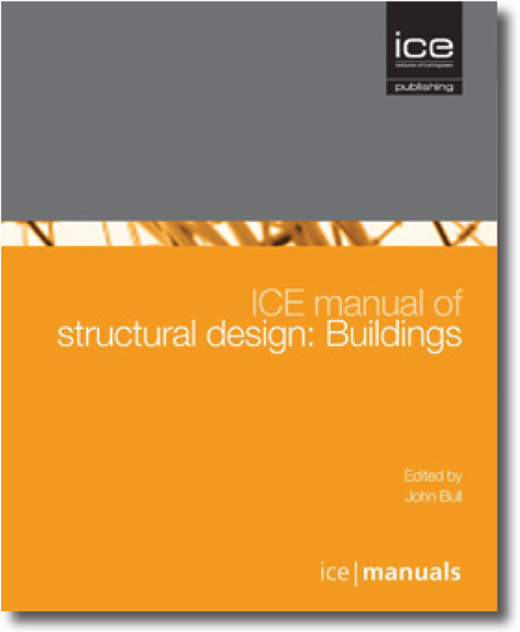
This substantial 426-page book – the seventh in the Institution of Civil Engineers' new series of ICE Manuals – covers the subject of structural design very thoroughly. There are 21 chapters covering topics from ‘the place of the structural engineer in society’ to ‘glass’.
As well as the technical subjects one might expect to be covered, there are also topics such as ‘tackling projects’, ‘managing risk’ and ‘taking a through-life perspective’. This I found refreshing – the editor and contributors have clearly set out to provide a holistic view of the design process.
I can also confirm that it is a ‘good read’. This in part is because it is not anything like a text book – it illustrates the guidance provided with examples and anecdotes from projects throughout the world, so the reader is entertained as much as informed by the text and illustrations.
Each chapter has been provided by different contributors who are each considered to be at the top of their profession; there are 23 of them and they come from both well-known consultants and academia. The content thus has good provenance, which is a lot more than can be said if one simply relies on the results of internet searches.
In addition to being up to date and comprehensive, the manual provides the opportunity for further reading and research via references, suggested reading, standards, statutory instruments and web addresses given at the end of each chapter. The comprehensive index at the back is obviously very useful too.
I have made significant use of this manual since acquiring it for review. Although the emphasis is on ‘buildings’ there is much within it to inform and guide civil and structural engineers involved in other infrastructure design. As such it will appeal to students and practitioners alike, young and old, and should become the first port of call for seeking guidance on any aspect of structural design.
Engineering: a very short introduction
ENGINEERING: A VERY SHORT INTRODUCTION
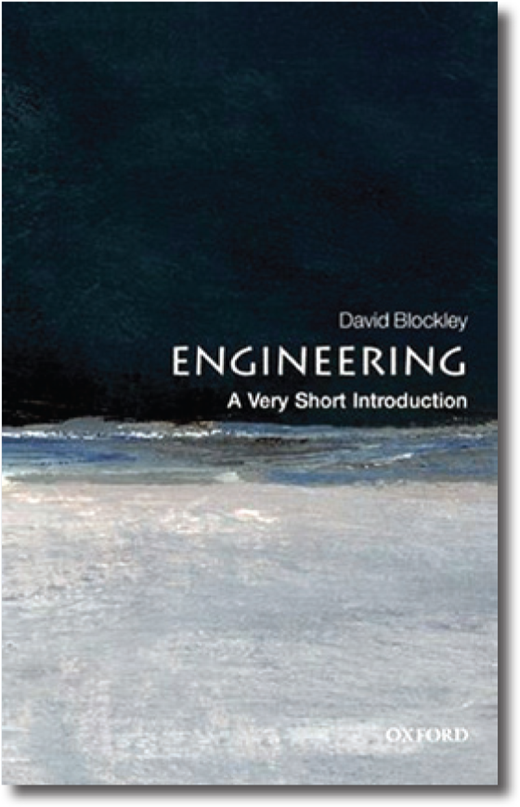
This is one of a major series of pocketbooks designed to provide a stimulating insight into a new subject in everyday language. In this case David Blockley provides a whistle-stop tour of the fundamentals of engineering through the ages, describing the key discoveries and developments and the impacts these have had on people and the environment.
The chapters deal intelligently with the concept of engineering – taking an idea and turning it into reality – followed by some of the broad principles which have shaped modern engineering. These include working with or against gravity; how heat translates into motion; the age of electromagnetism, electronic components and the information technology revolution; and the complexity of systems and their risks.
For the non-engineer who wants to understand what engineers do this book provides a well-referenced and concise answer, as well as demonstrating the wide-reaching involvement and passion of engineers through the ages. For engineers, the book provides a nice reminder of all the basics we learned at university, providing bite-sized chunks of history, science, application and modern relevance.
The final chapter poignantly deals with ‘the age of systems – risky futures’ and provides some good sound bites on the inherent complexity and risk associated with engineering projects today. It looks at some of the more politically relevant questions, such as ‘why do engineering projects fail?’, ‘why do they go over budget?’ and ‘how safe is safe enough?’ through an explanation of risk and uncertainty.
It shows how informed decision-making is vital to the success of engineering projects today, as well as the importance of the quality of information. The author's challenge for the future is not just to achieve successfully integrated projects, but to achieve synergy – where the whole is greater than the sum of its parts.
In summary, this concise book provides excellent references for further reading and is an affordable, quick read to brush up on engineering history and its modernday application. It is even more powerful as a tool for non-engineers to understand how intimately engineering contributes to the quality of peoples' lives – and the consequences of success or failure.
NEW BOOKS
The ICE library carries one of the most comprehensive ranges of civil engineering books in the world, including all new titles from ICE Publishing (shown in bold below). New books received in the past 3 months include the following.
| A guide to the project management body of knowledge (5th edition) | Project Management Institute | £42·59 |
| Advances in water desalination | N Lior | £117·00 |
| Arctic offshore engineering | A Palmer | £66·35 |
| Bridge design and evaluation | G Fu | £85·00 |
| Building surveys (8th edition) | P Glover | £29·99 |
| Dealing with difficult demolition wastes: a guide | K Adams | £36·00 |
| Designers' guide to Eurocode 5: design of timber buildings: EN 1995-1-1 | J Porteous | £60·00 |
| Effective site investigation | C Clayton | £37·50 |
| Energy generation through waste water: renewable energy | A Salim | £40·00 |
| Epic engineering: great canals and barrages of Victorian India | A Robertson | £25·00 |
| Financial management in construction contracting | A Ross | £39·99 |
| Finite element methods for engineers (2nd edition) | R Fenner | £36·00 |
| Forensic engineering: damage assessments for residential and commercial structures | S Petty | £99·00 |
| Foundation and anchor design guide for metal building systems | A Newman | £60·99 |
| Fukushima: impacts and implications | D Elliott | £30·00 |
| Ground improvement (3rd edition) | K Kirsch | £120·00 |
| Guidance on the management of landfill sites and land contamination on eroding or low-lying coastlines | N Cooper | £120·00 |
| Guidelines for landscape and visual impact assessment (3rd edition) | Landscape Institute | £49·99 |
| Hydraulics in civil and environmental engineering (5th edition) | A Chadwick | £39·99 |
| Ireland's civil engineering heritage | R Cox | £17·99 |
| Major soil groups of the world: ecology, genesis, properties, and classification | J Legros | £89·00 |
| Making space for the river: governance experiences with multifunctional river flood management in the US and Europe | J Warner | £89·00 |
| Modern construction management (7th edition) | F Harris | £34·95 |
| Monitoring water quality: pollution assessment, analysis and remediation | S Ahuja | £78·99 |
| NEC3: How to use BIM with NEC3 contracts | Institution of Civil Engineers | £20·00 |
| NEC3: How to use the ECC communication forms | Institution of Civil Engineers | £20·00 |
| NEC3: How to use the PSC communication forms | Institution of Civil Engineers | £20·00 |
| NEC3: How to use the TSC communication forms | Institution of Civil Engineers | £20·00 |
| NEC3: How to write the ECC works information | Institution of Civil Engineers | £20·00 |
| NEC3: How to write the PSC scope | Institution of Civil Engineers | £20·00 |
| NEC3: How to write the TSC service information | Institution of Civil Engineers | £20·00 |
| Partial saturation in compacted soils: Geotechnique symposium in print 2011 | D Gallipoli | £60·00 |
| Principles of railway operation | J Glover | £25·00 |
| Problem solving and data analysis using Minitab: a clear and easy guide to six sigma methodology | R M Khan | £50·00 |
| Project ethics | H Jonasson | £28·50 |
| Reinforced concrete structural reliability | M El Reedy | £82·00 |
| Reliability of structures (2nd edition) | A Nowak | £63·99 |
| Retrofitting of heritage structures: design and evaluation of strengthening techniques | S Syngellakis | £93·00 |
| Seismic performance of concrete buildings | L Crainic | £95·00 |
| Sustainable retrofitting of commercial buildings: warm climates | R Hyde | £90·00 |
| The making of the Queen Elizabeth Olympic Park | J Hopkins | £49·99 |
| The Shard: London Bridge Tower | Fondazione Renzo Piano | £27·51 |
| The Shard: the official guidebook | K Powell | £5·96 |
All books can be borrowed from the ICE library on the first floor at 1 Great George Street, London, SW1P 3AA from 8.30 am to 6.30 pm Monday to Friday. ICE Publishing titles can be purchased from the ICE library or ordered by calling +44 1892 832299, emailing orders@icepublishing.com or by visiting www.icevirtuallibrary.com/content.books.

