


Ireland's civil engineering heritage

This textbook-sized glossy is actually two books in one: an historical review of the various infrastructure sectors – roads, canals, railways, water and drainage and maritime – followed by a geographical gazetteer of surviving works, from the grandiose Foyle Bridge to the blunt University College Dublin water tower.
The historical review is the highlight, with a span of over a millennium and a cast of many unexpected and lesser-known ‘engineers’, from seventh century Nendrum monks and their tide-mill to the energetic and splendidly named Binden Blood Stone. There are cameo appearances by some engineering great and good – such as Robert Stevenson, both John Rennies and Brunel – although celebrities did not always get it right in designing for Irish ground conditions.
There is a hint of folklore in some of the accounts and the reader is left wanting to know more. Why, for example, were the final locks on the Ulster canal built too narrow for the barges to pass through, and why was the Ballinamore and Ballyconnell Navigation only used by eight vessels in 9 years?
There are also some eighteenth century aphorisms relevant to justifying modern infrastructure, such as, ‘have something to carry before you seek the means of carriage’ and the conclusion that much Irish infrastructure could be justified only as a means of employment generation.
Modern politicians contemplating public works programmes in these straitened economic times should take note. Highly recommended.
Bridge design and evaluation – LRFD and LRFR
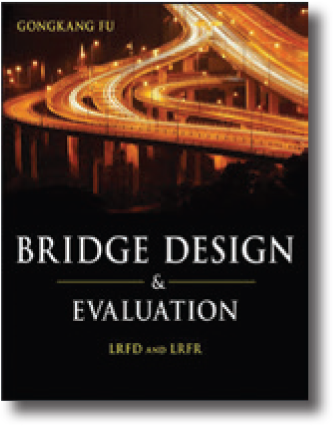
If Aashto is your main reference code for beam-and-slab bridge design then this book will be very useful, as it covers both the load and resistance factor design (LRFD) and the load and resistance factor rating (LRFR) methods.
Almost half of the 420 pages are devoted to the design of bridge decks, with well-explained, fully worked examples for medium-span decks. The calculations and diagrams are clear, enabling good comparisons between use of rolled steel beams, plate girders and prestressed concrete beams to support the top slab.
The reader is then taken through the parallel process of evaluating bridge components to illustrate the code differences between design and evaluation. Shear connection and fatigue analysis are covered but bracing and diaphragm components are not, other than by reference to their roles.
The book also covers bearings and non-piled substructures. The comprehensive illustrations and photographs give good insight into bridge components, and flow charts aid understanding of each analysis process. There is a short section to illustrate long-span forms of bridges – cable stayed, suspension, truss and arch – to give the reader an insight on more complex structures.
Overall, therefore, if you work with the Aashto codes (and are used to US imperial units) this will be a very useful textbook.
Reliability of structures (2nd edition)
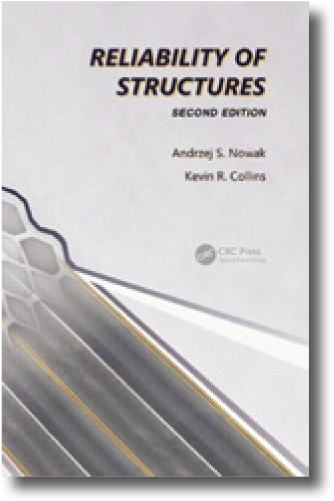
This second edition of Novak and Collins' book comprises ten chapters covering a variety of technical content, such as the basics of probability, simulation techniques, modelling structural loads, safety analysis and some design issues.
The widely used Monte Carlo simulation is elaborated in chapter 4. The examples of how to generate statistical data for normal and lognormal random numbers are likely to be helpful for practising engineers and students interested in statistical modelling.
The background of limit-state design is provided in chapter 5 in conjunction with detailed explanations on reliability index. The first-order second-moment reliability method is covered with a typical structural problem, and a step-by-step procedure is summarised to implement the Hasofer–Lind reliability index, supported by several examples.
Chapter 6 reveals various load models for structural design. Bias factors and coefficient of variation are specified for dead and live loads. The live load models used in the Aashto specifications are illustrated with some parametric study results. Other types of loads such as wind, snow, ice and earthquake are concisely discussed.
The last chapter of the book is about uncertainties in the building process. Of interest are human error, uncertainty categories and failure rates. Overall, this book is informative and practical and I recommend it as a reference for practising engineers, engineering students and research professionals.
NEW BOOKS
The ICE library carries one of the most comprehensive ranges of civil engineering books in the world, including all titles from ICE Publishing (shown in bold below). New books received in the past 3 months include the following.
| A better way to build: a history of the Pankow companies | M Adamson | £31·16 |
| BIM for facility managers | P Teicholz | £57·50 |
| Biomass as energy source: resources, systems and applications | E Dahlquist | £82·00 |
| Bridge construction equipment | M Rosignoli | £80·00 |
| Building services handbook (7th edition) | R Greeno | £29·99 |
| CESMM4 carbon and price book 2013 (8th edition) | Mott MacDonald | £160·00 |
| Concrete, from archeology to invention, 1700–1769: the renaissance of Pozzolana and Roman construction techniques | R Gargiani | £65·00 |
| Construction law: law and practice relating to the construction industry (11th edition) | J Uff | £30·95 |
| Corrosion of steel in concrete: prevention, diagnosis, repair (2nd edition) | L Bertolini | £86·40 |
| Critical excitation methods in earthquake engineering (2nd edition) | I Takewaki | £100·00 |
| Design against blast: load definition and structural response | S Syngellakis | £93·00 |
| Design and construction of nuclear power plants | J Schnell | £45·00 |
| Design of fastenings for use in concrete – the CEN/TS 1992-4 provisions | R Mallee | £45·00 |
| Design of structural elements to Eurocodes (2nd edition) | W McKenzie | £38·99 |
| Environmental geotechnics (2nd edition) | R Sarsby | £100·00 |
| Environmental impacts of hydraulic fracturing | F Spellman | £82·00 |
| FRP deck and steel girder bridge systems: analysis and design | J Davalos | £95·00 |
| Green buildings pay: design, productivity and ecology (3rd edition) | B Edwards | £35·00 |
| How to plan and implement seismic isolation for buildings | Japan Society of Seismic Isolation | £98·68 |
| Intelligent buildings: design, management and operation (2nd edition) | D Clements-Croome | £45·00 |
| Leak detection: technology and implementation | S Hamilton | £75·00 |
| Low carbon development: key issues | F Urban | £26·99 |
| Management of global construction projects | E Ochieng | £34·99 |
| Managing climate risk in water supply systems | C Brown | £79·00 |
| Manual for the geotechnical design of structures to Eurocode 7 | The Institution of Structural Engineers | £70·00 |
| Milestones in water reuse: the best success stories | V Lazarova | £99·00 |
| Natural ventilation in high-rise office buildings | A Wood | £39·99 |
| One Great George Street: the headquarters building of the Institution of Civil Engineers | M Dunkeld | £45·00 |
| Safer stairs in public places – assessment of existing stairs | A Gilbertson | £50·00 |
| Seismic behaviour and design of irregular and complex civil structures | O Lavan | £117·00 |
| Statics and mechanics of structures | S Krenk | £53·99 |
| Steel–concrete composite bridges: designing with Eurocodes (2nd edition) | D Collings | £75·00 |
| Steel bridges: conceptual and structural design of steel and steel-concrete composite bridges | J Lebet | £72·68 |
| Technologies for converting biomass to useful energy: combustion, gasification, pyrolysis, torrefaction and fermentation | E Dahlquist | £82·00 |
| The deep mixing method | M Kitazume | £89·00 |
| The design manager's handbook | J Eynon | £39·95 |
| The governance of energy megaprojects: politics, hubris and energy security | B Sovacool | £80·00 |
| The Intercity story 1964–2012 | C Green | £35·00 |
| Total sustainability in the built environment | A Cotgrave | £36·99 |
| Towers, turbines and transmission lines: impacts on property value | S Bond | £65·00 |
| Underground engineering for sustainable urban development | National Research Council | £40·00 |
| Understanding building failures (4th edition) | J Douglas | £29·99 |
| Urban energy systems: an integrated approach | J Keirstead | £35·00 |
| Water and wastewater infrastructure: energy efficiency and sustainability | F Spellman | £70·16 |
| Worked examples for the design of concrete structures to Eurocode 2 | T Threlfall | £35·00 |
All books can be borrowed from the ICE library on the first floor at 1 Great George Street, London, SW1P 3AA from 8.30 am to 6.30 pm Monday to Friday. ICE Publishing titles can be purchased from the ICE library or ordered by calling +44 1892 832299, emailing orders@icepublishing.com or by visiting www.icevirtuallibrary.com/content.books.

