


1200043 London Olympic Park underpass leads to better understanding of cast iron
By Martin Kirk (August 2013)
Contribution by Michael Bussell
I would counsel caution in extrapolating from the cast-iron sewer pipe project reported by Kirk (2013).
When I drafted the guide to appraisal of iron and steel structures for the Steel Construction Institute (Bussell, 1997), I suggested a three-stage assessment process. The first two stages successively took as permissible tensile stress the 23 N/mm2 quoted for buildings in the London County Council (General Powers) Act 1909 (1909), and then the derived figure – reduced from 46 N/mm2 to allow for live load effects – given for bridges in the 1993 edition of BD21. The guidance is unchanged in the 1997 edition and in the current 2001 edition (HA, 2001) cited by Kirk. The third-stage assessment required material sample testing to support any increase in permissible stress.
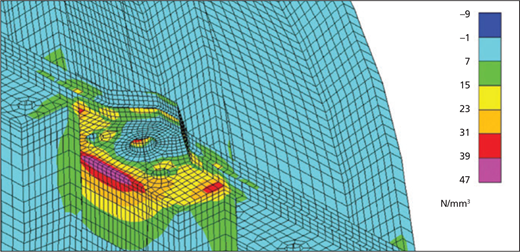
As I read Kirk's Figure 6 (repeated here) and his observation that the peak local stress value on a first assessment (shown graphically as around 47 N/mm2) was about twice the ‘standard allowable tensile strength’, he would seem to have followed a similar approach – using 23 N/mm2 as the permissible tensile stress. The calculated peak value would just have scraped in a ‘pass’ on a second-stage assessment based on BD21 guidance. However, this was the assessed situation even before any construction work was to start, so I fully endorse the wisdom of taking material samples, which led to a considered view that a permissible tensile stress of 75 N/mm2 in the sewer pipes could be adopted.
That said, I would hesitate to support the suggestion that such an increased stress level should be adopted in building or bridge appraisal without very persuasive and consistent material test results to support this. As the paper's synopsis observes, ‘cast iron can be much stronger than assumed from design codes’, but I question whether the findings ‘demonstrated the conservatism in allowable stress limits that are generally used for cast iron’.
Cast-iron beams with tension flanges usually thicker than the 19 mm sewer pipes stand an increased risk of failure if stressed at higher levels. Fracture mechanics argue convincingly and tests confirm that the modulus of rupture (i.e. flexural tensile strength) of a brittle material decreases with increasing thickness as a result of the increased probability of a ‘trigger’ flaw being present and hence making abrupt failure more likely.
While nineteenth-century cast iron can be appraised manageably, it remains (like wrought iron too) a material of variable strength. The possible consequences of an abrupt structural failure of a beam rather than the cracking of a sewer pipe need to be addressed with care.
Also, did the author attempt a local hand calculation of stress for comparison against the stresses reported by the finite-element analysis shown in figure 6? I have had experience of finite-element analysis reporting very high local stresses in, for example, masonry tunnel invert-sidewall corners, when the actual tunnel shows no sign of distress. Hand-sketching of stress flows around the tunnel corners has been found to reduce the indicated peak stresses to more manageable figures consistent with observed performance.
Author's reply
The author agrees that generally accepted allowable stress limits should be used in the first instance for design. Clearly extreme caution is required when departing from such rules. It was on the basis of in situ testing of the as-built structure that it could be explained why the structure had been performing adequately for over 100 years under higher stresses.
Some hand calculation was carried out and gave similar results although it did not include variation through thickness plate stress due to bending. The author recognises that a poorly chosen finite-element model can indicate high values in small areas which would not be appropriate to use, particularly for materials that can accept local yielding. However, this is not the case for cast iron, which is known to be brittle, and the finite-element modelling results needed careful inspection to confirm appropriateness.1
The peak local stresses being carried by the cast-iron sewer pipes on this project should not be extrapolated to cast-iron beams
The peak local stresses being carried by the cast-iron sewer pipes on this project should not be extrapolated to cast-iron beams

