


NEC3 and NEC4 compared
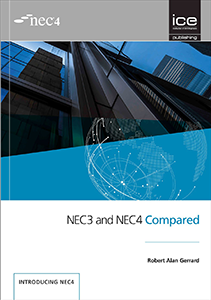
With the release of the NEC4 suite of contracts in June 2017, there is a need to bring those in the industry familiar with NEC3 forms up to speed on the changes to this widely used contract family. Gerard’s new book provides a clause-by-clause comparison between NEC4 and NEC3 versions of the Engineering and Construction Contract (ECC) – the main works contract in the suite – but the principles behind the changes are consistent across the other forms.
The book explains why specific changes have been made between NEC3 and NEC4, focusing on the feedback provided over the last few years by the industry. Each ECC clause is shown, starting with the core clauses and then the main option and secondary clauses, with each individual change highlighted and explained. The explanations themselves cover both the rationale behind the changes and the practical implications. A brief glossary of new NEC4 terminology is also provided, which is particularly useful for the reader to understand the main differences quickly.
The writing style, as with NEC contracts themselves, is simple and non-legalistic – which means it is a useful easy reference which can be quickly used on a regular basis. With NEC4 being the future of the now globally used NEC suite, this is an invaluable resource for practitioners. It is aimed towards practitioners of varying backgrounds including engineers, supervisors, quantity surveyors and contractors. In summary, I found the book to be an easy-to-digest way of learning about the differences between NEC3 and NEC4.
Tall building foundation design
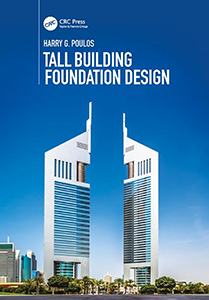
As Poulos highlights, tall buildings are an integral part of modern cities. Understanding the design requirements of these structures is important for geotechnical engineers, especially as lessons are learned as the number of tall structures designed and constructed increases and their heights rise, too.
This book aims to clarify the issues that need to be considered in the design of tall buildings from a geotechnical perspective and bring together some of the latest available information on geotechnical design techniques. It also sets out the process and methods by which foundation design parameters can be evaluated.
The author firstly describes the evolution and modern characteristics of tall buildings in the context of foundation design, then moves to more detailed technical matters. Topics covered include defining building loads, deriving ground characteristics, design for ultimate and serviceability limit state and design for dynamic and seismic loading. There are also specific chapters on pile load testing and performance monitoring and control.
Although the book covers a broad range of design issues, each is explored in substantial depth – with equations and graphs used to explain the principles described. The graphics used are excellent in that they show in simple form the issues that are addressed in the main body of the text. I found the final chapter to be of particular interest as it gave specific reallife examples of projects across the globe, with practical applications of the technical principles described in earlier chapters.
The book is heavily referenced, which is essential for a text that aims to be used by engineers in earnest. This book is certainly a vital reference for those in the field of geotechnical design of tall buildings – and would be of useful reference generally for all civil engineers.
ICE specification for piling and embedded retaining walls (3rd ed.)
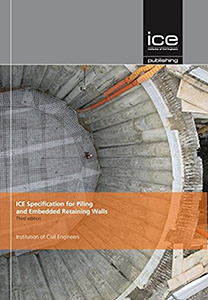
This is one of the most popular of ICE’s specifications and is supported by the Federation of Piling Specialists. Sometimes referred to by the abbreviation ‘Sperwall’, it is the UK’s national technical specification for piling and embedded walling works either on land or near shore, and has been fundamental in raising piling standards in the UK and elsewhere.
The third edition has been updated to take account of developments in piling techniques, changes to European standards and modern forms of contract and procurement methods. It is divided into three parts, with part A covering general requirements for successful construction. This includes information on the tendering process, design responsibility and non-technical issues such as safety, quality and sustainability.
Part B covers specification requirements and accompanying guidance notes. There are 21 sections covering different piling and embedded retaining wall methods, materials used (concrete, steel and timber), general requirements and common testing methods – including instrumentation. Part C provides guidance for each of the previous 21 sections based on experience from contractors and consultants to minimise risk associated with geotechnical works.
The specification is not intended to inhibit innovation – novel solutions can be implemented provided additional clauses are included.
A British Geotechnical Association early career group meeting was held at ICE in October 2017, where the updates to the specification were presented by Pete Ingram and Tony Suckling.
NEW BOOKS
The ICE Library maintains one of the most comprehensive collections of civil engineering books in the world, including all titles from ICE Publishing (shown in bold below). New books received in the past 3 months include the following.
| A guide to the project management body of knowledge (6th ed.) | Project Management Institute | £85·00 |
| Applications of fire engineering | M Gillie | £145·00 |
| Assessment, restoration and reclamation of mining influenced soils | J Bech et al. | £118·00 |
| Brittle fracture: selection of steel sub-grade to BS EN 1993-1-10 | D Brown and T Cosgrove | £45·00 |
| Building integrated solar technology | R Krippner | £64·56 |
| Complex steel structures: non-orthogonal geometries in building with steel | T Meyer-Boake | £43·91 |
| Concrete in extreme environments | J Bull and Z Zhou | £85·00 |
| Construction delays (3rd ed.) | T Trauner et al. | £66·99 |
| Construction materials: their nature and behaviour (5th ed.) | M Soutsos and P Domone | £44·99 |
| Construction quality management: principles and practice (2nd ed.) | T Howarth | £45·99 |
| Crossrail project: infrastructure design and construction (vol. 4) | R Williams and M Black | £75·00 |
| Design of steel structures for building in seismic areas | R Landolfo et al. | £45·00 |
| Environmental impact assessment: theory and practice | A Mareddy | £118·00 |
| Feasibility studies in construction projects: practice and procedure | M Kulwin | £130·00 |
| Fire prevention on construction sites (9th ed.) | RISCAuthority et al. | £25·00 |
| Fire safety engineering design of structures (3rd ed.) | J Purkiss et al. | £118·00 |
| Geomechanics of marine anchors | C Aubeny | £99·00 |
| Managing reality (3rd ed.) | B Mitchell and B Trebes | £175·00 |
| NEC3 and NEC4 compared | R Gerrard | £40·00 |
| NEC4: the role of the project manager | B Mitchell and B Trebes | £45·00 |
| NEC4: the role of the supervisor | B Mitchell and B Trebes | £45·00 |
| Non-destructive testing and evaluation of civil engineering structures | J Balayssac and V Garnier | £138·00 |
| Nuclear engineering: a conceptual introduction to nuclear power | M Joyce | £49·99 |
| Planning and design of engineering systems (3rd ed.) | G Dandy | £39·99 |
| Rapid load testing on piles: interpretation guidelines | P Holscher et al. | £85·00 |
| Recycled aggregate concrete structures | J Xiao | £86·00 |
| Reinforced concrete design to Eurocode 2 | G Toniolo et al. | £74·50 |
| Significant changes to the International Building Code 2018 | International Code Council | £30·99 |
| Small practice and the sole practitioner | M Davys | £30·00 |
| Structural analysis: a unified classical and matrix approach (7th ed.) | A Ghali and A Neville | £49·99 |
| Structural steel design (6th ed.) | J McCormac | £129·99 |
| Super structures | I Graham and I Murray | £14·99 |
| Taking control of writing your thesis: a guide to get you to the end | K Guccione and J Wellington | £23·99 |
| The contractor’s NEC3 ECC handbook | S Evans | £59·95 |
| The Queensferry crossing: vision to reality | D Watt | £19·35 |
| Water resources: a new water architecture | M Norton et al. | £99·95 |
All books can be borrowed from the ICE Members’ Resource Hub on the second floor of 1 Great George Street, London, SW1P 3AA from 9.15 am to 5.30 pm, Monday to Friday. ICE Publishing titles can also be purchased from the ICE Members’ Resource Hub or ordered by calling +44 1892 832299, emailing orders@icepublishing.com or by visiting www.icevirtuallibrary.com/content/books.

