Welcome to this Civil Engineering special issue on on underground construction.
It explores some of the latest developments and innovations that are transforming underground construction across the world. The wide-ranging papers cover various ways in which underground spaces can meet society’s future needs, and the innovations in underground construction technology that are helping to improve safety, delivery and environmental performance.
The issue has been supported by the British Tunnelling Society (BTS), an Institution of Civil Engineers associated society, which celebrates its 50th anniversary next year. Since its first meeting in March 1971, it has since grown to become one of the world’s most vibrant gatherings of professional tunnellers in the world, providing industry guidelines, codes of practice, training, conferences and advice to government on all aspects of underground construction.
The environmental impact of construction works is a growing concern. The first paper by Thomas (2020) discusses how, through innovation, the environmental impact of underground construction can be reduced. The nature of underground works is such that it is difficult to reduce embedded carbon dioxide. However, through plant selection, alternative technology and maximising the inclusion of temporary support as part of the permanent solution, significant improvements can be made.
Ground risk is a key influencer in the development of underground projects and, in particular, the safe construction of the works. Encountering unforeseen conditions not only impacts on safety but can have significant impacts on cost and schedule. Dickman (2020) discusses the use of seismic techniques to permit sporadic or continuous prediction of geological uncertainties in advance of the excavation, as opposed to more traditional approaches such as forward probing. Linking the data collected to the wider predicted impacts on surface during construction, helping to control both cost and programme.
Lamont et al. (2020) bring their considerable experience of excavating tunnels and underground spaces in soft, wet ground using compressed air at pressures up to 15 bar, significantly above usual practice. As experience of working in compressed air has become more limited over time, this paper provides a key introduction to working in high-pressure compressed air as a safe approach to the construction of subaqueous tunnels in soft ground, addressing such aspects as unstable ground conditions and tunnel-boring machine (TBM) cutterhead maintenance.
Hong Kong has a long tradition of cavern construction and the use of underground space to deliver infrastructure, thereby freeing up the surface for other development. Ho et al. (2020) discuss this rich history in the context of the Hong Kong Cavern Master Plan (CEDD, 2017) with regards to cavern applications and engineering practice. The Sha Tin Sewage Treatment Works is presented as a recent example of placing such infrastructure in large-span caverns releasing significant amounts of prime development land for other beneficial uses.
Next, Schwob et al. (2020) explain the extreme challenges of creating a subsea road tunnel in Hong Kong at depths of up to 58 m, and how innovative methods coupled with advanced diving techniques enabled the construction of the tunnel. The paper also describes the unusual cofferdam and shaft construction that was required to launch and retrieve the TBMs.
The sixth paper addresses the risks involved in sprayed-concrete-lined tunnels under London, UK. Anthony et al. (2020) explain how the lessons learned from previous tunnelling in equivalent geological conditions were applied in the construction of further underground facilities at London Underground’s Bank station capacity upgrade project. These facilities will improve the passenger capacity, reduce cross-station passenger journey time and provide step-free access to the Northern line and the Docklands Light Railway. Fire and excavation measures were also improved.
Sub-surface geology is one of the biggest risks to the costs of a tunnel project. Eddies et al. (2020) next describe the risks incurred on previous tunnelling projects and their effects on out-turn cost. They outline the benefits of using an iterative and predictive ground-modelling approach to managing sub-surface risk, and they explore the benefits of utilising a pre-construction geophysical screening process, which can assist in the reducing of uncertainty. A case study is then presented of the experience gained by such an approach on the Sirius Minerals project, where it assisted the design of the route of the transport tunnel partially routed under the North Yorkshire National Park (UK).
Thorpe (2020) provides the final paper, which describes the approach taken on a small conveyor tunnel in Warwickshire, UK. Not all tunnel projects are mega-projects and this paper outlines the design and construction of a vital link in the expansion of a quarry that produces the raw constituents of cement. The rationales for choosing the method of construction are described.
On behalf of the Editorial Panel, we would like to thank not only the authors of the papers in this issue but also the numerous other authors who had provided papers on underground works for the panel to consider for publication. Each paper was of a high quality and it is only space that limits their publication.
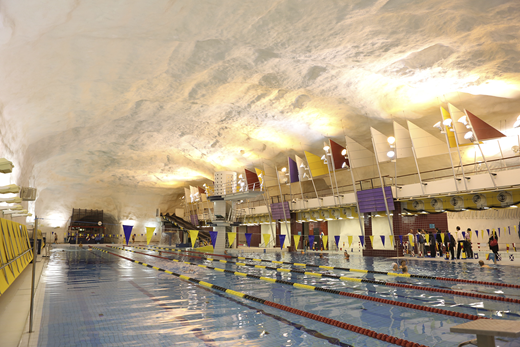
Engineered underground spaces can serve many uses, from transport tunnels and utility storage to retail and leisure use – such as this 1993 swimming pool in Helsinki, Finland (see p. 26)
Engineered underground spaces can serve many uses, from transport tunnels and utility storage to retail and leisure use – such as this 1993 swimming pool in Helsinki, Finland (see p. 26)
In particular we would like to thank the BTS for their support with this special issue. We wish them a happy 50th birthday for next year and look forward to celebrating many more.