Welcome to the May 2022 special issue of Civil Engineering. Unlike any other special issue we have previously published, it reports on how civil engineers worldwide have coped during an unprecedented global disaster: the Covid-19 pandemic.
Faced with lockdowns, staff shortages, supply chain disruption, travel restrictions and social distancing rules, civil engineers had to make unprecedented changes to their working practices to keep vital infrastructure delivery and maintenance projects moving forward safely. And many of these innovative solutions have proved so effective they look set to form part of a ‘new normal’ as the profession emerges into a post-pandemic world.
The rapid international spread of Covid-19 left no infrastructure sector unscathed. Every civil engineer and their employers had to adapt rapidly as numerous lockdowns started to be imposed in 2020. It was initially expected to be a short, sharp pause but the crisis is still going on in 2022, with severe restrictions remaining in place in many areas around the world. This continues to limit civil engineers’ daily travelling and working routines and especially their attendance at public meetings and events. But while the impacts of Covid-19 are still being felt globally, many countries are finally starting to emerge from the pandemic and take stock of the lessons learned.
Every civil engineer and their employers had to adapt rapidly as numerous lockdowns started to be imposed in 2020
Overall, civil engineers have learnt that working collaboratively has ensured their survival, not just as individuals but also of their projects and businesses. The profession has largely bounced back, but with many outdated techniques and practices replaced with more effective and innovative solutions born out the pandemic. A common theme of all papers in this issue is the dramatic evolution that can be achieved when barriers to change are suddenly removed and there is a single common goal.
The first three papers report on how the pandemic impacted different infrastructure projects and sectors. Trigle (2022) highlights the challenges faced when, part way through the massive Thames Tideway Tunnel project in London, UK, workers were told to stay at home. It discusses how the reduction in personnel triggered closure of one of the worksites, the technical challenge of safely stopping a tunnel boring machine for extended periods of time and the practical difficulties of creating a Covid-safe environment in confined underground spaces.
The next two papers look at how the pandemic affected infrastructure businesses in India, where the construction sector employs nearly 60 million people. Sheth (2022) starts by pointing out that a biological disaster such as Covid-19 is unique in that, unlike other natural disasters, it does not engage civil engineers directly. She goes on to describe the significant impact of the pandemic on the Indian infrastructure sector and concludes with a case study of how small and medium civil engineering practices endured. Prasad and Bhat (2022) then report on the challenges experienced by one of India’s leading civil engineering contractors on a major metro contract in Mumbai. They describe the impact of the pandemic on project delivery, including time, cost and supply chain issues, and discuss the mitigation strategies adopted.
The next three papers report on how Covid-19 travel restrictions led to a significant increase in virtual interaction between civil engineers to keep their projects progressing. Jefferies et al. (2022) explained how aerial drone surveys were used to produce three-dimensional photogrammetry models to enable the designs to be completed for refurbishment of seven rural bridges in Wales. Although born of necessity due to the pandemic, they demonstrate how this emerging technology eliminates many of the risks associated with conventional surveys and is likely to have much wider adoption in the future.
Covid-19 travel restrictions led to a significant increase in virtual interaction between civil engineers to keep their projects progressing
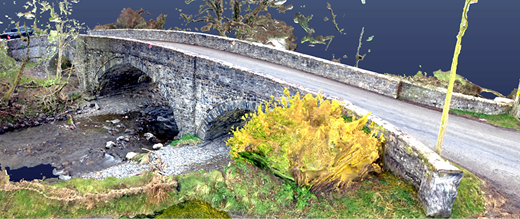
Photogrammetry model of a bridge surveyed remotely during the pandemic using drones (see page 22)
Photogrammetry model of a bridge surveyed remotely during the pandemic using drones (see page 22)
Spinola-Richards (2022) then demonstrates how aid-funded projects in developing countries continued to be successfully supervised during the pandemic by remote teams of civil engineers. Her paper describes the challenges and solutions involved in delivering a school in Uganda using local low-skilled workers and volunteers supervised by civil engineers working for a charity in Cardiff, UK. At times it involved reverting to simpler historic techniques, such as using fires to crack large rocks in the ground, to achieve the desired outcomes.
Mather (2022) explains how increased virtual networking during the Covid crisis led to greater collaboration and achievement of common goals, including sustainable development goals. She explores the importance of virtual networking during the pandemic and the benefits it had in terms of inclusion, equality and sustainability. In enabled a greater focus on the social, environmental and economic aspects of civil engineering projects to ensure positive effects for society. The paper concludes that, in a post-pandemic environment, it is important for civil engineers to continue networking, both within the workplace and the wider profession.
Our final two papers also focus on lessons learned from the pandemic that will affect the future of civil engineering. Goodger and Murray (2022) report on the approach adopted across the international Laing O’Rourke group to transform its focus on employee well-being. The approach was based on three Hs: being more human, hybrid working and home complementing work. It has supported better well-being and performance by focusing on the type of work that needs to be done and how it is done, while removing the focus on where work is done has also led to greater personal sustainability for project delivery teams and their support staff.
The approach was based on three Hs: being more human, hybrid working and home complementing work
Finally, Jackson and Thompson (2022) consider the massive economic impact of the pandemic on public-sector finances, concluding that a much greater use of private finance initiatives will be needed to fund future infrastructure projects. They highlight both good and bad outcomes of private finance initiatives around the world and suggest how they can best be used by governments to ‘build back better’ and meet climate targets. The key is to focus on specific projects and to structure deals to provide quality, value for money and longevity.
We hope you enjoy this special issue, particularly as it confirms that the recent challenges forced on the civil engineering profession by the Covid-19 pandemic have made us all smarter and stronger to achieve our common goals. Our thanks go to all the authors for sharing their often-painful experiences with us and to our referees for reviewing the many submissions we received.