The purpose of this paper is to assess the financial performance of the intermediary institutions that have operated in the Turkish capital markets taking the issue of bank-origin and non-bank-origin institutions into account.
Financial performance of the intermediary institutions has been measured by the Technique for Order Preference by Similarity to Ideal Solution (TOPSIS) method between the years 2005 and 2016. In order to implement the TOPSIS method, the relative importance of financial performance indicators has been determined by Entropy, survey results and considering equal weights approaches.
Empirical findings indicate that the average performances of continuously operating intermediary institutions during the concerned period are above the average performance levels of all intermediaries. Additionally, the average rank of bank-origin intermediary institutions have been found higher than the non-bank origins for all years. This reveals that the average financial performance of the bank-origin intermediary institutions is higher than the average score of non-bank origins during the related years.
This study is unique in terms of evaluating the performance of intermediary institutions in Turkish capital markets with a comprehensive framework. Determining the relative importance of financial performance indicators according to entropy, survey results and equal-weight approaches and revealing the average financial performance ranking methodology for bank-origin and non-bank-origin intermediary institutions have added value.
1. Introduction and literature
Financial intermediaries play a crucial and sensitive role in securities market as well as in the economy. Levine (1997) stated that the financial functions of these intermediaries are as follows: mobilizing savings, allocating resources, exerting corporate control, facilitating risk management and easing trading of goods and services. Moreover, Levine et al. (2000) revealed that the exogenous component of financial intermediary development has been positively associated with economic growth.
The overall size of the financial intermediaries, the conduction level of commercial banking institutions with the intermediation and the extent to which financial institutions transfer credit to private sector activities provide information about financial intermediary development (Levine et al., 2000). Diamond (1984) emphasized that financial intermediaries also have another crucial role in reducing the information asymmetries that lead to adverse selection problems. Rising economic development in countries has spawned the need for investment and capital, and this has led to a growth in supply and demand of intermediary institutions in financial markets (Aras and Muslumov, 2003).
Exploring the performance of financial institutions has been so significant, since the well-performing financial institutions ensure a fundamental guarantee of healthy growth of the real sector. At the beginning of the 2008 global financial crisis, financial institutions and managers, who are the main actors of the system, have to take excessive risks by acting with short-term financial targets. This fact has led to a large financial cost that the entire economy has to undergo (Aras and Yobaş, 2013). In the financial system, which is based on trust, the decrease of trust also negatively affects the functioning of the financial intermediation system (Aras, 2018). Effective corporate governance practices are an indispensable element in increasing the robustness of the financial intermediation system and reducing financial risk, which is a major step in the proper functioning of the financial markets and the economy as a whole (Aras and Crowther, 2013).
There are several decision making methods and tools that are available to measure performance ranks of intermediary institutions. Tunay and Akhisar (2015) evaluated the financial performance of private banks according to their Technique for Order Preference by Similarity to Ideal Solution (TOPSIS) scores during the years 2009 and 2013. They have found that the higher the capital adequacy ratio, the higher the level of protection available to depositors. Başçı (2016) studied the financial performance and ranked Turkish private banks using AHP and TOPSIS, taking into account their branch capability. He reveals that there are some way to reduce branch cost.
For Turkish intermediary firms, the number of studies are very limited. Okay and Köse (2015) evaluated the financial performance of five listed brokerage companies according to ten financial ratios using TOPSIS between the years 2011 and 2014. They determined that the fluctuation of profitability ratios, in particular, had an impact on financial performance in the related years. Moreover, Günay and Kaya (2017) also studied five brokerage houses for 2014 and 2015 using 11 financial ratios. They compared the financial performance of the listed firms using ELECTRE, ORESTE and TOPSIS methods. For 2014, they found similar ranking for all the models for the related firms and notated that for 2015, they have different rankings.
After giving the significance of this sector for financial markets and providing literature review, the following section contains the current status of intermediary institutions in Turkey. The third section discusses the methodology of TOPSIS, which was used to determine the financial performance of these institutions. That section also includes the data set used for the study, the steps taken in the analysis, and the final research findings. The conclusion of the study contains the significance of the findings for the Turkish intermediary institutions.
2. Financial intermediaries in Turkey
Intermediary Institutions have an essential role in financial markets with the effective transfer of funds needed in these markets to those demanding these funds, particularly through securitizations. Therefore, it is vital for examining the performance of the institutions and assess their performance with the development of Turkish capital markets.
Turkish Capital Markets Board’s (CMB) Communiqué, Number 46 is the main regulation regarding the establishment and activities of intermediary institutions. Financial intermediaries have to be required to obtain a license from the CMB in order to be able to offer services. CMB also determines minimum requirements for application and examines each application in detail before issuing a license. According to the communique, intermediary institutions licenses are listed as securities trading, public offering, portfolio management, investment consultancy, repo/reverse repo agreements, margin trading, derivatives trading and securities lending and short-selling. Capital Market Law describes investment firms as banks and intermediary institutions. While intermediary institutions can operate in the equity, fixed income and derivatives markets, and in leveraged transactions, banks are prohibited to operate in the equity market directly and cannot engage in equity-linked derivatives or leveraged transactions.
Turkish Capital Markets Association (TCMA) is a self-regulatory organization that sets professional rules and monitors the members to provide a fair and orderly capital market. Financial intermediaries, banks that are authorized for capital market operations, asset management companies and investment trusts, should become members of the TCMA (Turkish Capital Markets Association, 2018).
In channelizing funds from savers to investors, intermediary institutions play a significant role. At the end of 2016, 71 brokerage firms were registered in the industry. CMB has defined the intermediary institutions that have 50 percent of their shares or up owned by a bank, either directly or indirectly as bank origin and other intermediary institutions as non-bank origin (TCMA, 2018 Report, p. 83). As at the end of 2016, there were 29 bank-origin and 42 non-bank-origin intermediary institutions in operation.
Table I gives the total number of Turkish intermediary institutions in terms of private, public and bank origin and non-bank origin during the years 2005 and 2016. After 2013, there has been a decreasing trend in the number of institutions.
Table II gives the fundamental financials of Turkish intermediary institutions. At the end of 2016, total assets were increased by 38.31 percent and reached approximately 21 billion TL. This increase was heavily depended on the increase in the current assets (41.20 percent). Intermediary institutions had almost 17 billion total liabilities and short-term financial liabilities made up 16 billion TL of this amount, while 412 million TL belonged to long-term liabilities as of 2016.
Related table also exhibits that intermediary institutions generated 164 billion revenue with a decrease of 11.29 percent at the end of 2016. Furthermore, net profit of those institutions increased by 12 percent and reached 483 million TL, and 75 million TL of this sum was generated by firms trading mainly in the foreign exchange market.
There is no doubt that specifically for emerging countries, the growth of the capital market depends upon the active role of market intermediaries. During the last decade, there have been substantial regulatory, structural, institutional and operational changes in Turkish securities market.
3. Methodology
3.1 Data, sample and analysis process
The main objective of the research is to assess the performance of the intermediary institutions that have operated in the Turkish capital markets between the years 2005 and 2016 using the TOPSIS method. While the number of intermediary institutions was 100 at the beginning of the period, in 2016, there were only 71 firms in Turkish capital markets. During the observation period, the number of firms have been 55 that operated consistently. Financial data of these institutions are obtained from TCMA, Capital Markets Board of Turkey and corporate web-sites of the intermediary institutions.
Primarily in the research, a comprehensive survey was conducted to high-level executives of intermediary institutions during the December 2017−March 2018 period in order to determine the main indicators for the financial performance. For further survey detail see Aras et al. (2018b). Also, the literature review has been considered. Table III gives the abbreviations and formula of financial performance indicators employed in the study.
After determining indicators, the weights of the primary indicators, representing the financial performance, have been calculated. For this purpose, entropy, survey and equal-weight approaches have been used and performance scores obtained from the TOPSIS method are compared.
3.2 Method
In this study, the financial performance of the intermediary institutions has been measured by the TOPSIS method. The TOPSIS method was developed by Hwang and Yoon (1981) and it is a classical multi-criteria decision making (MCDM) method that ranks alternatives according to their distance from the so-called positive ideal solution and negative ideal solution. In addition, after applying this method, a performance score that lies between 0 and 1 is obtained. Thus, alternatives can be ranked from the best to the worst using these scores. Moreover, this method does not assume that each criterion has equal importance. Therefore, it requires a set of weights from the decision maker.
In literature, objective or subjective methods can be used for determining the relative importance of each indicator. Subjective method has some disadvantages when the total number of indicator is large. Moreover, this kind of weighing process can be unstable, suboptimal and arbitrary (Zeleny, 1974). In addition, a number of indicator can lead to conflict with each other. From this point, the entropy method is preferred to evaluate the weights of the indicators as objective method. Entropy was introduced by Shannon and Weaver (1949) with the theory of communication and it has been widely used in information theory in the course of time. Entropy can be defined as a measure of observational variety or actual diversity and it does not assume anything about the nature of the frequency or probability distribution, and therefore it is accepted as a nonparametric measure of variety (Krippendorff, 1986).
TOPSIS has consecutively six steps as follows:
Step 1: construct the decision matrix.
Supposing there are m alternatives and n criteria in a MCDM problem, decision matrix D can be expressed as follows:
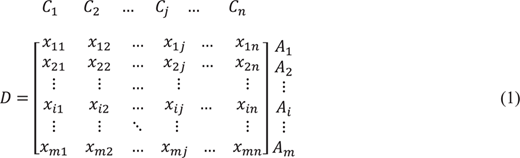
Step 2: calculate the normalized decision matrix.
The decision matrix needs to be normalized for each criterion Cj (j=1, 2, …, n) to gain the projection value of each criterion rij. By doing this, Matrix R=[rij] can be obtained:
(2)Step 3: calculate the weighted normalized decision matrix.
Elements in each column of matrix R are multiplied with the relevant wj value and matrix V is created. Matrix V is as follow:
(3)Step 4: determine ideal and negative ideal solutions.
In this step, maximum and minimum values in each column of weighted matrix are determined as follows.
Positive ideal solution:
(4)Negative ideal solution:
(5)Step 5: calculate the distance from the positive ideal solution and the negative ideal solution.
The distance of each alternative from positive ideal solution and negative ideal solution is calculated as given in the following equations:
(6)(7)Step 6: Calculate the closeness coefficient.
In this step, the closeness coefficient of each alternative is calculated and ranked in descending order, as given in the following equation. The alternative with higher closeness coefficient value will be the best choice:
3.3 Empirical results
In order to implement the TOPSIS method, the relative importance (weights) of these indicators has to be determined. The relative importance of these indicators has been determined by Entropy method, survey results and considering equal weights consecutively.
Empirical results have been categorized into three phases. In the first phase, the relative importance (weights) of financial performance indicators according to Entropy, survey results and equal weights has been determined. In the second phase, the TOPSIS method has been employed according to Entropy results. In that phase, financial performance, financial performance developments, and the performance development of the top intermediary institutions have been evaluated on a yearly basis.
Phase I: determining the relative importance (weights) of financial performance indicators according to entropy, survey results and equal-weight approaches
First, the individual completing survey was asked to indicate the degree of importance of the related financial performance indicators in terms of a five-point Likert scale (1-Low, 2-Average, 3-Good, 4-Very Good, 5-Excellent). A total of 76 responses were received from the 55 intermediary institutions. Second, entropy method is applied in order to determine weights using 55 institutions. By doing this, weights that represent the whole intermediary institution sector are obtained, and discrepancies between the institutions are removed using common values. In this way, it is possible to ensure an objective comparison for all institutions. Last, each indicator has equal weight that is 0.05.
Table IV exhibits the degree of importance of financial performance indicators based on three approaches. The italic values give the most important indicators and the last column shows the average values of all these related methods. According to Entropy results, operating profit has been found as the most important indicator affecting the financial performance among all indicators, while based on survey results, net sales level has become the most significant indicator.
According to the both survey results and entropy results, operating profit, total net sales, equity growth rate, total assets, asset growth rate and total equity indicators have found to be the common financial performance indicators in the top ten indicators.
These three approaches state that substantial differences occur while determining the degree of importance of financial performance indicators during these years.
Phase II. Employing TOPSIS method
After determining the relative importance (weights) of financial performance indicators according to three approaches, financial performance scores of 55 intermediary institutions have been calculated on a yearly basis and average values are calculated for research period. Additionally, based on average weight, financial performance scores are obtained and all results are compared.
Table V represents the average rank of bank-origin and non-bank origin intermediary institutions in top ten and bottom ten according to entropy, survey results, equal-weight and average-weight approaches.
The table also represents that there is substantial differences in average performance scores of intermediary institutions according to four approaches. This indicates that using objective or subjective methods for determining weights does not significantly affect the results. Another finding that has to be noted is that seven of the intermediary institutions in top ten ranking are bank-origin, and except one, the others have been in non-bank origin intermediary institutions in top bottom rankings. This fact also states that bank-origin intermediary institutions have the highest financial performance.
While employing objective or subjective methods for determining weights does not significantly affect the results, entropy method is preferred due to its objectivity in the following part of the research. Based on common Entropy results, performance scores for all intermediary institutions and 55 intermediary institutions that operated consistently throughout the research period are calculated.
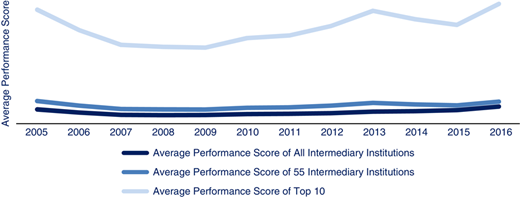
Figure 1 gives the average performance score of all intermediary institutions, 55 intermediary institutions continuously operating between the years 2005 and 2016 and top ten institutions during the related years. Findings reveal that the average performances of continuously operating intermediary institutions during the concerned period are above the average performance levels of all intermediaries operating in this period. Likewise, the performances of the best ten performing institutions seem to differ significantly from the others. This is an important indicator of a possible oligopolistic structure and the high concentration in the Turkish intermediary institutions.
The disruptions that arise in the unsoundly structured financial systems matter for both the development of the existing system and for the parties involved in the market, i.e. savings account holders, investors and issuers/borrowers. The situation can ultimately render the functionality of the intermediary mechanism between the financial sector and the real sector. The fulfillment of the intermediary function in the financial system in order to meet the requirements of the institutions and investors is of great importance in terms of the confidence in the capital markets and the sustainability of the market development. In the related figure, the effects of the 2008 global financial crisis are seen in all three groups. Depending on these supports and precautions, the recovery that began in the second half of 2009 continued in 2010 as well. It is seen that the performances of the institutions have increased, especially since the second half of 2011.
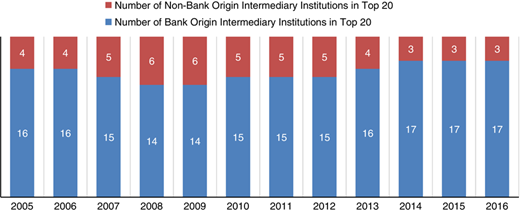
Figure 2 states the bank-origin and non-bank origin differentiation of top 20 intermediary institutions according to financial performance scores. Results reveal that the majority of 20 intermediary institutions with the highest scorer are bank originated.
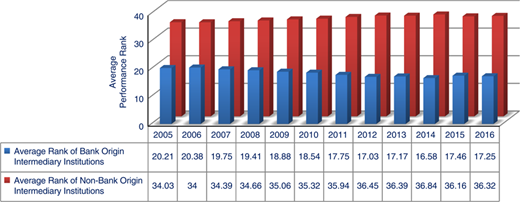
The financial performance scores have also been calculated for bank-origin and non-bank-origin intermediary institutions during these years. Figure 3 states the average rank of these two group intermediaries during the related years. For all years, the average rank of bank origin intermediary institutions has been found higher than the non-bank origins. This reveals that the average financial performance of the bank-origin intermediary institutions is higher than the average score of non-bank origins for all years.
4. Conclusions
Transmitting the savings into the financial system via financial instruments and enabling the borrowers to access the funds, it is required to have the specialized financial intermediaries. These intermediary institutions play a major role in the development of the capital markets by carrying out intermediary activities in line with the demands and expectations of the investors. Therefore, it is necessary that the securities market provides a well-developed, efficiently administered and properly regulated market system specifically for emerging capital markets.
This study has employed several financial indicators to assess the performance of intermediary institutions in Turkish capital markets with a comprehensive framework. Operating profit has been found as the most important indicator affecting the financial performance among all indicators, while based on survey results, net sales level has become the most significant indicator. This reveals the fact that raising operating profit and net sales is relatively more significant than raising other financial performance indicators. Additionally, operating profit, total net sales, equity growth rate, total assets, asset growth rate and total equity indicators have found to be the common financial performance indicators in the top ten financial performance indicators. Moreover, findings reveal that the average performances of continuously operating intermediary institutions during the concerned period are above the average performance levels of all intermediaries operating in this period. Likewise, the performances of the best ten performing institutions seem to differ significantly from the others. This is a significant indicator of a oligopolistic structure and the high concentration in the Turkish intermediary institutions.
For all years, the average rank of bank-origin intermediary institutions has been found higher than the non-bank origins. This reveals that the average financial performance of the bank-origin intermediary institutions is higher than the average score of non-bank origins for all years.
The role of the intermediary institutions in ensuring an atmosphere of confidence and stability in the capital markets emphasizes the management and performance of the institutions in the sector. It deems necessary to take the steps parallel to the findings regarding the current situation for the sake of a sound development of the intermediary sector.
This study was supported by Turkish Capital Markets Association (TCMA).