


Research on science communication in organizational contexts is scarce – even though many cases can be found where organizations from science and beyond communicate about science-related issues, or where organizational contexts have an impact on the communication of individual scientists and scientific organizations. Therefore, it is time for an “organizational turn” in science communication research, and for more scholarly emphasis on the specific cases that science-related communication in, from and about organizations presents. Such an approximation would benefit both science communication research and analyses of strategic and organizational communication.
This special issue of the “Journal of Communication Management” on “Communicating Science in Organizational Contexts” is a step in this direction: It compiles commentaries from leading scholars in the respective fields as well as research articles coming from various disciplines and conceptual as well as methodological paradigms. In the editorial, we assess overlaps between scholarship on science communication and strategic communication, respectively, based on a meta-analysis of journals in the field(s), develop a guiding heuristic for analyzing science communication in organizational settings, and introduce the contributions to the special issue.
The meta-analysis shows that overlaps between science communication research and scholarship on strategic communication are scarce. While organizations and their communication appear occasionally, and increasingly often, in science communication research, scholars of strategic communication only rarely analyze science communication.
The meta-analysis is limited to the publications of five scholarly journals over ten years. It still demonstrates the lack of research in the intersection of scholarship on science communication and strategic communication.
Scientific organizations are rapidly extending and professionalizing their strategic communication, and an increasing number of organizations beyond science communicate on science or science-related issues. Understanding science communication in organizational settings, therefore, is crucial for practitioners in both areas.
Analyzing science communication in organizational settings is of increasing importance – yet few studies exist that have done it, and the respective research fields devote not much attention to one another. The special issue is a first foray into this new, intersectional field.
1. When “organizational society” meets “knowledge society”: science communication and the rising importance of organizational contexts
From research institutes fact-checking political statements on social media and scientists writing blogs on university websites to corporate communicators informing journalists about potential COVID-19 vaccines, a considerable and increasing amount of science communication is being conducted in organizational settings. This is indicative of two general trends. First, organizations – that is, collectives of individuals with a shared purpose, a common identity and thematic focus, an internal structure and designated leadership have become one of the most important social entities in contemporary “organizational societies” (e.g. Zald, 2017). Organizations take a myriad of forms, such as administrations and political parties, non-governmental organizations (NGOs), corporations, churches, museums, foundations, cooperatives, universities, research institutes and think tanks (e.g. Daft and Lane, 2007). They exist in fields as diverse as politics, religion, culture, sports and science, influence their members (Meyer and Scott, 1992), and fundamentally shape social interactions and individual relationships (e.g. Kühl, 2010; Tyler, 1999). Thus, organizations play a vital role in contemporary societies around the globe. Second, science and public communication of science have risen in importance. In “knowledge societies” (Stehr, 1994), scientific results and science-based technological innovations are crucial for addressing individual, organizational and societal challenges (Fischhoff and Scheufele, 2013). At the same time, science is an expert endeavor; scientific results contain methodological detail, statistical caveats and specialist terminology that is difficult for lay audiences to comprehend. As a result, science communication – the public communication of and about science, its findings, methods and processes (Bonfadelli et al., 2017) – has become more important in recent years, as both a field of practice (e.g. Bucchi and Trench, 2008) and an object of scholarly research (e.g. Guenther and Joubert, 2017; Schäfer, 2012).
Both trends – the increasing relevance of organizations and the societal influence of science and science communication – have been extensively researched in recent years, resulting in a wealth of review articles, handbooks and introductory textbooks on organizational analysis (e.g. Grothe-Hammer and Kohl, 2020; Handy, 2007; Haveman and Wetts, 2019) and science communication research (e.g. Bucchi and Trench, 2008; Fähnrich et al., 2019; Jamieson et al., 2017). However, analyses of the overlap between both fields appear to be lacking. Research on science communication in organizational contexts is scarce, even though many organizations in the field of science and beyond have communicated about science-related issues and organizational contexts have had a significant impact on the communication of many individual scientists and on science communication more broadly. For example, in recent years, academic and research organizations, such as universities, scientific academies and scientific associations, have expanded, professionalized and diversified their communication efforts. They have allocated more resources to communication (e.g. Bauer and Gregory, 2007), intensified their media relations (Serong et al., 2017; Vogler and Schäfer, 2020), engaged more extensively in brand building and reputation management (e.g. Bélanger et al., 2014; Chapleo, 2011) and communicated via a broad range of online and social media (Metag and Schäfer, 2017, 2019). In doing so, however, they do not merely act as representatives of science but often also represent their specific organizational interests (Horst, 2013), such as that of legitimizing their organization's goals while competing with other organizations for public attention, legitimacy and reputation.
The increasing importance of science communication in scientific organizations has also resulted in an active and growing community of science communication practitioners, specialized curricula for teaching science communication and the emergence of national and international organizations for science communication professionals (Gascoigne et al., 2010; Rauchfleisch and Schäfer, 2018; Trench, 2017). Moreover, organizations from other realms of society, including corporations, political parties, think tanks and NGOs, also increasingly communicate about science-related issues (e.g. Fähnrich, 2018a), such as advances and ethical, legal and social challenges in the fields of biotechnology (for an overview Bonfadelli, 2017), nanotechnology (Donk et al., 2012), climate change (e.g. Jun, 2011) and nutrition (Neff et al., 2009). Like universities or scientific organizations, some of these organizations – such as companies, political think tanks and NGOs – produce scientific knowledge themselves (cf. Etzkowitz and Leydesdorff, 2000; Nowotny et al., 2001). Others do not, however, and mainly use scientific evidence to justify political decisions, promote new products, or appear trustworthy to stakeholders and generate a favorable public image by basking in the light of the latest scientific and technological developments (e.g. Boswell, 2009; Fähnrich et al., 2019). Other organizations may highlight conflicting evidence or risks associated with specific scientific fields or technological advances (e.g. Bonfadelli, 2017) or even spread misinformation, pseudoscience or anti-science sentiments (e.g. Dunlap and McCright, 2011; Harambam and Aupers, 2015).
There are various other overlaps between organizational communication and science communication, such as the structural and procedural adaptation of organizations to an alleged legacy media logic (e.g. Rödder, 2011; Schäfer, 2014), the internal incentives and pressure organizations employ to ensure certain kinds of outside communication and potentially prevent others (cf. Peters, 2013) and the establishment of pseudo-organizations as communicative straw men to engage with controversial science issues (e.g. Gierth and Bromme, 2020; Hobbs et al., 2019). The list of these phenomena is undoubtedly incomplete, but it underlines the vital role that organizations play in science communication and the occurrence of science communication in a variety of organizations. Against this backdrop, it is surprising to see that the nexus between science communication and its organizational contexts has not yet been extensively explored by scholars and that organizational communication has been dismissed by some science communication scholars, who have labeled it one-sided “propaganda” (for an overview of this debate, see Roberson, 2020).
We think it is time for an organizational turn in science communication research and more scholarly emphasis on the cases that science-related communication in, of and about organizations (Eisenegger, 2018) present for research on strategic communication and communication management. Such an interdisciplinary endeavor would benefit both sides. This special issue of the Journal of Communication Management is intended as a step in this direction. It compiles commentaries from leading scholars in both fields and research articles from various disciplines and conceptual and methodological paradigms. In this editorial, we address science communication in organizational contexts in three steps. First, we look at the existing scholarship on science communication in organizational contexts. Presenting the results of a meta-analysis of scholarly journals in the two fields, we assess overlaps between and examine how these overlaps have developed. Second, we propose a conceptual understanding of science communication in organizational contexts that might serve as a starting point for future research. Third, we introduce the contributions to this special issue.
2. Mapping scholarship on science communication in organizational contexts
Both science communication and strategic communication [1] are established fields of scholarship with their own paradigmatic cultures, institutional characteristics and outlets for publication (e.g. Fähnrich, 2018b; Rauchfleisch and Schäfer, 2018; Werder et al., 2018). As overlaps between these fields appear to be rare, we aim to assess these overlaps empirically in a first step. We investigate how often publications on science communication actually analyze organizations, how often studies of strategic communication focus on science-related issues or scientific organizations and these overlaps have developed over time.
To answer these questions, we conducted a meta-analysis of scholarly journals. This approach has been used before to assess research on communication regarding the environment (Comfort and Park, 2018), climate change (Schäfer and Schlichting, 2014), health (Snyder and Hamilton, 2002), risk (Gurabardhi et al., 2004) and strategic science (Fähnrich, 2018b). Previous meta-analyses have assessed particular research fields, their characteristics and, in some cases, their developments by selecting and analyzing scholarly publications, either using keyword searches in scholarly databases, such as Scopus (e.g. Rauchfleisch and Schäfer, 2018) or Web of Science (e.g. Schäfer and Schlichting, 2014), or by choosing flagship journals from the field and analyzing their content (e.g. Guenther and Joubert, 2017). We chose the latter approach for two reasons. First, both scholarly fields have established high-profile, international scholarly journals. Second, this approach limited the efforts necessary for data collection and cleansing, which can be considerable when keyword searches are used (e.g. Schäfer, 2012, 652f.).
To assess science communication research, we focused on Public Understanding of Science and Science Communication, arguably the two most important journals in the field and those with the highest journal impact factors, and the Journal of Science Communication, the best-known open-access journal in the field. To assess strategic communication research, we chose the Journal of Communication Management, one of the leading and most well-established journals in the field, and Public Relations Review, one of the oldest and best-established journals in the field of public relations, which is a subfield of strategic communication (cf. Hallahan et al., 2007). We downloaded the full texts of all articles published in these journals between 2009 and 2019 from Clarivate's Web of Science database, which includes leading journals across all disciplines and has been used for similar analyses (Comfort and Park, 2018; Schäfer, 2012; Schäfer and Schlichting, 2014). We also downloaded article meta-data, including authors, titles, publication dates and full abstracts.
Overall, we identified 2,802 journal articles. For pragmatic reasons, we randomly selected 15% of these articles for analysis. This resulted in a working sample of 219 science communication publications and 185 articles from the field of strategic communication. Two coders performed a content analysis of these 404 articles (intercoder reliability, measured by Cohen's Kappa, was 0.8) to identify instances where organizations were analyzed in scholarly publications on science communication and where science communication was analyzed in publications on strategic communication (see Figures 1 and 2).
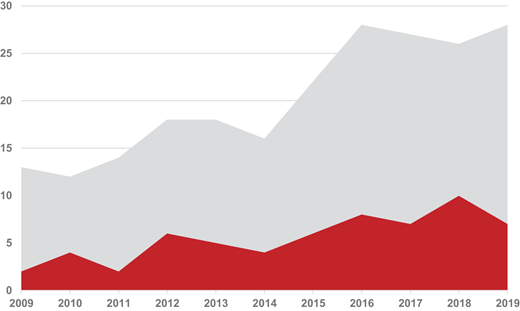
Annual number of scholarly publications on science communication that reference organizations or organizational communication (darkred) and those that do not (light gray) (from a 15% random sample of all articles published in Public Understanding of Science, Science Communication and the Journal of Science Communication between 2009 and 2019, n = 219)
Annual number of scholarly publications on science communication that reference organizations or organizational communication (darkred) and those that do not (light gray) (from a 15% random sample of all articles published in Public Understanding of Science, Science Communication and the Journal of Science Communication between 2009 and 2019, n = 219)
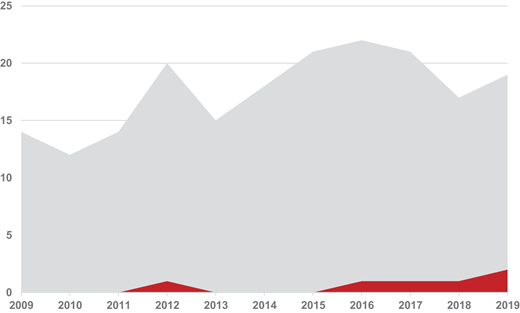
Annual number of scholarly publications on strategic or organizational communication that reference science communication or scientific organizations (darkred) and those do not (light gray) (from a 15% random sample of all articles published in the Journal of Communication Management and Public Relations Review between 2009 and 2019, n = 185)
Annual number of scholarly publications on strategic or organizational communication that reference science communication or scientific organizations (darkred) and those do not (light gray) (from a 15% random sample of all articles published in the Journal of Communication Management and Public Relations Review between 2009 and 2019, n = 185)
Overall, the analysis shows that most science communication research is not concerned with organizations or their communicative efforts. Out of the 219 journal articles analyzed, 160 (73.1%) do not focus on organizations, while 59 (26.9%) do. Most of the organizations analyzed in this field are media organizations or publishing houses, which are addressed in 36 articles (16.5%). A majority of these analyses are concerned with media coverage about science-related issues (e.g. Jaspal and Nerlich, 2014; Lassen, 2018; Lewis et al., 2015). However, some address organizational characteristics, such as working routines and newsroom organization (e.g. Appiah et al., 2015; McKinnon et al., 2018). Other organizations, such as corporations (4, 1.5%), NGOs (4, 1.5%), political parties (4, 1.5%) and think tanks (1, 0.5%) are rarely the subject of science communication research. Furthermore, the analysis shows clear changes over time. The number of articles published in the three science communication journals analyzed has clearly risen; it more than doubled between 2009 and 2019. Over the same period, the publication of articles analyzing organizations or organizational communication also increased in line with the overall increase in article numbers.
Strategic communication journals are even less concerned with science-related issues or science organizations and their communication efforts. Only six out of the 185 sampled journal articles (3.2%) mention scientific organizations or science-related issues. All six focus on institutions of higher education, namely universities, analyzing topics such as their public relations strategies in response to political events (Pyle et al., 2018) or their use of social media (e.g. Linvill et al., 2012; Sanderson et al., 2016). However, issues relating to science communication are generally scarce in these journals, nor does this not change significantly over time. Even though the number of articles published in the strategic communication journals analyzed also rose between 2009 and 2019 – albeit less sharply than in the science communication journals – the proportion of articles analyzing science communication remained low level over the entire period. Although five of the six articles presenting such analyses were published in the past five years, this represents only a very slight increase at best and one that is not statistically significant. Generally, these results are in line with assumptions by scholars in both fields. Few scholars from the field of communication management and strategic communication have explored science-related issues (cf. Fähnrich, 2018a), and the growing field of science communication has paid scant attention to the role of organizations (cf. Horst, 2013).
3. Approaching science communication in organizational contexts: toward a conceptual foundation
Science communication in organizational contexts has to date received little scholarly attention, and the existing studies differ strongly in their objectives, foci, disciplinary backgrounds and their understanding of both science (communication) and organizations. Against this backdrop, further research in the field would profit from a sound discussion of science communication, communication in organizational contexts and their overlaps. To identify the directions such discussions could take, we organize approaches from both science communication research and analyses of communication in organizational contexts in a two-dimensional heuristic matrix. We then sketch potential overlaps and blind spots that might be worth considering in future research.
The first dimension of the heuristic matrix distinguishes between two basic approaches to analyzing science communication. Science communication has been systematically researched for about 30 years (Bauer, 2017) and has been significantly developed (Guenther and Joubert, 2017) and diversified (Rauchfleisch and Schäfer, 2018). This increase in scholarly attention has led to a broad variety of definitions and understandings relating to different disciplinary backgrounds (e.g. communication science, psychology and political science; for an overview, see Lessmöllmann et al., 2020), national contexts and understandings of science (van Dijck, 2003), as well as science communication paradigms and models (Chilvers and Kearnes, 2015; Schäfer et al., 2020). Despite such diversity, two basic perspectives can be identified.
First, science communication is often understood as public communication from scientists, universities, research institutes and laboratories on the one hand and specific sectors of the public or society at large on the other. This perspective is prevalent in prominent definitions in the field. For instance, Burns et al. (2003, p. 191) define science communication as the “use of appropriate skills, media, activities, and dialogue to produce one or more of the following personal responses to science[:] Awareness[,] Enjoyment[,] Interest[,] Opinions[,] Understanding.” Similarly, Davies and Horst (2016, p. 4) see science communication as “organised actions aiming to communicate scientific knowledge, methodology, processes or practices in settings where non-scientists are a recognised part of the audience.” The communicators mentioned or implied in these definitions are generally scientific organizations or individual scientists (who are often embedded in organizational contexts) who communicate with outside, non-scientific or “lay” audiences (Schäfer and Metag, 2020). This understanding of science communication as the external communication of scientific communicators, such as scientific organizations, can be understood as actor-related.
The second perspective is broader insofar as it views science communication as communication on science-related topics. With the digital transformation and the changes that have occurred in the media ecosystem, the science communication landscape has also changed, resulting in a diversification of the actors involved (Akin and Scheufele, 2017, p. 25). This has led scholars to argue that science communication can no longer be understood as simply communication from scientific communicators but must be regarded as all public communication about science and the ethical, social and political issues surrounding it (e.g. Scheufele, 2013, 2014). From this perspective, science communication is seen as “all forms of communication focused on scientific knowledge or scientific work, both within and outside institutionalized science, including its production, content, use and effects” (Schäfer et al., 2015, p. 13). This topic-focused perspective includes but is not limited to communication from scientific organizations.
Analyses of strategic and organizational communication represent another broad, diverse and interdisciplinary field of research, which has grown and diversified in recent years, integrating previously separate fields of inquiry (e.g. Werder et al., 2018). Within this field, another fundamental distinction can be identified, which delineates different sub-fields and clarifies the different roles of “organizational contexts.” This distinction, which represents the second axis of our heuristic matrix, is that between communication from organizations, communication about organizations and communication within organizations (Eisenegger, 2018).
Communication from organizations resonates with the concept of strategic communication – an established scholarly field concerned with intentional and persuasion-oriented organizational communication, such as public relations, marketing, branding, corporate communication and communication management (Hallahan et al., 2007; Zerfass et al., 2018). Holtzhausen and Zerfass define strategic communication as “deliberate and purposive communication a communication agent enacts in the public sphere on behalf of a communicative entity to reach set goals” (Holtzhausen and Zerfass, 2013, p. 74). Accordingly, the organization central as it initiates and conducts the communication. It does so intentionally to pursue organizational goals and uses communication strategically as a (more or less) planned and managed activity (Zerfass et al., 2018).
Communication about organizations refers to the public representation of organizations in the news and social media. Such representations are researched in diverse fields, such as journalism studies, political communication, and digital communication research, and for a variety of stakeholders, including political organizations, companies, NGOs, social movements and universities. Communication about organizations may be influenced by strategic communication as the research on agenda building and the influence of strategic communication on news media shows (e.g. Lee et al., 2015) [2].
Communication within organizations is also an object of diverse research traditions. It is important in fields such as internal communication and integrated communication, which focus on aspects such as identity formation and organizational culture and explore how these can be strengthened using strategic communication with the purpose of meeting organizational objectives (Christensen et al., 2009). Constructivist conceptualizations of organizational communication are based on the assumption that organizations are constituted exclusively by communication (Cooren et al., 2011; Putnam and Nicotera, 2009). From this perspective, organizations are “endlessly self-organizing and reshaping themselves through their object-oriented and linguistic practices” (Taylor and Robichaud, 2004, p. 409). These approaches look beyond formalized and strategic communication and consider informal and (initially) non-strategic conversations and texts as also constitutive of organizations.
Each of these perspectives on organizational communication can be linked to the two understandings of science communication outlined above. This leads to a matrix that captures a variety of phenomena and offers a comprehensive perspective on science communication in organizational contexts (see Table 1).
Conceptual map: approaches to science communication in organizational contexts
| Organizational perspective | ||||
|---|---|---|---|---|
| Communication from organizations | Communication within organizations | Communication about organizations | ||
| Relation to science | Actor-related: communication from scientists and scientific organizations | (Strategic) communication of scientific organizations (e.g. media releases, public events) | Communication as a constitutive element of scientific organizations (e.g. with regard to formal and informal procedures and practices and organizational culture) | Public communication about scientific organizations (e.g. reports in journalistic media, social media communication) and its effects |
| Topic-related: communication about science-related topics | (Strategic) communication from diverse organizations (e.g. scientific organizations, NGOs, political organizations, business organizations, associations) on science-related topics | Constitution of organizations (e.g. networks, project consortiums) with members from different societal fields who connect around science-related issues (e.g. for funding applications, public–private partnerships) | Public communication about science-related issues in other organizational contexts (e.g. regarding the development of science desks in journalistic media, research teams in corporations, fact-checking strategies of social media organizations) and its effects | |
As Table 1 shows, our matrix consists of six potential perspectives on science communication in organizational contexts. In the remainder of this section, we briefly introduce these perspectives.
Communication from science organizations: The perspective of communication from organizations and the actor-related conception of science communication refers to the analysis of strategic communication from scientific organizations, such as universities and research institutes. Notably, there has been considerable research activity in this area in recent years (cf. Fähnrich et al., 2019), including studies of public and media relations (e.g. Borchelt and Nielsen, 2014), university marketing (e.g. Melewar et al., 2018), online communication (e.g. Peruta and Shields, 2016) and event communication (Fähnrich and Schäfer, 2019). Less attention has been paid to scientific organizations' strategic public affairs management, issues management or crisis communication (cf. Fähnrich et al., 2015). Apart from the overall societal and academic relevance of these issues and the opportunities for related empirical research, the study of strategic communication from science organizations also presents opportunities for theoretical advances. Scientific organizations occupy a special position as they are obliged to meet the politically fostered societal objectives of science communication while also promoting their organizational interests. This has led to frequent criticism of the strategic communication of scientific organizations (Marcinkowski and Kohring, 2014; Roberson, 2020). Research on how scientific organizations might address and overcome these challenges would be useful and would clearly profit from the integration of strategic communication and science communication approaches.
Communication about science-related issues from organizations: Analyzing strategic communication as communication from organizations is also useful when applied to science communication from non-scientific organizations. This area of research focuses on science-related communication from organizations, such as companies addressing climate change in their communication (see Thaker's contribution in this issue) or NGOs using scientific results in their campaigns (Doyle, 2007). For these organizations, referring to science is a strategic way of legitimizing their own interests (Fähnrich, 2018a). Empirical data on the prevalence of these forms of science communication is rare, but analyzing it is crucial, especially given their potential consequences for the public perception of science. Therefore, research should focus more on science communication from various strategic actors, including those who promote pseudoscience, deny science or spread anti-science sentiments, which pose challenges for both science and democratic development (e.g. Dunlap and McCright, 2011). Such analyses could focus on these organizations' communication strategies, their chosen formats and media, the actors involved, and the effectiveness of their strategies.
Communication about science organizations: Research that covers both actor-related science communication and communication about organizations is concerned with the public presence of scientific organizations. In recent years, this topic has received some attention, especially with regard to representation of universities in the news media (cf. Donk et al., 2019) and their online presence (for an overview Metag and Schäfer, 2019). A common conceptual reference point of this research is the mediatization of science, stating that scientific organizations aim at greater visibility in the media, and trying to identify the extent and the drivers of such an orientation (for an overview Schäfer, 2014). For instance, researchers have found that being listed in the Shanghai ranking influences how universities are represented in the media (Hegglin and Schäfer, 2015) and that the media releases of institutions of higher education have an impact on their news media presence (e.g. Sumner et al., 2014; Vogler and Schäfer, 2020). This suggests a substantial influence of organizational science communication on public opinion formation and underlines the need for more systematic research in this area. This research should also focus on the audience effects of new and social media communication regarding scientific organizations.
Communication about organizations that refer to science: Other approaches focus on communication about non-science organizations referring to science. Due to the variety of relevant organizations, this research is diverse and stems from different contexts. Research on science journalism is of particular relevance and has yielded a substantial amount of studies (Bauer et al., 2013; Dunwoody, 2014; Schäfer, 2017). However, studies on political organizations, such as ministries, social movements (e.g. Lee and VanDyke, 2015) and think tanks (e.g. Ruser, 2018) are sparse. These organizations should receive more scholarly attention in the future, as should “new” intermediaries, such as scientific publishers, libraries, social media platforms and search engines, all of which play increasingly important roles in science communication but have rarely been analyzed from this perspective.
Communication in science organizations: This research focuses on the embedding of the communication function within the organization, e.g. with regard to efficient communication management. Although this topic has been studied extensively in relation to other organizations, scientific organizations have rarely been analyzed (cf. Schwetje et al. in this issue). This is surprising as universities are particularly interesting cases insofar as they can be seen as loosely coupled organizations (Weick, 1976) whose members – such as individual scientists – can communicate on their own, without necessarily taking organizational interests into account (Horst, 2013). Focusing on this interplay between centralized and decentralized communication management might prove analytically fruitful (Entradas and Bauer, 2019) and might also draw attention to fundamental questions about the role of communication for organizational development and the formation of organizational identity (see Davies in this issue).
Communication about science-related-issues within organizations: One approach to science-related communication in scientific organizations focuses on scientific knowledge production and (informal) scholarly communication (Cronin, 2003). Whereas science communication and scholarly communication are distinct research areas, the changing media and communication ecosystem has led to increasing overlaps between them, which are exemplified in developments such as open access, open science, citizen science, open peer-review and crowdfunding (Franzen and Dickel, 2016). Information that was previously shared within the scientific community is now – sometimes strategically – made available to non-scientific public audiences. The rise of digital media and digital platforms has played a crucial role in this development, blurring the boundaries between scholarly and public communication, especially in social media (Jünger and Fähnrich, 2020). These changes have enhanced the public visibility of science, but they have also influenced scholarly communication within organizations. The implications of this integration, however, have thus far barely been considered by researchers.
These perspectives on science communication in organizational contexts offer ample opportunities for research, including theoretical and methodological development and empirical analyses. Future research should take up these challenges and integrate perspectives from various disciplines to improve our understanding of intersections between science communication and organizational contexts.
4. Perspectives on science communication in organizational contexts: the contributions to this special issue
This special issue “Communicating Science in Organizational Contexts” addresses some of the challenges outlined above and tackles some desiderata in the scholarship on this topic. It contains contributions from scholars of communication management, strategic communication, organizational communication, organizational sociology, and science communication from Finland, Germany, New Zealand, Norway, Switzerland, the UK and the US. In the first part of the special issue, two leading experts in both science communication research and organizational and strategic communication research were asked to reflect upon the intersections between the two fields. In their commentaries, John Besley and Øyvind Ihlen describe how crossovers between these fields can lead to a mutual enrichment of research perspectives, conceptual understandings and empirical work. Besley explains that strategic science-related communication increasingly takes place in organizational settings that are not always conducive to high-quality science communication or to promoting broader societal goals. He argues that both science communication research and analyses of strategic communication can show ways toward improvement, such as clearer planning of strategic aims and target audiences and a careful reflection on structural conditions and organizational interests. From a complementary perspective, Ihlen describes how science communication has gained importance in organizational contexts. Using vaccine hesitancy as an example, he argues that rhetorical theory may provide useful insights for science communication scholars regarding concepts such as “truth” and “credibility” to improve their strategic communication and increase its effectiveness.
These commentaries are supplemented by seven research articles covering a wide range of topics at the intersection of science communication, organizational communication and strategic communication. The contributions in the first part of the special issue focus on the organizational embedding of science communication and on the ways in which it is influenced by organizational contexts and conditions. Taking a comparative approach, Simone Rödder's article “Organisation Matters: Towards an Organisational Sociology of Science Communication” analyzes how science communication is structured and realized in different organizational settings. She compares the editorial office of a daily newspaper, the press office of a university and a science media center and analyzes how the respective set-ups shape the occurrence of science-media contacts and conflict resolution between these two sides. Rödder demonstrates how different organizational contexts lead to different outcomes and how conceptual reflection on structural differences can contribute to the study of science communication through an organizational lens.
Thorsten Schwetje, Christiane Hauser, Stefan Böschen and Annette Leßmöllmann, in their article “Communicating Science in Higher Education and Research Institutions: An Organization Communication Perspective on Science Communication,” provide a comprehensive assessment of the status quo and current changes in the science communication capacities of German institutions of higher education. Based on a systematic review of prior scholarship, more than 50 expert interviews, standardized survey work and document analyses, they show that organizational contexts strongly influence the work of science communicators and document how communicators constantly reflect upon and switch their roles due to changing expectations and demands from internal and external organizational stakeholders.
Kaisu Koivumäki and Clare Wilkinson's article “Exploring the Intersections: Researchers and Communication Professionals' Perspectives on the Organizational Role of Science Communication” focuses on another interface between (research) organizations and communicators. They explore the influence of project and funding contexts on the interactions between and scientists and communication professionals and on their perceptions of one another. Analyzing an energy research project which was conducted across five Finnish research institutions and drawing on semi-structured qualitative interviews, the authors show that large-scale research projects can present challenging contexts for communicators as they make it more difficult to generate a shared sense of identity and purpose among both researchers and communication professionals. This can hamper the quality and cohesiveness of communication efforts.
The second part of the special issue consists of contributions that analyze strategic science-related communication addressed to the broader public and non-scientific stakeholders. Sarah Davies' article “University Communications as Auto-Communication: The NTNU ‘Challenge Everything' Campaign Purpose” analyzes how university communicators make sense of their work in the specific communicative setting of a campaign. Adopting an ethnographic approach that combines semi-structured interviews and informal organizational ethnography with sense-making and auto-communication concepts, Davies focuses on the “Challenge Everything” recruitment campaign conducted by the Norwegian University of Science and Technology (NTNU) in 2018. Her “thick description” shows that the original conceptual openness of the campaign led communicators to rapidly personalize it and fill it with their own meanings and understandings of their roles, interests and concerns. She also demonstrates how the campaign gave rise to new forms of expertise within the university, as well as to immediate contestations of those.
Jagadish Thaker, in his article “Corporate Communication about Climate Science: A Comparative Analysis of Top Corporations in New Zealand, Australia, and Global Fortune 500,” analyzes how leading corporations from Australia and New Zealand and others in the Global Fortune 500 group communicate about the scientific basis of climate change. Using standardized quantitative content analysis of corporate reporting, he shows that few of the companies mention climate science and that even fewer explicitly agree with the far-reaching scientific consensus on the existence and anthropogeneity of climate change. Instead, most corporations, particularly large Australian and global corporations, limit their communication to the business and societal aspects of climate change.
The contributions in the third part of the special issue assess the implications of organizational science communication for the parties involved, focusing on its external effects on relevant stakeholders and its internal effects within the organizations themselves. Birte Fähnrich, Jens Vogelgesang and Michael Scharkow focus on universities' strategic communication on Facebook. Using a broad organizational sample consisting of the world's top 50 universities according to the Shanghai University Ranking and analyzing a three-year period from 2012 to 2015, they assess the content of these universities' Facebook posts and their effects in terms of user engagement based on likes, comments and shares. The results of the authors' semiautomatic content analysis indicate that the world's top universities appear to be more effective than global brands in engaging social media users. However, the authors' multilevel regression models also suggest that universities do not yet use Facebook to its full potential and that they could improve user engagement considerably by reflecting upon the characteristics of the media they upload and posting times.
In his paper “The Effects of Media Reputation on Third-Party Funding of Swiss Universities,” Daniel Vogler asks whether the visibility and evaluation of universities in Swiss news media – which are partially determined by the universities' strategic communication efforts and interpreted by the author as their organizational “media reputation” – has a measurable influence on the amount of private and public third-party funds they acquire. He combines data from Swiss news media coverage between 2011 and 2017 with economic data on Swiss universities and shows that a positive evaluation of a university correlates with higher levels of private – but not public – third-party funding.
The research articles and commentaries assembled in this special issue address many of the gaps in the scholarship outlined earlier in this editorial, and they do so for a variety of national cases and organizational contexts. Nevertheless, many desiderata of scholarship have yet to be tackled, and many of the findings assembled in this special issue require further substantiation and replication for other countries and organizational cases. However, we hope that this special issue will encourage more researchers to explore the intersection of organizational, strategic and science communication. The contributions collected here show that this is a relevant and interesting field from which many instructive findings can be extracted.
The authors would like to thank the editorial team of the Journal of Communication Management, particularly Jesper Falkheimer and Peggy Simcic Brønn, for inviting us to edit this special issue. We also appreciate the support of the Emerald team, namely James Hicks and Hui Zhao. In addition, we are indebted to the authors, commentators and reviewers who have contributed to this issue.
Notes
We focus on strategic communication research as understood by Zerfass et al. (2018), Holtzhausen and Zerfass (2014) and Hallahan et al. (2007), that is, as any research dealing with “the purposeful use of communication by an organization or other entity to engage in conversation of strategic significance to its goals “(Zerfass et al., 2018, p. 493). We acknowledge that research dealing with “communication in organizational contexts” is broader but we had to focus our analysis for practical reasons.
Interestingly, research on organizational communication offers a contrary perspective, whereby public communication contributes to the constitution of organizations. For instance, loosely coupled social movements may be “talked into existence” and their collective identities may be strengthened through their public representations (Schoeneborn and Scherer, 2012).

