In this article, we propose a novel methodological approach to understanding the informational texture of climate obstruction and related issues by weaving together scattered but entangled data fragments.
Using a methodological allegory about skipping stones in a lake and noticing the resulting ripples, we draw on the literature on climate change denial online and previous methodological approaches to explore and analyse fragmented digital phenomena. We implement this proposed methodological approach by focusing on the effects of a stone hitting a lake of climate obstruction. This is done through a series of skips, including analyses of search engine results pages, hyperlink networks, podcast show notes and large language models' responses.
The methodology proposed and adopted allows for a simultaneous qualitative and quantitative approach to the interpretative analysis of content that is similar in meaning but takes a variety of modes and forms. We show how opposition to climate change mitigation fluctuates in the informational texture and thrives in the context of a recent controversial pseudo-documentary film. We also point towards further possible applications of the methodological approach in question.
Skipping stones and noticing the ripples extends present approaches to studying informational textures through interconnected data fragments representing the same phenomena across a multitude of information systems and platforms.
Introduction
Studying the sprawling informational texture of climate obstruction – that is, opposing, delaying or stalling climate change mitigation and adaptation (Ekberg et al., 2023) – requires new methodologies. Like other contested issues where meaning is shaped by conflicting interests and values, climate obstruction transmutes across information systems, institutions, documents and platforms, becoming increasingly unruly and harder to pin down. The climate change countermovement (CCCM) has a history of taking advantage of tensions in society and exploiting different institutions and institutional processes to shape policy, politics and public opinion (Dunlap and Brulle, 2020). The associated destabilisation of society's evidence base for decision-making and knowledge creation contributes to weakening public and political support for mitigating climate change, such as through necessary regulation and reducing greenhouse gas emissions. This, in turn, further increases social and political tensions and public polarisation. Today, much of this is happening online and can be traced, as such tensions are turned into memetic material that multiplies and spreads in a variety of formats. By connecting different, sometimes disparate, issues, new layers of meaning take shape – and some of these new meanings take hold.
Recently, a pattern has emerged that is specific to today's platformised information infrastructure. It suggests that contrarian climate knowledge, i.e. misleading, sometimes conspiratorial, claims about climate change, climate policies and related concerns, people, and communities (Coan et al., 2021; de Nadal, 2024), is seeping into new groups through network effects. This might be groups who are concerned with specific, local climate change adaptation and mitigation projects, with climate policies affecting their region or community, but also with previously unrelated concerns, such as vaccination, nutrition and health, traffic regulation or gun control (see Grünwald and Patterson, 2025; Madhani et al., 2025). Yet the investigation of how this happens poses numerous methodological challenges and requires a rethinking of methods and data creation. Search engine results, trending topics, generative artificial intelligence summaries, content from legacy media, Wikipedia articles, web pages, forum posts, social media content, podcasts, shareable images, shorts, memes and other data fragments in various formats join up to create an issue's specific informational texture. The power of narratives and stories in presenting the results of quantitative computational methods for making inferences from messy data is well recognised (cf. Kery et al., 2018; Zheng et al., 2022), but they often lack the necessary metaphors and vocabulary to assemble and make sense of viral, dispersed, large-scale phenomena spreading throughout the web and beyond.
Noticing a rush of data fragments
In her book “The mushroom at the end of the world: On the possibility of life in capitalist ruins”, Anna Tsing (2015) writes, “[t]o listen and tell a rush of stories is a method”, and as the object of research, she proposes “contaminated diversity; its unit of analysis is the indeterminate encounter” (p. 37). It is a method that focuses on the specific and is tied to concrete encounters with myriad stories, but also fragments of stories or data. It is therefore suitable for approaching a research object such as the informational texture of climate obstruction, which is characterised by movement, change and elasticity, and in which the rules of encounter and connection are at least as important as the epistemic content of a message, story or data fragment. Tsing (2015) uses the notion of a rush of stories to identify the paradoxical status of a research object that is both indeterminate and diverse as well as empirically specific. The act of noticing these stories generates the data and constitutes the method. Noticing the data, however, requires software and various nested and layered systems of computation. This in turn demands an ongoing reflection on datafication, algorithmic systems, platform incentives, the logic of amplification, ownership and control, legal requirements and limitations and the like, what might be called infrastructural awareness and meaning-making (Haider and Sundin, 2022).
In this situation of data deluge, there are also risks in relying too strongly on finding stories at the expense of finding potentialities for stories and speculation, thereby foregrounding reductive interpretations that bundle the chaos into straightforward plots. But we must realise that the restless flickering of meaning is what we can notice of the informational texture – online and offline, but mostly in the hybrid space between. This is the object of research, the “contaminated diversity” of “indeterminate encounters” that Tsing (2015, p. 37) speaks of. There are too many stories, and many are synthetic, calculated and strategically placed and multiplied, copied and pasted, overwhelming and remodelling the informational texture. Here, telling one story is overly reductive and risks making it appear unique; telling all of them is as futile and boring as it is impossible. Therefore, and to avoid thinking in terms of plots, we shift our attention away from stories as our guiding metaphor. Instead, we turn our attention towards the rules of connection. By this, we mean the rules that govern how differently mediated data fragments can be threaded together to create meaning (cf. White, 2017), into what we call the specific informational texture of an issue. Noticing the ongoing climate obstruction as it plays out and describing its informational texture requires, therefore, a slight modification of Tsing's statement into: Noticing and showing a rush of data fragments is a method (see Tsing, 2015).
In this article, we propose a methodology that we liken to skipping stones in a lake and which helps us to explore issues and their informational texture, controversial or not, in a relational way. Within this methodology, the lake serves as a metaphor for the dispersed, mutable, and heterogeneous issues that emerge in specific ways within datafied and hybrid environments. We can metaphorically throw different stones into this lake, which skim the surface and form ripples of varying amplitudes and lengths upon impact. Similar to diffraction, this process allows us to perceive relations. They may be ephemeral and unstable, but they exist in this moment and have effects. By doing so, it is possible to gain momentary closeness, explore pressure points that produce and reproduce tensions, and identify contemporary instances where doubts, distrusts and disbeliefs gain traction, and where they forge new connections.
This article is divided into two parts. In the first part, we lay the theoretical and conceptual groundwork for our proposed methodology and establish its foundation. The article's second part then puts it to work and further refines it by implementing it in actual methods. It addresses methodological challenges involved in studying the threading together of fragments of facts, news, political programmes, conspiratorial worldviews or urban legends, along with anecdotal and other forms of evidence, into a sprawling amalgamation of climate obstruction. This is done through an analysis of the informational texture surrounding the climate-denialist pseudo-documentary Climate: The Movie (Sethi and Ward, 2024). We pay particular attention to how opportunistic exploitation establishes new connections between communities and even localities, re-ordering hierarchies of expertise and thereby transforming the informational texture of climate change knowledge, as well as climate obstruction. How are seemingly disjointed efforts to obstruct climate mitigation and adaptation woven together, and how can we approach their study with a methodology that values both differentiation and similitude? These are the fundamental questions that motivate this article. In what follows, we outline such a methodological approach, which is that of skipping stones and noticing the ripples.
Skipping stones and noticing the ripples
Skipping stones and noticing the ripples is a methodology that sits at the juncture of sociomateriality and bricolage approaches. It provides a conceptual map for exploring the informational texture of dispersed and heterogeneous issues by focusing on how some of their constituent parts ripple through it. It is an invitation to pay attention to infrastructural configurations that support and enable a wide range of formats, genres, platforms and media, such as web search engines and various social media platforms, conversational agents, generative AI applications, textual documents, podcasts, images, videos and memes, to name but a few. Relationships forged between these fragments and their remnants, as they traverse society, give rise to meaning and informational textures. Following them to some – not all – of those places where relationships are formed allows us to trace out emergent meanings and possibly challenge some. Multiple small data fragments, together with their shedding, function as units of analysis that can be relationally threaded together (cf. Flyverbom et al., 2024; White, 2017). This way, our proposed methodology serves to explore the constitution of informational textures through an amalgamation of methods, including digital, in-person and hybrid methods, some closing in and others zooming out.
To explain, a lake as a body of water serves as a metaphor for the diverse and mutable issues that arise in datafied and hybrid societies. Often, they appear as data fragments that are algorithmically optimised for maximising interactions, amplification, engagement and further distribution, or so-called virality. The metaphorical stone, then, is a representation of a content item – joined up with one or several methods – that is utilised to explore the body of water, with the shape of the stone influencing its trajectory as it crosses the lake. An impact, furthermore, occurs when a stone hits a specific place on the lake, skipping onwards. This impact is a way to inquire into how the issue reacts at a given time using a specific stone. This reaction, in turn, is represented as a series of ripples, which are what we notice, record and investigate to make sense of the informational texture of the issue at hand.
Data fragments that together make up the lakes are readily and ubiquitously available throughout society, most online, but not necessarily all. Application protocol interfaces (APIs) permit the export of search results, hyperlinks, podcast metadata and related forms of references, other documents or adjacent data fragments. Likewise, web scraping processes and scripts can be used to access content and metadata. These data comprise key material for studies incorporating digital methods, for example through highlighting how contrarian climate knowledge makes it into society's wider informational texture. While data fragments can be heterogeneous and diverse, and equally messy, data science software packages can serve to assemble and organise such messy data (Wickham et al., 2023). Adjoining, interpreting and visualising these issues as data fragments through a variety of means (skips of a stone) can serve to connect and relate contested issues, valuably highlighting and making visible how phenomena occur across platforms and technical infrastructures and thereby make sense of crucial contemporary questions in relational terms.
Skipping stones through contested lakes allows an understanding of how ripples are formed as the stones touch the surfaces (dispersion), as well as how amplitudes (changes) are phased and what ripples (traces) can be discerned. The skips of stones can then show how content fragments are variously threaded together and provide a glimpse into the rules of connection. Marres (2017) writes about the need to design both methodology and research against and with the digital, as a relational task: “one which requires us to establish relevant and generative connections between specific methods, instruments, techniques […] and so on” (p. 114). These generative connections are both figuratively and literally created through the methodological metaphor of Skipping stones and noticing the ripples, where the findings from one skip relationally ties to, and inspires, the next. In what follows, we apply the suggested methodological approach to the empirical example of how data fragments associated with the climate-denialist pseudo-documentary Climate: The Movie traverse and transmute across networked information systems.
Relational climate obstruction online
As a case in point, we turn towards the climate change countermovement's (CCCM) efforts to intervene in contentious societal issues with contrarian climate knowledge. By CCCM, we refer to Riley Dunlap and Brulle's (2020) description of a vast and interconnected set of actors, including conservative and right-wing foundations, think tanks, campaign groups, politicians and corporations incorporating misinformation campaigns as a main form of tactic. Scientific uncertainty runs the risk of being incorrectly interpreted and maliciously exploited as doubt or disagreement by fake experts on climate change (Ekberg et al., 2023). The concept of climate obstruction thus incorporates denial but also ignorance, opposition to solutions and policy delay (Ekberg et al., 2023). Contrarian climate knowledge depends on the existence of what C. Thi Nguyen (2020) describes as “an epistemic structure whereby all outside sources of evidence have been thoroughly discredited” (p. 150); and which supports so-called thought-terminating heuristics offering temptingly clear solutions for otherwise complex issues (Nguyen, 2021). This can be likened to what Carin Graminius (2022) calls fast-food information; “something that is digested fast but is not fulfilling [… and …] disappears, carries no weight, and is part of a fast flow of everyday impressions” (p. 94). Related, recent contributions show how the CCCM strategically intervenes in shaping the rules of discourse and its formations. McKie (2021), for example, makes use of hyperlink network analyses to show that the CCCM utilises the web to connect climate change sceptic and contrarian organisations transnationally, which indicates organised efforts to diffuse talking points into current discourse. Blogs, it is moreover shown, have played a vital role in delaying climate action (McKie, 2021). The interconnections of actors – as mentioned by Dunlap and Brulle (2020) – and their associated communities can thereby serve to reverberate climate scepticism throughout the texture, by which malicious information and claims risk being amplified through echoes. It is therefore important to remember, as Treen et al. (2020) state, that “once misinformation exists online, its reach can be amplified and echoed through sharing and repetition behaviours of online social media users” (p. 5). Climate obstruction thus becomes memetic in character, fostering and amplifying the discourse. As shown in work on Internet memes (Hagen and Venturini, 2024; see also Rogers and Giorgi, 2024), the repetition of ideas and phrases through variation serves to stabilise and foster ideological mimicry that spreads and disseminates throughout a discourse.
Considering the repetition of malign narratives in climate obstruction, it is also necessary to bear in mind how these representations emerge and for what reasons. Booth et al. (2024) describe a six-step pathway of indoctrination in conspiracy-oriented and radicalised fringe online communities disseminating misinformation: uncertainties and questions, curiosity and criticism, connection, community investment, erratic behaviour and, finally, committing harm. Several of these aspects relate to the previous scholarly contributions accounted for, especially in the sense of connections and community investments as the entanglement of actors of various forms and types. But the uncertainty aspect is also highly prevalent when it comes to the lack of data availability around current and contested issues. This echoes the notion of data voids, discussed by Michael Golebiewski and danah boyd (2018) as “search terms for which the available relevant data is limited, non-existent, or deeply problematic” (p. 1). People thereby risk falling into such data voids as uncertainties surrounding a certain contested issue prevail. As Ekberg et al. (2023) discuss, there are direct risks from actors maliciously exploiting scientific uncertainty on climate change, as possibilities to consciously and incorrectly misinterpret current studies may occur.
One question that arises from the sheer scale and prevalence of online climate obstruction is how to study contested issues across platforms. As a first step, we need to recognise the need to go beyond the conventional dualism of qualitative and quantitative methods and find new ways to conduct digital social research in situations of fluid hybridity (Ganesh and Stohl, 2020). This means, for instance, computational approaches to examining digitised and born-digital content (cf. Lindgren, 2020; see also Venturini and Rogers, 2025) and combinations of interpretive and inferential methods for studying things and activities that are sociomaterially embedded in infrastructure or other systems and configurations. It involves, as Marres (2017) writes, “the experimental re-configuration of relations between social research and its publics, between data and methods, knowledge and intervention, in ways that are both highly problematic and offer the promise of renewing social enquiry in society” (p. 43). Such a methodology is, as Marres (2017) continues, “ultimately, a form of awareness” (p. 44). More recently, Gobbo et al. (2025) have also suggested participatory and elicitation-based approaches to map, make sense of and subsequently reshape understandings of contemporary controversies surrounding artificial intelligence and society. With these pointers in mind, the rest of this section provides a brief overview of some key approaches to assembling and analysing dispersed, but related, contents and phenomena as they sprawl online and develop their specific, but also memetic and repetitive, informational textures.
Against this backdrop, trace ethnographic approaches have varyingly served to interpret user interactions in digital milieus, utilised to turn “thin documentary traces into ‘thick descriptions’ of actors and events that are often invisible in today's distributed, networked environments” (Geiger and Ribes, 2011, p. 1). Use cases include the exploration and investigation of vandalism on Wikipedia (Geiger and Ribes, 2010) and search queries on wind power (Ekström and Tattersall Wallin, 2023; see also Haider et al., 2023). In their trace ethnography methodology suggestion of building an apparatus, Østerlund et al. (2020) ad opted for the term diffraction – as initially utilised by Barad (2007) and Donna Haraway (1997) – to explicate and understand the ways that traces of user activities ripple through an information system. Using this metaphor for a method approach to the study of gravitational wave glitches in a citizen science project, Østerlund et al. (2020) describe how the approach allows one to make sense of the phenomenon under scrutiny and how the phenomenon is configured as it is transferred through the apparatus.
Indeed, Østerlund et al. (2020) are less concerned with studying controversies, destabilisation and climate change obstruction than we are in this present article. Still, this approach is a notable one as a basis for our understanding of how climate obstruction activities and ill-intentioned interventions are used to create tensions in ongoing and contemporary debates. There is reason to look not only inwards at a single information system, but rather outwards at how these phenomena are diffracted through a variety of information systems, platforms and media formats. The diffractive approach to phenomena that percolate through the layers of a platform is indeed relevant to consider changes over time. Neighbouring systems through which the same phenomena are propagated in a memetic manner must, however, also be considered. To summarise, it is important to keep in mind that the diffractive reading goes beyond the single information system and even beyond an imagined digital/analogue divide.
In today's platformised, algorithmic information infrastructure, different types of misleading content, including conspiratorial content and “populist expertise” (Marwick and Partin, 2024) seep into discursive formations in new and opaque ways, also when it comes to environmental issues and climate change (de Nadal, 2024). Starbird et al. (2019) show how online (dis)information operations are “participatory, taking shape and persisting as collaborations between orchestrated agents and organic crowds [… and that …] these operations take advantage of and resonate with the design of social media platforms that have become central to how information is created, shared, and negotiated across the globe” (p. 21). These are crucial insights to bear in mind for the study of climate obstruction across platforms, but also of other issues and their informational textures. Legitimate discussions and critique blend with questionable content, different forms of evidence and expertise, forming a fragmented informational texture that is to a considerable degree characterised by friction. It seems counterintuitive, but it might be precisely this fragmentary and rough texture that makes it seductive in the first place.
Bates et al. (2016) suggest the exploration of data journeys to “capture the ‘life of data’ from their initial generation through to re-use in different contexts” (p. 1), by considering these data as mutable mobiles travelling between sites. Recent research has explored climate change scepticism and misinformation on websites, social media and information systems such as website widgets and trackers (Alperstein, 2024). Moreover, climate misinformation has been studied on online video sharing websites such as YouTube (de Nadal, 2024), and ambivalent, ambiguous and occasionally confusing discussions of climate issues have been found to occur on TikTok (Hautea et al., 2021). Climate obstruction happens across platforms and also includes the analogue. For instance, recommending people to Google very specific words and phrases has been examined as a strategic tool for organising alternative information ecosystems and for amplifying the reach of climate obstruction across platforms, media and situations (Rödl and Haider, 2025). Yet, the fluid hybridity (Ganesh and Stohl, 2020) and restlessness, but also the corporate ownership of society's information infrastructure, pose challenges to both method and methodology.
This need for methodological liminality – that is, an in-betweenness and amalgamation of qualitative and quantitative approaches to studying large-scale phenomena – can be approached by joining together methods in a bricolage, and in this way engage with available resources for new purposes (cf. Pratt et al., 2022); in and for digital cultures. Such an approach brings together different computational and other methods to relationally link data fragments in a way similar to trace ethnography (cf. Ekström, 2022a, b; Ekström et al., 2022; Geiger and Ribes, 2011) and open them up for critical examination (Marres, 2017). We conduct this inquiry by metaphorically tossing a stone into a lake and observing the ripples that form as the stone strikes and skips across its surface. The informational texture we investigate is that of contrarian climate knowledge. However, since our aim is to develop the methodology, we limit ourselves to just one stone; thus, what we learn about how contrarian climate knowledge is textured will necessarily be indicative rather than comprehensive.
Skipping stones and noticing the ripples put to work
In this section, the methodology of Skipping stones and noticing the ripples is put to work through a series of empirical vignettes. We, as researchers, throw our stone across the lake of contrarian climate knowledge and follow it on three skips or points of impact. The first impact leads to large language models (LLM) and retrieval augmented generation (RAG) as implemented in Microsoft Copilot. From there, following the references and links provided, the next impact highlights the climate hyperlink networks and denialist clusters within that network. The connected web entities in the clusters then instigate the third and final skip, which leads to podcasts and podcast aggregators. These three impacts, along with the trajectory connecting them, help us draw conclusions about the informational texture of contrarian climate knowledge. These conclusions are necessarily limited, but they are still significant additions to the understanding of contrarian climate knowledge. Ideally, the understanding would be nuanced by adding skips from several other and differently shaped metaphorical stones. For a detailed list of the units of analysis and methods employed in our application of the methodology, see Appendix (Table A1).
The following analysis, interpretation and visualisation of relationally bound contrarian climate knowledge through a series of breaking points applies the theoretical lens provided by Anna Tsing's (2015) writing on alienation, accumulation, disturbance and indeterminate encounters. From this, we can infer the sprawling of interventions in tense issues, the conditions and relations for how such interventions are formed and, importantly, for how they gain meaning, as well as for certain fault lines that might open up opportunities for intervention. We employ the methodology tactically and create our empirical material by skipping through today's messy online information ecosystem.
First skip: chatbot alienation
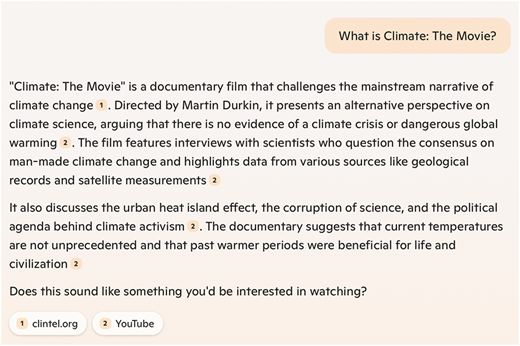
The first skip of the stone's trajectory – skimming through the allegorical lake of contrarian climate knowledge – is that of a prompt for an LLM-driven chatbot that is integrated with a search engine (Bing), namely Microsoft Copilot, through retrieval-augmented generation (RAG). This skip takes as its starting point the response to the prompt “What is Climate: The Movie?” whereby an analysis of this response is conducted in a deconstructing, interpretative sense. In particular, attention is paid to language and style by “moving down to the sentence level and even the choice of words” (cf. Asdal and Reinertsen, 2022, p. 93), doing so serves to perform an initial investigation into how climate obstruction manifests itself online through new information systems and the associated emerging infrastructural arrangements. The implementation and exemplification of this approach is straightforward, but nonetheless both effective and reasonable considering the current and wide adoption of LLM-based chatbots for generating and retrieving content. The rhetorical tone of chatbots is fascinating in the sense that they tend to be so polite when discussing such devastating matters. The underlying assemblage of descriptions concerning the pseudo-documentary in question is likewise problematic, as current descriptions have been automatically scraped and trickled down into, and used to train Copilot's model, from which it can be translated into rhetorical niceties.
When we give Copilot the prompt “What is Climate: The Movie?” (Figure 1, retrieved January 31 2025), we receive in return a summarising and seemingly impartial statement devaluing established science on climate change to a “mainstream narrative” and presenting the pseudo-documentary as an “alternative perspective” to such a narrative. The contrast between the style and content of the response is stark. Other prompts inquiring about Climate: The Movie result in very similar responses (Haider, 2024). The tone is straight and to the point, with no room for valuations or assessments. The pseudo-documentary, it is moreover stated, provides such an alternative view of the current state of climate change research by interviewing scientists questioning the “consensus on man-made climate change” and discussing “the corruption of science and the political agenda behind climate activism”. We are presented with a dry, and seemingly conclusive, statement that paints the film's point of departure as a sound, or even welcome, alternative to the established state of climate change consensus, questioning expertise. It is difficult, at this point, to not contemplate Tsing's (2015) notions of alienation and the construction of commodities as “things […] torn from their lifeworlds to become objects of exchange” (p. 121). Tsing (2015) exemplifies this process with the foraged mushrooms, which her book revolves around, becoming hunting trophies. Even though the current setting differs in many ways from the situation from which Tsing (2015) develops her theory, there are clear similarities and even overlaps. This idea helps with seeing how the datafication of climate change knowledge is grounded in a form of alienation that commodifies expertise – and challenges to expertise – as something to be (re)assembled and placed in a puzzle by an AI chatbot or similar software.
Moreover, the alienation of established notions concerning climate change is executed by the probe that is the final line of Copilot's response, since this part of the response itself functions as a prompt. Following the matter-of-fact rhetorical description of a deeply controversial and highly problematic pseudo-documentary on the alleged corruption of science and the political agenda behind climate activism, the chatbot – which is connected to the Bing web search engine – gives the illusion of a dialogue. Moreover, it seeks to give the user a choice by jovially asking “Does this sound like something you'd be interested in watching?”, followed by links to the Clintel Organisation (Climate Intelligence, clintel.org), and the pseudo-documentary itself on YouTube.
The YouTube link is noteworthy. There are many uploads of the pseudo-documentary on YouTube, as well as other video platforms, and unsurprisingly, Copilot links to the YouTube video with the most views. The channel it is posted on is called “Food Lies”. Most videos on the channel promote a meat-based diet, positioning meat as the most natural and healthiest food for humans. Climate: The Movie is by far the most viewed, most popular and most commented video on the channel with almost half a million views. By comparison, the next most viewed video on the channel – a takedown of veganism – was posted in 2019 and has around half as many views. The tags used to describe Climate: The Movie are the same as those of the channel itself: Sapien, food lies, paleo, keto, carnivore, yes2meat (YTLarge, n.d.). On YouTube, tags are descriptive keywords meant to describe a video's content to make it easier to find. Tags are less important than a video's title and description, but they still provide interesting metadata for understanding a video's position in relation to its surroundings. Here they appear to create a link between two issues, contrarian climate science and contrarian nutritional science.
The purpose of these hyperlinks in the context of the response generated by the GenAI chatbot response is – at least – twofold: Firstly, the format mimics that of a scientific footnote. This method of providing sources confers authority and credibility. There is an aura of legitimacy to the claims made, without having to take full responsibility for them. Secondly, the accompanying of references with the phrase, “Does this sound like something you'd be interested in watching?” puts the responsibility on the prompter. This bears a resemblance to telling people to do their own research and suggesting exactly what words and phrases to Google, which then via so-called data voids lead into staged epistemic structures specifically optimised for big tech's platformised information infrastructures (Rödl and Haider, 2025). The next skip of our stone explores hyperlinks as units of analysis, which is done through network visualisations.
Second skip: hyperlink accumulation
In the first skip, the chatbot gave us two leads in the form of references: to climate change denial organisation Clintel, and to the actual streamable climate obstruction pseudo-documentary on YouTube. In addition to this act of referencing being understood as an actual suggestion and nudge to the prompter to further seek information on this matter, there is a methodological angle to these particular references; these hyperlinks can be used as impacts to be further explored in the trajectory of the skipped stone. That is, if we consider the chatbot prompt as the first skip of the stone against the surface of the lake, and the chatbot in turn provides a reply providing hyperlinks as references, then an exploration of digital references to other web entities would make a valid and logical next step in our exploration.
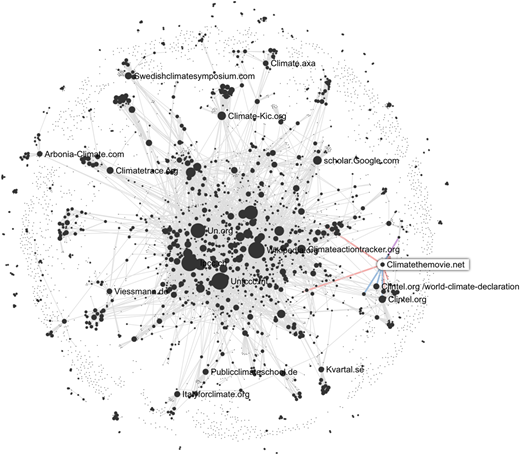
Thus, the stone hits another spot of the lake and a second skip occurs. This impact is that of a methodical approach that involves the large-scale amassing of web search engine results related to climate change and the subsequent exploration of the hyperlinks within these results, forming a large network. Through this approach, as will soon be shown, it is possible to make sense of how climate change-related hyperlinks reference each other, and how they are entangled and bound together, but also how denial spreads through this very network (Figure 2). The initial assemblage of these search engine results was conducted through the Results Assessment Tool (RAT), which automatically scrapes established search engines such as Google Search, Bing and DuckDuckGo for the topmost search results from predefined queries (Sünkler et al., 2024) – fetched from Google Trends data on queries related to Climate: The Movie. These queries include, for instance, “climate the movie”, “system change not climate change”, “climate anxiety”, “the cold truth”, “climate protesters” and “is climate change real”. A list of unique URLs from the retrieved search engine results was furthermore fed to the web entity corpus collection tool Hyphe (Jacomy et al., 2016). Through Hyphe, in turn, it was possible to bulk assemble hyperlinks from each search result and thereby create a hyperlink network of web pages related to climate change in general and Climate: The Movie in particular.
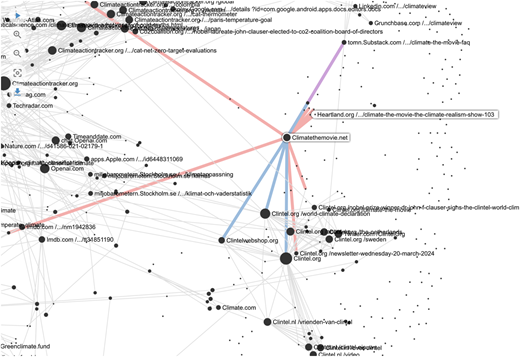
The hyperlink network is a vast conglomeration of links between web pages, sprawling into clusters drawn into or stretched away from the large central points that comprise NASA, Wikipedia, the United Nations Framework Convention on Climate Change and the Climate Action Tracker. Still, a notable cluster related to Climatethemovie.net can be identified on the right-hand side of the network. A cluster is here an accumulation of connected entities of web pages referring to each other. However, accumulation has specific effects. Tsing (2015) notes, “[a]ccumulation is important because it converts ownership into power. Those with capital can overturn communities and ecologies” (p. 133). Through accumulation, space and power are amassed in the network, which in the present study is an ecology of web pages. Since the logic of commercial search engines requires new content to be continually noticed, crawled and indexed, accumulation and growth are self-reinforcing (P et al., 2024). The accumulation becomes clearer in a zoomed-in view of the cluster (Figure 3).
Traceable from this zoomed-in view are the connections formed between Climatethemovie.net and other web pages. Red edges designate inbound hyperlinks, blue edges designate outbound hyperlinks, and purple edges designate mutual hyperlinks. While this is a relatively small cluster compared to the network overall, it is important to bear in mind that the cluster nonetheless stirs up the general relationships between web pages by way of assemblage and accumulation; it does not comprise isolated entities. “If nature has turned finite, and even fragile,” Tsing (2015) continues, “no wonder entrepreneurs have rushed to get what they can before the goods run out” (p. 135). Something comparable occurs in the ecology of climate change web pages since, to stay relevant in the network, the cluster – and thereby also contrarian climate knowledge and by extension the climate change countermovement – must grow, multiply and nestle itself among expert actors. The skip shows the prevalence of Climatethemovie.net and its ominous connection to other web pages, easy to find and reach via general-purpose search engines. Notable in Figure 3 is the edge connecting Climatethemovie.net with a podcast from the US think tank, the Heartland Institute. Given such connections, the next skip in the stone's trajectory leads to contrarian climate knowledge and the appearance of the climate change countermovement in podcasts, a rapidly expanding sector with increasing importance for the shaping of public opinion (Vallström and Törnberg, 2025).
Third skip: podcast disturbance
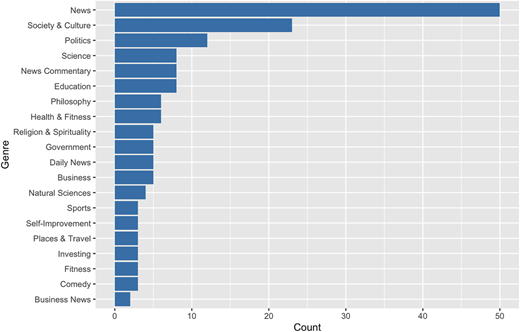
Following the thread from the hyperlink network graph, described in the previous section, evokes the image of agents stirring up the informational texture of climate knowledge more generally by intervening with contrarian claims. Above, we drew on the notions of alienation and accumulation to make sense of how different actors, through mimicking and performative gestures, give rise to contrarian climate knowledge, thus contributing to climate obstruction. In terms of methods, document analysis and network analysis provided the basis for the respective impact. Drawing on the connected nodes of Climatethemovie.net and the Heartland Institute podcast, there is reason to include podcasts as a unit of analysis and examine climate obstruction and denial invoked in data fragments obtained from episode descriptions. This is achieved through the third skip on this lake of contrarian climate knowledge, which is that of explorations of podcasts covering Climate: The Movie. Here, the impact is that of a content analysis of podcast descriptions seeking to inductively derive meaning from the data (Bryman et al., 2022). Data were retrieved through the podcast search engine Listen Notes. A breakdown of the top 20 most frequently specified genres for the retrieved podcasts discussing Climate: The Movie is found in Figure 4.
Unsurprisingly, most podcasts are in English and only 14 out of 87 are in other languages (Dutch, German, Japanese, Norwegian and Swedish). About half have a presence on Spotify, making them very widely available. Two are also on YouTube, and all but two have an Apple iPlayer ID. The variable genres – used to describe overarching themes – are interesting. Most are assigned two themes, but some have five and others just one or two. By far the most common theme is News (50), followed by Society and Culture (23), both of which are more prominent genres than those of Science (8), Philosophy (6), Natural Sciences (4) or Earth Sciences (1). These results indicate that Climate: The Movie is discussed to a larger extent in podcasts where current news-related, societal and cultural events are conferred about than in podcasts directly related to scientific work or scholarly communication. What is more, the data retrieved from Listen Notes include two interesting metrics: the – claimed – popularity of podcasts as a Listen Score presented in integers, and a Global Rank Listen Score provided in percentages. These systems of measurement serve to convey a relative score indicating the “estimated popularity of a podcast compared to all other rss-based public podcasts in the world on a scale from 0 to 100” (Listen Notes, 2025). While these metrics are indeed relative to scores of other podcasts, Listen Notes provides several examples, and target groups for, these alleged quality measures: whether a podcast is popular enough for an influencer or celebrity to be a guest in; whether the podcast is pitchable to marketing, advertising or public relations professionals; how recommendable the podcast is for aggregator websites; or simply whether the podcast is worth listening to (Listen Notes, 2025). When sorting the Listen Notes data on the ten highest scores for these two metrics, we find that all of the podcasts are ubiquitously available through at least one, and in most cases both, of the major audio streaming services: Apple Podcasts and Spotify.
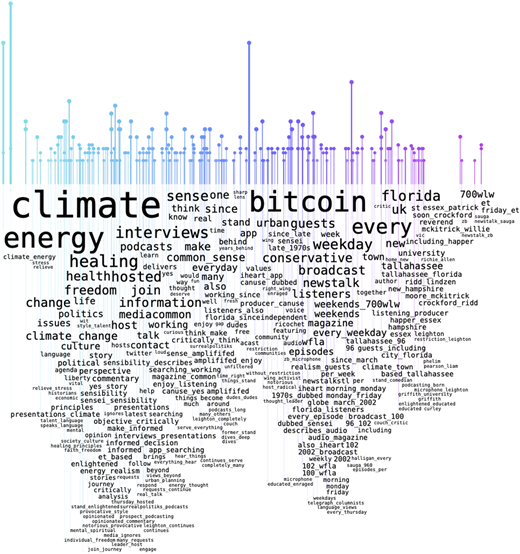
Drawing on this initial understanding of prominent genres of podcasts in which Climate: The Movie is discussed, and to gain an overarching understanding of the content of the retrieved podcasts, we created a word rain visualisation (CDHUppsala, 2024; Skeppstedt et al., 2024) of the provided podcast descriptions (Figure 5). The word rain displays both word frequency and semantic topic mapping. While the x-axis denotes semantic similarity, the y-axis denotes word prominences through word positions and font-sizes as per word frequencies. The left event bundles terms such as “climate”, “energy”, “healing” and “interviews”, whereas the right event collects the terms “bitcoin”, “broadcast”, “newstalk”, “Florida”, “conservative” and “uk”.
This suggests two main themes arising from the podcast descriptions: climate and energy on the one hand, and cryptocurrency on the other. The presence of the former, climate and energy, is to be expected and, to some extent, reflects the title of the pseudo-documentary in question. However, the notable prominence of the latter, Bitcoin, requires some comment. The fact that discussions on climate change occur in close thematic proximity to discussions about the cryptocurrency Bitcoin suggests an overlap with the so-called manosphere (McGlashan and Krendel, 2024).
These themes and ideas emerge and recur through our qualitative, in-depth reading of the episode descriptions. Most notable, perhaps, is the re-emergence of phrases and even whole sentences from the film's introductory text as posted on the Clintel website (clintel.org). For instance, following the trajectory of the stone from the previous skip, we find the following sentences in the Heartland Institute's podcast episode coverage:
“[t]he film exposes the climate alarm as an invented scare without any basis in science. It emphatically counters the claim that current temperatures and levels of atmospheric CO2 are unusually and worryingly high” (excerpt from episode description for “Climate: The Movie – The Climate Realism Show #103”).
Exposition and counterclaims are apparent motifs here, as directly copied from the introductory text to Climate: The Movie. One can also consider this statement through Tsing's (2015) perspective. If Copilot's response has the capacity to alienate the prompter from established understandings of climate change, and if hyperlink networks of interconnected CCCM websites seek to accumulate edges and thereby growth in the network as a whole, then this form of podcast description – as well as the podcast episode as a whole – can be understood in line with Tsing's (2015) notion of a disturbance: “a change in environmental conditions that causes a pronounced change in an ecosystem” (p. 160). Although Tsing (2015) stresses that disturbances need not be negative or human-induced, they nonetheless have the capacity to renew ecologies, as well as to destroy them. The coverage of the pseudo-documentary film in question is certainly one way to create disturbance and provoke change in the ecosystem that is established, scientific understandings of climate change. Another statement as directly derived from the same introductory text can be found in the American Conservative University podcast:
“On the contrary, compared to the last half billion years of earth's history, both current temperatures and CO2 levels are extremely and unusually low. We are currently in an ice age” (excerpt from episode description for “Climate: The Movie (The Cold Truth)”).
These ideas are ringing through a series of different podcasts in ways similar to the memetic mimicry discussed by Hagen and Venturini (2024). They thereby comprise emulative interventions to the established and scientific understandings of human-produced climate change in the Anthropocene. Once again, it is important to consider that “[d]isturbance opens the terrain for transformative encounters, making new landscape assemblages possible” (Tsing, 2015, p. 160). By disturbing the status quo in a dispersed way – echoing the same message in a variety of channels – the message reverberates throughout the web, leading to further alienation and accumulation through growth. “Small disturbances,” Tsing (2015) remarks, “eddy within the currents of big disturbances” (p. 187). As these disturbances gain ground, so do the probabilities of pronounced changes in the ecosystem of current evidential knowledge on climate change. The podcasts work as conduits for information (cf. Nguyen, 2020) about the pseudo-documentary film, repeating ideological narratives by means of mimicry. Their claims not only provoke thoughts; they provoke beliefs and seek to appropriate expertise as well as whole evidence bases through fragmented but conglomerated networks of climate obstruction and denialism. Podcast descriptions comprise just one such form of data fragments, but they – along with the auditive discussions that go on within these very podcasts – swirl into a larger current when they assemble en masse.
Throughout this section, we have discussed the alienation effect emerging from prompting Microsoft Copilot with the question: “What is Climate: The Movie?”, as well as the illusions of both dialogue and choice occurring as the chatbot itself prompts the questioner to consider whether they would be interested in watching the climate change denialist film. We have subsequently traced these websites and their web of entangled hyperlinks through a network analysis approach, understanding the emerging climate obstruction cluster in the sense of accumulation and growth of edges as capital. In addition, we studied a part of the cluster more closely through quantitative content analyses of podcast episode descriptions. Through this, we were able to catch sight of emulative and incessant interventions as a means of disturbing established knowledge of human-induced climate change. Through three skips, a trajectory is formed as ripples are shaped by our stone – more concretely, the integration of Climate: The Movie with a set of methods and applications – skimming across the lake. This trajectory is further examined and alleviated in the concluding discussion.
Concluding discussion
As we write in the introduction, this article has two purposes, namely, to propose and develop a methodology for analysing informational textures and to say something about the informational texture of climate obstruction. However, because of the way the proposed methodology is conceived, these purposes cannot be separated. Skipping stones and noticing the ripples invites and even depends on indeterminate encounters. It is necessarily both radically situated and situating and therefore precludes scalability. Scalability is, in the words of Anna Tsing (2015), “the ability of a project to change scales smoothly without any change in project frames” (p. 38). It is a hallmark of efficiency, capitalism, and modern science. However, because scalability assumes that additions and expansions adhere to predetermined formats and are not transformative, it “banishes meaningful diversity, that is, diversity that might change things” (Tsing, 2015, p. 38). To explain this, the bricolage of methods combines with the pseudo-documentary to form the stone that helps us to notice how climate obstruction plays out online, and then to say something about what we call its informational texture, i.e. how opportunities for meaning-making are constituted by connections, indeterminate encounters and shifting arrangements of a diverse range of differently charged data fragments. Neither the informational texture nor our description of the texture is arbitrary. On the contrary, it is situated and specific, even though we can only follow a few leads or skips, and it is impossible to enter the same data flow twice. Furthermore, as we focus on what opportunities for encounters are created or emerge, we can see how values favouring simple growth-oriented narratives, masculine identities and science denial are formative. But of course, there are opposites and nuances, and there are openings where these values can be shifted. It would be necessary to skip several carefully chosen stones across the issue to gain a better grasp of its informational texture. However, since our goal here is to develop and discuss a methodology, we will return to this task in a later study.
Our methodological proposal – Skipping stones and noticing the ripples – contributes to the understanding of the informational texture of online climate obstructions in the following ways. The first skip across the lake of contrarian climate knowledge makes visible LLM-fuelled chatbots' absorption of CCCM arguments and the subsequent alienating effect that this absorption has upon the prompter. Most notably, this alienation occurs as Copilot, in the output generated in response to the question “What is Climate: The Movie”, seeks to reassure the prompter that the climate change obstruction of Climate Intelligence is authoritative and credible, in contrast to the “corruption of science, and the political agenda behind climate activism”. Seen through the lens of Tsing's (2015) reasoning on human–nature relations in the Anthropocene, we consider this as an approach to own parts of the informational texture through the data provided to the prompter. Next, in the second skip, we followed the references that Copilot gave us to a larger network of hyperlinks around climate change. In this part of the thrown stone's trajectory across the lake, we found further efforts by the CCCM to accumulate connected entities – exemplified by a cluster tying Climatethemovie.net to, for example, Clintel.org and think tank and lobby organisation Heartland Institute's podcast. In the third skip, the Heartland Institute lead was followed up through a part-natural language processing, part-content analysis of podcast descriptions and episode descriptions, where we showed that Climate: The Movie's introductory text almost verbatim found its way into a multitude of podcast descriptions. Certainly, the manner in which Climate: The Movie's topics make their way across the web is incongruent, but this does not take away our main argument – related to the central questions motivating the article – that the efforts to obstruct climate change are disjointed yet interconnected, and require methodological flexibility to be noticed through an assortment of data fragments and, in turn, shown and critiqued.
The methodological suggestion of Skipping stones and noticing the ripples takes at its core the metaphor of the trajectory across the lake. Through this metaphor, phenomena that are similar in meaning yet disparate and differentiated in form can be noticed and explored through a bricolage of methodical impacts. The topic of Climate: The Movie reverberates across the web – and of course also elsewhere – in myriad ways, understood in the scope of this article through data amassed and mangled through an LLM, in the context of connected websites and as the stuff of podcast descriptions. Much like repetition-through-variation occurs in memes as part of political discussions in online message boards, as shown by Hagen and Venturini (2024), the theme of Climate: The Movie is mimicked and repeated in varying ways online, as visualised and analysed through the data fragments collected throughout this present study. Dunlap and Brulle (2020) discuss how interconnected actors – including campaign groups, corporations, conservative foundations and think tanks – fuel and amplify climate obstruction. Likewise, McKie (2021) has shown how actors strategically intervene in the shaping of rules of discourse and formations. As we show when applying the approach of Skipping stones and noticing the ripples to this particular empirical setting, the interconnection of very different types of actors, groups and even infrastructures reverberate climate obstruction through society. Because of the logic of algorithmic systems that infuse everyday life and society, intention is not even required, and neither is a coherent message. Fragments invite and afford the making of connections and suffice to shift the informational texture as a highly effective normalisation machine; disturbance for the sake of transforming ecologies, in Tsing's (2015) terminology. Fragmentation, elasticity and even a conspiratorial undertone are advantages of contrarian climate knowledge here, for it can be, and is, highly produced specifically for the arenas and corporate platforms that reinforce and reassemble it. In contrast, science and other forms of research-based knowledge are cumbersome, uncertain, but also vetted, slow, resource-intensive and produced for very different purposes than influencing public and political opinion and shaping policy decisions (Haider and Sundin, 2022).
Our contribution with this study is twofold: we show how the topic of Climate: The Movie reverberates throughout a variety of data fragments across the web and how the informational texture takes several shapes, while still pertaining to the same climate obstruction issue. At the same time, we show that such an analysis is possible through the methodological approach of Skipping stones and noticing the ripples, in which the traces occurring as the impacts are analysed and brought together in a connecting sense. This echoes past sociomaterial approaches to analysing how phenomena travel (Bates et al., 2016) or diffract (cf. Østerlund et al., 2020; see also Barad, 2007; Haraway, 1997), throughout platforms and information systems. At the same time, the methodology proposed here further develops these approaches by examining the emergence of issues as data fragments move across and beyond multiple platforms, which foregrounds their informational textures. A fluid and flexible approach to methods (cf. Pratt et al., 2022), as well as the weaving together of small data fragments, has been of specific significance in achieving these forms of connections. More concretely, the novelty of Skipping stones and noticing the ripples originates in the methodological approach of making sense of the (unruly) informational texture of an issue by first noticing and then also showing, or making noticeable to others, a rush of data fragments (cf. Tsing, 2015). This allows for the relational tracing of meaning not only across social media and other platforms but also to other forms of digital content, including synthetic media and hybrid or even analogue situations. The suggested approach can be adjusted to other empirical settings and situations to explore, describe and examine different informational textures. Skipping stones and noticing the ripples puts forward a theoretical-methodological approach to relationally explore and examine contested, platform-transcending issues, where different materialities contribute to how meaning emerges and fluctuates.
Research ethics
This research has been approved by the Swedish Ethical Review Authority: 2024-06023-01.
The authors would like to thank two anonymous reviewers for their comments, which improved the article. Moreover, the authors would like to thank Dirk Lewandowski and Sebastian Sünkler at Hamburg University of Applied Sciences, Germany, for assistance with data collection. The authors would also like to thank the participants at the 2025 Winter session of the Nordic Summer University study circle Act, React and Reflect: Meta-perspectives on Climate Change Knowledge, for valuable feedback on an early version of the article manuscript.
Appendix
Units of analysis and methods used
| Stone skip | Unit of analysis | Data collection method | Data collection/production tool | Data format | Number of data points | Data analysis method |
|---|---|---|---|---|---|---|
| First skip | Chatbot replies | GPT prompting | Microsoft Copilot | Screenshot | 2 chatbot replies | Document analysis |
| Second skip | Search engine results | Search engine data querying | Research Assessment Tool (RAT) | Comma-separated values (CSV) | 7,882 rows of search results | Network analysis |
| Domain network | Network data amassment | Hyphe | Node and edge data | 3,563 nodes, 6,362 edges | ||
| Third skip | Podcast descriptions and episode descriptions | Podcast search engine querying | Listen Notes | CSV | 130 rows of metadata entries | Term frequency computation, word rain visualisation |