


Research supports the need for college literacy skills for prospective and new college students. Expanding the literacy landscape to include the information needs of college-bound patrons aligns with the mission and vision of public libraries as lifelong learning institutions while supporting educational attainment and workforce development in less privileged communities. This paper reports on library staff awareness of college planning resources to provide quality services. This study may also enhance public library staff's college literacy and understanding of today's college-going population.
An online survey questionnaire was administered in this cross-sectional study of library staff in the Southeastern United States.
The findings indicate that public library staff encounter inquiries that reflect the college literacy needs of the community. These include questions from prospective students about entrance exams, financial aid and scholarships, college admissions requirements and deadlines, and options for career advancement. Respondents also emphasized meeting the academic needs of currently enrolled college students through providing support with learning management systems and proofreading assignments.
This research serves as a starting point for understanding the demand for and awareness of college planning resources with public libraries. This work extends existing regional literature on public library services through its emphasis on Appalachia.
Introduction
Even with the steady stream of information and resources available online, prospective and entering college students continue to report information deficits related to college planning. The breadth of information available online is both a blessing and a curse as prospective students must separate fact from fiction, filtering objective information from strongly stated, opinionated reviews. Depending on factors such as socioeconomic status, geographic location and biases, high school students experience uneven support, and sometimes discouragement from teachers and guidance counselors. Students, especially those from less privileged backgrounds, have misperceptions about the ease of college admissions processes underestimating the time needed to apply and the overall costs of attendance once admitted (Gibbons et al., 2020). Similarly, adult learners or post-traditional students experience many institutional, situational and dispositional barriers that impede their attempts to start or return to their studies after time away (Osam et al., 2017; Spencer et al., 2024).
Given the need to better understand prospective students' college-related information behaviors, the aims of this research are twofold. First, this research aims to understand prospective students' information needs in the context of college planning with a focus on public libraries. Second, this research aims to learn about library staff's awareness of college planning resources to support college literacy of prospective students. Based on these objectives, the current study examines the following research questions:
What requests for college planning information do library staff receive from prospective students?
How familiar are public library staff with online college planning resources?
While the aims and research questions concern the college planning process, serving patrons seeking such information and guidance represents the kind of lifelong learning and attention to multiple literacies that public libraries are increasingly expected to support. Understanding information professionals' familiarity with college planning resources will benefit public library administrators, community partners and most importantly, college-bound members of the community. Identifying what staff know about relevant resources as well as understanding the circumstances in which they use the resources and the demand for such resources will inform efforts to collaborate with local colleges and universities. Findings from this research also inform plans for future professional development activities for library staff by pinpointing gaps in these information professionals' knowledge bases regarding college literacy.
Background
Regional context
The geographic region of interest in this research is the Southeastern United States, specifically Central Appalachia (estimated population as of 2023 of 1,853,687; Srygley et al., 2025), which includes parts of Kentucky (KY), Tennessee (TN), Virginia (VA) and West Virginia (WV). These states make up a tri-state region (KY-TN-VA) connected by the Cumberland Mountains as well as a tri-city region (TN-VA-WV) known for its petrochemical production. It should be noted that the state of West Virginia is the only state fully within Appalachia. A vast area rich in natural resources, the Appalachian region and its people have endured exploitation by lumber and coal companies since the end of the nineteenth century (Sarnoff, 2003). Though these companies brought jobs to Appalachia, paternalistic systems carried out through the formation of company towns wielded control over residents. Company towns, “built and operated by a single business enterprise” (Garner, 1992, p. 3), provided workers – in the United States and abroad – with homes, schools, stores and medical facilities operated by the company. However, with this modest boom came bust for some communities when industries closed and towns and residents were abandoned. Some scholars attribute the region's current social, environmental and economic challenges – including persistent poverty in Central Appalachia – to these early corporate extractive practices (Sarnoff, 2003; Snyder, 2014).
Data indicate a connection between unemployment and educational attainment in that among the counties with 10% or greater unemployment rates, the share of adults with at least a high school diploma was below the national average (Srygley et al., 2025). Historically, bachelor's degree attainment rates have been lower in Appalachian counties than in non-Appalachian counties in the same states. However, though the number of four-year degrees attained by adults ages 25 and over in Central Appalachia are the lowest among the Appalachian subregions, these individuals have attended some college as indicated by a higher percentage point change in associate's degree attainment from 2014–2018 to 2019–2023 (1.1% increase compared to 0.6%–0.8% for the other subregions) (Srygley et al., 2025).
Low educational attainment rates may be attributed to myriad sociocultural and economic factors. Lack of career role models, academic under-preparedness, school counselors directing students to non-collegiate options and competing family and work commitments are just some of the hurdles prospective students confront (Gibbons et al., 2020; Potter et al., 2024). Reflecting on the college admissions experience as a first-generation student from rural Appalachia, Snyder (2015) writes: “My parents were clueless. I was clueless. We didn't know whether I was supposed to take the ACT or the SAT or both …. We were clueless but determined to figure it out” (pp. 77–78). Gibbons et al. (2020) observed a similar bootstrap attitude and positive outlook among research participants. While these students possess academic aptitude and ambition to pursue higher education, they encounter obstacles that thwart their progress.
These barriers are not exclusive to students in Appalachia or rural parts of the United States. Moreover, prospective students globally face similar barriers to postsecondary or tertiary educational attainment. In rural China, students from working class and agricultural backgrounds lacked the social and cultural capital to guide their university and degree selections making decisions based on their socioeconomic, cultural and academic limitations (Liu, 2019). Black students in rural South Africa cited lack of career guidance and information about admissions requirements as detriments to the pursuing higher education (Maila and Ross, 2018). Aspiring adult learners in Australia encounter challenges related to rurality such as the need to travel long distances to campus and the associated costs therein. They also tend to have less social capital and fewer networks of college-going people that can serve as models and guides through the tertiary education process (Douglas et al., 2020). Prospective students of refugee status relied on word-of-mouth information from family and friends, making them vulnerable to misinformation when making vital college decisions (Bajwa et al., 2017). Such barriers exacerbate inequities experienced by marginalized populations and thus contribute to already fraught social and economic conditions.
Overall, this project aims to minimize barriers impacting students' ability to make informed decisions related to college planning. The current research aims to provide a better understanding of the need for college literacy support in the Southeastern United States through an examination of patrons' information needs as conveyed through inquiries posed to library staff. This work also examines library staff awareness of college planning resources that support providing quality, information-rich services to patrons. Findings will inform public library services, programming and collaborations to support the higher education attainment aspirations of its patrons and community. This research also joins a growing body of region-specific literature examining the role and impact of public libraries (Baum et al., 2023; Mehra et al., 2017; Mehra and Jaber, 2020).
Higher education in the United States
Undertaking a degree program in the United States involves navigating many moving parts. There is an application for admission and its accompanying documentation such as transcripts from previous institutions, personal statements and letters of recommendation. There is the process of applying for financial aid through the institution and the federal government. In the United States, students finance their education through a combination of private scholarships, institution scholarships, personal savings such as a caregiver's 529 savings plan, and federal financial aid in the form of student loans and need-based grants. In addition to these processes, students and families must understand the vocabulary of higher education systems. For example, a common confusion is the difference between tuition and fees. Tuition supports institutions' operating budget, instruction, libraries and academic support while fees cover institutional services such as student services, campus activities and social clubs; sometimes an institution will assess a separate technology fee. In the 2022–2023 academic year, the average total cost for full-time, first-time undergraduate students was $27,100 at degree-granting public institutions (i.e. taxpayer funded institutions) and $58,600 at private nonprofit institutions (U.S. Department of Education, 2023). Students must also pay for books and supplies, which vary by degree program. Lastly, students may live on campus (a common practice for entering freshman or first-year students), off campus with family or off campus but not with family; each option has associated financial and personal costs.
This mix of tuition and fees may vary depending on a student's status as an on-campus vs online student; and access to certain institutional services, such as counseling, may be limited based on a student's enrollment status.
Literature review
Libraries supporting multiple literacies
This research defines college literacy as the literacy or knowledge base needed to make informed decisions about one's entry into higher education (Hands and Candela, 2024a). This article reports on the results of a study to ascertain the nature of college literacy inquiries and the extent to which public library staff are aware of resources that support patrons' college literacy. While some library staff report that the role of public libraries in college literacy is that of supporting college-bound patrons, connecting them with available resources, and providing information and technology support (Hands and Candela, 2024a), public libraries are less engaged in college literacy or serving the needs of college-bound patrons than other literacies such as early literacy or digital literacy. A better understanding of the demand for college planning information and public library staff knowledge of resources is needed to guide libraries toward initiatives to begin or improve services for this user group. This focus on the knowledge base of prospective students as a literacy aligns with the discipline's emphasis on similar literacies in the literature under the umbrella of information literacy.
Information literacy is often framed as a concept relevant to school and academic library settings (Gerrity, 2018). With attention to social learning and metacognition, information literacy is defined as the “set of integrated abilities encompassing the reflective discovery of information, the understanding of how information is produced and valued, and the use of information in creating new knowledge and participating ethically in communities of learning” (Association of College and Research Libraries, 2016, p. 3). Interactions with patrons at public libraries differ from those at school or academic libraries; thus, the nature of information literacy may also differ. Public library staff may encounter differences such as time constraints at public information services desks, the need to assist multiple patrons at one time, and patron motivation and inclinations to learning. Still, information literacy and its related skills are important in public library settings as has been documented in the literature in various global contexts (Demasson et al., 2019; Ireland, 2017; Julien and Hoffman, 2008; Matteson and Gersch, 2020). Crawford and Irving (2013) connect information literacy to lifelong learning, and we have witnessed public libraries successfully addressing the lifelong learning needs of patrons through offering topical information literacy services, for example, digital literacy, health literacy and financial literacy. As such, the institution can address the needs of college-bound patrons through the implementation of college literacy programs and services. Doing so aligns with the lifelong learning mission and vision of today's public libraries fitting within the corpus of other literacies.
Public libraries support communities by responding to a range of literacies that extend beyond a person's ability to read and write. The American Library Association's (ALA) Committee on Literacy has adopted the definition from the Organization for Economic Co-operation and Development (OECD, 2009, p. 7) which states,
Literacy is the ability to identify, understand, interpret, create, communicate and compute, using printed and written materials associated with varying contexts. Literacy involves a continuum of learning in enabling individuals to achieve their goals, to develop their knowledge and potential, and to participate fully in their community and wider society.
Through this broad definition, libraries address a lifespan of twenty-first century literacy needs including digital, health, food, financial, media and data literacies.
In recent years, there has been an uptick in library services and research literature on the potential for increased health literacy to address the growing health inequities in the United States (Lenstra, 2020; Rubenstein, 2016; St. Jean et al., 2019; Vardell and Wang, 2022). Lenstra's Let's Move in Libraries initiative has been hugely successful in drawing attention to the small and large ways libraries may address health literacy and health promotion in their communities. Likewise, health literacy intervention programs were found to enhance elderly individuals' ability to manage their health conditions (Zolbin et al., 2022).
Related to health literacy, we also have seen libraries partner with social service agencies and providers such as social workers to provide direct services, programming and information to patrons. Topics for such programming have extended well beyond what might be thought of as the public library's traditional domain to include mental health care, housing and substance abuse. At some libraries, social workers are integrated library employees (Esguerra, 2025), which takes pressure off non-social work-trained staff to meet the challenging needs of patrons beyond traditional reference inquiries.
Financial literacy intersects with college planning as students and families frequently report a lack of knowledge about financial aid processes and requirements. An information gap related to financial aid options exists for both traditional and post-traditional students. A national College Confidence survey (Sallie Mae, 2022) highlights the information deficits of students and parents. Forty percent of participants felt the available financial aid options were overwhelming with 42% reporting they do not know where to go for help while planning to pay for college. Though most families (74%) have heard of the FAFSA (the free application for financial aid in the U.S.), only 20% feel very prepared to complete the application, which currently includes 49 questions some of which may be skipped depending on response. Non-traditional (also known as post-traditional) report financial barriers as the reason for stopping out of school during their first attempt at college (Spencer et al., 2024). One participant stated: “I had no financial literacy regarding money. … Just not having access to the resources that were necessary was a huge barrier” (p. 8).
A multipronged approach to college literacy
The complexities of today's higher education environment, especially in the United States, calls for involvement from multiple support systems. Ten years ago, Perna and Riepe (2015) wrote, “closing gaps in attainment requires a comprehensive approach that recognizes the roles and responsibilities of different stakeholders” (p. 42). This continues to be the case today as barriers to entry into higher education institutions persist. The current research advances the view of public libraries as a stakeholder in addressing the issue of college degree attainment from an information access perspective.
Recognizing the connection between workforce development and college degree attainment, some public libraries are engaged in work related to college literacy. For example, a local private college in New York has collaborated with Brooklyn Public Library to offer its two-year degree at the library's central branch (Mt. Auburn Associates, 2022). Nearby, the New York Public Library has a College & Career Pathways program with team members located at branches throughout the system. The program offers teens one-on-one counseling sessions to assist with financial aid and college application processes; promotes college directories and entrance exam preparation books available in the library's catalog; and connects patrons to databases with college and career planning resources. This level of service offering is also valuable to adult patrons beginning their college journeys. Outreach and communications should reflect their circumstances (Hamrock et al., 2021); they should not be expected to access resources advertised to teens. Unfortunately, college planning initiatives are often misdirected because, as Deil-Amen (2015) writes, “Our conceptions of the typical college students are based on traditional notions and an imagined norm of someone who begins college immediately after high school, enrolls full time, lives on campus, and is ready to begin college-level courses” (p. 134). This narrow conception excludes over 40 million individuals nationwide categorized as “Some College, No Degree” (Causey et al., 2023).
Previous research (Hands, 2022; Hands and Candela, 2024b) observed that resources and services such as those just mentioned are not widely available at public libraries and when made available, they are designed for and marketed to teenage patrons ignoring the college literacy needs of post-traditional students (e.g. adults and those with nonlinear college paths). Adults also experience gaps in college knowledge and challenges when navigating the college admissions process and have information needs that may be addressed by public libraries. Barriers experienced by non-traditional have been characterized in the literature as situational (e.g. caregiving responsibilities), institutional (e.g. universities the 9 am–5 pm work schedule of university staff) and dispositional (e.g. lack of confidence) (Karmelita, 2020; Osam et al., 2017). These barriers each present challenges to the information seeking experience of non-traditional students (Karmelita, 2021), some of which may be addressed through college literacy programs and services at a public library.
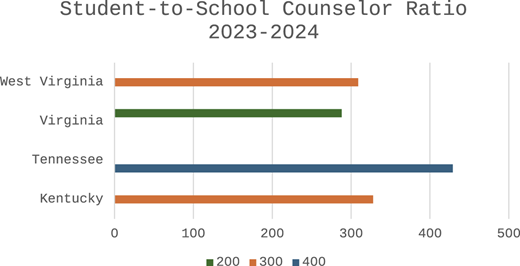
College literacy and the information needs of prospective students is an understudied topic in library and information science literature. College literacy is often considered in the context of a traditional college student, that is, someone entering college or university immediately after completing high school. For this reason, many consider college literacy to be solely under the purview of post-secondary school and guidance counselors. However, while the American School Counselors Association (n.d.) recommends a 250-to-1 ratio of students to school counselor, in the 2023–2024 school year, the ratio was 376-to-1. The ratios for the states included in the current research are shown in Figure 1; all four states' ratios are higher than recommended.
Student-to-school counselor ratio by state
Student-to-school counselor ratio by state
School libraries are another reasonably assumed venue for supporting college literacy albeit only for traditional age students. However, school libraries focus on college-level academic skills, not the information needed to make college planning decisions as is the focus of this research. Zhou and Adkins (2016) remind us that information alone does not solve the issue of degree attainment – a reality echoed in an ACT report on information sources used during college planning, which found that despite the ubiquitousness of online information high school students continue to have difficulty finding desired college information (Schnieders and Bobek, 2024).
Public libraries have a demonstrated practice of focusing on a range of literacies as illustrated in the discussion above. The current research focuses on public libraries as a source for college planning resources and information because they are trusted spaces. As Zhou and Adkins (2016) write, “beyond mere knowledge of an option, students need to trust that the option is available to them, trust the people who are promoting the option, and have support throughout the college application process” (p. 337).
Library staff awareness as trust-building
Trust in one's fellow citizens, elected officials and institutions is eroding in the United States and globally (Edelman Trust Institute, 2025). Yet, the public library is one institution that, until very recently, has maintained its identity for being a source for trustworthy information (Geiger, 2017). As an institution, the public library has benefited from legitimacy or cultural support based on its role in democracy and intellectual freedom, cultural and historical preservation, and education (Yamagishi et al., 2024). According to Pew Research Center, trust in information from the local public library is greater than from other information sources including family and friends, government sources and local news organizations (Rainie, 2018). People have fond memories of visiting the library in their youth and of their favorite librarian or staff person. Many people value the access to technology and the Internet that libraries provide. Patrons appreciate the non-commercial aspects of the public library. During times of natural disaster, public libraries and staff step up to provide vital resources and community connection. These experiences likely engender trust as communities value public libraries' support for personal advancement, community development and vulnerable populations (Stenstrom et al., 2019).
Research shows that individuals perceive content from interpersonal sources to be of higher quality and view human information sources as more accessible (Zimmer and Henry, 2017). As noted in Adle's (2025) review of the literature, one reason for positive public trust of libraries is quality service from and interaction with library staff. Library staff excel at relationship-building serving as “catalysts for civic engagement and scholarly pursuits, thereby fostering the trust bestowed upon them by the community” (Yamagishi et al., 2024, p. 1357).
Because of its long-standing reputation as a trustworthy, valuable community resource, the public library might be the institution for such support for prospective students of all ages. Addressing the information needs of these patrons likely overlaps with existing services and resources offered by public libraries. Libraries have long offered citizenship workshops, digital literacy training and conversation clubs and English language learning opportunities to non-native English speakers and those new to the United States. These same patrons may experience informational barriers impacting their ability to understand educational options or enroll in college courses (Bajwa et al., 2017).
This research positions the library as an asset in college degree attainment, particularly in small or rural communities or communities like Appalachia, because of the importance of community and family. Library staff may be more trusted advocates, messengers and supporters to guide their community through the college planning process. If prospective students perceive library staff as trusting, knowledgeable and possessing quality information (i.e. as an interpersonal source), they may use library staff as resources to support their college literacy. Staff living and working in the region also may be aware of and able to concerns about attending college such as leaving home or experiencing culture shock (Snyder, 2014).
As employees of an institution important to personal and community development, public library staff are called on to address an array of information needs. With varied information needs comes the expectation for public library staff to be informed about resources at the local level and beyond. To ensure staff are prepared to assist with college planning questions, we must better understand their awareness of resources that support college literacy.
Methods
An online survey was used to collect data. Surveys are a common data collection method used to investigate public library staff awareness of resources, tools and practices. Tsabedze and Tella (2020) used surveys to determine Eswatini librarians' usage and awareness of select providers of massive open online courses (MOOCs). Similarly, Hussain and Nisha (2017) employed a survey questionnaire to examine makerspace awareness and usage among library professionals in India. Adopting a survey design for the present study allowed for broad dissemination and ease of completion, especially for staff working in small or understaffed libraries.
The survey targeted public library staff. Demographic data collected on the survey included respondents' educational backgrounds and the state and county of respondents' libraries. State and county data were used to determine the library's location within or outside of Appalachia, which was the region of interest for the overall project. The first two sections of the survey are reported here.
To address RQ1, Section 1 of the survey gathered data on the information needs of prospective college students based on the query topics encountered by library staff. These questions also give insight into the demand for college planning resources and information and the type of patron requesting such information, i.e. adults or teens or both. The survey listed seven areas related to college planning about which patrons might request information and assistance: admissions requirements and application deadlines, financial aid and scholarships, local and/or regional colleges and universities, college majors, entrance exams (e.g. SAT and ACT), online college planning resources and college for career advancement. For each topic, respondents selected whether they received questions on these topics and from whom. Participants then were asked about the frequency of inquiries based on their previous selection. This follow-up question used a four-point Likert-type format. The last question in this section asked participants what other questions about college planning they have received from patrons. This was an open-ended question with a textbox for responses.
To address RQ2, Section 2 of the survey focused on respondents' familiarity with a variety of college planning online resources. The first question was a four-point Likert-type format with possible response items ranging from “very familiar” to “not at all familiar” for each resource listed. The list of resources was not exhaustive, focusing on popular college planning resources such as College App, FAFSA and College Board. These and other state-specific resources, which were included as choices, were observed on library websites in earlier phases of this research project (Hands and Candela, 2024b). For those resources for which participants indicated they were very, moderately or slightly familiar with, a follow-up question asked if they had heard of the resource and used it personally or with patrons or heard of the resource but never used it. As with the previous section, an open-ended question invited participants to share other college planning resources familiar to them but not listed. Finally, the survey inquired about college planning resources, events, programs and services offered outside the library to gauge awareness of resources in the broader community.
The survey instrument was designed and administered using Qualtrics and estimated to take no more than 15 min to complete. Members of the research project's advisory board piloted the survey and offered feedback on the general flow and item responses (Vogt et al., 2014). For example, pilot testers reported that a four-point Likert scale for the follow-up questions was preferred to a five-point scale.
After receiving institutional IRB approval, recruitment notices requesting participation were posted in listservs specific to the states under examination (Kentucky, Tennessee, Virginia, and West Virginia) as well as those with broader audiences such as ALA Connect, the Public Library Association listserv on ALA Connect and the Association for Rural and Small Libraries. These listservs are frequented by library staff fulfilling a range of professional and paraprofessional roles and who may encounter college-bound patrons. Patrons pose their questions to staff working in a variety of roles within the public library, therefore experience in providing formal reference and information service as part of one's day-to-day duties was not a criterion for participation in the survey. Neither were participants required to possess an MLIS degree. The requirement of a graduate degree in library and information science for librarians is more commonly found in city and suburban libraries (75% and 65%, respectively). According to the 2024 Public Library Association staffing report, just 16% of town or rural libraries required the degree for staff in librarian positions. For other positions, even fewer libraries (less than 10% overall) report requiring the degree (Public Library Association, 2024). Eliminating the degree criterion for this survey made participation more inclusive of all staff who might address the college literacy needs of patrons including those working in libraries that may not require an LIS graduate degree to be classified as a professional librarian and libraries with small staff. In 2024, city libraries had a median of 43 full-time staff compared to a median of 8 at suburban libraries and just a median of two at town and rural libraries (Public Library Association, 2024). Including participants working in Appalachian and non-Appalachian libraries facilitated an understanding of college planning inquiries and awareness across geographic contexts. Completion of the survey implied consent to participate. The survey remained open for two months in the spring of 2023 with reminders sent to the listservs. Respondents were entered into a drawing to receive a selection of college planning books to add to their library collection. Quantitative survey responses were analyzed using descriptive statistics while the open-ended responses were analyzed using qualitative content analysis method.
Findings
Respondents
According to the IMLS Public Library Survey, in the fiscal year 2023, libraries in the four states employed approximately 8,878 staff across over 470 central libraries and 532 branches. The service area population totaled over 21 million. Due to the fluctuating nature of library staffing, the exact population size of library staff is unknown, thus this is a non-probability sample. Convenience volunteer sampling (Vehovar et al., 2016) resulted in 160 survey responses across all four states. Findings reported here are based on the 129 respondents who completed the survey to the end.
The greatest number of responses were received from staff working in libraries in Kentucky (34%, n = 44), closely followed by Virginia (33%, n = 42). The education completion levels of participants ranged from no degree (5%, n = 10) to a Master of Library and Information Science degree (27%, n = 53) or other graduate degree (13%, n = 25) with some participants holding multiple degrees. Of interest in the broader aims of this project was the region of participants' libraries within their respective states (i.e. within Appalachia or Central Appalachia). Forty percent of all respondents (n = 52) worked at libraries in the Appalachian region with over half of those respondents working in Central Appalachia. These demographic data are summarized in Tables 1–3.
Participants by location (n = 129)
| Library location | Participants | Percentage |
|---|---|---|
| Kentucky | 44 | 34 |
| Tennessee | 26 | 20 |
| Virginia | 42 | 33 |
| West Virginia | 17 | 13 |
Patron queries related to college planning
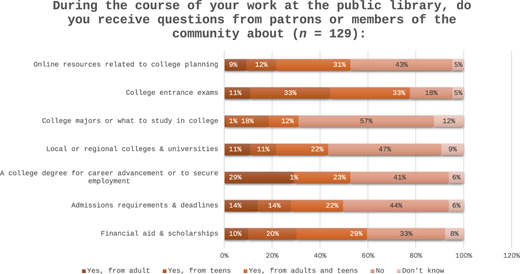
The survey asked participants about the demand for information related to aspects of college planning and the types of patrons making said requests (i.e. teens, adults or both). The highest number of patron inquiries about college planning was related to entrance exams (78% of adults and teens combined). The number of patron questions pertaining to financial aid and scholarships also was among the highest of the categories presented on the survey (60% of adults and teens combined). In terms of library staff receiving related to admissions requirements or application deadlines, 50% (n = 64) responded in the affirmative to receiving inquiries from adults or teens. Fifty-three percent (n = 68) of respondents reported receiving college planning questions related to career advancement or to secure employment with most inquiries (54%, n = 37) coming only from adult patrons. Patron inquiries about general online college planning resources (53%) exceeded those about local colleges and universities (43%) and majors or degree programs (31%). These results are displayed in detail in Figure 2.
College literacy inquiries by topic
College literacy inquiries by topic
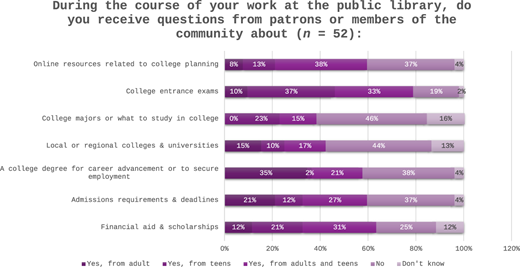
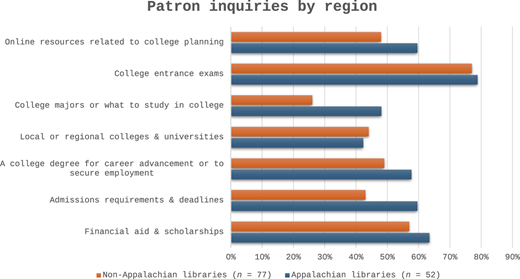
For respondents working at libraries in Appalachia, the number of patron requests echoed that of the larger sample. Most inquiries pertained to entrance exams (79%, n = 41) followed by financial aid and scholarships (63%, n = 33). Requests reported by staff in Appalachian libraries are shown in Figure 3. Figure 4 compares affirmative responses for Appalachian and non-Appalachian libraries by college planning topic.
College literacy inquiries by topic for Appalachian libraries
College literacy inquiries by topic for Appalachian libraries
Regional comparison of college literacy inquiries
Regional comparison of college literacy inquiries
Figure 5 shows a state-level comparison of the college planning topics of inquiry received from patrons. Across all four states, the greatest number of inquiries pertained to college entrance exams; in West Virginia inquiries about entrance exams tied those about a college degree for career advancement or to secure employment. For three states (Kentucky, Tennessee and Virginia), the next highest number of inquiries were related to financial aid and scholarships.
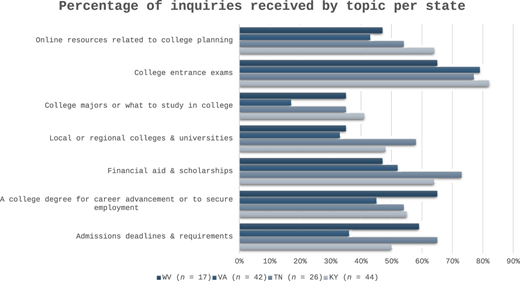
State-level comparison of college literacy inquiries
State-level comparison of college literacy inquiries
In a follow-up survey question, participants were asked how often they receive inquiries related to the college planning categories described above. This question only appeared for those respondents who answered in the affirmative (i.e. yes, from adults; yes, from teens; yes, from adults and teens) to the previous question. The four-point Likert-type response options were never, rarely, sometimes and often. The mode rating for the topics that received the most patron inquiries (i.e. entrance exams, financial aid and scholarships, college planning for career advancement or employment and admissions deadlines or requirements) was “sometimes” as shown in Figure 6.
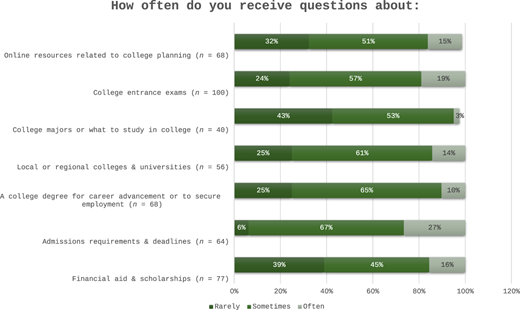
Frequency of college literacy inquiries by topic
Frequency of college literacy inquiries by topic
Other information needs of patrons
The survey invited participants to share qualitative comments on other college planning related topics of inquiry received from patrons. Survey participants noted receiving questions about job fairs, free college classes to take for credit, degree requirements for becoming a librarian and community service requirements for college admissions. One respondent remarked that families of first-generation students want to know what college is like in general. Prospective students ask about on-campus features such as parking and housing as well as general student life to make comparisons between institutions. Some prospective students are weighing the pros and cons of a college degree posing the question: “Why college?” to library staff. Patrons also inquire about the “trade-offs between going to a four-year college and entering the workforce directly,” as one respondent noted. This is a reasonable concern today when the value of a college education is being called into question (Fry et al., 2024).
Though they may have access to their college or university academic library, currently enrolled college students continue using the public library. From these patrons, library staff reported receiving questions about navigating online learning management systems and submitting course assignments online. Students ask library staff to proofread assignments prior to submission, inquire about textbooks and seek to borrow laptops to complete their assignments. They also ask if their public library card will work at the local college. Interestingly, one respondent shared that college staff refer students to the public library for information on scholarships and preparatory tests. Perhaps some college staff assume that public libraries have better access to this pre-college information.
The nature of these questions from currently enrolled college students implies that students may not fully use or be aware of the many resources available on-campus such as open educational resources, the campus writing center, instructional technology services or laptop lending programs – often housed within the academic library. Or as noted in Antell's research (2004), college students may use the public library because of personal convenience, familiarity and ease of use, staff and atmosphere. For example, a respondent shared that “patrons mostly desire reliable Internet access and/or study space to take tests and exams.” Whatever the reason current college students use public libraries, these responses show the range of college literacy information needs handled by public library staff.
Library staff awareness of resources
The next set of questions surveyed public library staff awareness of select online college planning resources. The survey included links to the resources in question in case participants chose to view a website to determine familiarity. Participants were asked about their familiarity with the following online resources:
FAFSA and Federal Student Aid
Fastweb – scholarship website
College Board – administrator of AP tests and the SAT entrance exam
ACT.org – administrator of the ACT entrance exam
Common App – resource for college applications
College Navigator – free, federal college consumer information tool
BigFuture – college and career planning website from College Board
College Scorecard – free, federal consumer information tool to compare college costs
LearningExpress Library – online test prep resource and database from EBSCO
Kentucky Virtual Library (KYVL), Tennessee Electronic Library (TEL), Find It Virginia (FindItVA), and WV Info Depot - state-specific online resources offering access to electronic databases for college and career planning.
Respondents indicated their familiarity using a four-point Likert-type format with response items ranging from “very familiar,” “moderately familiar,” “slightly familiar” and “not at all familiar”. The state-specific resources appeared only for respondents working in the respective state.
Library staff were most familiar with the FAFSA and Federal Student Aid websites with 98% (n = 126) indicating some familiarity with the resources (47% very familiar). The website for the ACT test was second most familiar with 82% (n = 106) reporting some familiarity (34% moderately familiar compared to 23% very familiar). Library staff were less familiar (62% indicated some familiarity) with the College Board website, perhaps not associating it with the SAT exam. Survey respondents were well-acquainted with their respective state-specific online resource with familiarity between 82 and 96%. Figure 7 illustrates responses from this section of the survey in more detail.
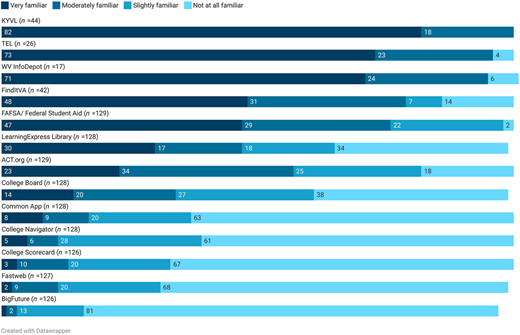
Level of familiarity with online resources (by %)
Level of familiarity with online resources (by %)
Familiarity levels for library staff working in Appalachian libraries were similar, with most respondents indicating familiarity with FAFSA and Federal Student Aid websites as well as ACT.org (96% and 86%, respectively). Seventy-three percent expressed familiarity with LearningExpress Library, likely due to its prominence among public libraries. Familiarity with College Board was relatively high (67%), though most respondents were only slightly familiar with the resource. These findings are summarized in Figure 8.
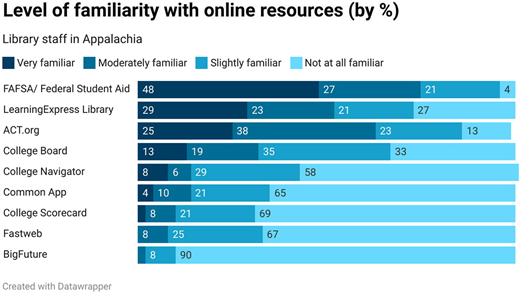
Level of familiarity with online resources among library staff in Appalachia
Level of familiarity with online resources among library staff in Appalachia
A follow-up question about usage was posed to those respondents who specified at least some familiarity with one of the online resources. They were asked to indicate whether they had heard of and used the resource (either personally or with a patron) or heard of but had not used the resource. The FAFSA and Federal Student Aid website, LearningExpress Library and ACT.org were most familiar and used by library staff (89%, 75% and 62% heard of and used, respectively). BigFuture, Fastweb, College Scorecard and College Navigator were among the less familiar and used online resources. This is important to note because prospective students have difficulty interpreting university tuition and fee structures (Davis et al., 2019; Schnieders and Bobek, 2024). Though valuable resources with comparison tools and quality information, College Scorecard and College Navigator are less mainstream resources, which may explain their low usage among library staff. Data on use of each online resource are displayed in Figure 9.
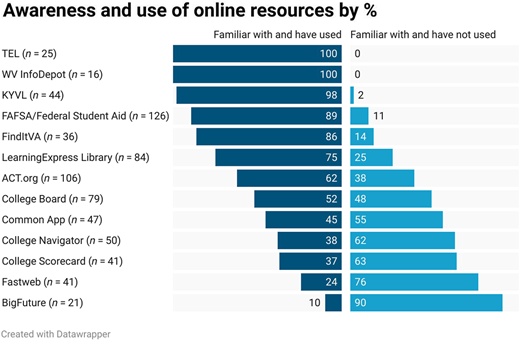
Awareness and use of online college planning resources (by %)
Awareness and use of online college planning resources (by %)
Other online resources
An open-ended question asked participants to share other college planning resources that were familiar or that they had used but were not listed in the previous questions. This question yielded reports of resources that provide information on scholarships, college rankings and comparison guides (e.g. Niche.com and US News and World Report's college rankings) and resources for career planning (e.g. Occupational Outlook Handbook).
Community resources
One open-ended question asked participants about their knowledge of college planning resources, events or services offered by organizations or groups in the community. In their responses, library staff noted the types of programs offered as well as the organization or entity. Most respondents listed the local high school, community college and university as entities supporting college literacy in their community. Respondents noted that local colleges hosted college nights and counseling sessions, open houses and campus tours for prospective students. One library staff shared: “The colleges and universities in my area are very active in promoting themselves in community events and often hold their own college fair events.” Another participant wrote:
New River Community College recently did a program at our library for adults and homeschooled children attending NRCC. It was especially aimed at adults who might not think they were college material. That is, people who graduated high school and got out into the work world thinking college was not in their future.
Notable in this response and a few others is the mention of the library hosting representatives from local colleges and organizations. For example, one respondent shared that someone from the local development district “set up a table in the library to offer career and college planning.” These events build awareness among patrons as well as library staff who go on to share information with others. Other respondents mentioned government-sponsored programs such as Upward Bound, TRIO and GearUp indicating a broad awareness of college planning programs available to assist prospective students beyond online resources.
Discussion
The complex higher education landscape in the United States requires prospective students to utilize multiple resources, social networks and services when working through admissions and financial aid processes. For some students, the bureaucratic path of applying to college is made smooth through connections such as parents and other close contacts who attended college, participation in college preparatory programs, assistance from college consultants and guidance from knowledgeable school counselors. Other prospective students experience information obstacles that could be addressed by institutions such as public libraries. This exploratory study surveyed public library staff in Kentucky, Tennessee, Virginia and West Virginia to learn their familiarity with and use of college planning resources and to understand the demand for college planning information. Survey results offer insight into the college literacy needs of prospective college students and indicate that patrons in the Southeastern United States actively seek college planning information from their public libraries. Main findings are discussed here.
Notably, among the categories of college planning inquiries presented to respondents, entrance exams had the highest number of patron inquiries compared to financial aid. Because of the many components involved in calculating college costs (e.g. tuition, fees, housing, dining and transportation), it was expected that more inquiries from patrons would concern financial aid and scholarships. Further, financial aid has been among the top five categories of information students report difficulty finding (Schneiders and Bobek, 2024). The number of questions from patrons related to entrance exams may signify patrons' awareness of entrance exams being a standard admission requirement for most colleges and universities. Library staff also may receive a high number of inquiries about college entrance exams because, based on observation of the college planning information and services offered by public libraries, test preparation workshops are widespread.
The demand for information about financial aid and scholarships was second highest following inquiries about entrance exams. Recent data note that the percentage of students awarded aid at four-year institutions increased 83%–85% between 2010–2011 and 2020–2021 academic years (National Center for Education Statistics, 2023). Before a student is awarded financial aid, they must collect and submit details on their and their household's personal finances and savings to determine qualifications for aid. Gathering this data is time-consuming; missing important filing deadlines can mean the difference between attending college or delaying one's start date. Families also want information on the various resources that might be used to pay for college, student loan options and information on the true cost of education (Sallie Mae, 2022). Receiving financial aid and scholarships is vitally important for many college students, thus the demand for information in this category is not surprising.
Though in this study most financial aid inquiries were reported to come from teen patrons, it should be noted that library staff received questions from adults as well. States have increasingly emphasized college degree attainment among adults through initiatives such as the Lumina Foundation's Stronger Nation, which began with the goal that 60% of working adults would receive a degree or certification by 2025 (Lumina Foundation, 2025). Because non-traditional students pursue education amidst competing personal and professional demands that draw on their financial resources (e.g. childcare, elder care, mortgage and healthcare costs), it is expected that questions about financial aid and scholarships would come from this population.
It is clear from the literature that patrons need college literacy support in the same way they need general information literacy skills to assess and evaluate information, especially online information. In a survey of over 800 non-traditional students attending colleges in Tennessee, more than 57% of students reported using the Internet as their primary information source for identifying institutions of interest; 70% indicated that university websites were a source for information gathering (Hutchens, 2016). Yet, Davis et al.’s (2019) examination of college websites identified inconsistencies in terminology used across university websites and incongruences between information provided by local and external sources, both of which may cause confusion for consumers trying to understand the true cost of tuition. Knowing the importance of information literacy in this digital age and in this time of mis/disinformation, public libraries can be an important resource for helping patrons handle these college-related information literacy deficits.
College majors or programs of study were among the top five types of information students had trouble finding (Schnieders and Bobek, 2024). In the current study, library staff did not receive many inquiries about what to study in college. Choice of college major is personal and may depend on wage and non-wage factors. In addition to earnings, job amenities, workplace flexibility, enjoyment of the course of study are some of the factors students consider when choosing a major (Patnaik et al., 2020; Wright, 2018). For adult prospective students, the choice of major may be driven by utilitarian reasons including professional development goals or changing careers (Hutchens, 2016). In such instances, one's choice of college or university already may be decided leaving patrons to focus on other college planning information needs such as those related to financial aid.
While staff are not expected to influence prospective students' choice of major, they can share resources to assist in decision making. Patrons are likely not aware that public libraries have print and online resources such as Peterson's Test and Career Prep meant to aid in making choices about college majors. Based on their interactions with a broad range of community members and organizations, library staff also may have knowledge about which local or regional colleges specialize in certain fields of study. Though patrons should be referred to an academic advisor for more detailed discussions about majors and coursework, research shows that prospective and current students want to research and explore their options on their own (Karmelita, 2020). Resources at public libraries can help these individuals prepare to have informed conversations with university staff, which in turn may boost their confidence to attend college.
Library staff received few inquiries about local or regional colleges and universities signaling that patrons already could be aware of institutions in their immediate vicinity. The number of public colleges and universities for the states under examination is between 8 and 16, not including community and technical colleges.
Findings from this research suggest that library staff receive questions regarding college planning from teens as well as adult learners. It is unclear, however, if questions from adult patrons were posed on behalf of themselves or a teenage child in their care as in imposed query (Gross, 2005). In the qualitative comments, one participant noted that they receive questions from parents or caregivers. Future research might more deeply explore the nature of these queries to better understand the intended audience for the information.
Public library staff surveyed exhibited varied levels of awareness of the select college planning resources. This finding is consistent with research on health information awareness among public library staff that found that health literacy knowledge mixed among staff across professional roles in the library (i.e. library managers and library assistants) (Rubenstein, 2018). Awareness of resources is not dependent on one's position within the library. Among staff in the role of librarian in Tsabedze and Tella's (2020) study on awareness of MOOCs, the majority were not aware of massive open online course platforms. As shown in Rubenstein's (2018) research, knowledge of health literacy was lower among staff who had not undergone specific training on the subject. Formal training on college planning resources, such as occurs with business and government sources, may serve to boost staff's own college literacy resulting in an information-rich experience for patrons. Library staff and prospective students may be aware of and use resources other than those presented in this study. Fortunately, library staff were familiar with online resources specific to their state. These resources provide patrons with access to proprietary databases that aid in college and career planning and for which it would be cost-prohibitive for community members to use without library access. A follow-up study might investigate resources utilized by prospective students in the Appalachian region.
While familiarity with select online resources varied, library staff demonstrated a high degree of awareness of college literacy resources and events offered within their communities. In open-ended responses, staff shared about state-sponsored college prep programs, college fairs hosted by local colleges, a mobile classroom that has visited the library and tabling events within the library. Also, some library staff noted awareness of resources based on their personal experiences as a student or assisting their children.
Though previous research found that libraries could better support college literacy through more robust website content (Hands and Candela, 2024b), the current study demonstrates the community awareness of public library staff. Their knowledge of local resources contributes to libraries meeting the lifelong learning aims and needs of its communities. This research also points to the potential of library staff to be valuable unofficial resources to the community. Based on library staff awareness of college planning resources locally in addition to online resources, they are encouraged to continue leaning into their connector role (Hands and Candela, 2024a) through partnerships with like-minded, local college attainment organizations to share the load of supporting the community's college literacy. Indeed, connection-building is one way in which librarians engage in social infrastructuring, connecting the library to its local community (Eckerdal et al., 2024).
Limitations
This study was not meant to be generalizable as it only surveyed library staff in four states in one region of the United States. Still, given the few empirical studies on college literacy, this research serves as a starting point for a larger, national study on the demand for college planning information and the awareness of college planning resources among public library staff.
Another limitation of this study was its participation inclusiveness. The survey was open for all library staff to complete considering that patrons pose questions to all library staff, not just reference staff. Staff who completed the survey worked in various departments of the library, which may have impacted their responses regarding the demand for college literacy services and awareness of resources. That is, individuals working in technical services may be aware of college planning resources but do not receive inquiries due to the nature of their work. A future study may focus on interviewing public-facing staff.
Conclusion
Through a cross-sectional survey of public library staff, this research presents a snapshot of the demand for college planning information and resources in four states in the Southeastern United States. Survey findings also provide insight on library staff awareness of online college planning resources at national and state levels. Findings give insight into the college literacy information gaps of prospective students as evidenced by the queries posed to public library staff.
Responses reveal that library staff are more familiar with the online resources for federal financial aid and the ACT entrance exam than other popular resources such as Common App and College Board (related to the SAT test). Library staff across all four states are very or moderately familiar with state-specific online resources that provide access to college planning resources. This research informs future public library practices that support college literacy and regional workforce and economic development initiatives.
This study contributes to existing literature highlighting the information needs of prospective college students. Coupled with research noting that library staff view the role of the public library as connector, provider and supporter of college-bound patrons (Hands and Candela, 2024a), it is apparent that libraries should mind the gap between information needs, staff awareness, perceptions of the library's role to engage with college literacy for the continued development of our communities. Patrons need assistance developing college literacy skills especially when making life-changing decisions and when information is fragmented and inconsistent. That patrons seek college planning information from libraries illustrates the multipronged approach individuals take to obtain information when making college decisions. Research on college planning mostly has been conducted by scholars in education disciplines. Data on the ratio of school counselors to students illustrate the need for multiple stakeholders to support college literacy. Examining prospective students from an information science perspective brings an important lens that may shape access to higher education for marginalized communities.

