


This article explores the ethical and practical complexities of documenting data creation processes using paradata in research documentation. While transparency is essential for making data truly FAIR, the recent paradata literature has acknowledged that radical openness can conflict with legal and ethical obligations, especially when paradata involves personal notes and identifiable individuals.
The contemporary literature is examined to explore how paradata is framed as both a solution and a challenge in current discourse. Ethical challenges and proposed solutions are then discussed from the perspective of major ethical theories to identify trajectories of problems and solutions.
It is argued that paradata is best approached not as a static entity but as a process underpinned by a meshwork of trajectories incorporating values, explicit and implicit purposes (questions and answers), ethical theories guiding their operationalisation and the means by which they are put into practice. The ethical disclosure of paradata is context-dependent and must balance openness with sensitivity. Paradata itself can help in the process of deciding what is sensitive and what is disclosable, but forcing such decisions risks obscuring the contextual complexities of the ethical hurdles involved.
Paradata is processual and the (dis)closability of particular aspects of a research process depends on the circumstances, not only of the paradata artefacts and the context of their use, but those of the entire trajectories of processes, data making and use.
A comprehensive discussion on the ethical aspects of paradata making in research documentation has been so far absent from the literature.
Introduction
Studies of data documentation and reuse point to the need to document not only the nature of data but also the processes and practices of how it came into being. Data can be truly open, findable, accessible, interoperable and reusable, as per the FAIR data principles (Wilkinson et al., 2016), only if it is known how it came into being, has been (re)shaped and used during its lifetime. Such process information is typically termed in the contemporary literature as paradata (Huvila, 2022). However, alongside the emphasis on the importance of openness, not only of research results but also of investigation processes, the literature across disciplines incorporates extensive examples of how radical transparency can also backfire and how it is frequently at odds with other equally central ethical and practical principles and legislation (John, 2018; Santana, 2024). The risk of unwelcome repercussions is especially apparent with paradata, which is often available in personal notes and commentaries and requires understanding and identifying actors who participated in data making and processing (e.g. Börjesson et al., 2020; Huvila et al., 2025b). A part of the problem is also that demands for transparency and openness can, as research shows (e.g. Genes et al., 2025; Wulff et al., 2000), counterintuitively lead to less transparency. Instead of being self-evident, process transparency and paradata both turn into a paradox. Data creators and data creating communities can mitigate actual and potential problems of increased disclosure by producing formally correct but in practice non-informative documentation, which creates a mere illusion of openness (Etzioni, 2014). Ultimately, however, it is also obvious that the presence of conceivable risks does not necessarily imply that transparency needs to be abandoned as a goal, but rather that there is an obligation to consider what forms of openness are appropriate, defensible, and achievable (Elliott, 2022; Kiddey, 2020). There is an apparent research and knowledge gap regarding where such limits should be set, what the extent of process transparency should be and on what premises the ethical decisions regarding paradata should be made.
This article takes the first steps toward addressing this specific knowledge gap by tracing back how the pursuits for process transparency are underpinned by implicit and explicit ethical norms, drawing on the literature and the work conducted in the research project CApturing Paradata for documenTing data creation and Use for the REsearch of the future (CAPTURE)[1]. It explores how transparency of data making and data practices in general is framed as a problem in the contemporary discourse on data, how paradata is devised as a solution and how the solution itself can be problematic. We inquire into the trajectories of how articulated transparency needs and theoretical assumptions about how to address them implicate specific types of paradata and lead to widely different outcomes – both when it comes to the transparency of practices and their unwanted and potentially problematic side effects.
The remainder of this article is structured as follows. First, we outline the problems relating to the transparency of data making, paradata as a proposed solution and problems relating to that solution. The discussion continues by inquiring into the aims of working with paradata and its possible positive and negative outcomes following a set of trajectories envisioned on the basis of ethical value theory. Finally, we discuss how to put these findings into practice when working with paradata to document data making.
Transparency of data making as a problem
The lack of contextual knowledge on research data in general, and more specifically on its creation, processing and use, has been broadly acknowledged as a significant barrier to its effective reuse in research (e.g. Andersson et al., 2024; Faniel et al., 2018; Huvila, 2022). Reuse is understood in this context broadly as using data for any secondary purposes beyond the ones it was collected or generated for, by those who collected or generated it, or anyone else (cf. Pasquetto et al., 2017). It has been further argued that the problem is not so much how to technically represent such information but how to understand and decide what exactly should be documented and preserved for maximum benefit, and how to avoid wasting unnecessary resources on creating and keeping documentation of doubtful utility (Huggett, 2016; Huvila, 2022). The key question, as articulated in the CAPTURE project, is to determine what information about the creation and use of research data is needed and how to capture enough of that information to make the data reusable (Huvila and Ekman, 2024).
Deciding what information is important and what is enough are, however, intricate problems (Huvila, 2022). The need for information is contextual and situational, depending on the purpose for which it is used, but also on the experience and background knowledge of its potential users. It entails not only knowledge about processes and practices but also of how they are enacted in practice (Huvila, 2025b). Interpreting evidence of research work also entails a basic understanding of research methods, including the possibilities they offer and their limitations (Stronegger, 2024) and understanding the epistemic context of research (Huvila, 2020).
The currently dominant ideal of data sharing builds on a vision of limitless transparency that allows anyone to exploit data for any thinkable and currently unimaginable purposes (Slavnic, 2017). Data discourse has clearly objectivist tendencies, portraying data as an apolitical resource (Söderström and Datta, 2023). Poor documentation and lack of transparency create friction and obstacles for using data that are treated as detrimental and should be avoided. The poor reusability of data is frequently connected to lost opportunities to address major scientifically and socially relevant questions (e.g. Lauer et al., 2021; Wilkinson et al., 2016) but also portrayed as intrinsically negative and unnatural for data, which is conceptualised as something that is innately meant to be (re)used (cf. Nafus, 2014).
Paradata as a solution
Paradata has been increasingly acknowledged as a potential solution to issues related to process transparency, initially in survey research and later in heritage visualisation, and more recently, in additional domains including research data, artificial intelligence and records management (Cameron et al., 2023; Huvila et al., 2024b). Keeping adequate contextual information, including paradata, to provide insight into documented entities and their processual underpinnings is an ethical imperative (e.g. Huvila, 2025a; Ulguim, 2018). Failing to do so can lead to misconceptions of the premises of how something is known (Squires et al., 2022). Paradata has been variously described as auxiliary data descriptive of processes and practices and sometimes contrasted with metadata by suggesting that paradata is data about processes and metadata is data about data (Sköld et al., 2022). While juxtaposing metadata and paradata can help to highlight paradata’s focus on processes and practices rather than data artefacts, it is counter-productive given that typical metadata (as a genre) regularly contains a lot of information that functionally qualifies as paradata (Huvila, 2022). Regarding the older allied concept of provenance (cf. e.g. Bak, 2024; Bettivia et al., 2023; Douglas, 2017), while drawing a clear boundary is equally difficult as in the case of metadata, paradata has been suggested to be less focused on the technical trajectory and historical origins of data but rather to signify in a broader sense all informative things that potentially can elucidate processes and practices. Rather than being a distinct self-sufficient form of data, research on what informs and is used to inform about data-making shows how paradata is deeply contextual (Huvila, 2025b; Sköld, 2025; InterPARES, 2024, cf. InterPARES, 2026).To avoid losing sight of what might qualify as paradata in different contexts and situations and where it might be found, “paradata” is best understood as a broader category of informative things, some of which are often represented in standardised metadata elements, with the rest typically available (or unavailable) elsewhere, rather than a sub-category of metadata. Data can be paradata or metadata depending on who is looking at it and for what purpose it is intended to be used, and vice versa (Huvila, 2022). Consequently, rather than suggesting that paradata is a fixed entity, Huvila proposes a definition of paradata as “a category of things that can be appropriated as informative of processes and practices” (Huvila, 2025a, b).
Rather than being a question of the absence of documentation, research shows that a lot of paradata tends to be already available in existing data documentation (e.g. Sköld and Andersson, 2025) and even in the data itself (Börjesson et al., 2022). The conundrum with paradata is that it is often incomplete and difficult to find (Liu and Huvila, 2025). It can be fragmented across different parts of documentation and data, making it difficult to obtain an overall picture of what paradata is available and which important details are missing. Therefore, the main challenge with process documentation is not necessarily to expand its quantity or scope but rather to determine how to complement the existing incomplete documentation with enough relevant additional information (Huvila, 2022).
Even if determining how much and what paradata would be enough and not too much is difficult, the fundamental premise underpinning the idea of paradata in much of the literature is that with the help of enough of the right kind of paradata, transparency is a priori achievable in one way or another (Huvila, 2025b). However, depending on how paradata is conceptualised – either in an objectivistic sense as facts, or, as an interpretivist would, as ingredients for constructing an understanding of practices and processes (Huvila, 2025b) – it unfolds as two different kinds of solutions to the transparency conundrum. The two perspectives also incorporate diverging expectations of the extent to which transparency can be achieved completely as a definite state of affairs (objectivistic) or partially as a moving target in the making (interpretivist). The objectivist perspective builds on a strong modelling assumption (Maguire et al., 2020; Offert, 2017): that practices and processes can be sufficiently modelled formally as paradata and that this resulting paradata equates with how a living being conceptualises practices and processes. The interpretivist perspective sees the two incommensurable, however, possibly acknowledging that paradata can be helpful in conveying enough information of a practice or process to another living being to enact their own, sufficiently similar version of it (Huvila, 2025b).
When approached as a category of things appropriable as informative of processes and practices from parallel, partly contradictory and partly complementary perspectives, the relation of paradata to the possible transparencies to which it can contribute transpires as both variable and malleable. Even if paradata is multifarious, in an epistemic sense, it is still a very specific solution with similarly distinct implications, limitations and conundrums, stemming from the fundamental assumption that a lack of transparency is an information problem. Its specificity as an informational, documentary solution is also what underpins working with paradata, including the spectrum of possible answers to questions like: what is information that qualifies as paradata, and what paradata is informative for, for whom and when, what are the consequences of informing and getting informed with specific types of paradata, and what is enough but not too much paradata.
Solution as a problem
Outcomes of transparency are not given
Being an informational solution to an informational problem, the paradoxes of paradata are also inherently informational. Unlike what the literature sometimes suggests, the intricacy of paradata does not, however, limit itself to the practical complexities of working with whatever paradata might be available. Many of the paradoxes are not mere practical challenges but go back to principles, goals and decisions that are far from self-evident and that are often conflicting, underpinning paradata and the practices it is documenting. Policies that endorse and stipulate information making in terms of research data documentation are driven by multiple partly distinct, partly overlapping arrangements of values (Börjesson et al., 2015). According to such value regimes, documentation is envisioned to contribute to diverse positive outcomes across knowledge production in science, scholarship and society. In many cases, the proliferation of guiding values is not a problem. Values can co-exist, frictions can be negotiated, and their very presence indicates a healthy diversity of perspectives (Boltanski and Thévenot, 2006; Ekbia and Evans, 2009). For example, archaeology and archaeological (para)data can serve in parallel the intrinsic ends of contributing to the knowledge of the human past and instrumental ends of contributing to well-being, human development, tourism, creative industries and solving major societal challenges (e.g. Huvila et al., 2022). The same multiplicity of possible contributions applies to paradata and open scholarly and scientific practices in general. They can contribute both to effective reuse of research materials and increasing trustworthiness of research by making it possible to validate previous research results. The complicating is, however, that not all ends are reconcilable.
While process documentation might appear as a wholly positive and uncontroversial enterprise, it has multiple potentially problematic implications and side-effects. The UNESCO definition of open science as an “inclusive construct [.] aiming to make multilingual scientific knowledge openly available, accessible and reusable for everyone, to increase scientific collaborations and sharing of information for the benefits of science and society, and to open the processes of scientific knowledge creation, evaluation and communication to societal actors beyond the traditional scientific community” (UNESCO, 2021) is clear in its broad ambitions but incorporates many assumptions of causalities that are uncertain and side-effects that are difficult to anticipate. A link between openness and inclusiveness is not given (Kiddey, 2020). Openness might or might not lead to an increase in scientific collaborations and sharing of information, and it can – but does not necessarily – lead to benefits in science and society, or to the opening of the processes of scientific knowledge creation to everyone. The often-yearned emphasis on incentivising data documentation and sharing (Maedche et al., 2024) can be expected to increase the amount of documentation and the time used to document and parcel out data, but it is by no means certain to guarantee their usefulness, impact, or positive outcomes. Rather than suggesting that the conceptualisations of openness are necessarily flawed or that the goals of the open movement are undesirable (cf. Wilson and Edwards, 2016), it is appropriate to underline that their realisation and the suggested causalities remain inconclusive (Leonelli, 2023). The proposed means do not necessarily guarantee ends. Even more importantly, it is a bad idea to imagine that they would not have any side effects.
Similarly to openness in general, collecting, preserving and sharing paradata to varying degrees can benefit science and society but also have both obvious and less apparent negative side-effects. It is not given that generated paradata provides the assumed kind of transparencies. It can be difficult to access and use and may mislead users into thinking that particular aspects of processes are more important than others, or it can be entirely indecipherable to its intended audiences (Huvila et al., 2024a). Mandatory disclosure can restrict willingness to participate in research (Guzzo et al., 2022). Requirements to document paradata following specific directives influence both the resulting paradata and also the everyday practices that are being documented to such an extent that they may fail to serve their purpose.
When paradata backfires
Paradata can both include and exclude through making individual participants and particular aspects of practices more transparent than others, purposefully and unintentionally (Huvila et al., 2024a). Controversially, by reducing transparency of processes, individuals and communities, it can anonymise others (cf. Huvila, 2017). For example, in archaeology, a meticulous description of an excavation process might once again put focus on the excavating archaeologist but render any auxiliary work invisible (cf. Cline, 2023; Everill, 2012). Similarly to data in general, paradata in many cases makes datasets easier to exploit for actors with substantial resources and uncontrolled power, whereas vulnerable and more democratic systems are less likely to benefit (cf. Adams, 2020). Paradata can easily be used to measure and evaluate individuals and their performance beyond what is considered fair (Huvila et al., 2024a). If everyone, including small-scale and scarcely resourced projects, is expected to contribute extensive paradata, there is a risk that it benefits most those with sufficient resources to process and synthesise it on a scale. Further, while paradata can facilitate collaborations, it can create a false impression of the adequacy of documentation that can downplay the experienced need of cooperating with data creators.
Paradata can also expose individuals and communities in unwanted ways. Currently, such risks are probably best recognised and most actively mitigated in research conducted with Indigenous communities (Beck and Neylon, 2012) and past human remains (e.g. Ulguim, 2018), but often less so with many other currently or prospectively vulnerable individuals or groups involved in data making and processing. The risk of misappropriation, misrepresentation and bypassing legal and moral rights applies to potentially everyone, including individual researchers and organisations, who share process information (Guzzo et al., 2022; Maedche et al., 2024). Typical examples of groups usually having fewer opportunities to have their say include in science and scholarship are community members, amateurs, technicians and students (Cline, 2023; Huvila, 2017; Mickel et al., 2016).
While the danger of silencing individuals is particularly apparent with marginalised communities, the parallel risk of exposing individuals and communities applies to everyone. This pertains especially to documenting and preserving personal discussions and reflections on practices and processes that can be highly valuable as paradata (Friberg and Huvila, 2025). Many of these discussions might not only be personal but also private, and involve individuals and groups beyond the creators of the paradata. As Chrysanthi et al. (2016) point out, video-recording is in this respect particularly controversial, but even written notes can be problematic. Individuals and communities might not necessarily object to keeping some of this information, and keeping it may indeed be considered a professional responsibility. In spite of this, they might feel uncomfortable about publishing and sharing such paradata without provisions, especially if it has not been clear from the outset that such information will be kept and shared.
Beyond the broader ethical hurdles of disclosing and retaining paradata – which could often be addressed by proactive transparency and by engaging everyone involved in decisions about what to document and how – the personal and even private nature of paradata also makes it problematic in a strictly legal sense. Collecting and processing paradata might be questionable or even illegal under personal data legislation (cf. Campbell and Barker, 2013). For example, securing consent can be difficult when a large number of actors are documented. Documentation of when data has been processed reveals working days and holidays and may disclose individuals’ religious beliefs, which are generally categorised as sensitive personal data.
Regarding paradata, it is also apparent that its ethics resembles what Sørensen (2013) points out of archaeological ethics: it is not stable or consensual. “[D]ata sensitivities and risks change over time” (Beck and Neylon, 2012, p. 490). Documentation that is currently uncontroversial might become controversial in the future. The conceptions of its adequacy might also change. Novel artificial intelligence-based natural language and object detection techniques allow identifying individuals and combining datasets far beyond what was considered possible only a few years ago. The same applies to recent radical legislative changes around the globe that have turned information on, for example, political opinions and gender identity into sensitive data.
Finally, while perhaps the majority of the most apparent ethical problems relating to eliciting paradata relate to exposing people, asking data creators to generate yet another type of information – or information on a new level granularity – has implications for the broader process of data creation. These repercussions touch both the creation of research documentation and scientific and scholarly knowledge production as a whole. In contexts outside of scholarly work, for example, in healthcare, there is a lot of evidence of how general requirements to document and keep information can lead to a shift of focus from (primary) documentation to the supporting process of (secondary) documenting (Spencer, 2015) and to decline in the specificity of primary documentation (Genes et al., 2025; Wulff et al., 2000). An overemphasis on documenting research work could lead to less comprehensive and useful documentation of the research materials and findings. Studies of documentation work also demonstrate that expectations of increased documenting, sharing and opening of processes can lead to under-documentation, increasing use of shadow systems to manage information and use of oral communication to avoid leaving traces (e.g. Fenster, 2005; Gierlich-Joas et al., 2024). Similarly, there is evidence from how such expectations impact what is documented and how (Genes et al., 2025; Wulff et al., 2000). Researchers, for example, sometimes protect their professional renommée by avoiding to make too strong statements on matters that might later be proven wrong (Huvila, 2017). At the worst, glossy “mis-paradata” can be used for “paradata-washing” (Huvila et al., 2024a, p. 261) of poorly conducted work. Finally, there is also evidence of how explicit requirements to document particular details can lead to the exclusion of others. An illustrative example is the long-standing debate on the impact of pro forma documentation in archaeology (e.g. Pavel, 2010; Sandoval, 2021; Yarrow, 2008). What ends up being recorded may be distorted, and requiring the documentation of certain information can mean that other crucial details are neglected. Ticking the boxes becomes a priority while the purpose of the work itself is forgotten.
Aims and value of paradata
After considering conceivable pitfalls relating to paradata and process documentation, it is appropriate to turn back to the question of what problems paradata is assumed to solve and what the expected value of producing, managing and using it is. Openness and transparency can be aims in themselves, but also mean increasing trust. They can facilitate reproducibility and aggregability (Curcin, 2017; Faniel and Yakel, 2017). However, without specifying what exactly should be trusted, reproducible or aggregable, it will be difficult to say whether and eventually when such aims can and will be reached (Huvila, 2020). Especially in policy texts, the problems transparency is expected to solve are often described in sweeping, unspecific terms that easily miss the point or are at the very least difficult to operationalise in practice. This applies to the earlier discussed UNESCO manifest but also such paradata-specific policy documents like the London Charter (The London Charter Organisation, 2009) and Seville Principles (International Forum of Virtual Archaeology, 2011) in the heritage domain. Even if full disclosure has apparent advantages, it is equally obvious that in many cases it is not an option, not least because it would be impossible in practice. Information from third parties is not always available, and even more importantly, documenting every conceivable detail is simply not doable. Moreover, terms such as understanding, explanation and transparency have multiple possible meanings. What makes a dataset trustworthy or aggregable, or an analysis reproducible, depends on context and situation, as does what constitutes a sufficiently good explanation or description to enable understanding or trust.
There are also ambiguities regarding the very essential questions of data work in the epistemic pursuit of conducting research, including whether and when the fundamental aim of engaging with research documentation is to generate data or contribute to knowledge production (Baker and Mayernik, 2020, cf. e.g. Börjesson and Huvila, 2019; Huggett, 2022a) and to what extent the relation of observations and knowledge is mediated by data or not (Huvila and Sinnamon, 2024). Knorr Cetina (2003) has famously termed constellations of ideas and ideals that guide the epistemics of research epistemic cultures. They differ across and according to disciplinary and methodological boundaries of research fields. Even if data production and documentation aim at enabling and broadening the opportunities of (later) knowledge production, they and how they are enacted in practice form an additional step in the process. Conceptualising and documenting research material first as “data” facilitates some future actions but at the same time constrains others (cf. Huvila, 2009) if compared to research that proceeds directly from observation to knowledge generation.
Considering this, similarly to how Borgman (2015) asks about data sharing, it is relevant to ask what the question is if paradata is assumed to be an answer. Sometimes it can be to produce formally correct documentation, sometimes to enable a specific type of analysis in the future. Like with data sharing, the questions are many and much more intricate and multifarious than the aim of process documentation would only pertain, for example, to providing transparency or facilitating reusability. The awareness of the need to negotiate such differences is increasing (Farinetti et al., 2025). When formulating guidelines for good data sharing, or paradata and process documentation alike, it is however difficult to address all possible questions. Even researchers are negotiating recommendations and regulatory documents to fit in the contexts of the work (Chiumento et al., 2020), and if the guidelines and sets of principles would sincerely aim at being hospitable to multiple aims, there are always design goals that take precedence over the others. They might be explicit or implicit in the specification and outweigh others because they are presented first as an overarching goal or because they are prioritised in how the guideline is envisioned to be operationalised. For example, even if the FAIR guidelines undoubtedly can function as a basis for empowering process documentation and data sharing for countless purposes, their outspoken premise is the “urgent need to improve the infrastructure supporting the reuse of scholarly data” (Wilkinson et al., 2016, p. 1). The framing of findability preceding accessibility, interoperability and reusability incorporates a hierarchy of questions and answers. In contrast, when no precedence is defined or built into a guideline, it becomes easily self-contradictory.
Normative ethics underpinning goodness and badness of paradata
A parallel matter to deciding what questions paradata and process documentation should address is to work out how to decide what is “good” openness or transparency that produces “good” findability, reusability or trustworthiness as an outcome of paradata. Turning to this question shifts the already intricate matter of pairing countless and often incompatible pairs of questions and answers together to a matter of ethics – of how to decide what is good and bad. Different understandings of how (good and bad) transparency or reusability are determined imply dissimilar ends and means of producing paradata. Giving precedence to answering a particular question deprioritises others. If data-making is documented on organisational level, the choices and actions of individuals might be disregarded. The understanding of values – in practice, the choice of how goodness is conceptualised – has implications for process documentation. In the end, it affects the extent to which, and even more importantly, in what terms a particular piece of paradata can be utilised to answer specific questions.
In current theorisation of normative ethics, it is conventional to distinguish three major branches: deontology, consequentialism and virtue ethics (Hursthouse and Pettigrove, 2023). In simple terms, deontology is based on the premise that there are universal rules of what is right and wrong, doing right and reaching goals is consequently a matter of following these rules (Shafer-Landau, 2012, p. 481). Analogously, from a deontological perspective, producing good paradata is a question of developing a standard and guidelines based on such universal laws. Good paradata is what is right or correct paradata, according to them. Consequentialism is based on the idea that the rightness or wrongness of actions depends on their effect (Wood, 2019). Classical utilitarianism, a prominent form of consequentialism, posits that the effect to consider is the extent to which actions contribute to happiness in terms of reducing suffering (Häyry, 1994). A consequentialist would posit that paradata is good if its effects are good. Finally, virtue ethics approaches the problem from the perspective of the actions of virtuous persons (Wood, 2019). Good paradata would be what a virtuous maker of paradata would create.
In parallel to deontology, consequentialism and virtue ethics, additional ethical theories and categorisations exist. The apparent contextuality of paradata resonates with the ideas of pragmatism and postmodernism (Hickman, 2007) in how it is difficult or outright impossible to identify or establish a consensus of universal principles of goodness or badness. The diversity and contextual variation of paradata creation practices documented in the literature (Huvila et al., 2025a) also demonstrate that paradata-making is also guided by a certain degree of ethical egoism. The difficulty of determining the effects of paradata, its adequacy, what are reasonable guidelines to follow, and the practical opportunities and difficulties of generating it mean that it is frequently generated locally according to its makers’ personal preferences. Acknowledging the situationality of paradata practices (Huvila, 2025b) is also what distinguishes deontological approaches to paradata from virtue ethics. Even if the actions of a virtuous person are sometimes claimed to manifest (universal) laws (e.g. Crisp, 2015), to be truly virtuous, a right-minded paradata maker would adapt their paradata making to a specific situation, whereas their deontologically minded colleague would strive to follow an objectively correct standard.
Considering the diversity of paradata practices, the apparent bottom line is that the typical practice of paradata making is guided by multiple, partly compatible and partly contradictory ethical norms of goodness rather than a single underlying ethical theory. However, considering the differences in the implications of prioritising a particular idea of the goodness of paradata, it is also apparent that similarly to how values and aims of paradata making have significant implications to its outcomes (Huvila et al., 2025a), also the ideas of what is considered to be good and bad – or, following Boltanski and Thévenot (2006), what is worthwhile – have a comparably decisive effect on what comes out of the process – or, more accurately, processes in the plural.
Trajectories of paradata making
Traversing paradata making from the underlying principles of data documentation, through questions paradata is expected to answer and how to determine the goodness of its outcomes, unfolds an abundance of paths it can take. Figure 1, inspired by the work of Brey (2000) on disclosive computer ethics, illustrates some of these trajectories of how paradata unfolds. The courses from diverse values that underpin paradata making explicated and implicated typically in general declarations of principles and policies, purposes or questions paradata is expected to answer (e.g. to make data reusable, trustworthy, research reproducible), theories of how, for example, “good” openness and reusability are reached, epistemic cultures that influence how research is conducted, what counts as knowledge and how it is achieved, and their practical applications, form a meshwork of trajectories.
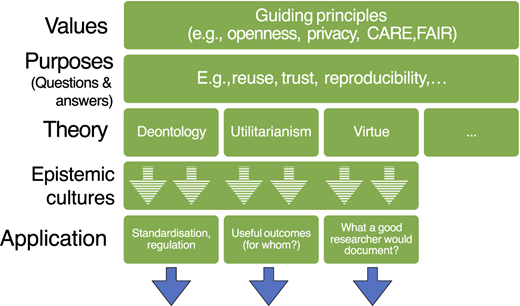
Trajectories of how paradata unfolds from values embedded in guiding principles through theories and practices of how good and bad outcomes are determined to paradata inspired by Brey (2000). Disclosive computer ethics. ACM SIGCAS computers and society, 30(4), 10–16. https://doi.org/10.1145/572260.572264
Trajectories of how paradata unfolds from values embedded in guiding principles through theories and practices of how good and bad outcomes are determined to paradata inspired by Brey (2000). Disclosive computer ethics. ACM SIGCAS computers and society, 30(4), 10–16. https://doi.org/10.1145/572260.572264
Each of them is radically different from each other and leads to fundamentally very different outcomes. The intricacy of the meshwork of trajectories lies, however, in that the outcomes of individual paths might still remind of each other. To some extent, a deontological pursuit for formulating universal laws – for instance, in terms of documentation guidelines – can result in tenets that produce useful outcomes from a utilitarian perspective and paradata that a virtuous paradata maker would produce. Their compatibility is not, however, given, and requires careful consideration. A guideline developed on the basis of what a particular group of users have found useful (utilitarianism) is not a universal law in a deontological sense and requires deliberation when used with other communities. Correspondingly, following a deontological law might not be what a virtuous paradata maker would do in practice, owing to the contextuality of paradata making and use (see, e.g. Huvila et al., 2025b).
Similarly to paradata, also the trajectories are contextual. From the moment when paradata is appropriated into use, their contextuality traverses back to the beliefs of how documentation of processes and practices is expected to contribute to practical questions and answers and value propositions reflected by various guiding principles. Such perceptions are premised on cultural and disciplinary and research community-specific ideas of what is relevant to share and how to reach particular audiences and goals of transparency (e.g. Huvila and Sinnamon, 2024; Poirier and Costelloe-Kuehn, 2019) within scholarship. In parallel, they are inherently linked to ideas and ideologies of openness and transparency, their utility and appropriate means of advancing them, external to research practice. Therefore, in order to understand the values underpinning the trajectories and forces that influence the choice of prioritised questions, apposite theories and how they are applied, rather than taking any of them by their face value, it is relevant to ask genealogical questions of where they come from, what is meant by them, what they meant to achieve, and why do they look like as they do. This applies as much to guiding principles like FAIR and CARE, questions like reproducibility and reuse, theories and their different applications.
Resolving the paradox in practice
The practical value of roughing out trajectories of paradata making from their underpinning values, to questions and answers they are expected to address, ethical theories and how they are operationalised lies in how following these trajectories can help to identify rifts and (dis)continuities in paradata practices and opportunities to address them. Concerning the overarching question of when paradata paradoxal and what specifically limits the extent of process transparency in research documentation, the intricacy and multiplicity of the trajectories mean that paradata becomes a paradox on numerous occasions along their course. The limits and extents are similarly both specific to particular moments along the trajectories but also to the trajectories as a whole and their enmeshments. This means that while resolving many of the paradoxes of paradata are too complicated to be possible, the measures to address and mitigate them need to attend to the trajectories rather than their individual elements.
First, instead of merely focusing on documenting how data is created, processed and used, the length of the trajectories underlines the importance of deciding and disclosing the intended purposes of the produced documentation. In addition, rather than assuming that it is necessary in every single case to go all in: to make data fully compliant with, for example, FAIR (Wilkinson et al., 2016), CARE (Carroll et al., 2020), TRUST (Lin et al., 2020) and LOUD (Newbury, 2018) principles, it is worthwhile to take seriously the FAIR mantra from EU’s Horizon 2020 guidelines, “as open as possible, as closed as necessary” (Landi et al., 2020, p. 47) both when practicing data documentation and formulating its ideals. In many cases, the key aims of process documentation can be reached by keeping paradata rather than disclosing it all, maintaining control and for instance, providing contact details rather than disclosing information upfront. What is needed are trusted (digital) repositories that are trusted not only in a technical sense but also in taking the ethical responsibility they are often implicitly expected to do (Beck and Neylon, 2012), ensuring that data does not end up in the wrong hands, for example following a sudden natural or human-induced crisis or a change of regime. Decisions of when, what and how to disclose and withhold information would also need to be carefully planned in advance, clarified to everyone involved upfront, and applied consistently.
Second, tracing the trajectories shows how the practical making of paradata stems from values that are practiced through enacting ethical theories. Partly, it is worth considering to what extent the existing guiding principles for data documentation cover known and identifiable ethical conundrums relating to practice and process documentation, and to what extent they align in practice with broader standards and guidelines of research ethics (e.g. Declaration of Helsinki and CIOMS Guidelines in the medical domain, see Holm, 2019; van Delden and van der Graaf, 2017; national and transnational research ethics guidelines, see, e.g. Desmond and Dierickx, 2021). CARE principles (2020) acknowledge Indigenous perspectives that differ from Western neoliberal ideas of openness, and further alignment is needed between paradata work, research data practices in general and research ethics. It is also worth considering to what extent similar considerations are pertinent to addressing the concerns of other communities in global, glocal and local societies around the world. At the same time, it is important to consider to what extent particular ideas of openness, sharing and freedom of information – including paradata – are fundamental to participating in specific types of epistemic engagement. Openness has different connotations and implications for a positivist and an interpretivist, just as it has different meanings in communities outside of what is termed research within and outside of academia. A researcher who asks for paradata has an obvious responsibility to problematise their own notion of what information is crucial for specific epistemic purposes and engage in dialogue with anyone who might be concerned with associated forms of disclosure. However, it is equally critical to broaden the dialogue on the mutuality of all such commitments to non-researcher communities and to empower all participants to also reflect on the implications of not documenting and not sharing paradata, and how such actions affect the possibility of engaging in particular types of epistemic moves in the future. As the extensive literature on the implications of insufficient paradata suggests, declining access to specific forms of paradata closes doors to corresponding trajectories of knowledge-making. For contemporary social research, this means the impossibility of studying certain topics. For example, in observational research, without paradata on how a study was conducted, it can be difficult to know whether no mentions of a particular activity mean that it did not take place or that it was simply not documented. For the study of the past, this means sealing off parts of knowledge of the human past and whatever implications that knowledge might have in the present and future. To give an example, in archaeology, the documentation of where and how artefacts were retrieved is crucial for understanding their relation to other artefacts. In this respect, all decisions to document and share concern both the hyper-local world of every individual community and human being and reach far beyond to concern the entire more-than-human lifeworld. Obviously, participation need not be identical across all fields of study and society. Paradata in one field of scholarship can differ from that in other branches of science and scholarship, and there is room for variation between different areas within individual disciplines as well.
Third, while paradata forms a paradox in how process transparency can be both beneficial and detrimental for diverse purposes, it can also play a part in a shift towards addressing ethical conundrums (Huvila et al., 2024a). Rather than merely focusing on paradata as a cause of ethical quandaries of (non-)disclosure, a better understanding of processes can also help us to understand what might be ethically problematic to disclose about them and what might not. This applies as much to the involvement of marginalised communities and disclosing the location of vulnerable cultural remains as it does to excessive use of resources to produce process documentation and transparency requirements that interfere with basic privacy expectations of those involved. Even if paradata is frequently incorporated in the datafied solutionist discourse as a form of auxiliary data that makes other data quantifiable and technically interoperable, when conceptualised as a category of informative things, it does not imply a solution that would automatically signify a mandatory “return to hypothesis-testing, scientific approach” (Kiddey, 2020, p. 34) in interpretative research but rather a force that can both “push back against the current hegemony of the new scientific approach” (Kiddey, 2020, p. 35) and contribute to making datafied and automated research practice (Huggett, 2022a, b) more ethical.
Fourth, as the trajectories of values, goals, theories and applications are associated with specific communities and cultures of thinking about data and documentation, the proximity of data creators and users – the epistemic distance (Huvila, 2020) between those who generate data and paradata and engage with it – appears to be a reasonable indicator of the likelihood and gravity of ethical frictions. While a key affordance associated with paradata is its capacity to facilitate cross-domain and interdisciplinary use of data (Huvila, 2022), many ethical hurdles can reasonably be avoided or mitigated if data (re)use is expected to require a sufficient understanding of practice in the field where data originates – including an awareness of its associated ethical conundrums. Rather than acritically embracing the mantra of unlimited datafication of everything for everyone, it is vital to limit – or at the very minimum slow down – the access to data and process knowledge to leave space and time for taking ethics seriously into consideration and implementing it in paradata, paradata work and their outcomes. This requires shared understanding and standardisation, but also flexibility to accommodate contextual nuances that would otherwise be lost.
Fifth and finally, a further obvious fact is that solving the ethical conundrums relating to process documentation cannot be detached from the general workings of scholarship in society. The wickedness of the problem of paradata also concerns its ethical underpinnings and implications, not only the technical and epistemic difficulties of communicating a sufficient understanding of a practice. Uncritical documentation and sharing of information as a solution to the envisioned problems of transparency and access will have diverse negative consequences. The guiding obligation of social science research to protect human participants (cf. Jacobs et al., 2021) dovetails with a similar obligation towards the environment and the more-than-human world (cf. Szymanski et al., 2021), and the legacy of the past (cf. Ireland and Schofield, 2016). However, uncritical rejection of the need to know more about processes and practices is likewise counter-productive. In contrast to how open science is often framed as a disruptive innovation that is expected to be implemented fast and furiously to reap its asserted benefits, it is critically important to hold back and aim at what Henderson and Clark (1990) term architectural innovation instead. Rather than forcing comprehensive process documentation into place, forging change that is sensitive to ethical conundrums and focused on the aims of documenting rather than its means requires a reconfiguration of current practice rather than a revolution insensitive to what is being changed. It is hardly far-fetched to suggest that such efforts would benefit from being conducted in collaboration with relevant communities mobilising what Wylie (2015) terms interactive pluralism. As she suggests, it can help researchers to affirm and critically examine their epistemic goals, standards and practices. In the profoundly pluricentric contemporary existence, this applies to researchers potentially utilising paradata from across diverse domains, epistemic, theoretical and methodological backgrounds. In the context of open scholarship, it is equally crucial that diverse local and global, professional and non-professional communities outside of academia are engaged in a reciprocal process of not only exchanging ideas but of revising and regenerating them. None of the communities should be winning or losing – or adapting to the point of surrendering its central epistemic and ethical premises (cf. Williams and Shipley, 2020; Wilson, 2007) – but rather jointly learn and together revise their beliefs about the needs and consequences of transparency, what paradata is, what implications it has, and how it can be harnessed to work for the greater benefit of everyone.
Conclusions
In this article, we have concluded that paradata is a paradox: documenting processes is an ethical obligation at the same time as there are, in different senses, problematic types of paradata and controversial kinds of openness and transparency depending on the frame of reference from which they are approached. The problem lies in that paradata is not a thing in an objectifying sense but rather a process in itself. A piece of documentation is not good, bad, adequate, insufficient, too open or too closed in and of itself. All such qualities are matters relating to the process that starts from fundamental values guiding research work and its documentation, the aims of such documentation to facilitate specific future practices, ethical theories underpinning appropriate measures and continues to the measures themselves and the consequences of their use. Correspondingly, the ethics of disclosing or withholding paradata is less a binary question of full disclosure than a matter of following the paradata process and its underpinning trajectories of values, purposes (questions and answers), theories and their applications. Rather than being, the trajectories make the resulting paradata to different degrees disclosable according to specific ethical norms — as open as possible and as closed as necessary. How disclosable it is depends on the circumstances — not only of the paradata artefacts and the context of their use, but also those of the entire trajectories. The processual nature of paradata and its ethics also means that they need to be allowed to take time. Paradata itself can help in the process of deciding what is sensitive and what is disclosable. Trying to force such decisions comes with a risk of unsustainable outcomes in social but also in a very comprehensive more-than-human sense, with consequences for living individuals, communities and societies, the cultural and natural heritage of the past, and the environment. Paradata is, after all, not separate from what it documents nor from the ethical trajectories of choices of how to do it in practice.
An early version of this work was presented at the Computer Applications and Quantitative Methods in Archaeology (CAA) 2024 in Tāmaki Makaurau Auckland, Aotearoa New Zealand. The work greatly benefited from inspiring discussions in the session “The Ethics of Open Data” organised by Leigh Anne Lieberman, Melissa Cradic, and Sarah W. Kansa. The author would also like to thank everyone in the CAPTURE team for all the ethics-related discussions throughout the years.
Note
www.uu.se/en/research/capture; Huvila (2025c).

