


This paper reviews how trust, credibility, and cognitive authority are understood in research on complementary and alternative medicine (CAM) information practices among Chinese immigrant cancer survivors. It argues that this literature is best understood as a process of negotiation across fractured and discontinuous information landscapes, rather than as a simple problem of access, accuracy, or source evaluation.
This paper presents a targeted narrative review with integrative conceptual synthesis. A structured audit trail documents search sources, search blocks, inclusion and exclusion criteria, appraisal logic, evidence tiers, and conceptual coding across library and information science (LIS), health communication, immigrant health, integrative oncology, and survivorship research.
Three conditions shape CAM information practices: dual pathways of exposure, sociocultural mediation, and platformed credibility. Survivors move between deliberate seeking and incidental encounters, interpret information through language, migration, family, and Traditional Chinese Medicine (TCM) frameworks, and assess credibility within digital systems that organize visibility, repetition, and social endorsement.
The review suggests the need for bilingual and culturally responsive credibility support in library, community, and clinical settings. It also shows why future qualitative research should examine disclosure, family mediation, cross-language source comparison, and culturally specific judgments of authority.
The paper contributes an LIS account of CAM information practices by bringing Wilson's information behavior model, information practices and encountering, Lloyd's fractured information landscapes, and Patrick Wilson's cognitive authority into dialogue. It proposes a conceptual model that explains trust as negotiated across clinical, familial, cultural, community, and platformed authority systems.
1. Introduction
Cancer survivorship increasingly unfolds in open, networked, and platform-mediated information environments. Survivors encounter health information through search engines, social media, patient communities, ethnic media, commercial websites, community networks, and clinical communication (ElKefi and Asan, 2021; Farsi et al., 2022; Bachl et al., 2024). Wider access can support empowerment, peer connection, and self-advocacy (Johansson et al., 2021; Lawless et al., 2022). At the same time, it can expose survivors to misinformation, commercialization, conflicting claims, and information overload (Sansevere and White, 2021; Suarez-Lledo and Alvarez-Galvez, 2021; Tapuria et al., 2021). These conditions are especially important for cancer survivors who are considering or using complementary and alternative medicine (CAM).
For many cancer survivors, CAM is not a peripheral concern (Mao et al., 2022; Balneaves et al., 2018; Jazieh et al., 2021). Studies have documented substantial interest in, and use of, CAM among cancer populations, often in relation to symptom management, recovery, long-term quality of life, spiritual meaning, and hopes for control in an uncertain post-treatment period (Andersen et al., 2023; Mao et al., 2022; Balneaves et al., 2018; Jazieh et al., 2021). Yet information about CAM is often uneven in quality, commercially driven, weakly regulated, or framed differently across social and cultural settings (Huchel et al., 2024; Knecht et al., 2020). Survivors may encounter one message from clinicians, another from online communities, another from family members, and another from traditions such as Traditional Chinese Medicine (TCM) (Balneaves et al., 2018; Hutten et al., 2023; Hu et al., 2020). As a result, the central issue is not only whether information is available. It is also how survivors decide what feels trustworthy, useful, safe, and worth acting on (Balneaves et al., 2018; Hutten et al., 2023; Scarton et al., 2018).
This issue becomes even more complex for Chinese immigrant cancer survivors (Lim et al., 2019; Wen et al., 2014; Young et al., 2023). Many move across more than one language, more than one health system, and more than one cultural framework for understanding illness and recovery (Lim et al., 2019; Yeom et al., 2022). They may consult biomedical advice while also valuing family experience, ethnic community knowledge, Chinese-language media, or culturally grounded therapies (Kakai et al., 2003; Leng et al., 2020; Ng et al., 2021). They may also manage stigma, protect face, or avoid conflict with clinicians when discussing CAM use (Akeeb et al., 2023; Hu et al., 2020; Jermini et al., 2019; Li et al., 2021). In this setting, trust and credibility are not fixed properties of information sources. They are negotiated (Wilson, 1983; Lloyd, 2017; Sbaffi and Rowley, 2017).
This paper argues that research on CAM information practices among Chinese immigrant cancer survivors can be better understood through a library and information science (LIS) lens. In particular, it shows the value of reading this literature through Wilson's (1997) model of information behavior, scholarship on information practices (Dervin, 1998; Savolainen, 2008), the idea of fractured information landscapes (Lloyd, 2017), and Patrick Wilson's (1983) concept of cognitive authority. Together, these perspectives help explain why survivors do not simply evaluate information by accuracy alone. They work across overlapping and sometimes competing systems of authority while responding to practical, social, and cultural constraints.
The paper has three goals. First, it synthesizes literature on CAM information practices in cancer survivorship, with particular attention to Chinese immigrant survivors. Second, it examines how trust, credibility, and authority are constructed across clinical, digital, familial, and culturally grounded information settings. Third, it proposes a conceptual model and identifies implications for LIS theory and for culturally responsive information support in library, community, and clinical contexts. This paper contributes to LIS by showing how cognitive authority is negotiated across fractured information landscapes in cancer survivorship. Rather than treating trust as a property of individual sources, the model explains trust as an outcome of movement across exposure pathways, sociocultural filters, and platformed credibility conditions. This contribution extends information behavior research by connecting source authority, relational mediation, and platform visibility within one conceptual account of CAM information practices.
2. Review approach and literature selection
This paper uses a targeted narrative review with integrative conceptual synthesis. Following review typologies in LIS and health information research, the review does not aim to estimate prevalence or provide a full systematic map of all studies on CAM and cancer survivorship. Its purpose is to develop and refine a conceptual model. For this reason, the review combines structured database searching with citation chaining and close conceptual reading. The aim was not only to identify studies that supported the model, but also to locate literature that complicated, limited, or clarified its scope.
Searches were conducted in December 2025, with citation chaining used during revision to check key theoretical, comparator, and disclosure-related sources. The main publication range was 2003–2025, because Kakai et al. (2003) was one of the earliest retained studies linking ethnicity, cancer, CAM use, and health information choices. Foundational LIS works published before 2003 were retained when they were theoretically necessary.
The phrase ‘conceptually relevant’ is used in a specific sense. It does not mean that literature was selected because it supported a pre-existing framework. A work was treated as conceptually relevant when it helped explain one or more core processes in the review. These processes included seeking or encountering CAM information, judging credibility across clinical and digital settings, negotiating disclosure, moving across languages and health systems, and assigning authority under uncertainty. Literature that complicated the initial argument was deliberately included. This included work on non-Chinese immigrant and ethnic minority cancer populations, CAM disclosure, clinician-patient communication, online health misinformation, information horizons, and serendipitous information acquisition.
The search strategy combined database searching with citation chaining. Searches were designed to locate literature across four domains: LIS and information behavior; CAM and integrative oncology; cancer survivorship and immigrant or minority health; and digital health information credibility. Databases and sources included Library, Information Science and Technology Abstracts (LISTA), Library and Information Science Source, Scopus, Web of Science Core Collection, PubMed/MEDLINE, CINAHL, PsycINFO, and Google Scholar. Citation chaining began from key works, including Wilson (1983, 1997, 1999), Lloyd (2017), Balneaves et al. (2018), Scarton et al. (2018), Sbaffi and Rowley (2017), Sutton et al. (2019), and Erdelez and Makri (2020).
Search terms combined population, condition, information, and theoretical concepts. Population terms included Chinese immigrant*, Chinese American, Chinese Canadian, Asian immigrant*, ethnic minorit*, migrant, and underserved. Condition and CAM terms included cancer survivor*, oncology, cancer patient*, complementary medicine, alternative medicine, integrative oncology, traditional Chinese medicine, TCM, herbal medicine, and acupuncture. Information-related terms included information seeking, information behavior, information practices, online health information, credibility, trust, cognitive authority, and disclosure. Theoretical terms included information encountering, serendipity, information horizons, and fractured information landscapes. These terms were combined iteratively because relevant literature uses different disciplinary vocabularies. For example, oncology studies may discuss CAM disclosure without using information behavior terminology. LIS studies may discuss credibility or authority without focusing on cancer survivorship.
Inclusion decisions were made through analytic screening rather than statistical pooling. Works were included when they addressed CAM use, information needs, or information support among cancer survivors. They were also included when they addressed Chinese immigrant, Asian immigrant, or other minority survivorship experiences relevant to language, culture, disclosure, or care relationships. Additional included works addressed health information credibility, trust, misinformation, online source evaluation, LIS concepts, or digital platform conditions that shape visibility and exposure. Works were excluded when they focused only on CAM efficacy, pharmacology, or clinical outcomes without information, communication, or decision-making relevance. They were also excluded when they were narrowly biomedical, duplicated stronger sources, or did not inform the review question.
The literature was then read in two stages. First, sources were grouped by evidence level and substantive focus. Second, they were coded against the emerging model domains. Empirical studies were assessed for population relevance, clarity of design, relevance to information or communication practices, and transferability to the review's focus. Conceptual works were assessed for explanatory value, influence within LIS or health information research, and fit with the phenomenon under analysis. Clinical studies were not appraised for treatment effectiveness because the review does not evaluate CAM efficacy.
To reduce the risk of a confirmatory review, literature that did not fit the initial model was not automatically excluded. Comparator studies on other immigrant and ethnic minority cancer survivors and studies of CAM disclosure to clinicians were used to test the model's boundaries. This process clarified which dynamics appear broader across marginalized survivorship contexts, such as disclosure barriers and clinical communication concerns, and which are more specific to Chinese immigrant contexts, such as the role of TCM, face, family mediation, and Chinese-language information environments. The framework was therefore refined through comparison across empirical and theoretical sources rather than applied as a fixed structure from the outset.
The final cited corpus comprised 57 works. Table 1 summarizes the search and selection audit, including search period, sources, search concepts, inclusion and exclusion criteria, appraisal logic, and the purpose of the audit trail. Table 2 presents the evidence levels used in the synthesis and explains how different bodies of literature contributed to the argument. Table 3 maps the cited corpus to the analytic categories used in the conceptual synthesis. Because this is an integrative conceptual synthesis, individual works often informed more than one analytic category.
Search and selection audit for the targeted narrative review
| Review element | Reporting in the revised review |
|---|---|
| Review type | Targeted narrative review with integrative conceptual synthesis; not a systematic review or scoping review |
| Search period and scope | Searches conducted in December 2025; main publication range 2003–2025; foundational LIS works retained when theoretically necessary |
| Main sources | LISTA; Library and Information Science Source; Scopus; Web of Science Core Collection; PubMed/MEDLINE; CINAHL; PsycINFO; Google Scholar; citation chaining from key theoretical and empirical works |
| Core search concepts | Cancer survivorship; CAM, integrative oncology, and TCM; Chinese immigrant, Asian immigrant, minority, migrant, and underserved populations; information seeking, information behavior, information practices, trust, credibility, cognitive authority, disclosure, information encountering, fractured information landscapes, and information horizons |
| Inclusion criteria | Works addressing CAM information practices, survivorship information needs, immigrant or minority health communication, disclosure, multilingual information movement, trust or credibility, platformed health information, or LIS concepts needed to explain authority and discontinuity |
| Exclusion criteria | Works focused only on clinical CAM efficacy, pharmacology, biomedical mechanisms, or treatment outcomes without information, communication, credibility, disclosure, decision-making, or sociocultural relevance |
| Appraisal logic | Empirical works were assessed for population relevance, design clarity, information or communication relevance, and transferability. Conceptual works were assessed for explanatory value, influence in LIS or health information research, and relevance to the phenomenon |
| Final cited corpus | 57 works. Counts by analytic category are non-exclusive because a single work could inform more than one part of the synthesis |
| Purpose of audit trail | To show how conceptually relevant literature was identified, to document boundary testing, and to reduce the risk that the review simply confirmed a pre-selected framework |
Evidence level and role in the synthesis
| Evidence level | Example sources | Role in the argument |
|---|---|---|
| Direct Chinese immigrant or Chinese-speaking cancer evidence | Balneaves et al. (2018), Chiu et al. (2006), Leng and Gany (2014), Leng et al. (2014, 2020), Lim et al. (2019), Wen et al. (2014), Young et al. (2023) | Grounds the discussion of language, family mediation, TCM, support needs, culturally specific survivorship issues, and clinical communication |
| Closely related Chinese or Chinese-heritage evidence | Hu et al. (2020), Ma et al. (2021), Ng et al. (2021) | Extends the evidence base on digital support, family information needs, dietary practices, and culturally shaped health information practices |
| Comparator immigrant, minority, and underserved evidence | Akeeb et al. (2023), Bari et al. (2021), Butow et al. (2013), Coleman et al. (2024), Kakai et al. (2003), Kristoffersen et al. (2022) | Tests transferability and boundaries, especially for disclosure, communication, unmet needs, socioeconomic conditions, and minority cancer survivorship |
| General cancer-CAM information evidence | Hutten et al. (2023), Scarton et al. (2018), Johnston et al. (2025), Sansevere and White (2021), Huchel et al. (2024), Lam et al. (2023) | Supports the analysis of CAM information practices, exposure, trust, source evaluation, digital CAM content, and online communities |
| LIS and health information theory | Wilson (1983, 1997, 1999), Lloyd (2017), Dervin (1998), Savolainen (2008), Sonnenwald (1999), Erdelez (1997), Erdelez and Makri (2020), Sutton et al. (2019) | Provides the conceptual and methodological grounding for information behavior, information practices, discontinuity, encountering, cognitive authority, and review positioning |
Conceptual coding of the cited corpus
| Analytic category | Role in synthesis | Cited works coded to category, non-exclusive (n) |
|---|---|---|
| Information behavior, practices, and encountering | Explains active seeking, incidental exposure, source use, and everyday information practice | 17 |
| Fractured landscapes, discontinuity, sense-making, and information horizons | Explains gaps, boundary crossing, and movement across different information settings | 8 |
| Cognitive authority, trust, and credibility | Explains why some sources become worth relying on and how credibility differs from action-guiding authority | 12 |
| CAM survivorship, disclosure, and sociocultural mediation | Grounds the framework in cancer survivorship, Chinese immigrant health, minority and underserved populations, family mediation, TCM, and clinician-patient communication | 31 |
| Digital platforms, misinformation, and platformed credibility | Explains how ranking, recommendation, repetition, social endorsement, and commercial visibility shape trust | 16 |
Note(s): The categories in Table 3 are not mutually exclusive. Each cited work was coded to one or more analytic categories based on its role in the synthesis. For example, a study of CAM disclosure among Chinese immigrant cancer survivors could be coded under both “CAM survivorship, disclosure, and sociocultural mediation” and “cognitive authority, trust, and credibility.” The purpose of the coding was to make the logic of conceptual relevance visible, not to classify studies into mutually exclusive evidence types
This tiered evidence logic is important because the literature directly focused on Chinese immigrant cancer survivors is limited. The model is grounded in direct Chinese immigrant and Chinese-speaking cancer survivorship studies where available. Broader comparator literature is used to test transferability and limits, not to assume that all immigrant or ethnic minority cancer survivors have the same experiences.
3. Theoretical framework: authority, discontinuity, and fractured landscapes
The review is guided by four mutually reinforcing conceptual lenses: information behavior and practices; information encountering and discontinuity; fractured information landscapes; and cognitive authority. These lenses are not treated as interchangeable. Each explains a different part of the problem. Information behavior and practices explain what people do with information. Information encountering and discontinuity explain how CAM information often enters awareness outside deliberate searching and how gaps or breakdowns become meaningful. Fractured information landscapes explain why survivors must move across settings with different norms, languages, and forms of legitimacy. Cognitive authority explains how certain sources become worth relying on in practice. Figure 1 summarizes how these lenses complement each other.
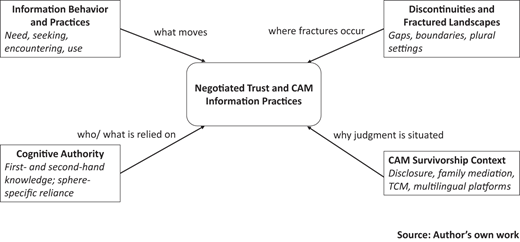
Wilson's model of information behavior provides the starting point because it conceptualizes information seeking, processing, and use within social and environmental contexts (Given et al., 2023; Wilson, 1997, 1999). Its value for this review lies in its attention to intervening variables, including psychological, social, role-related, environmental, and source-related factors. For cancer survivors, these variables may include symptom burden, fear of recurrence, language barriers, family expectations, clinical communication, platform access, and perceptions of source reliability. The model also leaves room for feedback and iteration: information use can generate new uncertainty, further seeking, or revised judgments about sources.
However, a behavioral model alone is not sufficient. CAM information practices are not only individual acts of problem solving. They are embedded in social relationships, cultural repertoires, routines, and practical constraints. Information practices research broadens the analysis by examining the socially situated ways people seek, share, avoid, interpret, and use information in everyday life (Dervin, 1998; Savolainen, 2008). This is important in survivorship because CAM-related decisions may be shaped by family conversations, cultural expectations, religious or spiritual meanings, dietary routines, and informal comparison with peers. A practice perspective therefore helps explain why information can be credible in one setting and questionable in another.
The review also draws on information encountering and related work on serendipity and opportunistic information acquisition. CAM information is often not obtained through a single deliberate search. It may be encountered through social media, family recommendations, community conversations, ethnic media, online forums, or commercial videos (Erdelez, 1997; Williamson, 1998; Erdelez and Makri, 2020). This literature helps correct a search-centered bias. It shows that useful, persuasive, or risky information may become salient because it appears unexpectedly, repeatedly, or at a moment of heightened concern. In CAM contexts, an incidental encounter can become the trigger for later seeking, cross-checking, disclosure, or therapy adoption.
Discontinuity is the linking concept across these traditions. In Dervin's sense-making approach, information need can be understood as a gap or discontinuity between a person's situation and their ability to move forward (Dervin, 1998). Sonnenwald's information horizons similarly draw attention to the range of sources and social networks available within particular contexts (Sonnenwald, 1999). Lloyd's fractured information landscapes extend this concern by showing how people's established information environments can be disrupted when they move across institutional, social, linguistic, or cultural boundaries (Lloyd, 2017). Although Lloyd developed the concept in relation to refugees and forced migration, its analytic value extends to other contexts where people must reconcile multiple information worlds. Chinese immigrant cancer survivors may not experience fracture in the same way as refugees, but they may experience discontinuities across health systems, languages, cultural frameworks, family expectations, and digital platforms.
Lloyd's concept is especially useful because it resists a deficit view of information problems. In her account, fractured landscapes are not simply environments where people lack information. They are environments where established ways of knowing may no longer align with new institutional expectations, where sources carry different legitimacy across settings, and where people must learn how to recognize, validate, and use information in unfamiliar conditions (Lloyd, 2017). Applied to CAM information practices, this concept helps explain why survivors may move between biomedical advice, TCM frameworks, family testimony, online forums, community networks, and commercial content. The problem is not only source quality. It is the work of reconciling multiple systems of meaning and accountability.
Patrick Wilson's concept of cognitive authority provides the final conceptual bridge. In Second-Hand Knowledge, Wilson argues that much of what people know is not derived from direct firsthand experience, but from reliance on what others say, write, demonstrate, or make available (Wilson, 1983). Cognitive authority refers to the authority granted to sources that are regarded as knowing, believable, relevant, and worth relying on within a particular sphere. It differs from administrative authority or formal status. A clinician may possess formal biomedical authority. Yet a family member, peer survivor, TCM practitioner, ethnic media source, or platform-amplified voice may hold cognitive authority for a specific question. This is especially likely when the question concerns lived experience, cultural fit, side effects, diet, or daily management.
This distinction between firsthand and second-hand knowledge is central to CAM information practices. Survivors rarely have complete firsthand knowledge of therapy safety, interactions, evidence quality, or long-term effects. They therefore rely on second-hand knowledge produced by clinicians, relatives, online peers, medical websites, community organizations, social media influencers, and traditional knowledge systems. Cognitive authority helps explain why some of these sources become action-guiding. It also explains why credibility and authority are not identical. A source may appear credible but not become authoritative enough to shape action; conversely, a source may have strong relational or cultural authority even when its biomedical evidence is uncertain.
Taken together, these lenses shift the paper away from asking only whether survivors find accurate information. They foreground how survivors negotiate authority across discontinuous settings, how incidental exposure becomes consequential, how cultural and relational mediators shape interpretation, and how digital systems organize what appears visible and familiar. The next section uses this framework to synthesize the literature thematically.
4. Navigating the fracture: a thematic synthesis
4.1 The dual pathways of exposure: seeking and encountering
Information behavior research has often focused on active seeking. Survivors search for treatment information, symptom management advice, practical support, side-effect management, and survivorship guidance (Kuhlthau, 1991; Scarton et al., 2018; Wen et al., 2014; Given et al., 2023). This work is valuable, but it can be too narrow when applied to CAM. CAM-related information is also encountered incidentally through social media feeds, community networks, advertisements, family conversations, support groups, ethnic media, and culturally familiar routines (Erdelez, 1997; Williamson, 1998; Erdelez and Makri, 2020). The result is a dual pathway: survivors may search deliberately, but they also become aware of CAM through ordinary social and digital exposure.
This distinction matters because CAM often enters survivorship life before it becomes a formal decision. A survivor may hear about an herbal formula from a relative, see acupuncture discussed in a Chinese-language forum, watch a video about diet and recurrence prevention, or receive advice in a community setting. These encounters can shape what becomes thinkable or worth investigating. They may also generate uncertainty: a survivor who had not planned to seek CAM information may begin searching after repeated exposure to claims about symptom relief, immune support, or treatment side-effect reduction (Balneaves et al., 2018; Hutten et al., 2023; Johnston et al., 2025). In this sense, information encountering is not accidental in consequence, even when it is accidental in origin.
The literature also suggests that active seeking and incidental exposure are mutually reinforcing. A purposeful search may be triggered by an encounter, and an encounter may become meaningful because a survivor is already managing symptoms, fear of recurrence, or unmet needs (Schmidt et al., 2022; Hutten et al., 2023). This movement is especially visible in digital environments, where recommendation systems, online forums, and social media feeds can repeatedly expose users to related claims after a single search or interaction (Bachl et al., 2024; Ng et al., 2023). CAM information practices therefore cannot be modeled as a linear sequence from need to source to decision. They are iterative movements between seeking, encountering, cross-checking, discussion, avoidance, and action.
4.2 Interpreters and sociocultural filters
The second theme concerns sociocultural mediation. Survivors do not evaluate information as isolated individuals. They interpret information through relationships, migration histories, language access, cultural meanings, and practical constraints. Chinese immigrant survivors may move between English-language clinical information and Chinese-language community, media, or platform sources, which offer different forms of accessibility and authority (Butow et al., 2013; Lim et al., 2019; Wen et al., 2014). Information that appears authoritative in a biomedical setting may be difficult to understand or apply, while information from family or community networks may feel more linguistically accessible and culturally intelligible.
TCM is particularly important because it can function as more than a treatment option. For some survivors, it is an information system with its own concepts of balance, recovery, diet, energy, bodily regulation, and prevention (Chiu et al., 2006; Leng and Gany, 2014; Leng et al., 2020; Zhao et al., 2025). This means that CAM information is not always interpreted as an unfamiliar claim requiring evaluation from the ground up. It may be read through prior cultural knowledge, family experience, and established categories of bodily care. At the same time, TCM-related claims may create clinical uncertainty when survivors must reconcile cultural familiarity with biomedical concerns about interactions, safety, or evidence quality (Jermini et al., 2019; Knecht et al., 2020; Mao et al., 2022).
Family members also act as interpreters, translators, and gatekeepers, and sometimes decision partners. They may search for information, recommend or discourage therapies, translate clinical advice, filter online content, or shape whether CAM use is discussed with clinicians (Balneaves et al., 2018; Ma et al., 2021). These roles can support survivorship by reducing language barriers and connecting survivors to community knowledge. They can also complicate authority when family recommendations compete with clinical advice or when relatives control the flow of information. In such cases, cognitive authority is distributed across relationships rather than located in a single source.
The analysis also situates Chinese immigrant survivors within broader research on immigrant, racialized, underserved, and minority cancer populations. Studies of underserved, uninsured, immigrant, and racialized minority cancer populations show that CAM use and CAM-related information practices are shaped by several intersecting factors. These include socioeconomic status, language access, racialized healthcare experience, cultural safety, social support, spirituality, and perceived unmet needs (Bari et al., 2021; Coleman et al., 2024; Kakai et al., 2003; Butow et al., 2013). The Chinese immigrant context is therefore not exceptional in having fractured information conditions. What is distinctive is the specific configuration of TCM frameworks, Chinese-language media ecologies, family mediation, migration histories, and clinical communication barriers. This comparative framing avoids overgeneralizing from one ethnic group while still preserving the analytic specificity of the paper's focus.
4.3 Disclosure, silence, and clinical relationships
A third theme concerns disclosure and the clinician-patient relationship. CAM use often remains partially disclosed, selectively disclosed, or undisclosed to health professionals (Akeeb et al., 2023; Balneaves et al., 2018; Kristoffersen et al., 2022). Non-disclosure is sometimes treated as an individual failure of communication, but the literature suggests a more complex information process. Survivors may avoid disclosure for several reasons. They may anticipate disapproval, see CAM as outside clinical concern, struggle to translate culturally grounded practices into biomedical language, or wish to preserve relational harmony (Hu et al., 2020; Li et al., 2021). Disclosure is therefore not simply the endpoint of information seeking. It is a site where competing authority systems become visible.
This issue is central to cognitive authority. A clinician may have strong authority regarding treatment safety and drug interactions, while family members or culturally familiar practitioners may have stronger authority regarding diet, everyday symptom management, or culturally meaningful recovery practices. When survivors anticipate that one authority system will invalidate another, they may manage information strategically by withholding, softening, translating, or discussing CAM only in selected settings. Such practices should not be dismissed as irrational. They are ways of navigating fractured authority conditions.
4.4 Platformed credibility and system-shaped authority
The fourth theme concerns platformed credibility. Digital environments have expanded access to CAM information, but they have also changed how authority is signaled and organized (Bachl et al., 2024; Ng et al., 2023; Sbaffi and Rowley, 2017; Huchel et al., 2024). Search engines, social media platforms, recommendation systems, online forums, and commercial websites do not simply deliver information. They structure visibility through rankings, recommendations, repetition, engagement metrics, sponsored placement, visual polish, and social endorsement. These cues can create impressions of legitimacy that do not necessarily correspond to evidence quality (Sansevere and White, 2021; Huchel et al., 2024).
This is especially important in immigrant and multilingual contexts. Chinese-language platforms, websites, messaging apps, video channels, and community networks can make CAM information more accessible and socially meaningful (Chang et al., 2021; Zhao et al., 2022). They can also intensify exposure to anecdotal claims, product marketing, and uneven credibility. Survivors may rely on social endorsement or repeated exposure when formal signals of authority are difficult to compare across languages and systems (Chang et al., 2021; Lam et al., 2023; Ng et al., 2023; Zhang et al., 2021). The platform itself therefore becomes an authority-shaping environment. It may not possess authority in the human sense, but it organizes familiarity and visibility in ways that affect what seems credible.
Across these four themes, the same pattern recurs: CAM information practices are not adequately explained by access, literacy, or source quality alone. Survivors move through discontinuities among languages, platforms, relationships, cultural frameworks, and health systems. Trust emerges through this movement. A source becomes authoritative not simply because it is objectively accurate, but because it is encountered at the right time, mediated by trusted relationships, intelligible within cultural frameworks, reinforced through platform visibility, and judged useful for a practical survivorship concern.
5. Conceptualizing CAM information practices across fractured landscapes
The conceptual model in Figure 2 explains CAM information practices as a process of negotiated trust across fractured information landscapes. The model centers on three interacting domains: exposure pathways, sociocultural filters, and platformed credibility conditions. These domains shape how survivors recognize cognitive authority and decide whether to act, disclose, withhold, cross-check, or continue seeking information.
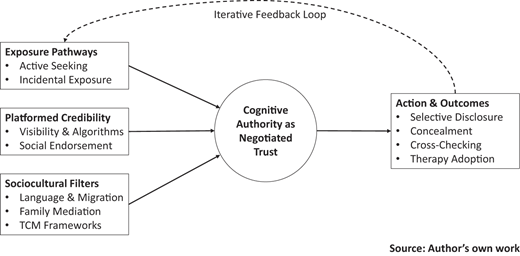
Conceptual model of CAM information practices in fractured information landscapes
Conceptual model of CAM information practices in fractured information landscapes
The model is meant to capture processes that existing studies often describe separately. Some studies focus on information needs, others on CAM prevalence, family mediation, disclosure, digital exposure, or culturally grounded care practices (Balneaves et al., 2018; Hu et al., 2020; Lam et al., 2023; Scarton et al., 2018). What is often missing is an account of how these elements interact. The model addresses that gap by treating CAM information practices as relational, iterative, and authority-laden.
The first domain, exposure pathways, includes both active seeking and incidental exposure. Survivors may search deliberately when they need help with symptoms, side effects, recovery, recurrence concerns, or decision making. They may also encounter CAM information through family conversations, ethnic media, social media feeds, online forums, and community interaction. These two pathways influence each other over time. Repeated incidental exposure may prompt active searching, while active searching may reshape future platform recommendations and increase further encounters.
The second domain, platformed credibility conditions, refers to the ways digital systems organize authority through visibility, repetition, social endorsement, and design cues. These features can amplify some sources while obscuring others, even when survivors are trying to make careful judgments. Claims may become familiar because they are repeatedly encountered. They may become persuasive because they circulate through trusted community channels. They may appear legitimate because they are visually polished, heavily shared, or positioned near biomedical terminology. Platformed credibility therefore helps explain how cognitive authority can be simulated or redistributed by systems.
The third domain, sociocultural filters, includes language, migration-related conditions, family mediation, stigma, face concerns, and culturally grounded health frameworks such as TCM. These filters shape not only what information is understandable, but also what seems relevant, respectful, actionable, and safe to discuss. The same source may be judged differently depending on who presents it, in what language, in what relational setting, and for what purpose. Sociocultural filters therefore do not sit outside information behavior. They shape the interpretive conditions under which information becomes meaningful.
At the center of the model is cognitive authority. Survivors do not encounter authority as singular or stable. They negotiate among biomedical authority, relational authority, cultural authority, experiential authority, and platform-shaped authority. The importance of each form changes depending on the information problem. A clinician may be authoritative for drug interactions. A family member may be authoritative for culturally meaningful dietary practices. An online peer may be authoritative for lived experience. A TCM framework may be authoritative for interpreting bodily balance. A digital platform may shape what claims become familiar enough to consider. Cognitive authority sits at the center because it is the point where exposure, interpretation, and practical judgment come together.
The model also includes feedback loops. Information use may lead to more seeking, selective disclosure, concealment, cross-checking, therapy adoption, therapy avoidance, or renewed reliance on one authority system over another (Wilson, 1999). A survivor who experiences dismissive clinical communication may turn to culturally familiar sources. A survivor who encounters alarming online content may consult family members before deciding what to do. A recommendation from a trusted family member may send someone back to online searching, while repeated exposure to social media content may encourage selective discussion with a clinician rather than full disclosure. In this sense, these feedback loops show why CAM information practices are iterative and relational rather than linear.
It is useful to contrast this model with a simple linear information-seeking approach. In a linear model, a person has a need, looks for information, evaluates sources, and makes a decision. That sequence captures part of what happens, but it misses how people move back and forth across social relationships, languages, platforms, and authority systems. It also misses silence (Akeeb et al., 2023; Balneaves et al., 2018; Hu et al., 2020; Li et al., 2021). In many survivorship situations, what shapes decision making is not only what information is found, but what information is withheld, softened, translated, or discussed only in certain settings. Non-disclosure is therefore not external to information behavior. It is one of the outcomes through which fractured authority is managed.
The model's contribution is to show how cognitive authority operates within fractured information landscapes. Existing studies often describe barriers, preferences, unmet needs, or patterns of source use, but they less often explain how authority is negotiated across several information systems at the same time (Butow et al., 2013; Balneaves et al., 2018; Scarton et al., 2018; Zhang et al., 2021). By placing cognitive authority within fractured landscapes, the model offers a clearer way to understand why trust in survivorship is dynamic, socially mediated, culturally situated, and system-shaped. It also shows why CAM information practices should be understood not simply as responses to information quality, but as ongoing efforts to navigate plural systems of meaning and legitimacy.
6. Discussion and implications
The conceptual model developed here has several implications for LIS. First, it expands information behavior research by showing that survivorship information practices involve movement across infrastructures, relationships, and culturally specific systems of meaning. Wilson's model remains useful because it captures context, intervening factors, and the iterative movement between need, seeking, and use (Wilson, 1997, 1999). The present review extends this discussion by foregrounding plural authority systems. In immigrant survivorship, information behavior is shaped not only by individual need and source choice, but also by language mediation, family interpretation, platform visibility, and culturally grounded judgments of credibility.
The review also strengthens the connection between information behavior and cognitive authority. Health information research often treats trust as something located in an individual source, institution, or technology (Sbaffi and Rowley, 2017; Chang et al., 2021). This paper suggests that trust is better understood as emerging from the interaction between sources, systems, relationships, situations, and histories of care. Instead of asking only why one source is trusted, LIS researchers should also ask how conditions of visibility, familiarity, social endorsement, and cultural intelligibility make certain sources authoritative in practice. This shift is especially important for CAM because authority is often divided among biomedical evidence, personal experience, traditional knowledge, and commercial or platformed claims.
Moreover, the review clarifies the value of fractured information landscapes while avoiding overreliance on a single concept. Lloyd's framework is useful because it explains discontinuity, boundary crossing, and the work of reconciling knowledge systems (Lloyd, 2017). However, the framework becomes stronger when placed in dialogue with information horizons, sense-making gaps, information encountering, and cognitive authority (Dervin, 1998; Sonnenwald, 1999; Erdelez and Makri, 2020; Wilson, 1983). This broader theoretical architecture prevents the paper from treating fracture as a metaphor only. It specifies what is fractured: exposure pathways, linguistic access, clinical and cultural authority, platform visibility, disclosure norms, and everyday decision-making contexts.
Furthermore, the model contributes to research on digital health credibility by showing that platform design is part of the information landscape itself. Digital platforms shape what survivors encounter, what becomes familiar, and what is socially endorsed. From an LIS perspective, credibility support should therefore move beyond teaching users to identify reliable websites. It should also help them understand how rankings, recommendations, advertising, repetition, influencer authority, and community endorsement shape what appears trustworthy.
The practical implications are significant. Libraries, community organizations, and clinical information services can support survivors by offering bilingual and culturally responsive CAM information resources; curated pathways that distinguish evidence-based integrative oncology resources from commercial promotion; and guidance for comparing sources across languages and authority systems. Libraries and related information services can play an important role because they can provide mediated support outside the time pressure and hierarchy of clinical encounters. These settings can help survivors ask questions they may hesitate to raise with clinicians, while still encouraging attention to safety, interactions, and evidence quality.
Clinical settings also have a role to play. If clinicians acknowledge that survivors draw from multiple authority systems, they may create safer conditions for disclosure and more meaningful conversation. Rather than treating CAM questions as evidence deficits or noncompliance, clinicians can ask open-ended questions about what survivors have heard, where they encountered it, who recommended it, and what concerns they hope to address. This approach does not require clinicians to endorse unsupported therapies. It requires them to understand disclosure as an information practice shaped by trust, cultural safety, and anticipated judgment.
Methodologically, the review also points directly to the need for future qualitative research. Many important processes within fractured landscapes, such as selective disclosure, hidden uncertainty, family interpretation, and culturally specific judgments of trust, are difficult to capture through broad surveys alone. Qualitative research can show how survivors describe these practices in their own words and how authority is negotiated in everyday life. Interviews, focus groups, diary studies, digital ethnography, and participatory methods could show how survivors describe uncertainty, compare sources, and decide what can be said in clinical, family, and online settings. Such work would also help examine variation across cancer type, treatment stage, symptom burden, migration history, socioeconomic status, digital literacy, and family structure.
The review has limitations. Because it is a targeted narrative review with integrative conceptual synthesis, it does not provide exhaustive systematic mapping of all studies on CAM, all Chinese immigrant cancer survivorship research, or all digital health credibility literature. It also does not appraise clinical efficacy of CAM therapies. Its strength is conceptual integration; its limitation is that it depends on transparent selection and careful boundary setting. Future work could extend this review through a systematic or scoping review that maps empirical studies by population, cancer type, CAM modality, source type, disclosure behavior, and theoretical framework. Such work would be valuable for testing, refining, or challenging the conceptual model proposed here.
Future research should also examine whether the model travels beyond Chinese immigrant cancer survivors. Other immigrant, racialized, and underserved cancer survivor groups may face similar fractured authority conditions, but the specific configurations of language, culture, family, spirituality, healthcare experience, and platform use may differ. Comparative qualitative research could identify which elements of the model are generalizable across marginalized survivorship contexts and which are specific to Chinese-language, TCM-informed, or migration-shaped information environments.
7. Conclusion
Research on CAM information practices among Chinese immigrant cancer survivors points to a complex information environment shaped by migration, language, culture, family relationships, digital platforms, disclosure norms, and competing forms of authority. Survivors are not simply choosing between reliable and unreliable information. They are navigating fractured information landscapes in which different sources offer different kinds of legitimacy, usefulness, and meaning.
A LIS perspective is especially valuable because it explains how trust is produced through information practices rather than located only in sources. By bringing together information behavior, information practices and encountering, fractured information landscapes, and cognitive authority, this paper shows that trust in survivorship is relational, situated, and socially negotiated. This perspective helps explain why CAM information practices cannot be reduced to source quality alone. They involve cross-language movement, family mediation, platformed exposure, selective disclosure, and culturally grounded judgments of practical relevance.
For information studies, the broader contribution is clear. Documents, platforms, communities, expert systems, and cultural frameworks do not simply transmit health knowledge. They also shape what can be known, what can be trusted, and what kinds of judgment become possible in everyday life. CAM information practices among Chinese immigrant cancer survivors make this especially visible and offer a productive site for advancing LIS theories of authority, credibility, and information practice in culturally layered health environments.

