


This study develops and applies a multicriteria decision-support model to evaluate maritime patrol aircraft alternatives in the context of Brazilian Air Force strategic planning.
The study considers nine aircraft alternatives and ten quantitative evaluation criteria. Three Brazilian Air Force officers, including engineers and operations officers, participated in unstructured interviews to help identify and confirm the criteria and alternatives. Aircraft performance data were obtained from the Military Power database and cross-checked against information available on manufacturers’ websites. The Preference Selection Index (PSI) was used to derive objective, data-driven criterion weights, while the Combined Compromise Solution (CoCoSo) method was used to rank the alternatives. Sensitivity analysis was conducted using three values of the compromise parameter.
In the baseline scenario, the Kawasaki P-1 was the highest-ranked alternative, followed by the Tu-142 and the P-8 Poseidon. Although the final scores varied slightly across the three tested values of the compromise parameter, none of the alternatives changed position, indicating stability within the tested parameter settings.
The study’s contribution is primarily applied. It provides a transparent framework for preliminary screening of maritime patrol aircraft using quantitative and monotonic criteria when defensible subjective weights are unavailable, while explicitly recognizing that the framework is not a complete acquisition model.
1. Introduction
Maritime patrol aircraft support surveillance, search and rescue, maritime domain awareness, anti-submarine warfare, and the protection of national maritime areas. The strategic role of these platforms has evolved alongside the expansion of their surveillance, reconnaissance, rescue, and maritime security functions (Richard et al., 2021). In Brazil, the Brazilian Air Force has historically employed dedicated patrol platforms to support national defense and maritime safety missions, including the PBY Catalina, Lockheed Hudson, P-95 Bandeirulha, and P-3 Orion aircraft (Oliveira and Fernandes, 2019).
The prospective replacement of the current P-95BM and P-3AM platforms is addressed within the strategic planning context established by the Brazilian Air Force’s Military Strategic Plan (PEMAER) 2024–2033 (Brasil, 2024). These platforms perform activities related to the surveillance and protection of Brazilian maritime areas, including intelligence, surveillance and reconnaissance, maritime patrol, search and rescue, and anti-submarine warfare missions.
The evaluation of maritime patrol aircraft involves multiple, potentially conflicting technical, operational, logistical, and economic criteria. An aircraft may perform well under some criteria while performing less favorably under others. Criteria such as range, endurance, operating cost, speed, payload capacity, operating altitude, crew positions, and weapons capacity directly influence an aircraft’s suitability for different operational requirements.
Operations Research (OR), particularly multicriteria decision analysis (MCDA), provides formal procedures for structuring trade-offs, organizing heterogeneous information, and supporting transparent decision-making. Multicriteria approaches allow alternatives to be evaluated simultaneously under different criteria, making the assumptions, weights, and aggregation rules used in the decision model explicit.
Previous studies have applied multicriteria methods to aircraft, warships, and other defense-related selection problems. These applications demonstrate the usefulness of MCDA in complex defense decisions but also show that the resulting rankings may depend on the weighting procedure, normalization technique, aggregation rule, and parameters adopted. Therefore, an applied multicriteria study should not be limited to reporting a final ranking but should also justify its methodological choices and examine the stability of the results.
Within this context, the following research question guides the study: How can a transparent multicriteria decision-support model be used to evaluate maritime patrol aircraft alternatives for the Brazilian Air Force using available quantitative performance data?
The practical aim of this study is to structure and rank nine maritime patrol aircraft alternatives according to ten quantitative evaluation criteria. The methodological aim is not to introduce a new multicriteria method, but to examine the use of PSI for objective weighting in combination with CoCoSo for ranking, and to determine whether the resulting ranking remains stable across different values of the CoCoSo compromise parameter.
The study’s contribution is primarily applied. First, it structures a maritime patrol aircraft evaluation problem within the strategic context of the Brazilian Air Force. Second, it makes explicit the criteria, alternatives, data sources, normalization procedures, and objective weighting process. Third, it combines an objective weighting method with a compromise-based ranking method.
Finally, it examines the stability of the ranking using three values of the CoCoSo parameter . From a defense analytics perspective, the model provides a transparent analytical framework for comparing aircraft performance and identifying alternatives warranting further institutional assessment. The resulting ranking should be interpreted as decision-support evidence rather than an automatic or definitive procurement recommendation.
The remainder of the paper is organized as follows. Section 2 describes and structures the decision problem. Section 3 presents the theoretical foundations and related studies. Section 4 describes the methodological procedures. Section 5 presents the PSI and CoCoSo results, along with the sensitivity analysis. Section 6 discusses the study’s limitations, and Section 7 presents the final considerations.
2. Description and structuring of the problem
The Brazilian Air Force faces a strategic planning challenge related to the prospective replacement of its current maritime patrol platforms, including the P-95BM and P-3AM. These platforms support intelligence, surveillance, and reconnaissance; maritime patrol; search and rescue; and anti-submarine warfare activities. In anti-submarine warfare operations, airborne platforms contribute to the detection, monitoring, and response to submarine threats, making their operational performance and mission capabilities particularly relevant to platform evaluation (Friedman, 2019).
Brazil is responsible for monitoring and protecting an extensive maritime area in the South Atlantic, commonly associated with the concept of the Blue Amazon. This responsibility involves national sovereignty, maritime traffic monitoring, environmental protection, search and rescue activities, and commitments related to the safety of air and maritime navigation.
The prospective replacement of the current aircraft, therefore, requires evaluating alternatives capable of meeting various operational demands. This evaluation must consider technical and operational performance while recognizing that a formal procurement process would also involve financial, logistical, industrial, institutional, and interoperability-related dimensions.
The divergent phase corresponds to problem structuring, supported by Problem Structuring Methods (PSM), while the convergent phase corresponds to Decision Analysis (DA). The problem context also considers requirements associated with the International Civil Aviation Organization (ICAO) and the International Maritime Organization (IMO).
Figure 1 summarizes the problem-structuring and decision-analysis process adopted in this study. The representation distinguishes an initial divergent stage, in which the decision context, operational requirements, criteria, and alternatives are discussed, from a convergent stage, in which the quantitative multicriteria procedures are applied.
 A flowchart illustrating the problem-structuring and decision-analysis process. The flowchart is divided into two main phases: the Divergent Phase and the Convergent Phase. The Divergent Phase includes steps such as unstructured interviews with three FAB officers, FAB operational requirements, important concepts like ICAO and IM, required capabilities, and the conceptual structure of the problem. These steps lead to problem structuring. The Convergent Phase includes the definition of objectives, criteria, alternatives, PSI and CoCoSo, and the interpretation of results. The process starts with a decision problem and ends with decision-support findings. The flowchart shows the sequence of steps and the flow of information from the decision problem through problem structuring to decision analysis and finally to decision-support findings.
Problem-structuring and decision-analysis process. Source(s): Figure by authors
A flowchart illustrating the problem-structuring and decision-analysis process. The flowchart is divided into two main phases: the Divergent Phase and the Convergent Phase. The Divergent Phase includes steps such as unstructured interviews with three FAB officers, FAB operational requirements, important concepts like ICAO and IM, required capabilities, and the conceptual structure of the problem. These steps lead to problem structuring. The Convergent Phase includes the definition of objectives, criteria, alternatives, PSI and CoCoSo, and the interpretation of results. The process starts with a decision problem and ends with decision-support findings. The flowchart shows the sequence of steps and the flow of information from the decision problem through problem structuring to decision analysis and finally to decision-support findings.Problem-structuring and decision-analysis process. Source(s): Figure by authors
In the divergent stage, the decision context, operational requirements, institutional concepts, required capabilities, evaluation criteria, and potential aircraft alternatives were discussed and consolidated into a single agreed decision structure. This stage was intended to clarify the decision problem before applying the quantitative procedures. The supporting consultations are described in Section 4.
In the convergent stage, the objective, criteria, alternatives, and decision matrix were formally defined. The PSI method was subsequently applied to derive objective criteria weights, and the CoCoSo method was used to obtain the baseline ranking of the aircraft alternatives. The final stage consists of interpreting the multicriteria results within the model’s stated scope and procurement-related limitations.
Figure 2 presents the conceptual structure of the decision-support model. It connects the confirmation of the evaluation criteria and aircraft alternatives, construction of the performance matrix, PSI-based objective weighting, CoCoSo-based baseline ranking, and sensitivity analysis involving alternative values of the CoCoSo compromise parameter.
 The flowchart begins with the criteria for aircraft performance evaluation, including range, endurance, operating cost, maximum speed, payload capacity, maximum operating altitude, number of positions, torpedoes, missiles, and sonobuoys. These criteria and alternatives are confirmed by three consulted FAB officers. The PSI method is used to determine criteria weights. A decision-matrix is constructed for the alternatives, which include P-8 Poseidon, Atlantic 2 (ATL2), Tu-142, IL-38, Kawasaki P-1, ATR 72 ASW, C-295 MPA, Shaanxi Y-9, and CP-140 Aurora. The multicriteria method CoCoSo is then applied using the weights. The process results in a baseline ranking, followed by sensitivity analysis for lambda, robustness, and decision-support findings.
Conceptual structure of the decision-support model and sensitivity assessment. Source(s): Figure by authors
The flowchart begins with the criteria for aircraft performance evaluation, including range, endurance, operating cost, maximum speed, payload capacity, maximum operating altitude, number of positions, torpedoes, missiles, and sonobuoys. These criteria and alternatives are confirmed by three consulted FAB officers. The PSI method is used to determine criteria weights. A decision-matrix is constructed for the alternatives, which include P-8 Poseidon, Atlantic 2 (ATL2), Tu-142, IL-38, Kawasaki P-1, ATR 72 ASW, C-295 MPA, Shaanxi Y-9, and CP-140 Aurora. The multicriteria method CoCoSo is then applied using the weights. The process results in a baseline ranking, followed by sensitivity analysis for lambda, robustness, and decision-support findings.Conceptual structure of the decision-support model and sensitivity assessment. Source(s): Figure by authors
The ten criteria and nine aircraft alternatives were organized in the decision matrix using the collected performance data. The subsequent objective-weighting, ranking, and sensitivity-analysis procedures are described in Section 4.
3. Theoretical framework
This section presents the theoretical foundations supporting the proposed decision-support framework, including related studies, the Brazilian defense and maritime context, and the multicriteria methods adopted in the analysis.
3.1 Related studies
The evaluation of aircraft and other defense platforms involves multiple technical, operational, logistical, and economic criteria, making multicriteria decision analysis particularly relevant to this class of problems. Previous studies have employed different weighting and ranking procedures to structure defense-related decisions and compare complex alternatives.
Diniz and Nunes (2024) proposed a hybrid methodology based on the Removal Effects of Criteria and Stable Preference Ordering Towards Ideal Solution methods to rank maritime patrol aircraft used in anti-submarine operations. The study considered criteria associated with technical performance, range, payload capacity, and operating cost, demonstrating the applicability of objective weighting and distance-based ranking procedures to the evaluation of maritime patrol platforms.
Ardil (2019) examined the application of various data normalization techniques to the multicriteria aircraft selection problem. The study demonstrated that the normalization procedure can influence the final results of the decision model. This finding reinforces the importance of clearly identifying and justifying the normalization equations used in aircraft-selection applications.
Maêda et al. (2021) applied multicriteria analysis to aircraft selection for the Brazilian Navy. The study considered operational and technical criteria and demonstrated how the structured use of multicriteria methods can support the evaluation of air platforms in a national defense context.
De Castro Araujo et al. (2024) integrated the Strategic Choice Approach with the MPSI-MARA method in an aircraft-selection problem. The combination of a problem-structuring approach with quantitative multicriteria procedures enabled qualitative and quantitative elements of the decision problem to be considered within the same analytical process.
Dos Santos et al. (2021) applied an AHP-based approach to warship selection, demonstrating the use of multicriteria methods for evaluating military platforms beyond aircraft. The study reinforces the adaptability of MCDA techniques to complex decisions involving different defense systems and operational requirements.
Recent defense-oriented studies have continued to employ hybrid multicriteria models. Živković et al. (2025) applied a fuzzy DIBR II–TOPSIS model to an operational planning problem at the tactical level. Although addressing a different type of decision, the study demonstrates the continued use of combined weighting and ranking procedures in defense analytics. Kress and MacKay (2025), while not applying an MCDA model, reinforce the broader importance of explicitly defining assumptions and analytical limitations in quantitative defense research.
Recent studies have also examined the application and integration of PSI. Obeidat et al. (2025) conducted a systematic and critical review of PSI applications, integrations, and future research directions. Toktaş et al. (2025) applied CRITIC, PSI, and CoCoSo under different normalization procedures, while Nedeljković et al. (2026) combined weighting and ranking methods in an applied selection problem. These studies emphasize the need to explain the function performed by each method and to examine the stability of the results. Wittig Vianna et al. (2026) applied an MPSI–CoCoSo structure to a country-ranking problem, demonstrating the continued use of PSI-related weighting procedures together with CoCoSo.
Other recent studies have expanded the application and integration of PSI with different weighting and ranking procedures. Alves et al. (2025) applied a hybrid PSI-CoCoSo model to a product-assortment management problem, demonstrating the use of objective weighting and compromise-based ranking in an applied decision context. Van Dua (2025) developed the PSI-RAPS-MCRAT method by integrating PSI with additional multicriteria procedures for evaluating and ranking alternatives. Son et al. (2025) proposed the combined PSI-ROC weight model, which integrates information from the decision matrix with a rank-based weighting procedure. These studies show that PSI can be incorporated into various hybrid structures based on the characteristics and information available in the decision problem.
Research concerning CoCoSo has similarly emphasized the need for analytical verification. Rasoanaivo et al. (2024) examined limitations of the original CoCoSo formulation and proposed the CoCoFISo approach, including comparison with other multicriteria methods. This development demonstrates that the use of CoCoSo in an applied case should be accompanied by a clear explanation of its assumptions and scope.
Recent studies have also extended CoCoSo and applied alternative hybrid models to aircraft-selection problems. Khan et al. (2025) developed an extended CoCoSo model under an – rung orthopair fuzzy environment, demonstrating the adaptability of the method to decision problems involving uncertainty. In the aviation domain, Kaur et al. (2026) applied a hybrid CRITIC-TOPSIS model to the selection of transport aircraft in a neutrosophic environment, while Shi and Gao (2026) proposed an integrated hesitant fuzzy decision-making framework for used aircraft selection. Although these studies employ different weighting, representation, and aggregation procedures, they reinforce the importance of explicitly justifying the methods and assumptions used in aircraft-evaluation problems.
Sensitivity analysis is widely used in MCDA to investigate whether variations in model inputs or parameters affect the resulting preference scores or rankings. Więckowski and Sałabun (2023) systematically reviewed sensitivity-analysis approaches in MCDA, while Więckowski et al. (2024) examined single and multiple modifications in multicriteria models. Paradowski et al. (2025) subsequently addressed the assessment of ranking robustness using specific robustness measures.
Comparative research has also examined how multicriteria methods, normalization procedures, and weighting structures influence decision results. Malefaki et al. (2025) compared different MCDA methods and normalization techniques in an aerospace engineering application, showing that the final assessment may depend on the methodological configuration adopted. Linh et al. (2025) specifically evaluated the influence of weighting methods on the stability of alternative scores, highlighting the importance of distinguishing results derived from the original decision matrix from results influenced by the selected weight structure. These studies provide a basis for recognizing the scope and limitations of robustness assessments in applied multicriteria models.
Based on the reviewed literature, the research gap addressed by this study is applied rather than methodological. Previous studies have examined aircraft and defense platform selection, PSI-based hybrid models, CoCoSo extensions, alternative weighting procedures, normalization techniques, and sensitivity analysis. However, limited evidence was identified regarding the application of PSI-based objective weighting and CoCoSo ranking to the evaluation of maritime patrol aircraft within the strategic context of PEMAER 2024–2033.
The present study addresses this applied gap by structuring the decision problem, deriving objective criteria weights, ranking the aircraft alternatives, and examining the stability of the results under different values of the CoCoSo compromise parameter. The study does not propose a new mathematical method or claim that the PSI-CoCoSo combination is superior to other MCDA approaches.
3.2 National defense and maritime strategy in Brazil
The formulation of national defense strategies in Brazil has evolved in response to challenges in both terrestrial and maritime environments. The National Defense Policy (PND) and the National Defense Strategy (END) are central instruments in this process, serving as guidelines for the planning and execution of military and civilian actions.
According to De Rezende and Blackwell (2020), the END has sought to align defense spending choices with the objectives of power projection and the autonomous development of Brazilian military capacity, aiming to strengthen the country’s presence and deterrence.
Da Gama Correio (2020) highlights the synergy between the ideals of autonomy formulated by Hélio Jaguaribe and the strategic objectives of the END, particularly regarding technological independence and the protection of national resources.
In this context, the Brazilian Air Force has played an essential role in patrolling and surveilling the Brazilian coast, integrating air and technological capabilities to monitor the extensive coastline and the so-called Blue Amazon. This strategic concept encompasses Brazilian jurisdictional waters and their potential natural resources.
The geostrategic challenges of the South Atlantic and the Blue Amazon require an active Brazilian stance on maritime security through international cooperation. Vaz (2015) analyzes how Brazil has sought to articulate its presence in the oceans through multilateral forums, such as IBSA (India, Brazil, and South Africa), proposing maritime governance based on cooperation and shared security.
The study by De Barros Paes et al. (2018) reinforces the importance of applying systemic and integrated approaches in the defense sector, highlighting the complexity of the maritime domain and the need for advanced technological solutions to ensure secure surveillance.
Brancalion and Dias (2020) propose a distributed data-fusion architecture inspired by the Internet of Things (IoT) for coastal surveillance and highlight the potential of smart sensors and autonomous systems to strengthen maritime defense.
3.3 Multicriteria decision making
Operations research is a specialized field of mathematics that applies advanced analytical methods to decision-making, aiming to find optimal or near-optimal solutions to complex problems. An important subfield of operations research is multicriteria decision-making (Gomes et al., 2021). It supports decision makers confronting problems involving multiple criteria. It enables the structuring and resolution of problems and the identification of the most acceptable solution in accordance with the defined criteria (Diniz et al., 2024a).
Multiple incommensurate and conflicting criteria influence most practical problems in everyday life, and often, there is no single solution that satisfies all requirements simultaneously (De Almeida et al., 2020).
The decision problem is characterized by quantitative performance data, monotonic benefit and cost criteria, and the absence of independently elicited subjective criterion weights. These characteristics guided the selection of the analytical framework. PSI was selected to generate objective, data-driven criterion weights directly from the normalized decision matrix without requiring additional pairwise comparisons or best–worst judgments, as would be required by methods such as AHP or BWM.
CoCoSo was selected because it can incorporate externally generated criterion weights and combines additive and multiplicative appraisal components when ranking alternatives. Together, PSI and CoCoSo align with the structure of the decision problem and the data available in this case. Other ranking methods, including TOPSIS, VIKOR, and MABAC, may be appropriate for problems with different analytical objectives or assumptions.
3.4 PSI method
The Preference Selection Index (PSI), proposed by Maniya and Bhatt (2010), is an objective multicriteria procedure applicable to decision matrices composed of cardinal data. PSI derives the relative importance of the criteria from the variation observed in their normalized performances and can also calculate an overall performance index for each alternative. In the present study, PSI was used to generate objective criterion weights, which were subsequently incorporated into CoCoSo.
In the following formulations, denotes the number of alternatives and denotes the number of criteria. The index identifies an alternative, whereas identifies a criterion. The term represents the original performance of alternative under criterion , or represents the corresponding normalized value, and represents the weight assigned to criterion . The step-by-step application of the PSI (Maniya and Bhatt, 2010) is:
Step 1: Identify the objective, alternatives, selection criteria, and data required for the application.
Step 2: Formulate the Decision Matrix, based on Equation (1):
Step 3: Normalization of the Decision Matrix data.
If higher values are preferred (i.e. for a benefit criterion), then the performance of the original attribute can be normalized by Equation (2):
If lower values are preferred (i.e. for a cost criterion), then the performance of the original attribute can be normalized by Equation (3):
Step 4: Calculate the preference variation value ().
The preference variation value () for each criterion is calculated by analogy with sample variance using Equation (4).
where is the mean normalized value of criterion , calculated using Equation (5).
In these equations, represents the mean normalized value of criterion , and represents its preference variation.
Step 5: Determine the overall preference value ().
In this step, the overall preference value for each attribute is determined. To obtain the overall preference value, it is necessary to find the deviation in the preference value, and the deviation in the preference value for each attribute is determined using Equation (6):
The overall preference value is then determined using Equation (7).
The overall preference values for all criteria must sum to one. The term represents the deviation in preference, while represents the overall preference value or objective weight of criterion .
Step 6: Calculate the preference selection index () for each alternative using Equation (8).
The term represents the PSI performance index of alternative . In this study, however, the PSI procedure was primarily used to obtain the criteria weights, which were subsequently incorporated into CoCoSo.
Step 7: Rank the alternatives.
3.5 CoCoSo method
The Combined Compromise Solution (CoCoSo) method, proposed by Yazdani et al. (2019), is a compensatory multicriteria ranking method that combines additive and multiplicative aggregation measures. CoCoSo does not independently generate criteria weights; therefore, the objective weights derived through PSI were supplied as inputs to the method. The step-by-step process for applying this method (Yazdani et al., 2019) is:
Step 1: Build the initial decision-making matrix, according to Equation (9):
Step 2: Normalization of the criteria values is performed based on Equations (10) (for a benefit criterion) and (11) (for a cost criterion).
Step 3: Calculate the weighted sum and weighted exponential product using Equations (12) and (13).
The term represents the weighted additive aggregation value of alternative , while represents its weighted multiplicative aggregation value.
Step 4: The relative weights of the alternatives are calculated using Equations (14)–(16).
The parameter , with , is the compromise coefficient used in the third CoCoSo appraisal strategy. It regulates the relative contribution of the additive and multiplicative components of this appraisal measure. The analyst selects the value of ; a value of 0.50 is commonly used to give equal weight to the additive and multiplicative components.
Because the results may vary with , values of 0.25 and 0.75 were also evaluated in the sensitivity analysis.
The terms , , and represent the three relative appraisal measures used by CoCoSo.
Step 5: Final ordering of the alternatives, based on Equation (17).
The term represents the final CoCoSo score used to rank alternative . Higher values indicate more favorable aggregated performance under the model.
4. Methodology
This study is an applied, quantitative, and exploratory case study structured according to the methodological scheme presented in Figure 3. The analysis considers a finite set of aircraft alternatives, quantitative performance criteria, objective criteria weighting, and a compensatory multicriteria ranking procedure.
 A flowchart illustrating the methodological scheme for ordering maritime patrol aircraft. The process begins with problem identification, specifically the ordering of maritime patrol aircraft for the FAB. This leads to problem structuring, which involves design thinking and the development of a conceptual framework. Data collection follows, utilizing unstructured interviews with experts to establish ten evaluation criteria and identify nine aircraft alternatives from different countries. The selection of multicriteria methods, specifically DMMA, is then applied. The result is achieved through criteria weight generation using PSI and the ordering of alternatives using CoCoSo.
Methodological scheme of the research. Source(s): Figure by authors
A flowchart illustrating the methodological scheme for ordering maritime patrol aircraft. The process begins with problem identification, specifically the ordering of maritime patrol aircraft for the FAB. This leads to problem structuring, which involves design thinking and the development of a conceptual framework. Data collection follows, utilizing unstructured interviews with experts to establish ten evaluation criteria and identify nine aircraft alternatives from different countries. The selection of multicriteria methods, specifically DMMA, is then applied. The result is achieved through criteria weight generation using PSI and the ordering of alternatives using CoCoSo.Methodological scheme of the research. Source(s): Figure by authors
Figure 3 summarizes the main research workflow from problem identification to baseline ranking generation. The subsequent variation of the CoCoSo compromise parameter was conducted as a sensitivity-assessment procedure after completion of the baseline application.
The initial structuring of the problem was supported by three Brazilian Air Force officers, including engineers and operations officers. Unstructured interviews were conducted to help identify and confirm the evaluation criteria and aircraft alternatives included in the model. The three officers reached consensus on the proposed structure and approved the decision matrix without requesting changes after the numerical aircraft data were organized and verified. They did not assign numerical criterion weights; these were generated objectively using the PSI method.
The quantitative aircraft performance values were obtained from the Military Power (n.d.-a, n.d.-b) database, which served as the primary source for constructing the decision matrix. The information was subsequently cross-checked against the technical information available on the respective aircraft manufacturers’ websites. The data were standardized according to the units presented in Table 1 and organized into the decision matrix. The manufacturer websites were used for verification, while Military Power remained the common source applied consistently across the nine alternatives. Limitations associated with open-source aircraft data, configuration differences, and reference periods are discussed in Section 6.
Problem criteria
| Criteria | Description |
|---|---|
| Range (km) | The maximum distance the aircraft can travel without the need for refueling |
| Endurance (h) | The maximum time that the aircraft can remain in flight without the need for refueling |
| Operating Cost ($/h) | Estimated hourly operating cost of the aircraft, including maintenance, fuel, crew, and other expenses |
| Maximum Speed (km/h) | The maximum speed that the aircraft can reach under ideal conditions |
| Payload Capacity (t) | Maximum weight of cargo that the aircraft can carry, including armaments, sensors, equipment, and supplies |
| Maximum Operating Altitude (ft) | Maximum altitude in feet above sea level at which the aircraft can operate efficiently |
| Number of Crew Positions (units) | The number of crew positions required to operate the aircraft during missions |
| Torpedoes (units) | The maximum number of torpedoes that the aircraft can carry and launch during anti-submarine operations |
| Missiles (units) | The maximum number of anti-ship missiles that the aircraft can carry and launch during anti-submarine operations |
| Sonobuoys (units) | The maximum number of passive and active acoustic sonobuoys that the aircraft can carry and launch to detect submarines |
The model comprises nine alternatives and ten evaluation criteria: Range, Endurance, Operating Cost, Maximum Speed, Payload Capacity, Maximum Operating Altitude, Number of Crew Positions, Torpedoes, Missiles, and Sonobuoys. Operating Cost was treated as a cost criterion, with lower values preferred. The remaining variables were treated as benefit criteria, for which higher values are preferred.
The alternatives were identified from the sources consulted by the authors and from the aircraft considered during the problem-structuring stage. Their inclusion defines the scope of the present case study and should not be interpreted as an exhaustive survey of every aircraft potentially available internationally.
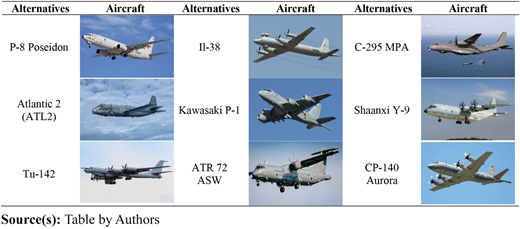
Nine aircraft types were preselected based on the Military Power (n.d.-a, n.d.-b) data and the problem-structuring discussions. The alternatives include aircraft operated by the Brazilian Air Force and by other air forces of regional or global strategic relevance, as shown in Table 2.
The Decision-Making Methods Assistant (DMMA) framework was used as an auxiliary instrument to characterize the problem, as shown in Figure 4 (Diniz et al., 2024b). The problem was characterized as a single-decision-maker problem with cardinal quantitative data and a compensatory aggregation structure. This characterization is consistent with the methodological rationale presented in Section 3.3.
 A table titled 'QUESTIONNAIRE FOR SELECTING MULTI-CRITERIA DECISION-MAKING METHOD(S)' with ten rows and two columns. The first column contains questions, and the second column contains answers. Row 1: Question: THE PROBLEM CRITERIA ARE EQUALLY IMPORTANT? Answer: No. Row 2: Question: DO YOU KNOW HOW TO ASSIGN WEIGHTS TO THE PROBLEM'S CRITERIA? Answer: No. Row 3: Question: WHAT TYPE OF INPUT DATA IS USED FOR THE PROBLEM CRITERIA? Answer: Quantitative Data. Row 4: Question: HOW MANY DECISION-MAKERS WILL MAKE THE DECISION? Answer: A decision-maker. Row 5: Question: DO YOU PREFER ALL CRITERIA TO BE GOOD ACROSS THE BOARD, OR CAN A STRONG CRITERION COMPENSATE FOR A WEAK ONE? Answer: No (cannot be offset). Row 6: Question: THE SUGGESTED METHOD FOR GENERATING WEIGHTS IS: Answer: PSI. Row 7: Question: WHAT IS THE TYPE OF INPUT DATA FOR THE PROBLEM ALTERNATIVES? Answer: Quantitative Data. Row 8: Question: HOW MANY DECISION-MAKERS WILL MAKE THE DECISION? Answer: A decision-maker.
Characterization of the decision problem using the DMMA framework. Source(s): Figure by authors
A table titled 'QUESTIONNAIRE FOR SELECTING MULTI-CRITERIA DECISION-MAKING METHOD(S)' with ten rows and two columns. The first column contains questions, and the second column contains answers. Row 1: Question: THE PROBLEM CRITERIA ARE EQUALLY IMPORTANT? Answer: No. Row 2: Question: DO YOU KNOW HOW TO ASSIGN WEIGHTS TO THE PROBLEM'S CRITERIA? Answer: No. Row 3: Question: WHAT TYPE OF INPUT DATA IS USED FOR THE PROBLEM CRITERIA? Answer: Quantitative Data. Row 4: Question: HOW MANY DECISION-MAKERS WILL MAKE THE DECISION? Answer: A decision-maker. Row 5: Question: DO YOU PREFER ALL CRITERIA TO BE GOOD ACROSS THE BOARD, OR CAN A STRONG CRITERION COMPENSATE FOR A WEAK ONE? Answer: No (cannot be offset). Row 6: Question: THE SUGGESTED METHOD FOR GENERATING WEIGHTS IS: Answer: PSI. Row 7: Question: WHAT IS THE TYPE OF INPUT DATA FOR THE PROBLEM ALTERNATIVES? Answer: Quantitative Data. Row 8: Question: HOW MANY DECISION-MAKERS WILL MAKE THE DECISION? Answer: A decision-maker.Characterization of the decision problem using the DMMA framework. Source(s): Figure by authors
Although three Brazilian Air Force officers participated in problem structuring, their consensual assessment was consolidated into one decision input. Because they did not provide separate individual judgments or weights, the “A Decision Maker” classification in Figure 4 describes the formal structure processed by the model rather than the number of participants consulted.
The PSI procedure was initially applied to the decision matrix to calculate the criteria weights. These objective weights were subsequently incorporated into CoCoSo, adopting = 0.50 as the baseline value. To examine the influence of the CoCoSo compromise parameter, the complete calculations were repeated using = 0.25 and = 0.75. At the same time, the original decision matrix, normalization procedure and PSI weights were maintained unchanged. This procedure isolated the influence of on the final scores and ranking.
The PSI weights were not manually altered because they are endogenous outputs calculated from the dispersion of the normalized performances rather than values freely assigned by the consulted officers. Artificially increasing or reducing these weights would no longer reproduce the PSI weighting procedure and would introduce weighting scenarios without additional empirical or elicited support. The sensitivity analysis therefore focused on , which is the explicit discretionary parameter in the CoCoSo calculation. This delimitation is acknowledged in the limitations of the study.
5. Results and discussion
This section presents and discusses the results obtained from the application of the multicriteria decision-support framework, including the objective criteria weights, the ranking of the aircraft alternatives, and the sensitivity analysis used to assess the stability of the results.
5.1 Application of the PSI method
Table 3 presents the original decision matrix composed of nine alternatives and ten quantitative criteria. The matrix was constructed using the performance values collected from the sources described in the methodology. The criteria are Range (C1), Endurance (C2), Operating Cost (C3), Maximum Speed (C4), Payload Capacity (C5), Maximum Operating Altitude (C6), Number of Crew Positions (C7), Torpedoes (C8), Missiles (C9), and Sonobuoys (C10).
Decision matrix
| Alternatives/Criteria | C1 | C2 | C3 | C4 | C5 | C6 | C7 | C8 | C9 | C10 |
|---|---|---|---|---|---|---|---|---|---|---|
| A1 | 7,500 | 4 | 25,000 | 907 | 9 | 41,000 | 9 | 5 | 4 | 129 |
| A2 | 9,000 | 18 | 15,000 | 648 | 8 | 30,000 | 13 | 4 | 2 | 100 |
| A3 | 12,000 | 16 | 30,000 | 850 | 10 | 42,650 | 11 | 8 | 2 | 80 |
| A4 | 9,500 | 12 | 15,000 | 650 | 9 | 33,000 | 7 | 5 | 2 | 64 |
| A5 | 8,000 | 8 | 19,000 | 996 | 9 | 44,000 | 13 | 8 | 4 | 80 |
| A6 | 3,700 | 8 | 7,000 | 518 | 7 | 25,000 | 6 | 2 | 1 | 48 |
| A7 | 5,630 | 11 | 5,500 | 576 | 9 | 30,000 | 5 | 4 | 1 | 50 |
| A8 | 5,700 | 10 | 10,000 | 650 | 10 | 33,000 | 10 | 3 | 4 | 80 |
| A9 | 9,266 | 17 | 13,000 | 667 | 6 | 35,000 | 10 | 4 | 4 | 80 |
The aircraft alternatives are identified as A1-A9. Operating Cost was modeled as a cost criterion, while the remaining variables were modeled as benefit criteria. The original decision matrix was normalized using Equations (2) and (3), resulting in the values presented in Table 4.
Decision matrix normalized by the PSI method
| Alternatives/Criteria | C1 | C2 | C3 | C4 | C5 | C6 | C7 | C8 | C9 | C10 |
|---|---|---|---|---|---|---|---|---|---|---|
| MAX | MAX | MIN | MAX | MAX | MAX | MAX | MAX | MAX | MAX | |
| A1 | 0.625 | 0.222 | 0.220 | 0.911 | 0.900 | 0.932 | 0.692 | 0.625 | 1.000 | 1.000 |
| A2 | 0.750 | 1.000 | 0.367 | 0.651 | 0.800 | 0.682 | 1.000 | 0.500 | 0.500 | 0.775 |
| A3 | 1.000 | 0.889 | 0.183 | 0.853 | 1.000 | 0.969 | 0.846 | 1.000 | 0.500 | 0.620 |
| A4 | 0.792 | 0.667 | 0.367 | 0.653 | 0.900 | 0.750 | 0.538 | 0.625 | 0.500 | 0.496 |
| A5 | 0.667 | 0.444 | 0.289 | 1.000 | 0.900 | 1.000 | 1.000 | 1.000 | 1.000 | 0.620 |
| A6 | 0.308 | 0.444 | 0.786 | 0.520 | 0.700 | 0.568 | 0.462 | 0.250 | 0.250 | 0.372 |
| A7 | 0.469 | 0.611 | 1.000 | 0.578 | 0.900 | 0.682 | 0.385 | 0.500 | 0.250 | 0.388 |
| A8 | 0.475 | 0.556 | 0.550 | 0.653 | 1.000 | 0.750 | 0.769 | 0.375 | 1.000 | 0.620 |
| A9 | 0.772 | 0.944 | 0.423 | 0.670 | 0.600 | 0.795 | 0.769 | 0.500 | 1.000 | 0.620 |
Table 5 presents the mean, variation in preference, and deviation in the preference value, calculated using Equations (4)–(6).
Calculation of the mean, the preference variation, and the deviation
| Variables/Criteria | C1 | C2 | C3 | C4 | C5 | C6 | C7 | C8 | C9 | C10 |
|---|---|---|---|---|---|---|---|---|---|---|
| 0.651 | 0.642 | 0.465 | 0.721 | 0.856 | 0.792 | 0.718 | 0.597 | 0.667 | 0.612 | |
| 0.348 | 0.544 | 0.588 | 0.209 | 0.142 | 0.172 | 0.391 | 0.524 | 0.875 | 0.299 | |
| 0.652 | 0.456 | 0.412 | 0.791 | 0.858 | 0.828 | 0.609 | 0.476 | 0.125 | 0.701 |
After applying the PSI method, the overall preference value was calculated using Equation (7) and is presented in Table 6.
Calculation of the overall preference value
| Variables/criteria | C1 | C2 | C3 | C4 | C5 | C6 | C7 | C8 | C9 | C10 |
|---|---|---|---|---|---|---|---|---|---|---|
| 0.110 | 0.077 | 0.070 | 0.134 | 0.145 | 0.140 | 0.103 | 0.081 | 0.021 | 0.119 | |
| 11.0% | 7.7% | 7.0% | 13.4% | 14.5% | 14.0% | 10.3% | 8.1% | 2.1% | 11.9% |
The PSI results indicated that Payload Capacity (C5) received the highest objective weight, at 14.5%, followed by Maximum Operating Altitude (C6), at 14.0%, Maximum Speed (C4), at 13.4%, Sonobuoys (C10), at 11.9%, Range (C1), at 11.0%, Number of Crew Positions (C7), at 10.3%, Torpedoes (C8), at 8.1%, Endurance (C2), at 7.7%, Operating Cost (C3), at 7.0%, and Missiles (C9), at 2.1%. These weights reflect the variation of the normalized performances in the decision matrix. They should not be interpreted as direct statements of institutional preference by the Brazilian Air Force or the three consulted officers.
5.2 Application of the CoCoSo method
After the PSI criterion weights were calculated, the original decision matrix in Table 3 was normalized using the CoCoSo procedure to generate the aircraft ranking. Because the problem included monotonic cost and benefit criteria, Equations (10) and (11) were used, yielding the normalized matrix shown in Table 7.
Decision matrix normalized by the CoCoSo method
| Alternatives/Criteria | C1 | C2 | C3 | C4 | C5 | C6 | C7 | C8 | C9 | C10 |
|---|---|---|---|---|---|---|---|---|---|---|
| MAX | MAX | MIN | MAX | MAX | MAX | MAX | MAX | MAX | MAX | |
| A1 | 0.458 | 0.000 | 0.204 | 0.814 | 0.750 | 0.842 | 0.500 | 0.500 | 1.000 | 1.000 |
| A2 | 0.639 | 1.000 | 0.612 | 0.272 | 0.500 | 0.263 | 1.000 | 0.333 | 0.333 | 0.642 |
| A3 | 1.000 | 0.857 | 0.000 | 0.695 | 1.000 | 0.929 | 0.750 | 1.000 | 0.333 | 0.395 |
| A4 | 0.699 | 0.571 | 0.612 | 0.276 | 0.750 | 0.421 | 0.250 | 0.500 | 0.333 | 0.198 |
| A5 | 0.518 | 0.286 | 0.449 | 1.000 | 0.750 | 1.000 | 1.000 | 1.000 | 1.000 | 0.395 |
| A6 | 0.000 | 0.286 | 0.939 | 0.000 | 0.250 | 0.000 | 0.125 | 0.000 | 0.000 | 0.000 |
| A7 | 0.233 | 0.500 | 1.000 | 0.121 | 0.750 | 0.263 | 0.000 | 0.333 | 0.000 | 0.025 |
| A8 | 0.241 | 0.429 | 0.816 | 0.276 | 1.000 | 0.421 | 0.625 | 0.167 | 1.000 | 0.395 |
| A9 | 0.671 | 0.929 | 0.694 | 0.312 | 0.000 | 0.526 | 0.625 | 0.333 | 1.000 | 0.395 |
With the weights assigned to each criterion by the PSI method (Table 6), the matrices of the weighted sum and the weighted exponential product were generated using Equations (12) and (13), as shown in Tables 8 and 9.
Weighted sum calculation matrix
| Alternatives/Criteria | C1 | C2 | C3 | C4 | C5 | C6 | C7 | C8 | C9 | C10 | |
|---|---|---|---|---|---|---|---|---|---|---|---|
| MAX | MAX | MIN | MAX | MAX | MAX | MAX | MAX | MAX | MAX | ∑ | |
| A1 | 0.050 | 0.000 | 0.014 | 0.109 | 0.109 | 0.118 | 0.052 | 0.040 | 0.021 | 0.119 | 0.632 |
| A2 | 0.070 | 0.077 | 0.043 | 0.036 | 0.073 | 0.037 | 0.103 | 0.027 | 0.007 | 0.076 | 0.549 |
| A3 | 0.110 | 0.066 | 0.000 | 0.093 | 0.145 | 0.130 | 0.077 | 0.081 | 0.007 | 0.047 | 0.757 |
| A4 | 0.077 | 0.044 | 0.043 | 0.037 | 0.109 | 0.059 | 0.026 | 0.040 | 0.007 | 0.023 | 0.465 |
| A5 | 0.057 | 0.022 | 0.031 | 0.134 | 0.109 | 0.140 | 0.103 | 0.081 | 0.021 | 0.047 | 0.745 |
| A6 | 0.000 | 0.022 | 0.066 | 0.000 | 0.036 | 0.000 | 0.013 | 0.000 | 0.000 | 0.000 | 0.137 |
| A7 | 0.026 | 0.039 | 0.070 | 0.016 | 0.109 | 0.037 | 0.000 | 0.027 | 0.000 | 0.003 | 0.326 |
| A8 | 0.027 | 0.033 | 0.057 | 0.037 | 0.145 | 0.059 | 0.064 | 0.013 | 0.021 | 0.047 | 0.504 |
| A9 | 0.074 | 0.072 | 0.048 | 0.042 | 0.000 | 0.074 | 0.064 | 0.027 | 0.021 | 0.047 | 0.469 |
Matrix of the calculation of the weighted exponential product
| Alternatives/Criteria | C1 | C2 | C3 | C4 | C5 | C6 | C7 | C8 | C9 | C10 | |
|---|---|---|---|---|---|---|---|---|---|---|---|
| MAX | MAX | MIN | MAX | MAX | MAX | MAX | MAX | MAX | MAX | ∑ | |
| A1 | 0.917 | 0.000 | 0.895 | 0.973 | 0.959 | 0.976 | 0.931 | 0.946 | 1.000 | 1.000 | 8.597 |
| A2 | 0.952 | 1.000 | 0.966 | 0.840 | 0.904 | 0.829 | 1.000 | 0.915 | 0.977 | 0.949 | 9.333 |
| A3 | 1.000 | 0.988 | 0.000 | 0.952 | 1.000 | 0.990 | 0.971 | 1.000 | 0.977 | 0.896 | 8.774 |
| A4 | 0.961 | 0.958 | 0.966 | 0.842 | 0.959 | 0.886 | 0.867 | 0.946 | 0.977 | 0.825 | 9.186 |
| A5 | 0.930 | 0.908 | 0.946 | 1.000 | 0.959 | 1.000 | 1.000 | 1.000 | 1.000 | 0.896 | 9.638 |
| A6 | 0.000 | 0.908 | 0.996 | 0.000 | 0.818 | 0.000 | 0.807 | 0.000 | 0.000 | 0.000 | 3.528 |
| A7 | 0.851 | 0.948 | 1.000 | 0.754 | 0.959 | 0.829 | 0.000 | 0.915 | 0.000 | 0.644 | 6.902 |
| A8 | 0.855 | 0.937 | 0.986 | 0.842 | 1.000 | 0.886 | 0.953 | 0.866 | 1.000 | 0.896 | 9.219 |
| A9 | 0.957 | 0.994 | 0.975 | 0.856 | 0.000 | 0.914 | 0.953 | 0.915 | 1.000 | 0.896 | 8.459 |
The next step was to calculate the three relative appraisal values for each alternative. The baseline application adopted λ = 0.50, assigning equal balance to the additive and multiplicative components of the third CoCoSo appraisal strategy. The resulting values are presented in Table 10.
Relative appraisal values of the alternatives for λ = 0.50
| Alternatives | |||
|---|---|---|---|
| A1 | 0.118 | 7.059 | 0.888 |
| A2 | 0.126 | 6.663 | 0.951 |
| A3 | 0.122 | 8.018 | 0.917 |
| A4 | 0.123 | 6.006 | 0.929 |
| A5 | 0.133 | 8.180 | 0.999 |
| A6 | 0.047 | 2.000 | 0.353 |
| A7 | 0.092 | 4.338 | 0.695 |
| A8 | 0.124 | 6.296 | 0.935 |
| A9 | 0.114 | 5.826 | 0.859 |
Finally, the ranking was calculated using Equation (17) and is shown in Table 11. The Kawasaki P-1 (A5) received the highest final score, 4.100, and was therefore the highest-ranked alternative in the baseline scenario, followed by the Tu-142 (A3) with 3.953, P-8 Poseidon (A1) with 3.567, Atlantic 2 (ATL2) (A2) with 3.483, Shaanxi Y-9 (A8) with 3.329, Il-38 (A4) with 3.213, CP-140 Aurora (A9) with 3.075, C-295 MPA (A7) with 2.348 and ATR 72 ASW (A6) with 1.116.
CoCoSo ranking of the alternatives for λ = 0.50
| Alternatives | Final rank | |
|---|---|---|
| P-8 Poseidon | 3.567 | 3 |
| Atlantic 2 (ATL2) | 3.483 | 4 |
| Tu-142 | 3.953 | 2 |
| Il-38 | 3.213 | 6 |
| Kawasaki P-1 | 4.100 | 1 |
| ATR 72 ASW | 1.116 | 9 |
| C-295 MPA | 2.348 | 8 |
| Shaanxi Y-9 | 3.329 | 5 |
| CP-140 Aurora | 3.075 | 7 |
The final scores represent the aggregated performance of the alternatives under the criteria, orientations, normalization procedure, and objective weights defined in the model. Accordingly, the ranking applies specifically to the decision structure adopted in this study and should not be interpreted independently of its assumptions and limitations.
5.3 Sensitivity analysis
A sensitivity analysis was conducted to examine whether changes in the CoCoSo compromise parameter affected the final scores and ranking. The baseline application adopted = 0.50. Two additional scenarios were subsequently calculated using = 0.25 and = 0.75. The original decision matrix, normalization procedure, and PSI criterion weights were maintained unchanged across all three scenarios to examine the effect of the CoCoSo parameter separately. Tables 12 and 13 present the relative appraisal values and final ranking obtained with = 0.25.
Relative appraisal values of the alternatives for λ = 0.25
| Alternatives | |||
|---|---|---|---|
| A1 | 0.118 | 7.059 | 0.891 |
| A2 | 0.126 | 6.663 | 0.962 |
| A3 | 0.122 | 8.018 | 0.913 |
| A4 | 0.123 | 6.006 | 0.944 |
| A5 | 0.133 | 8.180 | 1.000 |
| A6 | 0.047 | 2.000 | 0.361 |
| A7 | 0.092 | 4.338 | 0.709 |
| A8 | 0.124 | 6.296 | 0.949 |
| A9 | 0.114 | 5.826 | 0.871 |
CoCoSo ranking of the alternatives for λ = 0.25
| Alternatives | Final rank | |
|---|---|---|
| P-8 Poseidon | 3.568 | 3 |
| Atlantic 2 (ATL2) | 3.491 | 4 |
| Tu-142 | 3.950 | 2 |
| Il-38 | 3.223 | 6 |
| Kawasaki P-1 | 4.100 | 1 |
| ATR 72 ASW | 1.122 | 9 |
| C-295 MPA | 2.356 | 8 |
| Shaanxi Y-9 | 3.338 | 5 |
| CP-140 Aurora | 3.083 | 7 |
In this scenario, all nine alternatives maintained the same positions obtained in the baseline scenario. The change in affected the numerical values of the final scores but did not change the ranking.
Tables 14 and 15 present the corresponding relative appraisal values and final ranking obtained with = 0.75. This scenario also produced the same complete ranking as the baseline scenario.
Relative appraisal values of the alternatives for λ = 0.75
| Alternatives | |||
|---|---|---|---|
| A1 | 0.118 | 7.059 | 0.881 |
| A2 | 0.126 | 6.663 | 0.922 |
| A3 | 0.122 | 8.018 | 0.927 |
| A4 | 0.123 | 6.006 | 0.889 |
| A5 | 0.133 | 8.180 | 0.997 |
| A6 | 0.047 | 2.000 | 0.331 |
| A7 | 0.092 | 4.338 | 0.662 |
| A8 | 0.124 | 6.296 | 0.901 |
| A9 | 0.114 | 5.826 | 0.829 |
CoCoSo ranking of the alternatives for λ = 0.75
| Alternatives | Final rank | |
|---|---|---|
| P-8 Poseidon | 3.562 | 3 |
| Atlantic 2 (ATL2) | 3.464 | 4 |
| Tu-142 | 3.960 | 2 |
| Il-38 | 3.187 | 6 |
| Kawasaki P-1 | 4.099 | 1 |
| ATR 72 ASW | 1.102 | 9 |
| C-295 MPA | 2.326 | 8 |
| Shaanxi Y-9 | 3.307 | 5 |
| CP-140 Aurora | 3.055 | 7 |
Comparison of Tables 11, 13, and 15 shows that none of the nine alternatives changed their ranking position under the three tested values of . Therefore, the ranking was stable with respect to the CoCoSo compromise parameter over the examined interval. This conclusion is restricted to the parameter and values tested and does not imply that the ranking would remain unchanged under every possible modification of the decision model. Accordingly, the sensitivity analysis did not assess alternative criterion-weight structures. This internal stability should not be interpreted as external validation.
6. Limitations
The results should be interpreted in light of several limitations. First, the definition and confirmation of the criteria and alternatives were supported by three Brazilian Air Force officers, including engineers and operations officers. Although all three approved the decision matrix without requesting changes, their participation does not necessarily represent an official or institution-wide position of the Brazilian Air Force.
Second, the quantitative performance data were obtained from the Military Power database and cross-checked against information available on the aircraft manufacturers’ websites. Aircraft information may nevertheless vary depending on configuration, modernization package, mission system, source, reference period, and operating conditions. The values, therefore, represent the information available for the configurations described in the consulted sources and may not exactly match those evaluated in a formal procurement process.
Third, aircraft acquisition costs were not included because comparable, sufficiently reliable values were not available for all alternatives. The Operating Cost criterion does not represent total life-cycle cost, which may include acquisition, infrastructure, training, maintenance, spare parts, modernization, and disposal.
Fourth, the PSI weights reflect the mathematical variation of the normalized performances in the decision matrix rather than direct judgments regarding the strategic importance of the criteria. A criterion may receive a relatively high objective weight because it differentiates the alternatives more strongly, not necessarily because it is institutionally more important.
Fifth, the sensitivity analysis was limited to the CoCoSo compromise parameter . The stability observed for values of 0.25, 0.50, and 0.75 does not demonstrate that the ranking would remain unchanged under modifications to the original performance values, the criteria set, the alternatives, the normalization procedure, or the weighting method.
Finally, the study did not compare the baseline result with a second independent ranking method. Consequently, the analysis demonstrates internal stability only with respect to the tested CoCoSo parameter; it does not establish agreement among different MCDA methods or represent a complete procurement model. The same future-research directions are presented more fully in the final paragraph of Section 7, where recommendations for future work are most appropriately consolidated.
7. Final considerations
This study developed a multicriteria decision-support model for evaluating maritime patrol aircraft alternatives in the strategic context of the Brazilian Air Force. PSI was used to generate objective criterion weights, while CoCoSo was applied to rank the nine alternatives.
In the baseline scenario, using = 0.50, the Kawasaki P-1 obtained the highest aggregated score, followed by the Tu-142 and the P-8 Poseidon. These results reflect the criteria, data, orientations, normalization procedure, and objective weights adopted in the model and should not be interpreted independently of those assumptions.
The sensitivity analysis showed that the complete ranking remained unchanged when was varied from 0.50 to 0.25 and 0.75. Although the final scores showed small numerical changes, none of the nine alternatives changed their position. The ranking was therefore stable in relation to the tested values of the CoCoSo compromise parameter. The study contributes a transparent analysis of a defense analytics case through objective weighting, compromise-based aggregation, and explicit examination of parameter sensitivity.
More broadly, the framework is most applicable to preliminary screening problems involving quantitative and monotonic criteria when defensible subjective weights are unavailable and a transparent comparison of alternatives is desired. Its transferable value lies in combining data-driven weighting with compromise-based ranking while keeping the criteria, assumptions, and aggregation process explicit.
However, the framework is not intended to represent a complete acquisition model or an automatic recommendation for acquisition. The decision matrix does not incorporate all dimensions involved in formal procurement, including explicit stakeholder preferences, qualitative considerations, uncertainty, acquisition and life-cycle costs, industrial cooperation, logistics, training, interoperability, technology transfer, and configuration-specific characteristics.
Future studies may compare alternative weighting and ranking methods, examine sensitivity to changes in aircraft performance data and criterion weights, broaden the participation of experts and stakeholders, and pursue external validation in other defense decision contexts. Additional research may also improve the traceability and comparability of open-source data and incorporate acquisition and life-cycle cost information. These extensions would provide a broader assessment of the framework’s robustness, transferability, and practical applicability.

