The 79th annual meeting of the International Committee on Large Dams (ICOLD) was held in the Swiss city of Lucerne between 30 May and 3 June 2011. There was a good attendance of British Dam Society (BDS) members at the meetings with a total of ten delegates who represent the UK on a number of the different technical committees. In total there were more than 1000 delegates representing 65 countries.
1. Introduction
The main conference venue was the impressive Culture and Convention Centre (KKL) that is situated in the centre of the city and along the shoreline of the beautiful Lake Lucerne. This was an excellent location for this International Committee on Large Dams (ICOLD) event and the proximity of the hotels (all of which were in walking distance of KKL) meant that delegates could easily walk to and from the different meetings. As is customary at these events the proceedings over the 4 days covered a number of different components and included
an international symposium
the annual ICOLD executive meeting
meetings of the various technical committees of ICOLD
technical visits (see separate articles by Ian Hope, Andy Hughes and Tracey Williamson)
social events.
2. International symposium
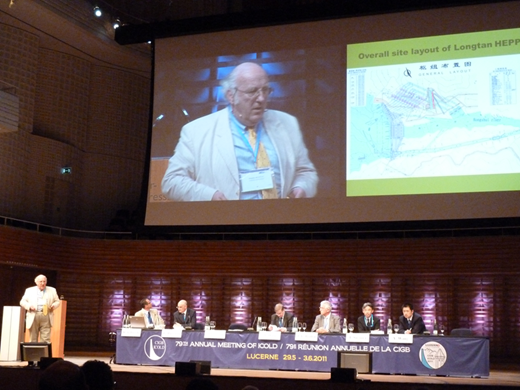
The theme of the 1-day symposium was ‘Dams and reservoirs under changing challenges’ (Figure 1). As might be anticipated from this broad subject there were a wide variety of papers that were presented and these were divided up into different sessions that covered
long-term behaviour of dams
dams and natural hazards
dams and climate change
dams in a sound environment.
In the first session the papers covered such things as dam surveillance using modern digital camera techniques, a risk-based approach to dam safety management in New South Wales, filter design for the heightening of an earth core/rockfill dam and the integrity of old post-tensioned anchors in gravity dams. With regard to natural hazards there were a number of interesting papers on floods and flood management in different situations plus a thought-provoking presentation on rockslide tsunamis in relation to lakes and reservoirs.
One of the most illuminating presentations was given by Mr Matsumoto from Japan who described the Tohoku earthquake that occurred in March 2011 and the impact that it had on dams in the north-east of Japan. The earthquake had a magnitude of 9 and had devastating consequences, largely due to the resultant 9·3 m high tsunami and overall the loss of life was estimated to be 24 000. A number of major dam installations were affected and in the aftermath of the event, 399 dams with a height of over 15 m were inspected. In general the dam structures performed extremely well under the seismic loading. It is estimated that about 50 dams suffered cracking, minor damage or minor deformation of ancillary structures. However, there was only one dam failure as a result of the earthquake. This occurred at the Fujinuma-ike earthfill embankment, which is approximately 18 m in height and which was constructed in 1949 for the storage of irrigation water. The earthquake caused a collapse of the downstream shoulder and hence a breach and the escape of water. In the flood wave that escaped, eight people were drowned. Although this was a tragic event, it was evident that things could have been much worse and in the context of the earthquake as a whole it was concluded that the Japanese dams had performed extremely well.
In the final session the presentations covered a variety of environmental issues including cost–benefit evaluation of environmental impacts and mitigation measures, a holistic approach to reduce the negative impacts of hydro-peaking and the environmental rehabilitation of an existing rockfill dam in Norway. The proceedings of the symposium, together with all of the technical papers, are available on the ICOLD website.
3. ICOLD executive meeting
The final day of the event was dedicated to the formal proceedings of the executive meeting. Martin Airey and Ian Hope as chairman and vice chairman respectively were representing BDS, and Andy Hughes as a past vice president of ICOLD was also present. The highlights of the meeting are outlined below.
Three new countries, Georgia, Armenia and Uzbekistan, were accepted into ICOLD as the 93rd, 94th and 95th member countries. It was stated that there are several other expressions of interest and that it is hoped that the milestone of 100 countries will be achieved in 2012.
Two new vice presidents were elected to replace Mr A. Marulanda of Colombia and Mr P. Mulvihill from New Zealand. For the first of these posts (America Zone) there were two nominations: Mr A. Pujol from Argentina and Mr R. Charlwood from USA. The voting went in favour of Mr Pujol who was duly elected with a margin of 45 votes to 20 votes. For the second post, Dr Sakamuto of Japan was the only candidate and he was thus elected.
A number of presentations were then given regarding future ICOLD meetings and proposed venues. First JCOLD gave an update on the preparations for Kyoto in 2012 and extended a warm welcome to all delegates to come to Japan for the 24th congress and 80th annual meeting that will take place between 2nd and 8th June. The USA gave a presentation on Seattle as the city proposed for the 2013 meeting. A vote followed and the proposal was formally accepted thus confirming Seattle as the location for the 81st annual meeting. For the 2014 meeting there are three possible locations and hence there were presentations from Sri Lanka, Indonesia (Bali) and India. The voting to decide the successful candidate will be made at the Kyoto meeting.
With regard to the latest ICOLD bulletins it was reported that three new bulletins had been published in 2010. These are
bulletin 135 – Geomembranes
bulletin 141 – Concrete-faced rockfill dams
bulletin 144 – Cost savings in dams.
In 2011 there are a further four bulletins that are in the final stages of editing prior to printing and distribution. These cover
bulletin 137 – Seismicity
bulletin 139 – Improving tailing dam safety
bulletin 142 – Safe passage of extreme floods
bulletin 143 – Historical review on ancient dams.
Further information on these bulletins is available on the ICOLD website and it should be noted that all are down-loadable as pdf versions (free access) to BDS members.
The final items on the agenda covered the presentation of the ICOLD accounts for 2010, followed by announcements of new representatives who will be joining the different technical committees. In this respect it is noted that Dr Peter Mason from the UK will be taking up a position on the ‘Hydraulics for Dams’ committee.
4. Social events
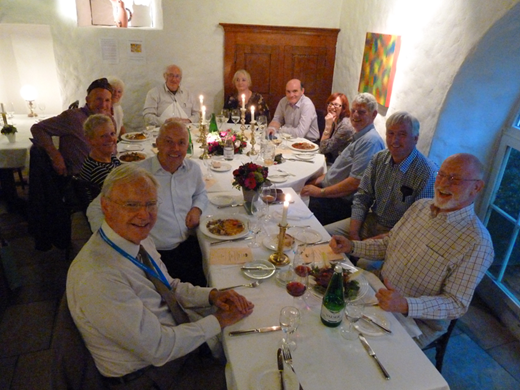
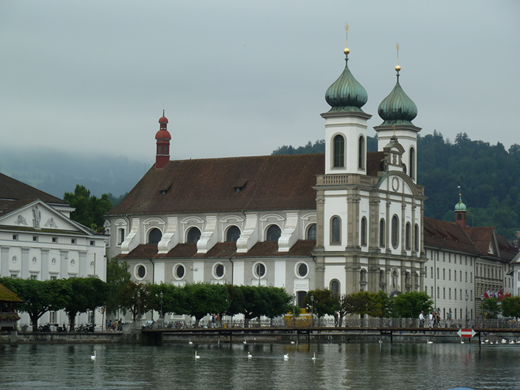
There were a number of social events that had been arranged for delegates and for accompanying persons (Figure 2). These included tours of the beautiful city of Lucerne (Figure 3), a welcome reception on the first evening, a symphony concert that was held in the magnificent concert hall of the KKL complex and, on the final evening, a farewell dinner and cruise on three 1920s paddle steamers that moved gently across the lake while delegates enjoyed the breathtaking scenery. As one might expect the whole ICOLD event was extremely well organised and planned by our Swiss hosts who at all times made us feel really welcome.
5. ICOLD technical committees
5.1 Global Climate Change and Dams Technical Committee: UK representative – Martin Airey
There were representatives of 13 different countries at the meeting and a similar number of observers, reflecting the current interest in the work of the committee and the relevance of climate change to dams, reservoirs and water resources in general. This committee is one of the newer technical committees and operates under the chairmanship of Ron Lemons from the USA who is ably assisted by Denis Albrecht from France. An initial presentation on the work of the committee was given at the last ICOLD meeting in Hanoi and since then further progress has been made with the preparation of a technical bulletin on dams and climate change.
It is hoped that the first draft will be ready for submission at the Kyoto congress in 2012. By its very nature, some of the work of this committee overlaps with the remit of other committees; notably floods and environment. The aim of the bulletin therefore will be to concentrate on those aspects of dam and reservoir development that are likely to be most influenced by climatic change conditions. A number of topics have been selected for inclusion and the bulletin will be structured accordingly to describe
setting the scene and the issues to be addressed
climate evolution – the facts and the uncertainties
climate change modelling
climate-induced impacts and risk assessments for dams
opportunities for new dams and reservoirs
contribution of reservoirs to greenhouse gas emissions
adaptation strategy and recommendations.
Each of these topics will be illustrated by means of case studies drawn from different parts of the world, where of course the impacts of climate change will vary significantly between regions.
5.2 Embankment Dams Technical Committee: UK representative – Rod Bridle
At a well-attended meeting, five bulletins in various stages of development were discussed: internal erosion in existing dams; geotextiles in dams; seepage and water control in dams; asphaltic concrete cores; dam slopes.
Much progress has been made on the internal erosion bulletin, with a large contribution to volume 1 dealing with processes and engineering, from Professor Robin Fell. Volume 2, dealing with monitoring and detection, is not yet drafted, although many contributions have been received. Both volumes were discussed and developed further at the ICOLD European Club Internal Erosion Working Group meeting in Brno in April this year to include work from research in Europe and practice in Russia and the USA. Dr Catherine O'Sullivan (UK) gave a presentation there on research in progress at Imperial College on the application of discrete element modelling to internal erosion. The ICOLD Embankment Dams Committee welcomed the current draft, and the intention to develop it further to make it easier to use by adding sections with examples on how to analyse and enumerate the forces involved in order to determine whether or not internal erosion could actually occur. The authors (J.-J. Fry, France, and R. Bridle, UK, with further assistance from Prof. Fell) planned to produce final drafts for agreement by the technical committee (TC) by 31 December 2011, and this may be circulated to member countries for final comments in time for formal approval at the ICOLD meeting in Kyoto in June 2012.
The USA (Dave Paul) were working on an update to the 1986 bulletin 55 on geotextiles in dams. They had circulated a questionnaire on practice around geotextiles in dams to over 100 countries but received responses from only 11, including the UK. They planned to request more responses. The TC agreed with the recommendation of a US Federal Emergency Management Agency report that geotextiles, including geofilters, should not be used in critical situations in dams, because of continuing concerns about durability of geotextiles. The EC standards on geotextiles would be referred to.
Austria (P. Schernutter), Canada (E. Peloquin) and Norway (V. Aarvold) put forward a contents list for discussion for an update to bulletin 84 (1992) on asphaltic concrete core dams. Several additional topics were added after discussion, including durability, low pressures under asphaltic cores and performance in hot climates. Information on Sulby and Queen's Valley was handed over to add to the data.
Finland (J. Laasonnen) put forward an early draft of a bulletin on seepage and water control in dams, but it overlapped with the internal erosion bulletin, and it was agreed that the issues it would have dealt with would be included in the internal erosion bulletin.
Iran (N. Tarkesdooz) suggested a bulletin dealing with the selection and optimising of slopes for dams. Selection on stability criteria alone could lead to maintenance and access difficulties and steep slopes required very heavy wave protection armour. A contents list would be put forward for agreement at the 2012 meeting in Kyoto.
Bulletin 135 ‘Geomembrane sealing systems for dams’ is now available. This was developed from the earlier European Club bulletin.
5.3 Dam Safety Technical Committee: UK representative – Andy Hughes
Twenty-three members of the Dam Safety Committee met in Lucerne in May 2011. The committee has completed all of its tasks apart from the preparation of an information and education document on risk management which will be completed by 2012.
The text of the bulletin on dam safety management has been presented and was accepted at the annual meeting in Lucerne.
A review of dam safety legislation and regulations has been commenced but the work of this review continues and it is hoped to be completed by the annual meeting in Kyoto in 2012.
The areas of interest selected for the next term include
new bulletin on dam safety management for all phases of life cycle preceding the operations phase
the current practice of risk assessment and management for dams
collection and dissemination of information on dam failures
relation between dam safety and dam ageing
dam safety legislation and regulation
the assessment of consequence and ‘hazard’ categories
the safe operation of ‘critical dam operational plant’
safety during construction and major refurbishment
safety of dams after earthquake
process for reviewing reports and bulletins submitted by other ICOLD committees.
5.4 Small Dams Technical Committee: UK representative – Andy Hughes
The final version of the bulletin has now been completed entitled ‘Small dams – design, surveillance and rehabilitation’ – and this will be sent to ICOLD Central Office Paris by the end of September. This concludes the work of the committee.
5.5 Constitutional Committee: UK representative – Andy Hughes
The Constitutional Committee reviewed the proposed changes to the constitution and the bye-laws. These were presented at the annual meeting and the proposed changes were accepted unanimously. A proposal for staged penalties for non-payment of membership charges was developed and this will be presented in Kyoto. This concludes the work of the committee.
5.6 Dams for Hydroelectric Energy Technical Committee: UK representative – John Sawyer
The ‘dams for hydroelectric energy’ bulletin contains a review of the role of hydropower and dams in world energy production. The bulletin starts with an overview of hydropower development to date, including summaries of the main hydropower producing nations, major dams and power plants. It then covers a number of key issues including the particular advantages of hydro, environmental and social impacts and development options. The bulletin is intended as a general introduction, accessible to a wider audience than just dam engineers, and includes an extensive listing of case histories, information sources and references to facilitate further investigation of the issues raised.
The draft bulletin is now about 95% complete. The intention is to fill in any missing text during the course of 2011, with a view to presenting the final bulletin to the 2012 ICOLD congress. The UK and South African committee members have offered to edit the draft into more polished English as the current text has largely been prepared by members with English as a second language.
As a separate matter, a new ICOLD committee is being formed on ‘Integrated operation of hydropower stations and reservoirs’. This will review current operational practice with the intent of producing guidelines on the safe management, operation and maintenance of hydropower schemes for owners and other interested parties.
5.7 Dams and Floods Technical Committee: UK representative – Tracey Williamson
The committee met in the Continental Park Hotel in the morning of 31 May 2011. The Japanese representative kicked off with a short presentation on the potentially devastating impacts of a typhoon in October 2009. The consequences of the resulting floods were reduced through the flexible operation of flood routing at three dams and highlighted the effectiveness of good communication between different dam owners.
A discussion on the probable maximum flood (PMF) followed, as a result of a proposal by the South African representative for ICOLD to recommend the use of the 1 in 104 return period flood event as the minimum annual exceedance probability (AEP) when determining the PMF. This proposal was rejected owing to the committee's agreement that the PMF is site specific and depends upon the probability that, first, the rainfall arrives in a region and, second, that it falls on a catchment; and the larger these areas, the larger the probability of the PMF occurring (and vice versa). It is also dependent on the method used to forecast the rain (e.g. the length of historical rainfall records in use).
The committee reviewed the table of contents for the next bulletin, which is currently being prepared. It was proposed to revise the bulletin title to ‘Flood evaluation for dam safety’. Chapter 1 will discuss different methods and parameters for evaluating floods, chapter 2 will cover the results of this analysis such as flood hydrographs, chapter 3 will look at dam safety practice with regard to hydrological conditions and chapter 4 will highlight the need for consideration of flood debris in design work.
The members were asked to provide case studies for the bulletin, particularly for chapter 4 showing how debris can have a negative impact on a dam if not considered in the design. If you have any good examples, please contact Martin Airey at martin.airey@mottmac.com.
5.8 Environment Technical Committee: UK representative – Tracey Williamson
The committee met in the Continental Park Hotel in the afternoon of 31 May 2011. Five tasks were listed on the agenda, of which one was noted as completed and two were in progress. It was agreed that the remaining two (tasks 2 and 4 – preparation for guidelines on environmental impact assessments) should not be taken forward as the committee's efforts should be focussed on accepted practice documents on specific environmental topics.
Task 1, a table on ‘Major environmental issues in each country’, has been completed with the aim to focus the work of the committee and identify specific topics for future papers.
The original terms of reference for task 3 were to ‘Revise and update the ICOLD position paper on dams and the environment’. However, a draft paper was tabled by Japan, which discussed ‘Global problems concerned with dams’. Since the purpose and target audience of this paper was not clear, a small working group convened on the following day. It was agreed at this meeting that the paper should be targeted at the media, students and other organisations requiring information on how recent global changes are influencing dam design, management and operation.
Task 5, a report on ‘Dams and resettlement – lessons learnt and recommendations’ has been submitted to ICOLD for approval and publication. A second draft report called ‘Areas of special historical, ecological, landscape or cultural interest’ has been revised by Japan and is to be circulated to committee members for review.
5.9 Tailings Dams Technical Committee : UK representative – Mike Cambridge
This committee was chaired by Rob Williamson (RSA), who is to be succeeded after the Lucerne meeting by Harvey McLeod (Canada). The committee has been working on a new bulletin on sustainability of closure since the 2006 conference in Sofia. The bulletin has now been approved by the ICOLD committee and received the final edit during the Lucerne meeting. The finalised text will be issued for publication in the next month.
Owing to their age and the advances made by the industry in the intervening period, a review of the following bulletins was also discussed.
Bulletin no. 104: tailings dam safety – a draft has been produced by Professor Abadjiev (Bulgaria) and is to be distributed to the committee for review before the 2012 meeting.
Bulletin no. 106: tailings disposal and design – it was considered that this bulletin would be best updated by the production of an addendum, the contents of which are to be agreed in Kyoto.
Bulletin no. 121: tailings dam incidents – it was agreed that an urgent review of this bulletin is required, and is to be prepared under the chair of John Philips (Australia). Preliminary lists of incidents which have occurred since this bulletin was first published are to be prepared by the committee during 2011.
New bulletin – the need for a new bulletin covering the design and implementation of tailings dams with complex cross-sections is to be discussed at the next ICOLD meeting.
The status of the following new national guidance documents was presented during the Lucerne meeting
new dam safety standards, including recommendations regarding the adoption of return periods in the design process, with particular respect to probability of occurrence (Spain)
guidance on climate change (Australia)
two new bulletins on tailings dam safety, both of which are available by way of the website (Canada)
tailings dam break analyses (USA)
geomembranes (China and RSA)
the development of a standard for hydraulic fill (tailings disposal) as part of the EU standard on Earthworks (TC396) (UK)
EU report on guidance for the inspection of category A waste facilities (principally large tailings dams) commissioned to accompany the directive on the management of extractive waste (UK)
new seismic codes (Germany).
5.10 Seismic Technical Committee: UK representative – Ljiljana Spasic-Gril
Two committee meetings were held during the annual meeting. The committee includes representatives from 31 countries. The main topics discussed were as follows.
ICOLD bulletins
a bulletin on reservoirs and seismicity will be published in summer 2011
the French translation of bulletin 62, approved in 2008, has been completed
the revised bulletin 72, approved in 2010, has been finalised and will be translated. It will be published as bulletin 148
the position paper on dam safety and earthquakes, approved in 2010, will be translated. All documents are available on the ICOLD web page.
Presentations by committee members
Canada: a short presentation was made by S. Rigbey on the new probabilistic seismic hazard analysis of dams in British Colombia, Canada
Chile: a presentation was made by G. Noguera on seismic hazard and seismic design of dams in Chile
China: a presentation was made by Chen Houqun on lessons learnt from the seismic behaviour of dams during the 12 May 2008 Wenchuan earthquake in China; also, a summary report on the 12 May 2008 Wenchuan earthquake in China (UNDP project on seismic aspects of dams) prepared by IWHR, Beijing, was distributed to the committee members prior to the annual meeting in Lucerne
France: a presentation was made by M. Lino on the proposed seismic design guideline in France
Japan: a presentation was made by N. Matsumoto on the 2011 Tohoku earthquake and dams. 400 dams were inspected after the M = 9·0, 11 March 2011 Tohoku earthquake. Forty dams were damaged and Fujinuma-ike embankment dam, with a height of 18·5 m and a reservoir volume of 1·5 Mm3 failed. Eight people were killed. Strong motion data were recorded at dams from the main shock and several aftershocks. In the Fukushima nuclear power plant area two dams could not be inspected and at two dams the spillway gates were opened. A large quantity of data were recorded from the Tohoku earthquake and the aftershocks. The data will be compiled and it is expected that they will be made available before the next annual meeting. Therefore, analysis and incorporation of these data into the revised draft report prepared by Matsumoto will take about 2 years
Russia: a presentation was made by V. Bronshteyn on the seismic analysis of the powerhouse of Sayana-Shushenskaya hydrolectric power plant.
Impact of ICOLD bulletin 72 (new bulletin148).
Key issues discussed were as follows. The seismic hazard parameters for the 10 000-year return period safety evaluation earthquake (SEE) ground motion, when determined probabilistically, are the mean values. Furthermore, it has to be realised that the new bulletin 148 will have considerable impact on the seismic design of new dams and the seismic safety evaluation of existing dams. If the SEE is determined based on earthquake scenarios, then the 84% fractile values of the seismic hazard parameters shall be used. This deterministic approach is feasible when there is sufficient information available on the active faults in the project region. In cases where inadequate information is available on active or potentially active faults then a probabilistic seismic hazard analysis is needed with mean values of the seismic hazard parameters.
During the meeting in Lucerne, it was proposed that the current UK seismic guide be reviewed and updated
to be in line with the new bulletin 148
to incorporate findings from the large earthquakes such as 2008 Wenchuan earthquake, 2010 Chile earthquake and 2011 earthquakes in New Zealand and Japan
to include new types of dams (RCC and CFRD dams including dams with asphalt core and surface membranes).
The scope of this review would need to be considered at future BDS meetings and funding sources to carry out this work would need to be investigated.