Overview of the 78th annual meeting of the International Commission on Large Dams (ICOLD) that was held in Hanoi, Vietnam in May 2010.
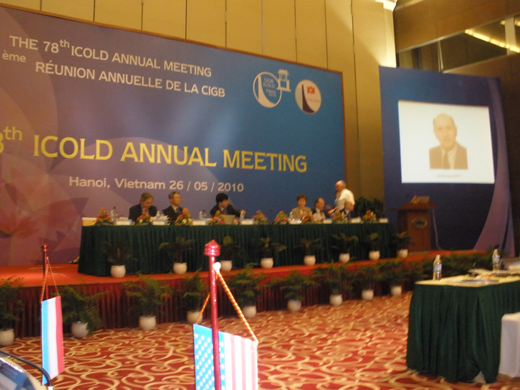
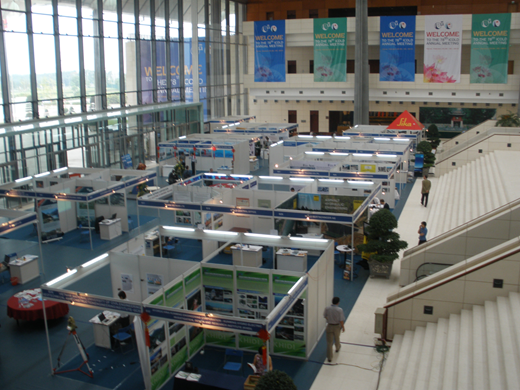
The 78th annual meeting of the International Commission on Large Dams (ICOLD) took place in Hanoi between the 23 and 26 May. There were three principal components of the proceedings: the main ICOLD executive meeting (Figure 1); various workshops and meetings of the different technical committees; and an international symposium, which this year was entitled ‘Dams and sustainable water resources development’. In addition there was a technical exhibition (Figure 2) that ran throughout the period. At all of these events there was a good representation of BDS members including Martin Airey, Rodney Bridle, John Sawyer, Malcolm Dunstan, Ljiljana Spasic Gril and Alison Bartle.
Peter Mason had been planning to attend but unfortunately because of personal reasons he was unable to make the trip, and hence I stood in as the UK representative at the executive meeting. In total 51 of the 90 member countries of ICOLD were represented and one of the first items of official business was to welcome two new countries (Mozambique and Ukraine) to the ICOLD family. Two new vice presidents of ICOLD were also elected during the meeting; these were Mr W. Floegl from Austria who becomes a vice president for the Europe zone, and Professor Pham Hong Giang from Vietnam who was elected as a vice president for the Asia zone.
Elections also took place to determine the topics for the four technical questions to be considered at the next full ICOLD congress, which will be held in Kyoto, Japan in 2 years′ time. The topics selected are outlined below and the formal call for papers will be issued in due course.
Question 92: Environmental friendly techniques for dams and reservoirs
Environmental and socially friendly planning, design and construction techniques for dams.
Mitigation and compensation measures.
Water quality and sediment issues.
Sustainable management of dams and reservoirs.
Question 93: Dam safety
Accidents and incidents at dams and reservoirs: recent case studies.
Risks associated with human and organisational factors.
Regulatory concepts, guidelines and good practice.
Specific risks for small dams.
Risks specific to tailing dams, pumped storage schemes, flood control structures and other special-purpose dams.
Question 94: Flood discharge
Evaluation and selection of extreme and design floods.
Recent trends in spillway design and spillway upgrading.
Special risks from gate operation and floating debris.
Energy dissipation, stepped spillways, stilling basins and downstream erosion.
Question 95: Ageing and upgrading
Risks associated with the long-term behaviour of dam foundations.
Long-term behaviour of dam materials and structures.
Decommissioning or upgrading?
Upgrading for seismic safety.
The executive meeting closed with a presentation from the US delegation who has made a bid to host the 2013 ICOLD meeting in Seattle. At the present time no other applications have been received, but the formal vote on the location of the 2013 meeting will not be made until next year.
In total there are some 25 technical committees of ICOLD that consider a whole range of issues, which influence all aspects of dam engineering thus ensuring that best practice from around the world can be understood and shared. BDS members sit on approximately half of these committees and are working and corresponding with our international colleagues on a regular basis. The developments from the Hanoi meetings are summarised below.
Seismic aspects of dam design (Ljiljana Spasic-Gril)
Ljiljana Spasic-Gril replaced Jonathan Hinks as a Committee member from the UK.
The technical committee had two meetings in Hanoi which were chaired by Martin Wieland from Switzerland. During the first meeting the following presentations were made on two recent earthquakes.
27 February 2010 Maule earthquake in Chile. The earthquake had a magnitude of 8·8. Several large dams were affected by this major earthquake; however, all of them performed well and no emergency reservoir draw down needed to be performed.
14 April 2010 Yushu earthquake in Qinghai province, China. The earthquake had a magnitude of 7·1. Several small hydropower plants were affected by this earthquake.
Several papers have been published by committee members in connection with the 12 May 2008 Wenchuan earthquake in China. The final report of the United Nations Development Programme (UNDP) project on seismic aspects of dams prepared by IWHR, Beijing has been completed. Committee members were also contacted by Science magazine journalists in connection with the possible relation between the Wenchuan earthquake and the Zipingpu reservoir. A corresponding short article has appeared in Science in March 2010.
In response to this article, the technical committee prepared a draft position paper on dam safety and earthquakes. The draft was discussed during the meeting and the position paper, was subsequently approved at the executive meeting. The main objective of this paper is to provide basic technical information on this subject to people with a technical background. In addition, the paper can be distributed to the press following strong earthquakes and it is expected that it will be used by journalists as a reference for their news articles.
During the second meeting revised ICOLD Bulletin 72 (1989): selecting seismic parameters for large dams was discussed. All the comments by the committee members were implemented in the revised document, and it was noted that Jonathan Hinks had coordinated the work on this revised bulletin. The bulletin was approved at the executive meeting.
Also, interpretation of seismic data obtained from strong motion instruments on various dams in Japan, China and USA, presented by Mr Matsumoto from Japan, was discussed during the second meeting. The results of this interpretation will be published as a bulletin once additional strong motion records from dams in Iran, Indonesia and China are obtained.
The objective of the committee in the forthcoming years is to focus on the seismic performance of roller-compacted concrete (RCC) dams and concrete face rockfill dams (CFRD) and a review of non-linear seismic analysis procedures for concrete and embankment dams.
Concrete dams (Malcolm Dunstan)
In spite of the distance of Hanoi from Europe and the Americas, there was the usual good turnout for the Concrete Dams Committee, 16 (including the president) out of 25 with four substitutes (i.e. an 80% attendance). The committee has just published one bulletin (no. 136 – The specification and quality control of concrete for dams; drafting sub-committee chairman John Berthelsen)), one is in the process of being published (Physical properties of hardened concrete in dams (Drafting sub-committee chairman Mario Berra)) and a further three bulletins are being drafted
selection of materials for concrete for dams
expanding concrete in dams
waterstops in concrete dams.
In addition a paper is being prepared on ‘Sustainable concrete dam construction’ and a contribution is being made to the Committee on Decommissioning for the bulletin ‘Decommissioning of concrete dams – options for recycling’. Finally, two databases are being initiated on the ‘Physical properties of concrete for dams’ and ‘Causes of expanding concrete in dams’.
Embankment dams (Rodney Bridle)
The committee now operates under its new name, replacing the slightly obscure old name: Materials for Fill Dams. We also have a new chair, Jean-Pierre Tournier from Canada, replacing Alberto Marulanda (Colombia), now a busy vice-president of ICOLD. Alberto's final task was as principal author of the bulletin on residual soils in dams, which is to be published shortly. The bulletin on cut-offs, a major work by Peter Brenner (Switzerland), is also coming out shortly. J.-J. Fry (France) and Rod Bridle (UK) made a presentation on the draft bulletin on dealing with internal erosion at existing dams. Members were asked to provide case histories for inclusion in the draft, which is a ‘living’ document and updates will be circulated from time to time, and is planned to be in advanced draft for next year's ICOLD meeting in Lucerne.
The internal erosion bulletin is being written by members of the ICOLD European working group on internal erosion. The working group also offered to work with others on an update of the 1995 bulletin on filters. A questionnaire on use of geotextiles in dams from Dave Paul (USA) was circulated for completion by members as a prelude to an updated bulletin on the use of geotextiles in dams. The proposal from Juha Laasonen of Finland to write a bulletin on groundwater control at dams was discussed and Juha will produce a synopsis and suggested contents for the next meeting. BDS members with an interest, or wishing to contribute to any of the bulletins mentioned or suggest others, or complete questionnaires are most welcome to contact Rod Bridle (rodney.bridle@damsafety.co.uk).
Floods (Martin Airey)
This committee is chaired by Mr C. Guillaud from Canada and includes a number of eminent dam engineers and specialist hydrologists. The committee has been working over the past 2 years on a new technical bulletin on integrated flood risk management. The bulletin will cover flood magnitude and estimation, the likely impacts of floods and alternative approaches to flood risk management on a catchment-wide basis. The final draft of the bulletin was discussed with a view to agreeing the final version by July 2010. Language editing will then take place in August so that the bulletin can be submitted to ICOLD for publication later this year.
Dams for hydroelectric energy (John Sawyer)
The committee which is chaired by Mr G. Ruggeri of Italy is working towards the production of a bulletin for the next annual meeting. A substantial draft text has been prepared although it is probable that the final version may only be completed in 2 years′ time. The scope of the bulletin is a broad-ranging review of the role of hydropower projects and the associated dams, rather than a detailed document on the dam technical issues. Topics within the bulletin will consider the following aspects of hydropower development
hydropower in response to energy needs, energy demand and production
dams and reservoirs for hydropower; current situation and future trends
policies and programmes for the promotion of renewable energies
pumped storage power plants
available information sources.
Dams and climate change (Martin Airey)
This is a relatively new committee having been first convened in Brasilia in 2009. However it is recognised that climate change could impact on dams and water resources in a number of ways and the work of the committee will inevitably be complementary with that of other technical committees such as Floods and Environment. Under the chair of Mr R. Lemons from the USA a draft terms of reference for the committee has been prepared and an initial paper plus presentation entitled ‘Climate change and potential challenges for the 21st century water resources engineer’ has been published in the proceedings of the symposium.
The international symposium
The international symposium was opened by the deputy prime minister of Vietnam and took place on the 25 and 26 May in the National Convention Centre of Hanoi. The overall theme was sustainable water resources and there was a wide range of papers presented that considered the different aspects of this topic in the context of dam development. Not surprisingly many of the papers covered projects in south-east Asia where there is ever-increasing demand for energy and new hydropower development. In particular there were presentations on projects and potential developments in southern China, Laos and Cambodia that could impact on the sustainable water resources development of the large river basins of the region such as the Mekong.
One of the most interesting and well-attended (standing room only) presentations did not really fit the general theme, but concerned the tragic accident that occurred at the Saayano – Shushenskaya hydropower plant in Russia in August 2009, when large parts of the power station were totally destroyed and 75 people lost their lives. In a very frank and open discussion the Russian delegates described the cause of this accident and the lessons that must be learnt for the future. While the initial problem had been caused by the relatively straightforward matter of fatigue of holding down bolts to one of the turbine covers, the consequences of the failure had been quite catastrophic. They went on to describe the immediate and medium-term works that were put in place to ensure the safety and integrity of the partially damaged dam. These included the measures to restore power to the flood control gates and the construction of a massive auxiliary spillway to carry the snowmelt flood flows for 2009/10, which prior to the disaster would have been discharged through the power station.
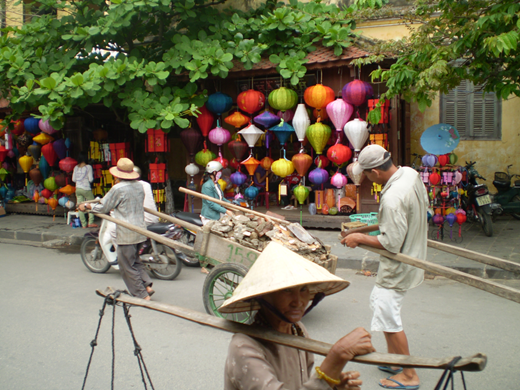
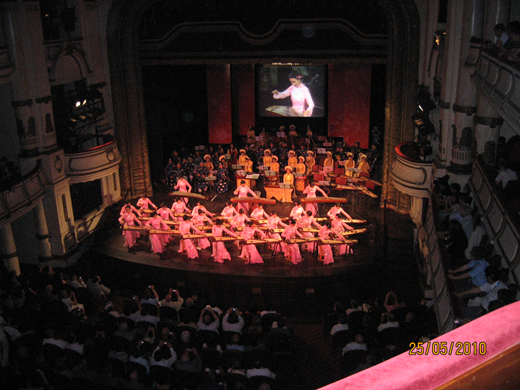
On the social side (Figure 3) the Hanoi meetings included a welcome reception, a farewell dinner and a cultural evening at the Opera House (Figure 4). This latter event included players in traditional Vietnamese dress who with a variety of unusual and unfamiliar looking instruments treated us to a delightful evening of music of both local and international origin. It is appreciated that the time and cost that is required to attend ICOLD meetings can be quite significant. However, the next ICOLD meeting in June 2011 will be in Lucerne, Switzerland and as it is a little nearer to home with lower-cost air fares it is hoped that a few more BDS members will be able to participate.