


In this paper, we view an individual's annuitization decision as an American style call option whose underlying asset is financial wealth, which controls the distance to annuitization. We then derive a certain threshold of wealth over which the individual is optimal to annuitize all of her wealth. We particularly focus on the effects of liquidity constraints on the individual's optimal annuitization decision, concerning their effects on the optimal investment and consumption strategies. We show that the annuitization decision can be significantly affected by the extent to which individual borrowing is constrained. More specifically, the optimal decision is for the individual to annuitize earlier with the tighter liquidity constrains she is exposed to than initially planned. This is particularly relevant to today's pandemic situation especially with the growing concern about cutting credit limits.
1. Introduction
Fears that the coronavirus will lead to widespread unemployment and a spike in consumer defaults have wiped more than two-thirds from the value of US credit card lenders and left executives contemplating cutting credit limits for some customers. (Financial Times, March 19, 2020)
The currently on-going COVID-19 pandemic has driven increased concerns about consumer defaults due to income discontinuities resulting from employment loss. The above quote from Financial Times demonstrates the possibility of cutting credit limits for some customers [1]. A very clear need has, thus, arisen to thoroughly explore the effects of liquidity constraints having a great deal of currency in the context of the post-pandemic era, especially on optimal financial decisions over the life cycle.
A crucial element one needs to consider when discussing optimal life cycle strategies is the decision to annuitize with retirement. In the UK and many other countries, individuals need to determine when to start their retirement pension along their retirement decision, which has to be irreversibly made at one distinct point in time (e.g. retirement) [2]. Basically, the rationale behind the decision to annuitize is to secure a certain quantifiable level of income in retirement which can be used to satisfy future consumption needs during retirement years.
Throughout the paper, we devote our attention to defined benefit (DB) pension plans providing the individual with a fixed monthly payment until death [3]. As far as the utility maximizing framework is concerned, the individual is assumed to exhibit the constant relative risk aversion (CRRA) utility preference. In the simplest possible economic setup with the constant investment opportunity, we then maximize the individual's (expected) discounted total utility from consumption by optimally controlling her investment and consumption, and the timing of annuitization, especially subject to liquidity constraints. Here, determining the optimal timing of annuitization resembles the optimal stopping problem of an American style call option whose underlying asset is the individual's financial wealth, which controls the distance to optimal annuitization [4].
In this paper, we investigate how an individual optimally makes an annuitization decision, particularly concerning the effects of liquidity constraints on life cycle investment and consumption policies. Our analysis therefore illustrates how the individual's optimal annuitization decision is affected by the extent to which individual borrowing is constrained. We theoretically derive and numerically verify that in the presence of liquidity constraints, similar to Park (2015, 2020), there also exists a certain threshold of wealth for annuitization over which the individual finds it optimal to annuitize all of her wealth. The major departure of our annuitization strategy from Park (2015, 2020)'s one is that the wealth threshold is now a function of the extent to which individual borrowing is limited (the liquidity constraint). Our numerical analysis demonstrates that the wealth threshold is known to be lower with tighter liquidity constraints. Put differently, the optimal decision is for the individual to annuitize earlier than initially planned with the tighter liquidity constraints she is exposed to.
This is particularly relevant to today's pandemic situation especially with the growing concern about cutting credit limits. Indeed, many people who are close to their retirement have already opted to retire early since the pandemic started [5]. This is because total available financial resources for annuitization are reduced due to the fact that the individual's ability to borrow is restricted by liquidity constraints. Such reduced resources would expose the individual to some financial challenges if she suboptimally opted to annuitize later and hence, had to meet consumption needs for a longer period until annuitization. Therefore, existing guidance on annuitization without consideration of liquidity constraints may represent an overly simplified situation.
When it comes to the individual's optimal investment and consumption strategies, in addition to the classical rule of thumb (e.g. mean-variance efficient rule, permanent income hypothesis, etc.), we find two extra opposing motives significantly affecting the optimal decisions. First, for individuals who aim to opt for optimal annuitization, the incentive to invest more in the stock market becomes larger to amass wealth as quickly as possible, and thereby the annuitization option is highly likely to be “in the money,” thus being exercisable. However, the risky asset demand can be reduced according to the extent to which individual liquidity is constrained. Intuitively, liquidity can be used as a buffer against adverse shocks in the stock market, but inability to pledge future income because of liquidity constraints makes the individual less effective when coping with the market shocks, thus requiring more savings for precautionary reasons.
This paper builds on two streams of the literature. First, it sits squarely within the optimal investment and consumption framework pioneered by Merton (1969, 1971), but reflecting liquidity (borrowing) constraints caused by market frictions (e.g. informational asymmetry, agency conflicts and limited enforcement). A highly partial listing includes Cocco et al. (2005). The major departure of ours from Cocco et al. (2005) is that while it considers somewhat extreme cases for which individuals are not allowed at all to pledge future income so that they cannot borrow against it, we consider novel and more realistic cases for which individuals can borrow against future income with certain limits according to their credit quality. Second, we further draw on the literature on optimal annuitization. Since the seminar works of Yarri (1965) and Richard (1975) on annuitization, Milevsky and Young (2007), Park (2015, 2020) have investigated full annuitization under which individuals are required to annuitize all of their wealth at one distinct point in time (e.g. retirement). However, these papers are independent of liquidity constraints, thus not exploring the effects of liquidity constraints on annuitization. While being motivated by the crucial role of liquidity constraints in the life cycle investment and consumption strategies, we generalize Kim et al. (2020, hereafter KJP) to include more realistic liquidity constraints [6].
Since the model in this paper determines the optimal annuitization time endogenously under the condition that the individual is exposed to liquidity constraints, one could say that our paper is merely an extension of the work of Park (2015) and KJP. Obviously, we add liquidity constraints to the baseline annuitization models of Park (2015) and KJP, but adding constraints to the models could offer various insights and implications to get a better understanding of the impact of liquidity constraints especially on the optimal life cycle consumption/savings, investment and annuitization decisions. Even though KJP has an analysis with non-borrowing against future income, it may not be able to quantitatively identify in the optimal decisions the role of the extent to which individual borrowing is limited. The qualitative properties of the optimal decisions with liquidity constraints can be expected based on the analysis of KJP, however, we can theoretically and numerically demonstrate that there are major quantitative differences between individuals with liquidity constraints and individuals with the non-borrowing situation only. Furthermore, according to our option pricing interpretation on annuitization, if the individual neglects liquidity constraints (Park, 2015) or considers the non-borrowing situation only (KJP) in her routine annuitization decision, she would then incur substantial financial losses associated with suboptimal annuitization decision. This would, thus, still support the importance of liquidity constraints channel for annuitization, even concerning Park (2015) or KJP.
The paper is organized as follows. In Section 2, we develop the annuitization model especially with the extent to which individual liquidity is constrained. In Section 3, we provide the model solution with analytically tractable wealth threshold for annuitization, and optimal investment and consumption strategies. In Section 4, we show the graphical illustrations for the optimal strategies derived in Section 3 in order to discuss their various economic implications. In Section 5, we conclude the paper.
2. The model
We consider a representative individual who exhibits the following Cobb–Douglas utility function:
where ct is per-period consumption, lt is leisure, 0 < a < 1 is a weight for consumption, and γ* < 1 and γ* > 1 imply that consumption and leisure are complements and substitutes, respectively. We consider a binomial choice of leisure in which the individual enjoys leisure lt = l1 while working and after retirement. The wage rate w is assumed to be constant, so that the individual obtains a labor income stream . We normalize l1 = 1.
We consider two tradable assets in the financial market: one risk-less bond and one risky stock. The risk-less bond price grows at the risk-free interest rate r > 0:
The risky stock price is assumed to follow a geometric Brownian motion (GBM):
where μ > r is the expected stock return, σ > 0 is the stock volatility, and Wt is the standard one-dimensional Brownian motion defined on a suitable probability space.
We assume that the individual can pledge future income so that she can borrow against it. This setup is standard, but we assume novel and more realistic situations for which the individual has certain borrowing limits according to her credit quality. As such, the present value of future income is given by discounting it at the risk-free interest rate as I/(r + ν), where ν > 0 is the individual's mortality rate. Here, there are two limiting cases when it comes to individual borrowing. For the limiting case of full borrowing against future income (Park, 2015), the individual can be endowed up to the present value I/(r + ν), thus x ≥−I/(r + ν), where x is the individual's initial wealth. For the other limiting case of non-borrowing against future income (KJP), the individual has a non-negative wealth constraint: x ≥ 0. Summarizing,
We relax these unrealistically extreme cases by allowing the individual to borrow up to some certain limits according to her credit quality. Particularly, we newly introduce an exogenous new parameter ω representing the extent to which credit is tightened. With the empirically plausible range of 0 ≤ ω ≤ 1, the individual has the following liquidity constraints:
so that individual borrowing is now constrained partly depending upon its lower bound, which becomes a real consideration in the individual's decision-making process. The new borrowing limit is reminiscent of a starvation level below which the individual no longer sustains herself financially, and thus, she cannot invest in the stock market any more. Notice that by setting either ω = 0 or ω = 1, our model reduces to either KJP or Park (2015), respectively.
With the liquidity constraints (2), the individual dynamically accumulates her wealth Xt at time t by consuming ct, investing πt and Xt − πt in the stock and bond market, respectively, and obtaining income I:
We focus attention on the most situations until recently in the UK and US where the individual makes an optimal decision of when to start her retirement pension by a certain age (e.g. 65), which has to be irreversibly made at one distinct point in time (e.g. retirement). That is, the individual is currently a full-time worker and can start her retirement pension at retirement. Following Yarri (1965) and Richard (1975), we assume that the individual annuitizes all of her pensionable wealth especially at that optimally chosen time. By doing so, the individual can secure a certain quantifiable level of income in retirement which can be used to satisfy her future consumption needs during retirement years. More specifically, if the individual optimally opts for such a full annuitization with an amount of wealth Xt at time t, she can then receive retirement pension $Xt(r + ν) per annum until she dies:
The individual's problem is then to maximize her utilities (1) from consumption and leisure over the life cycle by optimally determining her consumption/savings and investment strategies, c and π, and timing of annuitization, τ:
which is subject to liquidity constraints (2) and dynamic wealth constraints (3), where E is the expectation taken at time 0, β > 0 is the individual's subjective discount rate, γ = 1 − a(1 − γ*) > 0 is the constant coefficient of relative risk aversion, τ is the optimal timing of annuitization and Xτ is the individual's pensionable wealth at that annuitization time. By entering annuitization at time τ, the individual's retirement pension Xτ(r + ν) is started to be generated (on a monthly basis in practice) and she consumes at a rate equal to Xτ(r + ν) during her retirement years.
3. Solution
Similar to Park (2015) and KJP, we endogenously determine optimal timing of annuitization as a certain threshold of wealth above which the individual finds it optimal to start her retirement pension by annuitizing all of her pensionable wealth.
There exists a certain threshold of wealth above which the individual finds it optimal to start her retirement pension by annuitizing all of her pensionable wealth and it is obtained in closed-form:
Proof. We prove the theorem in three steps.
We solve the problem (4) by endogenously determining an optimal annuitization boundary above which the individual finds it optimal to start her retirement pension by annuitizing all of her wealth. The problem is then to find a certain wealth threshold in the following optimal stopping problem (Bensoussan and Lions, 1982; Øksendal, 2007):
To solve the optimal stopping problem (5), we employ a convex-duality approach (Bensoussan et al., 2016). Specifically, introduce a dual variable λ(x) of wealth x as the marginal value V′(x) of value function and a dual function G(λ(x)) of value function as total wealth x + I/r which is the sum of wealth x and the present value I/r of future income discounted at the risk-free interest rate r [7]:
satisfying
For notational simplicity, we will write G(λ(x)) and λ(x) as G(λ) and λ, respectively, by omitting x unless there is any confusion. Taking a differentiation on the both sides of the first equation in (5) with respect to x, we obtain
The equation stated above is then rewritten as the following equation of dual variable λ and dual function G(λ): for any ,
where and are the unknown constants to be determined corresponding to wealth threshold and liquidity constraints x ≥−ωI/(r + ν) as stated in (2).
In this second step, we solve the restated equation (9). A general solution to equation (9) is given by
We now show how the dual function G(λ) having the closed-form as stated in (10) can be recovered to the value function V(x), thereby solving the original optimal stopping problem (5). Let us define
and
because of the first equation in (5). Notice that equation (9) shows that
Thanks to the relations given in (8), we can then have
Therefore, V(x) is indeed a solution to (5).
Let us then clarify the so-called value-matching and smooth-pasting conditions for determining these two constants specifically. The last equation in (5) is equivalent to
The third equation in (5) can be restated with dual variable λ and dual function G(λ) as
Using the relation (11) and the closed-form of G(λ) given in (10), the equation restated above becomes
which is a value-matching condition. Since the dual function G(λ) has been introduced as total wealth x + I/r as in (7), using the relation (11) and the closed-form of G(λ) we obtain
which is another value-matching condition. Also, as wealth approaches its lower bound as stated in (2), we get
which is the other value-matching condition. The FOCs for consumption and investment given in (6) can be rewritten with dual variable λ and dual function G(λ) as
The individual is not capable of investing in the stock market when her liquidity constraints do bind, so that
which results from the FOC for investment given in (15) and is the smooth-pasting condition.
Summarizing, there are four unknown constants A, A*, , satisfying four equations (12), (13), (14), (16). In this last step, we will show how to determine these four constants completely.
thus,
as a result,
By substituting A and A* given in (17) and (18) in (19) and (20), the following two relations are derived:
and
We now introduce a constant C ∈ (0, 1) which relates and as
Using the relation stated above, equation (22) determines the value of as
which completes the proof with (11). Q.E.D.
The distinct feature of optimal annuitization strategy stated in Theorem 3.1 from Park (2015) and KJP is that the new parameter ω ∈ [0, 1] representing the extent to which credit is tightened controls the distance to annuitization as well, in addition to financial wealth as usual. In the limiting case of ω = 0 where the individual cannot borrow at all against future income, the wealth threshold is exactly the same as KJP. In the other limiting case of ω = 1 for which the individual is allowed to fully pledge future income, the wealth threshold reduces to the case of Park (2015).
With the empirically plausible range of 0 < ω < 1, we now investigate how the individual's wealth threshold for optimal annuitization is affected by the extent to which individual borrowing is constrained. Our numerical analysis demonstrates that the wealth threshold is known to be lower with the smaller ω. That is, the optimal decision is for the individual to annuitize earlier than initially scheduled with the tighter liquidity constraints she is exposed to. This is particularly relevant to today's pandemic situation especially with the growing concern about cutting credit limits. Intuitively, total available financial resources for annuitization are reduced due to the fact that the individual's ability to borrow is limited by liquidity constraints. Such reduced resources would expose the individual to some financial challenges if she suboptimally opted to annuitize later and thus, had to satisfy consumption needs for a longer period until annuitization. Hence, existing guidance on annuitization without taking liquidity constraints into account annuitization may represent an overly simplified situation.
Next, we provide analytic comparative statics for the optimal life cycle investment and consumption policies with liquidity constraints and optimal annuitization.
The optimal life cycle investment and consumption policies with liquidity constraints and optimal annuitization are derived in closed form:
Proof. Using the FOCs for consumption c and investment π given in (15), the definition of dual function G(λ) given in (7) and rearrangement of the general solution given in (10) complete the derivation of optimal consumption policy ct as stated in the theorem.
To derive the optimal investment policy as formulated by its FOC in (15), we need to calculate the first derivative G′(λ) from the general solution (10) as
as a result, substituting the optimal consumption policy ct given in the theorem in λ−1/γ above and using the FOC for investment πt given in (15) complete the derivation of the optimal investment policy. Q.E.D.
The optimal life cycle investment policy given in (23) generalizes the classical Merton's investment wisdom in two ways especially with optimal annuitization and liquidity constraints. More specifically, in addition to the standard mean-variance efficient rule , the two extra terms involving A > 0 and A* > 0 on the right-hand side of (23) represent the effects of optimal annuitization and liquidity constraints on the optimal investment, respectively. Since α > 1 and −1 < α* < 0, as far as γ > 1 is concerned consistent with the data, the second term demonstrating the effects of optimal annuitization turns out to increase the risky asset demand, while the last term showing the effects of liquidity constraints turns out to reduce the risky investment. The former result is consistent with Park (2015) in that the annuitization can be viewed as an American style call option whose underlying asset is the individual's financial wealth, which controls the distance to optimal annuitization. For individuals who aim to opt for optimal annuitization, the incentive to invest more in the stock (save less in the bond market) market becomes larger to amass wealth as quickly as possible, and thereby the option is highly likely to be “in the money,” thus being exercisable.
While the effects of liquidity constraints on the optimal investment as identified by the last term on the right-hand side of (23) are known to reduce the demand for risky asset investment. This result is consistent with KJP in that the market is incomplete with its frictions from the individual's view because she is liquidity constrained, and the market incompleteness makes the individual more conservative when taking on the stock market risk. Intuitively, liquidity can be used as a buffer against adverse shocks in the stock market, but inability to borrow against future income due to liquidity constraints makes the individual less effective when responding to the market shocks, thus resulting in less risky investment and more riskless savings for precautionary reasons.
When it comes to the consumption/savings decision given in (24), the generalization here is that Friedman’s (1957) permanent income hypothesis (PIH) is driven not only by the individual's total available financial resources x + I/r (financial wealth plus human capital), but more interestingly, also by the effects of annuitization and liquidity constraints as we have analyzed in the optimal life cycle investment decision above. Since the extra effects have a negative impact on the amount of optimal consumption, PIH implications on consumption/savings may be somewhat overestimated to the extent to which the annuitization option is exercisable and individual liquidity is constrained.
We next provide the net payoff upon annuitization in the following theorem. This is the option pricing interpretation, which is useful for understanding much of the implications on the impact of liquidity constraints.
Assuming γ > 1 and
Proof.Static budget constraint. We first convert the dynamic budget (or wealth) constraint given in (3) into a static constraint. The following unique state price density process which exists given dynamic market completeness under no arbitrage will play a pivotal role in the conversion:
Specifically, applying It ’s formula to with the dynamic budget (or wealth) constraint given in (3) results in
where is the Brownian motion defined under the new martingale measure with respect to the state price density ξt; the new probability measure is defined by Girsanov's theorem as
and the Brownian motion then follows
Here, is the filtration generated by the standard Brownian motion Wt. We then integrate both sides of (25) from 0 to τ as follows:
Taking expectation under the new martingale measure, we obtain
Also, changing the martingale measure into the physical measure using their relation (26), we get
which is the static budget constraint.
Problem reformulation. We now reformulate the individual's annuitization problem (4) especially using the static budget constraint given in (27). Using the standard Lagrangian approach, we can construct the so-called indirect value function J(λ) in dual (which can be converted into the original value function V(x) in primal) and it is given by
The FOCs for consumption c and wealth X are then determined as
By substituting the FOCs in (28), we can now obtain the following pure optimal stopping problem:
where
will play a pivotal role as a state variable in the characterization of the payoff upon annuitization.
Net payoff upon annuitization. The obtained optimal stopping problem (29) can be restated as
where
and the second equality results from Merton (1969, 1971) by solving the post-annuitization case in closed-form. Q.E.D.
Theorem 3.3 shows many direct consequences of the option pricing interpretation. First, the original annuitization problem (4) can be now converted into an American style call option problem where the new state variable Zt defined in the theorem can be treated as the underlying asset of the option. Here, the state variable e−(β+ν)tZt discounted at the mortality-risk perceived subjective discount rate β + ν follows a GBM with volatility equal to the Sharpe ratio θ and mean equal to the mortality-risk adjusted interest rate r + ν. The very last term I/(r + ν) in the square brackets on the right-hand side of the net payoff is the present value of future income as we predicted based on the drift r + ν of the underlying asset (or the state variable). We can then regard this term as the strike price of the option capturing the permanent loss of human capital upon annuitization. In other words, the individuals are at the cost of forgone income by entering annuitization (or exercising the option).
Interestingly, the first terms inside the square brackets have an intuitive interpretation. More precisely, they are the positive utility terms brought about by annuitizing all of her wealth. Since the parameter represents the present utility unit of post-annuitization leisure preference discounted at the mortality-risk perceived subjective discount rate β + ν, the terms involving parameter K capture the payoff of the annuitization option especially in utility units as measures utility of consumption.
Summarizing, there are two opposing economic forces behind the optimal annuitization decision. On the one hand, the individual obtains the benefit of extra leisure after annuitization. On the other hand, the individual bears the cost of forgone income by annuitizing all of her wealth. The individual, thus, optimally exchanges her human capital (expressed in monetary terms) with the extra leisure (in utility terms) upon annuitization, thereby striking an optimal balance between the benefit of extra leisure and the cost of forgone income.
Having understood much of the economics behind the optimal annuitization decision, we can now further emphasize the importance of liquidity constraints channel for annuitization, even concerning the existing papers (Park, 2015; KJP). Theorem 3.3 implies that ignoring or even misestimating the extent to which individual borrowing is constrained can be costly to individuals who aim to achieve their successful retirement years towards the end of their life cycle. More concretely, the optimal stopping boundary Zτ corresponding to the optimal annuitization is determined endogenously depending upon the individual's ability to borrow (Theorem 3.1). So, if the individual neglects liquidity constraints (Park, 2015) or considers the non-borrowing situation only (KJP), the state variable Zt would then be realized as a value lying in somewhere between Zτ and . In case of annuitization at any higher value than Zτ, while the individual is required to pay a fixed amount of forgone income, I/(r + ν), the benefit of extra leisure after annuitization measured in the utility terms is reduced, as a result, the net payoff (the benefit minus the cost) upon annuitization is smaller than as optimally planned. In an extreme case of annuitization at a very high Zt by ignoring the liquidity constraints, the net payoff might be even negative. Therefore, the individual would incur substantial financial losses associated with suboptimal policy without correctly taking the liquidity constraints into account the annuitization decision.
4. Graphical illustrations
Based on the model solution we have derived in our previous analysis, we now provide the graphical illustrations for the optimal strategies to discuss their properties and economic implications. To have a fair comparison between ours, Park (2015), and KJP, we maintain the same baseline parameter values used in KJP as follows:
4.1 Changes in liquidity constraints
The optimally (endogenously) determined wealth threshold for annuitization by Theorem 3.1 does depend crucially on the extent to which individual borrowing is constrained (Figure 1). First, we can confirm that the threshold decreases with respect to tighter liquidity constraints with smaller ω, thus clearly demonstrating the negative effects of liquidity constraints on the optimal annuitization decision. Put differently, the individual would find it optimal to annuitize all of her wealth earlier than initially planned, especially when she is more liquidity constrained. This result would, thus, indicate the economic importance of correctly incorporating the liquidity constraints in the annuitization decision.
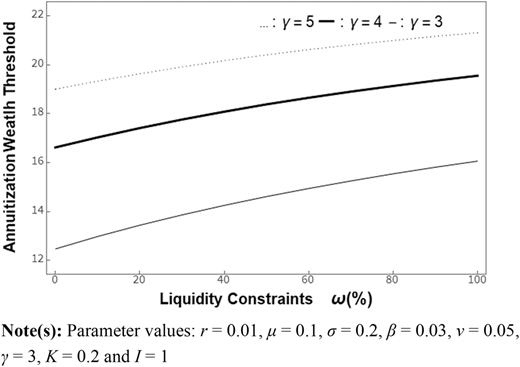
Annuitization threshold as a function of liquidity constraints for three different values of risk aversion
Annuitization threshold as a function of liquidity constraints for three different values of risk aversion
4.2 Changes in risk aversion
The annuitization decision relies on the levels of risk aversion as well (Figure 1). The larger risk aversion the individual exhibits, the higher wealth threshold she optimally targets for her annuitization. Intuitively, the more risk averse individual tries to absorb an adverse shock in the financial market by working longer while still receiving her labor income and therefore, she does not want to exercise her annuitization option earlier.
4.3 Changes in post-annuitization leisure preference
The individual who cares a lot about leisure after annuitization with greater K will want to enter annuitization later (Figure 2). The major incentive to annuitize all of wealth results from an increase in leisure once annuitized. That is, the extra leisure is brought about by annuitizing, so high levels of wealth upon entering annuitization are the natural manifestation of a stronger preference for leisure after annuitization.
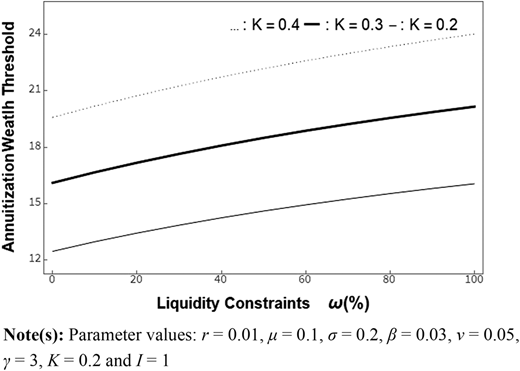
Annuitization threshold as a function of liquidity constraints for three different values of post-annuitization leisure preference
Annuitization threshold as a function of liquidity constraints for three different values of post-annuitization leisure preference
4.4 Changes in financial market parameters
The individual's optimal annuitization decision is also affected by changes in fundamental parameter values for the financial market (Figure 3). The better investment opportunities with higher expected stock return and/or lower stock volatility allow the individual to enter annuitization later than originally scheduled by targeting the greater wealth threshold for annuitization. The insights behind this decision on later annuitization result from the properties of human capital with investment opportunity. Intuitively, the value of human capital increases with investment opportunity, and therefore, a higher human capital value would encourage the individual to continue to work enjoying more utilities obtained from her greater human capital, thus delaying the timing of annuitization.
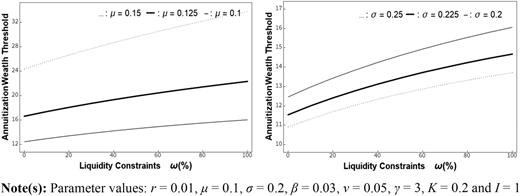
Annuitization threshold as a function of liquidity constraints for three different values of stock return and volatility
Annuitization threshold as a function of liquidity constraints for three different values of stock return and volatility
4.5 Optimal consumption and investment strategies
As we have analyzed in Theorem 3.2, the optimal consumption and investment strategies are significantly affected by the extent to which individual liquidity is constrained. As expected, the amount of consumption and investment further decreases with respect to tighter liquidity constraints (smaller values of ω) (Figure 4). The more liquidity constrained individual is willing to save more due to their liquidity concerns by reducing both consumption and risky investment.
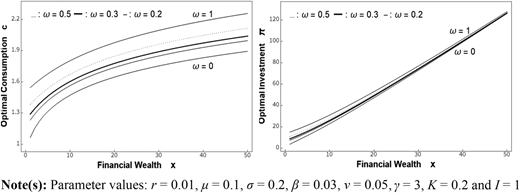
Optimal consumption and investment strategies as a function of financial wealth for the extent to which individual liquidity is constrained
Optimal consumption and investment strategies as a function of financial wealth for the extent to which individual liquidity is constrained
5. Conclusion
In this paper, we have developed an analytically tractable workhorse annuitization model especially focusing on liquidity constraints that can be readily utilized to investigate the individual's various life cycle issues associated with consumption, investment, retirement and annuitization. Having taking the extent to which individual liquidity is constrained into account the annuitization model, we isolate and very closely investigate the annuitization issues associated with liquidity constraints. We theoretically and numerically demonstrate that a certain threshold of wealth for annuitization is known to be lower with tighter liquidity constraints, thereby implying that the individual would find it optimal to annuitize all of her wealth earlier than originally scheduled. This is particularly relevant to today's pandemic environment especially with the increasing concern about cutting credit limits.
The optimal life cycle investment and consumption policies are affected by the liquidity constraints accordingly. We theoretically identify two extra motives for investment and consumption in addition to the classical rule of thumb: (1) annuitization and (2) liquidity constraints. Having treated the annuitization decision as an American style call option whose underlying asset is the individual's wealth as in Park (2015), overall the incentive to consume less and invest more in the stock market becomes larger with the annuitization motive in order to accumulate wealth as soon as possible. While the effects of liquidity constraints should act reversely for the investment and consumption decisions for precautionary reasons because of liquidity concerns. We hope this paper will lend itself for the individual to strike a useful balance between these two opposing motives for investment and consumption over the life cycle.
This research was financially supported by Daesan Shin Yong Ho Memorial Society through its research support project. The author is grateful for the area editor Prof. Eun Jung Lee and two anonymous referees for their valuable comments and suggestions.
Notes
The issue of constrained borrowing (credit) has been encountered by many individuals. According to the Survey of Consumer Finances (2017), “In 2016, 20.8% of families were considered credit constrained – those who reported being denied credit in the past year, as well as those who did not apply for credit for fear of being denied in the past year.”
Even in the United States, most individuals have an option to annuitize with variable annuity contracts that can be exercised once only. In a social security aspect, retirement benefits are provided in the style of a lifetime annuity based on a retirement age of 65. As such, individuals would receive a smaller or larger annuity if they opted to retire earlier (as of age 62) or later (up to age 70). With a deferred income annuity (also known as an Advanced Life Delayed Annuity), the annuity income can be generated even after age 70, but before age 85.
Even though the world pension market seems to come around to the change from DB pension plans to defined contribution (DC) pension plans, salaried employees often resort to a typical DB pension plans, which may be the case within our academic profession. In the UK, the researches on DB pension schemes are timely and still have to be conducted actively for the foreseeable future, at least, due to increased concerns about deficits of UK DB pension schemes (Pension Protection Fund Data): “Plummeting stock market prices and rock-bottom interest rates may forced the Universities Superannuation Scheme (USS) to raise contribution levels sooner than expected and to offer “much less generous” pension, experts have said” (Times Higher Education March 22, 2020).
This can be understood in the context of real option applications. For instance, Kang and Han (2020) have studied a military service system by the real option theory. Lee et al. (2021) has also investigated the optimal investment with regime switching by chracterizing regime-dependent thresholds of cash flows above which an investor finds it optimal to invest in a new project.
“Latest statistics from the Office for National Statistics, combined with a study from provider LV, have suggested thousands of people aged 55 and above have been leaving the full-time workforce since the coronavirus crisis began …. Its findings have indicated that more than 154,000 people aged 55–64 have opted for early retirement because of redundancy and reduced income, a desire to reduce their risk of exposure to Covid-19 or the pandemic has made them reassess their priorities in life. (Financial Times, February 2, 2021)”
Kim et al. (2020) regard a borrowing constraint as the extreme case considered in Cocco et al. (2005) for which individuals cannot borrow at all against future income.
Actually, the present value of future income incorporating the individual's mortality rate is given by I/(r + ν) where the mortality-risk perceived interest rate r + ν has been used as the discount rate for future income. Although the dual function G defined as the total wealth with the present value I/r instead of I/(r + ν) seems to overlook the effects of mortality rate, the mortality is a real consideration not only in the increased subjective discount rate β + ν for the annuitization problem (4), but importantly, also in the liquidity constraints (2).

