The study aims to examine the nexus between product innovation performance (PIP), cross-functional teams' collaboration (CFC), and management accounting systems (MAS) based on knowledge-based theory (KBT), social capital theory (SCT) and contingency theory (CT). Furthermore, the study also aims to explore the mediating role of MAS in the CFC-PIP nexus, which remains untested.
This study tested the main hypotheses through a two-stage design: first, a meta-analysis of 25 studies to synthesize prior evidence for hypothesis development, and second, an empirical investigation to test the hypotheses, based on data from 328 managers from Pakistan's Hi-tech firms using SmartPLS 3.
Our findings show that CFC has a significant, positive impact on PIP, indicating that cross-functional teams enhance product innovation in Pakistani Hi-tech firms. Second, we find that CFC is positively associated with the MAS. Third, MAS positively impacts the PIP. Finally, MAS mediates the relationship between CFC and PIP.
This is the first study to integrate KBT, SCT and CT to test MAS as a mediator between CFC and PIP. On the other hand, this study's empirical finding is that generating new ideas through collaboration among departmental workforces indicates that MAS mediates the nexus between CFC and PIP. Our study offers valuable insights for companies aspiring to innovate and succeed in today's business landscape, providing context-specific guidance for Hi-tech firms in developing economies.
1. Introduction
Innovative performance is significant for Hi-tech firms to compete in national and international markets (Tang et al., 2021; Zheng et al., 2025). A key factor is the cross-functional teams' collaboration (CFC), which significantly impacts a firm's product innovation performance (PIP). However, prior studies have found inconclusive evidence. For example, Pérez-Luño et al. (2019) found a negative association; in contrast, Sun et al. (2016) documented a direct relationship; however, Graner and Mißler-Behr (2014) failed to find any relationship between CFC and PIP. Another important factor that influences PIP is management accounting systems (MAS), which also has inconclusive findings. In particular, this relationship has been reported as positive (Miftah, 2020), negative (Bisbe and Otley, 2004), and unclear (Le et al., 2020). Thus, syntheses of these mixed findings are needed, which addresses this via a meta-analysis of prior studies. A meta-analysis enables us to statistically resolve inconsistencies among the nexuses of CFC-PIP and MAS.
Despite decades of research, four critical gaps remain insufficiently addressed. First, while individual studies have examined bivariate relationships, prior research has scarcely provided a comprehensive meta-analysis simultaneously synthesizing the CFC-PIP, CFC-MAS, and MAS-PIP relationships to establish definitive effect sizes and resolve the striking inconsistencies documented across primary studies (Hunter et al., 1986; Magnacca and Giannetti, 2024). Second, the mediating role of MAS in the CFC-PIP nexus remains largely unexplored; prior studies have predominantly treated CFC and MAS as parallel or competing predictors of innovation performance rather than examining whether MAS serves as a transmission mechanism through which cross-functional collaboration translates into enhanced product innovation outcomes (Chenhall and Moers, 2015; Magnacca and Giannetti, 2024). This omission is particularly notable because management accounting systems are fundamentally designed to facilitate information sharing, coordination, and decision-making, processes that cross-functional teams require to innovate effectively (Magnacca and Giannetti, 2024; Naranjo-Gil and Hartmann, 2007).
Third, existing research is predominantly Western-centric, with limited attention to developing economies like Pakistan, characterized by unique governance challenges, skill shortages, and distinct socio-cultural dynamics, leaving questions about the generalizability of findings from Western contexts largely unanswered (Naranjo-Gil and Hartmann, 2007; Shahzadi et al., 2018). Fourth, to the best of our knowledge, prior studies have rarely integrated knowledge-based theory (KBT), social capital theory (SCT), and contingency theory (CT) into a unified framework to explain the CFC-MAS-PIP nexus, particularly the mediating role of MAS (Grant, 1996; Häuberer, 2011). However, the theoretical gap remains: no prior study has integrated knowledge-based theory, social capital theory, and contingency theory to explain the CFC-MAS-PIP nexus, especially the mediating role of MAS. Our study addresses this gap by proposing that KBT explains how CFC facilitates knowledge transfer and recombination, SCT explains how collaborative networks enhance information flow into MAS, and CT explains how MAS characteristics serve as contingent factors that enable adaptive decision-making for product innovation under uncertainty. Our study also aims to add new evidence on the case of high-tech firms in Pakistan. The articulation of these research gaps has been refined to enhance clarity and logical coherence, providing a stronger justification for our integrated theoretical framework and empirical investigation.
Our study has explored the nexus between CFC and PIP and the mediating role of MAS in the nexus between CFC and PIP, using data from 328 responses from top- and middle-level managers working in various Hi-tech firms in Pakistan through questionnaires. PLS-SEM is used to test the hypotheses, and various other tests are also employed to check the robustness and accuracy of the results. Our study also employed meta-analysis to test the mixed findings for hypothesis development. After applying various tests and techniques, a significant and positive association is found between CFC and PIP. Furthermore, results suggested that the MAS positively mediates the relationship between CFC and PIP. This study will be effective for all firms that are innovation strivers and make efforts to ensure the success of their businesses.
Our study adds to the contemporary innovation management, technology management, and strategic management literature in the following ways. This study's primary contribution is to reinvestigate the conflicting relationship between CFC and PIP via meta-analysis and new evidence for hypothesis development, and then test it empirically in the case of high-tech firms in Pakistan. Likewise, our study also aims to address contradictory results regarding the impact of MAS on PIP. Third, our study contributes by exploring the mediating role of MAS in the relationship between CFC and PIP. The role of MAS is pivotal for teams' collaboration, innovation, timely information, and decision-making. This technique fills a gap in the literature by offering new insights about how MAS improves PIP. Finally, our study provides useful strategic insights for Hi-tech firms, especially in developing countries like Pakistan, to strengthen their competitive advantage and innovation processes. Specifically, the study will urge innovation-oriented firms and their middle-level and top managers to make strong policies regarding the use of MAS to enhance collaboration in their functional departments so that team members can bring out innovative ideas through mutual understanding and performance. These innovative ideas and collaborative efforts of functional groups will lead to successful product innovation performance in firms.
2. Theoretical review and hypotheses formation
2.1 Meta-analysis for hypotheses development
Meta-analysis involves synthesizing findings from previous studies to evaluate their combined influence on a specific subject (Hunter et al., 1986). This research employs diverse keywords such as product innovation performance, product innovation, product innovativeness, new product development, cross-functional teams' collaboration, cross-functional integration, cross-functional collaboration, cross-functional cooperation, management accounting systems, management accounting information systems, and managerial accounting information systems to find the relevant studies from various renowned research databases. After the initial research, more articles were found in the citations and reference lists of the relevant articles. Then, the inclusion criteria were applied: (1) include studies published in the English literature; (2) these studies have reported the coefficient correlation r value. We have 25 studies that met the specified inclusion criteria through an extensive search for literature, as shown in Appendix 1 (Table A1). We have used the correlation value r and the final sample size of the selected studies for meta-analysis by following prior meta-analytical research (Barreto and Hogg, 2017; Chahal et al., 2020). We have employed a robust meta-analysis technique, the weighted least squares model proposed by Stanley and Doucouliagos (2017), for hypothesis development.
Appendix 2 (Table A2) presents the synthesis of prior inconclusive literature via meta-analysis regarding the connections among product innovation performance (PIP), cross-functional teams' collaboration (CFC), and management accounting systems (MAS). The analysis indicates a positive and significant relationship between CFC and PIP, with an estimated value of 0.147 and a p-value of 0.033, based on 17 relevant studies. Furthermore, the analysis reveals an insignificant relationship between CFC and MAS, displaying an estimated value of 0.183, a p-value of 0.121, derived from 3 studies. We also found a positive and significant association between MAS and PIP, demonstrating an estimated value of 0.285 and a p-value of 0.028 based on 5 studies. However, these studies consider heterogeneity as indicated by higher values of I2, due to a smaller sample size for our hypothesis development. We encourage upcoming studies to conduct stand-alone meta-analysis with a higher sample size and more robust analysis.
2.2 Hypotheses development
2.2.1 Cross-functional teams' collaboration and product innovation performance
The theoretical framework of this study integrates three complementary theories. Knowledge-based theory (KBT) explains how CFC facilitates knowledge transfer and recombination for product innovation. Social capital theory (SCT) explains how CFC members bring diverse resources and network-based trust to support MAS. Contingency theory (CT) explains how MAS, as a contingent factor, must be flexible and adaptive to enhance PIP under conditions of uncertainty. According to knowledge-based theory, intellectual capital is essential for a firm to gain innovation and a competitive edge (Grant, 1996). In this study, KBT is operationalized as the extent to which cross-functional collaboration facilitates the transfer, recombination, and application of diverse functional knowledge (e.g. R&D, marketing, production) to generate product innovation. The core theoretical mechanism is that CFC enables teams to overcome information silos, leading to novel solutions. Therefore, employees or managers in cross-functional teams (CFC) can lead to the emergence of innovative ideas, such as advancements in the companies' products (Holtström, 2022; Sun, 2024; Yao et al., 2025). The CFC allows various functional units to harmonize their objectives and operations whilst utilizing their collaborative proficiencies, ultimately assisting in product innovation performance (PIP) (Holopainen et al., 2024). However, prior research yielded inconclusive evidence; for instance, Pérez-Luño et al. (2019) found an adverse association; in contrast, Clercq et al. (2013), Engelen et al. (2012), and Sun et al. (2016) recognized a direct relationship; however, Graner and Mißler-Behr (2014) failed to find any relationship between CFC and PIP. Thus, our study reconciles inconclusive findings through meta-analysis by following Gao et al. (2015). The presentation of the theoretical mechanism has been refined to more clearly articulate how KBT underpins the CFC-PIP relationship, particularly emphasizing the role of knowledge transfer and recombination across functional boundaries. In line with the knowledge-based theory and our meta-analysis, we expect a positive association between CFC and PIP, therefore we hypothesis:
There is a positive association between cross-functional teams' collaboration and product innovation performance.
2.2.2 Cross-functional teams' collaboration and management accounting system
According to Macintosh and Daft (2019), the firm's departments and their functional teams are better interlinked via a management accounting system (MAS). The relationship between CFC and MAS is backed by the social capital theory (Häuberer, 2011), as all the members of the CFC team bring numerous resources and practical exposure from their social networks. We operationalized SCT as the social resources (information, influence, solidarity) accessible to team members through their cross-functional networks. The theoretical mechanism posits that diverse social networks enhance the quality and timeliness of information flowing into the MAS. However, very few studies have examined this association and have not reached a conclusion. Specifically, Duh et al. (2014) documented a positive relationship between CFC and MAS, while our meta-analysis, Thanh Hoai and Nguyen (2021), and Rowe (2004) failed to find such a relationship. Based on social capital theory, we expect that members of the CFC team significantly bring resources that effectively contribute to the MAS of the Hi-tech firms; therefore, we hypothesis:
There is a positive association between cross-functional teams' collaboration and the management accounting system.
2.2.3 Management accounting system and product innovation performance
Contingency theory, based on contingent factors, i.e. technology, organizational size, tasks, etc., significantly affects organizational performance (McAdam et al., 2019; Shen et al., 2022). However, considering MAS as a contingent factor, expect that the MAS of a firm must be flexible and smart enough to stimulate innovative thinking among employees and managers (Sterrett et al., 2020). When MAS provides information that is broad in scope (covering non-financial and external factors), timely (available when needed), aggregated (summarized appropriately), and integrated (coordinated across functions), managers are better equipped to identify innovation opportunities, evaluate alternative product development paths, and make confident decisions under uncertainty (Gerdin, 2005; Naranjo-Gil and Hartmann, 2007). Previous studies on the nexus between MAS and PIP have reported contradictory pieces of evidence, as Miftah (2020) and Tsai et al. (2020) found positive; in contrast, Bisbe and Otley (2004) reported negative, while Le et al. (2020) and Saeidi and Othman (2017) have not found a relationship. These inconsistencies may stem from differences in contextual factors (e.g. industry, national culture, firm size) or variations in how MAS dimensions (scope, timeliness, aggregation, integration) are conceptualized and measured across studies (Chenhall and Moers, 2015). The theoretical justification linking contingency theory to the MAS-PIP relationship has been strengthened, with clearer articulation of how MAS characteristics (scope, timeliness, aggregation, integration) serve as contingent factors that enable managers to navigate uncertainty and make effective innovation decisions. Therefore, based on contingency theory and our meta-analysis, we stress that MAS supports the firm's innovative decisions with smart and agile contingency factors that lead to higher PIP. Based on the above arguments, we hypothesis that:
There is a positive connection between management accounting systems and product innovation performance.
2.2.4 The mediating effect of management accounting systems
There are some studies in the literature regarding the associations between CFC MAS and PIP, as reviewed above. However, there is a gap in the literature when it comes to exploring the mediating influence of MAS in the association between CFC and PIP. Integrating KBT, SCT, and CT, we propose that CFC generates knowledge and social resources (via KBT and SCT), which are then channeled and codified by MAS into decision-useful information (via CT), which in turn drives product innovation. Thus, MAS serves as a critical transmission mechanism. Based on the prior theoretical views, Thanh Hoai and Nguyen (2021) claimed that extensive collaboration among various functional team members ensures the propagation of novel ideas, which is helpful for an organized MAS. These novel ideas certify effective decision-making for a firm's budgeting, controlling, and operational information elements that lead to higher innovation (Gerdin, 2005). However, it can also be challenging for organizational managers to maintain MAS adaptability due to certain reasons, i.e. inadequate accounting knowledge and expertise, suspicious transitions, or breakdown of effective communication between management and workforce, that can hinder innovative thinking (Biswas and Akroyd, 2022; Wahyuni and Triatmanto, 2020). The mediating logic has been articulated more precisely to demonstrate how MAS functions as the transmission mechanism through which cross-functional collaboration translates into improved product innovation outcomes, thereby addressing the theoretical gap identified in the literature. Based on the above arguments, the following hypothesis is devised to test the mediating impact of the MAS on the connection between CFC and PIP.
The management accounting systems positively mediate the association between cross-functional teams' collaboration and product innovation performance.
3. Methodology
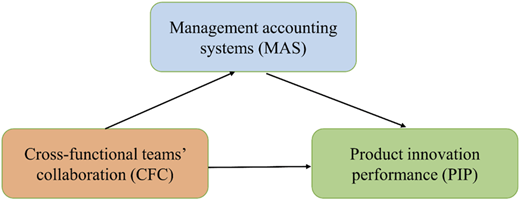
First, a meta-analysis approach is used to synthesize contradictory pieces of evidence regarding the nexus between product innovation performance (PIP), cross-functional teams' collaboration (CFC), and management accounting systems (MAS). Second, the hypotheses of this study are tested through a quantitative design via surveying top and middle managers of Pakistani Hi-tech firms. Figure 1 shows the research model of this study.
3.1 Quantitative study
A quantitative study is conducted to test the hypotheses. We preferred quantitative research over qualitative research due to time, cost, and difficulty in approaching and interviewing top and senior managers.
3.1.1 Sampling and data collection
The sample data is gathered via a questionnaire from middle and top managers of Hi-tech firms in Pakistan. We chose these managers as our respondents because they can provide the most relevant information about all departmental activities, projects, resources, and collaboration among the departments' workforce. Based on convenience sampling, we have distributed 800 questionnaires to the managers of Hi-tech firms. However, we have received only 347 responses. Our final sample size is 328 responses after removing 19 incomplete responses, which represents a response rate of 41%.
3.1.2 Measurement of constructs
The questionnaire is developed based on a literature appraisal because most of the auspicious scales of the analyzed variables were adopted from the literature and incorporated from earlier research. However, an imperative description of our selected variables is given below: Product innovation performance (PIP) is the process of innovating and signifying new or existing products. We initially assessed PIP employing its five dimensions based on De Luca and Atuahene-Gima (2007) research, which instructed survey participants to signify the degree to which the company had acquired its product innovation targets. These dimensions are organizational slack, radical innovation, firm size, technological uncertainty, and market uncertainty. The 5-point scale is employed to quantify all the dimensions. Cross-functional teams' collaboration (CFC) is the collaboration of people from different departments and backgrounds for a specific purpose, goal, or project. It is divided into two dimensions: CFC ability and CFC intensity. For both cross-functional cooperative ability and cross-functional cooperative intensity, a 6-item scale is used. Both dimensions of CFC have been investigated to assess their impact on PIP and MAS. These scales were derived from the study of Thanh Hoai and Nguyen (2021). The management accounting system (MAS) is an information system that helps management make better and more calculated decisions based on information provided in the form of reports, documents, and statements. MAS is investigated by analyzing its four dimensions (Thanh Hoai and Nguyen, 2021). These dimensions are scope, timeliness, aggregation, and integration. The 5-point scale is employed to quantify all the dimensions. The constructs in our study are operationalized numerically, with responses ranging from 1 (strongly agree) to 5 (strongly disagree). This scale forms the basis of our questionnaire. Specifically, we have taken the average of all the items in the construct as a numerical proxy for each construct.
3.1.3 Common method bias
This study collected the data from various respondents simultaneously; therefore, the common method bias problem in the data set cannot be ignored. Consequently, we estimated Herman's Single Factor with the help of SPSS. Factor Analysis was performed using all 21 items to extract one principal factor explaining the majority of the variance. The results indicated that the first factor is responsible for 46.26%, below the cut-off value of 50%. Therefore, the possibility of a significant effect of CMB on the estimated results has been ruled out. Further, we conducted the full multicollinearity test recommended by Kock (2015) and checked the VIF values, and we found that all values were less than 3.3, which indicates that no threat of CMV exists in the data.
3.1.4 Respondents profile
Table 1 depicts the demographic breakdown of our final sample. Our respondents are 33% top managers and 67% middle-level managers in Pakistan's top Hi-tech firms. According to gender classification, 56% of respondents were male, and 44% were female. 34% of respondents were under 25, 39% were between the ages of 25 and 35, 24% were between the ages of 35–45, and only 3% were over 45.30% of the firms have 1,000–5,000 employees, and 4% consist of more than 5,000 employees. This demonstrates that most data is gathered from medium and large firms with more than 500 employees. According to Tables 1 and 7% of respondents had a Bachelor's qualification, 20% had a Master's degree, and 33% had an M.Phil. Furthermore, 40% were Ph.D. degree holders. This signifies that most of our survey participants were knowledgeable enough to comprehend the questions on the questionnaire and provide accurate answers.
3.1.5 Data analysis
We analyzed and tested our hypotheses using the partial least squares structural equation model (PLS-SEM). While PLS-SEM is often recommended for complex models with mediation and non-normal data, we acknowledge that our sample size of 328 is not “small” by conventional standards. The Shapiro-Wilk test indicated a non-normal data distribution (p < 0.05), justifying the use of PLS-SEM over covariance-based SEM. Additionally, PLS-SEM is preferred for its predictive orientation and robustness to non-normality. With a small sample size, PLS-SEM can provide more reliable results than the traditional covariance-based structural equation model (CB-SEM) (Hair et al., 2017). PLS-SEM is the most appropriate technique for obtaining accurate and reliable results (Bedford and Speklé, 2018; Nitzel, 2016). Therefore, we adopted the PLS-SEM technique with the SmartPLS 3 software developed by Hair et al. (2019) to get a robust estimation of our hypotheses. Our study has tested the mediating role of MAS in the relationship between CFC and PIP using SmartPLS 3 and employed Hayes (2012) approach for robust analysis.
4. Results and discussion
4.1 Findings of the quantitative study
4.1.1 Model fit indices and validity-related procedures
In Table 2, factor loadings represent indicator reliability, whereas composite reliability reveals the internal consistency and reliability of the reflective variables. Furthermore, the average variance extracted (AVE) demonstrates the variables' convergent validity. Covariance-based SEM findings of the model fit indices including all latent variables. A confirmatory factor analysis (CFA) was conducted to assess the model's fitness. The CFI and TLI values ≥ 0.95 indicate a good fit, and SRMR ≤0.08 and RMSEA ≤0.08 indicate an acceptable fit (Hu and Bentler, 1999). The proposed four-factor model demonstrates a satisfactory data fit: χ2 = 436.093, with CFI = 0.955, TLI = 0.950, SRMR = 0.035, and RMSEA = 0.065. The results show that the proposed four-factor model displays better fit indices than the alternative models.
According to Table 2, the factor loading of all items of the latent variables fall between 0.797 and 0.950, significantly higher than the threshold value of 0.50 (Al Maktoumi et al., 2020). As a result, the factor loadings of our variables demonstrate the high reliability of our indicators. Our variables' average composite reliability (CR) oscillated from 0.911 to 0.953, significantly larger than 0.70. These findings demonstrate the internal consistency and reliability of all variables. The results in Table 2 also demonstrate the convergent validity of variables, as the AVE of all variables ranges from 0.698 to 0.837, greater than 0.5. These findings indicate that the indicators of latent variables effectively predict them. The convergent validity of our variables is evidenced by the composite reliability and AVE findings, which are greater than their threshold values (Table 2). Table 2 reveals that the VIF values for our variables are less than 5. Consequently, our model meets the standard (Dobni et al., 2022). These test scores/statistics justify that our model has no multicollinearity issues. As a result, our study's measurement model fits perfectly and is reliable.
Following Fornell and Larcker (1981), the strategy was exercised to quantify the discriminant validity of latent variables. The discriminant validity of constructs is depicted in Table 3. According to Table 3, the correlation between latent variables is greater than the correlation between other indicators, ranging from 0.835 to 0.915. These findings validate the Fornell and Larcker (1981) criterion and also confirm that the HTMT ratios were less than 0.85, and these findings collectively establish discriminant validity. Therefore, it demonstrates that the variables met the discriminant validity assumptions.
4.1.2 Hypotheses testing through PLS-SEM
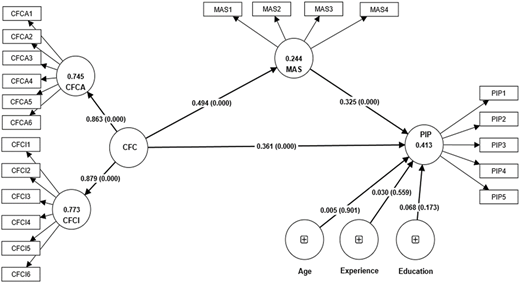
Table 4 displays the results of hypothesis testing using path coefficients, means, standard deviations, p-values, and t-values. Table 4 illustrates that CFC has a significant and positive impact on PIP (β = 0.361, p < 0.01). Therefore, in line with knowledge-based theory and prior literature, we conclude that CFC significantly enhances the product innovation of Pakistani Hi-tech firms (Clercq et al., 2013; Engelen et al., 2012; Sun et al., 2016); as a result, H1 is accepted. Correspondingly, CFC has a significant and positive association with the MAS (β = 0.494, p < 0.01), which supports our H2. Hence, our findings show that CFC is positively associated with the well-organized MAS of Pakistani Hi-tech firms, which is consistent with social capital theory and previous literature (Duh et al., 2014).
The MAS also significantly and positively impacts the PIP (β = 0.325, p < 0.01), which supports our hypothesis (H3). Thus, our study concludes that MAS significantly enhances the PIP of Pakistani Hi-tech firms based on contingency theory and past literature (Miftah, 2020; Tsai et al., 2020). Likewise, the mediating influence of the MAS also shows significant results (β = 0.160, p < 0.01) with a VAF of 38.14%, indicating partial mediation. Thus, as per our expectations, we have interpreted that the MAS significantly and positively mediates the relationship between CFC and PIP. Consequently, H4 is accepted. Figure 2 shows the output of PLS-SEM using SmartPLS 3, which shows consistent results graphically.
4.1.3 Mediation analysis through the Hayes Macro process
VAF statistics are used to check the mediation results, which are calculated by dividing the indirect effect of the mediation path by the total effect, as results are reported in Table 5, which clearly shows the presence of partial mediation in the mediation path. The standard value to confirm the presence of full mediation is above 0.80, and if the value is (0.20–0.80), it confirms the presence of partial mediation, and in case the value is less than 0.20, as per the criteria, there will be no mediation.
4.1.4 Implications of the findings
Our findings offer practical implications for Hi-tech firms in developing countries. First, managers should strengthen cross-functional collaboration (CFC) to drive product innovation through training, capacity building, education, and partnerships with local and international research centers. Regulators, including the Securities and Exchange Commission of Pakistan, can support this by encouraging long-term technological partnerships with advanced countries such as China. The practical significance of our findings suggests that even modest improvements in cross-functional collaboration can yield meaningful innovation gains. For instance, Hi-tech firms that implement structured interdepartmental meetings and shared performance metrics may realize improvements in product innovation outcomes that are not only statistically discernible but also strategically valuable in competitive markets. Second, a strong management accounting system (MAS) improves innovative decision-making in new product development, but top management must also ensure effective internal controls to support cross-functional teams. Managers of Hi-tech firms should recognize that the value of MAS extends beyond traditional financial reporting; when designed to provide broad-scope, timely, and integrated information, MAS becomes a strategic tool for identifying innovation opportunities and evaluating product development alternatives under uncertainty.
Third, because MAS only partially mediates the link between CFC and innovation, Hi-tech firms' managers should complement it with knowledge management systems, innovation rewards, and open communication. This partial mediation indicates that while MAS is an important transmission mechanism, other complementary factors such as organizational culture, leadership support, and external partnerships also play significant roles in translating cross-functional collaboration into product innovation. Fourth, since CFC has the strongest direct effect on MAS, firms should build strong cross-functional team structures before upgrading MAS. Policymakers can encourage integrated CFC-MAS adoption through incentives such as tax relief. For resource-constrained SMEs in Pakistan, a sequential approach is more realistic: start with basic cross-functional routines, such as regular interdepartmental meetings and shared performance measures, then gradually introduce MAS modules, beginning with reporting systems and later adding innovation rewards and knowledge-sharing platforms. This phased implementation allows firms to realize incremental benefits while managing limited financial and technical resources effectively. Finally, while these recommendations fit Pakistan well, firms in individualistic cultures such as the USA, Germany, and the UK may need more formal MAS controls to compensate for weaker informal collaboration. Cross-cultural differences should be carefully considered when generalizing these findings, as collectivist cultures like Pakistan may rely more heavily on informal social networks and trust-based collaboration, whereas individualistic contexts may require more structured and formalized mechanisms to achieve similar innovation outcomes.
5. Conclusion
The current study has documented several important insights. This study makes three primary contributions. First, it resolves prior empirical contradictions through meta-analysis for hypothesis development, confirming those hypotheses via quantitative research to explore the above relationships using the responses of 328 top and middle managers of Hi-tech Pakistani firms. This quantitative study also found a positive association between CFC and PIP that is in line with knowledge-based theory. Based on social capital theory, our study also found that CFC has a significant and positive association with the MAS. Third, the findings support the contingency theory with a positive relationship between MAS and PIP. Fourth, and most importantly, this study provides the first empirical evidence of MAS as a partial mediator of the CFC and PIP relationship. Finally, our study adds new evidence by documenting the mediating role of MAS on the significant and positive relationship between CFC and PIP. The meta-analytic findings for hypothesis development should be interpreted with caution, we have limitations, as some relationships examined in this study are based on a limited number of primary studies, particularly the CFC-MAS nexus, which relied on only three studies. This underscores the need for future stand-alone meta-analyses with larger sample sizes to confirm and extend our findings.
Our study has fruitful implications for policymakers and management within Hi-tech firms. The study's empirical findings proved that collaboration among cross-functional teams is helpful for PIP. Enhancing product innovation allows Hi-tech firms to leverage the results to improve their PIP. Understanding the pivotal role of CFC will enable managers to better team structures and foster a culture of collaboration conducive to innovation. Management can devise more diverse, proactive, and experienced teams for new product innovation. An efficient MAS is vital for idea generation, product innovation, and improved performance. Hi-tech firms capitalizing on the relationships between collaboration, MAS, and innovation performance can gain a competitive edge in their respective markets. This advantage can be leveraged for sustainable growth and success. Management should specifically pay attention to the continuous improvement of the MAS to remain distinguished among competitors via innovation. Beyond statistical significance, the practical relevance of our findings suggests that managers should prioritize investments in MAS capabilities that support cross-functional team coordination, as even incremental improvements in MAS effectiveness can translate into strategically meaningful gains in product innovation performance. The Hi-tech firm is a large contributor to GDP and is a major sector in any country's exports. It is suggested that national policymakers facilitate Hi-tech firms with new technology, improved systems, and a skilled and experienced diverse workforce to increase the gross domestic product and boost their exports.
Despite significant contributions to the literature, our research has some shortcomings, which we fully acknowledge. First, boundary conditions must be acknowledged: our findings are situated in Pakistan's collectivist culture, which may amplify the effectiveness of CFC. Replication in individualist cultures is needed. Second, our quantitative study findings are limited to Pakistani Hi-tech firms; future research must extend this work with a cross-country and/or cross-sector diverse sample. Specifically, our findings apply primarily to medium-to-large Hi-tech firms and may not generalize to SMEs or other sectors. Third, our study is based on the responses to closed-ended questions. We urge the upcoming studies to conduct interviews with the Hi-tech firms' managers and employees for more practical insights.
Fourth, the cross-sectional design of our study limits causal inferences; future research should employ longitudinal designs to establish temporal causality among CFC, MAS, and PIP relationships. Additionally, reliance on self-reported data introduces potential common method bias, which we attempted to mitigate through procedural remedies (Harman's single-factor test and marker variable technique), though future studies could incorporate objective innovation metrics to complement perceptual measures. Fifth, we recommend that future research contribute to this area by using mixed methodology and different cultural and technology-related barriers to Hi-tech firms. Finally, our meta-analysis was intended to review prior literature for hypothesis development purposes only; given the limited number of available studies, particularly for the CFC-MAS and MAS-PIP relationships, future research should conduct stand-alone meta-analyses with robust moderation analysis and address publication bias issues using comprehensive search strategies and funnel plot asymmetry tests.
Ethics statement
The study received ethical approval from the Department of Commerce, University of the Punjab, Gujranwala Campus, Pakistan, and all research procedures were conducted in accordance with established ethical standards.
The authors used ChatGPT (GPT-5, developed by OpenAI), Microsoft Copilot and Grammarly Professional to improve the manuscript’s clarity, readability, grammar and stylistic consistency. All outputs were carefully reviewed and verified by the authors, who take full responsibility for the final manuscript.