The rapid evolution of artificial intelligence (AI) is redefining professional practices across industries, offering unprecedented opportunities to enhance decision-making, innovation and productivity. This study aims to examine the current state of proficiency and application of AI skills among construction professionals in a developing country by using Nigeria as a case study.
This research adopts a quantitative approach, using a structured questionnaire survey administered to 209 construction professionals in Nigeria, with a 60% response rate. The collected data were analysed using descriptive statistics and inferential techniques, including frequency and percentage distribution, mean, the Shapiro–Wilk test and Kruskal–Wallis H-test.
The findings reveal uneven digital competency levels among respondents, with relatively stronger skills in data handling and Building Information Modelling, but significantly weaker proficiency in advanced AI-related competencies such as automation and digital project management. Overall proficiency remains low, constrained by limited formal education, curriculum–industry misalignment and a persistent knowledge–practice gap. While awareness of AI exists, its application remains largely operational rather than strategic, indicating slow but emerging adoption with opportunities to leverage global best practices through improved policy frameworks, leadership and cultural change.
This research provides one of the first detailed evaluations of AI skill proficiency and application in Nigeria. The research contributes a novel regional perspective by exploring AI skills in the construction sector within Lagos, Nigeria. By uncovering the gap between proficiency and the practical application of AI skills, this study not only enriches academic understanding but also calls on researchers, policymakers and industry leaders to address this shortfall through targeted research, responsive policy frameworks and innovative construction practices.
1. Introduction
The rapid evolution of artificial intelligence (AI) is redefining professional practices across industries, offering unprecedented opportunities to enhance decision-making, innovation and productivity. Within the architecture, engineering and construction (AEC) industry, which encompasses architecture, engineering, construction, urban planning and related disciplines, AI is increasingly being deployed for tasks such as generative design, predictive maintenance, project scheduling, cost estimation, quality monitoring and sustainability assessment (Elmousalami et al., 2025; Memon et al., 2025; Obi et al., 2025; Regona et al., 2024). By automating complex analyses, detecting patterns in large databases and enabling more data-driven decisions, AI has the potential to transform how AEC professionals conceptualise, design, construct and manage infrastructure (Bang and Olsson, 2022; Abioye et al., 2021). These capabilities promise enhanced efficiency, cost savings and improved decision-making, thereby addressing the complex challenges of urbanisation, infrastructure delivery and environmental sustainability (Cina et al., 2025; Regona et al., 2024). Yet, the realisation of these benefits in developing countries remains uneven.
However, the effective integration of AI into professional practice depends not only on technological availability but also on the skill proficiency of AEC practitioners and their willingness to adopt such innovations (Obi et al., 2025; Abioye et al., 2021). In developing countries, adoption trajectories are often shaped by factors such as insufficient organisational investment in digital transformation, inadequate technological infrastructure, limited access to advanced training and cultural resistance to change (Sánchez et al., 2025; Zavodna et al., 2024). These constraints can exacerbate the gap between the technological potential of AI and its practical utilisation in professional contexts, thereby limiting its contribution to sustainable development goals in the AEC industry. Skill proficiency plays a significant role in bridging this gap. AEC professionals must possess both technical competencies, such as understanding AI algorithms, data analytics and relevant software applications and soft skills, including adaptability, critical thinking and collaborative problem-solving in AI augmented workflows (Onatayo et al., 2024; Abioye et al., 2021). Where such capabilities are absent, the adoption of AI risks remaining superficial, confined to symbolic or experimental applications, rather than being integrated into core, mainstream practice. Importantly, there remains limited empirical evidence distinguishing between professionals’ awareness of AI, their actual proficiency and the extent of its practical application in developing-country contexts (Obi et al., 2025). This distinction is critical, as high levels of awareness do not necessarily translate into meaningful or strategic use in practice. Existing studies in developing-country contexts have largely focused on broader themes such as awareness of digital technologies, adoption barriers and organisational readiness for AI integration rather than on measuring professionals’ actual AI skill proficiency. For example, Oke et al. (2023) examined awareness and usage of automation techniques in the Nigerian construction industry, whereas Pittri et al. (2025) investigated barriers to digital technologies adoption for circular economy practices in the Ghanaian construction industry. Similarly, Nnadozie et al. (2026) assessed awareness and current implementation levels of AI technologies among construction professionals in Imo State, Nigeria, emphasising adoption patterns rather than competency depth. While these studies provide valuable insights into technology diffusion challenges, they offer a limited understanding of the proficiency and practical application of AI-related skills among construction professionals.
Moreover, as AI continues to revolutionise construction practices, industry professionals are increasingly required to complement traditional project management expertise with advanced digital competencies [CIOB Artificial Intelligence (AI) Playbook, 2024]. This transformation is redefining professional roles and driving a realignment of educational and training priorities (Obi et al., 2025). Yet, the transition poses significant challenges. Research highlights that the integration of digital technologies, including AI, is frequently constrained by a pronounced skills gap within the construction workforce (Balogun, 2024; Siddiqui et al., 2023). Balogun (2024) further emphasises that this persistent global deficit in digital capabilities remains a critical barrier, as technological innovation consistently advances faster than the workforce’s ability to adapt. Bridging this gap is therefore imperative, not only to facilitate the industry’s digital transformation but also to inform policy interventions and shape training frameworks that equip professionals for the demands of the emerging smart construction era.
Against this backdrop, this study aims to empirically assess the level of AI-related awareness, proficiency and practical application among construction professionals in Nigeria. Specifically, the study evaluates the level of awareness of AI technologies, the extent of technical proficiency in AI-related tools and concepts and the degree of practical application in project environments.
Nigeria provides a compelling context for this investigation as one of the largest and fastest-growing construction markets in Africa, yet one that faces significant digital transformation challenges (Adepoju and Aigbavboa, 2020). Lagos, as the country’s primary economic and construction hub, offers a concentrated environment of professional practice and innovation, making it a suitable case for examining emerging AI competencies. By focusing on this context, the study extends existing research on AI adoption in construction, which has largely focused on developed economies, by providing empirical insights from an underrepresented but rapidly evolving market.
The findings of this study will provide insight into workforce readiness, highlight critical skill–practice mismatches and guide targeted training and curriculum development. They will also support employers in making informed investment decisions, aid policymakers in shaping digital transformation strategies and contribute to improved project delivery and competitiveness within the construction industry. Although this study is situated in Nigeria, its findings offer broader relevance for other countries with comparable socio-economic conditions and construction industry characteristics. The remainder of this paper is organised as follows. Section 2 reviews the relevant literature on AI skills in the AEC industry and the theoretical perspectives underpinning the study. Section 3 presents the research methodology, including data collection and analysis procedures. Section 4 reports the results, while Section 5 discusses the findings in relation to existing literature. Finally, Section 6 concludes the paper with implications, limitations and recommendations for future research.
2. Literature review
2.1 Overview of artificial intelligence skills in architecture, engineering and construction industry
The AEC industry is undergoing rapid digital transformation, with AI increasingly integrated into design, project management and operational processes. AI refers to the capability of machines to mimic human intelligence, including learning, reasoning and decision-making, often improving performance over time without explicit programming (Awuzie and Moghayedi, 2024; Mishra, 2024; Haleem et al., 2022). In the AEC context, AI technologies such as machine learning, natural language processing, computer vision and robotics are applied to tasks, including predictive maintenance, project scheduling, cost estimation and quality monitoring (Haleem et al., 2022; Collins et al., 2021). It is extensively applied across diverse industries to enhance innovation, precision and operational efficiency. According to Obi et al. (2025), AI has been applied across diverse sectors, including health care, finance, manufacturing, retail, transportation and construction, to enable functions such as treatment planning, predictive analytics, diagnostics, customer service chatbots, algorithmic trading, fraud detection, process automation, predictive maintenance, quality control, customer behaviour analysis, inventory management, personalised marketing, traffic management, logistics optimisation, autonomous vehicles, risk management, sustainability performance enhancement and project planning. Collectively, these applications highlight AI’s capacity to revolutionise operations and decision-making across diverse fields. While these applications demonstrate the transformative potential of AI, existing studies have largely focused on technological functionalities and use cases rather than the competencies required by professionals to effectively use these tools.
The successful integration of AI into the AEC industry depends not only on technological availability but also on the availability and proficiency of relevant skills among professionals. Obi et al. (2025) noted that the true transformation requires both understanding and mastery of AI tools. AI skills in construction involve the ability to apply artificial intelligence tools and techniques to optimise planning, design, execution and facility management processes in the AEC industry (Bang and Olsson, 2022). These skills include proficiency in data analytics for project forecasting, machine learning for predictive maintenance, computer vision for site monitoring and safety management, natural language processing for automating documentation and communication and AI-integrated Building Information Modelling (BIM) (Zhang et al., 2025; Pracucci, 2024; Allouzi and Aljaafreh, 2024; Balogun, 2024; Hanna et al., 2018). These skills are emerging as critical competencies, enabling practitioners to harness AI for informed decision-making and innovative problem-solving. AI skills for AEC professionals used in this study are summarised and presented in Table 1.
AI-related competencies in the AEC industry can be categorised into three domains: foundational digital skills, technical AI skills and application-oriented managerial skills. Foundational digital skills include competencies such as data management, data privacy and the use of cloud-based platforms, which enable professionals to operate effectively in digital environments. Technical AI skills encompass knowledge of AI/ML concepts, programming, predictive analytics and the integration of AI tools with systems such as BIM. Application-oriented and managerial skills involve the practical use of AI in project delivery, including decision-making, collaboration with AI specialists and the management of digital transformation processes. This categorisation provides a structured framework for assessing variations in awareness, proficiency and practical application of AI among construction professionals.
Prior studies highlight the importance of these skills in enhancing project outcomes, including improved scheduling accuracy, cost estimation, resource allocation and quality control (Tian et al., 2025; Abioye et al., 2021). Mastery of AI-driven technologies such as drones, BIM-integrated AI systems and autonomous equipment enhances productivity and supports sustainable construction practices, making these competencies increasingly critical for competitiveness in the modern construction industry (Elmousalami et al., 2025; Regona et al., 2024). However, much of the literature treats AI adoption primarily as a technological or organisational issue, with limited attention to how different categories of skills influence the transition from awareness to effective application. Where skills are discussed, they are often presented in a fragmented manner, without a systematic framework linking technical knowledge to practical implementation.
This limitation is particularly evident in developing-country contexts. While there is growing awareness of AI’s potential, adoption is often constrained by skill shortages, limited access to infrastructure and inadequate training opportunities (Demaidi, 2025; Rana et al., 2024; Mienye et al., 2024; Uwagaba et al., 2023). As a result, many professionals remain at the level of basic awareness, relying on imported technologies and external expertise, leading to partial or superficial adoption (United Nations, 2025; Zavodna et al., 2024; UNIDO, 2024). Contributing factors include underinvestment in digital upskilling, slow curriculum adaptation in higher education and limited collaboration between industry and academia (Akinwalere and Ivanov, 2022). These patterns suggest a disconnect between awareness, proficiency and practical application of AI in the AEC industry.
Despite increasing scholarly attention to digital transformation, there remains limited empirical evidence that systematically assesses AI-related skills across these domains while distinguishing between awareness, proficiency and practical application, particularly in the Nigerian context (Obi et al., 2025). This gap is significant, as the possession of relevant skills is essential for meaningful AI integration. Accordingly, this study assesses the proficiency and application of AI skills among construction professionals in Nigeria, providing insights into workforce readiness and contributing to the broader discourse on digital capacity building in developing countries. The findings are expected to inform targeted training, policy development and industry strategies aimed at closing skill-practice gaps and enhancing competitiveness.
2.2 Theoretical framework for the study
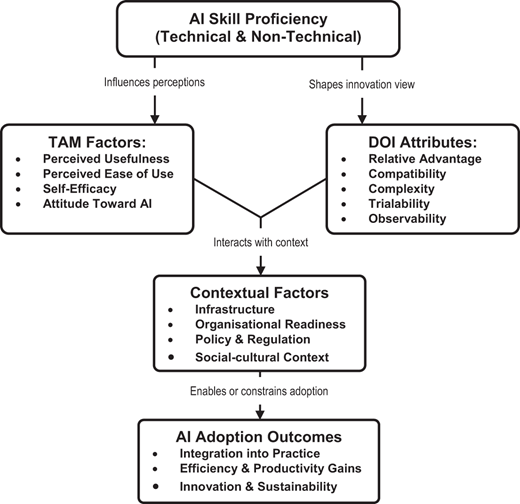
This research is underpinned by the Technology Acceptance Model (TAM) and Diffusion of Innovations (DOI) theory, which collectively serve as the core theoretical lenses. While the TAM and DOI provide valuable theoretical perspectives for understanding technology adoption, they are not explicitly operationalised in this study’s measurement model. Instead, these frameworks are used as interpretive lenses to contextualise the observed patterns of awareness, proficiency and application of AI among construction professionals. The integration of TAM’s cognitive determinants of technology use with DOI’s innovation diffusion attributes offers a novel analytical framework for explaining AI skill proficiency and adoption in the built environment, thereby extending the explanatory power of both models within a construction industry context. The proficiency and application of AI skills among construction professionals can be examined through the TAM, which posits that perceived usefulness (PU) and perceived ease of use (PEOU) significantly influence technology acceptance (Kabir et al., 2022). For construction professionals, PU may relate to how effectively AI enhances project planning, design accuracy, risk management and productivity, while PEOU concerns the ease with which AI tools can be integrated into existing workflows without extensive technical expertise. Factors such as prior exposure to digital tools, availability of structured AI training programs and user-friendly interfaces can increase PEOU, thereby improving proficiency. Additionally, organisational support, leadership advocacy and evidence of tangible performance gains influence PU, motivating professionals to acquire and apply AI skills. The implication of TAM here is that training initiatives should not only focus on building technical competencies but also highlight the real-world benefits of AI in construction, design and project management to foster acceptance and sustained usage.
The DOI theory complements TAM by explaining how AI skills and applications spread within the AEC sector. According to DOI, adoption is influenced by relative advantage (perceived benefits over current methods), compatibility (alignment with existing practices and cultural norms), complexity (perceived difficulty), trialability (opportunities to experiment) and observability (visibility of benefits) (Faiz et al., 2024; Rogers, 2003). Construction professionals may be more inclined to adopt AI when they see early adopters, such as leading firms, successfully using it to deliver cost and time efficiencies. Peer influence, professional networks and industry case studies can further accelerate adoption by increasing observability and reducing perceived risks (Roberts et al., 2021). The implication of DOI is that policymakers, professional bodies and industry leaders should foster pilot projects, showcase success stories and promote knowledge-sharing platforms to build momentum for AI adoption. Together, TAM and DOI highlight that both individual perceptions and social-system factors must be addressed to improve AI skills proficiency and adoption in the AEC sector. Figure 1 depicts the conceptual framework that integrates AI skill proficiency, constructs from the TAM and DOI theory, contextual factors and adoption outcomes within the context of construction professionals.
3. Research methodology
The primary aim of this study is to assess the proficiency and extent of application of AI skills among construction professionals in Nigeria. The research was conducted in Lagos State, Nigeria’s commercial hub and fastest-growing urban centre. Lagos has a high volume of ongoing construction activities, with a significant concentration of engineering and building construction firms (Osuizugbo, 2020). Also, Lagos state was chosen as the study area because of its rapid urbanisation, increasing interest in innovation and sustainable construction practices (Enoh et al., 2023). This rapid urbanisation, coupled with the growing emphasis on innovation, underscores the significance and timeliness of examining the proficiency and application of AI skills among construction professionals in Lagos, Nigeria.
This research used a quantitative approach, with a structured questionnaire survey serving as the primary data collection instrument. This method was chosen for its efficiency in capturing large data sets (Roopa and Rani, 2012), thereby enabling a comprehensive assessment of construction professionals’ proficiency and the extent of application of AI skills in Nigerian construction projects. A literature review was undertaken to identify AI-related skills for construction professionals. The questionnaire items were developed based on an extensive review of existing literature on AI adoption and digital competencies in the AEC industry, ensuring that the selected skill variables were theoretically grounded. The AI-related skills extracted from existing studies formed the basis for developing a structured questionnaire designed to achieve the aim of the study. The questionnaire gathered respondents’ views on proficiency and the extent of application of AI skills in construction projects and was divided into four sections. However, only three sections were used for this study. The first captured respondents’ background information, while the second and third addressed questions related to proficiency and application of AI skills, respectively. The last section collected data on factors influencing the adoption of AI skills among construction professionals; however, as this falls outside the scope of the present study, it was not included in the analysis.
To enhance the reliability and clarity of the survey instrument, a pilot study was conducted with 15 AEC professionals, including architects, builders, quantity surveyors, project managers and engineers. The pilot aimed to evaluate the questionnaire’s relevance, structure and comprehensibility while identifying potential challenges that could compromise data accuracy. Based on the feedback, several refinements were made: technical terms were simplified to ensure accessibility for respondents from diverse professional backgrounds; ambiguous items were restructured for clarity; and the Likert scale was adjusted to provide more consistent response options. These modifications strengthened the overall reliability and validity of the questionnaire, ensuring that the data collected would be both accurate and meaningful. In addition, expert review was sought to ensure content validity, confirming that the questionnaire items were relevant, comprehensive and aligned with the study objectives. Ethical considerations were observed throughout the study. Participation was voluntary, and informed consent was obtained from all respondents prior to completing the questionnaire. Participants were informed of the purpose of the study and assured that their responses would remain anonymous and confidential and would be used solely for academic research purposes. To assess AI proficiency, a five-point Likert scale was used, with the following ratings: 1 = None (i.e. No experience or knowledge), 2 = Basic (i.e. Familiar with the concept but no hands-on experience), 3 = Intermediate (i.e. Can perform tasks with some supervision or guidance), 4 = Advanced (i.e. Can perform tasks independently and confidently) and 5 = Expert (i.e. Can mentor others or develop strategy around this skill). Similarly, the extent of AI skill application was evaluated using a five-point Likert scale, defined as 1 = Never (i.e. I have never used this skill), 2 = Rarely (i.e. I use this once in a long while), 3 = Sometimes (i.e. I apply this occasionally), 4 = Often (i.e. I use this regularly in my work) and 5 = Always (i.e. This is a core part of my daily work).
This study used purposive and snowball sampling techniques to identify and recruit participants with relevant expertise in the construction industry. Owing to the challenges associated with poor record-keeping practices in Lagos State, these methods were particularly suitable for the study context. The sampling frame comprised construction professionals, including architects, engineers, builders, quantity surveyors and project managers, actively engaged in AEC projects in Lagos State. Participants were recruited through professional networks, industry contacts and peer referrals. Inclusion criteria required respondents to be registered with recognised professional bodies in Nigeria and to possess relevant industry experience. While this approach enabled access to knowledgeable and experienced respondents, it may introduce sampling bias and limit the generalisability of the findings beyond similar urban and professional contexts. Purposive sampling was employed to deliberately select construction professionals practising in Lagos who are registered with recognised regulatory bodies in Nigeria. This approach ensured that the respondents had the necessary qualifications, relevant industry experience and were actively engaged in the construction sector. Snowball sampling was subsequently employed after the initial purposive selection, whereby initial respondents were asked to refer other qualified construction professionals within their professional networks who met the study’s inclusion criteria. This approach was particularly useful in expanding access to eligible participants in a context where comprehensive sampling lists were not readily available. Google Forms was selected as the platform for survey administration because of its user-friendly interface, flexibility in questionnaire design and efficiency in data collection and analysis (Keadkraichaiwat et al., 2024). The online format facilitated broader distribution, offered convenience for respondents and enabled real-time monitoring of responses. Of the 209 questionnaires distributed, 126 were successfully retrieved, yielding a response rate of 60%, which satisfies the acceptable standards for survey-based studies in construction management research (Lakens, 2022). Hence, the response rate was deemed satisfactory and acceptable for the study. Data collection was conducted between May and July 2025.
The data collected for this study were analysed using the Statistical Package for the Social Sciences (SPSS) version 25, widely recognised software for quantitative data analysis. The reliability of the survey instrument was assessed using Cronbach’s alpha coefficient, which measures internal consistency (Taber, 2018). This test ensured that the items in the instrument reliably captured the intended variables. As noted by Taber (2018), a higher Cronbach’s alpha value indicates stronger internal consistency across measurement items. For this study, the 16 AI-related skills for construction professionals produced a Cronbach’s alpha coefficient of 0.961 and 0.970 for AI proficiency and extent of AI skills application, respectively, demonstrating a high level of internal consistency across the scale.
Descriptive statistics, including frequency and percentage distribution, were used to present the demographic characteristics of the survey participants. In addition to reliability testing, efforts were made to establish validity. The Shapiro–Wilk test was conducted at a 0.05 significance level to examine the normality of the data set, a critical step in determining the appropriateness of subsequent statistical analyses (Singh and Masuku, 2014). The results indicated that the data were not normally distributed, thereby justifying the use of non-parametric techniques. Accordingly, the Kruskal–Wallis H-test was applied to assess potential differences in responses across participant groups, allowing the study to identify whether statistically significant variations existed among categories of respondents (Field, 2013). Furthermore, mean values were calculated to rank responses and provide insight into overall trends in AI proficiency and application. The use of descriptive statistics is appropriate for summarising respondents’ skill levels, while the Kruskal–Wallis H-test, as a non-parametric, is suitable for analysing non-normally distributed Likert-scale data and comparing differences across groups. These analytical techniques are widely used in construction management research and align with the study objectives.
Accordingly, TAM and DOI are applied in this study to support the interpretation of findings, particularly in explaining how perceived usefulness, ease of use and innovation diffusion dynamics may influence the transition from awareness to practical application of AI.
4. Results
To aid interpretation, mean score ranges were used to classify the levels of AI proficiency and application as follows: 1.00–1.80 = very low, 1.81–2.60 = low, 2.61–3.40 = moderate, 3.41–4.20 = high and 4.21–5.00 = very high. These thresholds provide a consistent basis for interpreting the descriptive statistics.
4.1 Background details of respondents
Table 2 provides a summary of the respondents’ background details, highlighting their professional background, highest academic qualifications, years of experience in construction, type of organisation they belong and mode of AI skill acquisition. The majority of the survey participants are quantity surveyors (28.60%), followed by project managers (27.00%). The professionals who participated least are the engineers (12.70%). Bachelor’s degree holders constituted the majority (35.70%), followed by Master’s degree holders (29.40%) and next to it are the PhD holders (17.50%). Regarding years of experience in the construction industry, over 70% of the respondents have more than 10 years of experience in the industry. In terms of organisation type, most respondents represented consulting firms (65.10%). The distribution reflects a concentration of highly experienced professionals, underscoring the maturity of the sample population and enhancing the credibility and reliability of the study’s findings.
Furthermore, the results in Table 2 indicate that online courses (49.20%) are the predominant mode of AI skill acquisition in the study area, underscoring the increasing importance of digital platforms in providing accessible, flexible and up-to-date training opportunities. On-the-job training (32.50%) also plays a crucial role, reflecting the value of experiential learning and employer-driven capacity building in bridging skill gaps. By contrast, formal education (18.30%) contributes the least, suggesting that traditional academic programs may not yet be fully aligned with the rapid pace of AI advancements in construction. This distribution highlights the growing reliance on non-traditional learning pathways, which has implications for both industry and academia. For the industry, it emphasises the need to integrate structured workplace learning to strengthen applied competencies. For academia, it suggests the importance of revising curricula to incorporate AI-related skills, ensuring that formal education remains relevant in preparing future construction professionals.
4.2 Level of proficiency of artificial intelligence skills in the construction industry
The results in Table 3 show that the overall level of proficiency in AI-related skills within the Nigerian construction industry remains relatively low across professional groups, with mean values ranging from 2.0 to 2.7. Based on the defined classification thresholds, this indicates predominantly low to moderate proficiency levels. Among the listed competencies, data collection, preparation and visualisation (overall mean = 2.71, moderate; rank 1) emerged as the most developed skill, reflecting the growing emphasis on data-driven decision-making in the industry. Similarly, data privacy and protection protocols (overall mean = 2.51, low; rank 2) and working with AI/IT experts (overall mean = 2.44, low; rank 4) ranked high, suggesting an increasing awareness of the importance of data governance and interdisciplinary collaboration.
However, more technical competencies such as basic Python/R programming (overall mean = 2.19, low; rank 16), use of cloud-based platforms (overall mean = 2.21, low; rank 15) and application of predictive analytics (overall mean = 2.28, low; rank 14) recorded the lowest scores. This pattern highlights a significant gap in advanced digital and coding-related skills that underpin effective AI implementation. Overall, the findings suggest that while foundational data-related competencies are gradually developing, proficiency in more specialised AI capabilities remains limited, potentially constraining the transition from basic awareness to strategic adoption within the industry.
Across professions, architects and quantity surveyors recorded relatively higher proficiency in certain areas, such as data collection and BIM integration with AI tools, while builders and project managers showed lower mean scores in more technical aspects (see Table 3). Also, in Table 3, the Kruskal–Wallis test results (p > 0.05 across all skills) revealed no statistically significant differences among the professional groups, suggesting that the low to moderate proficiency in AI skills is consistent across disciplines rather than isolated to specific roles. This uniformity implies that the adoption of AI in construction is still at an early stage, requiring industry-wide training and capacity-building initiatives rather than profession-specific interventions. Overall, the findings underscore the urgent need for structured upskilling programs to bridge the digital competency gap and enhance AI integration into construction practice.
4.3 Extent of application of artificial intelligence skills in construction projects
The results in Table 4 show that the overall extent of application of AI-related skills in Nigerian construction projects remains generally low to moderate, with mean values ranging from 2.2 to 2.6. Based on the defined classification thresholds, this indicates limited practical integration of AI across professional groups. Among the assessed skills, data collection, preparation and visualisation (overall mean = 2.66; moderate; rank = 1) and BIM data integration with AI tools (overall mean = 2.56; low; rank = 2) emerged as the most applied competencies. This suggests that professionals are relatively more comfortable applying AI in areas that align with existing digital workflows, particularly data management and BIM-related processes, which are increasingly embedded in industry practice.
In contrast, more technical competencies such as basic programming in Python/R (overall mean = 2.21; low; rank = 16) and understanding AI/ML concepts (overall mean = 2.30; low; rank = 15) recorded the lowest levels of application. This pattern indicates that advanced AI capabilities are not yet integrated into routine professional practice. Instead, the findings suggest a continued reliance on external AI/IT specialists for technical implementation, while in-house professionals primarily engage with user-level or pre-configured AI tools. Overall, this disparity highlights a gap between the availability of AI technologies and their effective utilisation, reinforcing the limited transition from awareness to practical, in-depth application within the industry.
The Kruskal-Wallis test results provide further insights into variations across professional roles. Significant differences were observed in data privacy and protection protocols (χ2 = 9.896, p = 0.042) and BIM data integration with AI tools (χ2 = 10.684, p = 0.030), indicating that adoption levels for these skills vary notably across professions (see Table 4). For instance, Quantity Surveyors ranked highest in applying data privacy and protection protocols (mean = 3.00, rank = 1), reflecting their sensitivity to financial and contractual data security. Similarly, Architects and Quantity Surveyors reported relatively higher application of BIM data integration with AI tools, compared to Builders and Project Managers. The lack of significant variation in most other AI skills (p > 0.05) suggests a uniformly low adoption trend across roles. Overall, the findings reflect an industry still in its early stages of AI integration, with emphasis on data-oriented applications but limited internal technical expertise. This points to the need for targeted training, upskilling and strategic collaboration with AI experts to move from surface-level application towards deeper AI integration in construction project delivery.
4.4 Mean gap analysis for proficiency and application
The results in Table 5 show that both the proficiency and application of AI-related skills in the Nigerian construction industry are generally low to moderate, with mean scores ranging from 2.2 to 2.7. Based on the defined classification thresholds, this indicates limited depth of both competence and practical utilisation across most skill areas. Among the assessed competencies, data collection, preparation and visualisation recorded the highest level of proficiency (mean = 2.71; moderate) and application (mean = 2.66; moderate), reflecting the relative familiarity of construction professionals with foundational data-handling tasks compared to more advanced AI-driven capabilities.
In contrast, basic Python/R programming recorded the lowest scores in both proficiency (mean = 2.19; low) and application (mean = 2.21; low), indicating that coding-related competencies are not yet widely developed or embedded in professional practice. This reinforces the broader pattern of limited engagement with advanced technical aspects of AI.
Notably, translating AI outputs into practical instructions (proficiency mean = 2.44; low; application mean = 2.43; low) and data privacy and protection protocols (proficiency mean = 2.51; low application mean = 2.52; low) exhibited minimal differences between proficiency and application. This suggests that, for these skills, the level of understanding closely aligns with their practical use. Overall, the findings indicate that while some foundational competencies are consistently applied, more advanced AI skills remain underdeveloped, highlighting a persistent gap between basic capability and deeper, strategic utilisation.
The mean gap analysis in Table 5 highlights areas where a mismatch exists between knowledge and use. The largest gaps were observed in logical thinking and automation setup (0.17), managing digital transformation (0.17) and AI-embedded project management software (0.16). These gaps in the construction sector of Nigeria indicate that while there is a growing recognition of the importance of these skills, the actual application in practice lags behind proficiency, possibly because of organisational, cultural or infrastructural barriers. Similarly, using AI insights for scheduling, cost control and risk mitigation (0.15) and understanding AI-related risks (0.15) showed significant gaps, pointing to the challenge of translating AI’s potential into actionable project management strategies. Overall, the results reveal that while the Nigerian construction industry is making progress in adopting fundamental AI-related skills, a stronger focus is needed on bridging the gap in advanced applications and strategic integration of AI into project delivery.
The findings also suggest a gradual but uneven trajectory in the integration of AI into construction practice in Nigeria. The narrower gaps in basic skills such as data handling, privacy protocols and translating AI outputs point to areas where construction industry professionals feel more confident in aligning their knowledge with practice. However, the wider gaps in more strategic and transformative skills, such as digital transformation management, predictive analytics and automation setup, indicate that while practitioners may have some awareness or training, they face challenges in embedding these capabilities into day-to-day workflows. This imbalance highlights the Nigerian construction industry’s current state: AI adoption is still more operational than strategic, with emphasis on immediate, tangible applications rather than long-term, systemic integration. Bridging this gap will require targeted training, investment in supportive infrastructure and stronger collaboration between AI specialists and construction professionals to ensure that proficiency translates into meaningful and consistent application across construction projects.
5. Discussions and implications of key findings
The findings of this study highlight critical gaps in the integration of AI skills in the Nigerian construction industry, with important implications for education, professional development and industry practice. The limited contribution of formal education to AI skill acquisition suggests that universities and technical institutions are lagging in adapting curricula to meet the digital demands of modern construction. This reflects a critical barrier to technology acceptance, aligning with the TAM, which emphasises the importance of perceived usefulness and perceived ease of use in adoption (Kabir et al., 2022). If educational institutions are not equipping professionals with AI competencies, then the perceived usefulness of AI may remain low, as construction professionals are unfamiliar with its strategic applications. This misalignment between academic training and industry needs has been noted in other contexts, where construction professionals often rely on informal or self-directed learning to acquire digital competencies (Zulu et al., 2023; Succar and Poirier, 2020). Within the DOI framework (Rogers, 2003), the lack of formalised training represents a barrier to the knowledge stage of innovation diffusion, where individuals must first understand an innovation before forming favourable or unfavourable attitudes towards it. This raises the urgent need to reform construction education by embedding AI-focused modules and aligning training with global industry standards. Without such educational reform, the industry risks perpetuating a workforce that is inadequately prepared for digital transformation.
The consistently low proficiency in AI skills across professional groups signals systemic challenges rather than isolated gaps. This uniformity suggests that the problem is rooted not only in individual capacity but also in broader structural barriers such as limited access to resources, institutional inertia and lack of policy frameworks to support AI upskilling in the industry (Ali et al., 2024; Abioye et al., 2021; Oesterreich and Teuteberg, 2016). This corresponds to the TAM notion of external variables that shape users’ attitudes towards technology adoption (Kabir et al., 2022). Without adequate enablers, construction professionals may not progress towards meaningful use of AI, regardless of their openness to innovation. This trend aligns with the early adoption stage in DOI, where AI adoption in Nigeria remains limited to innovators and a few early adopters, leaving the majority of construction professionals (early and late majority) yet to engage. Similar findings have been observed that construction industries globally face hurdles in aligning digital innovation with workforce capacity (Omotayo et al., 2024; Rinchen et al., 2024; Windapo, 2021). This low proficiency could hinder competitiveness and limit the ability of firms to harness AI for productivity, safety and quality improvements in projects. The implication is that capacity-building initiatives need to be industry-wide rather than targeted at specific professions.
Another major implication is the mismatch between knowledge and use of AI skills, particularly in advanced areas such as automation setup, logical thinking, digital transformation management and AI-embedded project management. This highlights the TAM construct of behavioural intention to use (Kabir et al., 2022). While professionals may have a basic awareness of AI, their ability to strategically apply these tools in real projects remains modest. Awareness of AI does not translate into actual adoption when ease of application is low, reflecting barriers in perceived ease of use. This phenomenon reflects what Pan and Zhang (2021) described as the “knowledge–practice gap” in digital construction innovation, where awareness does not necessarily translate into adoption or integration. Within DOI, this situation reflects a stall between the persuasion and decision stages, where awareness has been created but adoption remains tentative because of uncertainty about relative advantage and complexity. Without hands-on, practical pathways, professionals are unable to cross the threshold into consistent AI application. Hence, bridging this gap requires deliberate investment in practical, project-based training, mentorship programs and partnerships between academia, professional bodies and technology providers to ensure that skills acquired are directly relevant to workplace needs.
Furthermore, the finding that AI adoption in Nigeria remains more operational than strategic reflects a narrow focus on immediate applications rather than long-term systemic integration. This corresponds to the DOI’s distinction between the concepts of trialability and observability. Current AI adoption is largely operational; construction professionals apply AI for immediate, tangible results (e.g. cost estimation, scheduling), but long-term strategic integration has not yet emerged. This trajectory is consistent with early-stage adoption patterns observed in other developing countries, where AI is first applied in isolated functions before becoming embedded in organisational strategies (Darko et al., 2020). In TAM terms, this reflects a scenario where perceived usefulness is limited to short-term tasks, but not yet seen as transformative at organisational or industry levels. For sustainable adoption, there must be a shift in perception towards AI as a strategic enabler of competitiveness and innovation. The implication here is that firms may benefit in the short term from improved efficiency in tasks such as cost estimation, scheduling and risk management, but without a strategic approach, they risk missing broader opportunities for innovation, competitive advantage and sustainability. Policymakers and industry leaders must therefore promote a shift from ad hoc adoption to structured digital transformation strategies.
The uneven and gradual trajectory of AI integration across the Nigerian construction sector signals both challenges and opportunities. On one hand, the slow pace may delay the industry’s ability to compete with global peers in terms of innovation and productivity. This underscores DOI’s concept of innovation-decision processes varying across adopter categories (Rogers, 2003). While a few innovators may be experimenting with AI, the majority remain cautious, leading to slow and uneven diffusion. This reflects TAM’s insight that external barriers (such as inadequate training, lack of leadership support and absence of regulatory incentives) constrain both perceived ease of use and usefulness (Kabir et al., 2022). On the other hand, it provides an opportunity to learn from global best practices and avoid pitfalls associated with premature adoption. Previous studies (e.g. Sacavém et al., 2025; Rinchen et al., 2024; Abioye et al., 2021) have shown that successful digital transformation in construction requires not just technology acquisition but also cultural change, organisational readiness, leadership support and clear regulatory frameworks. This means that alongside technical training, emphasis must be placed on fostering organisational readiness, incentivising innovation and developing coherent policies that encourage sustainable adoption of AI.
This study should be interpreted in light of certain limitations. First, the geographic focus on Lagos State, although justified by its prominence in Nigeria’s construction industry, may limit the transferability of the findings to other regions with different socio-economic and infrastructural conditions. Second, the use of purposive and snowball sampling, while appropriate for accessing knowledgeable professionals, introduces potential sampling bias and limits the representativeness of the sample. Third, the reliance on self-reported measures may be subject to response bias, as participants’ assessments of their proficiency and application levels may not fully reflect actual practice. These limitations suggest that the findings should be interpreted with caution, although they still provide valuable insight into emerging AI skill patterns within the Nigerian construction context.
6. Conclusion, recommendations and future research directions
The study assessed the current state of proficiency and application of AI skills among construction professionals in a developing country using Nigeria as a case study. A detailed review of existing literature was carried out to identify the various AI skills. These insights informed the formulation of a structured questionnaire, distributed among construction professionals in Lagos State, Nigeria, with the collected data analysed through appropriate statistical methods. The study reveals significant gaps in the integration of AI skills within Nigeria’s construction industry, largely because of the limited role of formal education and misalignment between academic curricula and industry needs. The findings revealed low AI proficiency across construction professional groups, underscoring the need for industry-wide capacity-building initiatives. The study further revealed a persistent knowledge–practice gap, where basic awareness of AI exists but practical application in areas like automation and digital project management remains limited, requiring project-based training, mentorship and stronger academia–industry collaboration. Overall, AI adoption in Nigeria remains operational rather than strategic, progressing slowly but offering opportunities to learn from global best practices while emphasising cultural change, leadership and policy frameworks to drive sustainable digital transformation.
6.1 Recommendations
Based on the findings, it is recommended that construction industry stakeholders prioritise structured interventions to strengthen AI capacity development beyond traditional education by integrating AI-focused curricula into academic programs, fostering industry–academia partnerships and encouraging continuous professional development through specialised training and certification. Professional bodies and organisations should promote cross-disciplinary AI upskilling initiatives that emphasise advanced competencies such as logical reasoning, automation setup, digital transformation management and AI-enabled project management tools, thereby aligning knowledge with practical application. Furthermore, construction firms should move from operational adoption towards strategic integration by embedding AI into long-term project delivery frameworks and innovation strategies. Policymakers and regulators can also support adoption through enabling policies, funding incentives and awareness campaigns that accelerate digital transformation. Collectively, these measures will bridge the current proficiency gaps, enhance the industry’s competitiveness and ensure a more systemic and sustainable integration of AI into the construction industry.
6.2 Future research directions
The findings of this study open several important avenues for future research. First, the limited role of formal education in AI skill acquisition highlights the need for further investigation into how construction-related curricula in higher institutions can be restructured to incorporate AI competencies. Future studies could examine the comparative effectiveness of traditional academic programs and non-traditional learning pathways such as online platforms, professional certifications and industry-driven training schemes. Such work would provide valuable insights for policymakers, universities and professional bodies seeking to foster more robust AI literacy among construction professionals in developing contexts.
Second, the results suggest that AI adoption in the Nigerian construction industry remains primarily operational rather than strategic, with emphasis on immediate applications rather than long-term systemic integration. Future research could therefore explore pathways for advancing from basic AI usage towards more sophisticated, domain-specific applications, such as predictive analytics, automation in design and construction processes and AI-embedded project management systems. Comparative studies across developing and developed economies would also help to uncover contextual enablers and barriers to the strategic adoption of AI in construction practice.
Thirdly, the identified gaps in logical reasoning, automation setup, digital transformation management and use of AI-enabled project management software point to critical cross-disciplinary skill deficiencies. Future research should investigate how interdisciplinary training, linking construction management with computer science, data analytics and systems thinking, could bridge these gaps. Longitudinal studies examining the evolution of AI proficiency among construction professionals over time would also provide a more nuanced understanding of how skill mismatches affect project outcomes, productivity and innovation within the sector.