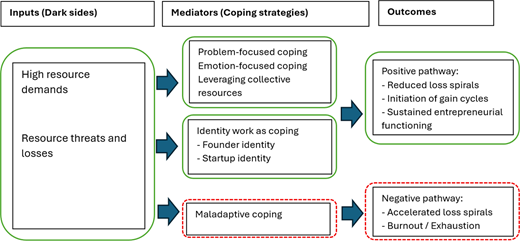
Startup founders often face the dark sides of entrepreneurship, such as limited resources, high pressure and personal strain. This study explores how technology startup founders in Central and Eastern Europe (Poland, Latvia, Bulgaria and Romania) experience and cope with these challenges. Using conservation of resources (COR) and coping theory, the paper aims to show how founders deal with stress, protect their resources and find ways to stay motivated. It also links coping with identity work, showing how founders maintain a sense of purpose under pressure.
The study is based on twelve in-depth interviews with technology startup founders from four emerging European economies. Interviews were analyzed in ATLAS.ti using both deductive coding from COR and coping theory, and inductive identification of new themes. Founders were chosen from different technology sectors and venture stages to capture varied experiences. This qualitative approach allowed a detailed understanding of how they experience stress, use different coping strategies and reshape their founder identity while managing the demands of running a startup.
Founders faced many forms of strain, including financial insecurity, regulation, lack of time and threats to self-esteem. They used a mix of coping strategies: problem-focused, emotion-focused and collective. Some also showed less effective coping, such as overworking and being unable to detach, which led to burnout. Beyond these strategies, identity work played a key role: by seeing themselves as resilient, flexible or visionary, founders reframed stress and found new energy. The study shows how coping and identity help sustain entrepreneurs in resource-scarce settings new insights into founder resilience in emerging economies.
This study offers new insight into how startup founders cope with adversity by identifying identity work as a distinct and powerful coping mechanism. While previous research has focused on behavioral or emotional strategies, this paper shows that redefining the self and the venture can itself serve as a vital resource that protects against loss and burnout. By integrating COR and coping theory with identity perspectives, and by examining founders in emerging European ecosystems, the study extends existing theory and deepens understanding of entrepreneurial resilience under resource scarcity.
1. Introduction
Technology startup founders are individuals who take on high levels of risk while aspiring to create solutions that address important human needs and transform everyday life (Colombo and Grilli, 2005; Santisteban et al., 2021; Visintin et al., 2025). In recent decades, technological change has reshaped societies in profound ways, and many of these changes have originated from the ideas and actions of startup founders. This makes them a particularly important group for understanding both the promises and the challenges of entrepreneurship (Hashai and Zahra, 2022).
Despite their importance, founders often face what has been described as the dark side of entrepreneurship (Shepherd, 2019; Wang et al., 2022). This article understands the dark side of entrepreneurship as the negative financial, psychological, ethical and social aspects of engaging in entrepreneurial activity, such as facing significant financial risk, burnout, negative emotions and work–life imbalance. These conditions are often intensified in startups, where resource scarcity, high demands on time and energy and the constant risk of loss shape the entrepreneurial experience (Herrmann et al., 2022; Zahra, 2021).
Prior research shows that entrepreneurs use a variety of coping strategies, including problem-focused actions, emotion-focused regulation, avoidance or reliance on social support (Ahmed et al., 2022; Arpiainen and Kurczewska, 2017; Thompson et al., 2020). However, most studies examine entrepreneurs in general, with less attention to startup founders who operate under particularly intense uncertainty and resource scarcity (Aryadita et al., 2023). Moreover, coping has mainly been viewed as a way of protecting resources, leaving open the question of how founders also draw on their entrepreneurial role identity when confronted with such challenges. Addressing this question requires attention to how entrepreneurs define themselves in relation to their roles. Entrepreneurial role identity refers to the meanings individuals attach to themselves in relation to performing entrepreneurial roles, shaping how founders understand who they are and how they should act in entrepreneurial contexts (e.g. Leitch and Harrison, 2016).
Entrepreneurship in Central and Eastern Europe remains shaped by the region’s ongoing transition. In countries such as Poland, Latvia, Bulgaria and Romania, entrepreneurs operate in institutional environments that still combine market dynamism with persistent structural weaknesses, such as underdeveloped capital markets, complex bureaucracy and uneven public support for innovation. These features are typical of emerging entrepreneurial ecosystems, where formal institutions offer limited protection and informal networks often compensate for resource gaps (Welter, 2011). Understanding how founders cope with such environments is crucial for explaining foundations of resilience in emerging economies.
Responding to the limited research on founders’ coping within Central and Eastern Europe, this study examines how entrepreneurs in emerging ecosystems manage strain; not only through resource protection but also through identity work as an adaptive process. In this context, identity work refers to the ongoing ways in which individuals define, negotiate and sustain their sense of themselves as founders. It can shape how they interpret adversity and respond to the dark side of entrepreneurship (Kuran and Khabbaz, 2025). By integrating identity work into the coping literature, the study highlights that coping involves not only the preservation of resources but also development of the founder’s identity.
The study adopts an interpretivist approach, focusing on the subjective experiences of startup founders. Twelve in-depth semi-structured interviews were conducted with European technology founders in and analyzed in ATLAS.ti using a combination of inductive and deductive coding.
The article proceeds as follows. The next section presents the theoretical framework, drawing on research on the dark side of entrepreneurship, Hobfoll’s conservation of resources (COR) theory, coping theory and identity work, followed by the research methodology and findings. The article concludes with implications for theory and practice, contributing by documenting how technology startup founders experience the dark side of entrepreneurship, advancing theory by integrating COR and identity perspectives and offering practical insights for founders, entrepreneurship educators and support organizations. In doing so, it extends understanding of entrepreneurial coping and resilience within the institutional and resource conditions of Central and Eastern Europe.
2. Literature review
2.1 The dark side of entrepreneurship
While entrepreneurship is often associated with innovation and opportunity, scholars have increasingly emphasized its costs. Shepherd (2019) distinguished between the dark side (negative psychological and emotional reactions), the downside (financial loss) and the destructive side (harm to society through resource depletion). Building on this, the present study defines the dark side of entrepreneurship as the negative financial, psychological, ethical and social aspects of entrepreneurial activity, including significant financial risk, burnout, negative emotions and work–life imbalance.
Previous research documents that entrepreneurship does not always provide financial rewards. Hamilton (2000) showed that most entrepreneurs earn less than in salaried employment, a finding confirmed in later studies (Lévesque et al., 2002). Although research findings vary with some studies indicating that entrepreneurs, depending on place and context, may achieve higher earnings (Dvouletý et al., 2021), the experience of many firms shows that survival is often the primary goal (Berner et al., 2012). These economic constraints and uncertainties place additional demands on entrepreneurs, making the personal characteristics that support venture creation particularly consequential (Dams et al., 2022; McCarthy et al., 2023). Beyond this, psychological perspectives highlight that traits which initially drive venture creation can later become liabilities. Kets de Vries (1985), for instance, argued that needs for control, recognition or independence may foster venture creation but also lead to stress, relational conflict or organizational dysfunction. Stress, uncertainty and overload are consistently reported as features of entrepreneurial life (Cardon and Patel, 2015; Jamal, 1997), often intensified by blurred boundaries between professional and personal life (Spivack et al., 2014; Ziemianski and Golik, 2020) and experiences of social isolation (Ziemianski et al., 2025).
The dark side has also been examined at relational and systemic levels. Family business research shows how founder–family–firm dynamics may generate long-term tensions (Montiel Mendez and Soto Maciel, 2021), while studies on women entrepreneurs reveal persistent work–life conflict (Ufuk and Özgen, 2001; Kirkwood and Tootell, 2008). Other scholars describe entrepreneurship addiction, where persistence becomes excessive and harmful despite potential business gains (Spivack and McKelvie, 2018).
Overall, evidence shows that entrepreneurship entails significant costs alongside its benefits. Yet this body of research remains fragmented, scattered across financial, psychological and social perspectives. Following Shepherd’s (2019) call to address these issues as “the compassionate thing to do”, this study is intended to focus specifically on how technology startup founders, operating under acute resource scarcity, cope with this dark side of entrepreneurship.
2.2 Conservation of resources (COR) theory
The COR theory argues that people are motivated to obtain, retain and protect resources they value (Hobfoll, 1989, 2001). Stress occurs when resources are lost, threatened with loss or not gained despite significant effort. Over time, COR has expanded beyond stress to explain motivation, performance and engagement (Halbesleben et al., 2014; Hobfoll, 2011). Defining resources precisely has been a challenge for COR. Hobfoll (1998) distinguished personal, material, energy and condition resources as central. Later work stressed that resources must also be understood in context: they matter if they help individuals or organizations achieve goals (Halbesleben et al., 2014). This contextual view is particularly relevant for startup founders, who face high demand and chronic scarcity of resources.
A central principle of the theory is the primacy of loss over gain: losing resources has a stronger, faster and longer-lasting impact than gaining them (Hobfoll et al., 2018). For startup founders, the loss of key employees, the energy devoted to activities that yield little return or damage to social credibility can often outweigh the motivational effect of small wins and make recovery particularly difficult. COR also emphasizes resource investment. Individuals must spend resources to protect themselves from loss, recover from setbacks or generate new gains. Founders invest time, energy and financial capital, often at the expense of stable income and social status, to keep their ventures alive and to pursue objectives they believe in, frequently tied to the transformative potential of their product or service.
Another key concept of the theory is the loss spiral. Those individuals and organizations with fewer resources are more vulnerable to further losses, creating a self-reinforcing cycle. This is a familiar reality for founders: a financial setback can fuel exhaustion, damage relationships and limit opportunities, triggering additional losses. COR also recognizes resource crossover, where resources such as enthusiasm or self-efficacy transfer from one person to others (Westman et al., 2013). Founders may energize their teams with optimism, but when their own resources are depleted, they must still sustain collective morale, demanding even greater investment of personal energy.
COR has been applied to entrepreneurship in various contexts. Doern (2016) showed how UK business owners coped with sudden losses during riots, highlighting the importance of tangible and personal resources. Newman et al. (2018) found that networks function as resources that enhance entrepreneurs’ well-being. More recent work has applied COR to startups, such as studies on conflict and peacemaking (Klein and Kozusznik, 2024) and coping under the extreme uncertainty of the COVID-19 pandemic (Yahyaoui et al., 2021). Together, these studies illustrate the breadth of contexts in which COR has been applied to entrepreneurship.
Despite this broad application, existing research has focused mainly on external shocks or objectively identifiable losses, while little is known about the subjective experiences of founders coping with ongoing resource threat. This gap is critical because founders operate in contexts where resources are scarce, demands are high and allocation is complicated by novelty and uncertainty (Zahra, 2021). A recent review identified COR as one of the most prominent frameworks for explaining coping and burnout in entrepreneurship (Hartmann et al., 2022). COR therefore provides an essential foundation for this study, but it does not fully explain the coping strategies founders use in practice or the role of identity work as a potential coping mechanism - a gap this article addresses.
2.3 Coping theory in entrepreneurship
Coping is understood as an individual’s responses when facing a situational stressor (Aitken and Crawford, 2007). It refers to both voluntary and automatic cognitive, emotional and behavioral reactions to stress, with the goal of reducing its impact and enabling ongoing functioning (Compas et al., 2001; Folkman and Moskowitz, 2004; Stanislawski, 2019). While COR theory explains the conditions under which stress arises from resource threat and loss, coping theory clarifies the strategies individuals use to manage these stressors and protect valued resources.
Traditionally, two main coping strategies have been distinguished: problem-focused and emotion-focused coping (Lazarus and Folkman, 1984). Problem-focused coping involves managing or altering the source of stress, while emotion-focused coping refers to regulating emotional responses. Many specific strategies build on this model (Carver et al., 1989). Both can be constructive or less effective. For example, problem-focused coping may involve careful prioritization but also lead to overcommitment and exhaustion, while emotion-focused coping may foster learning and growth but can also result in denial. Seeking social support illustrates the overlap: it may be problem-focused (seeking advice) or emotion-focused (seeking sympathy). While the problem–emotion focused dichotomy has been criticized as overly simplistic (Skinner et al., 2003), it remains a common and useful framework for examining responses to stress, including those of entrepreneurs facing resource constraints.
Research confirms the importance of these strategies in entrepreneurship. A review by Ahmed et al. (2022) identified 35 studies, with most focusing on problem-focused coping and fewer on emotion-focused coping, reflecting entrepreneurs’ tendency to favor action-oriented responses (Schonfeld and Mazzola, 2015). Evidence specific to founders highlights the role of experience in coping. Uy et al. (2013) found that active coping (equivalent to problem-focused) had positive effects on well-being regardless of experience, while avoidance coping (a form of emotion-focused coping) was more effective for experienced founders than novices. Over time, combining both strategies was associated with higher well-being, suggesting that founders must learn which approaches are most effective in their context (Colombo and Grilli, 2005). Apart from individual strategies, also collective coping through shared sensemaking has been explored (de Vasconcelos Gomes et al., 2018).
At the same time, the entrepreneurship literature has applied the concept of coping in increasingly broad ways. Ahmed et al. (2022) also classify effectuation and bricolage as coping, even though these are typically understood as decision-making logics or resource-use approaches rather than psychological coping strategies (Baker and Nelson, 2005; Fisher, 2012; Sarasvathy, 2001). While this illustrates the importance of coping for entrepreneurship, it also shows how the concept has become stretched and sometimes blurred. This makes it important to return coping to its theoretical roots in psychology and to connect it with frameworks such as COR, while also examining underexplored mechanisms, particularly identity work as a potential coping process. In this study, coping is understood in line with psychological theory as the strategies founders use to manage stressors and maintain functioning in the face of hardship.
2.4 Identity work and entrepreneurship
Identity can be defined as an individual’s understanding of who they are in a given context, and identity work as the ongoing activities through which individuals construct, maintain and revise this sense of self (Brown, 2015; Watson, 2008). Although identity is fundamental for human functioning and a key motivator of action (Oyserman et al., 2012), it has only recently gained more attention in entrepreneurship research (Belchior and Castro-Silva, 2023; Leitch and Harrison, 2016; Navis and Glynn, 2011).
Leitch and Harrison (2016) emphasized that in the entrepreneurial context, identity serves two important functions. It reflects social expectations about appropriate actions, becoming a guide for behaviors, beliefs and emotions. At the same time, it is a source of differentiation from other social actors. Laakkonen (2012) similarly highlighted that identity is linked to action through socially embedded prescriptions that emerge in interaction with others.
Beyond the personal identity of the entrepreneur, organizational identity also plays a role (Oliver and Vough, 2020). In startups, two levels are often distinguished: the specific identity of the venture, shaped by the founding team and its practices and a collective identity derived from belonging to the broader category of startup firms, often associated with transformation, agility or being smart (Powell and Baker, 2017; Snihur and Clarysse, 2022). Both dimensions influence entrepreneurial decision-making but may also create tensions between uniqueness and conformity (Snihur, 2016).
Entrepreneurship research has traditionally focused on identifying the content of entrepreneurial identity and, more recently, the processes by which it is formed (Gioia et al., 2013). While identity has mainly been framed in terms of its motivational power, less is known about how it can serve as a coping mechanism. Reframing difficulties as inherent to the entrepreneurial role, for example, accepting stress, sacrifice or uncertainty as “part of being a founder” may provide a useful frame for coping and sustaining motivation under adversity. From a COR perspective, identity itself can therefore be seen as a valued personal resource and identity work as a way of protecting or restoring this resource under strain.
These aspects are particularly important for technology startup founders, whose ventures demand intense identity work at both individual and organizational levels. At the individual level, founders often reconstruct their personal identity when moving from secure careers in large organizations with abundant resources to startups characterized by scarcity and uncertainty – a transition that can stretch personal resources to their limits (Hong and Gimeno, 2010; Zaheer et al., 2022). At the same time, founders engage in authenticity work, aligning their evolving role with personal values and seeking validation from others to feel authentic in their founder identity (O’Neil et al., 2022). Such processes may help sustain well-being and guide action under strain. Together, these forms of identity work highlight how founders’ sensemaking and self-definition may function as important coping resources under conditions of sustained uncertainty and strain.
Answering the question of how founders structure the process of “becoming who they are” is crucial in itself (Powell and Baker, 2017). Beyond this, founder identity serves multiple purposes that are essential for both individual functioning and venture outcomes (O'Neil et al., 2022). However, it has not yet been sufficiently analyzed how identity work also helps founders cope with the difficulties they encounter. While prior research shows that founder identity motivates action and shapes outcomes, little is known about how founders actively use identity work as a coping mechanism when facing ongoing threats to their resources. Addressing this gap is essential, as integrating COR and coping perspectives with identity work allows coping to be seen not only as resource protection, but also as the process of reaffirming and reshaping the entrepreneurial role. The argument is not that identity work and coping are the same phenomenon, but rather that identity work can function as coping in contexts of resource scarcity and strain, helping founders reframe challenges and develop and sustain their role identity.
Taken together, prior research shows that entrepreneurship is associated with significant psychological, financial and social costs. Yet little is known about how startup founders cope with these conditions under resource scarcity, particularly in ways that draw on their founder identity. Addressing this gap, this study explores how technology startup founders experience resource threats and engage in coping processes, with special attention to the role of identity work.
3. Methodology
3.1 Research objectives
The objective of this study was to investigate how startup founders deal with the dark side of entrepreneurship, particularly the experience of resource loss and threat and the coping mechanisms they use under these conditions. It study was guided by the following two research questions:
What kinds of experiences of high demands, resource threats and resource losses do technology startup founders encounter?
How do technology startup founders cope with these experiences under conditions of scarcity and uncertainty?
3.2 Research design
This study used a qualitative, interpretivist research approach. This approach emphasizes understanding individuals’ subjective experiences and perspectives and rests on a constructivist ontology, which posits that reality is socially constructed through interpretations and interactions (Golden-Biddle and Locke, 2006). Accordingly, people’s sense-making processes are central to inquiry. As Graebner et al. (2012) argue, when research aims to capture lived experiences, informant subjectivity should be regarded not as a source of bias but as an inherent and valuable element of the phenomenon under study. Hence, in this study subjectivity was treated as a source of insight. A qualitative design can be considered particularly appropriate when the goal is to capture complex, context-dependent and nuanced experiences (Czernek-Marszałek, 2020).
Consistent with this interpretivist orientation, the study followed an inductive–deductive analytic logic that allowed empirical patterns to emerge while remaining informed by existing theoretical frameworks. This approach was chosen to support an in-depth understanding of founders’ lived experiences of resource-related challenges and the coping processes through which they respond to them, as outlined in the study’s research objectives. Addressing these aims required an analytic strategy that focuses on participants’ sense-making processes and interpretations. Alternative qualitative approaches, such as purely deductive coding or template analysis, were therefore considered less suitable, as they would have constrained sensitivity to emergent experiences and coping processes. Similarly, approaches primarily focused on narrative form or discourse were not adopted, as the study seeks to theorize coping dynamics rather than narrative structures. The used strategy was thus chosen to balance theoretical grounding with openness to emergent empirical insights. The described research design is complemented by an explicit consideration of researcher positionality and reflexivity, presented in the following section.
3.3 Researcher positionality and reflexivity
This study was conducted by an author with an academic background in psychology, which informed sensitivity to individuals’ lived experiences, meaning-making processes and the ways subjective interpretations regulate action. This perspective aligned with an interpretivist epistemological stance and shaped an interest in how entrepreneurs experience stressors, mobilize coping strategies and construct understandings of themselves and their ventures.
Prior engagement with research on the dark sides of entrepreneurship sensitized the analysis to issues of strain, resource depletion and identity tensions, while also requiring reflexive awareness to avoid privileging deficit-based interpretations. Reflexivity was practiced primarily through sustained analytical reflection during the coding process, particularly when inductive insights challenged initial expectations.
The author’s practical exposure to entrepreneurship was limited and primarily advisory (e.g. supporting early-stage startup activities such as recruitment decisions, strategic reflection with founders and engagement with experienced entrepreneurs and investors). This provided contextual familiarity without positioning the researcher as an insider. In addition, work with students and executive-level participants considering entrepreneurial careers heightened awareness of survivorship bias and dominant success-oriented narratives in entrepreneurship, reinforcing attentiveness to the less visible, ongoing struggles described by participants.
Reflexive practices were complemented by focused consultation with an external qualitative researcher, who reviewed the coding process, with particular attention to the emergence of the inductive category, to ensure that interpretations were grounded in the data rather than in researcher assumptions, as further described in the trustworthiness procedures.
3.4 Data collection and sampling
Semi-structured interviews were chosen as the primary data collection method, as they allow participants to articulate their perspectives while providing flexibility to probe emerging themes in greater depth. The interviews focused on resource-related challenges, dark sides of the entrepreneurial path (including experiences of stress and strain), coping responses and reflections on the founder’s role.
Participants were recruited through purposive sampling, using founders’ support organizations, the researcher’s institutional resources, personal networks and snowballing. Inclusion criteria required participants to be currently active founders or co-founders of technology startups, still running the companies they had established. Efforts were made to recruit founders who could reflect meaningfully on their experiences and who represented a broad range of technology sectors. All participants were based in Central and Eastern Europe (Bulgaria, Romania, Poland and Latvia), providing a diverse perspective on entrepreneurial activity within emerging European ecosystems. Table 1 provides an overview of the sample.
Interviews lasted between 36 and 82 min, with an average duration of 51 min. Participants were informed about the confidentiality of the study, their right to decline to answer any questions and their ability to withdraw at any time. All participants gave informed consent for the interviews to be recorded and for their accounts to be analyzed.
3.5 Data analysis
The interviews were transcribed and analyzed using a coding strategy that combined deductive and inductive approaches (Van Maanen et al., 2007). Atlas.ti 25 qualitative data research software was used. Deductive codes were derived from the theoretical framework (e.g. resource threat, resource loss, resource investment from COR; problem-focused coping, emotion-focused coping from coping theory). These categories provided the aggregate coding dimensions.
Within each dimension, inductive first-order codes were developed to capture emergent patterns. For example, under resource loss, codes included resources lost time or resources lost energy. First-order codes were then clustered into broader second-order themes. In total, the analysis produced themes covering resource threats and losses, coping strategies and the emergence of identity work. Resource demands, however, emerged as a more holistic category: rather than breaking down into distinct first- or second-order themes, they were described across accounts as the continuous and pervasive requirements of entrepreneurship. Separate tables presenting the first-order codes, second-order themes and aggregate dimensions are provided within the sections of the empirical findings, with the exception of resource demands, which are presented narratively.
Notably, identity work was not a predefined code but emerged inductively during the analysis. Founders frequently described coping not only in terms of actions or emotional regulation but in terms of affirming their entrepreneurial role (e.g. framing themselves as resilient, versatile or visionary or referring to the identity of their startup). Through iterative coding and comparison across transcripts, these accounts were consistently distinct from other coping strategies. They were therefore clustered as a higher-order category labeled identity work.
To strengthen the credibility and confirmability of the analysis, several qualitative validation practices were applied throughout the analytic process (Lincoln and Guba, 1985). Coding decisions and category development were documented and revisited iteratively, allowing the researcher to track how first-order codes were refined, merged or elevated to higher-order themes. This supported transparency in how interpretations developed over time.
In addition, constant comparison across interviews was used to assess whether emerging interpretations, including the identity work category, were observable across multiple cases rather than derived from isolated accounts. Identity work was retained as a distinct category only after repeated instances showed that founders framed coping explicitly in terms of who they were or who their ventures were, rather than solely in terms of actions or emotional regulation.
Finally, analytic interpretations were informed by reflexive engagement, as described in Section 3.3, involving critical examination of how the researcher’s theoretical expectations and prior familiarity with entrepreneurship research might shape interpretation. To further limit subjective bias, elements of the coding structure and the emergence of identity work were discussed with an external qualitative researcher, who provided critical feedback on category boundaries and interpretive claims. Together, these practices were used to ensure that the findings are grounded in the data rather than speculative interpretations.
3.6 Ensuring trustworthiness
Several measures were used to ensure the trustworthiness of the study (Lincoln and Guba, 1985). Credibility was supported by triangulating interview data with publicly available information about the participants and their ventures (e.g. company websites, media coverage, YouTube interviews, ecosystem reports). The use of open-ended questions and probing during semi-structured interviews allowed participants to elaborate freely, reducing the risk of leading responses. Dependability was enhanced through documenting coding decisions, creating definitions of codes, category development and iterative changes made during analysis. Confirmability was strengthened by consulting another qualitative researcher, who reviewed the coding process and in particular the emergence of the identity work category, helping to ensure that interpretations were grounded in the data rather than researcher bias (Gioia et al., 2013). Finally, transferability was supported by providing detailed descriptions of the research context, sampling criteria and participant characteristics (see Table 1).
4. Findings
The analysis began with using the deductive codes associated with COR and coping. The following description is structured as follows: first, COR and the perception of demands by founders is presented, followed by resource threat and loss, after that coping and strategies and then how identity work emerged as a separate category. Quotations were lightly edited for readability (e.g. removal of filler words or digressions) but without altering the meaning of participants’ accounts.
4.1 COR and resources
As previously noted, the deductive coding categories in this part of the analysis were based directly on COR theory. The first category concerned the demand for resources, followed by codes relating to resource threat and resource loss. During coding, many first-order codes were labeled with the prefix “resource threatened” or “resource lost” to remain closely aligned with COR terminology. For presentation purposes, these labels have been simplified in the tables and findings (e.g. “resources lost time” is presented as “time lost”).
4.1.1 Resources demand.
Founders consistently described running a startup as an endeavor that requires heavy and continuous investment of resources. COR highlights that resource investment is a key mechanism through which individuals protect against loss, recover from setbacks and pursue future gains. The interviews showed that this principle applied strongly to startup founders, who framed entrepreneurial activity as resource-intensive from the very beginning and throughout later stages of company growth.
One founder emphasized the impossibility of separating professional and personal life, noting that founders remain deeply engaged and invest resources, even when their firms become established:
It’s not possible to draw that line; it simply doesn’t exist. I know people who have been successful building large companies with hundreds of employees, and I don’t know a single case where a significant portion of duties is delegated to the team so that the founders have plenty of time for themselves and their families. I haven’t seen such a case […] (Founder 11).
This reflection illustrates that resource demands persist beyond the early stages of venture development, showing the need for continuous resource investment consistent with COR theory.
Founders also highlighted the personal resources they had to put at stake, including reputation and self-esteem. One explained his attempts to convince potential clients:
I put a lot of energy into it. It was difficult and I wasn’t the best at it, so after some time we decided to bring in a dedicated salesperson, and I worked together with him. Because when it comes to a startup, you’re not always selling the product, you’re also selling the people, showing that we are trustworthy. At the early stages of a startup, you can’t sell someone a logo that nobody knows; you have to sell yourself as a person. (Founder 8).
Here, credibility itself functioned as a critical personal resource, showing how founders often invest outside their comfort zones to secure further material or social resources.
The perception of ongoing strain was visible in founders’ narratives and further reinforced by metaphors of endurance. One founder described the experience of entrepreneurship as an endless marathon:
From the inside, every founder tends to see things in darker shades- that something might not work, even if from the outside it looks perfect. It feels like running endlessly, because there is no finish line and the company just keeps evolving. (Founder 10).
Founders often use sports metaphors to highlight the constant demands of entrepreneurship. Unlike a marathon with a finish line, startups require a continuous investment of personal, material and social resources.
Taken together, these accounts demonstrate how founders perceive startups as inherently resource-demanding endeavors, where heavy personal and organizational investment is unavoidable and enduring.
4.1.2 Resource threats and loss.
As previously noted, the broad deductive categories of codes in this part of the analysis were derived directly from COR theory. The coding began with resource demand, which has been described above and then turned to resource threats and resource losses. Within these latter categories, inductive first-order codes such as, for example, time lost, energy drain or loss of social status were clustered into broader second-order themes. The findings presented below are organized according to these themes. Table 2 summarizes the first-order codes and second-order themes that constitute the aggregate dimension Resource Threats and Loss.
4.1.2.1 Financial and material threats.
Threat to financial resources was commonly mentioned. Founders emphasized the difficulty of keeping ventures afloat while costs continued to accumulate without stable income. As one founder recalled about a particular period in his company’s history:
You don’t have a salary, you don’t have any incoming clients, but the costs keep running. You still need to pay the rent and all the other monthly expenses. So you have to know how to cope with that. (Founder 3).
In addition to financial strain, some reported being caught up in formal and regulatory difficulties, which consumed resources and carried the risk of sanctions:
Because of this, I often feel caught up in never-ending formal difficulties. It is not simply a matter of mood or perception. For example, there are unresolved issues with tax returns, yet my accountant advises against pursuing them, as irregularities from the previous year could easily result in further scrutiny and potential penalties. (Founder 1).
Another dimension of financial and material vulnerability was the lack of safety and security in the entrepreneurial path. As one founder reflected:
From the sales figures and the expansion of our equipment base, I can see that it makes sense, and that keeps me motivated. But it is not a safe path. Since then, there has never been a moment when I could sit back and say, ‘okay, it was worth it, now I’m secure.’ It always feels risky, more like taking part in a dangerous game. I think it will take many more years before I see the first real signal of safety. (Founder 11).
These accounts show that threats extended beyond immediate financial strain to encompass long-term insecurity, risky investments and formal obligations. Founders described these challenges as frustrating, yet also as recurring and almost everyday aspects of their entrepreneurial experience. Consistent with COR theory, resources central to achieving one’s goals – such as the material resources highlighted here – should therefore be regarded as particularly critical.
4.1.2.2 Time and energy strain.
A major recurring theme concerned the heavy investment of time and energy required to run a startup. Founders frequently noted how day-to-day demands consumed more than they anticipated:
When I look at the time I spend on the startup during the week, half, or even three-quarters goes into managing tasks and checking on them. In an ideal world, with experienced analysts or programmers, you plan the sprint, they execute it, and you just review at the end of the week. That would take maybe 25% of my time. But when it takes more than half, there are weeks when it weighs on me. (Founder 9).
This quote reflects both frustration and the founder’s sense that his resources could be invested more productively elsewhere. COR highlights that when resources are over-concentrated in one area, individuals are less able to mobilize them in others, increasing vulnerability to further loss. Founders also described how over-investment of effort drained their energy and created risks of burnout.
4.1.2.3 Unmet expectations and wasted effort.
Another recurring theme was the disappointment founders experienced when their efforts to win customers or partners failed to generate the expected returns. As one put it:
Maybe we were too optimistic in expecting them to be more open and to say yes. And we do get this reaction in pitches of people saying ‘oh wow, we want that.’ But then their processes are so slow (laughs). (Founder 4).
Others recalled discouragement when potential collaborators or partners failed to deliver after initial enthusiasm:
There are times when discouragement sets in, when we don’t have enough time to do something we really need to do. We feel disappointed when someone we relied on doesn’t follow through, or when an enthusiastic partner keeps postponing. Or when a company that promised us a huge volume of clients suddenly shifts to other priorities. (Founder 12).
These examples illustrate how founders often perceived their efforts as unrewarded, leading to frustration and a conviction that opportunity costs were taking place as their resources could have been invested more productively elsewhere. From a COR perspective, such situations represent a double loss: depletion of existing resources and the absence of anticipated gains.
4.1.2.4 Psychological and identity-related threats.
Several founders described threats to psychological resources such as self-esteem and values. In some cases, negative emotions were tied to the feeling that their investments were wasted. In others, to a deeper fear that failure would undermine their sense of self. For example, one founder expressed concern about disappointing investors who had placed trust in him personally:
Investors expect a tenfold return. I was concerned that by delivering less, I would disappoint them. They invested in me, not just in the business, so I worried about letting down the people who had trusted me. (Founder 2).
This illustrates that resource loss was not only material but also tied to the erosion of condition resources such as trust and reputation. Although this founder later recognized such thinking as unhelpful and reframed it, at the time it was a genuine and significant part of his experience. Others similarly mentioned feelings of irritation, discouragement or conflict with personal values, showing that emotional strain was intertwined with the risk of loss.
4.1.2.5 Social and relational losses.
Finally, some founders reported threats to social resources, including relationships and status. For example, one compared his earlier experience in academia with the low recognition he perceived as a startup founder:
Socially, running a startup has no value. If you say you work at a university, people react, ‘oh, that’s nice’. If you say you’re running a startup, it’s different and people don’t see it that way at all. If you say you’re a doctor or that you work at a zoo, people think it’s impressive. But here, nothing. No social recognition whatsoever. (Founder 1).
Although this perception was not shared by all participants, it illustrates that founders may also experience losses in terms of social esteem and standing. The remark was delivered with ironic humor, suggesting that while the founder did not present it as deeply painful, it nevertheless reflected an underlying sense of frustration. Other accounts referred to tensions with stakeholders or conflicts within the startup, highlighting the situations of threats to social and relational resources.
4.1.2.6 Loss spirals.
Beyond single incidents of loss, founders described how one setback could cascade into further deterioration. One participant reflected critically on the tendency of some entrepreneurs to overcommit:
Bigger and bigger projects, bigger companies, bigger leverage […] These people are usually more likely to make big mistakes. Mistakes in startups are normal, but when you start making them in series, aiming for bigger and riskier things, you can crash. And every failure in a startup is someone’s personal drama. It’s one thing when a fund doesn’t earn 50 million, but people in the startup can lose their jobs overnight. (Founder 8).
This quote illustrates that despite the common narrative of “failing fast”, resource losses rarely do no harm. Instead, they can trigger spirals that affect not only founders but also employees and stakeholders. COR theory explains such cascades as loss spirals, where the depletion of one resource increases the likelihood of losing others.
Taken together, these accounts demonstrate that startup founders face multiple, interrelated threats to resources, ranging from financial and material strain (including formal difficulties and long-term insecurity) to psychological, relational and social losses. COR theory suggests that such losses are more salient than equivalent gains and can easily escalate into spirals of depletion. These dynamics help explain why coping strategies become essential to sustaining entrepreneurial activity, as discussed in the following section.
4.2 Founders’ coping
As previously noted, the deductive categories for coping were derived from coping theory, distinguishing between problem-focused and emotion-focused coping (Lazarus and Folkman, 1984; Carver et al., 1989). Inductive coding further revealed additional themes of collective coping (mobilizing startup resources such as team engagement and abilities) and maladaptive strategies. Here, coping is understood in line with coping theory as the set of strategies that allow individuals to function despite experiencing significant challenges (Ahmed et al., 2022). The findings are presented according to these four categories. Table 3 summarizes the first-order codes and second-order themes for the aggregate dimension of coping strategies.
4.2.1 Problem-focused coping.
Entrepreneurs often rely more heavily on problem-focused coping than on emotion-focused strategies (Ahmed et al., 2022). Among the founders in this study, one of the most frequently mentioned strategies was perseverance. Many participants described persistence as an indispensable condition for keeping the startup alive. Coping with difficulties was often framed simply as continuing to work and taking action, particularly when things did not go as planned. One founder explained:
There are days where nothing goes well and you have to do at least a little bit something so the next day you can be productive. If you want to really achieve something, you have to grind. And this is something which I think is overlooked and not seen by many people- that to achieve big things, you have to move big things. Sure. You can also do it by moving small things, but constantly. (Founder 6).
This illustrates problem-focused coping as persistence: the founder emphasizes continuing to act, even in small ways, as a means of coping with adversity. In COR terms, this can be interpreted as the continual reinvestment of energy resources to prevent further deterioration, making persistence both a coping mechanism and a resource protection strategy.
Action taking was another common strategy. One founder reflected on the brutal statistics of startup failure and explained how she managed to cope by focusing on immediate tasks:
The statistics are brutal, I heard about them in different workshops. […] I think if I thought every day that statistically speaking, in 95% of cases this won’t work out, I would have problems functioning normally and keeping motivation. It would certainly disturb me in daily work. But somehow, naturally, it happens that I don’t think about it, I just focus on what needs to be done. (Founder 7).
This account shows that action taking functions not only as a problem-focused strategy that helps complete necessary tasks, but also as a way of preventing being overwhelmed. It thus blurs the line between problem- and emotion-focused coping. Here, task engagement provides both instrumental progress (problem-solving) and emotional relief (reducing worry) – it illustrates that coping strategies can serve multiple functions simultaneously.
Another important element of problem-focused coping was readiness to change and acceptance of transformation. Founders described, for example, changing the company profile (such as targeting a new type of customer when previous efforts failed), altering organizational structures, but also their individual transformation. One founder recalled a particularly transformative experience when he fought to defend his company from an attempted hostile takeover:
Suddenly I found out who my real friends were. Suddenly I learned that you don’t need to have a monthly salary, because you can spend a year at war with international lawyers and still survive. And I managed, together with my co-founder; we integrated, we stopped being afraid of small things, and suddenly very serious people started talking to us. Now the project is something completely different. (Founder 5).
This example shows how coping through action can sometimes be forced by circumstances, yet also stimulate changes that founders later described as positive. It illustrates adaptation as a coping strategy and responding to acute threats not only to survive, but also to reconfigure the business in ways that generate new opportunities.
A further recurring theme was gaining knowledge and development. Founders emphasized that constant curiosity, obtaining new information and developing, both individually and within the team, helped them cope with the demands of entrepreneurship:
I research a lot, I read a lot, I compare many business models and I study the competition. I am curious about what makes businesses work and what skills people need to make them succeed. In the team, I learn every day from my colleagues, and it’s very rewarding to learn from the people you work with. There’s a kind of transparency and also a kind of vulnerability between us, where we can say hard things to each other and still find a way to make it work. We give honest feedback and we don’t get upset about it (laughter). (Founder 4).
Similar to the previous examples, this shows that coping is often not easy but can be transformative, especially when feedback and reflection are involved. From a theoretical point of view, development enhances perceived control over stressful situations, allowing founders to reframe challenges as manageable and to build capacity for future coping.
Other problem-focused strategies mentioned by founders included prioritizing tasks, particularly important given the limited resources and heavy demands they faced and using their individual abilities to the fullest. While not illustrated here with direct quotations for reasons of space, these strategies were nevertheless commonly reported across the sample.
4.2.2 Emotion-focused coping.
Another set of strategies identified in the interviews related to emotion-focused coping. In line with theory, this category involves efforts to regulate emotional responses to stressful situations rather than attempting to change the situation itself (Lazarus and Folkman, 1984; Carver et al., 1989). These strategies often include cognitive reappraisal, seeking support from others or maintaining boundaries. As noted earlier, the distinction between problem- and emotion-focused coping is sometimes blurred, since emotional regulation can also lead to changes in action, for example, reframing a problem as less crucial may alter priorities and subsequent behaviors (Folkman and Moskowitz, 2004). Nevertheless, founders in this study frequently described practices that fit the core definition of emotion-focused coping.
A prominent strategy involved maintaining space for rest and recovery, often framed as the need for a private life outside the startup. One founder reflected on how exhaustion made it necessary to respect personal limits:
There’s always so much stuff to do, but discouragement also comes and it can feel dreadful when you’re tired. When you’re tired, everything seems darker. After the weekend, because the weekend came, everybody re-energized and everything felt better. That recovery can come from the team, but I think the key is that it has to come from each of us. What I’ve learned is that if you’re exhausted, you can’t think clearly, you can’t be strategic, and every moment of discontent can easily turn very negative. (Founder 12).
In COR terms, this illustrates how resource recovery prevents further loss spirals: losing energy and optimism could quickly undermine strategic thinking and self-efficacy. Founders emphasized family time, sports and leisure activities as ways to recharge and avoid depletion.
Several founders described using professional support such as coaches or psychotherapists. One participant emphasized the importance of psychological help for entrepreneurs:
I worked with a psychologist for some time and I’m quite open about that. It gave me a lot of perspective I hadn’t considered before. We also focused on how to cope with stress and how not to get too emotionally involved in everything, which is really important. Because you can’t run a business without being emotionally involved. (Founder 3).
This strategy reflects cognitive reappraisal and long-term emotional regulation. Rather than offering only immediate relief, psychotherapy was described as building lasting resources by changing perspective and developing sustainable coping skills.
Emotion-focused coping also involved reframing how problems and limitations were perceived. Founders often spoke of accepting failures, acknowledging constraints and aligning their views with reality. One participant explained how conversations in the startup community gave him a more objective view:
I wasn’t aware that participating in such communities had this value, that we can make our problems public. I realized I’m not the only one struggling. Talking to people with no stake in my startup gave me objective opinions and a different perspective. (Founder 8).
This illustrates reframing as aligning perceptions with reality. By seeking external input, the founder reduced feelings of isolation and anxiety, gaining a sense of perspective that helped regulate emotions.
Finally, emotion-focused coping often relied on validation and reassurance from others. Founders also emphasized family members, co-founders and close peers as crucial sources of emotional reassurance. Social support did not directly solve problems but helped founders regulate their emotions, making setbacks feel less isolating and more manageable.
These strategies illustrate how founders regulate their emotions to sustain functioning. By creating boundaries for rest, seeking professional help, reframing stressful situations and drawing on social validation, founders protect their emotional resources. In COR terms, such strategies help avoid spirals of loss and build longer-term resilience.
4.2.3 Leveraging collective resources.
The third theme that emerged was leveraging collective resources. Entrepreneurship is increasingly recognized as a collective phenomenon, and in startups especially, founders must rely on the diverse skills and capabilities of co-founders and team members in contexts marked by high resource demand and scarcity. This category appeared as distinct because it combines coping strategies that both help achieve business objectives and provide psychological support.
One founder described how the positive attitude of the team itself became an unexpected resource:
Anyway, what’s surprising is the team’s positive attitude. People really approach things with optimism, even though we’re still very much at the beginning. If working in a startup is a value for anyone, it seems to be especially true for our employees. There’s this shared sense that maybe in ten years we’ll look back and laugh about that first laptop we bought with the money we scraped together. (Founder 1).
Here, the founder expressed surprise at employees’ strong motivation. In COR terms, such enthusiasm represents a resource that can fuel further gains, contributing to a resource caravan passageway – a social context that supports resource accumulation. Interestingly, the founder implied that employees might even value the startup experience more than founders did.
Another founder emphasized how dividing responsibilities and complementing each other’s skills with his co-founder helped them cope with the demands of running a startup:
He is quite a different person, and we complement each other well. We discuss vision and strategy together, but I take the lead in shaping them, while he focuses more on technology. Dividing responsibilities this way has been healthier for both of us. He involves me as a sparring partner on technology, and I involve him as a sparring partner on vision and strategy. This arrangement has worked for years and provides a good balance. There is no dominance in our partnership; only within our respective areas of responsibility. I often say this company has two CEOs, myself and my cofounder, not just one. The difference is that he prefers to stay in the background rather than act as the frontman. (Founder 5).
This illustrates how collaboration provides both cognitive resources (through sparring and refining ideas) and protection against resource depletion. Alignment of roles and responsibilities reduces the risk of conflict and prevents resource-draining spirals.
Across the interviews, founders frequently mentioned that relying on trust in the team and effectively using team competencies were essential coping mechanisms. Delegating tasks to team members, trusting their judgment and recognizing their expertise created space for founders to conserve their own resources and avoid burnout. By leveraging team strengths, founders were able to prevent resource spirals and sustain long-term functioning. These accounts demonstrated that coping in startups is not only an individual effort but also a collective process.
4.2.4 Maladaptive coping.
A final theme related to coping and a one that emerged inductively was maladaptive coping. Founders more often referred to these patterns when reflecting on the wider startup world than to themselves, but some also admitted that they had engaged in them themselves, at least at certain times. Maladaptive coping here refers to strategies that may temporarily reduce stress but ultimately drain resources and increase vulnerability.
One founder compared his own difficulty in detaching from the company to a form of social media addiction:
With email on your phone, you get dozens of messages. You go on vacation, sit with your family but you still feel the urge to check, to log in. It’s just like social media: you want to see what’s happening in the company. Nothing will happen if you don’t check. The company will survive a week without you, even two; I’ve tested it. But then you catch yourself going back to the phone. It feels like an addiction, just like social media: you keep logging in, reading threads, replying, checking again in the evening, at night. I think it really has traces of addiction. And it’s hard to put it aside, just like social media. (Founder 10).
This illustrates what COR theory would describe as excessive resource investment. Instead of allowing recovery, energy and attention are continually consumed. Such patterns resonate with the idea of entrepreneurial addiction described in the entrepreneurship literature (Spivack et al., 2014).
Several founders also acknowledged burnout caused by maladaptive coping: not seeing solutions leads to working all the time and lack of results reduces self-efficacy which further deteriorates functioning. Some participants explicitly pinpointed this as part of their own experience. In COR terms, this illustrates how the loss of one resource (e.g. confidence) triggers the loss of others (e.g. ability to act strategically and energy), making recovery increasingly difficult. These findings show that coping is not always adaptive – when overinvestment prevents recovery, coping itself can become a mechanism of resource loss.
One founder vividly described how overwork, combined with the absence of visible solutions, ultimately led to burnout during the early stages of developing his startup at the university:
I think I had a burnout. In the first two or three years, I spent nights in my office, leaving at four in the morning and coming back at eight for classes. But what really caused the burnout was that I no longer saw any solutions for how to scale. (Founder 2).
4.3 Coping through identity work
An inductive category that emerged from the analysis was identity work as a coping strategy. It was not part of the initial deductive coding scheme but appeared repeatedly during the analysis as founders often described coping in terms of the identity of themselves or their startups, for example by saying “this is who we are” or “this is what you face when you are a startup.” From the perspective of coping theory, such statements could be seen as a form of cognitive reframing and thus as emotion-focused coping. However, identity work appeared too frequent and too distinctive to be reduced to reframing alone. Following calls to expand coping categories to capture context-specific strategies (Folkman and Moskowitz, 2004), this study treats identity work as a separate form of coping.
To ensure conceptual clarity, identity work was coded as coping only when founders explicitly framed their responses in terms of self or organizational identity. For example, statements where participants described themselves as “resilient” or “responsible”, or referred to their startups as “problem solvers” or as having particular qualities (e.g. “when you are a startup then […]”), were coded as identity work because they located coping in who they are or what the startup is. In contrast, when founders spoke about for example persistence, action or rest without linking these behaviors to identity, such passages were coded under problem-focused or emotion-focused coping. This distinction was systematically applied throughout the coding process.
After this category had been inductively identified and validated, first-order codes were developed and then clustered into broader second-order themes. Table 4 presents the coding structure for the aggregate dimension identity work as coping. The findings related to this category are presented in the following section.
4.3.1 Resilient and persevering self.
A central theme that emerged was the construction of a resilient and persevering self. Founders often described their identity in terms of resilience, responsibility and the ability to persist under strain. This identity work allowed them to cope with difficult situations by affirming traits that sustain functioning despite uncertainty and threat.
One dimension of this theme was responsibility. Several founders defined themselves as fully responsible for the outcomes of the startup. One explained:
As a founder, you are 100% responsible. If something fails with a client or a team member, it’s my fault as I probably didn’t set expectations or communicate clearly enough. Responsibility isn’t split; it’s only my fault. (Founder 3).
Here, the founder positioned himself as the sole bearer of responsibility. In COR terms, responsibility becomes more than an obligation and functions as a personal resource which reinforces self-efficacy and a sense of control in the face of threats. By framing himself as responsible, the founder preserves agency and sustains operation despite stress.
Another recurring aspect of this theme was resilience. This was one of the most common codes in the identity work category, appearing across many interviews. One founder described her coping approach as follows:
I have many flaws and many traits that don’t help me, but I want to point out the one that does. It’s the ability to set a goal and pursue it, knowing it might not work out, yet also knowing I can always change what I’m working on: the goal, the product, or the business model. Having known myself for so many years, I’m certain I will always work on some kind of business idea and bring it to life. Whether it’s this project which I truly hope it will be, because it’s very important to me or another one, or whether I have to adjust my idea or my path to the goal, I will do it. Either way, I’ll still be in business, because I don’t see any other possibility. (Founder 7).
This illustrates identity work as coping: by affirming that being an entrepreneur is central to who she is, the founder reframes uncertainty and failure not as an end but as part of a continuing entrepreneurial journey. Persistence is sustained not only by action but also by maintaining a resilient entrepreneurial identity (O'Neil et al., 2022).
Founders also, when referring to dealing with challenges of running a business, referred to themselves as risk-takers and bold decision-makers, accepting that running a startup requires tough and sometimes uncompromising choices. One reflected on how this changed his self-perception:
Running the company has changed me a lot, and I don’t see this transformation as entirely positive. People who work with me may notice traits that seem ruthless in relationships. These come simply from having an overview of the whole company, and sometimes you have to fire someone immediately because they are undermining things others can’t even see. From the outside, that can be judged very negatively. I feel that in these relationships I am becoming more and more binary, more zero–one. So, it’s not a completely positive assessment of myself. (Founder 11).
This reflection shows how coping through identity work can involve reframing the self as capable of hard and even ruthless decisions. Although the founder did not see this as wholly positive, he nonetheless incorporated it into his entrepreneurial identity as a necessary trait for coping with the demands of leading a company.
4.3.2 Visionary and aspirational self.
Another facet of identity work that emerged was the visionary and aspirational self, seeing oneself as creative, as a builder and as a visionary, with entrepreneurial activity at times framed even as an existential necessity. Here these elements appeared as strategies of coping, enabling founders to deal with uncertainty, stress and resource scarcity.
One founder described following his vision as non-negotiable, even at the cost of leaving a comfortable and profitable position:
Saying no to pursuing the idea would have felt like a betrayal of myself, like giving in to fears or choosing a comfortable life instead of what I knew deep down was true. From that moment, I realized I couldn’t walk away, because if I did, I would always know I was deceiving myself. That would feel like being trapped, unable to live with the decision. Over time, the ego I started with dissolved; applause or admiration from others stopped mattering. It wasn’t about splendor, pride, or even money anymore. I kept going simply because it had to be done. (Founder 5).
This account shows how entrepreneurial identity itself becomes a personal resource in COR term. It sustains self-efficacy and meaning in the face of adversity. At the same time, the identity also defines what counts as a resource loss: abandoning the vision would represent not only a failed opportunity but a loss of integrity and sense of self. From a coping perspective, threats such as strain and fear can be reframed as secondary obstacles, mere impediments on the path to realizing the vision.
The role of a builder was also central. One founder, who was responsible for setting vision in his team and who thrived in the early chaos of the venture, explained:
Building a company is my passion. It gives me the same drive and endorphins I once had from playing guitar or skateboarding for hours. It’s not about money; that’s just a by-product. What matters is doing, building, even when you don’t know how. You start, piece things together, and improve with each iteration. (Founder 10).
Here, the builder identity functions as a condition resource (a stable frame that provides orientation), allowing the founder to transform uncertainty from a threat into an opportunity for experimentation. Coping, in this sense, is sustained by seeing oneself as someone who builds regardless of obstacles.
Founders also spoke of aspiration expressed as a refusal to settle. One explicitly described continuous stress and pressure as part of the entrepreneurial condition:
I don’t focus too much on the good things. Maybe we should celebrate small victories more? But when you see the big picture and all the things you haven’t done or still dream of doing, you get this continuous stress that somehow keeps you alive. When people start feeling comfortable, that’s a problem. As a founder, you should always feel under stress and pressure; that there isn’t enough time, that you should do more, try more, and keep working. (Founder 3).
This statement illustrates how identity work enables founders to reframe strain itself as a resource. In COR terms, constant pressure becomes a paradoxical form of motivation and a psychological resource that sustains energy and persistence. Instead of interpreting pressure as depletion, the founder constructs it as vitality, turning what could be a loss spiral into a driver of continued effort.
These accounts show how the visionary and aspirational self allows founders to cope by embedding meaning in their entrepreneurial identity. Stressors are reframed as secondary, obstacles are incorporated into the journey and pressure is reconstructed as fuel for progress. In this way, identity work enables founders to sustain functioning by turning vision and aspiration into enduring personal and condition resources.
4.3.3 Versatile and growth-oriented self.
Another form of identity work was the versatile and growth-oriented self. Founders often described themselves as occupying multiple roles: as employers responsible for others, as people accountable to clients and investors and as learners who must adapt constantly to variety in roles and tasks. These roles and responsibilities that follow, when integrated into entrepreneurial identity, helped them cope with the strain and uncertainty of startup life.
One founder reflected on how meeting peers at a similar stage helped him reframe his role as an employer and entrepreneur and reduced stress linked to self-doubt:
When we started talking with people at a similar stage, I suddenly realized: ‘Oh, I’m not alone in this.’ It turned out that I wasn’t stupid or the worst CEO in the world; it’s just how things are. Sharing some of these problems was a real wow moment for me, and it showed we could also work together on solutions. (Founder 8).
This illustrates identity work through social comparison and normalization. By realizing that others faced the same difficulties, the founder reframed challenges not as personal failure but as part of the founder condition. In COR terms, normalization protected self-esteem as a personal resource while also placing the founder in a peer community that functioned as a condition resource, reducing the risk of spirals of self-doubt.
Another recurring theme was responsibility toward stakeholders, including teams, clients, investors and others. Founders often presented this role identity as something that helped them persist through hardship. One explained:
I think there are two character traits that define me in this context. One is persistence, sometimes bordering on the unreasonable. The other is responsibility. When I started the business, with my first employees and first obligations, I felt that I was no longer responsible only for myself and for my own dreams and ideas, but for other people as well. (Founder 11).
Here, the founder integrated responsibility, initially a general personality trait into his entrepreneurial role. This made responsibility a central element of his entrepreneurial identity, what identity scholars call a cardinal component (Fauchart and Gruber, 2011). From a COR perspective, this identity resource strengthened motivation to cope, since setbacks threatened not only personal goals but also obligations to others. In this way, responsibility acted as a stabilizing resource that buffered strain.
The role of the learner was also central. Founders often described learning as inseparable from the dark sides of entrepreneurship: receiving harsh feedback, realizing an idea might not work and committing resources with the risk of loss. One founder put it vividly:
This work requires finding joy in pain, one needs that kind of sports mentality when building a company. Suffering happens often, because you learn very quickly and constantly face situations that force you to adapt. Many of them are unpleasant and stressful. Like anyone, you learn in the discomfort zone, but as a founder, you are in that zone almost all the time. That’s why I think it’s a kind of masochism: exposing yourself to a constant stream of negative or mentally challenging emotions and experiences. (Founder 10).
Another added, emphasizing the ability to learn from failure:
It is especially the case with engineers- they are all smart, with good grades, they’re awesome. But in real life and in business, grades don’t matter. What matters is adaptability and the feedback loop you’re willing to accept. Because if you cannot accept failure, you will not learn. (Founder 3).
These quotes highlight how the learner identity reframes strain as part of growth. In COR terms, learning transforms resource threats into resource gain cycles: while painful in the short term, failure and negative feedback become opportunities to build long-term capacity. This resonates with the entrepreneurial learning literature, which emphasizes how learning from adversity shapes founders’ resilience and future performance (Cope, 2005; Politis, 2005).
Summarizing, the versatile and growth-oriented self allows founders to reframe the dark sides of entrepreneurship as integral to the founder role. This identity perspective normalizes stress, embeds responsibility as a resource and reframes strain as learning. In COR terms, it sustains both personal and condition resources and fosters gain cycles that replenish energy for problem-focused coping. In entrepreneurship terms, it demonstrates how identity complexity can function as a coping resource under conditions of extreme uncertainty (Powell and Baker, 2017).
4.3.4 Startup identity.
An additional inductive theme showed that coping extended beyond personal identity work to include startup identity work. Founders also engaged in startup identity work, drawing on the understandings of what it means to be a startup. In this sense, coping was anchored not only in the self but also in the organization. This reflects insights from organizational identity research, where the “central, enduring, and distinctive” features of organizations provide meaning and orientation (Albert and Whetten, 1985; Navis and Glynn, 2011).
One founder reflected on the duality of failure in startups:
You could say that because we are still a relatively young team, there isn’t that much financial pressure on the whole project. If it fails, everyone understands that it is a startup and has the right to fail. On the other hand, when you have been working on something for three years, it is hard not to be emotionally attached. (Founder 1).
Here, failure and the following distress, core dark sides of entrepreneurship are reframed as a normal feature of startup identity, which reduces pressure and protects self-esteem as a personal resource. Yet the founder also notes the difficulty of detachment, showing that startup identity can both buffer and sustain strain.
Another common element was the temporal perspective of results. Startups were often described as organizations where losses are expected in the short term but framed as investments for the future. One founder contrasted this with his prior experience in an established firm:
When you run a conventional business, you more or less know how to calculate profitability. As long as you stay in the green, it’s fine, but once you slip into the red, it’s not. With a startup, it’s different- you have to dive deep into the red and trust yourself that one day you’ll resurface, rather than sink. (Founder 8).
Here, negative results are reinterpreted as necessary investment, rather than resource loss. By invoking startup identity, the founder normalizes being in the red and operating without visible results for extended periods, treating this not as failure but as an expected phase of venture building. In COR terms, this illustrates how startup identity helps founders reframe depletion in ways that prevent loss spirals.
Scarcity was also framed as a defining element of startup identity. One founder described how limited resources validated the authenticity of early-stage ventures:
Wannabe founders often think they need funding, but you don’t need funding to start, only to scale. My current startup began operating with just €500, and once the idea is validated, I can invest much more. I’ve seen many ventures stall while waiting for investment, and many succeed by starting without it. (Founder 2).
Here, scarcity is not experienced as depletion but as a condition resource that signals legitimacy and resilience. This is congruent with work on how startups use identity narratives to claim authenticity in the face of limited resources (Lounsbury and Glynn, 2001).
Another element was problem-solving and usefulness. Some founders emphasized that their startup’s value lay in creating solutions for real needs:
The best part is solving problems. It can be frustrating at times as you wish the solution came earlier, but the most important thing is the chance to create something new, innovative, and interesting. Working on a big technological challenge, one that could have huge value for business or even for humanity, feels worthwhile. (Founder 7).
Defining the startup as a problem solver created a sense of meaning that buffered stress, functioning as a condition resource that sustained motivation.
The temporal framing of aspiration was also part of startup identity. One founder explained:
You know what helps? At an important meeting I said openly that this idea is still very fresh. It feels like our time is still ahead of us. It’s not that we missed the moment or that the idea is worthless. It’s just that our five minutes haven’t come yet, but they will. We don’t know when, with whom, or how, but it’s worth being there and holding on. (Founder 1).
This illustrates how belief in a future turning point functions as a psychological condition resource, allowing founders to endure strain in the present by projecting hope into the future.
Finally, startup identity was linked to ecosystem support.
But now we’re a startup. And being a startup means there is much more support; from different kinds of companies and from the ecosystem around us, which is interested in helping new ventures grow. (Founder 12).
Here, startup identity is directly tied to access to external condition resources- accelerators, networks and ecosystem support that reinforce coping capacity.
All in all, these accounts show that founders cope not only by constructing personal entrepreneurial identities but also by drawing on the collective identity of startups as a category. Shared narratives of failure tolerance, delayed results, scarcity, problem-solving, aspiration and ecosystem support provide interpretive frames that normalize strain and prevent spirals of resource loss. In COR terms, startup identity supplies both personal and condition resources that buffer against threat. In identity terms, it shows how founders use broader organizational narratives to make sense of and cope with the dark sides of entrepreneurship.
5. Discussion
Summarizing, the study explored how technology startup founders cope with the particular dark side of entrepreneurship, mainly resource demands, threats and losses. Alongside problem-focused, emotion-focused and collective coping strategies, founders sometimes displayed maladaptive patterns. Most notably, identity work emerged as a distinctive coping mechanism, enabling founders to reframe stressors and transform potential losses into sources of meaning and motivation. This section outlines the theoretical contribution of the study and concludes with a summarizing model. It then turns to the practical implications, followed by a discussion of the study’s limitations and potential directions for future research.
5.1 Theoretical contributions
5.1.1 To COR theory.
In terms of theoretical contribution, this study advances COR theory by applying it to the underexplored group of technology startup founders – individuals who play a major role in shaping technological and social change yet remain relatively under-researched (Zaheer et al., 2022). The findings indicate that entrepreneurship in this context is highly resource-demanding, exposing founders to chronic risks of depletion and investment without guaranteed returns.
A key contribution of this study is the identification of identity work as a resource that buffers against loss spirals and can initiate gain cycles. Previous research has examined how founders cope with challenges (e.g. Colombo and Grilli, 2005; Drnovšek et al., 2010), but the specific use of identity in this way has received little attention. One recent study (Bunduchi et al., 2025) links identity and coping, but it focuses narrowly on crisis management during COVID-19 rather than on the everyday experiences of founders with the dark sides of entrepreneurship. The present research addresses this gap while embedding the analysis within the COR framework. In COR terms, identity functions both as a personal resource, providing self-esteem, meaning and a sense of agency and as a condition resource, anchored in roles such as being accountable to others (Halbesleben et al., 2014). By constructing narratives of themselves as resilient or visionary, founders were able to reinterpret setbacks as part of the entrepreneurial journey, thus sustaining self-efficacy and control. Similarly, difficult feedback was often reframed as learning, transforming potentially negative experiences into catalysts for gain cycles. The study also shows how reframing depletion as investment is facilitated by identity. Operating at a financial loss, or “diving into the red,” was not necessarily seen as failure, but when supported by founder identity, as a necessary investment in future growth. In this way, identity narratives redefined the meaning of resource expenditure and protected founders from spirals of loss (Hobfoll, 2011).
5.1.2 To coping theory in entrepreneurship.
The study also advances coping theory as applied to entrepreneurship. Traditionally, coping has been divided into problem-focused and emotion-focused strategies (Lazarus and Folkman, 1984, with entrepreneurship research largely following this distinction (Schonfeld and Mazzola, 2015). This study responds to calls for more fine-grained categories by showing that identity work can function as a distinct form of coping (Skinner et al., 2003). For startup founders, whose role identity is deeply intertwined with everyday life (Ziemianski et al., 2025), this study expands existing knowledge by showing that identity work sustains meaning and enables them to face challenges without disengaging. Similar mechanisms may apply in other occupations where role identity becomes a way of life, but for founders this appears particularly central.
Another contribution is the identification of hybrid coping strategies. The findings show that action taking not only addresses external problems but also regulates emotions, while reframing and identity building, often treated as emotion-focused sustain persistence and stimulate new problem-focused actions. This demonstrates how coping strategies can be interdependent, challenging the previous divisions (Stanislawski, 2019).
Finally, the study highlights the importance of boundaries to adaptive coping. While persistence and overcommitment are often celebrated as “grit,” the findings show that excessive investment can lead to exhaustion, reduced self-efficacy and lower performance (Wach et al., 2021). In COR terms, such maladaptive loops illustrate how coping itself can become a mechanism of resource loss. By identifying this tipping point, the study contributes to coping theory by shedding more light on the limits of entrepreneurial grit and indicating how effective coping requires balance between persistence and recovery.
5.1.3 To founder and organizational identity research.
This study expands our understanding of entrepreneurial identity building, especially among startup founders. Earlier research looked at other specific groups such as sports equipment founders (Fauchart and Gruber, 2011) or lawtech (Goto et al., 2025), while this study focuses on a diverse set of technology founders. The findings show that founders build complex identities that combine core personal traits (e.g. persistence, responsibility), traits that required personal transformation (e.g. risk-taking, ruthlessness) and role-based elements (e.g. being an employer or representing the venture). This complexity matters: self-complexity is known to buffer against stress (Koch and Shepperd, 2004) and in line with COR theory, it can function as a resource under uncertainty by allowing founders to flexibly draw on different aspects of identity to cope with strain (Hobfoll, 2011; Rothermund and Meiniger, 2004).
Another contribution concerns the distinction between founder identity and startup identity in the narratives. Each carried a different tone and emphasis: founder identity accounts often highlighted duty, responsibility and persistence, whereas startup identity narratives appeared more forgiving, stressing tolerance for failure, hope that “our time will come” and reliance on ecosystem support. This contrast suggests that the identities of founders and their organizations are nuanced and may serve different roles in coping. While earlier studies have examined links between personal characteristics, startup performance and brand identity (McCarthy et al., 2023; Shi, 2019), the differing emotional tones of these narratives have not been explored.
Finally, the study identifies the role of identity in reframing strain as motivation. Specific identity narratives allowed founders to reinterpret adversity in constructive ways: scarce resources were seen as opportunities, financial losses were reframed as necessary investments and being “in the red” was treated as a stage that required self-trust. These processes demonstrate how identity work can transform pressure into vitality, turning strain into a sustaining resource. These findings of the study respond to recent calls for deeper investigation into identity work as a central process in entrepreneurship (O’Neil et al., 2022; Powell and Baker, 2017).
5.2 The summarizing model
Based on the analysis, a summarizing model is proposed that integrates the study’s findings with COR theory (Figure 1). The inputs represent the dark sides of entrepreneurship which were found to be particularly salient for founders, namely, the high demand for resources together with recurring experiences of resource threat and loss. These inputs are consistent with COR, which identifies loss and the primacy of resource demands as central stressors. The mediators are the coping strategies used by founders. They include problem-focused and emotion-focused coping, as well as identity work as a distinct form of coping that provided additional leverage by reframing strain and sustaining meaning. Collective coping was also evident, while maladaptive coping strategies are incorporated as a potential pathway within the model.
The outcomes of effective coping are the mitigation of loss spirals, the initiation of gain cycles and the possibility of sustained entrepreneurial functioning despite adversity. At the same time, the model highlights a boundary pathway: when coping becomes maladaptive, for example through overinvestment and exhaustion, it can accelerate loss spirals and lead to negative outcomes such as burnout and reduced self-efficacy.
The model was constructed through an iterative process of abstraction from the qualitative findings. The input and mediator components correspond to aggregate dimensions that emerged directly from the coding process and were repeatedly observed across participants’ accounts. The arrows in the model represent analytically derived processual linkages which are not deterministic causal relationships. They illustrate how founders’ coping strategies shape the way resource demands, threats and losses unfold over time. Identity work is depicted as a distinct mediating pathway because it emerged inductively as a recurring mechanism through which founders sustained meaning and reaffirmed their entrepreneurial role under strain.
The outcome components of the model should be understood differently from the empirically coded inputs and coping strategies. Rather than representing first- or second-order codes, they reflect interpretive implications of the observed coping processes, informed by COR theory and participants’ accounts of experienced consequences. These outcomes indicate possible pathways, such as, for example, the mitigation or acceleration of loss spirals or the sustainability of entrepreneurial functioning. As such, the model integrates empirically grounded processes with theoretically informed propositions about how different coping pathways are likely to shape longer-term resource dynamics.
5.3 Practical implications
This study offers several important practical implications for different stakeholders. Startup founders could use the findings to become aware of the range of coping strategies available to them and learn how to flexibly use different approaches depending on the situation. In particular, they should recognize the pivotal role of identity work in coping. Identity building, both at the individual and startup level can serve as a resource that helps buffer strain and sustain functioning. Constructing a differentiated and rich founder identity (e.g. resilient, versatile, aspirational) allows founders to face diverse challenges without becoming locked into a single, rigid self-image. At the same time, collective efforts with co-founders and peers can strengthen startup identity, providing a shared narrative that normalizes setbacks, reframes resource depletion as investment and sustains endurance. Such narratives are not only beneficial for founders themselves but also for employees, who may draw motivation and perspective from them. Founders can also use contacts with the entrepreneurial ecosystem to test and co-create supportive identities. Finally, it is crucial that founders remain vigilant toward maladaptive coping, such as overinvestment and entrepreneurial “addiction.” Recognizing early warning signs and institutionalizing recovery practices, such as non-negotiable rest and recovery routines can serve as safeguards against burnout.
Educators can use these findings to help prospective and current founders build a realistic understanding of what it means to run a startup. Rather than romanticizing the role, education should incorporate both the bright and dark sides of entrepreneurship. Awareness of identity work, coping strategies and the boundaries of grit can prepare founders for challenges and help them avoid harmful patterns of overcommitment. Training programs can emphasize that resilience is not only about persistence but also about reframing, recovery and identity maintenance. Similarly, support organizations can play an important role by creating safe spaces for founders to discuss both the bright and dark aspects of entrepreneurship. Peer forums, mentoring programs and networks can normalize difficult experiences, such as periods of operating “in the red” or investing effort without immediate return as expected parts of the startup journey. Professional coaches and therapists can help founders construct identity narratives that transform strain into adaptive motivation. They can also provide tools for recognizing when coping becomes maladaptive, for example when persistence turns into overinvestment. Such interventions may help sustain morale, resilience and well-being over the long term.
For policymakers across Central and Eastern Europe, the findings highlight the need for support mechanisms that go beyond funding to address psychological and relational resources. Simplifying administrative procedures, ensuring continuity in innovation programs and promoting peer-mentoring networks can reduce unnecessary resource losses. Entrepreneurship education and accelerator curricula should integrate reflection on coping and identity development, preparing founders for uncertainty rather than solely for growth. By recognizing founders’ identity work as a key component of entrepreneurial sustainability, policy makers can design interventions that help build resilience and thus, in the longer term, contribute to the development of regional entrepreneurial ecosystems.
5.4 Limitations and avenues for further studies
This study is not without limitations. First, the findings are shaped by the size and composition of the sample. Although participants were carefully selected to represent different levels of entrepreneurial experience (e.g. number of startups founded, age, company size and the character of their activity) and chosen for their ability to provide meaningful insights, the group consisted of 12 founders. As in all qualitative studies, there is a question of generalizability. Prior research indicates that samples of this size can still be sufficient for producing robust and meaningful insights (Guest, Bunce and Johnson, 2006; Vasileiou et al., 2018), yet the findings should be interpreted with caution. Second, all participants were Europe-based, which further narrows the contextual scope. It is important to emphasize, however, that qualitative research is not intended to be statistically generalizable. Instead, findings can be transferable to contexts with similar conditions. It is reasonable to expect that not only technology founders in other locations but also other entrepreneurial groups (e.g. family business owners) may face comparable circumstances of resource scarcity and strong identity investment in their ventures.
These limitations point to several avenues for future research. First, quantitative studies could test how identity work functions as a coping mechanism and how it influences outcomes such as burnout, persistence and venture performance. Second, longitudinal research could explore how identity evolves over time and interacts with coping, especially during periods of heightened adversity or failure. Third, cross-cultural studies could examine whether the patterns observed here hold in different institutional and cultural contexts. Finally, comparative studies could investigate whether similar mechanisms are present in other groups of entrepreneurs, such as SME owners or family business founders.
Future research could also extend the analysis to the dark sides of entrepreneurship as experienced by startup team members. In particular, examining power relations within entrepreneurial teams may offer important insights into how coping, resilience and identity processes are intertwined with asymmetries in authority and resource control. Entrepreneurial narratives emphasizing commitment, sacrifice and resilience may function not only as individual coping mechanisms but also as normative expectations that legitimize excessive workloads, role overload or the normalization of strain among team members. From a COR perspective, such dynamics may result in uneven distributions of resource loss within teams, where, for example, performance ambitions are sustained at the expense of team members’ time, energy and well-being.
Taken together, these directions suggest that the intersection of identity work and coping in entrepreneurship represents a rich and promising area for future research that spans both individual founders and entrepreneurial teams.
5.4.1 Contextual boundary conditions: Central and Eastern Europe.
The processes identified in this study should be interpreted in light of the structural conditions characterizing entrepreneurship in Central and Eastern Europe. Entrepreneurial activity in the region has developed in the context of post-socialist transformation, evolving regulatory frameworks and comparatively young entrepreneurial ecosystems. While entrepreneurship has expanded alongside institutional reforms and European Union integration, prior research highlights the persistence of regulatory instability, limited access to early-stage financing and elevated levels of uncertainty (Brás, 2020; Global Entrepreneurship Monitor, 2024; van Wilgenburg et al., 2019).
From a COR perspective, such structural conditions may intensify perceptions of resource threat and loss, thereby increasing the importance of coping processes that are also observed across entrepreneurial contexts more broadly. Individual predispositions, such as orientations toward resilience, meaning-making and identity-based sensemaking, can therefore be considered broadly relevant to entrepreneurial activity. However, in contexts characterized by less established institutional support and prolonged uncertainty, these individual-level dispositions may become more salient and more frequently mobilized. Situating the obtained findings within broader socioeconomic and ecosystem conditions thus helps define both the contextual boundaries and the broader relevance of the study’s conclusions.
6. Conclusion
This study has shown that coping in startups is not only about what founders do, but also about who they become and how they narrate what a startup is. By focusing on the particular dark sides of entrepreneurship- resource scarcity, strain and the persistent threat of loss, the analysis demonstrated how founders draw on multiple coping strategies, from problem- and emotion-focused approaches to leveraging collective resources. Importantly, the study identified identity work as a distinct and powerful way of coping, allowing founders to reframe stressors, buffer loss spirals and sustain motivation under pressure. In doing so, the study extended COR theory, coping theory and identity research, showing how they intersect in entrepreneurial contexts. At the same time, by situating the analysis in Central and Eastern Europe, the research highlights how coping and identity work unfold within emerging entrepreneurial ecosystems marked by institutional transitions, limited resources and evolving support structures. These contextual conditions shape both the nature of strain and the strategies available to founders. Recognizing this interplay offers valuable insights for founders, policymakers and ecosystem builders.