This paper aims to examine how entrepreneurs in Kenya mobilize social capital to develop their ventures within an evolving entrepreneurial ecosystem. It explores how social relationships within an innovation hub shape entrepreneurial collaboration, legitimacy and engagement with broader ecosystem actors.
Adopting a qualitative case study approach, the study draws on 15 in-depth interviews with founders and hub managers at Nairobi’s iHub, one of Kenya’s most prominent innovation hubs. The analysis focuses on how entrepreneurs mobilize and interpret social relationships within the hub community to support venture development and ecosystem interaction.
The findings identify three interconnected dimensions through which social capital is enacted within the hub community. Relational capital emerges through bonding and bridging ties that enable trust-based collaboration, peer learning and external legitimacy. Moral capital reflects shared norms of reciprocity, integrity and purpose that stabilize cooperation and shape what is perceived as legitimate entrepreneurial behavior. Developmental (co-creation) capital captures how entrepreneurs leverage linking ties to policymakers, donors and corporates to influence policy, expand digital inclusion and build ecosystem capacity. Together, these dynamics illustrate how hub-based entrepreneurial communities can translate interpersonal relationships into both venture development and broader ecosystem engagement.
The study offers a contextually grounded perspective on how relational, moral and developmental dimensions of social capital interact within a specific innovation hub environment. By highlighting how entrepreneurial communities mobilize social relationships to support both venture growth and ecosystem participation, the paper contributes to research on entrepreneurship in emerging economies and advances understanding of how social capital operates in institutionally complex settings.
1. Introduction
Over the past decade, Kenya has emerged as one of Africa’s most vibrant entrepreneurial ecosystems. Often referred to as “Silicon Savannah” (Züfle, 2023), the country hosts a rapidly expanding network of innovation hubs, incubators and start-up accelerators that have transformed Nairobi into a regional epicenter of technological and social innovation (Atiase et al., 2020; Ndemo and Weiss, 2016). Among these, the iconic iHub, founded in 2010, has become a prominent symbol of Kenya’s innovation landscape (Friederici, 2019), serving as a platform for digital entrepreneurs, investors and development organizations to interact and create new ventures (Littlewood and Kiyumbu, 2018). As the Kenyan entrepreneurial ecosystem has matured, iHub offers a theoretically informative site for examining how enterprise development unfolds in one institutionally complex and resource-constrained urban setting. Rather than treating this case as representative of “African hubs” as a whole, this paper uses iHub as a bounded case through which to explore mechanisms of social capital formation and use within a mature Kenyan innovation hub.
Despite growing scholarly attention to entrepreneurship in African contexts, existing research often emphasizes macro-level policy reforms or ecosystem structures, while overlooking the relational foundations that sustain entrepreneurial activity at the venture and community levels (Kolade et al., 2021; Simba et al., 2023; Züfle and Carlowitz, 2026). In contexts where formal market and regulatory systems remain challenging or unevenly accessible, entrepreneurs frequently rely on social relationships such as trust, reciprocity and community affiliation to access resources, information and legitimacy (Igwe and Ochinanwata, 2021; Williams and Vorley, 2015). These relational dynamics are not merely compensatory mechanisms for weak institutions but rather constitute a central organizing principle of enterprise development in many emerging-economy settings. Understanding how entrepreneurs mobilize and transform social relations under such conditions, therefore, remains critical for both theory and practice, particularly at the micro level of entrepreneurial interaction, which also resonates with recent calls on the micro-foundations of entrepreneurial ecosystems (Cosenz et al., 2023; Roundy and Lyons, 2023).
Against this backdrop, social capital theory provides a useful conceptual lens for exploring the dynamics of enterprise development in African contexts. Traditionally, social capital has been defined as the network-based resources and trust-based norms that facilitate cooperation and collective action (e.g. Bourdieu, 2018; Coleman, 1988; Putnam, 1993). Within entrepreneurship research, it explains how networks enhance opportunity recognition, access to finance and venture performance (Anderson et al., 2007; Stam et al., 2014). However, prevailing formulations often rest on utilitarian assumptions, treating social capital as an economic resource to be extracted for individual gain. In many African contexts, social relations are embedded within moral and communal frameworks that link entrepreneurship to broader social responsibilities and collective advancement (Iliffe, 2015; Littlewood and Holt, 2018; Sedeh et al., 2021). In such environments, social capital is not only transactional but also normative, shaping how entrepreneurs interpret the purpose of business and the legitimacy of success (Luseno and Kolade, 2021; Urban et al., 2024; Wakkee et al., 2018). This does not necessarily imply wholly distinct forms of social capital beyond the established bonding, bridging and linking categories; rather, it suggests that these established forms may be enacted and interpreted through stronger moral and developmental meanings in specific contexts.
Building on these prior studies, this paper argues that the evolving Kenyan entrepreneurial ecosystem offers a distinctive setting for re-examining social capital theory. In African innovation hubs such as Nairobi’s iHub, entrepreneurial collaboration often intertwines market-oriented goals with shared commitments to inclusion, community empowerment and developmental progress (Atiase et al., 2020; Jiménez and Zheng, 2018). To explore these dynamics, the following research question is raised:
How do entrepreneurs in Kenya mobilize social capital to develop their ventures within a maturing entrepreneurial ecosystem?
To answer this question, the study draws on a qualitative case study of iHub in Nairobi, based on 15 in-depth interviews with entrepreneurs and hub managers. The purpose is not to generalize to all hubs in Kenya or across Africa, but to develop an analytically grounded account of how social capital is experienced and mobilized within this particular hub context.
The paper aims to make three contributions. First, it extends social capital theory by revealing its normative and developmental dimensions in one African entrepreneurial ecosystem, showing how familiar forms of social capital can take on distinctive meanings in context. Second, it conceptualizes innovation hubs as collaborative communities that transform interpersonal trust into relational, moral and developmental dynamics, while treating these as contextually grounded analytical dimensions rather than universally transferable categories that support venture growth and enable coordination between entrepreneurs, investors and public actors. Third, it contributes to debates on enterprise development in Africa by offering a contextualized understanding of how social and moral relationships underpin entrepreneurial trajectories and shape shared pathways of venture development. Accordingly, the paper advances a case-based interpretation of enterprise development at iHub, rather than a continent-wide model of African entrepreneurship. In sum, these insights contribute to more context-sensitive narratives of enterprise development, in which entrepreneurship emerges as a socially embedded, morally grounded and collectively sustained process that invites a reconsideration of how businesses are built in specific African ecosystem settings.
2. Literature review
2.1 Social capital theory
Social capital theory offers a foundational lens for understanding how social relationships, networks and shared norms facilitate cooperation and resource exchange in entrepreneurial settings. Classic formulations view social capital as the aggregate of actual or potential resources embedded within social networks (Bourdieu, 2018), as well as the trust and obligations that arise from these networks (Coleman, 1988). Putnam (1993) further emphasized the collective dimension of social capital, defining it as a public good rooted in norms of reciprocity and civic engagement that strengthen societal cohesion. A further distinction can be made with regard to bonding, bridging and linking social capital. Bonding social capital refers to dense, trust-rich ties within a distinct community. Bridging social capital captures the looser, outward-facing connections that link entrepreneurs across different groups or networks. Linking social capital denotes vertical relationships with actors who hold formal authority or resources, such as investors, policymakers or development agencies (Putnam, 2000; Szreter and Woolcock, 2004). Across these perspectives, social capital represents both a resource by providing access to information, financing and opportunities and a relational mechanism that lowers transaction costs and enables collective coordination. It thus captures the inherently social foundations of economic behavior, positioning relationships, rather than individuals, as the primary unit of entrepreneurial action.
A more nuanced understanding of network emerges when considering the contributions of Lin, Burt and Portes. Lin (2001) conceptualizes social capital as resources embedded in social networks that actors can access and mobilize for purposive action, thereby clarifying why entrepreneurial ties matter not only as relationships but as channels to information, influence and opportunity. Burt’s (1992) theory of structural holes adds that entrepreneurs may gain advantages by bridging disconnected actors or groups, allowing them to broker information and resources across otherwise fragmented networks. At the same time, Portes (1998) cautions that social capital may also produce exclusion, excessive obligations, restrictions on individual autonomy and downward-leveling norms. These perspectives are particularly relevant for entrepreneurship in emerging economies, where networks can simultaneously enable access to scarce resources, create brokerage opportunities and reproduce social constraints.
In entrepreneurship research, social capital has been widely recognized as a key determinant of venture creation, innovation, growth and societal impact (Anderson et al., 2007; Davidsson and Honig, 2003; Hidalgo et al., 2024; Mohiuddin and Yasin, 2023). Entrepreneurs rely on personal and professional networks to identify opportunities, attract investment and mobilize knowledge that would otherwise be inaccessible (Hoang and Antoncic, 2003; Raharja et al., 2026). Moreover, social capital enhances legitimacy by signaling trustworthiness and competence to external stakeholders such as investors and customers (Stam et al., 2014). However, this dominant literature tends to emphasize individualistic conceptions of social capital by focusing on how it helps entrepreneurs achieve private goals within structured, institutionally stable environments. As a result, less attention has been paid to how the same bonding, bridging and linking ties may be infused with shared moral expectations, collective obligations and developmental aspirations in contexts where entrepreneurship is embedded in broader community logics.
Emerging scholarship challenges this notion by foregrounding the contextual, moral and collective dimensions of social capital (Light and Dana, 2013). In many non-Western and resource-constrained settings, social capital extends beyond instrumental exchange to include ethical obligations, collective identity and community reciprocity (Williams and Vorley, 2015). These relationships shape not only access to resources but also the meaning and legitimacy of entrepreneurship itself, influencing how entrepreneurs define success and responsibility. In the African context, recent studies emphasize that social capital cannot be fully understood without reference to local moral economies rooted in solidarity, mutual aid and collective advancement (Iliffe, 2015; Littlewood and Holt, 2018). Within these value systems, entrepreneurship is often perceived as a vehicle for community empowerment and social progress alongside an individual pursuit (Luseno and Kolade, 2021; Urban et al., 2024; Wakkee et al., 2018). At the same time, these insights do not necessarily require the introduction of wholly separate forms of social capital. Rather, they suggest that established social capital categories may be enacted in context-specific ways that are more explicitly moral, collective and development-oriented than is often assumed in mainstream entrepreneurship research.
2.2 Innovation hubs in Africa
This relational, moral and multi-layered view of social capital is particularly relevant for African innovation hubs, which have emerged as key organizational spaces where entrepreneurs build bonds, forge new connections and access institutional actors. Since the late 2000s, innovation hubs have rapidly proliferated across African entrepreneurial ecosystems. Building on recent attempts to capture the fuzzy hub concept (Züfle, 2023), the following definition is used: “[I]nnovation hubs are organizations that provide and manage facilities where (mostly) early-stage companies and entrepreneurs closely co-locate, typically in the same building or room and that offer them, to a varying extent, support services, such as networking, training, mentoring and financing services, to promote their entrepreneurial ventures or innovations” (Züfle and Bickenbach, 2025, p. 701). Unlike traditional incubators or accelerators, many African hubs operate at the intersection of market, state and civil society, combining commercial and developmental objectives (Atiase et al., 2020). This hybridity often distinguishes many hubs in African ecosystems from more narrowly commercial incubation models, positioning them as both business enablers and social intermediaries that align enterprise growth with developmental and community-oriented missions. These dynamics resonate with indigenous African philosophical frameworks such as Ubuntu, which emphasize relationality, collective well-being and the moral embeddedness of economic activity (Mangaliso, 2001; West, 2014). From this perspective, entrepreneurial action is not solely driven by individual profit maximization but is embedded in communal responsibilities and shared value creation. Such frameworks help explain why innovation hubs in African contexts often function as socially grounded spaces where economic and developmental objectives are intertwined.
The emergence of innovation hubs in Africa cannot be understood outside their institutional context. Many African economies are characterized by challenging institutional environments often described as institutional voids in terms of regulatory frameworks, financial systems and infrastructural support (Mair and Marti, 2009). Hubs mitigate these gaps by providing shared workspaces, entrepreneurial training and access to both local and international networks (Jiménez and Zheng, 2018). They act as brokers and producers of social capital, connecting fragmented actors and translating informal, trust-based relationships into structured entrepreneurial opportunities (Littlewood and Kiyumbu, 2018). In doing so, hubs perform crucial intermediary functions: linking early-stage entrepreneurs to investors, mediating between start-ups and public institutions and shaping the narratives of African innovation that circulate globally (Friederici, 2018).
However, the specific roles and influence of hubs vary considerably depending on their organizational model, ecosystem position and external partnerships. African hubs are not homogeneous, but their effectiveness varies depending on organizational form, funding model and ecosystem maturity (Züfle and Bickenbach, 2025). Some hubs operate primarily as co-working providers, while others offer structured acceleration programs. In mature ecosystems, such as those in South Africa, Nigeria and Kenya, hubs tend to connect local innovation to global markets and investment flows (Ndemo and Weiss, 2016; Sarangé and Chuku, 2021). In contrast, hubs in emerging ecosystems often take on a developmental and capacity-building role, collaborating with governments and NGOs to create the foundational conditions for entrepreneurship. These variations underscore the need for context-sensitive analyses that capture how hubs cultivate, convert and diffuse social capital within specific African settings. Consequently, empirical studies of individual hubs should be interpreted with attention to these structural differences, rather than assuming a uniform model of “African innovation hubs”.
2.3 iHub in Kenya’s entrepreneurial ecosystem
Within Africa’s innovation landscape, Kenya’s iHub stands as one of the most pioneering and widely discussed institutions. Founded in 2010, iHub was the first widely recognized organization on the continent to explicitly adopt the label “hub,” deliberately positioning itself as a hybrid organizational form distinct from co-working spaces, incubators and venture accelerators (Friederici, 2019). As Erik Hersman, iHub’s main founder, noted at its launch, the idea was to create an entity that was “part open community workspace, part investor and VC hub, and part incubator” (Hersman 2010, as cited in Friederici, 2019: 200). This hybrid design was meant to provide a “uniquely suitable answer” to the challenges faced by young African innovators operating under conditions of institutional constraint. Because of its early establishment and high visibility in Kenya’s digital ecosystem, iHub has frequently been cited as an influential node within Nairobi’s technology community.
From its inception, the notion of community was central to iHub’s identity and mission. As Moraa (2012: 9) described, the vision was to nurture “an enabling environment and a collaborative space where a community of technology entrepreneurs can grow and share ideas.” The founders emphasized that the hub’s culture and trajectory should be shaped primarily by its members, while staff played a supporting and mediating role (Friederici, 2019). By creating a space for “independent yet interdependent” entrepreneurs to connect, iHub aimed to foster a collective entrepreneurial process through which locally relevant technological innovations could emerge. In this sense, iHub functioned as a platform for cultivating bonding social capital in the sense of dense, trust-rich ties among entrepreneurs who shared values, commitments and developmental aspirations.
Crucially, iHub’s founders rejected a strict separation between the internal hub community and the external Nairobi tech scene. Instead, iHub was conceived simultaneously as its own micro-ecosystem and as an integral part of Kenya’s broader innovation environment (Friederici, 2019). Through regular events, open-door policies and partnerships, the hub connected entrepreneurs with industry actors, investors, academics and policymakers (Moraa, 2012). These outward-facing interactions fostered bridging social capital by linking members to diverse networks and ideas, while also generating linking social capital by creating structured access points to decision-makers and resource holders in government, multinational firms and global development organizations.
In sum, the literature shows that entrepreneurial success in African contexts hinges not only on market mechanisms but on the social, moral and developmental relationships through which entrepreneurs navigate institutional uncertainty. Social capital theory highlights the importance of bonding, bridging and linking ties, while research on African innovation hubs demonstrates how these organizational spaces actively cultivate and convert such ties into entrepreneurial opportunities, legitimacy and institutional connections. Within this broader landscape, iHub represents one influential example of a mature, globally connected innovation hub embedded in an African entrepreneurial ecosystem. These insights suggest that iHub provides a favorable setting for examining how entrepreneurs mobilize relational, moral and developmental dimensions of social capital in practice. Studying this hub, therefore, offers an analytically informative case for exploring how social capital operates within a specific entrepreneurial community, rather than serving as a proxy for all African hubs.
3. Methodology
3.1 Research design and setting
In this study, a qualitative research design is adopted to explore how entrepreneurs in Kenya’s iHub mobilize and transform social capital. Social capital theory provides the analytical lens to understand how relational networks, shared moral norms and collective orientations shape entrepreneurial action in emerging ecosystems. An inductive, theory-building approach (Siggelkow, 2007; Suddaby, 2006) is particularly suited for capturing the socially embedded and evolving nature of entrepreneurial collaboration in resource-constrained and institutionally challenging environments. Following established qualitative research traditions, the study adopts a single-case design that allows for an in-depth examination of social processes within a specific organizational setting. This approach aims to generate analytical insights into the mechanisms through which social capital operates in this particular ecosystem context. Studying iHub, therefore, allows for a detailed exploration of how social relationships, trust and cooperation underpin venture development and ecosystem interaction within a hub-based entrepreneurial community.
The Kenyan entrepreneurial ecosystem provides a compelling context for the study. Prior research has shown that Kenya not only exhibits a dynamic entrepreneurial ecosystem but also a high concentration of innovation hubs (Atiase et al., 2020; Ndemo and Weiss, 2016; Sarangé and Chuku, 2021; Wahome, 2023). The research focuses on iHub Nairobi, a prominent and widely documented innovation hub within Kenya’s digital entrepreneurship landscape and a focal node in Kenya’s entrepreneurial ecosystem. Founded in 2010, iHub functions as a community platform connecting entrepreneurs, investors, corporates and policymakers. It represents a fertile site for studying how social relationships, trust and cooperation underpin venture development and ecosystem building. Its long-standing role in Nairobi’s technology community and its hybrid organizational structure make it a theoretically informative setting for examining how social capital is enacted within a mature hub environment.
3.2 Data collection
A purposive sampling strategy ensured inclusion of participants directly engaged with iHub. Purposive sampling is widely used in qualitative case research to identify information-rich participants who can provide detailed insights into the social processes under investigation (Patton, 2015; Yin, 2018). Entrepreneurs were contacted via iHub management using a research invitation drafted by the researcher. This mediated approach was a pragmatic choice, as direct access to hub-based start-ups from outside is limited. At the same time, it may have introduced a degree of selection bias toward entrepreneurs who are more actively engaged with, or positively disposed toward, the hub environment. To mitigate this risk, the invitation emphasized that participation was entirely voluntary and independent from iHub’s organizational structures and that no information would be shared with hub management. This assurance was reiterated at the beginning of each interview to encourage open and critical reflection. In addition, participants were selected to reflect variation in sector, venture stage and role within the hub community, allowing for the inclusion of diverse perspectives on collaboration and ecosystem engagement. While the sample primarily captures the experiences of entrepreneurs embedded in the hub, the study explicitly interprets these accounts as context-specific insights into active community members rather than as representative of all entrepreneurs in Nairobi’s ecosystem, including more peripheral or disengaged actors.
The data collection was conducted through semi-structured, in-depth interviews with entrepreneurs and hub managers onsite at iHub in November 2023. In total, 15 interviews were conducted in English, lasting between 45 and 85 min each. They were audio recorded and subsequently transcribed verbatim. Participants included founders or co-founders of start-ups in education, health, finance, logistics and circular economy, as well as hub managers responsible for program coordination and ecosystem development (see Table 1). This composition allowed the study to capture perspectives from both venture-level actors and hub coordinators who interact with the broader ecosystem.
Although the number of interviews is modest, qualitative case study research prioritizes depth of insight over sample size and seeks to uncover underlying mechanisms rather than statistical patterns (Siggelkow, 2007). The interview sample, therefore, aimed to capture a diversity of entrepreneurial experiences within the hub rather than represent the broader population of African entrepreneurs. Participants were selected to reflect variation in sector, venture stage and role within the hub community, allowing the study to explore how social capital operates across different entrepreneurial trajectories within the same organizational setting.
The interviews followed a semi-structured format to balance comparability across cases with openness to emergent insights (Myers, 2008). The interview guide covered three core areas:
entrepreneurs’ personal trajectories and motivations;
collaborative practices and network building in the hub; and
reflections on the entrepreneurial ecosystem.
The order of the questions remained flexible to accommodate the participants’ narratives and the guide was repeatedly adjusted during the course of data collection to probe emerging themes related to trust, reciprocity and collaborative practices within the hub environment.
3.3 Data analysis
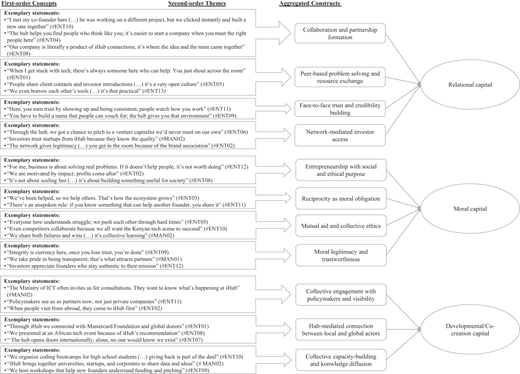
Data analysis was conducted in parallel with data collection according to the principles of grounded theory, to move systematically from empirical data to conceptual abstraction (Strauss and Corbin, 1998). The multistage analysis was supported by MAXQDA software. The process unfolded in three iterative stages: first, open coding was used by analyzing the transcripts line by line to extract first-order concepts closely aligned with participants’ own terms and meanings. Examples include statements such as “I met my co-founder here,” “we share clients and advice” and “we build with purpose, not just for profit.” These codes captured the lived experiences of collaboration, reciprocity and moral orientation. Second, axial coding encompassed that related concepts were clustered into second-order themes that represented deeper theoretical categories, such as “peer-based resource exchange,” “reciprocity as moral obligation” and “collective engagement with policymakers”. The constant comparison method (Glaser and Strauss, 1967) guided this step, ensuring coherence across interviews and industries. Third, in the stage of selective coding and aggregation, the second-order themes were synthesized into three aggregate dimensions representing the key mechanisms of social capital in the iHub ecosystem, namely, relational capital, referring to trust-based collaboration and network mobilization for learning and resource access, moral capital, including shared ethical norms and reputational legitimacy that sustain cooperation and developmental/co-creation capital, comprising collective ecosystem-building activities that link entrepreneurship to national development and policy reform.
Importantly, the aggregate dimensions emerged inductively from the coding process as patterns in how participants described collaboration, trust and collective engagement within the hub environment. They are therefore treated as empirically grounded analytical dimensions that capture how social capital is enacted in this context, rather than as entirely new forms of capital independent of established bonding, bridging and linking social capital categories. The progression from participants’ voices to theoretical constructs is illustrated in the Gioia data structure (Figure 1) (Gioia et al., 2013).
To ensure transparency and establish a strong link to theory, several strategies were used. First, analytical memos were drafted to capture emerging insights and to help connect empirical findings with theoretical reflections on how social capital operates as a moral and developmental resource in African entrepreneurial ecosystems. Second, coding and theme refinement continued until theoretical saturation was reached (Saunders et al., 2018). Third, triangulation was achieved by comparing perspectives from entrepreneurs and hub managers and by reviewing relevant institutional reports (e.g. Sarangé and Chuku, 2021). Fourth, peer debriefing sessions with two senior qualitative scholars helped refine category boundaries and challenge early interpretations. Fifth, reflexive field notes documented the researcher’s positionality and interpretive stance throughout the process. These steps enhanced the analytical robustness of the findings and ensured that the resulting theoretical insights remained firmly grounded in participants’ lived experiences.
Ultimately, regarding the scope of inference, this study follows an analytical rather than statistical generalization logic (Yin, 2018; Siggelkow, 2007). iHub is treated as a theoretically revelatory case of a mature, globally networked innovation hub operating in an institutionally complex environment. The mechanisms identified, relational, moral and developmental capital, are therefore not intended to represent all African innovation hubs, but to illuminate how social capital operates under conditions where entrepreneurs co-locate in dense communities, formal institutional support is partial and hubs act as intermediaries between ventures and public actors. Accordingly, the findings should be interpreted as analytically transferable insights that may inform the study of hubs with similar organizational missions, funding structures and ecosystem maturity, rather than as universally generalizable patterns across African entrepreneurial ecosystems.
4. Findings
The analysis of the interviews with entrepreneurs and hub managers at iHub reveals that social capital operates as a dynamic and multi-layered resource underpinning entrepreneurial success, legitimacy and collective development. Entrepreneurs consistently portrayed iHub not only as a physical space but as a community in which collaboration, moral obligation and ecosystem-building converge. The findings identify three interrelated dimensions of social capital, namely, relational, moral and developmental (co-creation) capital that together illustrate how Kenyan entrepreneurs transform relationships into both economic and developmental capacities within a challenging institutional environment.
4.1 Relational capital
At the heart of iHub’s entrepreneurial community lies a form of relational capital rooted in trust, proximity and everyday collaboration. Entrepreneurs repeatedly emphasized that “the people” rather than the infrastructure constitute the true value of the hub (#ENT01; #ENT03; #ENT09). As one founder explained: “It’s easier to trust someone you see working hard every day next to you […] you know their character before you do business together” (#ENT11). Such daily visibility allows the development of relationships based on shared efforts and mutual observations. Founders described meeting business partners and co-founders by chance within this context. As one education tech founder recounted: “I met my co-founder here” (#ENT10). These kinds of encounters illustrate how proximity within the community of iHub creates strong, trust-based ties that underpin collaboration and risk-sharing in uncertain and challenging environments.
Relational capital also manifests through informal mentorship and continuous peer learning. One hub manager described iHub as an environment where “everyone is both a teacher and a learner” (#MAN02), while a founder explained that “[w]hen I get stuck with tech or strategy, there’s always someone here who can help […] you just go across the room” (#ENT01). This form of spontaneous knowledge exchange transforms iHub into a living classroom, where collective experience-sharing is occurring continuously. For many founders, this openness was a source of both efficiency and emotional reassurance. As a sales manager of a logistics start-up described: “Even if you’re new, people take time to show you how things work” (#ENT05). Such unstructured mentorship fostered an atmosphere of interdependence, in which problem-solving was both social and reciprocal.
Beyond internal trust and learning, iHub membership generated external credibility. Association with iHub signaled professionalism and seriousness to investors, clients and international partners. A hub manager stressed that being affiliated with the hub increases the trust of investors in the respective start-up (#MAN01). Similarly, a health tech founder emphasized that “(t)he network here opens doors you can’t open alone” (#ENT06). Through this reputational effect, relational capital extended beyond the immediate community, bridging entrepreneurs to broader ecosystems of finance, policy and technology. Collectively, these relational dynamics, particularly trust-based collaboration, peer mentorship and legitimacy through association, suggest that a hub can transform interpersonal ties into critical entrepreneurial resources that, at the same time, mitigate uncertain institutional and market environments.
4.2 Moral capital
While relational ties provided the foundation of collaboration, their stability rested on a deeper layer of moral capital, understood as a shared ethical understanding of how entrepreneurs should behave toward one another and toward society. Within iHub, reciprocity emerged as a defining moral principle. As a health tech founder explained: “Helping each other is part of how our start-ups survive” (#ENT02). This moral obligation to “give back” was echoed across interviews, with a fintech founder noting that “[w]e’ve been helped, so we help others” (#ENT03). These accounts suggest that reciprocity was not merely strategic but embedded in a moral economy that treated cooperation as a duty rather than an option. Such reciprocity created a sense of mutual accountability that stabilized collaboration and preserved community trust.
Integrity and trustworthiness further reinforced moral capital. Entrepreneurs repeatedly referred to honesty and consistency as “the real currency” of the ecosystem. A fintech founder succinctly stated that integrity is vital because “once you lose trust, you’re done” (#ENT09). Other entrepreneurs linked ethical behavior directly to investment readiness, suggesting that moral reputation functions as both social and economic capital (#ENT06; #ENT13). And a hub manager observed that “[i]nvestors respect founders who act transparently and stay grounded in the community” (#MAN01).
Equally central to moral capital was a shared sense of purpose that transcended individual gain. Entrepreneurs framed their work as simultaneously commercial and developmental, emphasizing the social mission of their ventures. A sales manager of a health tech start-up, for instance, explained that one can make money and still improve people’s lives (#ENT02). Another entrepreneur reflected that if his education tech app does not help people, “it’s not worth doing” (#ENT12). This orientation toward social contribution shaped both how entrepreneurs defined success and how they sought legitimacy among peers and partners. Theoretically, this suggests that moral capital acted as a key normative orientation. It governed trust, guided behavior and legitimized a start-up as an ethical and communal endeavor rather than only a private pursuit.
4.3 Developmental and co-creation capital: from collaboration to institutional influence
A third dimension of social capital identified in the data is developmental or co-creation capital. This comprises the collective capacity of entrepreneurs to translate relationships and moral commitments into broader ecosystem-building and policy influence. Many interviewees viewed iHub not only as a platform for business development but as an aspiration for Kenya’s technological and social transformation. As the founder of an education tech start-up explained, “[w]e’re not just building companies (.) we’re building Kenya’s tech future” (#ENT13). This sense of collective purpose materialized in joint initiatives such as coding bootcamps, youth mentorship programs and digital literacy projects. “We organize bootcamps for students; giving back is part of the deal” (#ENT10), said the co-founder of another education tech start-up. These practices suggest how entrepreneurs reinvest social capital outward and support public value creation.
This developmental orientation also extended to engagement with state and international actors. A hub manager noticed that the ICT Ministry invites hub officials for consultation (#MAN02). Such collaborations enabled entrepreneurs to influence national innovation policies, positioning start-ups as legitimate stakeholders in Kenya’s development discourse. At the same time, global partnerships expanded local visibility. Through the participation in hub-initiated acceleration programs in partnership with external organizations, such as Mastercard Foundation, many entrepreneurs discovered opportunities that were otherwise out of reach for them (#ENT01; #ENT12; #ENT13). Entrepreneurs were also aware of their role in shaping Kenya’s innovation identity. “When people visit from abroad, they come to iHub first” (#ENT02), as one entrepreneur stressed. In theoretical terms, this suggests that developmental capital extended beyond the hub, positioning iHub as an example of purpose-driven entrepreneurial collaboration within Kenya’s innovation ecosystem.
5. Discussion
This study aimed at exploring how entrepreneurs within Kenya’s iHub ecosystem mobilize social capital to sustain enterprises. The analysis demonstrates that social capital in this setting extends far beyond network access or resource exchange. Instead, it constitutes a community of collaboration in which relational ties are intertwined with moral expectations and developmental aspirations through which entrepreneurs generate trust, legitimacy and collective agency. Three interrelated mechanisms – relational, moral and developmental (co-creation) capital – capture the processes through which social ties are transformed into entrepreneurial and societal value within the iHub context. By theorizing these mechanisms, the study contributes to social capital theory in two main ways: first, by illustrating how established forms of social capital can be enacted within African moral economies and community-oriented entrepreneurial settings; and second, by showing how social capital can become a vector of institutional co-creation and developmental entrepreneurship in hub-based ecosystems.
5.1 Rethinking social capital from an African perspective
Classic social capital theory (e.g. Bourdieu, 2018; Coleman, 1988) conceptualizes networks as resources that enable individuals to access information, opportunities and trust for mutual benefit. However, this framework often assumes relatively stable institutional contexts where norms and contracts are externally enforced. In contrast, the iHub case illustrates how entrepreneurs collectively reproduce and stabilize such norms through everyday social interaction within the hub community. This observation supports arguments that in African contexts, institutional formation is often relationally constructed through informal collaboration and network-based governance (Williams and Vorley, 2015). The findings of this study show that relational capital at iHub, particularly trust and collaboration, appear to function as important mechanisms through which informal coordination and credibility emerge within the entrepreneurial community. Entrepreneurs build credibility through repeated co-presence, shared learning and reputation by association. Such mechanisms create locally embedded systems of informal governance. They resonate with prior studies suggesting that trust-based communities often substitute for weak or absent formal institutions in entrepreneurship (Simba et al., 2023; Sutter et al., 2013).
Equally significant is the emergence of moral capital, which adds an ethical component to business activities. Whereas Western social capital research often treats trust as a rational expectation of reciprocity, iHub members frame it as a moral obligation rooted in values of integrity, fairness and collective development. This aligns with Gaddefors and Anderson (2017), who argue that entrepreneurship in constrained environments is sustained by moral legitimacy and shared purpose. Reciprocity and purpose are primarily understood as duties. In doing so, entrepreneurs appear to broaden the meaning of legitimate entrepreneurial behavior within their community. The findings suggest that contribution often prevails over competition and moral accountability over opportunism within this hub environment. This perspective resonates with African communitarian philosophies such as Ubuntu (Mangaliso, 2001; West, 2014) and challenges the universal applicability of purely market-centric models of social capital. In this context, relationships appear to entail moral expectations that help sustain cooperation beyond instrumental gain. In this sense, moral capital can be interpreted as an informal yet powerful governance mechanism that regulates behavior through shared ethical norms (Murithi et al., 2020).
Finally, developmental or co-creation capital extends social capital into a broader mechanism of institutional engagement. Entrepreneurs leverage their networks to engage with ministries, donors and global partners, effectively transforming interpersonal trust into institutional interaction. Such collective engagement echoes prior work on entrepreneurial ecosystems as co-created structures shaped by multi-actor collaboration (Shams and Kaufmann, 2016). These interactions suggest a shift from enterprise development understood purely as firm-level growth to enterprise development as ecosystem co-creation. At the same time, the enactment of developmental capital is not free from tension. While entrepreneurs benefit from linking ties to external actors, these relationships are often characterized by asymmetries in power, resources and agenda-setting authority. Donors, policymakers and international organizations may shape funding priorities, innovation narratives and definitions of impact, potentially constraining entrepreneurial autonomy or privileging externally driven development agendas. In this sense, social capital not only enables access and coordination but may also embed entrepreneurs within unequal relational structures that influence whose interests are represented and whose voices are amplified (Portes, 1998; Doh et al., 2019).
Moreover, the interplay between moral and commercial orientations can generate tensions within entrepreneurial practice. While iHub entrepreneurs emphasize reciprocity, integrity and community-oriented purpose, they simultaneously operate under pressures to achieve financial sustainability, scale their ventures and meet investor expectations. These dual imperatives may at times conflict, requiring entrepreneurs to navigate trade-offs between collective commitments and market demands. Rather than resolving these tensions, the findings suggest that social capital functions as a mediating mechanism through which competing logics are negotiated in practice. Taken together, these insights indicate that social capital in hub environments operates simultaneously across multiple levels: as a micro-level mechanism of trust-based collaboration, as a meso-level system of shared moral norms and as a macro-level process of developmental engagement with institutions. While these dynamics are observed within the iHub case, they offer theoretically relevant insights for understanding how entrepreneurial communities may mobilize social capital in institutionally complex environments.
5.2 Rethinking enterprise development through hub-based entrepreneurial communities
The findings speak directly to the call for new narratives and evidence of enterprise development in Africa by uncovering how entrepreneurs within the iHub ecosystem create hybrid models that connect social embeddedness with innovation-driven growth. In contrast to deficit-oriented perspectives that frame African enterprise as constrained by informality or institutional voids, the iHub case illustrates how such “voids” can also become spaces for institutional creativity. This observation supports emerging arguments that African entrepreneurs often display “institutional agility” by turning systemic constraints into opportunities for innovation (Atiase et al., 2020; Doh et al., 2019). In this context, entrepreneurs do not merely adapt to weak institutions but actively engage in shaping and reconfiguring them through relational collaboration, moral reciprocity and developmental engagement. The case, therefore, suggests that trust-based relationality, integrity-driven reciprocity and collective co-creation can function as micro-level mechanisms through which entrepreneurial communities navigate and reshape institutional environments.
From this perspective, enterprise development appears not only as an economic process but also as a socially embedded and collectively negotiated project. The entrepreneurs at iHub exemplify a form of “developmental entrepreneurship” that integrates private initiative with broader social and institutional engagement, thereby blurring the boundaries between business, civil society and state (Amaeshi and Idemudia, 2015). Through their networks, they not only build ventures but also participate in ecosystem-building activities such as policy dialogue, skills development and community-oriented innovation initiatives. Such practices suggest that enterprise development in hub-based ecosystems may extend beyond firm performance to encompass broader processes of ecosystem formation and community-building, thereby contributing to emerging narratives within African entrepreneurship scholarship.
By highlighting the interplay between relational, moral and developmental dimensions of social capital, this study contributes a contextually grounded perspective for analyzing how enterprise development unfolds within entrepreneurial ecosystems. Rather than proposing a universal model of African entrepreneurship, the iHub case illustrates how locally embedded capabilities built on trust, shared values and collective purpose can shape entrepreneurial trajectories in institutionally complex environments. This perspective resonates with recent calls to broaden management and entrepreneurship research by incorporating African experiences and ways of knowing into theory development (Nachum et al., 2023). In doing so, the findings underscore the importance of examining how entrepreneurial agency, social relationships and ecosystem institutions interact to shape contextually grounded pathways of enterprise development.
5.3 Limitations and avenues for future research
This research has several limitations that also offer avenues for further inquiry. First, the empirical focus on a single innovation hub in Nairobi represents only one segment of Kenya’s diverse entrepreneurial landscape. iHub is a relatively mature and globally networked hub and its members often enjoy visibility and access to resources not shared by entrepreneurs in more peripheral or rural contexts. Consequently, the findings should be interpreted as analytically grounded insights into this particular ecosystem rather than as representative of all African innovation hubs. Future research could extend this analysis to other hubs across Kenya or other African countries, comparing how the relational, moral and developmental dimensions of social capital manifest under varying levels of institutional development, digital inclusion and resource availability. Such comparative studies would deepen understanding of how social capital adapts to different socioeconomic environments across the continent.
Second, the study relies on interview-based narratives, which capture entrepreneurs’ perceptions and self-representations rather than direct observations of behavior. Although the qualitative design allowed for rich insights into participants’ lived experiences, the data set remains limited in size and scope. While steps were taken to ensure validity through triangulation and theoretical saturation, ethnographic or longitudinal research could offer complementary insights into how trust, reciprocity and collaboration evolve over time. Following start-ups longitudinally, from the ideation stage through scaling or failure, could show how moral and developmental commitments are sustained, challenged or transformed across different stages of enterprise growth.
Third, this study primarily explores the perspective of entrepreneurs and hub managers. Future research might incorporate the viewpoints of investors, policymakers or donors to capture the full relational field in which moral and developmental social capital operates. This multi-actor approach could reveal potential tensions between commercial imperatives and moral obligations, offering a more nuanced understanding of hybrid enterprise systems. In addition, the sample was accessed through hub-based networks, which may have privileged the perspectives of entrepreneurs already embedded in the hub community. Future studies could therefore complement hub-based samples with entrepreneurs operating outside such support structures to better understand how social capital operates across different segments of entrepreneurial ecosystems. In addition, further inquiry into the gendered and generational dimensions of social capital could explore how women and youth entrepreneurs mobilize and experience moral and relational resources differently within entrepreneurial ecosystems.
Finally, a further limitation concerns the boundary conditions of the findings. The three dimensions of social capital identified in this study, namely, relational, moral and developmental capital, emerge from a relatively mature, urban and globally connected innovation hub. In less mature hubs or more peripheral and rural settings, these dynamics may operate differently. For instance, relational capital may be less dense due to weaker co-location and fewer opportunities for sustained interaction, while linking ties to policymakers, donors or international actors may be more limited. Similarly, the balance between moral and commercial orientations may shift in contexts where resource constraints are more acute or where survival imperatives dominate. These variations suggest that the configuration and relative importance of the identified dimensions are likely to be contingent on ecosystem maturity, resource availability and geographic context. Future research could therefore examine how social capital is enacted across different types of hubs and entrepreneurial environments to further refine the boundary conditions of the framework.
5.4 Policy implications
The findings suggest that fostering enterprise development in hub-based entrepreneurial ecosystems requires policies and managerial practices that recognize the developmental function of social capital. Policymakers in contexts similar to the Kenyan innovation ecosystem may consider integrating innovation hubs like iHub into the formulation and implementation of national entrepreneurship and digital inclusion strategies, providing stable, long-term support that safeguards their social mission while also enhancing resource accessibility for early-stage ventures. Beyond venture creation, such support can contribute to broader economic outcomes, including job creation, skills development and the strengthening of local innovation capacities. Public–private partnerships could further reinforce these effects by linking hubs with educational institutions, local governments and civic organizations to extend training and innovation opportunities beyond urban centers and into more peripheral regions.
For hub managers, the key implication is to nurture moral and relational trust, which can be implemented through institutionalizing mentorship, peer learning and reciprocity practices. The iHub case suggests that cultivating such trust-based communities may enhance collaboration, knowledge exchange and reputational legitimacy among entrepreneurs, while also improving access to investment and market opportunities. Strengthening these moral-developmental linkages can help transform hubs from temporary support platforms into potential engines of inclusive innovation, supporting not only venture growth but also longer-term ecosystem sustainability and economic resilience within institutionally complex environments.
Finally, the findings also carry implications for entrepreneurship education and training. Business and management curricula may benefit from incorporating context-sensitive perspectives on social capital that emphasize relational, moral and developmental dimensions alongside traditional market-based approaches. Integrating such insights into teaching can help prepare future entrepreneurs to navigate complex institutional environments, balance commercial and social objectives and engage more effectively with diverse ecosystem actors.
6. Conclusion
This study examined how entrepreneurs in Kenya’s entrepreneurial ecosystem, exemplified by iHub, mobilize and transform social capital to develop their ventures. The findings show that social capital in this context operates through three interrelated mechanisms (relational, moral and developmental/co-creation capital) that together translate interpersonal trust and shared values into entrepreneurial legitimacy, ecosystem collaboration and institutional influence. Entrepreneurs enact these forms of capital by building trust-based networks, embedding moral reciprocity in everyday practice and co-creating developmental initiatives with public and private actors. The iHub case illustrates how enterprise development within a hub-based entrepreneurial community can emerge as a socially embedded and collectively negotiated process. In this setting, entrepreneurship is shaped not only by market incentives but also by shared norms, reciprocal relationships and collaborative engagement with ecosystem actors. The findings, therefore, suggest that enterprise development in institutionally complex environments may rely strongly on relational trust, moral expectations and collective forms of ecosystem participation.
By highlighting the interplay between relational, moral and developmental dimensions of social capital, this study offers a contextually grounded perspective for understanding how entrepreneurial communities mobilize social relationships to support venture creation and ecosystem development. In doing so, the study contributes to ongoing debates on entrepreneurship in Africa by illustrating how entrepreneurs can act not only as market participants but also as contributors to the social and institutional foundations of entrepreneurial ecosystems. These insights invite further research into how social capital operates across different innovation hubs and entrepreneurial environments, thereby advancing a more context-sensitive understanding of enterprise development in emerging economies.
Ethical considerations
This study was conducted in accordance with the ethical principles outlined in the Declaration of Helsinki and in line with established standards for qualitative research involving human participants. At the time of the research, ESB Business School of Reutlingen University did not have an Institutional Review Board or equivalent ethics committee. Nevertheless, all procedures were designed and implemented to ensure participants’ rights, privacy and well-being.
Prior to each interview, participants received information about the purpose of the study, the voluntary nature of participation and assurances of anonymity and confidentiality. Verbal informed consent was obtained from all participants. Data were anonymized and securely stored.
The researcher affirms that the study complied with national and institutional ethical standards and with the Declaration of Helsinki (2013).
Consent of human participants
Verbal informed consent was obtained from all participants prior to each interview. Participants were informed about the purpose of the study, their right to withdraw at any time and the measures taken to ensure confidentiality and anonymity.