In an environment characterised by numerous technological breakthroughs, entrepreneurial alertness (EA), innovation culture and the development of managerial networks (MN) are critical catalysts to the digital transformation of small and medium-sized enterprises (SMEs). Moreover, SMEs may struggle to compete, remain relevant and survive in the current environment without undergoing digital transformation. This study used a moderated mediation approach to investigate whether SMEs’ innovation culture moderated the indirect relationship between EA and SMEs’ digital transformation through MN. The purpose of this study is to examine the moderating role of innovation culture in the indirect relationship between EA and SMEs’ digital transformation through MN using a moderated mediation framework.
This study used a quantitative method, grounded in a positivist research paradigm and a deductive approach, to clarify its explanatory and cross-sectional nature. A sample of 669 SMEs participated in this study using an online survey. Hierarchical regression analysis and the Hayes Process Macro Model 7 were used to test for moderated mediation.
The study determined that an increase in SME innovation culture further reinforces the impact of MN on the relationship between EA and SME digital transformation.
Active participation in digital forums, open communication and selecting strategic partners, such as financial technology firms, could help SME owners/managers accelerate digital transformation within their respective entities.
This study’s findings significantly contribute to theory and practice by revealing complex interrelationships among SMEs’ digital transformation predictors, namely, EA, innovation culture and MN, each playing a distinct role in driving SME digital transformation.
1. Introduction
Technological breakthroughs are rapidly reshaping the 20-first-century marketing environment, compelling firms to rethink how they create value and maintain competitiveness. In this context, the digitalisation of small and medium-sized enterprises (SMEs) has emerged as a prominent research topic, as scholars increasingly examine how these firms can successfully navigate the digital economy (Klos et al., 2023; Silva et al., 2025). Digital transformation enables SMEs to redesign products and services, improve operational efficiency and strengthen their competitive positioning in dynamic markets (Liu et al., 2024). Furthermore, transitioning to digital platforms enables SMEs to expand beyond traditional business models and enter emerging sectors, such as environmentally sustainable industries (Ismail, 2023). Digital technologies also enable SMEs to leverage social media and digital communication channels to reach broader audiences, develop creative marketing strategies and differentiate themselves from competitors (Holzmann and Gregori, 2023).
Despite these opportunities, SMEs, particularly those operating in emerging economies, face considerable challenges when adopting and implementing digital technologies. Structural constraints such as limited access to infrastructure, skills shortages and financial limitations contribute to a persistent digital divide between SMEs and larger organisations (Telukdarie et al., 2024; Abaddi, 2025; Meier et al., 2025). These constraints hinder SMEs’ ability to improve productivity, innovate effectively and enter new markets. Consequently, understanding the organisational and managerial factors that facilitate SME digital transformation has become increasingly important. In response to these challenges, this study examines the role of innovation culture in shaping the indirect relationship between entrepreneurial alertness (EA) and SME digital transformation through managerial networks (MN).
The adoption of digital technologies by SMEs can be explained by the broader theory of innovation, which holds that firms adopt new technologies to enhance competitiveness and respond to evolving market demands. One of the earliest insights in this regard can be traced to Schumpeter (1934), who argued that firms adopt innovation primarily to introduce new products and services. In practice, SMEs may not always create entirely new offerings but may instead upgrade existing products or processes to meet changing customer needs. However, successful product or process innovation requires an organisational environment that supports continuous learning, experimentation and knowledge creation. A strong innovation culture, therefore, becomes critical in fostering the organisational capabilities required for digital transformation (Okanga, 2023).
Beyond product development, SMEs also adopt digital technologies to improve operational efficiency and expand into new markets. Digitalisation enables firms to enhance production processes, optimise supply chains and gather valuable data regarding customer behaviour and market trends (Gotteland et al., 2020). For many SMEs that rely on external partners for production or distribution, digital tools provide an essential mechanism for coordinating activities and maintaining competitiveness. Moreover, digital transformation can signal an organisation’s strategic intent and readiness to participate in the digital economy (Meier et al., 2025). In this regard, managerial networking plays a critical role. MN refer to regular interactions between decision-makers across organisations aimed at enhancing organisational performance through knowledge exchange, learning and innovation (Torenvlied and Akkerman, 2012).
Nevertheless, not all managers engage equally in networking activities. Identifying suitable partners and leveraging external relationships effectively requires a high degree of entrepreneurial awareness. EA refers to the ability of entrepreneurs to recognise changes in the external environment and identify opportunities or threats that others may overlook (Montiel-Campos, 2021). Such alertness enables SME owner–managers to respond strategically to emerging technological trends and market shifts. However, recognising opportunities alone is insufficient; entrepreneurs must also mobilise the appropriate resources and partnerships to exploit them effectively. This challenge is particularly evident in digital transformation initiatives, where SMEs often lack the technical expertise and resources necessary to implement complex digital solutions (Meier et al., 2025). Consequently, EA may encourage SME decision-makers to establish MN that provide access to external knowledge, technological expertise and strategic partnerships. Despite its relevance, empirical research examining the interplay between EA, managerial networking and SME digital transformation remains limited.
While managerial decisions initiate digital transformation, successful implementation ultimately depends on the organisational context in which they are executed. Innovation culture plays a pivotal role in enabling employees to adopt new technologies and integrate innovative practices into daily operations. Innovation culture refers to shared values, beliefs and norms that encourage experimentation, creativity and openness to change within an organisation (Valencia et al., 2010; Ali and Park, 2016). When such a culture is present, employees are more likely to embrace digital tools, collaborate effectively with external partners and contribute to organisational learning. Conversely, in organisations where innovation is discouraged or unsupported, employees may resist technological change, thereby undermining digital transformation initiatives.
Digital transformation inherently involves experimentation, risk-taking and learning from both successes and failures. SMEs often possess relatively flexible organisational structures that can facilitate experimentation and rapid adaptation (Saleh and Wang, 1993). However, the success of such experimentation depends on whether the organisational culture encourages innovative behaviour and open communication. Prior research suggests that organisations with strong innovation cultures are better positioned to explore novel ideas and processes, thereby enhancing their capacity to sustain competitive advantage (Hurley and Hult, 1998). Accordingly, this study argues that SMEs characterised by strong innovation cultures are better able to leverage MN to translate entrepreneurial insights into successful digital transformation outcomes.
Although existing literature highlights the importance of digital transformation for SME competitiveness and economic development (Telukdarie et al., 2022), several gaps remain. Much of the current research focuses on technological adoption and organisational capabilities while paying limited attention to the behavioural and relational mechanisms that drive digital transformation. Furthermore, empirical studies examining these relationships in emerging economies remain scarce. Addressing these gaps is particularly important in contexts such as South Africa, where SMEs face significant structural barriers, including infrastructure constraints, limited information and communication technology (ICT) skills and economic inequality (Telukdarie et al., 2023; Shava, 2024).
Against this backdrop, this study investigates whether SME innovation culture moderates the indirect effect of EA on SME digital transformation through MN. By integrating insights from EA theory, social cognition theory, signal detection theory, social network theory, organisational culture theory and the theory of planned behaviour, the study provides a comprehensive framework for understanding the complex drivers of SME digital transformation. In doing so, it contributes to the growing body of literature on SME digitalisation while offering practical insights for entrepreneurs, policymakers and support institutions seeking to enhance SME competitiveness in the digital economy.
2. Theoretical background and hypotheses development
2.1 Theoretical background
The theory of planned behaviour provides an important behavioural lens for understanding SME digital transformation (Ajzen, 2020). The theory posits that individual behaviour is primarily determined by behavioural intentions, which are shaped by attitudes towards the behaviour, subjective norms and perceived behavioural control (Ajzen, 1985, 1991, 2012). In the SME context, owner–managers who hold favourable attitudes towards digital technologies, perceive strong support from professional networks and stakeholders and believe that they possess the necessary resources and ICT capabilities are more likely to pursue digital transformation initiatives. EA enhances these intentions by enabling SME owner–managers to recognise emerging digital opportunities within dynamic business environments (Baron, 2006). At the same time, MN reinforce subjective norms by exposing entrepreneurs to industry expectations, best practices and prevailing technological trends. Nevertheless, the success of digital transformation initiatives is also contingent on the organisational environment in which they are implemented (Omrani et al., 2022). In this regard, an innovation-supportive culture strengthens employees’ perceived behavioural control by encouraging experimentation, learning and the adoption of new digital technologies and processes. Consequently, the theory of planned behaviour provides a useful foundation for explaining how EA, MN and organisational culture collectively shape SMEs’ intentions and actions towards digital transformation.
At the individual level, this study draws on EA theory, social cognition theory and signal detection theory to explain how SME owner–managers recognise and evaluate opportunities in the digital landscape. EA theory, associated with the work of Kirzner (1973, 1979, 1999), suggests that individuals differ in their ability to identify and exploit opportunities that others overlook. This capability is grounded in the cognitive mechanisms described by social cognition theory (Bandura, 1986, 2001), which explains how individuals acquire, process and apply knowledge to interpret environmental changes and formulate strategic responses. Complementing this perspective, signal detection theory explains how decision-makers distinguish meaningful signals from irrelevant or misleading information in uncertain, information-rich environments (Swets, 1992; Swets and Green, 1978). When integrated, these theoretical perspectives conceptualise EA as a multidimensional cognitive capability that enables SME owner–managers to systematically scan their environment, interpret digital trends and evaluate opportunities associated with digital transformation.
At the relational level, social network theory, as articulated by Scott (2000), explains how MN function as conduits through which cognitive insights are translated into strategic action. Entrepreneurs who exhibit high levels of alertness are more likely to engage in purposeful networking to access knowledge, legitimacy and resources necessary for innovation and digital transformation. Through these relationships, SME owner–managers can bridge information gaps, acquire technological expertise and share best practices with partners and industry peers. Such interactions are particularly important for SMEs operating in resource-constrained environments where access to digital capabilities may be limited. MN, therefore, serve as an important mechanism linking entrepreneurial cognition with the practical implementation of digital transformation strategies.
At the organisational level, organisational culture theory, developed by Schein (1992), provides insight into how internal organisational dynamics influence the success of digital transformation initiatives. Specifically, innovation culture plays a crucial role in determining whether SMEs can effectively translate EA and networking activities into sustained digital advancement (Leso et al., 2023). In organisations that encourage openness to change, experimentation and continuous learning, an innovation culture fosters an environment where employees are willing to adopt new technologies and contribute to digital initiatives. Such cultures not only reinforce managerial efforts to pursue digital transformation but also enhance employees’ readiness to support organisational change. Consequently, an innovation culture moderates the relationship between MN and SME digital transformation by shaping employees’ collective attitudes, behaviours and engagement towards digital innovation.
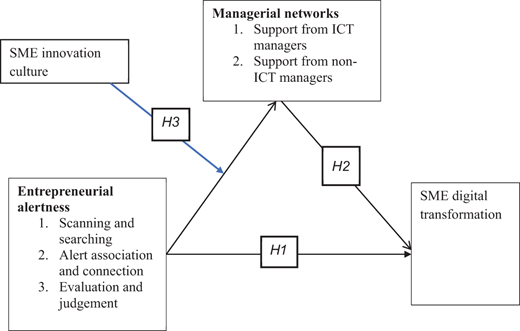
Taken together, these theoretical perspectives provide a comprehensive framework for understanding SME digital transformation. The cognitive dimension, grounded in EA theory, social cognition theory and signal detection theory, explains how SME owner–managers identify and interpret digital opportunities. The relational dimension, informed by social network theory, explains how entrepreneurs mobilise external relationships and resources to act upon these opportunities. Finally, the organisational dimension, supported by organisational culture theory, explains how innovation culture sustains and amplifies digital transformation efforts within the firm. Collectively, these perspectives offer a multi-level explanation of how SMEs recognise digital opportunities, mobilise strategic resources and create internal conditions necessary to successfully implement digital transformation initiatives, as illustrated in the research model, Figure 1.
2.2 Entrepreneurial alertness
Entrepreneurial literature that seeks to explain the new venture creation process and the development of new entrepreneurial opportunities for established entities emphasises the importance of alertness. According to Kirzner (1979), alertness is an individual’s ability to identify entrepreneurial opportunities that others do not consider lucrative, thereby leading to missed opportunities. Moreover, empirical literature focusing on EA advances two perspectives, namely, EA, which is considered a tool that entrepreneurs rely on to identify opportunities (opportunity-seeking) and reliance on EA to act on threats to the business through decision processes that help neutralise threats (advantage-seeking) (Kirzner, 1973, 1985, 2009).
To date, technology has introduced numerous opportunities and threats; however, not all South African SMEs are aware of the advantages of digital transformation [Small Enterprise Development Agency (SEDA), 2016; Telukdarie et al., 2023]. Thus, many SMEs lag in digital transformation due to limited exposure to emerging digital trends and technological knowledge. This lack of awareness heightens uncertainty and risk perceptions, making investments in digital transformation appear less attractive to SME decision-makers (De Massis et al., 2015; Hu and Hughes, 2020). Accordingly, SME owner/managers are yet to fully understand opportunities linked to ICT, such as e-commerce, which is considered a key driver of entity profits (Pratono, 2018). However, when they digitally transform, SMEs may also benefit from artificial intelligence, blockchain, cloud computing and Big Data. Since data are now considered the seventh factor of production, SMEs must digitally transform to successfully integrate into a domestic and global digital economy (AlNuaimi et al., 2022), which demands an entrepreneurially alert owner/manager to achieve this goal.
Mubarak et al. (2019) lamented that even those SMEs that understand the opportunities associated with digitalisation have yet to commit tangible resources to digital transformation. Accordingly, there is a dire need for SME owners and managers to understand and appreciate the threats posed by failing to exploit ICT opportunities. Moreover, case studies involving Nokia, Kodak and other companies that became victims must serve as a deterrent to firms that fail to adopt technological advancements (Bleicher and Stanley, 2016). Forming MN with both private sector managers and government stakeholders is therefore essential for facilitating information exchange that enhances opportunity recognition. Through these networks, SME owner–managers gain access to valuable macro- and micro-level insights regarding technological trends, market developments and policy environments. Such exposure increases digital awareness and enables SME decision-makers to formulate more informed and targeted digital transformation initiatives. Therefore, entrepreneurially alert SMEs stand a better chance of exploiting opportunities through ICT and correctly responding to disruptions in the macro-environment. Therefore, Tang et al. (2012) defined EA as the entrepreneur’s ability to appropriately evaluate unfamiliar changes, shifts, data and information and ascertain whether a lucrative opportunity lies ahead or poses a possible threat. They further argued that three key issues are critical for the entrepreneur to make a prudent judgement: scanning and searching for information, association and connection and evaluation and judgement.
2.2.1 Alert scanning and search.
Scanning and searching begin when it is acknowledged that a gap exists between the entity’s desired and current states. Thus, from an entrepreneurship perspective, this may relate to new or existing customer demands that the enterprise has not met. In the context of this study, the aim is to digitally transform the SME to exploit financial and strategic benefits from the implementation of ICT opportunities that other SMEs have yet to become aware of. Busenitz (1996) argued that, through alert scanning and search, SME owners will be persistent and rely on unconventional means to gather the data needed to transform their SMEs digitally. Moreover, SME owners may also rely on experience, technological education and knowledge from ICT experts (Reed, 2004). Therefore, both tacit (internal knowledge) and explicit knowledge (outside knowledge) will help determine which technology is required for successful digital transformation (Polanyi, 1967). It should be noted that there are no systematic channels that individuals typically follow to gain answers during scanning and information searches. However, if desired, collaboration is also possible, which may result in the development of MN that can be classified as extensive scanning and searching (Ericsson et al., 1993). In the context of this study, alert SME owners seeking to transform their entities are expected to embark on extensive scanning and searching, thereby building MN to ensure the appropriate technologies are used, resulting in more efficient resource utilisation.
2.2.2 Alert association and connection.
During the alert scanning and searching process, it is envisaged that entrepreneurs will emerge with ideas derived from pieces of evidence or information at hand. However, this information or evidence is usually insufficient for entrepreneurs to answer crucial market-related questions; however, it is not useless (Tang et al., 2012). Thus, sometimes fragments or clues emerge, and when associated with or connected to other market-related events, entity processes and existing products, ideas surface that can create value. Therefore, the association and connection phase involves linking the dots. However, even after associating and connecting the dots, the entrepreneur may notice that a gap in evidence or information remains. This realisation triggers further environmental scanning and searching to generate more data necessary to connect the dots and develop a clearer vision for creating or adding value. This move is supported by social cognition theory, which highlights four steps individuals must take to fully assess covariations (Crocker et al., 1984).
The first step involves understanding the evidence or the extant data (Tang et al., 2012). The second step involves categorising the evidence into either positive or negative attributes. Essentially, evidence that aligns with expectations is easier to work with and thus falls into the positive category. Moreover, certain inferences can be drawn from evidence that conforms to expectations. The third step involves individuals recalling the evidence and determining its frequency. Finally, all the evidence can be merged to form a complete picture. Accordingly, the individual’s expectations and experiences guide the combination of evidence from working with similar evidence. In addition, these emerging pictures are linked to other market-related variables to provide a more in-depth assessment. Through association, individuals can link one item to numerous other pieces of information to establish possible connections. Once meaningful connections are established, entrepreneurs need to further ascertain the usefulness of these new connections. Notably, this process is completed through further evaluation and pragmatic judgement.
2.2.3 Evaluation and judgement.
The evaluation and judgment phase enables entrepreneurs to make viability and feasibility decisions regarding the information they have generated after completing the scanning and search, along with the association and connection phases. In addition, when evaluating and making judgments, careful filtering and analysis of content are most critical (Reed, 2004). Hence, this is a delicate process that requires extreme caution, as the entrepreneur risks omitting key pieces of information if they lose concentration while solving the opportunity puzzle. Therefore, the content must be carefully matched to any existing products or services within the entity or those of the competition (Baron, 2006). The evaluation and judgment process, when concluded, will help the entrepreneur determine the profitability of the new opportunity. This approach is supported by signal detection theory (Swets, 1992), which assumes that individuals with enhanced information-evaluating capabilities are most likely to reach correct decisions. Assuming these individuals are entrepreneurs, one could argue that being alert may enhance their ability to identify and exploit opportunities and to create new ventures in a world driven by rapid technological change. This is important given the ongoing global transition of SMEs from industry 3.0–4.0 and 5.0 (Madhavan et al., 2024). Notably, South African SMEs are also preparing to integrate I4.0 and 5.0 despite the wide socio-economic gaps in the country (Yakobi, 2026).
2.3 SME digital transformation
Empirical evidence identifies three key themes in SME digital transformation. Firstly, digital transformation is driven by internal capabilities and external pressures. Entrepreneurial capability, organisational resources, technological readiness and managerial support influence SMEs’ adoption of digital technologies, while competitive intensity, evolving customer expectations and rapid technological change further motivate this shift (Li et al., 2018; Omrani et al., 2022). Secondly, SMEs pursue digital transformation to improve performance and competitiveness. Studies show that digital adoption enhances efficiency, productivity, innovation capacity, market responsiveness and participation in global value chains (Battistoni et al., 2023; Melo et al., 2023). Thirdly, successful transformation requires clear digital strategies, adequate resources, skilled personnel and supportive ecosystems involving governments, technology firms and business networks (Pelletier and Cloutier, 2019; Stich et al., 2020; Matt and Rauch, 2020).
In SMEs, digital transformation is a journey that begins with the acquisition of technological equipment for data capture, often referred to as digitisation. Such technologies include scanners, cameras, computer hardware, audiovisual equipment and backup systems, among others, that allow the capture and recording of non-digital items in digital form. Cenamor et al. (2019) defined digitisation as the use of digital tools that provide technical features, such as hardware or software applications. In essence, digital technologies are rooted in ICT systems that standardise information, enabling the repeated analysis, storage and distribution of large amounts of knowledge. Once the digitisation process is complete, digitalisation can begin. Digitalisation refers to entities using digital data to change, organise and improve processes and workflows, resulting in enhanced manual systems through automation processes. For example, buying and selling goods online are associated with generating new knowledge about customer behaviour, online payment systems, administrative changes and remote work (Vial, 2019). When digitisation and digitalisation are achieved, the entity will have been digitally transformed and ICTs will form a large part of this process (Sebastian et al., 2017).
At the firm level, digital transformation is highly sought after by SMEs due to the significant benefits that can be achieved when this process is partially or fully achieved. Accordingly, at the national level, SMEs’ digital transformation is critical if South Africa is to accelerate economic growth and sustain economic performance (Telukdarie et al., 2022). At the firm level, digitally transformed SMEs can improve workforce productivity by minimising human errors while simultaneously expanding into global markets with high-quality products and services (Vide et al., 2022). Moreover, this can be achieved with minimal investment and by relying on ICT experts and consultants, while forging networks with influential players, such as managers of various organisations, especially those who have used similar or related technologies. However, digitally transforming SMEs can become very costly if relevant, knowledgeable and experienced people (e.g. ICT managers; senior and middle managers in the private/public sector, and non-profit organisations) are not involved in the process. Hence, tapping into this pool of experience and knowledge enhances SMEs’ value-creation efforts, thus maximising investment returns.
Evidence also suggests that digitally transformed entities enjoy financial and strategic benefits (Tarutė and Gatautis, 2014). Moreover, regarding financial benefits, digital transformation enhances efficiency and effectiveness, resulting in improved profits and favourable operational margins (Müller et al., 2018). The total savings for SMEs embarking on digital transformation are expected to improve significantly as it enhances their cost-reduction capabilities (Pulka et al., 2018). Furthermore, the risk assessment capabilities of digitally transformed SMEs improve significantly, thereby enhancing productivity (Rahayu and Day, 2017). Aided by the ability to acquire high-quality data in real time and process large amounts of data within a short timeframe, business time is therefore saved and used more efficiently (Cenamor et al., 2019). Accordingly, business agility improves as communication between employees is quicker (Ross and Blumenstein, 2015), while collaboration and networking with business partners are also enhanced, allowing for easier exploitation of new opportunities while mitigating emerging threats (Saridakis et al., 2018).
Financial and strategic benefits that emerge after the digital transformation of SMEs include increased market share and brand awareness. Digitally transforming SMEs enables them to strengthen their market position and gain a competitive advantage (Chen et al., 2016). Therefore, SMEs can maintain their competitive advantage, resulting in sustained market share growth and increased brand awareness (Nuseir, 2018). Other strategic benefits that SMEs enjoy include the following: employee and customer satisfaction (Foroudi et al., 2018a, 2018b); improved service quality (Pfister and Lehmann, 2023a, 2023b); access to new markets (Kartiwi et al., 2018); and employee growth and environmental awareness (Okundaye et al., 2019).
Research in South Africa has sought to explain the motive behind SME digital transformation. Thus far, the evidence indicates that South African SMEs have acquired digital tools to enhance manufacturing competitiveness, improve market intelligence, engage in buying and selling in international markets and identify knowledge networks at low cost (Mabotja, 2018). Similarly, Disse and Sommer (2020) found that SMEs in sub-Saharan Africa have adopted digital tools to improve productivity and innovation. In addition, they determined that SMEs have adopted digital tools to align and adapt to market changes, such as the widespread use of digital finance by customers, equity providers and the government. In support, Ricci et al. (2021) noted that digital tools enable SMEs to offer personalised services, specifically by catering to customers’ preference for mobile money for transactions; thus, it is critical for SMEs to adapt to these market changes while benefiting from cost-cutting initiatives and simplified production processes.
Various digital tools are available for adoption by SMEs to expand their digitisation agenda (Meier et al., 2025). These include general administration and information technology systems, such as cloud computing and production, as well as supply chain-related digital tools, such as radio frequency identification. Other digital tools include communication, advertising and marketing tools such as customer relationship management and social media. Moreover, other digital tools available for adoption by SMEs include e-commerce, Big Data, Internet of Things, e-booking and electronic invoicing, all of which depend on the entity’s specific needs. For example, enterprise resource planning is ideal for the in-depth planning of entity functions. Although it is not readily available to small entities, it can be found and accommodated for medium and large entities, given their extensive operational scope (Kergroach and Héritier, 2025).
Despite these contributions, the extant literature reveals several conceptual, contextual and empirical limitations that continue to constrain a comprehensive understanding of SME digital transformation. Firstly, the diffusion of digital transformation capabilities remains highly uneven across geographical and socio-economic contexts. SMEs in rural and under-resourced regions continue to struggle to acquire basic digital infrastructure (Philip and Williams, 2019), ICT capabilities and technical expertise, while firms in urban centres are increasingly positioning themselves to leverage Industry 4.0 and emerging Industry 5.0 technologies to enhance strategic competitiveness. This imbalance highlights a dual digital economy in which technologically advanced SMEs coexist with digitally excluded enterprises. Such disparities are not merely technological in nature but are embedded in broader structural deficiencies, including limited access to finance, inadequate broadband infrastructure, weak institutional support and insufficient digital leadership capabilities (Sithole and Ruhode, 2021; Buthelezi and van Eck, 2024). Consequently, the digital transformation ecosystem in many emerging economies remains fragmented and unable to support inclusive SME digitalisation.
Secondly, much of the existing scholarship tends to conceptualise digital transformation as a linear process driven primarily by technology adoption, while paying insufficient attention to the organisational, strategic and behavioural mechanisms that sustain transformation over time. Although prior studies acknowledge the potential benefits of digital technologies, limited empirical evidence exists regarding how SMEs evaluate, institutionalise and sustain long-term digital transformation success, particularly under conditions of resource scarcity and environmental uncertainty (Pfister and Lehmann, 2023). This creates a significant theoretical gap, as transformation outcomes may depend not only on technology acquisition but also on firms’ internal capabilities, managerial orientation, and adaptive capacity.
Thirdly, the literature remains heavily dominated by evidence from developed economies, thereby limiting the generalisability of existing models to emerging-market contexts characterised by infrastructural constraints, institutional voids and distinct competitive realities. Variations across SME sizes, sectors, ownership structures and regional environments remain underexplored, despite evidence suggesting that digital transformation trajectories are context-dependent (Clemente-Almendros et al., 2024). As a result, current theoretical explanations fail to adequately capture the heterogeneous nature of SME digital transformation in emerging economies.
Furthermore, the pathways through which SMEs evolve from traditionally operated firms into digitally enabled enterprises remain insufficiently theorised and empirically validated (Battistoni et al., 2023; Ulas, 2019). Existing studies largely focus on adoption outcomes rather than examining the underlying mechanisms, boundary conditions and interrelationships among organisational capabilities, strategic orientations and environmental factors that facilitate successful transformation. Consequently, there remains a limited understanding of how and under what conditions digital transformation capabilities translate into sustained organisational outcomes. In response to these limitations, this study adopts a moderated-mediation perspective to provide a more nuanced explanation of SME digital transformation in an emerging economy.
2.4 Entrepreneurial alertness and SME digital transformation
Research suggests that SMEs fail to digitally transform primarily due to shortages of technology, technological skills and digital infrastructure (Viswanathan and Telukdarie, 2021). Alertness is a critical driver of SME digital transformation. From an opportunity-seeking perspective, SME owners can identify and understand current and future digital trends that directly and indirectly impact the normal functioning of an entity (Cozzolino et al., 2021). For example, most businesses currently offer online transactions, bypassing conventional working hours (Viswanathan and Telukdarie, 2021). Accordingly, given the demands of their daily jobs, most customers now prefer concluding online transactions before or after work, eliminating the need to visit the shop. Another digital trend entrepreneurs observe is chatbots, where customers can log complaints anytime and are issued a reference number for further commentary. Previously, the customer had to call the entity during regular business hours. The current generation of customers relies mainly on mobile money, requiring SMEs to adapt to changes in the digital financial environment. Through EA, entrepreneurs can recognise that social media plays a crucial role in information dissemination, advertising and customer engagement, an opportunity they must exploit to enhance the entity’s success (Tang et al., 2012). Based on the above discussion, this study hypothesises that:
Entrepreneurial alertness drives SME digital transformation.
2.5 SMEs’ managerial networks
The concept of MN is further explained in the literature from a social network theory perspective (Scott, 2000). In line with the stated theory, MN are structures in which senior managers from various entities, in collaboration with other stakeholders (private, government and non-profit managers, among others), connect with and assist one another to accomplish business-related goals (Panda, 2014).
The literature identifies two primary forms of MN. The first comprises ties established with other businesses, commonly referred to as business networks, while the second involves connections with government and political actors, often termed political networks (Li, 2005). In principle, each senior manager is embedded within a network of key value chain actors, including buyers, suppliers and competitors. Such interconnectedness facilitates the efficient creation and exchange of critical information (Shu et al., 2012). As managers contribute diverse contacts and expertise, valuable insights related to marketing, technology, production and innovation are shared, thereby enabling the digital transformation of SMEs at relatively low cost. Accordingly, MN can be understood as strategic, cross-sectoral relationships developed by senior managers to achieve short-, medium- and long-term organisational goals. Their strategic nature is particularly evident in their long-term orientation, which emphasises sustained relationship development and professional growth.
Empirical evidence highlights three key challenges faced by entities attempting to establish MN within emerging economies. Firstly, weak collaboration, leading to overdependency, often arises from varying stages of SME development, prompting firms to prioritise individual interests over collective value chain benefits (Holopainen et al., 2024; Reim et al., 2023). Consequently, SMEs that have experienced neglect or opportunistic behaviour from prior partners may develop trust deficits, making them reluctant to engage in new managerial ties. Secondly, such mistrust undermines the formation of cohesive network ecosystems. Marzi et al. (2023) weighed in, noting that networks with clear partnership goals provide the tools for entities to develop versatile, resilient partnerships. Thirdly, in the absence of well-established platforms, many SMEs struggle to access industry clusters and innovation hubs, limiting opportunities for knowledge exchange and technological advancement.
Despite these challenges, empirical studies consistently demonstrate that relationships among firms, government institutions and non-profit organisations play a critical role in facilitating knowledge transfer and enhancing digital capabilities. This highlights the importance of fostering collaborative platforms and strengthening industry partnerships (Liu et al., 2022). For example, Srećković (2018) emphasised the value of networking during periods of environmental uncertainty, particularly within architectural firms. Similarly, Winter (2003) found that managerial networking, as a component of organisational capabilities, significantly improves production efficiency. Furthermore, Mulyungi et al. (2022) demonstrated that managerial networking enhances the competitive advantage of Kenyan textile firms operating in highly competitive environments.
Although existing empirical evidence establishes a direct relationship between MN and various SME outcomes, the mediating role of MN within the context of SME digital transformation remains underexplored. This study addresses this gap by investigating whether MN mediate the relationship between EA and SME digital transformation.
2.6 The mediating role of managerial networks
Most SMEs lament the lack of managerial resources, which limits their capacity to collaborate and forge mutually beneficial networks critical to digital transformation (Ricci et al., 2021). Some SMEs, however, have the resources but lack the knowledge and are, therefore, hesitant to digitally transform (Elhusseiny and Crispim, 2021). Heberle et al. (2017) also noted that SMEs struggle to identify the benefits of digital transformation; as a result, they cannot precisely pinpoint what to digitise or with which technology. A significant deterrent to SMEs transitioning to digital transformation is the high investment required and the costs associated with software and licence renewals, among others (Esselaar et al., 2007). However, when SME owners/managers connect with ICT experts, as well as experienced and knowledgeable ICT managers from private, public and non-profit organisations, it creates a managerial network where excessive expenditures on ICT tools can be avoided, thereby enhancing SME digital transformation (Gono et al., 2016).
The advantage-seeking perspective of EA guides the entity’s decision-makers to connect with other managers facing similar market threats or opportunities and strategically position their firms (Eggers and Kaplan, 2013). Thus, despite the lack of managerial resources and hesitancy, EA enables entity decision-makers to identify influential market players with whom they can collaborate to enhance the entity’s success (Roundy et al., 2018). In addition, cutting-edge solutions can be shared through networks and partnerships, such as adopting ICTs to improve the entity’s digitisation capabilities. Overall, MN are pivotal in information sharing, research and development collaboration and other value-addition initiatives (Holopainen et al., 2026). Research further revealed that most SME owners in South Africa forge networks with large-firm managers who have better digital tools and knowledge of the most straightforward steps, for example, how to digitalise (OECD, 2017). It could also include more complex aspects such as value extraction, machine learning and Big Data (Gono et al., 2016), as well as the integration of digital tools into the existing business model and processes (Rupeika-Apoga et al., 2022). Therefore, based on the above, this study argues that:
Managerial networks mediate the relationship between entrepreneurial alertness and SME digital transformation.
2.7 Innovation culture in SMEs
Innovation culture, within the context of SMEs, refers to a set of organisational practices aimed at understanding the market environment through the development of capabilities and the establishment of supportive infrastructure to generate customer value (Arsawan et al., 2022). Prior research indicates that firms characterised by a strong innovation culture are better positioned to develop and sustain competitive advantages (Chatzoglou and Chatzoudes, 2018). Drawing on organisational culture theory (Schein, 1992), both external adaptation and internal integration shape employees’ beliefs, which in turn influence organisational performance. In dynamic marketing environments, sustained performance requires employees to be adaptable, receptive to change, engaged in continuous learning and capable of creativity and innovation (Groysberg et al., 2018). Moreover, these underlying assumptions, values, norms and behaviours must be effectively transmitted to new organisational members to ensure cultural continuity (Yip et al., 2020).
Empirical evidence further suggests that economies in which SMEs actively cultivate innovation cultures tend to experience significant performance improvements (Hanifah et al., 2020). Consequently, innovation culture is a critical determinant of SME sustainability. It enables firms to differentiate their offerings and maintain a competitive edge. In addition, it enhances organisational flexibility, allowing SMEs to respond more rapidly to macro-environmental changes (Kneipp et al., 2019). Such responsiveness often involves identifying and acquiring relevant technologies and skilled human resources to improve processes across production, logistics, supply chains and customer service (Gutierrez-Martinez and Duhamel, 2019). Collectively, these capabilities enable SMEs to deliver superior customer value, underpinned by a strong innovation culture (Iqbal et al., 2019).
Within the context of SME digital transformation, empirical evidence highlights three key innovation culture–related challenges. Firstly, employee resistance to change remains a persistent barrier, necessitating targeted awareness and change management initiatives to secure organisational buy-in. Although such resistance is often reported as lower in SMEs than in larger firms (Damanpour, 1992; Saleh and Wang, 2002), it still requires careful management. Secondly, beyond awareness costs, SME owner–managers must address skills gaps, as employees may lack the technological competencies required to support innovation and drive digital transformation (Lynch et al., 2010; Ferraresi et al., 2012). This increases the need for training and recruitment and, in some cases, may result in workforce restructuring. Nevertheless, evidence suggests that successful digital transformation extends beyond technical skills, emphasising the importance of fostering a culture of continuous innovation (Mariussen and Ndlovu, 2012). Thirdly, not all SMEs are inclined to adopt digital technologies, with some continuing to rely on traditional business practices, as reflected in the slow uptake of digital tools among SMEs in many developing economies (Telukdarie et al., 2024). For example, evidence from Thailand indicates that approximately 95% of SMEs, particularly those in the seafood sector, are still operating under Industry 1.0, Industry 2.0 and Industry 3.0, respectively (Madhavan et al., 2024), depicting a slow shift towards full digitalisation.
Despite these challenges, empirical evidence indicates that SMEs that successfully cultivate an innovation culture, by rewarding experimentation and learning, promoting digital upskilling and encouraging collaboration, are more likely to achieve successful digital transformation, particularly in developed contexts (Parrilli and Elola, 2012). However, the moderating role of innovation culture in the relationship between EA and MN within the context of SME digital transformation remains underexplored. This study, therefore, seeks to address this gap.
2.8 The moderating role of innovation culture
In any market, there is always a gap between what customers need and what SMEs can supply. To close the gap, selected resourceful entities have to engage in innovative activities. In addition, although SMEs face resource constraints, they are excellent innovators (Aksoy, 2017). Innovation describes firm behaviour, with the aim of reducing the gap between what is offered and the market’s demands. Such behaviour varies across entities; however, the most prominent is investing in continuous learning and knowledge creation (Brettel and Cleven, 2011). By undertaking continuous learning, new knowledge that addresses the market’s needs can emerge, which, when integrated, produces new goods and services, thereby drastically reducing the market gap.
As posited earlier, a culture of innovation must be promoted for employees to engage in meaningful innovation. Innovation culture is when employees of an organisation share ideas, beliefs and values on creating and adding value. This results in positive feelings and attitudes towards continually fulfilling the market’s needs (Liu et al., 2019). Tidd and Bessant (2021) further highlighted that an innovation culture creates a climate in which it becomes easier for employees to seamlessly translate new knowledge into market-preferred value offerings. In support, Okanga (2023) found that an innovation culture enables employees to focus, resulting in superior products, processes and market positioning.
Furthermore, the innovation culture of large entities tends to be more formalised, as they rely on research capabilities and strictly follow functional protocols; therefore, they take longer to respond to market needs (Damanpour, 1992). Thus, SMEs can close the aforementioned gap more quickly than large entities (Saleh and Wang, 1993). This is because SMEs’ innovation culture is flexible, as they face little to no resistance to change, enabling them to excel at risk assessment and tolerating uncertainty (Acs et al., 1997).
Moreover, recent research has highlighted responsible innovation (RI) (Chen et al., 2022), examining how firms currently pursue digital transformation within their entities and how this approach is likely to shape future innovation. By leveraging EA and managerial-level networking, SMEs can foster an innovation culture that drives their digital transformation (Iatridis and Schroeder, 2016). Therefore, this study argues that a strong SME innovation culture can strengthen the impact of MN on the relationship between alertness and SMEs’ digital transformation. This is because innovation is pivotal to the entity’s long-term competitiveness. When a firm is innovative, it can easily differentiate its offering from the competition, sustaining its profitability. More importantly, innovation drives the entity’s market share, creating wealth for the shareholders; hence, the need for a strong innovative culture (Aksoy, 2017). Given this discussion, the study hypothesises that:
The indirect effect of entrepreneurial alertness on SME digitisation through managerial networks will be moderated by SME innovation culture.
Figure 1 presents the study’s integrated research model, visually illustrating the hypothesised relationships among EA, MN, innovation culture and SME digital transformation. The model is grounded in multiple theoretical perspectives that collectively explain how cognitive, relational and organisational factors shape SMEs’ ability in resource-constrained economies to identify, interpret and respond to digital opportunities and threats.
3. Research method
The study used a quantitative research method, guided by a positivist research philosophy that structured the research. This study uses a causal design and data collection was conducted over a nine-month period using a self-administered online survey as the research instrument.
3.1 Sample
Shoprite Holdings (2025) estimated that by the end of 2023, there were at least 2.6 million formally registered small, medium and micro enterprises (SMMEs) in South Africa. The current President, Ramaphosa (2025), in his State of the Nation Address, also validated these numbers, pointing out that SMMEs in South Africa range between 2.4 and 3.5 million, excluding the informal sector. Conversely, estimates indicate that there are at least 1.9 million informal SMMEs in South Africa (Statistics South Africa, 2025).
Moreover, the data were obtained from surveys completed by formerly registered SMEs in South Africa’s five largest provinces regarding economic size. Gauteng Province, being the largest, contributed approximately 33.1% to South Africa’s gross domestic product, followed by KwaZulu Natal (15.9%), the Western Cape (13.9%), Mpumalanga (8%) and the Eastern Cape, contributing 7.6%, respectively (Statistics South Africa, 2023). In addition, an online survey was undertaken after acquiring SME contacts from the Small Enterprise Development Agency’s (SEDA) provincial offices.
SEDA is a state-owned enterprise established through the National Small Business Amendment Act, Act 29 of 2004. Its mandate is to implement the national government’s small business plans, and it answers to the Minister of Small Business Development. Boasting 54 branches, 46 co-locations and 110 incubators, it has the largest office network to fulfil its mandate and ensure the continuous growth and survival of SMEs in South Africa. Due to this strong on-the-ground presence, many entrepreneurship scholars in South Africa rely extensively on SEDA services for information on SMEs nationwide.
After extensive follow-ups, 669 SMEs responded to the survey. Gauteng Province received 237 SME responses, KwaZulu-Natal 219 and the Western Cape 103, while 72 and 38 were from Mpumalanga and the Eastern Cape, respectively. SMEs in the construction sector dominated the survey with 43%, followed by 38% of SMEs in the retail sector, 9% in agriculture, 7% in the fishing sector and 2% in the automotive industry, with one per cent emanating from the pharmaceutical and health sector. The distribution of SMEs by geographical location and sector is summarised in Table 1.
3.2 Procedure
Before administering the online survey, the researcher sought ethical clearance from the relevant authorities, which was granted. The consent form was emailed to participants who had consented to have their contact information shared with interested stakeholders. The consent form outlined and explained the participant’s rights to privacy, withdrawal, data usage, storage and sharing in detail, among other key ethical principles.
3.3 Measurement instrument and data quality
This study used existing scales to measure EA, SMEs’ innovation culture, managerial networking and SMEs’ digital transformation. However, minor modifications were made to align with the study’s context. Therefore, the researcher needed to perform a confirmatory factor analysis to establish the reliability and validity of the scales. A promax rotation was requested and a Kaiser–Meyer–Olkin sampling adequacy of 0.844 was achieved. Bartlett’s test of sphericity was significant (X2 = 5048, p < 0.001). To assess the scales’ reliability, Cronbach’s alpha (CA) and composite reliability (CR) were used. Ahdika (2017) stated that a CA > 0.4–0.6 is “quite reliable,” is “reliable” when the score is > 0.6–0.8 and is “very reliable” when the score is > 0.8–1. According to Hair et al. (2019), a CR ≥ 0.7 is required for a scale to be considered reliable. Factor loadings and average variance extracted (AVE) were used to assess convergent validity. Hair et al. (2016) suggested that an AVE of 0.5 or higher is considered good. Similarly, factor loadings of 0.5 and above are considered good. When factor loadings and AVEs range from 0.5 to 0.81, as was the case for all the scales used in this study, this indicates good convergent validity (Fornell and Larcker, 1981). AVE measures convergent validity of scales and was mathematically derived as an average of the squared factor loadings (see Table 2 for a detailed outline of the reliability and validity scores).
Furthermore, EA acted as the study’s independent variable (IV). To measure the IV, the study used the original three scales (scanning and search, association and connection and evaluation and judgement) developed by Tang et al. (2012). The motive for adopting the original scale was to assess its applicability in an emerging economy setting. After performing the factor analysis, the original evaluation and judgement scale with five items (coded EJ1 to EJ5) had factor loadings below 0.5 and were discarded. Two items from the association and connection scale, coded AC1 and AC2, converged into the evaluation and judgment scale. This change resulted in the collapse of the association and connection scale, which initially comprised 4 items. The emergent five-item evaluation and judgement scale was considered reliable and valid, with a CA of 0.871, a CR of 0.873 and convergent validity as indicated by an AVE of 0.569. An example of the scale item reads, “I have a knack for telling high-value opportunities apart from low-value opportunities.” Initially, Tang et al.’s scanning and search scale had six items; however, in this study, the item “I browse the Internet every day” was removed after confirmatory factor analysis, resulting in a new scanning and search scale with five items. The emergent scanning and search scale was also considered reliable and valid, given a CA of 0.879, a CR of 0.881 and an AVE of 0.64, indicating strong convergence. An example of the scale items reads, “I am always actively looking for new information.”
Innovation is a compulsory component of firm competitiveness (Chatzoglou and Chatzoudes, 2018; Damanpour, 1996). In this study, SME innovation culture serves as the moderating variable and was measured using the innovative culture scale developed by Terziovski (2010). It should be noted that, to date, no knowledge of this scale has been tested in South Africa; hence, its adoption. In fact, an innovation culture has long been proven to directly influence firm performance (Aksoy, 2017). Evidence of innovation culture as a moderating variable in the context of SME digital transformation is, however, scarce. After the confirmatory factor analysis, a three-item scale emerged. The emerged innovation culture scale was deemed reliable and valid, with a CA of 0.806 and a CR of 0.818. An AVE of 0.561 confirmed a strong convergent validity of the scale. An example of the scale item reads, “Employees take risks by continuously experimenting with new ways of doing things.”
An eight-item Likert scale was used to measure SME digital transformation as the dependent variable. The scale was reliable and valid, given that the CA was 0.938 and the CR was 0.939, while a strong convergent validity was observed, AVE = 0.703. The SME digital transformation scale was informed by the work of Teece (2007) and Warner and Wäger (2019). An example of the scale items reads, “Our technology/system has the capability to exchange real-time information with our partners.”
Evidence revealing the positive impact of managerial networking on firm performance is readily available in the literature (Danso et al., 2016; Srećković, 2018). However, its mediating impact remains unclear, especially in the context of SME digital transformation. In addition, two subscales were used to measure MN as a mediating variable in this study. The first subscale, comprising six items, was primarily influenced by Acquaah (2007). The scale was named “support from non-ICT managers.” The scale solicited data to reveal cooperation between SME managers and various managers in the private sector, focusing on large entities, non-profit organisations and government agencies at the district, provincial and national levels. The scale was considered reliable as it yielded a CA of 0.883, a CR of 0.885 and a strong convergent validity was confirmed by an AVE of 0.629. An example of the scale item reads, “Managerial officials in regulatory and supporting institutions support my business’s initiatives.” The second scale, “support from ICT managers”, emerged with four items. This was also considered reliable and valid, given that the CA was 0.820, the CR was 0.822 and convergent validity was supported by an AVE of 0.561. An example of the scale item reads, “ICT experts support my business’s digital transformation plans.”
In addition, discriminant validity was examined using Fornell and Larcker (1981) criterion, in which the square root of each AVE must exceed the correlations among variables. For this study, these criteria were satisfied, as depicted in Table 3, where the square roots of the AVEs appear in bold. In addition to convergent and discriminant validity, apparent or face validity was established. To establish face validity, the research instrument was emailed to research associates, postdoctoral fellows and senior researchers within the faculty who are experts in ICT use in SMEs. Their feedback enabled the researcher to strengthen the instrument by rephrasing unclear scale items and refining the instructions provided to respondents.
3.4 Data analytical plan
To ascertain whether SME innovation culture (SME IC) moderated the indirect effects of entrepreneurial alertness (EA) on SME digital transformation (SME DIG) through MN, a moderated mediation model was tested using the HAYES PROCESS Macro Version 4.2 (Hayes, 2022) for Statistical Packages in Social Sciences (SPSS). With the pre-programmed models totalling up to 92, Model 7 in PROCESS was chosen. Thus, hierarchical regression analysis was performed, as it simplifies the process to determine which variables were added, how much they contributed and whether their addition significantly changed the coefficients or explained the variance.
4. Results
The first step was to assess whether multicollinearity threatened the model. As a result, multicollinearity diagnostics were conducted to assess the degree of correlation among the predictor variables. The tolerance and variance inflation factor scores were observed as follows: EA (0.530; 1.885), innovation culture (0.582; 1.719) and managerial network (0.652; 1.533). Given that the variance inflation factor (VIF) ranged from 1.533 to 1.855 and the tolerance scores ranged from 0.530 to 0.652, these values were well within the acceptable limits: Tolerance > 0.2 and VIF < 5. The researcher could, therefore, conclude that there was no evidence of multicollinearity in the regression model predicting SME digital transformation. In addition, common method bias was also assessed using Harman’s single-factor test. The results revealed that a single factor accounted for 29% of the total variance, below the recommended 50% threshold, indicating that common method bias was not a significant threat to the data.
4.1 Moderated-mediation analysis
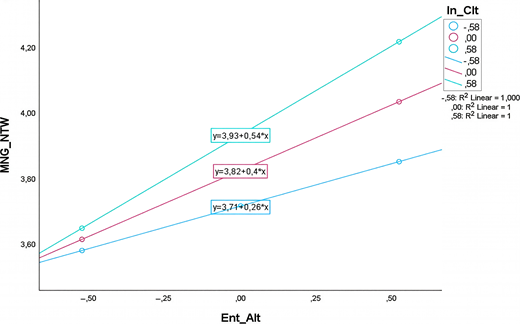
Model 1 presented MN as the outcome variable. The model explained approximately 37% of the variance in MN (R2 = 0.3693). EA had a significant positive effect on MN (β = 0.4014, t = 5.486, p < 0.001), while SME innovation culture (SME IC) also had a significant effect on MN (β = 0.1875, t = 2.808, p = 0.005). Importantly, the interaction between EA and SME IC was significant (β = 0.245, t = 2.469, p = 0.014), accounting for an additional 2.2% of the variance in MN (ΔR2 = 0.0215), indicating a significant moderating effect. An examination of the Johnson-Neyman analysis output revealed that the effect of EA on MN was positive and significant at all levels of the SME innovation culture score −0.581: β = 0.259, t = 2.839, p = 0.005 at the lowest level, 0.000: β = 0.401, t = 5.486, p < 0.001 at the mean level and 0.581: β = 0.544, t = 5.727, p < 0.001 at the highest level. The results are graphically depicted in Figure 2, which shows that the gradient is less steep at the low SME IC level (−0.581) and moderately steep at the mean SME IC level (0.000). However, as the level of SME IC increases (0.581), the gradient is much steeper. Model 1’s outcome reveals that the higher the level of SME innovation culture, the stronger the impact of EA on MN. This aligns with empirical evidence; for example, Zacca (2026) found that in the United Arab Emirates, SMEs with strong capabilities and high alertness were better positioned to benefit from their networks, thereby achieving superior competitiveness. This is supported by empirical evidence that advocates increased competitiveness of SMEs through the establishment of innovator networks in which employee positive attitudes towards innovation and beliefs play a central role, supported by top management, government and other private players (Sternberg, 2000; Rogers, 2004; Asheim et al., 2011).
Model 2 presents SME digital transformation as the outcome variable. EA had a significant positive effect on SME DIG (β = 0.348, t = 3.494, p = 0.001), supporting H1. MN also significantly impacted SME DIG (β = 0.303, t = 2.934, p = 0.004). Combined, EA and MN explained 20.7% of the variance in SME DIG (R2 = 0.2067). This finding aligns with prior research showing that alert entrepreneurs identify digital opportunities, while networks provide access to complementary resources necessary for implementation (e.g. Dayan et al., 2013; de Villiers Scheepers and Kerr, 2013).
The final output presents the mediation and moderated-mediation outcomes. The mediation analysis confirmed that MN mediates the relationship between EA and SME DIG, supporting H2 (β = 0.348, t = 3.494, p < 0.001). This is consistent with empirical evidence emphasising the role of networks in enabling SMEs to access innovation-related resources (Walter et al., 2006; Zacca et al., 2015; Bianchi and Stoian, 2024). The indirect effects of EA on SME DIG through MN were positive and significant at all levels of SME IC, −0.581: 0.122 (CI: 0.019–0.268) at the lowest level, 0.000: 0.078 (CI: 0.002–0.216) at the mean level and 0.581: 0.165 (CI: 0.026–0.343) for the highest SME innovation culture score. In addition to the indirect effects, the index results, which showed no zeros between the paths, confirmed H3, indicating that SME IC moderates the indirect effect of EA on SME digital transformation through MN (Index = 0.074, 95% CI = [0.006, 0.182]). In line with empirical evidence, SMEs with strong innovation cultures are better positioned to convert opportunity recognition into network-based strategies and, ultimately, digital transformation outcomes (Hanifah et al., 2019; Ramdan et al., 2022). Table 4 summarises the results.
5. Discussion
This study examined how EA influences SME digital transformation (SME DIG), both directly and indirectly through MN and how this mechanism is conditioned by SME innovation culture (SME IC). Overall, the findings reveal a multi-layered capability-building process in which individual-level cognition, relational resources and organisational context jointly shape digital transformation outcomes in SMEs.
5.1 Entrepreneurial alertness, innovation culture and managerial networks
Model 1 shows that EA exerts a strong positive effect on MN, while SME innovation culture also contributes significantly to network development. The model explained approximately 37% of the variance in MN, indicating moderate explanatory power. This suggests that although EA and innovation culture are important predictors of network formation, managerial networking behaviour in SMEs is also likely to be influenced by additional factors not captured in the model, such as prior entrepreneurial experience, industry embeddedness, institutional support structures and firm resource endowments. Thus, the findings should be interpreted as part of a broader network-building process rather than as a fully exhaustive explanation. These findings suggest that managerial networking is not merely a structural or externally determined activity but is partly rooted in the entrepreneur’s ability to identify, interpret and act on opportunity-relevant signals. In other words, alert SME owner–managers appear better positioned to recognise which relationships are strategically valuable, when to activate them and how to convert them into organisational advantage. This extends prior evidence suggesting that EA enhances SMEs’ ability to leverage relational opportunities under uncertain market conditions (Sternberg, 2000; Rogers, 2004; Asheim et al., 2011; Zacca, 2026).
The positive effect of SME innovation culture on MN further indicates that networking capacity is not solely an individual entrepreneurial function but is also shaped by internal organisational conditions. SMEs characterised by openness to experimentation, learning and idea-sharing are more likely to cultivate and sustain external ties because such environments lower the internal resistance often associated with new collaborations, external knowledge acquisition and strategic change (Okanga, 2023). This finding is especially important in the SME context, where managerial relationships frequently substitute for formalised systems, specialised internal capabilities and institutional support.
More importantly, the significant interaction effect between EA and SME IC reveals that innovation culture strengthens the relationship between EA and MN. The Johnson–Neyman results show that the effect of EA on MN remains significant across all levels of SME innovation culture but becomes progressively stronger as innovation culture increases. The interaction plot reinforces this pattern, with a flatter slope under low-innovation culture conditions and a markedly steeper slope under high-innovation culture conditions. This pattern suggests that innovation culture functions not as a passive background condition, but as an enabling organisational mechanism that amplifies the extent to which entrepreneurial cognition is translated into relational action.
This is a theoretically important finding because the interaction effect, although statistically modest (ΔR2 = 2.2%), demonstrates that organisational culture meaningfully conditions the extent to which entrepreneurial cognition translates into relational action. It indicates that EA, while valuable, does not operate in a vacuum. Rather, its strategic value depends partly on whether the organisational environment is sufficiently receptive to experimentation, collaboration and external engagement. In SMEs with weak innovation cultures, alert owner–managers may still recognise opportunities, but their ability to convert those insights into network-based action may be constrained by organisational rigidity, low innovation readiness or resistance to experimentation. However, alternative explanations are also plausible. For instance, some SMEs may rely more heavily on informal social ties, owner reputation or family-based networks, irrespective of internal innovation culture. This suggests that the relationship between EA and managerial networking may vary across different institutional and socio-cultural environments.
5.2 Entrepreneurial alertness, managerial networks and SME digital transformation
Model 2 shows that both EA and MN positively and significantly influence SME digital transformation. Although the model explained approximately 21% of the variance in SME digital transformation, this explanatory power is considered modest. This indicates that digital transformation in SMEs is a multidimensional phenomenon shaped by additional technological, environmental, financial and institutional factors beyond EA and MN alone. Variables such as digital infrastructure quality, government support, employee digital competencies, competitive intensity and financial readiness may also play important roles in shaping transformation outcomes. This reveals a dual-driver pattern, in which digital transformation is shaped not only by the entrepreneur’s ability to recognise emerging opportunities but also by the firm’s access to external relational resources. In practical and theoretical terms, this suggests that SME digital transformation is neither purely a technological phenomenon nor solely a function of internal managerial foresight. Instead, it is a socio-cognitive and relational process that depends on the interaction between entrepreneurial sense-making and network-enabled resource mobilisation.
The direct effect of EA on SME digital transformation indicates that alert SME owner–managers are better able to detect technological shifts, identify relevant digital tools and recognise the strategic value of digitalisation in responding to changing customer expectations, competition and market uncertainty. This is particularly relevant in emerging-economy settings, where institutional instability, infrastructural limitations, resource scarcity and digital inequality frequently constrain SMEs’ ability to respond effectively to technological change (Telukdarie et al., 2023; Macedo et al., 2024). In such environments, EA may partially compensate for environmental uncertainty by enabling SMEs to strategically identify and prioritise relevant digital opportunities despite limited resources. Under such circumstances, the ability to detect weak signals and anticipate technological relevance may be especially valuable.
The positive effect of MN on SME digital transformation further suggests that digitalisation in SMEs is facilitated through access to external knowledge, strategic partnerships and complementary capabilities. Digital transformation often requires SMEs to acquire expertise and technologies that are not readily available internally (Omrani et al., 2022). As such, MN likely provide access to software vendors, ICT consultants, platform providers, logistics partners, fintech actors and peer firms, all of whom can reduce uncertainty and lower the costs associated with digital adoption. In this sense, networks appear to function as bridging mechanisms that enable SMEs to compensate for internal capability constraints.
The mediation results deepen this explanation by showing that MN partially mediate the relationship between EA and SME digital transformation. However, the partial mediation effect also indicates that MN do not fully explain the relationship between EA and digital transformation. This suggests the existence of alternative mechanisms through which EA may influence digital transformation, including strategic flexibility, digital orientation, learning capability and proactive opportunity-exploitation behaviours. This is a particularly important contribution because it demonstrates that EA does not influence digital transformation only through direct strategic action. Rather, part of its effect is realised through the entrepreneur’s ability to establish and leverage strategically useful managerial ties. This finding moves the literature beyond the assumption that entrepreneurial cognition automatically translates into digital outcomes. Instead, it suggests that the path from recognising opportunities to achieving digital transformation is often relationally enacted.
The moderated mediation findings add a further layer of nuance. The indirect effect of EA on SME digital transformation through MN remains positive across all levels of SME innovation culture, becoming stronger as innovation culture increases. The significant index of moderated mediation confirms that this variation is meaningful. This reveals a clear amplification pattern: innovation culture does not simply affect digital transformation in isolation; rather, it enhances the efficiency of the entire EA → MN → SME DIG pathway.
Taken together, these findings suggest that SME innovation culture acts as a strategic multiplier. In SMEs with weaker innovation cultures, EA can still stimulate networking and, ultimately, digital transformation, but the pathway is less efficient and the returns are smaller. In contrast, in SMEs with stronger innovation cultures, the organisation is better positioned to absorb externally sourced knowledge, legitimise experimentation and implement digitally oriented strategic responses. Thus, innovation culture appears to enhance not only internal adaptability but also the firm’s capacity to derive digital value from externally connected entrepreneurial action.
Therefore, the study’s results reveal a coherent empirical pattern in which EA initiates opportunity recognition, MN operationalise opportunity exploitation and an innovation culture amplifies the effectiveness of this process. This layered mechanism provides a richer, more practically meaningful explanation of how SMEs in emerging economies pursue digital transformation under constrained, uncertain conditions. From a practical perspective, the findings suggest that SME digital transformation initiatives are likely to yield stronger outcomes when interventions move beyond technology acquisition alone and simultaneously strengthen entrepreneurial cognition, network-building capabilities and organisational innovation culture.
5.3 Theoretical implications
This study makes several theoretical contributions. Firstly, the findings extend Kirzner’s (1973)EA perspective by demonstrating that EA in SMEs is not merely a mechanism of opportunity recognition, but also a driver of network activation and digital strategic action. In this study, alertness does not end with the cognitive identification of opportunities; rather, it is translated into relational and organisational outcomes. This broadens the explanatory scope of EA by positioning it as a capability with both cognitive and strategic mobilisation effects. Secondly, the study contributes to social cognitive theory by showing that entrepreneurial cognition is not exercised in isolation but is embedded within a socially and organisationally conditioned context. The positive moderating role of SME innovation culture demonstrates that EA becomes more behaviourally consequential when supported by organisational norms that legitimise experimentation, collaboration and adaptation. In this regard, the study reinforces the view that cognition is socially situated and that its strategic effects are contingent upon the context within which it is enacted. Thirdly, the findings contribute to signal detection theory (Swets, 1992) by showing that EA may be understood as a signal-processing capability in digitally turbulent SME environments. The results suggest that alert SME owner–managers are better able to distinguish meaningful technological and market signals from background noise, enabling them to identify promising digital opportunities while avoiding unproductive collaborations and irrelevant innovations. This offers a theoretically useful lens for understanding how SMEs make digital strategic decisions amid uncertainty. Fourth, the study contributes to organisational culture theory (Schein, 1992) by showing that innovation culture is not merely an internal cultural attribute with direct performance effects, but also a boundary condition that shapes how entrepreneurial cognition is converted into managerial and digital outcomes. In this sense, innovation culture functions as an enabling infrastructure for entrepreneurial action, strengthening both network formation and the downstream digital transformation process. Finally, the study contributes to the SME digital transformation literature by offering a more integrated explanation of digitalisation. Rather than treating digital transformation primarily as technology-led, the findings show that it is also cognitive, relational and cultural. This is particularly important in emerging-economy settings, where digital transformation often unfolds in environments characterised by institutional gaps, limited absorptive capacity and uneven access to technological resources.
5.4 Practical implications
The findings have important implications for SME owners/managers, support institutions and policymakers. Firstly, the results suggest that SMEs should not treat digital transformation as a purely technological investment decision. Rather, digital transformation should be approached as an organisational capability-building process that requires EA, external relational engagement and an internal culture that supports innovation. SME owner–managers should therefore invest not only in digital tools but also in mechanisms that enhance environmental scanning, opportunity recognition and the strategic interpretation of technological change.
Secondly, because MN mediate, SME owners/managers should build selective, strategically aligned networks rather than indiscriminately expanding their contacts. Partnerships with technology vendors, ICT consultants, fintech providers, digital logistics platforms, universities and innovation hubs can reduce the costs and uncertainties associated with digital transformation. In emerging-economy contexts where formal support structures are often fragmented, such networks may serve as substitutes for missing internal expertise and institutional infrastructure.
Thirdly, the findings highlight the importance of cultivating a strong innovation culture within SMEs. Managers should create environments that encourage experimentation, knowledge-sharing, cross-functional collaboration and constructive engagement with new ideas. This can be achieved through innovation workshops, digital learning platforms, employee upskilling, open communication forums and reward systems that recognise initiative and experimentation (Hanifah et al., 2019; Yip et al., 2020; Atkočiūnienė and Siudikienė, 2021). Without such cultural support, even highly alert entrepreneurs may struggle to convert opportunity recognition into sustained digital transformation.
Fourthly, policymakers and SME support agencies should recognise that SME digitalisation requires more than subsidised access to technology. Effective interventions should also strengthen network-building platforms, innovation ecosystems, digital leadership development and trust-based collaboration mechanisms (Yoo et al., 2012). Programmes that connect SMEs to reputable technology providers, industry clusters and university-linked innovation platforms may be particularly valuable in contexts where SMEs face severe information and capability constraints. In addition, governments should prioritise broader digital inclusion strategies through investments in rural broadband infrastructure, digital literacy programmes and accessible SME training initiatives to reduce inequalities between urban and under-resourced regions. Educational institutions and business development agencies may also play a critical role by incorporating EA, digital leadership, innovation management and responsible technology use into SME training and managerial development programmes.
Finally, the findings imply that SME digital transformation must be supported by digital governance and risk management capabilities, including cybersecurity awareness, data protection practices and responsible technology adoption (Achieng and Malatji, 2022; Hai et al., 2021). As SMEs become more digitally connected, they also become more exposed to cyber risks, platform dependency and compliance pressures (Coco et al., 2024; Nadeem et al., 2024; Macedo et al., 2024; David et al., 2025). Thus, digital transformation should be accompanied by investments in resilience, not merely efficiency.
5.5 Research limitations
This study has several limitations that also create opportunities for future research. Firstly, the study was conducted in South Africa, an emerging-economy context characterised by infrastructural constraints, institutional unevenness and digital capability gaps. While this context strengthens the relevance of the findings for similar environments, it may limit their generalisability to more digitally mature or institutionally stable settings. Future studies could test the model across multiple countries to assess contextual differences in the relationship between EA and digital transformation. Secondly, the study focused on SME innovation culture as the principal boundary condition. Although this yielded important insights, future research could incorporate additional moderators such as absorptive capacity, digital orientation, market dynamism, strategic flexibility, environmental hostility or institutional support. This would allow for a more nuanced understanding of the conditions under which EA most effectively translates into digital transformation. Thirdly, the study used a cross-sectional design, which limits causal inference. Future research could adopt longitudinal designs to better capture how EA, MN and innovation culture interact over time as SMEs progress through different stages of digital transformation. Finally, the findings suggest that the relationship among EA, MN and SME digital transformation may serve as the basis for a broader conceptual framework of digitally oriented entrepreneurial action. Future studies could build on this by explicitly integrating signal detection theory, dynamic capabilities or institutional theory to further explain how SMEs interpret, prioritise and act upon digital opportunities in uncertain environments.
6. Conclusion
This study proposed and tested a model to explain how EA drives SME digital transformation. In addition, the study tested whether MN enabled entrepreneurially alert SMEs to further their digital transformation efforts. This study also contributed to the literature by highlighting the role of SME innovation culture, leading to entrepreneurially alert SMEs digitally transforming themselves when MN are indirectly involved. To achieve this, primary quantitative data were collected from 669 SMEs in South Africa’s five provinces through an online survey. Hierarchical regression analysis was performed in SPSS using the Hayes Process Macro, with Model 7. The study determined that EA has a significant positive effect on SME digital transformation, thereby supporting H1. The study also ascertained that MN mediate the relationship between EA and SME digital transformation, supporting H2. Finally, the results revealed that SME innovation culture moderated the indirect relationship between EA and SME digital transformation through MN, supporting H3. As such, the study’s findings make significant contributions to the theoretical body of knowledge, specifically by revealing the cultural and contextual adaptability of the EA framework. Furthermore, the finding that EA has a significant effect on MN and SME digital transformation makes a theoretical contribution to social cognition theory and signal detection theory. In addition, the outcome that SME innovation culture moderates the indirect relationship between EA and SME digital transformation through MN aligns directly with organisational culture theory. In practice, the study recommends that SME owner–managers strengthen EA as a digital enabler. This can be achieved through continuous participation in digital economy forums, technology conferences and expos. The study also recommends that SME owners/managers forge strategic partnerships to enhance digital success. This can be achieved by prioritising networks that offer access to digital and financial solutions, as well as market intelligence. Further, SME owner/managers should consider cultivating an innovation-driven culture. This can be achieved by recognising and rewarding risk-taking and experimentation. The study further concluded that EA, MN and innovation culture play varying roles in driving SME digital transformation.
Funding
This research received no specific grant from any funding agency in the public, commercial or not-for-profit sectors.